 📺
📺
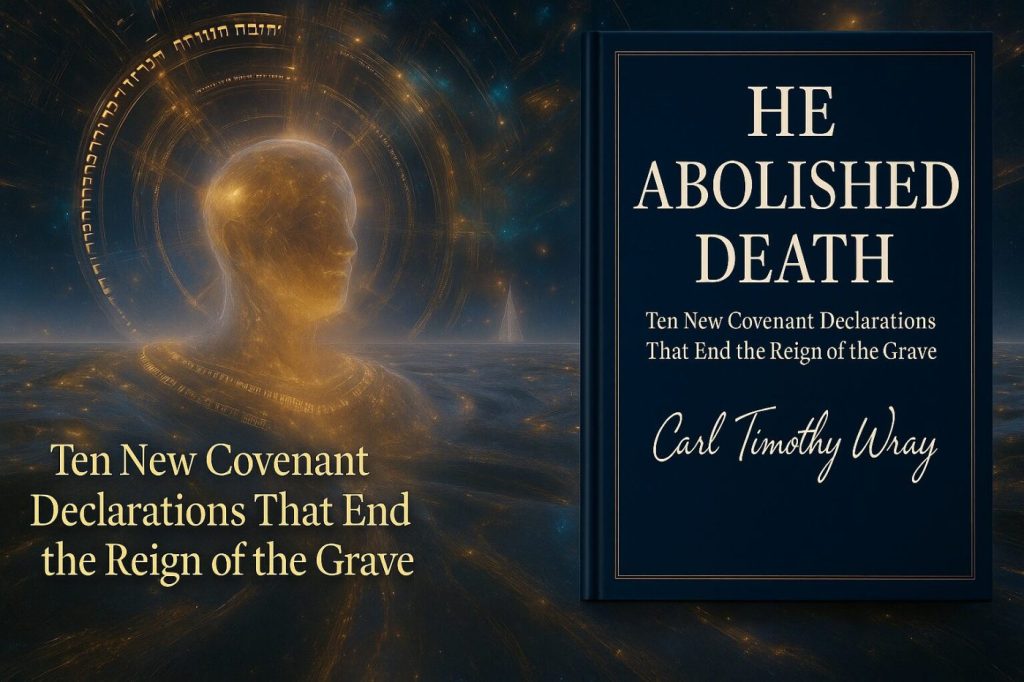
He Abolished Death: Ten New Covenant Declarations That End the Reign of the Grave
He Abolished Death: Author
Carl Timothy Wray is a teacher of the Full Counsel of God, devoted to unveiling the victory of Christ from Genesis to Revelation.
His writings confront religious tradition, expose partial gospels, and proclaim the finished work of the cross without compromise.
He writes to the elect, the hungry, and all who seek life beyond fear, delay, and the shadow of death.
- He Abolished Death: Read Book Here: 2. He Abolished Death: Download Free PDF Copy: 3. Read He Abolished Death Series:
INTRODUCTION:
Death has been treated as inevitable for so long that few remember it was ever an enemy.
It has been accepted, explained, spiritualized, and even defended as part of God’s plan. Yet the New Covenant never speaks of death as a friend, a helper, or a faithful servant. Scripture calls it exactly what it is — an enemy, and the last one Christ came to destroy.
Jesus did not come to teach humanity how to endure death with dignity.
He came to abolish it.
The gospel is not an announcement that believers merely survive beyond the grave. It is the declaration that death itself has been stripped of authority, judged, and overcome by the life of Christ. Immortality was not postponed to the end of time; it was brought to light through the appearing of the Son of God.
Yet much of the Church still preaches as if death reigns and Christ only rescues us from its aftermath. This contradiction has muted the power of the gospel and reduced resurrection life to future theology instead of present truth.
This book restores the testimony.
Each chapter is built upon a single New Covenant declaration — words spoken by Jesus, His apostles, or the Spirit of revelation — that directly confront the power of the grave. Together, these ten witnesses form a unified proclamation: death is defeated, life reigns, and the victory of Christ is absolute.
This is not speculation.
It is not philosophy.
It is not poetic comfort for the dying.
It is the Word of the Lord answering death — once and for all.
And when the Word speaks, death does not respond.
Chapter 1
He Abolished Death
(2 Timothy 1:10)
“But is now made manifest by the appearing of our Savior Jesus Christ, who abolished death, and brought life and immortality to light through the gospel.”
This verse is not poetic language.
It is not metaphor.
It is not future promise.
It is a legal declaration of the gospel.
Paul states plainly that something happened at the appearing of Jesus Christ — not at the end of time, not at the resurrection of the dead in general, but at the historical, incarnational appearing of the Son of God.
Two simultaneous acts took place:
Death was abolished
Life and immortality were brought to light
These two cannot be separated. Wherever one is preached honestly, the other must follow.
What “Abolished” Actually Means
The word abolished does not mean “made less harsh.”
It does not mean “delayed until later.”
It does not mean “still active, but reinterpreted spiritually.”
It means rendered powerless.
Stripped of authority.
Nullified as a ruling force.
Paul uses language of defeat, not management.
If death still reigns as an unavoidable master over those in Christ, then either:
Christ did not truly abolish it, or
The gospel has not been fully believed
Paul leaves no third option.
Death Was Not God’s Tool — It Was Adam’s Intruder
Death did not originate in God.
It entered through Adam.
Paul writes elsewhere, “By one man sin entered into the world, and death by sin.” Death is not eternal truth; it is a historical invader. It does not belong to creation’s design, but to creation’s fall.
Because of this, death is not something God preserves — it is something God judges.
And judgment does not mean eternal survival of death.
Judgment means termination of authority.
The Appearing of Christ Changed the Legal Order
Notice where Paul anchors this victory:
“By the appearing of our Savior Jesus Christ…”
Not the cross alone.
Not the resurrection alone.
But the appearing — God manifested in flesh, confronting death on its own ground.
Life did not overcome death from a distance.
Life entered death’s realm and swallowed it.
This is why Paul can say death is abolished before Revelation ever speaks of death being cast into the lake of fire. Revelation reveals the outcome; the gospel reveals the cause.
Life and Immortality Were “Brought to Light”
Paul does not say life and immortality were created.
He says they were revealed.
This means:
They already existed in Christ
They were hidden under the shadow of death
The gospel unveiled what had always been true in Him
Immortality is not a new invention for the end of the age.
It is the native life of the Son, now disclosed through the gospel.
Death hid life.
Christ revealed it.
A Gospel Without Immortality Is Incomplete
If death is abolished but immortality is not proclaimed, the gospel is half-told.
If heaven is promised but death is defended, the message is distorted.
Paul refuses both errors.
The victory of Christ is not escape after death.
It is triumph over death.
The gospel does not teach humanity how to die well.
It announces that death no longer has the right to rule.
The Foundation Stone
Every chapter that follows rests on this truth:
Death is not a mystery to be explained
Death is an enemy to be destroyed
And Christ has already begun that destruction
From this point forward, Scripture does not ask if death is defeated.
It reveals where, how, and to what extent that victory manifests.
The gospel does not whisper about death.
It abolishes it.
Chapter 2
The Last Enemy Destroyed
(1 Corinthians 15:26)
“The last enemy that shall be destroyed is death.”
Paul does not hesitate to name death for what it is.
Not a doorway.
Not a servant.
Not a natural transition.
An enemy.
This alone dismantles centuries of religious softening. God does not make covenants with enemies. He does not sanctify them. He does not preserve them forever. Enemies exist for one reason only — to be destroyed.
Death Is Not Neutral
An enemy is something that opposes purpose, resists life, and disrupts design. Death does all three.
Death interrupts communion.
Death fractures creation.
Death breaks what God called good.
If death were part of God’s eternal plan, Paul could not call it an enemy. The Spirit does not mislabel realities. Words matter, and Paul chooses his deliberately.
Death is hostile to God’s intention — therefore it stands under judgment.
“The Last Enemy” Does Not Mean “An Eternal Enemy”
Much confusion enters here because of one phrase: the last enemy.
“Last” does not mean permanent.
It means final in sequence.
There is an order to God’s redemptive work. Paul outlines it in this very chapter:
Adam brings death
Christ brings resurrection
Christ reigns until all enemies are put under His feet
Death is the final enemy removed
If death remains forever, then Christ never truly finishes His reign. That idea contradicts Paul’s entire argument.
The reign of Christ does not pause until death reigns again.
It ends with death’s destruction.
Christ Reigns Until… Not After
Paul says plainly:
“For He must reign, till He hath put all enemies under His feet.”
Christ’s reign has a purpose. It is not aimless rule; it is restorative dominion. Every enemy placed under His feet is an enemy stripped of power.
Death is not placed beside His throne.
It is placed beneath His feet.
And when the work is finished, Paul says something astounding:
“Then cometh the end.”
Not the end of creation.
Not the end of life.
The end of opposition.
Death’s destruction marks the completion, not the collapse, of God’s plan.
Destruction Means Termination of Authority
The word destroyed does not mean relocated.
It does not mean refined.
It does not mean given a holy role.
It means deprived of strength, rendered inoperative, neutralized.
Death does not get rebranded.
It gets removed.
This is why Paul later mocks the grave, not fears it. You cannot taunt what still holds power. You taunt only what has already been defeated.
Why Religion Needs Death to Survive
Religion often protects death because fear is a powerful motivator. A gospel that leaves death intact keeps humanity dependent on mediators, rituals, and delay.
But Paul’s gospel does something far more radical.
It announces a Christ who reigns until death itself bows and disappears.
If death were eternal, Christ’s reign would be incomplete.
But Paul declares a finished reign — one that ends with life alone remaining.
The Trajectory Is Clear
This verse establishes direction.
Christ is reigning now
Enemies are being subdued
Death is the final target
Destruction is the outcome
Nothing in Paul’s argument allows for a resurrected Christ who reigns forever alongside death.
The victory of Christ is not measured by survival beyond death, but by death’s removal from the equation entirely.
Chapter 3
Swallowed Up in Victory
(1 Corinthians 15:54–55)
“So when this corruptible shall have put on incorruption, and this mortal shall have put on immortality, then shall be brought to pass the saying that is written, Death is swallowed up in victory.
O death, where is thy sting?
O grave, where is thy victory?”
This is not imagery meant to comfort the dying.
It is language meant to humiliate death.
Paul is not explaining a process here — he is proclaiming a result.
Death Is Not Resisted — It Is Consumed
Notice what Paul does not say.
He does not say death is avoided.
He does not say death is bypassed.
He does not say death is escaped.
He says death is swallowed up.
To be swallowed is to be:
Engulfed
Overpowered
Absorbed into something greater
When something is swallowed, it loses its identity and its authority. It does not continue alongside what consumed it. It disappears inside a greater reality.
Life does not coexist with death.
Life consumes death.
Victory Is Not Survival — It Is Supersession
Religious thinking often frames victory as “we die, but we live somewhere else.”
Paul’s language says something very different.
Victory is not endurance through death.
Victory is death being overtaken by immortality.
Paul ties this directly to transformation:
“When this corruptible puts on incorruption…
When this mortal puts on immortality…”
This is not about location.
It is about state.
Corruption does not go to heaven to remain corruption.
Mortality does not change addresses and stay mortal.
They are clothed with something stronger.
The Sting and the Victory Removed
Paul then speaks directly to death.
Not about it.
To it.
“O death, where is thy sting?
O grave, where is thy victory?”
A sting implies poison.
A weapon.
A remaining threat.
Paul announces it gone.
You do not taunt an enemy who still holds a blade.
You taunt one whose weapon has been taken away.
Death’s sting is sin.
Sin’s power is the law.
Christ dealt with both.
No sting means:
No condemnation
No accusation
No final claim
And if death has no sting, it has no leverage.
Immortality Is the Answer, Not the Escape
Paul’s answer to death is not heaven-after.
It is immortality.
This is crucial.
Immortality is not a reward given later.
It is a life revealed in Christ and put on — like a garment — when the corruptible is overtaken.
Death is swallowed not by doctrine, but by life.
This is why the gospel does not announce:
“Death will one day be meaningful.”
It announces:
“Death will be overtaken.”
The Prophetic Tone of Triumph
Paul quotes prophecy here, but he does not treat it as distant.
“Then shall be brought to pass the saying…”
He is saying:
This has a fulfillment.
This has a moment.
This has a culmination.
And that culmination does not end with saints dying gloriously.
It ends with death silent.
The Grave Has No Final Say
When Paul asks, “Where is thy victory?” he is not asking for information.
He is stating fact.
The grave has no concluding argument.
It has no closing chapter.
It has no lasting power.
Whatever authority it once claimed has been swallowed up by something older, stronger, and eternal — the life of God in Christ.
Death does not get the final word.
Life does.
Chapter 4
The One Who Held Death Lost It
(Hebrews 2:14)
“Forasmuch then as the children are partakers of flesh and blood, He also Himself likewise took part of the same; that through death He might destroy him that had the power of death, that is, the devil.”
Death did not only exist as a condition — it existed as a dominion.
And dominion always has an administrator.
Hebrews identifies that administrator plainly: “him that had the power of death.”
Not God.
Not heaven.
Not divine decree.
The devil.
Death Was a Power Held — Not an Inevitable Law
This verse dismantles the idea that death is merely a natural law of the universe.
You do not hold power over gravity.
You do not administer authority over time.
But you can hold power over people through:
Fear
Accusation
Condemnation
Separation
Death functioned through all four.
The devil did not create death — but he wielded it.
And anything wielded can be taken away.
Christ Entered the Realm Death Ruled
The text is precise:
“He Himself likewise took part of the same…”
Christ did not destroy death from a distance.
He did not conquer it theoretically.
He entered the realm where death had authority — flesh and blood.
Life did not shout at death from heaven.
Life stepped into death’s jurisdiction and confronted it on its own ground.
This is why the incarnation matters.
If Christ had never taken flesh, death would have remained unchallenged in its domain. But by entering flesh and blood, Life placed itself directly under death’s claim — not to submit, but to overthrow.
Through Death, Death Was Undone
The paradox is deliberate:
“That through death He might destroy…”
Death was defeated by being exhausted on Christ.
It spent everything it had.
It emptied its accusation.
It unleashed its full claim.
And when death was finished doing its worst, Christ stood up — alive.
Death struck Life and broke itself.
From that moment on, death had no remaining weapon.
Destroyed Means the Holder Lost Authority
The word translated destroy does not mean annihilation of existence.
It means rendered powerless, ineffective, stripped of control.
The devil did not cease to exist — but he ceased to be death’s administrator.
No authority-holder = no authority.
Death can no longer accuse.
Death can no longer demand.
Death can no longer enforce.
Why Fear of Death Was Central
Hebrews later explains the result:
“Who through fear of death were all their lifetime subject to bondage.”
Fear was death’s enforcement mechanism.
Remove death’s power — and fear collapses.
Remove fear — and bondage ends.
This is why the gospel is fearless when rightly believed.
A gospel that leaves people terrified of dying has not yet preached Hebrews 2.
Death Is Now Unauthorized
Death may still appear.
It may still threaten.
It may still intimidate the senses.
But it no longer carries legal authority in Christ.
The one who held the power of death lost it.
And nothing remains of death except a shadow that no longer owns the ground it stands on.
This is not symbolism.
It is a transfer of authority.
And once authority changes hands, history eventually follows.
Life has taken the throne.
Chapter 5
Death Hath No Dominion
(Romans 6:9)
“Knowing that Christ being raised from the dead dieth no more; death hath no more dominion over Him.”
Paul does not present this as theology to be debated.
He presents it as knowledge to be known.
“Knowing that…”
This is settled truth in Paul’s mind, not speculation.
Dominion Is a Question of Authority
Dominion is not mere influence.
Dominion is rightful rule.
To say death has no dominion over Christ is to say death has:
No legal authority
No rightful claim
No governing power
Christ does not avoid death.
Christ outlived it.
And once dominion is broken, it cannot be reclaimed.
Resurrection Was a One-Time Overthrow
Paul is precise:
“Christ being raised from the dead dieth no more.”
Death does not get repeat access.
Resurrection was not a temporary exemption.
Christ did not escape death only to remain subject to it later.
He entered death once — and finished it.
This matters because dominion only exists where repeated authority is possible. Death’s inability to reclaim Christ proves its rule is ended.
Union Changes Everything
Paul does not speak of Christ in isolation.
Just a few verses earlier, he writes:
“If we have been united with Him in the likeness of His death, we shall be also in the likeness of His resurrection.”
Union is not symbolic.
It is participatory.
If death has no dominion over Him, then death has no rightful dominion in Him — and those who are in Him share that standing.
You cannot be joined to a Head free from death while the Body remains under its lawful rule.
That would divide Christ against Himself.
Dominion Is Broken Before Manifestation Is Complete
Paul is not denying that death still appears in the world.
He is denying that it reigns.
There is a difference between:
A dethroned enemy still making noise
A reigning king issuing lawful commands
Death today functions as a defeated tyrant — loud, intimidating, but without jurisdiction in Christ.
Paul’s declaration removes death from the seat of rule even while the world still feels the consequences of Adam’s fall.
This Is Why Faith Is Required
If dominion has ended, then what remains is not law — it is lying influence.
Death no longer rules by right.
It attempts to rule by belief.
This is why Paul places the word “knowing” at the front. Ignorance allows a dethroned power to masquerade as legitimate.
Truth exposes the fraud.
Christ Is the First Expression of a New Order
Christ is not the exception to humanity.
He is the template.
His resurrection is not a special case — it is the announcement of a new dominion order.
Death ruled Adam.
Life rules Christ.
And where Christ reigns, death cannot lawfully govern.
The Line Has Been Drawn
Paul does not soften this statement.
He does not balance it with caution.
“Death hath no more dominion over Him.”
That sentence alone redraws the map of reality.
Everything that follows Scripture-wise is the unfolding of this truth into the lives of those who believe.
Death may still knock.
But it no longer owns the house.
Dominion has changed hands.
Chapter 6
You Shall Never Die
(John 11:25–26)
“Jesus said unto her, I am the resurrection, and the life: he that believeth in Me, though he were dead, yet shall he live:
And whosoever liveth and believeth in Me shall never die.”
Jesus does not answer Martha with theology.
He answers her with identity.
“I am the resurrection, and the life.”
He does not say resurrection is coming.
He does not say life will arrive later.
He says He is both.
Resurrection Is Not an Event First — It Is a Person
Religion treats resurrection as something God does.
Jesus reveals resurrection as who God is.
If resurrection is a person, then death is not a permanent condition — it is a temporary confrontation with Life Himself.
Death is not resolved by time.
Death is resolved by presence.
Where Christ stands, resurrection stands.
Two Statements — One Unified Truth
Jesus makes two declarations that must be read together:
“He that believeth in Me, though he were dead, yet shall he live.”
“Whosoever liveth and believeth in Me shall never die.”
The first addresses those already marked by death’s shadow.
The second speaks of a state of life entered while believing.
Jesus is not contradicting Himself — He is revealing progression.
Life does not only answer death after it strikes.
Life also prevents death from ruling where belief abides.
“Never Die” Is Not a Metaphor
Jesus chooses His words carefully.
He does not say:
“Never truly die”
“Never spiritually die”
“Never die forever”
He says never die.
Religion rushes to redefine this because it feels too strong.
But Jesus does not soften it.
If His words are symbolic here, then His claim to resurrection loses all force. But if His words are literal in promise, then death has just been put on notice.
Believing Is Abiding, Not Assenting
The word believeth here is not intellectual agreement.
It is abiding trust, living union.
Jesus is describing a life lived from Him, not merely belief about Him.
This kind of believing is participation.
And where life participates in Life Himself, death cannot assert final claim.
Jesus Confronts Death Before the Tomb Opens
Notice the order.
Jesus says this before He raises Lazarus.
He speaks to death while Lazarus is still in the grave.
The miracle follows the declaration.
Word precedes manifestation.
This is always the order of the Kingdom.
Jesus is not discovering truth as He goes.
He is revealing what governs reality.
Lazarus Was Not the Point
Lazarus is the sign — not the message.
The sign answers the moment.
The message answers the age.
The message is this:
There exists a realm of life in Christ where death no longer defines existence.
Jesus is not merely showing power over death.
He is announcing a life that makes death unnecessary.
The Question That Divides Everything
Jesus ends with a question:
“Believest thou this?”
Not:
“Can you explain this?”
“Do you agree doctrinally?”
“Does this fit your theology?”
But:
Do you believe this?
Because believing this truth reshapes how life is lived now — not just how death is faced later.
Life Has Spoke for Itself
In this chapter, death is not debated.
It is overruled by Life speaking.
Jesus does not promise escape.
He promises continuity of life so complete that death loses relevance.
“I am the resurrection.”
“I am the life.”
Where He is believed, death has no rightful conclusion.
Life has spoken.
Chapter 7
I Hold the Keys
(Revelation 1:18)
“I am He that liveth, and was dead; and, behold, I am alive for evermore, Amen; and have the keys of death and of hell.”
This is not whispered revelation.
It is the first self-declaration of the risen Christ in the Book of Revelation.
Before seals, trumpets, beasts, or visions unfold, Jesus establishes authority.
Keys Mean Ownership and Control
In Scripture, keys never represent influence — they represent jurisdiction.
Whoever holds the keys controls:
Access
Release
Authority
Final decisions
If Christ holds the keys of death, death does not decide when to open or shut.
Death is no longer sovereign.
Death is subject.
“I Was Dead” — Past Tense
Jesus does not say He visited death.
He says He was dead.
Death exhausted its claim on Him.
And once death has spent itself on Christ, it has no remaining legal power over Him — or over those joined to Him.
Death did its worst.
And failed.
“Alive Forevermore” — Not Conditional Life
Jesus does not say He is alive for an age.
Or alive until another cycle.
Alive forevermore.
This is immortal life, uninterruptible and irreversible.
Death cannot re-enter where eternal life reigns.
Death No Longer Holds Itself
Death once functioned like a locked prison with its own authority.
Now it is a cell whose keys are held by Christ.
Death cannot:
Decide who enters
Decide who stays
Decide who leaves
Whatever power it once had has been transferred.
This is why Revelation does not begin with fear — it begins with the enthroned Christ declaring control over death itself.
The Order Matters
John falls as one dead at His feet — and Christ responds:
“Fear not.”
Why?
Because fear thrives only where death still holds authority.
Once Christ declares that He holds the keys of death, fear loses its justification.
A gospel that still breeds terror of death has not yet preached Revelation 1.
Death Is Now a Servant of Judgment, Not a Master of Life
Later in Revelation, death appears again — not ruling, but being used, limited, and finally judged.
This makes sense only if death has already lost its throne.
Death can no longer reign — it can only serve a temporary function until it is finally removed.
Keys determine this.
Authority Has Already Changed Hands
Revelation does not announce that Christ will one day hold the keys.
He speaks in the present tense.
“I have the keys.”
Not when time ends.
Not after the nations fall.
Now.
The Lamb begins the unveiling of Revelation by clarifying one fact:
Death does not run the story anymore.
The Tone Is Set
From this point on, every vision flows from this established authority.
Whatever happens in Revelation is not death winning battles — it is death being slowly and publicly undone.
The first voice John hears does not predict death’s victory.
It announces its defeat.
Christ lives.
Christ reigns.
And the keys are no longer in death’s hands.
Chapter 8
Death Judged and Cast Away
(Revelation 20:14)
“And death and hell were cast into the lake of fire. This is the second death.”
This verse is often read too quickly — and therefore misunderstood.
It does not describe death reigning forever.
It describes death being judged.
Death Is Not the Judge — Death Is the Defendant
For generations, death has been preached as if it were part of God’s eternal judgment. But Revelation says something entirely different.
Death itself is brought forward.
Death itself is judged.
Death itself is cast away.
Judgment does not preserve what it judges.
Judgment removes authority.
Death is not affirmed here — it is terminated.
The Lake of Fire Is Not the Preservation of Death
Fire in Scripture does not exist to keep enemies alive forever.
Fire exists to consume, purify, and end corruption.
Chaff is burned.
Dross is burned.
What is of God remains.
When death is cast into the lake of fire, it is not being crowned — it is being consumed.
This is why Revelation dares to say later that there shall be no more death. The fire is not death eternalized; it is death ended.
“This Is the Second Death” — For Death Itself
The phrase second death has terrified many because it has been misunderstood as endless dying.
But notice carefully:
It does not say people are the second death.
It says death and hell are cast into it.
The second death is not humanity dying again.
It is death itself dying.
The first death entered through Adam.
The second death is the death of death.
Why Judgment Must Reach Death
As long as death exists, creation is not fully restored.
As long as death remains, Christ’s reign is not finished.
Paul already told us the last enemy to be destroyed is death. Revelation simply shows how that destruction occurs.
Judgment here is not vengeance — it is resolution.
Death cannot be reformed.
Death cannot be rehabilitated.
Death must be removed.
Hell Is Cast Away Too
“Hades” — the realm of the dead — goes with death into judgment.
Why?
Because when death is removed, there is no realm for it to occupy.
No prisoners means no prison.
No death means no holding place for the dead.
Hell does not reign forever alongside God.
It is judged alongside death.
The Order of Victory
Notice again the sequence:
Christ holds the keys
Death loses authority
Death is judged
Death is cast away
Creation is healed
This is not chaos.
It is intentional, ordered victory.
The Gospel Reaches Its Logical Conclusion
If death were eternal, judgment would never end.
If death were holy, Christ would not destroy it.
But the gospel insists that God’s goal is life without interruption.
Revelation 20:14 is not a warning meant to scare the faithful.
It is a revelation meant to free them.
Death is not coming back.
It is not being recycled.
It is not preserved in another form.
It is judged — and removed.
This is not the loss of hope.
This is the fulfillment of it.
Chapter 9
No More Death
(Revelation 21:4)
“And God shall wipe away all tears from their eyes; and there shall be no more death, neither sorrow, nor crying, neither shall there be any more pain: for the former things are passed away.”
This verse does not announce a coping mechanism.
It announces an ending.
Not reduced death.
Not spiritualized death.
Not postponed death.
No more death.
Restoration Is Measured by What Is Removed
Notice how restoration is defined.
God does not say He will help humanity tolerate death better.
He does not say He will comfort them while death remains.
He removes the cause.
Tears cease because death ceases.
Pain ends because corruption ends.
Healing follows elimination.
Death Belongs to the Former Things
The Spirit places death in a specific category:
“The former things are passed away.”
Death is not eternal truth.
It is not part of the everlasting order.
It belongs to what passes away.
Anything that passes away cannot be part of God’s final kingdom.
The kingdom that endures forever is a deathless kingdom.
God Does Not Coexist with Death Forever
If death remained eternally, then sorrow, pain, and loss would always have an anchor.
But God promises removal, not management.
The wiping away of tears is not ongoing therapy.
It is a final act.
When God wipes tears away, He does so because the source of tears is gone.
This Is Not Escape — This Is Fulfillment
Revelation 21 is not about leaving creation.
It is about creation healed.
Heaven does not abolish earth — heaven renews it.
The absence of death is not because bodies disappear, but because life overflows everything.
The Throne Context Matters
Just before this declaration, a voice from the throne says:
“Behold, the tabernacle of God is with men.”
God does not remove death by removing people.
He removes death by dwelling fully with humanity.
Where life Himself dwells without restraint, death cannot coexist.
No Asterisk, No Footnote
Scripture does not add:
“No more death (spiritually)”
“No more death (except physical)”
“No more death (for the faithful only)”
It simply says no more death.
Any theology that reintroduces death afterward is speaking against the throne declaration.
This Is the Goal of Redemption
Revelation does not surprise us here — it confirms everything the gospel has been saying from the beginning.
Death abolished
Enemy destroyed
Authority removed
Judgment executed
Life remaining
This is not idealism.
This is completion.
When Christ said, “It is finished,” this verse tells us what finished looks like.
Life uninterrupted.
Love unbroken.
Creation whole.
The Promise Is Absolute
Revelation 21:4 does not inspire patience for dying.
It inspires expectation for life.
Death is not delayed into eternity.
It is erased from it.
The former things have passed away.
And death is among them.
Chapter 10
He Shall Never See Death
(John 8:51)
“Verily, verily, I say unto you, If a man keep My saying, he shall never see death.”
Jesus closes the matter where He opened it — not with theology, but with authority.
“Verily, verily” is not emphasis for drama.
It is the language of oath and certainty.
What follows is not opinion.
It is decree.
“Keep My Saying” Is Participation, Not Performance
Jesus does not say, “If a man understand My saying.”
He does not say, “If a man assent to My saying.”
He says, “If a man keep My saying.”
To keep is to guard, abide, dwell within, live from.
This is not obedience as law-keeping.
It is life-keeping.
Christ’s words are not commandments alone — they are containers of life. To dwell in His word is to dwell in the life that word carries.
“Shall Never See Death” Ends All Evasion
Jesus does not say:
“Shall not remain dead”
“Shall see death briefly”
“Shall die but be okay afterward”
He says never see death.
To “see” in Scripture is to encounter as experiential reality.
Jesus is not promising a better afterlife for those who die.
He is revealing a realm of life where death loses visibility and relevance altogether.
This Is Why They Were Offended
The Jews respond immediately with outrage.
Why?
Because Jesus had just placed Himself above Abraham, Moses, and every inherited framework of mortality.
They said, “Abraham is dead.”
Jesus did not refute the statement historically —
He transcended the category entirely.
Life is not measured by burial.
Life is measured by abiding in Him.
Death Is a Matter of Sight, Not Just Event
Jesus does not frame death as something people merely undergo.
He frames it as something people see.
Where revelation changes, experience follows.
If death is no longer the lens through which life is perceived, then death can no longer rule identity, decisions, or destiny.
The power of death is bound to perception.
Christ removes it by unveiling a higher order of life.
The Final Witness Completes the Testimony
The New Covenant opens with:
Death abolished
Enemy destroyed
Dominion removed
It closes with:
Death judged
Death erased
Death unseen
This final statement from Jesus does not contradict what came before — it seals it.
The gospel is not about making peace with dying.
It is about entering life so fully that death no longer defines existence.
The Seal of the Book
This is why the gospel is called good news.
Not because death became meaningful.
But because death became unnecessary.
Christ did not come to explain why we die.
He came to reveal why we live.
And once life is revealed, death has no place left to stand.
Conclusion — The Word Has Answered Death
Ten witnesses.
One testimony.
Death is not eternal.
Life is.
Death has been abolished, destroyed, swallowed, stripped of dominion, judged, and removed.
This is not future hope alone.
It is present truth pressing toward manifestation.
The gospel does not ask permission from death.
It speaks over it.
And when the Word speaks, death does not reply.
Conclusion
The Verdict of the Gospel
This book did not attempt to explain death.
It placed death on trial.
And after hearing the testimony of Jesus, the apostles, and the Spirit of revelation, the verdict is clear.
Death has been abolished.
Not postponed.
Not softened.
Not redefined.
Judged. Defeated. Removed.
From the appearing of Christ to the throne declarations of Revelation, the New Covenant speaks with one voice: death is an enemy, and enemies are not preserved — they are destroyed.
The gospel does not teach mankind how to die well.
It announces that life has overcome death entirely.
Immortality was not introduced at the end of time.
It was brought to light through the gospel.
And where light appears, darkness loses its claim.
If death were eternal, Christ’s work would be unfinished.
If death still reigned, Christ’s dominion would be partial.
If death had the final word, resurrection would be empty rhetoric.
But Scripture refuses all three.
Christ lives.
Christ reigns.
Christ holds the keys.
And death stands judged, stripped of authority, awaiting final disappearance from a renewed creation where God is all in all.
This is not denial of history.
It is alignment with truth.
The gospel does not invite agreement with fear.
It calls for agreement with life.
And once the Word has spoken, death is left with nothing to say.
The verdict has already been rendered.
Life reigns.
Death does not.
He Abolished Death: Author
Carl Timothy Wray is a teacher of the New Covenant and the Full Counsel of God, devoted to unveiling the victory of Christ from Genesis to Revelation.
His writings confront religious tradition, expose partial gospels, and proclaim the finished work of Christ without compromise.
He writes to reveal the triumph of life over death and to call readers out of fear, delay, and inheritance loss into the fullness of Christ.
Read Our New Book of Revelation Series:
- The Revelation of Jesus Christ — The Kingdom Revealed
- The Great Tribulation — Babylon’s Interpretation vs. God’s Revelation of Himself
- The Great Tribulation Meaning — Misunderstood by Religious Babylon, Interpreted by God’s Spirit
- Join our Facebook Page: