 📺
📺
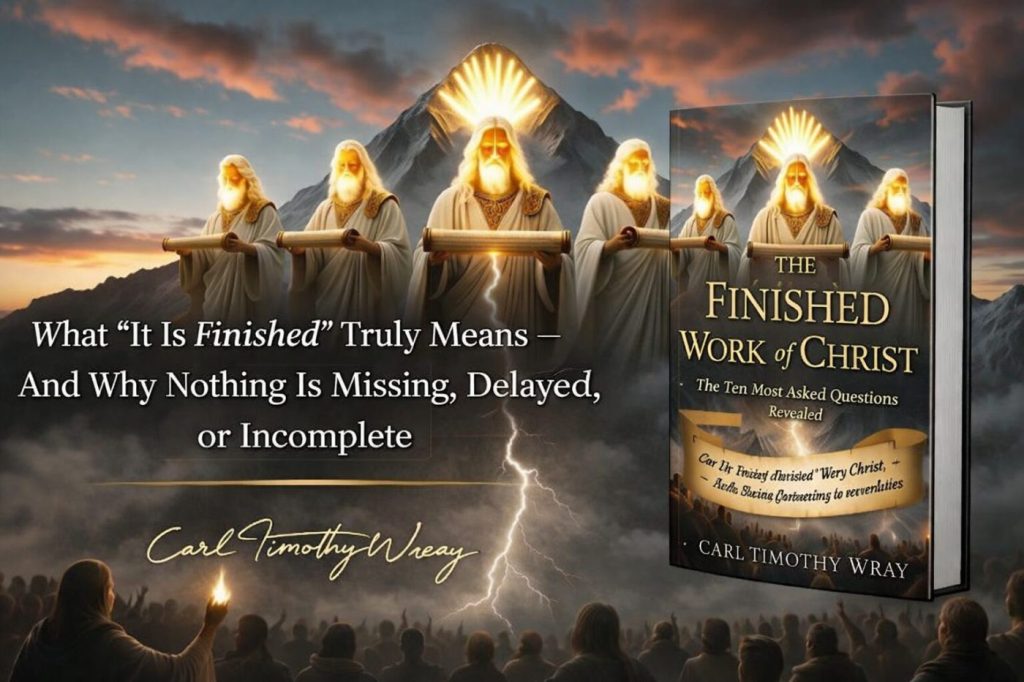
The Finished Work of Christ — What “It Is Finished” Truly Means — And Why Nothing Is Missing, Delayed, or Incomplete
✍️ AUTHOR
By Carl Timothy Wray
Carl Timothy Wray is a teacher of the finished work of Christ, devoted to unveiling the completed victory of the cross from Genesis to Revelation. His writings focus on reconciliation, sonship, and the revelation of a gospel that rests—not strives—in what Christ has already accomplished.
- The Finished Work of Christ: 2. Download Free PDF Copy: The Finished Work of Christ: 3. Read The Finished Work of Christ Series
🕊️ The Finished Work of Christ: INTRODUCTION
When Jesus cried out, “It is finished,” He did not speak in poetry, symbolism, or religious exaggeration. He spoke a declaration. Something ended. Something was completed. Something reached its designed conclusion—and nothing has been lacking since.
Yet two thousand years later, believers still wrestle with the same questions: What exactly was finished? Why does salvation still feel delayed? Why does faith so often feel conditional? Why does the Christian life feel like something left undone? These questions are not born from rebellion, but from mixture—hearing a finished declaration interpreted through unfinished frameworks.
This book was written to gently lift the veil from the ten most asked questions surrounding the finished work of Christ. Not to debate theology, but to reveal clarity. Not to stir controversy, but to restore rest. The gospel does not announce what God is willing to do—it proclaims what God has already done in Christ.
Nothing is missing. Nothing is delayed. Nothing is incomplete.
The work is finished—and this book exists to help you see it.
This book unveils the finished work of Christ, revealing what “It is finished” truly means and why nothing is missing, delayed, or incomplete in the completed work of Christ.
Chapter 1 — “It Is Finished” Does Not Mean “Paid in Full”
When Jesus cried out, “It is finished,” He was not borrowing language from accounting ledgers or legal courts. He was not announcing that a debt had been transferred, postponed, or managed. He was declaring that a work had reached its appointed end.
The Greek word recorded in John 19:30 is tetelestai. It does not primarily mean paid, though payment language has often been imposed upon it. It means completed, brought to its designed conclusion, fully accomplished, lacking nothing further. It is the language of fulfillment, not transaction.
To reduce tetelestai to “paid in full” subtly changes the nature of the cross. Payment language keeps something alive—debt, obligation, ongoing liability. Completion language announces an ending. Something did not merely get covered; it was finished.
Scripture does not say Jesus paid for sin.
Scripture says He put sin away.
“But now once at the end of the ages He has appeared to put away sin by the sacrifice of Himself.” (Hebrews 9:26)
Sin was not relocated.
Sin was not managed.
Sin was ended in its Adamic authority.
The cross was not a transaction between offended justice and appeasing sacrifice. It was the termination of an order. Adam’s world—defined by separation, accusation, and death—reached its end in Christ’s body.
This is why Jesus did not say, “The price is paid,” but “It is finished.” The work the Father gave Him to do was not to balance accounts, but to bring creation through death and out the other side.
“Now is the judgment of this world.” (John 12:31)
Judgment here does not mean punishment poured out on Jesus. Judgment means a verdict against the system that ruled mankind. The world of sin and death was judged, condemned, and brought to its conclusion in the cross.
Payment implies continuation.
Completion implies finality.
Yet Scripture also declares that we were “bought with a price” and “redeemed… with the precious blood of Christ.” This language does not contradict the finished work—it reveals its depth when understood in the counsel of God.
“You were not redeemed with corruptible things, like silver or gold… but with the precious blood of Christ.” (1 Peter 1:18–19)
This is not commercial language.
It is covenantal language.
God did not purchase humanity from Himself.
God did not pay Satan.
God did not negotiate forgiveness through violence.
Redemption in Scripture flows from the kinsman-redeemer, not the courtroom. In Israel, redemption meant recovering what was lost, restoring inheritance, and bringing a family member out of bondage. The price was paid to free, not to punish.
“The Son of Man came… to give His life as a ransom for many.” (Mark 10:45)
A ransom is not a bribe.
A ransom is a liberating act.
The blood of Christ is called precious not because God demanded blood, but because life was poured out to end death’s claim. In Scripture, blood represents life given—not wrath transferred.
“The life is in the blood.” (Leviticus 17:11)
So when Scripture says we were “bought,” it is not saying sin was paid for—it is saying humanity was reclaimed.
We were not bought from God.
We were bought by God.
And not with corruptible things—systems, sacrifices, or repeating offerings—but with incorruptible life, given once, never to be repeated.
This is why Hebrews does not say Christ paid for sin, but that He:
“Entered once for all… having obtained eternal redemption.” (Hebrews 9:12)
Eternal redemption does not mean eternal debt coverage.
It means a liberation that never needs repeating.
If the price were punitive, it would demand repetition.
If the price were transactional, it would keep accounts alive.
But because the price was life given to end death, the result is finality.
This is also why Scripture can boldly declare:
“He has abolished death and brought life and immortality to light through the gospel.” (2 Timothy 1:10)
You do not abolish something you intend to keep managing.
When Jesus said “It is finished,” He was not denying redemption language—He was fulfilling it. The price had been fully given, the recovery was complete, and nothing remained to be added.
The blood of Christ did not keep sin alive by covering it.
It ended sin’s reign by overcoming death itself.
Nothing was left undone at the cross.
Nothing was postponed for later belief.
Nothing was dependent on future performance.
The work was finished then—and it remains finished now.
This is the foundation upon which every other question must be answered. If this first question is misunderstood, the gospel will always feel incomplete. But when it is seen clearly, rest replaces striving, assurance replaces anxiety, and faith becomes agreement with reality rather than effort toward possibility.
The work is finished.
And everything else flows from that truth.
Understanding the finished work of Christ begins with seeing what “It is finished” truly means—not payment, but completion, finality, and the end of sin and death through the completed work of Christ.
Chapter 2 — God Did Not Need Punishment to Forgive
One of the most deeply held assumptions surrounding the cross is that forgiveness required punishment. That God’s justice demanded suffering before mercy could be released. That wrath had to be satisfied before reconciliation could occur. Yet when this assumption is held up to the light of Scripture, it quietly collapses.
Jesus did not come to change God’s heart toward humanity.
He came to reveal God’s heart.
Forgiveness did not begin at the cross. Forgiveness was already flowing from the Father long before nails touched wood.
“Father, forgive them, for they do not know what they do.” (Luke 23:34)
These words were not spoken after death.
They were spoken in the midst of violence.
If punishment were required before forgiveness, these words would be impossible. Yet Jesus forgave while blood was still being shed—not because justice had been satisfied, but because love was being revealed.
The cross did not make God merciful.
The cross revealed that God had always been merciful.
Much confusion arises from reading Scripture through legal frameworks foreign to God’s own self-revelation. Justice in Scripture is not retribution—it is restoration. It is not about inflicting harm to balance scales, but about setting things right.
“Mercy triumphs over judgment.” (James 2:13)
If mercy triumphs over judgment, then judgment cannot be defined as punishment. Judgment is the exposure and removal of what destroys life, not the destruction of the one ensnared by it.
This is why Scripture never says God punished Jesus instead of us. It says something far more profound:
“God was in Christ reconciling the world to Himself.” (2 Corinthians 5:19)
God was not standing apart, demanding payment.
God was inside the suffering, absorbing the consequence of humanity’s brokenness to bring it to an end.
The idea that God required violence in order to forgive paints the Father as divided within Himself—wrathful until appeased. But Jesus never revealed a divided Father. He revealed a Father who runs to meet the prodigal before repentance is complete, before restitution is offered, and before explanations are given.
“While he was still a long way off, his father saw him and had compassion.” (Luke 15:20)
No punishment preceded that embrace.
No payment was demanded.
The son was restored because he belonged.
This is the heart of reconciliation.
The cross was not God punishing Jesus so He could forgive humanity. The cross was God entering humanity’s death-bound condition to remove its power.
“Through death He destroyed him who had the power of death.” (Hebrews 2:14)
Notice what is destroyed: death, not sinners.
God’s justice was not satisfied by suffering—it was fulfilled by ending the reign of death. Sin’s power was never its offense alone, but its outcome. The wages of sin is death. Remove death, and sin loses its authority.
This is why Scripture says:
“He condemned sin in the flesh.” (Romans 8:3)
Sin was judged.
Death was abolished.
Humanity was reconciled.
God did not need punishment to forgive because forgiveness was never the problem. Death was the problem. And death was dealt with—not by wrath poured out, but by life poured in.
The cross is not the place where God finally decided to love humanity. It is the place where God proved that nothing—not sin, not death, not violence, not rejection—could stop Him from loving humanity all the way through death and out the other side.
Forgiveness is not conditional.
Reconciliation is not delayed.
Mercy is not measured.
The cross stands as the eternal testimony that God’s response to sin was not retaliation, but restoration. Not punishment, but participation. Not distance, but union.
And once this is seen, fear begins to dissolve. God is no longer approached as a Judge who must be appeased, but as a Father who has already come near.
This understanding does not weaken the gospel.
It strengthens it.
Because a gospel built on punishment will always leave people wondering if enough has been done. But a gospel built on reconciliation invites people to rest in what has already been accomplished.
God did not need punishment to forgive.
He needed only to be who He has always been.
And in Christ, He revealed Himself fully.
When forgiveness is seen through the finished work of Christ, it becomes clear that God did not need punishment to forgive, because reconciliation was already completed in Christ.
Chapter 3 — Faith Does Not Activate Salvation
One of the most subtle burdens placed upon believers is the idea that faith activates salvation. That something finished by Christ remains dormant until belief turns it on. This assumption quietly reintroduces delay into a work that Scripture declares complete.
Faith was never given to make something true.
Faith was given to see what is already true.
If salvation required activation, then the cross would stand as a possibility rather than an accomplishment. But Scripture never speaks of the cross as potential—it speaks of it as final.
“While we were enemies, we were reconciled to God through the death of His Son.” (Romans 5:10)
Reconciliation did not wait for belief.
It occurred while hostility still existed.
Faith did not cause reconciliation.
Faith awakens us to reconciliation.
This distinction is vital. When faith is taught as a trigger, believers are left measuring the quality, sincerity, or strength of their belief. Assurance becomes fragile. Peace becomes conditional. The gospel quietly shifts from Christ’s obedience to human response.
But Scripture consistently places salvation outside human initiation.
“By one act of righteousness, justification came to all men.” (Romans 5:18)
If justification came by one act, then it did not come by many beliefs. Faith does not add to Christ’s work—it agrees with it.
Faith is not a lever pulled to release grace.
Faith is the eye opened to recognize grace.
This is why Jesus did not say, “Your faith will cause God to heal you,” but often said, “Your faith has made you whole.” Faith did not generate healing—it recognized what was already present and available.
So it is with salvation. Faith does not persuade God. Faith does not complete Christ’s work. Faith does not convince heaven to act.
Faith says amen to what heaven has already done.
“He who believes… has passed from death into life.” (John 5:24)
Notice the tense.
Not will pass—has passed.
Belief does not move someone from death to life. It awakens them to the fact that the crossing has already occurred in Christ.
This is why the apostles preached salvation as an announcement, not an offer.
“God commands all men everywhere to repent.” (Acts 17:30)
Repentance is not earning forgiveness. It is changing the mind to align with reality. It is turning from an old way of seeing to a new way of being.
If salvation were activated by faith, then unbelief would have the power to undo what Christ accomplished. But Scripture never gives unbelief that authority.
Unbelief blinds—it does not uncreate.
Light does not cease to exist because eyes are closed.
Truth does not become false because it is unseen.
Faith does not make Christ Lord.
Faith recognizes that He already is.
This understanding removes pressure from the believer and restores confidence in Christ. Salvation no longer feels like something fragile that must be maintained, but something solid that can be rested in.
Faith is not effort.
Faith is agreement.
It is the heart’s yes to what God has already said yes to in Christ.
And when faith is seen rightly, striving ends. Assurance settles in. Love flows freely. The gospel becomes good news again—not a test to pass, but a truth to behold.
Salvation was not activated by your faith.
Salvation was revealed by it.
And because the work is finished, faith rests—not in itself—but in Him.
Faith finds its rest in the finished work of Christ, not by activating salvation, but by awakening to the completed work of Christ already accomplished at the cross.
Chapter 4 — The Myth of “Eternal Wrath Compressed Into Hours”
One of the most persistent explanations offered for the cross is the idea that Jesus endured the full measure of eternal wrath in a finite span of time. That what humanity deserved forever was somehow compressed into a few hours of suffering. This concept is often presented as necessary to protect God’s justice—but it is never stated in Scripture.
The Bible does not say God poured eternal wrath onto Jesus.
It says something far more profound.
“God was in Christ reconciling the world to Himself.” (2 Corinthians 5:19)
Wrath language has been imported into the cross to explain suffering, but Scripture explains suffering through identification, not punishment. Jesus did not suffer because God was angry at Him. He suffered because He entered the full depth of the human condition—a condition governed by sin and death.
Wrath in Scripture is not emotional rage. It is the consequence of life lived apart from God. It is what happens when creation resists its own source of life. Jesus did not receive wrath from the Father—He entered the condition where wrath is experienced, in order to bring it to an end.
“He was made sin for us.” (2 Corinthians 5:21)
This does not mean Jesus became sinful or morally corrupt. It means He fully entered the realm ruled by sin and death, carrying humanity through it and out the other side.
If eternal wrath were poured out on Jesus, then the Father would be divided against the Son. Yet Jesus consistently declared the opposite:
“I and the Father are one.” (John 10:30)
The cross was not a moment of divine fracture. It was a moment of divine unity expressed through self-giving love.
Much attention is often given to Jesus’ cry, “My God, My God, why have You forsaken Me?” But this cry is not proof of abandonment—it is the opening line of Psalm 22, a psalm that begins in anguish and ends in victory.
“He has not despised nor abhorred the affliction of the afflicted;
nor has He hidden His face from him.” (Psalm 22:24)
Jesus was not declaring separation. He was revealing fulfillment.
If God truly turned away from the Son, then reconciliation would have been impossible. Separation cannot heal separation. Only union can.
This is why Scripture emphasizes not wrath absorbed, but death destroyed.
“Through death He destroyed him who had the power of death.” (Hebrews 2:14)
What needed to be dealt with was not God’s anger, but death’s dominion.
Eternal wrath theories often attempt to explain how finite suffering could satisfy infinite judgment. But Scripture never requires such philosophical gymnastics. It declares instead that Christ entered death, exhausted its authority, and emerged victorious.
“Death no longer has dominion over Him.” (Romans 6:9)
If death no longer has dominion over Him, it no longer has dominion over those in Him.
Wrath was not transferred.
Wrath was disarmed.
The cross was not God punishing Jesus instead of humanity. It was God, in Christ, stepping into humanity’s darkest condition and bringing it to an end from the inside.
This is why Scripture never warns believers about future wrath in Christ. It declares boldly:
“There is therefore now no condemnation.” (Romans 8:1)
Condemnation ends where union begins.
Jesus did not suffer eternal wrath in compressed form. He suffered real death to end death’s reign. And because death has been abolished, wrath no longer governs the human story.
The cross does not reveal an angry God appeased by suffering.
It reveals a loving God willing to suffer to bring creation home.
And once this is seen, fear loosens its grip. The believer no longer wonders if enough wrath was absorbed—but rests in the truth that death itself has been defeated.
Wrath did not win.
Love did.
And the work was finished.
The finished work of Christ reveals that Jesus did not suffer eternal wrath, but entered death itself to abolish it, completing the work of redemption once for all.
Chapter 5 — How Were People Saved Before Christ’s Coming?
A common question surrounding the finished work of Christ is this: If salvation was accomplished at the cross, how were people saved before the cross? This question assumes that salvation began in time, rather than in the eternal counsel of God.
Scripture does not present salvation as a reaction.
It presents salvation as a plan established before time.
“The Lamb slain from the foundation of the world.” (Revelation 13:8)
Christ was not an afterthought to human failure. He was the revelation of God’s intention from the beginning. The cross did not start redemption—it manifested it.
Old Testament saints were not saved by a different gospel. They were saved by the same Christ, revealed through promise, shadow, and hope rather than historical fulfillment. Their faith was not in a mechanism of sacrifice, but in God’s faithfulness.
“Abraham believed God, and it was accounted to him for righteousness.” (Genesis 15:6)
Abraham did not understand the cross.
He trusted the promise.
Faith has never been about understanding outcomes. It has always been about trusting the One who speaks. The sacrifices of the Old Covenant were not payments for sin—they were prophetic signs pointing toward a reality already established in God’s heart.
“It is not possible that the blood of bulls and goats could take away sins.” (Hebrews 10:4)
If animal sacrifices could not remove sin, then Old Testament saints were not forgiven because of ritual performance. They were sustained by anticipation, not completion.
The cross did not retroactively forgive sins.
It revealed that sin had always been destined for removal.
Time does not govern God’s redemptive work. God speaks from the end as clearly as from the beginning.
“Known to God from eternity are all His works.” (Acts 15:18)
This is why Scripture can say that Christ’s sacrifice occurred once and yet applies to all ages. The cross stands at the center of history, but its reach extends both backward and forward.
Old Testament believers lived under promise.
New Testament believers live under fulfillment.
But the source of salvation has always been the same.
No one has ever been saved by law.
No one has ever been saved by sacrifice.
No one has ever been saved by effort.
All have been saved by God’s life given to humanity in Christ.
The cross did not change how God saves—it revealed how God has always saved. It did not correct a failed system; it completed a long-unfolding revelation.
This is why Jesus could say:
“Abraham rejoiced to see My day, and he saw it and was glad.” (John 8:56)
Abraham saw it—not historically, but prophetically. He saw the promise fulfilled before it was visible in time.
The same is true for every believer before the cross. They lived by faith in what God had declared true, even before it was seen in the natural world.
Salvation has never been bound to chronology.
It has always flowed from eternity into time.
So when we ask how people were saved before Christ, the answer is simple:
They were saved by Christ, just as we are—only we now see clearly what they saw dimly.
The work was not partial then and completed later.
The work was always complete in God—and revealed in fullness at the cross.
And now that the veil has been lifted, we no longer live by shadow or anticipation, but by unveiled truth.
The work is finished.
And it always has been.
From Genesis to the prophets, the finished work of Christ was promised before it was revealed, showing that salvation has always flowed from the completed work of Christ.
Chapter 6 — How Can a Person Know for Certain They Are Saved?
For many believers, assurance of salvation remains one of the most fragile aspects of faith. It rises and falls with feelings, performance, obedience, repentance, and perceived sincerity. Yet Scripture never intended assurance to be rooted in the believer’s consistency. Assurance was designed to rest in Christ’s finality.
Certainty does not come from looking inward.
Certainty comes from looking unto Jesus.
“Looking unto Jesus, the author and finisher of our faith.” (Hebrews 12:2)
If Christ is the finisher of faith, then faith cannot be finished by self-examination. Assurance does not come from measuring belief, but from trusting His obedience, not ours.
The gospel does not ask, “Do you believe enough?”
It asks, “Is Christ enough?”
And Scripture answers that question without hesitation.
“By one offering He has perfected forever those who are being sanctified.” (Hebrews 10:14)
If perfection is declared by one offering, then assurance is grounded in what has already been done, not in what is still being evaluated. The believer does not move in and out of salvation based on emotional or moral fluctuation. Salvation is not a fragile status—it is a finished reality.
This is why Scripture consistently places confidence outside the believer.
“He who believes in Him is not condemned.” (John 3:18)
Notice what is absent:
There is no condition added regarding endurance, strength, or flawless faith. Condemnation ends where union begins.
Assurance collapses only when salvation is framed as a contract rather than a covenant. Contracts depend on performance. Covenants depend on promise.
“If we are faithless, He remains faithful.” (2 Timothy 2:13)
Faithlessness may obscure awareness, but it does not undo faithfulness. God does not revoke what He has completed because of human instability. If assurance depended on consistency, no one could stand.
This is why the apostles never taught believers to look inward for proof of salvation. They pointed outward—to the cross, to resurrection, to Christ seated at the right hand of God.
“Since we have been justified by faith, we have peace with God.” (Romans 5:1)
Peace is not achieved—it is received. And peace is not something we maintain; it is something Christ has established.
When assurance is misunderstood, believers become trapped in cycles of fear: fear of falling away, fear of deception, fear of not believing correctly. But fear has no place in a finished work.
“Perfect love casts out fear.” (1 John 4:18)
Fear exists only where punishment is expected. Once punishment is removed, fear loses its power.
Assurance does not come from asking, “Am I holding on to God?”
Assurance comes from knowing, “God has already taken hold of me.”
“No one is able to snatch them out of My Father’s hand.” (John 10:29)
Security is not a doctrine—it is a reality established by union.
Salvation is not something you are trying to keep.
Salvation is something Christ has already kept.
And once this is seen, assurance stops being something sought and becomes something settled. The believer no longer lives under constant evaluation, but under constant grace.
You do not know you are saved because your faith feels strong.
You know you are saved because Christ finished the work.
That certainty does not produce passivity—it produces rest. And from rest flows love, obedience, and transformation—not as proof of salvation, but as the fruit of it.
Assurance is not confidence in yourself.
Assurance is confidence in Him.
And because the work is finished, that confidence can finally be unshaken.
True assurance rests in the finished work of Christ, not in human consistency, because salvation stands secure in the completed work of Christ alone.
Chapter 7 — Does the Finished Work of Christ Mean Everyone Will Be Saved?
This question often carries more emotional weight than theological clarity. It is usually asked from one of two fears: fear of minimizing Christ’s work, or fear of contradicting long-held religious structures. Yet Scripture invites us to approach this question not with anxiety, but with confidence in what Christ actually accomplished.
The finished work of Christ must be allowed to speak for itself.
The New Testament repeatedly declares two truths side by side:
Christ’s work is universal in scope
Humanity’s experience of that work unfolds through revelation and response
These truths are not enemies. They belong together.
“Behold, the Lamb of God who takes away the sin of the world.” (John 1:29)
Sin is not merely covered.
It is taken away.
If the sin of the world has been removed, then the barrier separating humanity from God has been dealt with at its root. Scripture does not say Christ made salvation possible for the world—it says He reconciled the world.
“God was in Christ reconciling the world to Himself.” (2 Corinthians 5:19)
Reconciliation is an accomplished act, not a pending offer.
This is where confusion often enters. Many assume that if reconciliation is complete, then human response is irrelevant. But Scripture does not present response as a condition for reconciliation—it presents response as awakening to reconciliation.
Light does not need permission to shine.
But eyes must open to see it.
The finished work of Christ does not eliminate human experience; it redefines it. Salvation is not God waiting for permission to act. Salvation is God acting decisively in Christ and then calling humanity to see, receive, and live from that truth.
“As in Adam all die, so also in Christ all shall be made alive.” (1 Corinthians 15:22)
This is not poetic exaggeration. It is covenantal language. Adam’s act affected all; Christ’s act does likewise—but in the opposite direction. Death came universally through one; life comes universally through One greater.
Yet Scripture also speaks of judgment, correction, and the refining fire of God. These are not contradictions to reconciliation; they are its instruments. Judgment in Scripture is not exclusion—it is exposure. Fire is not annihilation—it is purification.
“Each one’s work will become clear, for the Day will declare it… yet he himself will be saved, yet so as through fire.” (1 Corinthians 3:13–15)
Salvation is not negated by correction.
Correction serves salvation.
The finished work of Christ ensures that no one is beyond God’s redemptive reach. It does not guarantee immediate awareness or willing participation—but it does guarantee ultimate victory over sin, death, and separation.
“He must reign until He has put all enemies under His feet. The last enemy to be destroyed is death.” (1 Corinthians 15:25–26)
If death—the final enemy—is destroyed, then nothing remains to separate humanity from God. What remains is the unfolding of reconciliation through time, revelation, and transformation.
This is why Scripture speaks of Christ as:
“The Savior of the world”
“The reconciliation of all things”
“All in all”
The finished work does not ask whether God is willing to save all.
It declares that God has already acted decisively for all.
Human resistance does not defeat the cross.
Ignorance does not undo reconciliation.
Darkness does not overcome light.
But Scripture also honors the dignity of response. Salvation is not coercion. It is revelation. God does not force union—He unveils it.
So the question is not, “Will God reconcile all?”
The question is, “How does that reconciliation unfold?”
And Scripture answers: through truth, through fire, through correction, through love, through time—until death itself is no more.
The finished work of Christ does not end the story.
It secures the ending.
God’s purpose was never exclusion.
It was restoration.
And because the work is finished, that purpose cannot fail.
The finished work of Christ declares the reconciliation of the world to God, ensuring that nothing can ultimately resist the completed work of Christ.
Chapter 8 — What Is the Difference Between Justification and Sanctification?
Much confusion in the Christian life comes from misunderstanding the relationship between justification and sanctification. They are often presented as two separate tracks: one instant and complete, the other lifelong and uncertain. Justification is treated as a legal declaration, while sanctification becomes a gradual struggle toward holiness. This framework subtly divides what God has made one.
Scripture does not separate justification and sanctification the way religious systems often do.
It distinguishes them, but it does not divide them.
Justification is not legal fiction.
It is new creation.
“If anyone is in Christ, he is a new creation.” (2 Corinthians 5:17)
God does not declare someone righteous while secretly seeing them as something else. He does not call darkness light or brokenness whole. When God justifies, He creates. He brings forth what did not exist before.
Justification is not God pretending.
It is God producing.
This is why Scripture speaks of justification as something accomplished, not maintained.
“Having been justified…” (Romans 5:1)
The tense matters. Justification is settled because it flows from Christ’s finished work, not from ongoing human effort. It is rooted in identity, not behavior.
Sanctification, then, is not the process of becoming what you are not.
It is the unveiling of what you already are.
Sanctification does not add righteousness.
It reveals righteousness.
“But we all, with unveiled face, beholding as in a mirror the glory of the Lord, are being transformed…” (2 Corinthians 3:18)
Transformation happens by beholding, not striving. Growth flows from sight, not self-correction. Sanctification is the outworking of a finished reality, not the pursuit of a future one.
When justification is misunderstood as legal status only, sanctification becomes burdened with performance. Believers feel compelled to prove what God has already declared. Identity turns into obligation. Grace turns into pressure.
But Scripture never calls sanctification a ladder.
It calls it a fruit.
“Christ in you, the hope of glory.” (Colossians 1:27)
Holiness is not achieved by effort—it emerges from union.
This is why the New Testament speaks of believers as:
Saints, not sinners-in-progress
Holy, not hoping to be holy
Complete, not awaiting completion
“You have been made complete in Him.” (Colossians 2:10)
If completeness is already given, sanctification cannot be the pursuit of completeness. It must be the expression of it.
Justification establishes who you are.
Sanctification teaches you how to live as who you are.
One is the root.
The other is the fruit.
When these are reversed, the Christian life becomes exhausting. When they are rightly ordered, the Christian life becomes restful and transformative.
Sanctification does not threaten justification.
It flows from it.
And neither depends on human strength. Both depend entirely on Christ’s finished work.
The gospel is not a declaration followed by a probation period.
It is a declaration followed by illumination.
God does not justify you today and wait to see if you deserve it tomorrow. He justifies once—and then patiently reveals that reality in every area of the soul.
Justification is instantaneous.
Sanctification is progressive.
But both are grounded in the same finished act.
And because the work is finished, growth is not pressured. It is promised.
Holiness is not forced.
It is revealed.
And when this is understood, the believer no longer strives to become righteous—but learns to walk in the righteousness already given.
Justification and sanctification are both grounded in the finished work of Christ, revealing identity first and transformation flowing from the completed work of Christ.
Chapter 9 — What Is Christ Doing Now If the Work Is Finished?
If the work of Christ is truly finished, a natural question arises: What is Christ doing now? This question is often answered in ways that subtly reintroduce incompletion—suggesting that Jesus is still applying, extending, or finalizing what the cross only began.
Scripture, however, gives a far more peaceful answer.
Christ is not finishing redemption.
Christ is seated.
“When He had by Himself purged our sins, He sat down at the right hand of the Majesty on high.” (Hebrews 1:3)
Sitting down is not inactivity—it is completion. In Scripture, no priest under the Old Covenant ever sat down because their work was never finished. Christ sits because nothing remains to be added.
The ascension of Christ does not signal a new phase of unfinished labor. It declares the success of what has already been accomplished. His position at the right hand of God is not a place of negotiation or ongoing sacrifice—it is a place of authority and rest.
“This Man, after He had offered one sacrifice for sins forever, sat down at the right hand of God.” (Hebrews 10:12)
Notice the order:
One sacrifice
Forever
Sat down
If Christ is seated, then salvation is not being applied piece by piece over time. Redemption was obtained fully at the cross. What unfolds now is revelation, not completion.
So what is Christ doing now?
He is revealing Himself.
“When Christ who is our life appears, then you also will appear with Him in glory.” (Colossians 3:4)
Christ’s present activity is not redemptive labor—it is manifestation. He unveils what is already true through the Spirit, drawing humanity into the awareness of union.
This is why Scripture speaks of Christ as our High Priest, not to offer repeated sacrifices, but to present the finished work.
“He always lives to make intercession for them.” (Hebrews 7:25)
Intercession is not persuasion. Christ is not pleading with the Father on humanity’s behalf. He stands as the living testimony that reconciliation is complete. His presence is the intercession.
Christ’s wounds do not accuse.
They testify.
He does not ask the Father to forgive.
He reveals that forgiveness has already been given.
This is why the Spirit was sent—not to complete redemption, but to lead us into all truth.
“He will take of what is Mine and declare it to you.” (John 16:14)
The Spirit does not add to Christ’s work.
The Spirit unveils it.
What Christ is doing now is reigning—not by force, but by life. His reign is not about conquering enemies through violence, but about bringing all things into alignment with truth.
“He must reign until He has put all enemies under His feet.” (1 Corinthians 15:25)
Enemies are not destroyed by punishment—they are undone by revelation. The final enemy is not humanity—it is death. And death is already defeated, awaiting full manifestation.
Christ is not waiting for the world to be redeemed.
The world has been reconciled.
Christ is waiting for the revelation of the sons of God—for humanity to awaken to what has already been accomplished.
“The whole creation eagerly waits for the revealing of the sons of God.” (Romans 8:19)
So Christ’s present work is not correction of a failed plan. It is the unfolding of a finished one.
He is seated.
He is reigning.
He is revealing.
And because the work is finished, what remains is not anxiety—but expectation. Not effort—but awakening.
The work of redemption is complete.
The work of revelation continues.
And it continues until God is all in all.
Because the finished work of Christ is complete, Jesus is seated in rest and authority, revealing—not repeating—the completed work of Christ through the Spirit.
Chapter 10 — If the Work Is Finished, What Is the Christian’s Mission Now?
If the work of Christ is truly finished, then the mission of the believer must be understood in light of that finality. Otherwise, the mission itself becomes an unspoken admission that something remains undone.
The Christian mission is not to complete redemption.
It is to announce it.
The apostles never spoke as men trying to persuade God to act. They spoke as witnesses declaring what God had already done.
“God has reconciled us to Himself through Jesus Christ, and has given us the ministry of reconciliation.” (2 Corinthians 5:18)
Notice the order.
Reconciliation first.
Ministry second.
The church was not commissioned to make reconciliation possible. The church was commissioned to make reconciliation known.
This is why the gospel is called good news. News is not instruction. News is not requirement. News is a proclamation of an accomplished event.
You do not preach news by telling people what they must do.
You preach news by telling people what has been done.
The Christian mission, then, is not rooted in urgency born of fear, but in confidence born of completion. We do not speak because the world is lost and God is waiting—we speak because the world has been reconciled and humanity has not yet fully seen it.
“We implore you on Christ’s behalf, be reconciled to God.” (2 Corinthians 5:20)
This is not a plea for God to reconcile.
It is an invitation for humanity to agree with what God has already done.
Evangelism is not offering salvation.
Evangelism is announcing salvation.
Discipleship is not shaping people into something they are not.
It is awakening people to who they already are in Christ.
This is why Jesus did not tell His disciples to go change the world. He told them to bear witness.
“You shall be witnesses to Me.” (Acts 1:8)
A witness does not produce reality.
A witness testifies to it.
The mission of the believer flows from rest, not pressure. When the gospel is framed as unfinished, mission becomes frantic. When the gospel is seen as complete, mission becomes peaceful and powerful.
Fear-based mission says, “Act now or all is lost.”
Finished-work mission says, “Come and see what has been done.”
This understanding reshapes everything:
Prayer becomes agreement, not begging
Obedience becomes expression, not obligation
Love becomes natural, not forced
Holiness becomes fruit, not performance
The believer is not sent to fix the world.
The believer is sent to reveal Christ to it.
As this revelation spreads, transformation follows—not because people are coerced, but because truth has a way of liberating what it touches.
“You shall know the truth, and the truth shall make you free.” (John 8:32)
Freedom is the outcome of revelation, not the reward of effort.
The Christian mission is not measured by numbers, noise, or results. It is measured by faithfulness to the message—a message that refuses to add conditions to what Christ completed.
We are not builders of the kingdom.
We are witnesses of it.
We are not agents of reconciliation.
We are ambassadors of reconciliation already accomplished.
And when the mission is understood this way, the believer is finally free to live, love, and serve without anxiety—secure in the knowledge that the work is not fragile, and the outcome is not uncertain.
The cross did not fail.
The resurrection did not stall.
The Spirit did not arrive to fix a problem.
Everything necessary has been done.
The mission now is simple:
See it.
Believe it.
Declare it.
Live from it.
Nothing is missing.
Nothing is delayed.
Nothing is incomplete.
The work is finished.
The mission of the believer flows from the finished work of Christ, proclaiming the completed work of Christ as good news—nothing missing, nothing delayed, nothing incomplete.
Author
Carl Timothy Wray is a teacher and writer devoted to unveiling the finished work of Christ as revealed from Genesis to Revelation. His writings call believers out of striving and into rest, exposing religious mixture while proclaiming the completed victory of the cross, the reconciliation of all things, and the unshakable finality of what Christ has already accomplished.

The Finished Work of Christ Series:
- The Finished Work of Christ — The Ten Most Asked Questions Answered
- The Elect in the Book of Revelation
- Book of Revelation — Revelation 19:5 “And Out of His Mouth Goes a Sharp Sword”
- Join Our Facebook Page: