 📺
📺
The Finished Work of Christ From the Age of the Law, Through the Church Age, to the Kingdom Age Where God Is All in All
The Finished Work of Christ: AUTHOR
By Carl Timothy Wray
Carl Timothy Wray writes to restore the full counsel of God to the Church, revealing the finished work of Christ from God’s eternal vantage rather than fragmented human perspectives. His writings trace divine order through the ages, reconciling Law, Church, and Kingdom into one coherent revelation of Christ, culminating in God dwelling fully in man. He teaches not from impart, but from completion — speaking from what God has finished, not what man is still striving to obtain.
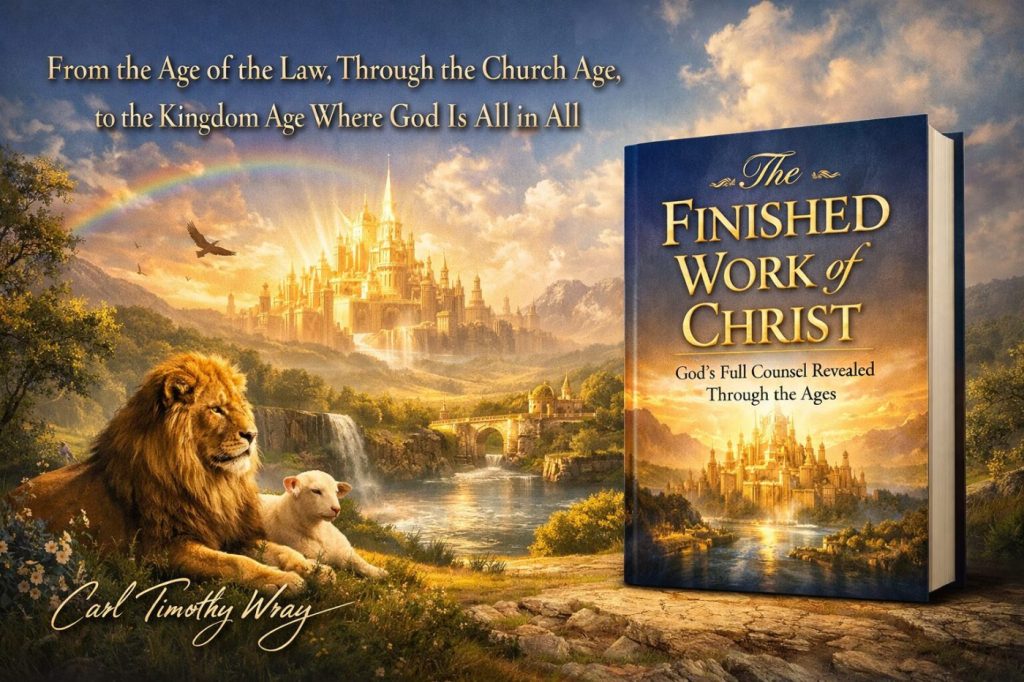
- Finished Work of Christ New Book: 2 Download Free PDF: Finished Work of Christ: 3. Read Finished Work of Christ Series
The Finished Work of Christ: INTRODUCTION
The finished work of Christ is not a partial revelation waiting to be completed by time, effort, or human achievement. It is the full counsel of God — settled in Him before the foundation of the world — revealed progressively through the ages until His original desire is fulfilled: God dwelling in man without interruption, division, or mediation.
Many have understood the finished work of Christ only in fragments — legally in the cross, spiritually in salvation, or experientially in growth — yet God has never revealed His purpose in pieces. What He finished in eternity, He chose to unveil through time, not because His work was incomplete, but because humanity required formation to receive fullness. The ages exist not as delays, but as divine wisdom unfolding Christ in perfect order.
This book presents the finished work of Christ as God sees it — whole, unified, and purposeful. From the Age of the Law, where Christ was revealed in shadow, to the Church Age, where Christ is revealed in life, and finally to the Kingdom Age, where Christ is revealed in fullness, each age serves one completed purpose. They are not competing dispensations, but successive unveilings of the same finished reality.
Here, ministry is seen not as an end in itself, but as a means toward habitation. Impart gives way to full counsel. Growth gives way to maturity. And mediation gives way to union. The finished work of Christ is not becoming true — it is being revealed until God is all in all.
Chapter 1
Why God Works in Ages, Not Just Moments
The finished work of Christ was completed in God before time began, yet it is revealed through the ages until God dwells in man without mediation, interruption, or division. What God finished in His heart before the foundation of the world was never dependent on human response to be completed, but it was always dependent on divine order to be revealed.
God does not work in fragments.
He works in fullness.
And fullness is not revealed in a moment — it is unveiled through ages.
From the beginning, God declared the end. He saw creation complete before it ever began, and He established His purpose in Christ before the world was formed. Yet God did not bring that finished purpose into manifestation all at once. Not because His work lacked power, but because His desire was not merely accomplishment — it was union.
God was not simply redeeming mankind; He was preparing a dwelling place.
And a dwelling place requires formation.
The ages are not evidence of delay.
They are the wisdom of God in motion.
Each age carries a true revelation of Christ, yet not the full expression of Him. This is not because Christ is divided, but because humanity could only receive Him in measure until maturity was reached. God reveals Himself according to capacity — never withholding truth out of reluctance, but unveiling it according to readiness.
The Age of the Law revealed Christ in shadow.
The Church Age reveals Christ in life.
The Kingdom Age reveals Christ in fullness.
These ages are not in conflict with one another. They are not corrections of failure, nor replacements of what came before. They are progressive unveilings of one finished work — God’s full counsel moving from declaration to manifestation.
The Law did not fail; it fulfilled its purpose by restraining until life could be received. The Church is not deficient; it fulfills its purpose by nurturing life until maturity is reached. And the Kingdom does not discard what came before; it brings everything into harmony when God is all in all.
This is why Scripture never speaks of God changing His mind, but of God revealing it. What was hidden in God was not undecided — it was reserved. And what was reserved was never meant to remain partial forever.
Impart belongs to immaturity.
Full counsel belongs to maturity.
Impart gives what is necessary to survive; full counsel reveals what is necessary to dwell. God is not content to merely forgive sin, heal wounds, or empower service. His end has always been habitation — God in man, man in God, without interruption.
This is why God works in ages, not moments.
Moments can change behavior.
Ages transform nature.
Moments can impart power.
Ages form sons.
Moments can inspire obedience.
Ages establish government.
God’s patience is not hesitation. His timing is not reluctance. The unfolding of the ages is the careful preparation of a vessel that can receive Him without measure and without distortion.
The finished work of Christ does not move toward completion. It moves toward revelation. And as it is revealed through the ages, every shadow gives way to substance, every impart gives way to fullness, and every form of mediation gives way to union.
God is not trying to get somewhere.
He is revealing where He has always been.
And when the ages have completed their work, the finished work of Christ will stand fully unveiled — not as a doctrine, not as a ministry, not as an experience — but as God dwelling in His creation, in perfect harmony, without division, forever.
Chapter 2
God’s Original Desire — Not Just Ministry, But Dwelling
Before there was law, priesthood, sacrifice, or ministry of any kind, there was desire. God did not begin with commandments; He began with communion. He did not seek servants to manage creation; He sought sons with whom He could dwell. The finished work of Christ does not originate in man’s fall, but in God’s heart — a heart that desired habitation long before redemption was required.
From the beginning, God’s intent was never distance. It was nearness.
“Let Us make man in Our image” was not a functional statement; it was relational. God created man as a vessel capable of union, not merely obedience. Eden was not a test site — it was a dwelling place. God walked with man, spoke with man, and rested with man. There was no mediation, no hierarchy, and no ministry. There was simply God and man in unhindered fellowship.
Ministry only appears when dwelling is disrupted.
The entrance of separation did not change God’s desire — it changed the method by which that desire would be restored. God did not respond to the fall by abandoning habitation; He responded by initiating a plan through the ages to bring man back into union without violating the nature of man or the holiness of God. Redemption was not God improvising; it was God unveiling a purpose already settled in His heart.
This is why the finished work of Christ cannot be understood as a reaction to sin alone. Sin created the necessity for rescue, but not the vision for union. The cross did not invent God’s desire to dwell; it removed the barriers that prevented it. What Christ finished was not merely forgiveness — it was the restoration of God’s dwelling place.
Before there was a Levitical priesthood, God Himself was the Priest walking with man.
Before there were sacrifices, God Himself was the Life sustaining man.
Before there were altars, God Himself was the Presence filling man.
The Law did not introduce distance — it managed distance until nearness could be restored. The priesthood did not create mediation — it governed mediation until union could return. Every structure God introduced after Eden was provisional, not permanent. Each one served the same unchanging desire: God dwelling with His people.
This is why ministry was never the goal.
Ministry exists because dwelling was interrupted. When union is restored, ministry gives way to habitation. God does not intend to be represented forever; He intends to be present. He does not desire intermediaries eternally; He desires intimacy without distance. The end of God’s work is not better systems — it is restored fellowship.
Impart belongs to the season of distance.
Dwelling belongs to the season of fullness.
God has always been moving creation toward the place where nothing stands between Himself and man — not sin, not law, not priesthood, not even ministry. The finished work of Christ secures this outcome by reconciling everything in heaven and earth into one dwelling place where God is all in all.
This is why the Kingdom Age is not defined by increased activity, but by settled rest. When God dwells fully in man, effort gives way to expression, and work gives way to being. What ministry accomplished in stages, habitation fulfills completely.
God’s original desire was never altered by time, failure, or delay.
It has only been revealed patiently through the ages.
And when that desire is fully realized, the purpose of the ages will be complete — not because God has finally arrived, but because man has finally been made ready to dwell with Him forever.
Chapter 3
The Age of the Law — Christ Ministering in Shadow
The Age of the Law was not the absence of Christ; it was the revelation of Christ in shadow. God did not introduce the Law because He withdrew from man, but because man could no longer bear unmediated presence. What had once been enjoyed in Eden now required structure, boundaries, and restraint — not to replace God’s desire to dwell, but to preserve man until that desire could be fulfilled again.
The Law was never God’s final word.
It was God’s protective word.
In the Law, Christ was present, but veiled. He was active, but mediated. Every commandment, sacrifice, priestly function, and holy boundary bore witness to Him. The Law did not reveal Christ directly; it revealed Him by outline, by pattern, and by symbol. It taught Israel what God was like, not by union, but by instruction. It showed holiness without imparting life, righteousness without union, and nearness without access.
This was not failure — it was wisdom.
The Levitical priesthood was Christ ministering through separation. The priest stood between God and man not because God desired distance, but because distance still existed within man. Blood was offered continually, not because it removed sin permanently, but because it pointed toward a sacrifice that would. Every repetition testified to incompletion — not in God’s purpose, but in man’s readiness.
The Law restrained.
The Law governed.
The Law preserved.
It kept Israel from destruction while simultaneously training them to recognize the Lamb when He appeared. Without the Law, man would have perished. With the Law, man was prepared.
Christ was present in every shadow.
He was the true High Priest hidden within the priesthood.
He was the true Sacrifice hidden within the offerings.
He was the true Temple hidden within the tabernacle.
He was the true Sabbath hidden within the command to rest.
Yet none of these could deliver fullness. Shadows instruct, but they cannot transform. They reveal shape, but not substance. They protect from chaos, but they cannot impart life. The Law could define sin, but it could not remove it. It could expose distance, but it could not heal it. It could command obedience, but it could not produce sonship.
This is why the Law was never meant to continue forever.
The Law did not fail; it fulfilled its assignment perfectly by bringing man to the edge of life and stopping there. Its purpose was to guard until Christ could be received, not to complete what only Christ could finish. When Christ appeared in the flesh, the shadow met its substance, and the provisional gave way to the permanent.
The transition from the Law to the Church was not rebellion against God — it was obedience to God’s plan. To remain in shadow after substance arrived would have been disobedience, not faithfulness. The Law prepared the way; Christ completed the journey.
In the Age of the Law, Christ ministered to man.
In the Church Age, Christ ministers in man.
In the Kingdom Age, Christ ministers as man united with God.
This progression is not accidental. It is the wisdom of full counsel unfolding through time.
The Law served until life could be received. And once life was imparted, the Law had nothing left to accomplish. Its ministry was complete, not abolished in contempt, but fulfilled in glory.
The Age of the Law stands as a faithful witness — not of limitation, but of preparation. It reminds us that God never rushed humanity into fullness before the heart was ready. He guarded man carefully, patiently, lovingly, until the day when shadow could finally give way to life.
And when life came, it did not despise the shadow — it fulfilled it.
Chapter 4
The Church Age — Christ Ministering in Life
The Church Age marks a profound shift in God’s revelation of Himself. Where the Law revealed Christ in shadow, the Church reveals Christ in life. This was not merely a change of covenantal structure; it was a change of location. Christ was no longer ministering through external symbols and mediated systems — He was now dwelling within man by the Spirit.
The Church Age did not begin with organization.
It began with union.
At Pentecost, the Spirit of God was poured out, not to create a new religious system, but to impart divine life. What could not be accomplished by commandments was now accomplished by indwelling. The righteousness the Law demanded but could not produce was now fulfilled by Christ living His life in His people. This was not moral improvement — it was new creation.
Life replaced restraint.
Union replaced separation.
Yet even this glorious age carries purpose without finality.
The Church Age is characterized by impart. Gifts are given. Grace is supplied. Life is shared. The Spirit distributes according to measure, empowering believers to grow, to serve, and to mature. Ministry expands because life must be nurtured. Apostles, prophets, evangelists, pastors, and teachers function not as replacements for Christ, but as expressions of His life ministering toward maturity.
This is the great glory of the Church: Christ in man, the hope of glory.
But impart, by nature, implies progression.
Life must grow.
Union must mature.
Sonship must be formed.
The Church was never designed to remain in perpetual childhood. It was never meant to live indefinitely by gifts, offices, and mediation. These are not signs of failure — they are signs of formation. Just as a child requires instruction and care until maturity is reached, so the Church requires ministry until Christ is fully formed within.
This is why the Church Age contains both glory and limitation.
Believers are complete in Christ, yet growing in understanding.
They are seated in heavenly places, yet walking through time.
They are one body, yet still learning unity.
The Spirit is fully present, yet not yet without measure corporately.
The Church Age reveals Christ in life, but not yet in fullness.
Ministry continues because maturity has not yet been fully realized. Teaching persists because understanding is still being formed. Leadership remains because governance is still being learned. These are not deficiencies — they are necessary stages in God’s wisdom.
The tragedy of the Church Age is not its limitations, but the belief that those limitations are permanent.
When impart becomes the goal instead of a means, growth stalls. When gifting becomes identity instead of sonship, fragmentation remains. When ministry becomes central instead of habitation, the Church settles short of fullness.
Yet God has never intended the Church to end in perpetual impart.
The Church Age exists to produce sons — not servants forever, not students forever, but mature sons capable of dwelling with God without mediation. The life imparted by the Spirit is not meant to remain distributed in measures indefinitely. It is meant to mature into fullness.
Christ ministers in the Church to bring the Church into Himself.
This is why Scripture speaks of a coming maturity, a unity of the faith, and a full-grown man. These are not future add-ons to salvation; they are the intended outcome of life imparted.
The Church Age is glorious.
But it is transitional.
It carries the seed of fullness, not the harvest. It nurtures life until the vessel is ready to contain God without interruption. And when that readiness is complete, impart will give way to habitation, and ministry will give way to presence.
The Church Age is Christ ministering in life — faithfully, patiently, lovingly — until life reaches its appointed fullness.
Chapter 5
The Kingdom Age — Christ Ministering in Fullness
The Kingdom Age is not the beginning of Christ’s reign; it is the unveiling of a reign that has always existed. Christ has never waited to be King. He has always ruled. What changes in the Kingdom Age is not His authority, but the condition of the vessel through which that authority is expressed.
The Kingdom Age is Christ ministering in fullness.
Where the Law restrained until life could come, and the Church nurtured life until maturity could be reached, the Kingdom reveals what life has been preparing for all along — God dwelling in man without interruption, division, or mediation. This is not an increase of activity; it is the arrival of rest. It is not greater ministry; it is the end of ministry as a necessity.
In the Kingdom Age, Christ does not minister to man, nor merely in man — He ministers as man united with God.
This is not replacement theology; it is fulfillment theology.
The Kingdom does not discard the Law or the Church. It gathers them into harmony. Everything restrained by the Law finds freedom. Everything imparted in the Church finds fullness. What was governed externally is now governed internally by life fully matured.
This is why Scripture describes the Kingdom not primarily in terms of works, but of righteousness, peace, and joy. These are not behaviors — they are conditions of being. They describe a state where God’s will is no longer resisted, misunderstood, or delayed, but expressed naturally through sons who have been fully formed.
The Kingdom Age is the age of sonship fully realized.
Here, authority flows without striving. Government operates without coercion. Dominion is expressed without violence. Christ’s rule is not enforced by law or sustained by ministry; it is revealed through alignment. Sons do not need to be managed when their hearts are perfectly joined to the Father’s heart.
This is the order of Melchizedek — not as a doctrine to be debated, but as a reality to be lived. It is priesthood without sacrifice, kingship without domination, and ministry without mediation. God does not stand above His people issuing commands; He dwells within them, expressing His nature through them.
The Kingdom Age is not loud.
It does not announce itself with spectacle. It emerges as inevitability — the natural result of life fully matured. When fullness arrives, nothing has to be replaced. Everything simply finds its proper place.
This is why the Kingdom Age follows preparation, not impatience. God does not release fullness until the wineskin is complete. Power without maturity destroys vessels. Authority without formation corrupts hearts. So God waits — not because He is reluctant, but because He is faithful.
When the Kingdom Age manifests, it does not need to learn how to function. It has already been living, teaching, governing, and reconciling under restraint. The removal of limitation does not create something new — it simply releases what has already been proven.
This is why the Kingdom Age does not begin with chaos, but with clarity.
The Kingdom Age reveals Christ ministering in fullness because nothing remains to be withheld. The heart has been prepared. The life has been tested. The mandate has been entrusted. The sons are ready.
And when Christ ministers in fullness, the purpose of the ages is no longer being approached — it is being expressed.
God is no longer visiting His people.
God is dwelling with them.
Chapter 6
From Ministry to Habitation — When God Rests
The movement from ministry to habitation marks the most misunderstood transition in the plan of the ages. Many have assumed that more maturity would result in more activity, more anointing, and more visible work. Yet God’s end has never been increased motion — it has always been settled dwelling. When God rests, it is not because nothing is happening, but because everything is finally aligned.
God rested on the seventh day not because creation lacked momentum, but because creation had reached harmony. Rest was not the absence of power; it was the perfection of order. In the same way, the Kingdom Age does not culminate in perpetual ministry, but in habitation — God dwelling in man so fully that ministry is no longer required to bridge distance.
Ministry exists because something stands between God and man.
Where there is distance, there must be mediation.
Where there is immaturity, there must be instruction.
Where there is fragmentation, there must be repair.
But when union is complete, these functions give way naturally. Not because they were wrong, but because they have finished their work.
Habitation is the evidence that ministry has succeeded.
God does not abandon ministry; He fulfills it. Apostolic labor, prophetic revelation, pastoral care, and teaching all exist for one purpose: to bring the people of God to a place where God can dwell without interruption. When that purpose is accomplished, ministry does not collapse — it rests.
This is the rest God has been moving toward from the beginning.
In habitation, God no longer needs to be explained.
In habitation, truth no longer needs to be enforced.
In habitation, righteousness no longer needs to be taught.
It is lived.
When God rests in man, governance becomes effortless. Authority flows not from command, but from nature. Obedience is no longer an act of willpower, but the natural expression of shared life. This is why Scripture describes the end not as endless labor, but as God being “all in all.” When God fills everything, nothing needs to be managed.
The shift from ministry to habitation is also the shift from preservation to expression.
Ministry preserves truth until hearts are ready. Habitation expresses truth because hearts are aligned. Ministry protects the people of God from error; habitation removes the appetite for error altogether. When God dwells fully, deception has no soil in which to grow.
This is why God does not rush habitation.
A partially prepared heart would turn habitation into corruption. A vessel still governed by self-preservation would misuse fullness. So God waits — patiently forming hearts through faithfulness, trust, and surrender — until nothing remains that would distort His presence.
When God rests, He does not withdraw.
He settles.
And when He settles, creation settles with Him.
Habitation does not announce itself with signs and wonders, though power flows freely within it. It announces itself through peace, clarity, and unity. There is no scramble to sustain momentum, no anxiety to preserve movement, no fear of losing relevance. Everything that proceeds from habitation proceeds from rest.
This is the Sabbath of the ages.
Not a day, but a condition.
Not inactivity, but harmony.
Not silence, but resonance.
From this place, God’s will is no longer something to be sought — it is something to be lived. Heaven and earth are no longer separate realms needing reconciliation; they are one dwelling place expressing the same life.
When God rests, the work of the ages is complete.
Not because God has stopped acting, but because nothing remains out of order.
Chapter 7
The Finished Work Manifested — God All in All
The finished work of Christ does not conclude with activity, expansion, or even triumph as men define it. It concludes with God Himself. When the work of the ages reaches its appointed end, there is no final system to establish, no remaining enemy to defeat, and no further distance to cross. There is only God — fully expressed, fully received, and fully dwelling in His creation.
This is what Scripture means when it says that Christ delivers the Kingdom to the Father, “that God may be all in all.” This is not abdication of authority; it is the fulfillment of purpose. Christ does not cease to reign — He completes the reign by bringing everything into perfect alignment with the Father’s heart. The work that began in eternal counsel ends in eternal habitation.
At this point, nothing remains partial.
What was declared finished before time began is now fully revealed within time. What was revealed through shadow, then through life, is now expressed in fullness. The ages have accomplished their work, not by adding anything to God, but by preparing creation to receive Him without distortion.
The finished work is no longer a doctrine to be believed.
It is no longer a message to be preached.
It is no longer a ministry to be sustained.
It is a condition of being.
God is no longer visiting His people. He is dwelling with them. There is no longer a need for mediation, because nothing stands between God and man. There is no longer a need for correction, because hearts are fully aligned. There is no longer a need for restraint, because love governs completely.
This is not the loss of individuality — it is the perfection of unity. God does not absorb creation into Himself; He fills it with Himself. Each vessel remains distinct, yet perfectly harmonized with the whole. Diversity does not disappear; it resonates. Authority does not dominate; it expresses love. Power does not overwhelm; it gives life.
This is why Scripture describes the end as a city, not an institution — a living dwelling place where God and man share life freely. Light is no longer external, because God Himself is the light within. Worship is no longer summoned, because life itself is worship. Obedience is no longer commanded, because will and desire are one.
Here, the redemption of the body is not the beginning of something new, but the removal of the final limitation. The life that has already been living, loving, governing, and reconciling is now unhindered. What was formed quietly now moves freely. What was faithful under restraint now expresses fullness without effort.
Nothing needs to be proven.
Nothing needs to be defended.
Nothing needs to be preserved.
God is all in all.
This is the Sabbath that remains for the people of God — not rest from labor alone, but rest in perfect communion. The striving of the ages gives way to the stillness of union. Time has served its purpose. Progress has reached its destination. The work has not merely been finished — it has been manifested.
And in that manifestation, God’s original desire is fulfilled.
Not ministry forever.
Not effort forever.
Not mediation forever.
But dwelling.
This is the end God saw from the beginning.
This is the purpose Christ finished at the cross.
This is the full counsel now revealed.
The finished work of Christ stands complete — not only in heaven, but in creation — because God has found His home.

The Finished Work of Christ Series:
- The Finished Work of Christ — “My Times Are in Thy Hand” (Psalm 31:15)
- The Finished Work of Christ — What “It Is Finished” Truly Means
- The Finished Work of Christ — Full Counsel: Legal, Vital, Revealed, and Manifested
- The Finished Work of Christ — Declared Finished vs Being Revealed in Time
- Join Our Facebook Page: