 📺
📺
The Finished Work of Christ Revealed Through Law (30), Grace (60), and Fullness (100) in Divine Order
The Finished Work of Christ: AUTHOR
By Carl Timothy Wray
Carl Timothy Wray writes from a lifelong pursuit of seeing Scripture as one unified revelation rather than fragmented doctrines divided by covenants, dispensations, or traditions. His work centers on unveiling the Finished Work of Christ from the full counsel of God—eternally settled in God’s heart, revealed through the plan of the ages, and manifested through Christ Himself in divine order. With clarity, patience, and spiritual precision, Wray traces how Jesus has always been the Minister of God’s purpose, appearing across realms and measures until the fullness of God is expressed in all.
The Finished Work of Christ becomes clear when Scripture is heard by measure—Law (30), Grace (60), and Fullness (100) in divine order.
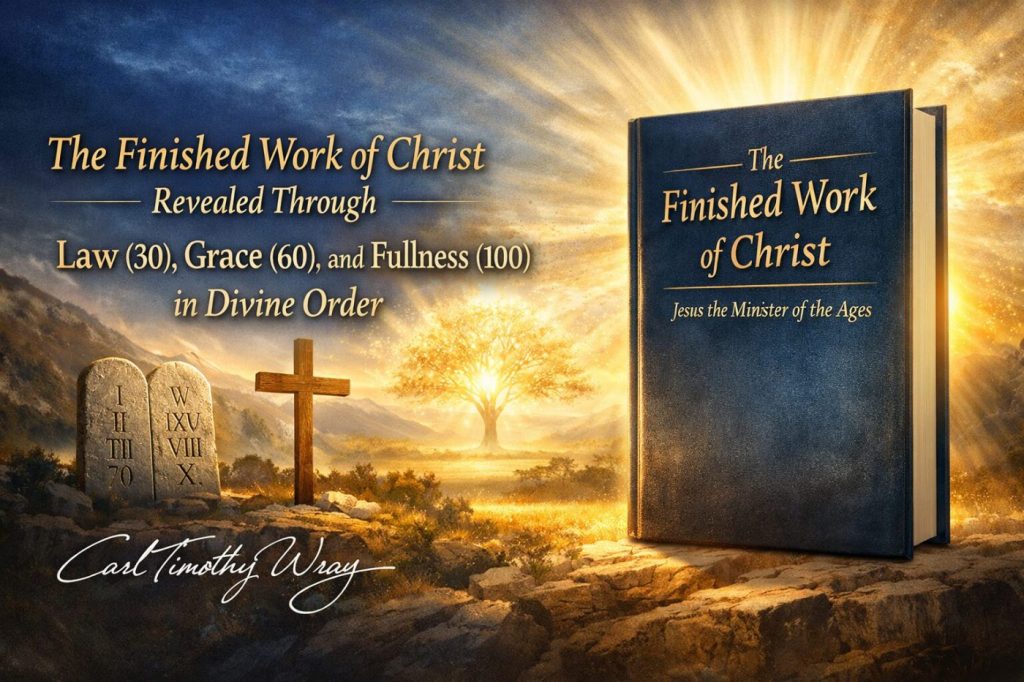
- Finished Work of Christ Book: 2. Finished Work of Christ PDF Download 3. Finished Work of Christ Series
The Finished Work of Christ: INTRODUCTION
Most believers have been taught to read the Bible in parts—Old Covenant versus New Covenant, law versus grace, past versus future. As a result, Scripture often appears contradictory, fragmented, and difficult to reconcile. Yet the problem has never been the Word itself. The problem has been our failure to recognize who has been speaking—and from where He has been speaking.
The truth is simple and profound: it has always been Jesus.
From Genesis to Revelation, from the wilderness to the cross, from Pentecost to the unveiling of sons, Christ has never ceased to minister. What has changed is not the Person, but the realm, the measure, and the capacity of creation to receive Him. Jesus did not contradict Himself across the ages; He revealed Himself progressively—first in shadow, then in impartation, and finally toward fullness.
Scripture itself marks this divine progression with language almost every believer recognizes: some thirty, some sixty, and some a hundredfold. Though familiar, few have understood that this pattern governs not only growth, but God’s entire administration of ministry. The Law revealed Christ in a thirtyfold measure—external, restrained, and veiled. Grace revealed Christ in a sixtyfold measure—indwelling, imparted, and mediated through ministry. Fullness reveals Christ in a hundredfold measure—unveiled, matured, and expressed through prepared sons.
This book does not introduce a new Christ, a new gospel, or a new destination. It simply restores divine order. When Christ is seen as the Minister of every age, Scripture comes into alignment, apparent contradictions dissolve, and the Finished Work of Christ is understood not as a moment alone, but as a completed counsel revealed through time.
The purpose of this writing is not to argue theology, but to install clarity—to help readers locate every verse, every covenant, and every voice in its proper realm. Once the Finished Work and God’s ministry are seen together, the Bible reads as it was always meant to be read: one Christ, one purpose, one unfolding revelation—until God is all in all. This book establishes the finished work of Christ as one unified revelation, showing how Jesus has always administered God’s eternal purpose in divine order from Law to Grace to Fullness.
The Finished Work of Christ — The Full Counsel Framework
This book is written from the understanding that the Finished Work of Christ was eternally settled in God’s counsel before time, legally accomplished through Christ, and progressively revealed within time through the Plan of the Ages.
Time is not where God decides — time is where God unveils.
Rather than viewing Scripture as fragmented covenants or competing dispensations, this work approaches the Bible as one unified revelation, unfolded through divine order until God becomes all in all.
Within this framework:
- Law revealed the standard and measure
- Grace imparted life and maturation
- Fullness manifests what was already complete
These are not eras in conflict, but dimensions of one divine mind.
The Levitical, Apostolic, and Man-Child ministries are therefore understood not as competing offices, but as ministries of revelation and maturation, each serving the unveiling of Christ’s completed work until His life is fully expressed in sons.
This book does not seek to add to what Christ finished, but to reveal what God settled, how it unfolds through Scripture, and how it is ultimately manifested in fullness God All in All.
Chapter 1
The Finished Work Was Settled Before Time
Before the Finished Work of Christ was revealed in history, it was settled in eternity. Before Jesus ever walked the earth, before the Law was given, before sin entered the world, God had already completed His counsel concerning creation, redemption, and consummation. The Finished Work did not begin in time—it was revealed in time.
This distinction is critical. God does not react. He does not adjust. He does not improvise. Everything God does in time flows from what He has already determined in Himself. Time is not where God decides; time is where God unveils.
Scripture testifies that Christ was “the Lamb slain from the foundation of the world.” This does not mean Jesus was repeatedly sacrificed, nor does it mean God anticipated failure and prepared a contingency plan. It means that in the eternal counsel of God, redemption was already complete before creation ever began. The cross did not originate salvation—it manifested what was already settled.
This is why the Finished Work of Christ cannot be understood merely as an event at Calvary. Calvary is the intersection point where eternal completion entered history. What was decreed in eternity became visible in time. What was settled in God’s heart was expressed through God’s Son.
Understanding this protects us from a distorted gospel. If we believe the Finished Work began in time, we will inevitably believe it is still unfinished. But when we see that the Finished Work originated in eternity, we understand that time serves revelation, not completion.
The plan of God did not unfold because something went wrong—it unfolded because something was already right.
Eternity Governs Time, Not the Other Way Around
One of the great errors in religious thinking is reversing the order of God. Many read Scripture as though God is moving forward, learning, responding, and adjusting. In reality, God speaks the end from the beginning. Eternity governs time; time does not govern eternity.
This is why Scripture can declare, with full authority, things that appear contradictory to the natural mind. God can say that death has been abolished, and also speak of death as the last enemy to be destroyed. These are not contradictions—they are statements spoken from different realms. Eternally, death is finished. Temporally, death is being revealed as finished.
The Finished Work exists fully in God’s eternal realm, but it is unveiled progressively through the ages. This is not delay—it is divine order. God reveals what He has finished according to capacity, maturity, and purpose.
Everything that follows—Law, Grace, ministry, manifestation—flows from this single truth:
God is not trying to accomplish something; He is revealing something He has already accomplished.
Why This Matters for Understanding Ministry
If the Finished Work was settled before time, then ministry does not exist to complete God’s work. Ministry exists to administer revelation. Ministry is not about finishing what Christ started; it is about unveiling what Christ has already finished.
This is why Jesus must be seen as the Minister of every age. From eternity forward, Christ has been administering the same finished counsel, but through different realms and measures. He did not change His purpose; He changed the way He revealed it.
Without this eternal foundation, ministry becomes confusing. People begin to think the Law failed, grace replaced it, and fullness must overthrow both. But when we see that all things originate in eternity, we understand that Law, Grace, and Fullness are not competing systems—they are progressive revelations of one finished counsel.
The Finished Work Precedes Manifestation
One of the most freeing truths in the gospel is this:
Manifestation does not determine completion—completion governs manifestation.
God does not wait for manifestation to declare something finished. He declares it finished first, then reveals it in time. This is why faith rests. Faith does not strive to finish God’s work; faith agrees with what God has already finished.
This also explains why Scripture speaks so confidently about the end. God does not hope for God all in all—He knows God will be all in all. The end is not uncertain; only the unveiling is progressive.
Once this is understood, anxiety disappears from theology. Fear leaves eschatology. Striving exits ministry. Everything finds its place.
The Eternal Foundation of the Ages
The ages are not experiments. They are administrations. Each age reveals another facet of the same finished work. God does not create new purposes—He unveils the same purpose more clearly.
This is why the Bible must be read from eternity downward, not from history upward. When eternity is the foundation, Scripture becomes unified. Christ becomes consistent. Ministry becomes clear.
And most importantly, the reader stops asking, “What is God trying to do?”
and begins to see, “What God has already done.”
Understanding the finished work of Christ as eternally settled before time allows every age to be read as the progressive unveiling of what God already completed in Himself.
Chapter 2
Jesus Has Always Been the Minister
One of the greatest misunderstandings in reading Scripture is the assumption that God speaks with different voices in different ages. Many have been taught—implicitly or explicitly—that the Old Testament reveals one mode of God, the New Testament reveals another, and the future reveals yet another still. The result is fragmentation: different tones, different intentions, and even apparent contradictions.
The truth is far simpler—and far more glorious.
It has always been Jesus.
From the beginning, Christ has been the Minister of God’s eternal purpose. He did not appear suddenly in the New Testament as a new voice replacing an old one. He was present from the start, administering the same finished counsel, but through different realms and measures according to the capacity of creation.
The ministry has never changed.
The measure has.
Christ Was Not Introduced—He Was Revealed
Scripture tells us plainly that Christ is the Word by whom all things were made. If all things were made by Him, then He did not arrive late in the story. He is not an afterthought. He is the Origin.
This is why the apostle can say that the Rock that followed Israel in the wilderness was Christ. This is not poetic symbolism—it is revelatory fact. The same Christ who would later walk the roads of Galilee was present with Israel, ministering according to the measure that age could receive.
Jesus did not change His identity.
He changed His mode of appearing.
What was veiled in the Law would later be unveiled in Grace. What was external would later become internal. But the Minister remained the same.
Ministry Begins With Christ, Not Man
Ministry did not originate when Moses ascended Sinai, nor when apostles were sent out, nor when churches were established. Ministry originates in Christ Himself. He is the true Minister of the sanctuary, the administrator of God’s purpose, and the expression of the Father in every age.
When ministry is misunderstood as a human function, confusion follows. People begin to argue over offices, authority, succession, and legitimacy. But when ministry is restored to its rightful source—Jesus Himself—clarity returns.
Men do not create ministry.
Ministry flows from Christ.
All human ministry exists only as a participation in what Christ is already doing.
One Minister, Many Realms
Christ has always ministered, but not always in the same realm.
In earlier ages, He ministered from without—through command, shadow, and distance. Later, He ministered from within—through indwelling life and impartation. And ultimately, He ministers toward fullness—through maturity, union, and expression.
These are not different ministries.
They are one ministry, revealed progressively.
The failure to see this continuity is what causes Scripture to feel disjointed. But once Christ is recognized as the constant Minister, the Bible reads as one voice speaking from different rooms in the same house.
Why Jesus Appears Differently Across Scripture
God never reveals more glory than creation can receive. This is not limitation—it is mercy and wisdom. Christ did not withhold Himself because He was unwilling; He withheld Himself because capacity had to be formed.
In earlier ages, creation could not receive Christ inwardly. Therefore, He appeared outwardly. Later, when the Word became flesh, Christ could dwell within humanity. And as humanity is matured, Christ is prepared to be revealed in fullness.
The appearance changes.
The Person does not.
This is why Scripture must be read with awareness of realm. Not everything Jesus says is spoken from the same measure. Yet everything He says is true, because it is spoken from the realm appropriate to the hearer.
The Ministry of Christ Is Progressive, Not Contradictory
When Christ says that death has been abolished, He is speaking from the realm of eternal completion. When He speaks of death as the last enemy to be destroyed, He is speaking from the realm of progressive revelation. Both statements are true. Neither contradicts the other.
The confusion only arises when we forget that the same Christ speaks from different measures.
Once this is understood, the tension disappears. Scripture aligns. The gospel settles. The reader no longer asks, “Which verse is correct?” but rather, “From which realm is Christ speaking here?”
That single shift resolves decades of confusion.
Christ as the Administrator of the Ages
The ages exist because Christ administers revelation in stages. He does not reveal everything at once. He reveals according to divine order. Each age unveils another facet of the same finished work.
Christ is not learning through the ages.
He is revealing through the ages.
This is why the Finished Work of Christ must always be read alongside the ministry of Christ. What was finished in eternity is revealed through administration in time. And Jesus Himself is the One administering that revelation. Seeing Jesus as the Minister of the Ages reveals that the finished work of Christ has always been administered by the same Person, though revealed through different realms.
Chapter 3
The Thirtyfold Realm: Christ Revealed Through the Law
To understand the Law correctly, we must first remove a deeply rooted misconception: the Law was not God operating apart from Christ. The Law was Christ ministering in a restrained measure—a thirtyfold revelation of the same life that would later be revealed more fully.
The problem has never been the Law itself. The problem has been reading the Law without recognizing the Person speaking through it.
The Law was not the absence of Christ.
It was Christ veiled.
Christ Was Present, but Measured
Scripture is clear that Christ was with Israel in the wilderness. He was not distant. He was not silent. He was not waiting for a later age to appear. The Word spoke. The Presence led. The Rock followed them—and that Rock was Christ.
Yet His appearance was restrained.
Why? Because the thirtyfold realm is not designed for fullness. It is designed for formation. The Law revealed righteousness, but did not impart it. It revealed life, but did not yet install it inwardly. It revealed God’s holiness, but from without.
This was not failure.
This was divine wisdom.
The Law as External Revelation
In the thirtyfold realm, Christ ministered externally. Commandments were written on stone, not on hearts. The Word came from outside, not from within. Obedience was demanded, not yet empowered.
This does not mean the Law was evil or flawed. It means the people had not yet been prepared to receive Christ internally. Capacity had not yet been formed.
The Law served as a tutor, not a destination. It taught mankind about God, about righteousness, about holiness, and about the need for life beyond human strength. It exposed the limitation of the flesh so that the necessity of grace would be unmistakable.
Christ was revealing Himself—but only as much as could be received.
Why the Veil Was Necessary
The veil was not punishment.
The veil was protection.
Had Christ revealed Himself in fullness under the Law, creation would not have survived the encounter. Glory always requires capacity. Where capacity is undeveloped, glory must be restrained.
This is why Moses could speak with God, yet not see His face. This is why the Presence could dwell among Israel, yet remain separated by distance and ritual. Christ was there, but He was veiled by measure.
Thirtyfold revelation is real revelation—but it is partial by design.
The Purpose of the Thirtyfold Realm
The Law accomplished exactly what it was meant to accomplish.
It:
- Revealed God’s nature
- Exposed humanity’s limitation
- Prepared the ground for incarnation
- Created hunger for inward life
The Law did not exist to finish God’s work.
It existed to prepare creation for the next measure.
When Christ later came in the flesh, He did not contradict the Law—He fulfilled it. Fulfillment does not mean replacement; it means completion of purpose.
Why the Law Must Be Honored but Not Returned To
Many err in one of two directions:
- They either despise the Law
- Or they attempt to return to it
Both miss the point.
The Law must be honored because it was Christ ministering in divine order. But it must not be returned to, because thirtyfold is not the goal. It is the beginning.
To return to the Law after grace is not faithfulness—it is regression. It is attempting to live in a realm that has already accomplished its purpose.
Christ does not move backward in revelation.
He moves forward toward fullness.
Hearing Jesus in the Old Testament
One of the greatest freedoms this understanding brings is the ability to hear Jesus clearly in the Old Testament. No longer do readers hear a harsh voice replaced by a gentle one. Instead, they hear the same Christ speaking from a different realm.
The commands, judgments, and instructions of the Law are not contradictions of grace—they are thirtyfold expressions of the same righteousness that would later be imparted inwardly.
Once this is seen, Scripture stops fighting itself.
Thirtyfold Is Preparation, Not Condemnation
The Law was never meant to condemn humanity eternally. It was meant to reveal humanity’s need for life. It showed what righteousness looks like so that grace could later supply what the Law demanded.
Christ was teaching creation how to recognize Him.
He spoke in shadow so that when substance arrived, it would be recognized.
When the Law is understood as a thirtyfold revelation of Christ, the finished work of Christ is no longer fragmented but seen in divine order.
Chapter 4
Why Ministry Was Necessary
If Christ has always been the Minister, and if the Law already revealed Him in a thirtyfold measure, an important question naturally arises: Why was incarnation necessary at all? Why did the Word need to become flesh? Why did ministry—through people, gifts, and offices—enter the picture?
The answer is simple, yet profound: revelation must move closer as capacity increases.
The Law revealed Christ from without. Grace required Christ within. And that inward revelation required incarnation.
The Transition From External to Internal
In the thirtyfold realm, Christ ministered externally. The Word spoke from outside the human vessel. Commands came from above. Obedience was required, but life was not yet imparted.
But God’s purpose was never external compliance. His purpose was internal union.
For that to occur, the Word could no longer remain distant. He had to enter humanity itself. This is why Scripture declares, “The Word became flesh and dwelt among us.” This was not merely a historical miracle—it was a necessary transition in divine order.
Christ did not come to give better instructions.
He came to give His life.
Incarnation Created the Need for Ministry
Once Christ entered flesh, ministry became necessary—not as a replacement for Him, but as a means of contact. Jesus could only be physically present in one place at a time, yet His purpose was to touch all of humanity. Ministry became the vehicle through which His life could be multiplied and imparted.
This is why Jesus said it was expedient for Him to go away. His departure did not signal absence—it signaled expansion. Through the Spirit, Christ could now live in many, not merely walk among a few.
Ministry exists because Christ chose to:
- Enter humanity
- Multiply His life
- Touch creation through people
Ministry is Christ reaching creation through flesh.
Ministry Does Not Originate With Man
It is vital to understand this: ministry did not originate as a human institution. It originated as a divine necessity following incarnation. The moment Christ chose to dwell in human vessels, ministry became the means by which His life could be expressed and imparted.
This guards us from idolizing ministry. Ministry is not an end in itself. It is a temporary administration serving an eternal purpose.
Christ did not need ministry to finish His work.
Creation needed ministry to receive His finished work.
Grace Is Not the End—It Is Impartation
The sixtyfold realm of grace is defined by imparted life. This is where Christ no longer merely commands righteousness, but becomes righteousness within. The Spirit writes the law on the heart. Life replaces effort. Union replaces distance.
Yet even here, ministry is still required.
Why?
Because impartation precedes manifestation. Christ must be formed in believers before He can be revealed through them. Grace supplies life, but that life must mature.
Ministry exists in the sixtyfold realm to:
- Impart life
- Shape vessels
- Form Christ within
- Prepare for fullness
Why Christ Did Not Reveal Fullness Immediately
It is tempting to ask why Christ did not begin in fullness. Why not skip the Law? Why not bypass ministry? Why not reveal glory at once?
The answer is capacity.
Fullness is not about power—it is about prepared vessels. Glory without capacity destroys. Life without maturity overwhelms. Christ never reveals more than creation can bear.
Therefore, incarnation and ministry are acts of mercy. They allow Christ to:
- Enter humanity safely
- Grow within vessels
- Prepare creation gradually
Christ always reveals Himself in order.
Ministry as a Bridge, Not a Destination
This is where many stumble. Ministry is often mistaken for permanence. Offices are treated as eternal identities rather than transitional functions. But Scripture makes clear that ministry exists until something greater emerges.
As union increases, ministry decreases. As maturity develops, mediation fades. Ministry gives way to direct expression.
This does not dishonor ministry—it fulfills it.
Incarnation and ministry make sense only when viewed as vehicles through which the finished work of Christ is imparted and revealed in humanity.
Chapter 5
The Sixtyfold Realm: Christ Revealed Through Grace
Grace marks a decisive transition in the revelation of Christ. In the thirtyfold realm, Christ ministered from without—through command, shadow, and restraint. In the sixtyfold realm, Christ ministers from within. Grace is not merely forgiveness, favor, or relief from judgment; it is the impartation of Christ’s own life into the human vessel.
This is why grace does not simply improve behavior—it transforms nature. What the Law demanded externally, grace supplies internally. Righteousness is no longer pursued; it is received. Obedience no longer flows from effort; it flows from life. Christ is no longer revealed merely as standard—He is revealed as indwelling reality.
This is the defining mark of the sixtyfold realm.
Christ in You — The Nature of Grace
The great mystery revealed in the New Covenant is not instruction, but union. Scripture declares, “Christ in you, the hope of glory.” Grace introduces humanity to a reality the Law could never produce: Christ living within man by the Spirit.
Grace does not lower God’s requirement; it fulfills it by installing divine life. The Spirit writes the law on the heart, not as regulation, but as nature. The believer does not strive to become righteous—Christ becomes righteousness within.
This is the glory of the sixtyfold realm: Christ imparted, Christ dwelling, Christ forming Himself in humanity.
Why Grace Still Requires Ministry
Although grace brings Christ within, it does not eliminate ministry. Instead, it redefines its purpose.
In the sixtyfold realm, ministry exists not to replace Christ, but to serve His formation. Gifts, callings, and offices function as instruments through which Christ nurtures His life within believers. Ministry is not the source of life; it is a servant of life.
Grace is relational, experiential, and powerful—but it unfolds progressively. Life must grow. Seeds must mature. Christ must be formed in the soul. Ministry exists in this realm to:
- Impart Christ’s life
- Teach believers to live from union
- Renew the mind
- Prepare vessels for maturity
Ministry in grace is formational, not final.
Grace Is Not the Destination
One of the most common misunderstandings is treating grace as the endpoint of God’s purpose. When grace is absolutized as the final goal, growth stagnates and expectation diminishes. But grace was never intended to be the end—it was intended to be the means.
The sixtyfold realm is glorious, liberating, and necessary. Yet it is still a realm of preparation. Christ is present, but not yet fully expressed. Life is imparted, but not yet fully manifested.
Grace prepares the vessel.
Fullness reveals the life.
To stop at grace is not faithfulness—it is incompletion.
Christ Formed Before Christ Revealed
Scripture speaks clearly of Christ being formed in believers. Formation always precedes manifestation. Grace does not bypass process; it empowers it. Growth, renewal, transformation, and maturity are not signs of deficiency—they are signs of life at work.
Christ does not rush His revelation. He patiently forms His life within humanity so that when fullness comes, it is stable, responsible, and life-giving. Grace ensures that Christ’s manifestation will not overwhelm creation, but bless it.
Grace Fulfills the Law Without Returning to It
Grace does not despise the Law; it fulfills its purpose. What the Law revealed externally, grace installs internally. There is no competition between Law and grace—only progression.
To return to the Law after grace is to misunderstand grace. But to dismiss the Law entirely is to misunderstand grace as well. Grace honors the Law by accomplishing what the Law could only point toward.
Christ does not erase previous revelation—He completes it.
The Sixtyfold Realm as Preparation for Fullness
Grace is the realm in which Christ prepares His body. Life is imparted, minds are renewed, hearts are softened, and capacity is formed. This preparation is essential for what follows.
Without grace, fullness would overwhelm. Without formation, manifestation would destabilize. Grace ensures that when Christ reveals Himself more fully, creation is ready to receive Him. Grace reveals the finished work of Christ as indwelling life, forming maturity within believers in preparation for fullness.
Chapter 6
One Life, Three Measures
At the heart of nearly all biblical confusion lies one mistaken assumption: that God operates through different systems rather than through one life revealed progressively. When Scripture is read as though Law, Grace, and Fullness are separate plans, contradiction appears. But when Scripture is read through the lens of measure, everything aligns.
The truth is simple and unifying:
There is one Christ, one life, and one finished work—revealed through three measures: thirtyfold, sixtyfold, and hundredfold.
These are not dispensations competing with one another. They are not replacements, revisions, or corrections. They are measures of the same seed, unfolding according to divine order.
The Seed Never Changes
Jesus Himself taught that the seed is the Word. A seed does not change its nature as it grows—it changes its expression. The same life that appears as a blade later appears as an ear, and eventually as full corn in the ear.
Thirty, sixty, and one hundredfold are not different seeds.
They are the same life at different stages of maturity.
This single truth dissolves countless theological arguments. God did not plant one seed in the Law, another in Grace, and another in Fullness. He planted one seed—Christ Himself—and revealed that seed progressively as creation gained capacity to receive Him.
Thirtyfold, Sixtyfold, and Hundredfold Are Measures, Not Systems
When Scripture speaks of thirty, sixty, and one hundredfold, it is not describing religious frameworks—it is describing growth. Growth does not negate earlier stages; it fulfills them.
- Thirtyfold reveals Christ externally
- Sixtyfold reveals Christ internally
- Hundredfold reveals Christ expressively
Each measure is real. Each measure is purposeful. Each measure serves the next.
The problem has never been the existence of earlier measures. The problem arises when earlier measures are treated as final.
Why God Uses Measures
God reveals Himself according to capacity, not desire. He does not withhold glory because He is unwilling, but because glory must be received responsibly. Measure protects creation from being overwhelmed.
In the thirtyfold realm, Christ was revealed as law and command. Creation learned righteousness conceptually. In the sixtyfold realm, Christ was revealed as indwelling life. Creation learned righteousness experientially. In the hundredfold realm, Christ is revealed through mature sons. Creation learns righteousness expressively.
This progression is not delay—it is wisdom.
One Christ Speaking From Different Measures
Many struggle with Scripture because they assume every statement must apply equally across all stages. But Christ speaks according to measure.
When He speaks from thirtyfold, He addresses immaturity.
When He speaks from sixtyfold, He addresses formation.
When He speaks from hundredfold, He addresses maturity.
The voice does not change.
The realm of address does.
Once this is understood, Scripture becomes coherent. Commands, promises, warnings, and declarations all find their proper place.
Growth Explains What Timelines Cannot
Attempts to explain Scripture purely through timelines inevitably produce tension. Growth, however, resolves it naturally.
Growth accounts for:
- Why something can be finished and still unfolding
- Why something can be true eternally and still progressive in time
- Why Christ can speak differently without contradiction
What is complete in seed form still requires time to mature. Time does not finish the seed—it reveals it.
Why Earlier Measures Must Be Honored
Thirtyfold and sixtyfold are not mistakes to be erased. They are necessary foundations. Without the Law, grace would not be understood. Without grace, fullness would not be survivable.
Honor does not mean remaining there.
Honor means recognizing purpose and moving forward.
Christ does not dishonor His earlier revelations—He fulfills them.
The Danger of Stopping Short
Every measure carries a temptation to stop.
- Thirtyfold tempts with control
- Sixtyfold tempts with comfort
- Hundredfold calls for responsibility
Stopping short does not negate salvation, but it limits expression. God’s purpose is not merely to save individuals, but to reveal His life through a mature creation.
This is why growth is not optional. It is inherent to life.
One Life, One Direction
The direction of God has never changed. From eternity to time, from Law to Grace to Fullness, the movement is always forward—toward manifestation, toward maturity, toward God all in all.
Everything in Scripture is moving in one direction.
Once this is seen, the Bible no longer feels divided. It feels alive, ordered, and purposeful.
Foundation Set
This chapter establishes the sixth immovable truth of this book:
Thirtyfold, sixtyfold, and hundredfold represent one Christ and one life revealed through progressive measures of maturity—not competing systems, but divine growth toward fullness.
With this framework firmly installed, we are now ready to address the question that has troubled generations: why Scripture sometimes sounds contradictory—and how those contradictions dissolve when Christ is heard speaking from different realms. Recognizing thirty, sixty, and one hundredfold as measures of growth brings the finished work of Christ into perfect harmony across all Scripture.
Chapter 7
Scripture Speaks From Realms, Not Contradictions
For generations, believers have been taught—directly or indirectly—that the Bible contains contradictions. One verse seems to cancel another. One passage sounds finished, while another sounds future. One declaration sounds absolute, while another sounds conditional. As a result, Scripture often feels tense, fragmented, and difficult to reconcile.
The problem, however, is not Scripture.
The problem is how Scripture is being heard.
The Bible does not contradict itself because Christ does not contradict Himself. What appears as contradiction is actually the same Christ speaking from different realms and measures.
The Mistake of Flattening Scripture
One of the most common errors in interpretation is flattening all Scripture into a single realm. When every statement is forced to apply in the same way, at the same level, and to the same audience, confusion is inevitable.
Christ does not speak to all people from the same measure at the same time. He speaks according to:
- Capacity
- Maturity
- Purpose
- Realm
When this is ignored, Scripture feels divided. When this is understood, Scripture aligns effortlessly.
The Same Jesus, Speaking Differently
Consider statements about death.
Scripture declares plainly that Christ has abolished death and brought life and immortality to light. Yet Scripture also declares that the last enemy to be destroyed is death. To a flattened reading, these statements appear contradictory.
They are not.
Both statements come from the same Christ. One is spoken from the realm of eternal completion and revealed victory. The other is spoken from the realm of progressive manifestation and unfolding revelation.
Eternally, death is finished.
Temporally, that finished reality is being revealed.
Once the realm is identified, the contradiction disappears.
Realms Explain What Debates Never Could
Theological debates often try to solve tension by choosing one verse over another—past versus future, already versus not yet, spiritual versus literal. But these approaches only shift confusion from one place to another.
Realms solve the issue at the root.
When the question changes from “Which verse is true?” to
“From which realm is Christ speaking here?”
clarity replaces conflict.
Christ speaks truthfully from every realm. What differs is the measure of revelation being addressed.
Why Jesus Could Speak in Absolutes and Processes
Jesus could speak in finished declarations and ongoing processes without contradiction because He knew where He was speaking from.
He could say:
- “It is finished,”
and also speak of things yet to be fulfilled.
He could declare righteousness accomplished, while also teaching transformation and growth.
He was not confused.
He was multi-dimensional.
Christ speaks from eternity into time, from fullness into process, from completion into growth. Scripture records those voices faithfully.
Hearing Scripture Through the Lens of Measure
Once thirtyfold, sixtyfold, and hundredfold measures are understood, Scripture organizes itself.
- Commands aimed at immaturity make sense
- Exhortations aimed at growth find their place
- Declarations aimed at maturity shine clearly
The reader no longer struggles to harmonize verses. The verses harmonize themselves when placed in their proper realm.
This is not interpretive gymnastics—it is divine order.
Why This Changes Everything
When Scripture is read through realms:
- Fear leaves eschatology
- Striving leaves theology
- Confusion leaves doctrine
- Peace enters understanding
The Bible stops sounding like an argument and begins sounding like one Man speaking wisely to different stages of growth.
The voice is consistent.
The wisdom is perfect.
The progression is intentional.
Scripture as One Continuous Revelation
From Genesis to Revelation, Scripture is not a collection of opposing viewpoints. It is a continuous unveiling of one finished counsel, administered through Christ, spoken into different realms according to measure.
Once this is seen, the reader no longer asks whether the Bible is unified. They recognize that it always was.
Foundation Set
This chapter establishes the seventh immovable truth of this book:
What appear to be contradictions in Scripture are actually Christ speaking truthfully from different realms and measures—one voice, one purpose, perfectly ordered.
With this lens firmly in place, we are now prepared to look forward—to the realm Scripture points toward but rarely defines clearly: the hundredfold realm of fullness. When Scripture is heard according to realm and measure, the finished work of Christ resolves every apparent contradiction without conflict.
Chapter 8
The Hundredfold Realm: Christ Revealed in Fullness
The hundredfold realm represents the intended maturity of God’s revelation in creation. It is not a new Christ, a higher gospel, or a privileged class of believers. It is the same Christ, revealed without restraint through a prepared people.
Fullness does not begin where grace ends; it emerges from grace. Just as the ear grows naturally from the blade, the hundredfold revelation arises organically from the life imparted in the sixtyfold realm. Nothing is added. Nothing is replaced. What was already present is simply revealed more fully.
Fullness Is About Capacity, Not Status
One of the greatest misunderstandings about fullness is the assumption that it is about elevation, rank, or power. In truth, fullness is about capacity. God does not reveal Himself according to human ambition, but according to spiritual maturity.
Glory always requires capacity. Where capacity is undeveloped, glory must be restrained. This is why Christ did not reveal fullness under the Law and why He did not fully reveal it even during the early days of grace. Humanity first had to be formed, healed, and matured.
Fullness is not reward.
Fullness is responsibility.
Christ Revealed Through Sons
In the hundredfold realm, Christ is no longer merely speaking to humanity or living within humanity. He is revealed through humanity. This is not replacement—it is expression.
Scripture speaks of creation waiting for the manifestation of the sons of God. This waiting is not for power displays, signs, or dominance, but for mature expression of divine life. Sons do not compete with Christ; they reveal Him.
What Christ planted in grace, He expresses in fullness.
Why Fullness Could Not Come First
Fullness requires stability. Without formation, revelation overwhelms. Without maturity, power destroys. God never reveals more than creation can steward.
This is why the ages unfold in order. Christ first revealed Himself externally, then internally, and only then expressively. Each stage protects the next.
Skipping process does not accelerate maturity—it undermines it.
Fullness Is the Natural Outcome of Life
Life moves toward fullness naturally. A seed does not struggle to become a harvest; it simply grows. In the same way, the hundredfold realm is not achieved through effort, imitation, or striving. It emerges as Christ’s life reaches maturity in prepared vessels.
This guards fullness from pride and prevents it from becoming elitist. Fullness belongs to life, not to ambition.
The End of Mediation
As Christ is revealed in fullness, mediation decreases. Ministry gives way to union. Instruction gives way to expression. Christ no longer needs to be mediated through offices when His life is fully expressed.
This does not dishonor ministry—it fulfills it. Ministry exists until fullness can carry what ministry once mediated.
Fullness and the Restoration of Creation
The hundredfold realm is not inward-focused. It is cosmic in scope. Scripture connects the revealing of sons with the liberation of creation itself. As Christ is expressed through mature vessels, creation begins to experience the freedom that was settled in eternity.
Fullness is not escape from the world; it is the healing of the world.
Fullness Does Not Contradict Grace
Grace does not end when fullness begins. Grace remains the source. Fullness is grace matured, not grace abandoned. Everything fullness expresses was first imparted by grace.
Grace planted the life.
Fullness reveals the fruit.
Foundation Set
This chapter establishes the eighth immovable truth of this book:
The hundredfold realm represents the mature revelation of Christ—His life expressed through prepared sons—not as ambition or replacement, but as the natural outcome of divine life reaching fullness.
With fullness now defined and grounded, we are prepared to address the role of ministry itself—why it is temporary, purposeful, and ultimately yields to union. The hundredfold realm reveals the finished work of Christ expressed through prepared sons as the natural outcome of divine life maturing.
Chapter 9
Ministry Is Transitional, Not Eternal
Ministry is one of God’s most gracious gifts to humanity—but it is not His final intention. When ministry is misunderstood as permanent identity rather than divine function, it becomes distorted. When it is seen in divine order, ministry is honored, fulfilled, and then naturally yields to something greater.
Ministry exists because of immaturity, not because of failure. It serves growth, formation, and preparation. When maturity comes, ministry does not collapse—it completes its assignment.
Ministry Exists for the Sake of Growth
From the beginning, ministry has existed to serve life, not to replace it. Under the Law, ministry restrained and instructed. Under Grace, ministry imparted and formed. In both realms, ministry addressed need.
But need is not eternal.
As Christ’s life matures within humanity, the need for mediation decreases. Instruction gives way to expression. Direction gives way to discernment. Oversight gives way to responsibility.
This does not diminish ministry—it reveals its success.
Why Ministry Cannot Be Eternal
Scripture makes it clear that God’s end is not eternal mediation, but direct union. Ministry is necessary only while Christ is being formed. Once Christ is fully revealed, mediation becomes unnecessary.
God’s goal has never been:
- Endless teaching
- Perpetual correction
- Constant oversight
His goal is mature sons who live from union.
Ministry fades not because it fails, but because it accomplishes its purpose.
The Decreasing Role of Mediation
As Christ is revealed more fully, mediation decreases. This is not rebellion—it is maturation.
When a child grows, instruction lessens. When maturity comes, responsibility increases. The same principle governs ministry.
Christ does not intend to forever speak through others on behalf of God. He intends to speak as life expressed through prepared vessels.
Ministry prepares the way.
Union completes the journey.
Why Ministry Must Not Be Idolized
When ministry is mistaken for permanence, it becomes idolized. Offices become identities. Titles become measures of worth. Authority becomes control rather than service.
But ministry was never meant to define identity. Identity is found in sonship, not function.
Ministry serves sons; it does not replace them.
Honoring Ministry Without Remaining Under It
True honor does not mean clinging to what God has already used. True honor recognizes purpose and moves forward in obedience.
The Law was honored by being fulfilled. Grace is honored by maturing into fullness. Ministry is honored by yielding to union.
Christ does not call His people to remain dependent—He calls them to grow up into Him.
Ministry and God All in All
The ultimate purpose of ministry is to prepare the way for God to be all in all. Ministry decreases as God increases—not in presence, but in expression.
As Christ fills all things, intermediaries are no longer needed. God does not rule through layers of separation forever; He fills creation directly through union.
This is not the loss of structure—it is the fulfillment of order.
Foundation Set
This chapter establishes the ninth immovable truth of this book:
Ministry is a divine, temporary administration—necessary for growth, honorable in purpose, but designed to decrease as Christ is formed and revealed, yielding ultimately to union and maturity.
With ministry now placed in proper order, only one thing remains: to name the destination clearly and without hesitation. Ministry finds its proper place when it is understood as serving the finished work of Christ until union and maturity are revealed.
Chapter 10
Unto God All in All
Every revelation has a destination. Every journey has an end. Every unfolding has a consummation. Scripture does not leave God’s purpose undefined or uncertain—it names it clearly:
“That God may be all in all.”
This is not poetic language. It is not symbolic exaggeration. It is the declared end of the Finished Work of Christ. Everything God has done—from eternity to time, from Law to Grace to Fullness—moves steadily and intentionally toward this one reality.
God all in all is not an abstract concept. It is the visible, experiential completion of what was settled in eternity.
The End Was Known From the Beginning
God has never been discovering His purpose along the way. He declared the end from the beginning and has been revealing that end through the ages. The Finished Work of Christ is not finished because history ends—it is finished because God’s purpose is complete.
What unfolds in time does not determine the outcome. It reveals it.
The end is not judgment without restoration, nor separation without reconciliation. The end is God filling all things with His life.
Christ as the Way to God All in All
Christ is not only the means by which God saves—He is the means by which God fills creation. The Finished Work does not terminate at forgiveness, justification, or even sonship. It culminates in expression.
Christ reveals the Father.
Christ fills humanity.
Christ reconciles creation.
And through Christ, God becomes all in all.
This is why every measure—thirtyfold, sixtyfold, and hundredfold—exists. Each serves the same destination. Each reveals Christ in increasing clarity until nothing remains unrevealed.
God All in All Is Not the Erasure of Creation
God becoming all in all does not mean creation disappears, individuality vanishes, or distinction is lost. It means everything finds its true life in God.
Union does not eliminate identity—it fulfills it. Creation does not dissolve into God; it is filled with God. The many do not cease to exist; they are brought into harmony with the One.
This is not absorption—it is participation.
The End of Mediation, the Beginning of Full Expression
When God is all in all, mediation ceases because separation no longer exists. Christ does not need to be mediated through systems, shadows, or offices when His life fills everything directly.
This does not negate Christ’s lordship—it reveals it fully. Christ reigns not by distance, but by indwelling. Authority is not imposed from above; it flows from within.
God governs creation through union, not separation.
Why This Is the True Gospel Destination
Any gospel that does not lead to God all in all stops short of completion. Salvation that saves individuals but leaves creation fragmented is incomplete. Redemption that forgives but does not restore is unfinished.
The Finished Work of Christ is complete precisely because it ends where God intended it to end: God filling all things with Himself.
This is why fear cannot rule the end. Love does.
This is why death does not win. Life does.
This is why Christ reigns. God does.
The Harmony of All Scripture
When God all in all is recognized as the destination, Scripture harmonizes naturally. The Law, the Prophets, the Gospels, the Epistles, and Revelation all speak the same end from different angles.
What was shadowed becomes substance.
What was promised becomes visible.
What was partial becomes complete.
The diamond stops turning—not because light is lost, but because every facet is fully illuminated.
The Finished Work Fully Revealed
This book began by establishing that the Finished Work was settled before time. It has shown how Christ has always been the Minister, revealing that finished counsel through Law, Grace, and Fullness in divine order.
Now the end is named without hesitation:
The Finished Work of Christ reaches its visible completion when God is all in all.
Nothing is missing.
Nothing is delayed.
Nothing is uncertain.
What God finished in eternity, Christ has revealed in time, and creation is being brought into harmony with that finished reality.
Final Foundation Sealed
This chapter establishes the tenth and final immovable truth of this book:
The ultimate purpose of the Finished Work of Christ is the full expression of God in creation—until God is all in all.
With this foundation laid, the ground is prepared for everything that follows.
The finished work of Christ reaches its visible completion when God fills all things through Christ, bringing creation into harmony until God is all in all.

The Finished Work of Christ Series
- The Finished Work of Christ — Acts 15:18: “Known unto God Are All the Works of His Hands from the Beginning of the World”
- The Finished Work of Christ — God’s Full Counsel Revealed Through the Ages
- The Finished Work of Christ — “My Times Are in Thy Hand” (Psalm 31:15)
- The Finished Work of Christ — What “It Is Finished” Truly Means
- The Finished Work of Christ — Full Counsel: Legal, Vital, Revealed, and Manifested
- Join Our Facebook Page