
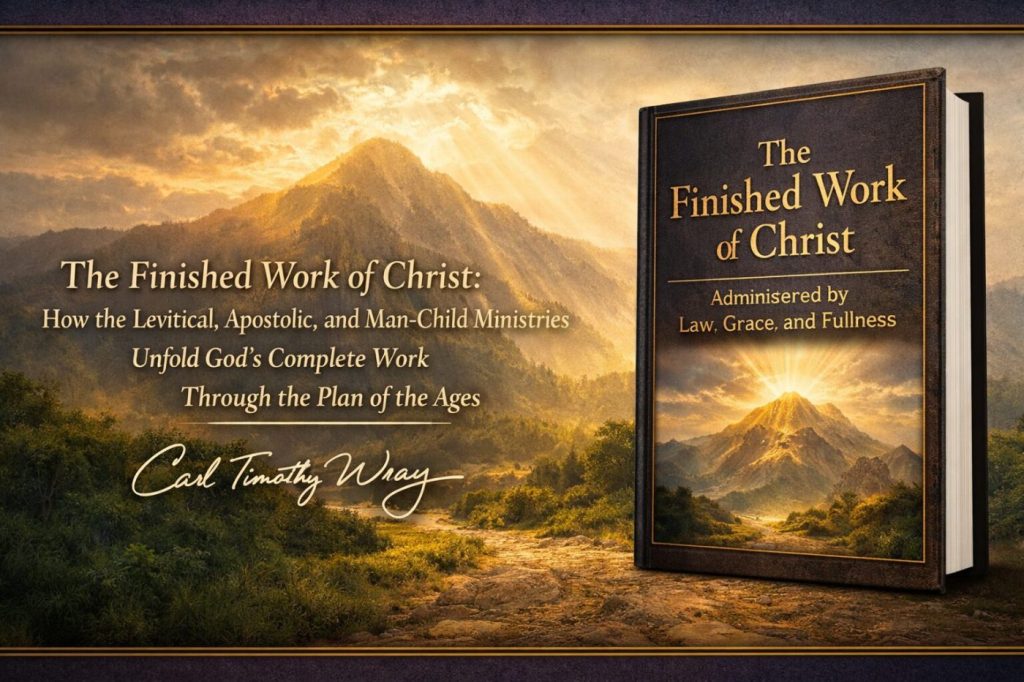
The Finished Work of Christ: How the Levitical, Apostolic, and Man-Child Ministries Unfold God’s Complete Work Through the Plan of the Ages
The Finished Work of Christ: AUTHOR
By Carl Timothy Wray
Carl Timothy Wray writes from a lifelong calling to unveil Scripture as one unified revelation governed by the Finished Work of Christ rather than divided by dispensations, traditions, or isolated doctrines. His ministry centers on restoring divine order to biblical understanding by revealing how God administers one completed work through the Plan of the Ages. With clarity, patience, and precision, Wray traces the progression from Law to Grace to Fullness, showing how Christ has always been the Minister of God’s eternal purpose until creation is brought into alignment and God becomes all in all.
INTRODUCTION
The Finished Work of Christ is not questioned in heaven.
What unfolds in time is not completion, but administration.
From eternity, God settled His purpose in Christ. Nothing was improvised, nothing revised, nothing left uncertain. Yet Scripture unfolds in ages, ministries, and measures—not because God’s work was incomplete, but because creation must be brought into alignment with what was already finished. This is the tension many believers feel but cannot articulate: How can a work be finished and still unfold?
The answer lies in divine order.
God has always administered one completed work through distinct ministries appointed to specific seasons. These ministries do not compete with one another, nor do they contradict the Finished Work of Christ. Each serves it—revealing, imparting, and preparing creation for greater expression. When this order is not understood, Scripture appears fragmented and ministry becomes confusing. When it is seen clearly, the Bible speaks with one voice.
This book reveals how the Finished Work of Christ is administered through three primary dimensions of ministry within the Plan of the Ages:
- Levitical Ministry — governing the age of Law, preparing the vessel through shadow, pattern, and discipline
- Apostolic Ministry — governing the age of Grace, unveiling the mystery, imparting life, and establishing the Church
- Man-Child Ministry — governing the age of Fullness, bringing manifestation, authority, and visible alignment with what has already been settled in God
These are not three works. They are not three gospels. They are not three competing revelations. They are three administrations of the same Finished Work of Christ, revealed progressively according to capacity.
Understanding this order resolves confusion surrounding Scripture, ministry, and spiritual growth. The Law is no longer seen as failure, but as preparation. Grace is no longer reduced to permission, but recognized as impartation. Fullness is no longer imagined as fantasy, but understood as the inevitable expression of Christ when divine order has done its work.
This book is written to stabilize, not sensationalize. It exists to bring clarity, not speculation. It is foundational by design, because foundations determine everything that can safely be built afterward. When the Finished Work of Christ is understood legally, administered through the Plan of the Ages, imparted vitally, unveiled by revelation, and expressed in fullness, Christ does not need promotion.
He appears.
This is the order by which God has always worked.
This is the pattern shown in the mount.
And this is the administration through which Zion is built.
The Finished Work of Christ — The Full Counsel Framework
This book is written from the understanding that the Finished Work of Christ was eternally settled in God’s counsel before time, legally accomplished through Christ, and progressively revealed within time through the Plan of the Ages.
Time is not where God decides — time is where God unveils.
Rather than viewing Scripture as fragmented covenants or competing dispensations, this work approaches the Bible as one unified revelation, unfolded through divine order until God becomes all in all.
Within this framework:
- Law revealed the standard and measure
- Grace imparted life and maturation
- Fullness manifests what was already complete
These are not eras in conflict, but dimensions of one divine mind.
The Levitical, Apostolic, and Man-Child ministries are therefore understood not as competing offices, but as ministries of revelation and maturation, each serving the unveiling of Christ’s completed work until His life is fully expressed in sons.
This book does not seek to add to what Christ finished, but to reveal what God settled, how it unfolds through Scripture, and how it is ultimately manifested in fullness God All in All.
CHAPTER 1
One Finished Work — Many Administrations
Before God ever spoke through Moses, before Paul ever wrote an epistle, and before John ever saw Revelation unfold, the Finished Work of Christ was already complete in the heart of God. Redemption was not discovered in time; it was settled in eternity. Scripture does not record God figuring out His will, but revealing what He already knew.
This is the first distinction that must be established:
completion and administration are not the same thing.
The Finished Work of Christ refers to what God accomplished in Christ as a single, unified reality. Administration refers to how that finished reality is unveiled, imparted, and expressed within creation according to divine order. Confusion enters when believers mistake administration for incompletion, or progression for contradiction.
God has never done more than one redemptive work.
But He has always revealed that one work in stages.
From Genesis onward, Scripture reveals that God governs His purpose through ages. These ages are not revisions of His plan; they are the orderly means by which His finished purpose is brought into visibility. Each age introduces a ministry appropriate to its measure, capacity, and assignment. The ministry does not define the work. The work defines the ministry.
This is why Scripture speaks of Law, Grace, and Fullness without contradiction.
The Law did not exist because Christ had not yet finished His work. It existed to prepare humanity for the revelation of that work. Grace did not appear because the Law failed, but because the time had come to unveil what the Law had been pointing toward. Fullness does not emerge because Grace was insufficient, but because imparted life must ultimately be expressed.
These are not replacements.
They are administrations.
When this is not understood, believers argue over which age is “right,” which ministry is “higher,” or which revelation is “final.” But when divine order is seen, every administration finds its place. The Law is honored without being returned to. Grace is cherished without being stalled in. Fullness is anticipated without being fantasized.
The Finished Work of Christ governs them all.
This chapter establishes the central truth upon which everything else in this book rests: God administers one completed work through many appointed ministries, each serving the same eternal purpose. Ministries differ not because Christ changes, but because creation is being prepared to receive Him more fully.
Until this distinction is settled, Scripture will appear fragmented and ministry will feel confusing. But once it is seen, the Bible speaks as one voice, and God’s work is understood as perfectly ordered rather than partially complete.
This is the foundation.
Everything that follows builds upon it.
In the next chapter, we will begin examining the first major administration of the Finished Work of Christ: the Levitical ministry, and how Law served not as an end, but as preparation for what was already finished in God.
CHAPTER 2
The Levitical Administration — Law as Divine Preparation
The Levitical ministry represents the first great administration of the Finished Work of Christ within the Plan of the Ages. It did not initiate redemption, and it did not complete it. Its assignment was preparation. God was not attempting to fix sin through the Law; He was preparing creation to recognize holiness, order, and the necessity of life beyond itself.
This distinction must be settled early:
the Law was never given to finish God’s work — it was given to prepare the vessel for it.
From the moment God brought Israel out of Egypt, He began teaching them how to see. Everything in the Levitical system was structured, measured, and patterned. The tabernacle, the priesthood, the sacrifices, the feasts, the garments — nothing was accidental. God was training humanity to think in terms of divine order, separation, and approach. The Law did not produce righteousness; it defined it. It did not impart life; it revealed the absence of it.
The Levitical administration governed an age where God’s presence was external. He dwelt among the people, but not within them. Access was limited. Mediation was required. Sacrifice was repeated. This was not because God desired distance, but because the vessel was not yet prepared for union. The Law restrained corruption while simultaneously pointing beyond itself.
Scripture calls the Law a shadow — and this is not a criticism.
A shadow is not false.
A shadow is cast by something real.
Every sacrifice pointed to a greater sacrifice. Every priest foreshadowed a greater Priest. Every veil testified that access was coming. The Levitical ministry was faithful precisely because it did not overreach its assignment. It did not promise what it could not deliver. Its glory was found in obedience, not fulfillment.
This is why the Law cannot be treated as failure — nor can it be revived as completion. When misunderstood, people either reject it entirely or attempt to return to it. Both errors arise from failing to see its place in the Finished Work of Christ. The Law was neither the problem nor the solution. It was the tutor, the guardian, the framework holding the promise in place until the appointed time.
The command repeated throughout the Law — “See that you make all things according to the pattern shown to you in the mount” — reveals the heart of this administration. God was teaching creation to build according to what was unseen. Before anything appeared on earth, it already existed in God’s counsel. The Levitical system trained humanity to honor the invisible even while living in the visible.
The Law did not bring rest.
It brought readiness.
By the time Grace appeared, humanity had been prepared to recognize sacrifice, priesthood, mediation, holiness, and covenant. The vessel had been formed. Expectation had been established. The Levitical administration had fulfilled its purpose — not by completing the work, but by preparing the way for its revelation.
In the next chapter, we will see how the Apostolic administration did not destroy this preparation, but fulfilled it — by unveiling the Finished Work of Christ and imparting the life the Law could only foreshadow.
CHAPTER 3
The Apostolic Administration — Grace as Revelation and Impartation
The Apostolic ministry marks the second great administration of the Finished Work of Christ within the Plan of the Ages. Where the Levitical administration prepared the vessel through shadow and pattern, the Apostolic administration unveiled the reality those shadows pointed toward. This was not the beginning of God’s work, but the revelation of what had already been settled.
Grace did not arrive because the Law failed.
Grace arrived because the time had come.
The Apostolic administration governs the age in which the Finished Work of Christ is revealed and imparted. What was external under the Law becomes internal through union. God no longer dwells merely among His people; He dwells within them. Righteousness is no longer defined only by commandment, but installed by life.
This is the great distinction of Grace.
Grace is not permission to remain unchanged.
Grace is the power to be transformed.
Through the Apostolic ministry, Christ is revealed not only as the sacrifice, but as the life. The cross is no longer seen merely as an altar; it is understood as the doorway into union. What the Law described, Grace delivers. What the Law demanded, Grace supplies. What the Law restrained, Grace overcomes by indwelling life.
This administration introduces revelation.
The apostles did not invent a new gospel. They unveiled the meaning of the old one. Paul speaks of the mystery hidden from ages and generations, now made manifest. That mystery was not a new plan, but a revealed plan — Christ in you, the hope of glory. The Apostolic ministry brings clarity to what the Law kept veiled.
Yet this revelation is not abstract. Grace is not merely teaching; it is impartation. The Apostolic ministry installs the life of Christ within the believer by the Spirit. Forgiveness is not only declared; it is accompanied by regeneration. Holiness is not only required; it is supplied through union. The believer does not strive to become righteous; they awaken to what has been given.
This is why Scripture speaks of believers as complete in Christ, even while acknowledging growth. Completion refers to source, not expression. The life is whole, but the vessel is still being aligned. Grace settles the legal question and begins the vital work.
However, the Apostolic administration is not the final expression of the Finished Work of Christ.
Grace reveals and imparts, but it does not yet fully manifest. The life of Christ dwells within, but creation does not yet see it openly. The Church is established, taught, and nourished, but the visible alignment of all things has not yet appeared. This does not mean Grace is lacking; it means Grace has an appointed role.
The Apostolic ministry governs the age of revelation and formation.
When Grace is misunderstood, believers either stop at forgiveness or attempt to force manifestation prematurely. Both errors arise from failing to see the next administration. Grace is not the end; it is the means by which the vessel is prepared for fullness.
The Apostolic administration fulfills the Law without abolishing its purpose. It establishes the Church without exhausting God’s intention. It imparts life without yet expressing that life in its final form.
In the next chapter, we will begin turning toward the third administration — the Man-Child ministry — where the Finished Work of Christ moves from indwelling reality to visible manifestation, and where what has been prepared and imparted is finally expressed in fullness.
CHAPTER 4
Why Grace Is Not the End — The Necessity of Fullness
One of the greatest misunderstandings in the Church has been the assumption that the Apostolic administration represents the final expression of God’s purpose. Because Grace reveals and imparts the Finished Work of Christ, many conclude that nothing further is required. Yet Scripture itself testifies that impartation is not the same as manifestation.
Grace installs life.
Fullness expresses life.
This distinction is vital. The Finished Work of Christ is complete in its source, but its expression within creation unfolds according to divine order. Grace does not negate this process; it initiates it. The indwelling Christ is not the conclusion of God’s purpose, but the means by which His purpose is brought forth.
Throughout Scripture, life always precedes visibility. Seed comes before fruit. Conception comes before birth. Formation comes before manifestation. The Apostolic administration establishes Christ within the believer, but it does not yet bring creation into visible alignment with that indwelling reality. Grace forms sons; it does not immediately reveal them.
This is why the New Testament speaks simultaneously of completion and expectation.
Believers are declared complete in Christ, yet urged toward maturity. They are seated with Him in heavenly places, yet groan with creation for manifestation. They possess the Spirit as a guarantee, yet await the revealing of what that guarantee promises. These are not contradictions — they are indicators of divine sequencing.
Grace, by design, creates hunger for fullness.
When this is not understood, believers either settle prematurely or strive anxiously. Some treat Grace as the final destination and grow passive. Others attempt to force manifestation through effort, imitation, or religious excitement. Both paths bypass patience, which Scripture identifies as the necessary companion of faith.
Faith receives what is finished.
Patience governs its appearing.
The Apostolic administration teaches believers how to live from a finished source without demanding premature visibility. It forms Christ within through teaching, fellowship, discipline, and growth. Yet Scripture consistently points beyond this stage toward a corporate revealing — not of gifts, offices, or movements, but of sons.
This is where many hesitate.
Fullness does not threaten Grace.
It completes its assignment.
Grace does not exist to suspend creation indefinitely in preparation. It exists to mature the vessel until manifestation is safe. God never reveals more than the vessel can bear, and He never manifests life before it is formed. The delay is not reluctance; it is wisdom.
This chapter establishes a necessary truth: if Grace were the final expression, Scripture would end with indwelling alone. Instead, it points toward something more — a visible alignment of creation with what has already been settled, revealed, and imparted.
The Finished Work of Christ demands fullness, not as an addition, but as an expression.
In the next chapter, we will begin defining that expression by examining the Man-Child administration — not as mysticism or elitism, but as the governmental manifestation of a life already perfected in source and matured through order.
CHAPTER 5
The Man-Child Administration — Fullness as Manifestation
The Man-Child ministry represents the third great administration of the Finished Work of Christ within the Plan of the Ages. It does not introduce a new revelation, nor does it add anything to what Christ has already accomplished. Its purpose is manifestation — the visible expression of what has been legally settled, revealed, and vitally imparted.
This administration answers a question Scripture itself raises:
If Christ dwells within, why does creation still groan?
The answer is not deficiency in the Finished Work, but timing in its expression.
The Man-Child ministry governs the age of fullness, where what has been formed inwardly is revealed outwardly. This is not individual ambition, spiritual hierarchy, or mystical elevation. It is the governmental appearing of maturity — Christ expressed through a prepared vessel without mixture, contradiction, or delay.
Where the Levitical administration trained creation to honor pattern, and the Apostolic administration installed life through union, the Man-Child administration brings alignment. It is the point where heaven’s settled reality is seen operating in earth without resistance.
This is why Scripture speaks of manifestation, not invention.
Nothing new is created here.
Nothing unfinished is completed here.
What appears has already been true.
The Man-Child is not defined by gifting, office, or role, but by measure. It is the ministry of full growth. As Scripture declares, “when that which is perfect is come, that which is in part shall be done away.” This does not diminish what came before; it fulfills it. Partial revelation gives way to complete expression. Preparation gives way to visibility.
This administration is governmental because it establishes order by nature, not by enforcement. Authority here does not come from appointment, charisma, or position, but from alignment with the Finished Work of Christ. Where alignment exists, dominion follows naturally.
This is why the Man-Child is never produced by effort.
It is not achieved.
It is not pursued.
It is revealed.
Just as birth follows gestation, manifestation follows maturity. Grace forms the life. Patience governs its growth. Fullness appears when formation is complete. Any attempt to bypass this order results in confusion, imitation, or collapse.
The Man-Child administration is therefore not separate from the Church — it is the Church brought to maturity. It is not elite — it is complete. It is not future fantasy — it is inevitable outcome.
This is the ministry Scripture connects to the revealing of the sons of God. Creation does not wait for more teaching, more gifting, or more structure. It waits for visibility — for what has been hidden within to stand forth without obstruction.
In this administration, the Finished Work of Christ is no longer debated, defended, or explained. It is seen.
In the next chapter, we will examine how these three administrations — Levitical, Apostolic, and Man-Child — do not compete or overlap, but function together in divine harmony under one Finished Work and one unified purpose.
CHAPTER 6
One Work, Three Administrations — No Competition, No Contradiction
Once the three administrations of the Finished Work of Christ are seen clearly, a vital truth must be established: they do not compete, overlap, or contradict one another. Confusion only arises when administrations are compared as rivals instead of understood as servants of one completed work.
There has never been more than one Finished Work of Christ.
There have only been different ways that one work has been administered.
The Levitical administration served by preparing the vessel through pattern and restraint. The Apostolic administration served by revealing and imparting life. The Man-Child administration serves by manifesting and governing what has been prepared and imparted. Each administration honors the others by fulfilling its own assignment without attempting to replace what came before or seize what comes after.
When this order is not understood, believers attempt to live in the wrong administration. Some try to revive the Law to produce righteousness. Others attempt to force manifestation while still requiring formation. Still others remain indefinitely in impartation, mistaking indwelling for completion. All three errors stem from the same root: failure to see administration as order, not hierarchy.
Later does not mean better.
Earlier does not mean inferior.
Each administration is perfect within its measure.
The Levitical ministry was perfect in preparing the vessel. The Apostolic ministry is perfect in imparting Christ’s life. The Man-Child ministry is perfect in expressing that life openly. Perfection here refers to faithfulness to assignment, not to finality of expression.
This is why Scripture speaks of “many administrations, but the same Lord.” Christ has always been the Minister behind every administration. He was present in the Law as shadow, present in Grace as life, and present in Fullness as manifestation. The ministry changes location, but the Minister never changes.
Understanding this harmony removes fear and rivalry from the body. No administration needs to defend itself. No ministry needs to assert superiority. Each simply serves the Finished Work according to its appointed place in the Plan of the Ages.
This also restores peace to Scripture.
Passages that once appeared contradictory now align. Statements about completion and expectation agree. Promises made under the Law are fulfilled through Grace and revealed in Fullness. Nothing is discarded. Everything is honored. Everything finds its place.
The Finished Work of Christ is not fragmented by time.
Time is the means by which it is revealed.
When believers see this, spiritual striving ceases. Faith rests. Patience governs. Growth becomes natural rather than forced. Creation moves steadily toward alignment rather than oscillating between extremes.
This chapter establishes the truth that must govern all further revelation: God administers one Finished Work through ordered ministries until His purpose is fully expressed. Any teaching, movement, or interpretation that violates this order will eventually collapse under its own weight.
In the next chapter, we will examine how faith and patience function within these administrations, and why Scripture declares that they are the necessary companions that carry a finished work safely into manifestation.
CHAPTER 7
Faith and Patience — How a Finished Work Enters Visibility
If the Finished Work of Christ is complete, and if God administers that work through ordered ministries, then one question naturally arises: How does what is finished in God become visible in creation without contradiction or delay? Scripture answers this question with two inseparable witnesses: faith and patience.
Faith receives.
Patience governs.
Faith is the means by which creation agrees with what God has already settled. Patience is the means by which creation is aligned with God’s timing. These two are not optional virtues; they are structural necessities. Without faith, the Finished Work cannot be received. Without patience, it cannot be manifested safely.
This is why Scripture never separates them.
Faith does not create the Finished Work. It receives it. Faith does not force manifestation. It rests in certainty. When faith is genuine, striving ceases because the outcome is already known. Faith sees the end from the beginning because God has already declared it.
Patience, however, protects faith from impatience.
Patience is not delay, reluctance, or passivity. Patience is alignment with divine order. It is the strength to remain steady while formation completes its work. Where faith says, “It is finished,” patience says, “Let it mature.”
Every administration of the Finished Work operates under this principle.
Under the Levitical administration, faith believed the promise while patience endured preparation. Under the Apostolic administration, faith receives the indwelling Christ while patience allows transformation to proceed. Under the Man-Child administration, faith stands fully persuaded while patience governs the timing of manifestation.
This is why Scripture says that the fruit of the Spirit includes both faith and long-suffering. These are not behavioral traits; they are expressions of Christ’s own life. Christ does not rush what is complete. He does not panic over time. He does not violate order to satisfy urgency.
When faith is isolated from patience, believers attempt to force outcomes. Revelation is rushed. Manifestation is imitated. Authority is assumed rather than expressed. When patience is isolated from faith, believers stagnate, waiting endlessly for what has already been given. Both distortions disappear when the two are held together.
Faith establishes certainty.
Patience establishes sequence.
This is how a finished work unfolds without contradiction. What is settled in God does not need to be hurried. It needs to be revealed in order. The ages exist not because God delayed, but because creation requires formation.
Faith anchors the believer in what is already true. Patience allows that truth to take shape, grow strong, and stand without collapse. Together, they ensure that manifestation is not premature and that fullness is not imagined.
This chapter establishes a governing truth: no administration of the Finished Work of Christ bypasses faith and patience. They are the carriers through which eternity enters time safely.
In the next chapter, we will examine how this ordered process moves creation from indwelling life to visible alignment, and why Scripture speaks of creation itself waiting for manifestation rather than more instruction.
CHAPTER 8
From Indwelling to Alignment — Why Creation Waits for Manifestation
Scripture does not say that creation waits for more teaching, more gifting, or more instruction. It says that creation waits for manifestation. This distinction is crucial. Teaching forms understanding. Gifting enables function. Instruction guides growth. But manifestation brings alignment — the visible agreement between heaven and earth.
The Apostolic administration establishes Christ within.
The Man-Child administration reveals Christ without.
Between these two lies a necessary transition: the movement from indwelling life to visible order.
Creation does not respond to intention alone. It responds to expression. While Christ dwelling within the believer is the greatest miracle of Grace, creation cannot yet “see” what remains hidden. The life must mature to the point where it governs outwardly what it already governs inwardly.
This is why Scripture speaks of creation groaning.
Creation is not groaning for redemption — that has already been secured. It is groaning for alignment. Disorder persists where maturity has not yet been revealed. Corruption remains where life has not yet taken visible form. The problem is not absence of Christ, but the concealment of His maturity.
This is the purpose of manifestation.
Manifestation does not add authority.
It reveals authority that already exists.
When Christ is fully expressed through a prepared vessel, alignment follows naturally. Chaos gives way to order. Resistance yields to rest. Government emerges not through force, but through presence. This is why the Man-Child administration is governmental by nature. It does not enforce righteousness; it establishes it by being aligned with the Finished Work.
This transition cannot be rushed.
Indwelling life must be formed before it can govern. The same Christ who indwells must be allowed to shape the soul, discipline the will, and order the affections. Anything revealed before formation is complete becomes imitation rather than manifestation. God never reveals what has not been prepared to stand.
This is why creation waits patiently.
Creation understands order even when believers do not. It recognizes authority that flows from alignment, not assertion. It responds to maturity, not declaration. When sons appear, creation responds — not because it is commanded, but because it recognizes its rightful head.
This chapter establishes why the Finished Work of Christ must pass through formation before manifestation. What is hidden within must be made whole before it can be made visible. Revelation without alignment produces noise. Alignment produces rest.
The Man-Child administration does not reveal new truth. It reveals settled truth made visible. It is the moment when creation sees what heaven has always known.
In the next chapter, we will examine how government flows naturally from maturity, and why authority in the kingdom of God is never seized, but always expressed.
CHAPTER 10
Unto God All in All — The Finished Work Fully Expressed
Every administration, every ministry, every age, and every measure has moved toward one unchanging destination. Scripture does not leave this end vague or symbolic. It names it plainly:
“That God may be all in all.”
This is not poetry.
It is purpose.
The Finished Work of Christ does not terminate at the cross, nor does it conclude with individual salvation, church growth, or even sonship alone. It culminates in God fully expressed in creation, without resistance, contradiction, or fragmentation. What was settled in eternity is revealed through the plan of the ages until nothing remains misaligned.
This is the end that governed the beginning.
The Finished Work Was Never Partial
From God’s perspective, the work was never incomplete. The Lamb was slain before the foundation of the world. Redemption was not God’s response to failure; it was the revelation of an eternal decision. Time exists not to complete God’s work, but to unveil it.
The problem has never been whether the work was finished.
The question has always been how creation would be brought into harmony with what was already finished.
This is why the Plan of the Ages exists.
One Work, Three Administrations
The Levitical administration revealed the standard.
The Apostolic administration imparted the life.
The Man-Child administration expresses the fullness.
Each did not replace the former — each fulfilled it.
- The Law revealed righteousness without imparting it.
- Grace imparted righteousness without fully expressing it.
- Fullness expresses righteousness as life made visible.
These are not competing ministries. They are progressive stewardships of one finished reality. God did not change His mind between ages. He revealed His mind in order.
Faith Receives — Patience Reveals
This entire movement unfolds through the principle Scripture calls faith and patience.
Faith receives what God has finished.
Patience governs the unveiling of what faith has received.
Impatience produces distortion.
Patience preserves order.
God never rushes manifestation because manifestation carries responsibility. Power without maturity destroys. Revelation without formation destabilizes. This is why the Man-Child does not appear suddenly as spectacle, but emerges steadily as maturity.
The harvest does not struggle to appear.
It ripens.
When Ministry Yields to Union
At the culmination of the ages, ministry does not dominate — it yields. Not because it failed, but because it succeeded. Mediation gives way to union. Instruction gives way to expression. Authority gives way to alignment.
God does not intend to rule creation forever through intermediaries.
He intends to fill creation with Himself.
This is not absorption.
It is participation.
Creation does not disappear into God; it is brought into agreement with God. Identity is not erased — it is fulfilled. Distinction remains, but contradiction ends.
God All in All Is the Gospel’s Destination
Any gospel that stops short of this end is incomplete.
Salvation without restoration is unfinished.
Forgiveness without transformation is partial.
Sonship without expression is immature.
The Finished Work of Christ reaches its visible completion when God fills all things through Christ, and Christ is expressed through a mature creation. This is not delay. This is design.
Nothing is missing.
Nothing is uncertain.
Nothing is threatened.
What God finished in eternity is being revealed in time — carefully, wisely, and irrevocably.
The Pattern Stands
This book began with the pattern shown in the mount.
It ends with the pattern revealed in creation.
Everything has been built according to design.
The Finished Work of Christ stands complete.
The administrations have served their purpose.
The foundation is secure.
The house is rising.
And the outcome is certain:
God will be all in all.
Nothing can stop it.
Nothing can reverse it.
Nothing can improve upon it.
What remains is not completion —
only manifestation.
The work is finished.
The order is established.
The life is appearing.
Foundation complete.

The Finished Work of Christ Series
- The Finished Work of Christ — God’s Full Counsel Revealed Through the Plan of the Ages
- The Finished Work of Christ — Built According to the Pattern
- The Finished Work of Christ — Jesus the Minister of the Ages
- Join Our Facebook Page