 📺
📺
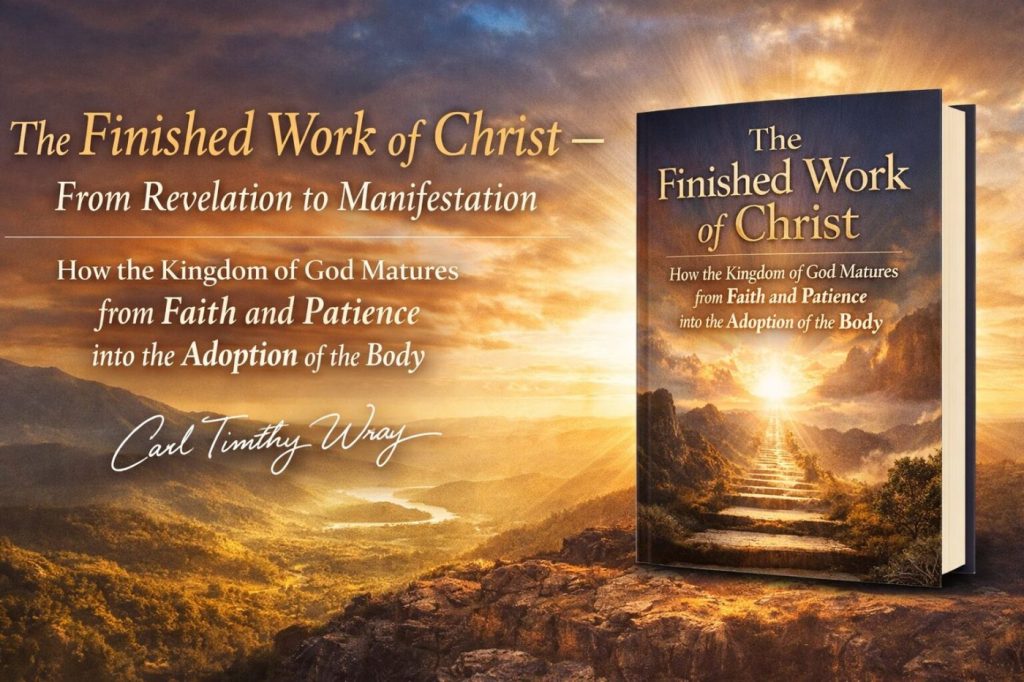
The Finished Work of Christ: How the Kingdom of God Matures from Faith and Patience into the Adoption of the Body
The Finished Work of Christ: AUTHOR
By Carl Timothy Wray
For over four decades, Carl Timothy Wray has labored to unveil the Finished Work of Christ from the full counsel of God—tracing what was eternally settled in heaven, revealed through the plan of the ages, imparted vitally by the Spirit, and destined to be manifested in fullness. His writings challenge fragmented theology and one-age thinking by restoring divine order, kingdom dimension, and true expectation. With clarity, patience, and reverence for Scripture, Wray presents the Gospel as God intended it: finished, revealed, and unfolding—until God is all in all.
The Finished Work of Christ: INTRODUCTION
Most confusion in the Church today does not come from a denial of the Finished Work of Christ—but from a misunderstanding of how that finished work is revealed and when it is manifested.
Jesus truly declared, “It is finished.”
Nothing was left unpaid. Nothing was left undone. Nothing remains to be added to the redemptive work accomplished by Christ. Before the foundation of the world, God had already settled His purpose, His plan, and His outcome. The cross did not originate redemption—it revealed what had been eternally complete in the heart of God.
Yet Scripture also testifies that what is finished in God is not manifested all at once in creation.
This is where many stumble.
The Church has been taught—often unintentionally—to equate revelation with manifestation, and possession with fullness. As a result, believers are left either striving to produce what God alone must manifest, or settling prematurely for partial expressions as though they were the final outcome.
This book exists to restore divine order.
The Kingdom of God is one Kingdom—but it is revealed and manifested in dimensions. Scripture consistently shows a maturation process: seed, blade, ear, and full ear; thirty-fold, sixty-fold, and one hundred-fold. Each dimension is real. Each is God-ordained. And each must be honored in its proper place.
The Church presently lives in a powerful and glorious dimension of the Kingdom—marked by faith, righteousness, indwelling life, gifts of the Spirit, and the tasting of the powers of the age to come. Yet the New Covenant itself testifies that creation still groans, believers still wait, and the adoption—the redemption of the body—remains ahead.
This does not diminish the Church.
It defines her purpose.
Revelation comes first.
Manifestation follows in God’s time.
Faith receives what is finished.
Patience governs the waiting.
And God Himself brings forth fullness—suddenly, sovereignly, and without human manufacture.
In these pages, we will carefully distinguish between what has been revealed and what is yet to be manifested, between indwelling life and embodied glory, and between the Church age and the fullness of the Kingdom. By restoring this clarity, false expectation gives way to true expectation, striving gives way to peace, and the people of God learn once again to follow the Lamb wherever He goes.
The Finished Work of Christ is not becoming true.
It is being revealed—until it is manifested.
When the Finished Work of Christ is understood through the full counsel of God, faith rests, patience governs, and the Kingdom of God is revealed—not as a future hope, but as a finished reality unfolding into manifestation.
The Finished Work of Christ — The Full Counsel Framework
This book is written from the understanding that the Finished Work of Christ was eternally settled in God’s counsel before time, legally accomplished through Christ, and progressively revealed within time through the Plan of the Ages.
Time is not where God decides — time is where God unveils.
Rather than viewing Scripture as fragmented covenants or competing dispensations, this work approaches the Bible as one unified revelation, unfolded through divine order until God becomes all in all.
Within this framework:
- Law revealed the standard and measure
- Grace imparted life and maturation
- Fullness manifests what was already complete
These are not eras in conflict, but dimensions of one divine mind.
The Levitical, Apostolic, and Man-Child ministries are therefore understood not as competing offices, but as ministries of revelation and maturation, each serving the unveiling of Christ’s completed work until His life is fully expressed in sons.
This book does not seek to add to what Christ finished, but to reveal what God settled, how it unfolds through Scripture, and how it is ultimately manifested in fullness God All in All.
Chapter 1 — Revelation Is Not Manifestation
One of the greatest sources of confusion in the modern Church is not unbelief—it is misplacement. Truths are believed, Scriptures are quoted, experiences are real, yet expectations are misaligned because revelation and manifestation have been treated as the same thing.
They are not.
The Finished Work of Christ is eternally complete. Nothing can be added to it, improved upon, or repeated. Yet Scripture consistently reveals that what is finished in God is revealed in stages and manifested in order. To confuse these stages is to misunderstand the nature of the Kingdom itself.
What Revelation Is
Revelation is the unveiling of what already exists in God.
When Jesus declared, “It is finished,” He was not initiating redemption—He was revealing it. The work had already been settled in eternity. The cross did not bring something into existence; it made visible what had always been true in God.
Revelation brings sight.
Revelation brings understanding.
Revelation brings assurance.
Through revelation, believers come to see:
- that righteousness is already theirs,
- that sin’s debt is already paid,
- that reconciliation is already accomplished,
- that life is already given.
Revelation changes how we see, how we believe, and how we rest. But revelation alone does not complete God’s purpose in creation.
What Manifestation Is
Manifestation is the embodiment of what has been revealed.
Scripture never teaches that revelation equals fulfillment. Instead, it teaches that revelation precedes fulfillment. What God reveals must still be manifested in His appointed order and time.
This distinction is everywhere in Scripture:
- The promise was revealed to Abraham long before it was manifested in Isaac.
- The inheritance was revealed to Israel long before it was possessed in the land.
- The Kingdom was revealed in Christ long before it was manifested in fullness.
- Life was revealed through the Spirit long before it is manifested in the body.
Manifestation is not mental agreement.
It is not spiritual awareness.
It is not ethical improvement.
Manifestation is reality expressed, not merely truth understood.
Why Confusion Entered
The Church has rightly emphasized revelation—faith, righteousness, grace, and indwelling life. But when revelation is treated as the final stage rather than a necessary stage, believers are left with two unhealthy outcomes:
- Striving — attempting to produce manifestation through effort, discipline, or zeal.
- Premature finality — assuming that what is currently experienced is the fullness God promised.
Both errors distort expectation.
Scripture never instructs believers to manifest the Kingdom. It instructs them to receive, walk, wait, and follow—until God manifests what He has already finished.
The Pattern God Established
God has always worked according to a pattern:
- Seed → blade → ear → full ear
- Thirty-fold → sixty-fold → one hundred-fold
- Promise → faith → patience → inheritance
At no point does Scripture allow the blade to claim it is the harvest, or the ear to claim it is the full ear. Each stage is real. Each stage is valuable. But only one is fullness.
Revelation belongs to the earlier stages.
Manifestation belongs to the final stage.
This is not delay.
This is order.
The Church’s Present Place
The Church lives in a glorious dimension of the Kingdom. Through the Spirit, believers have received life, righteousness, power, and authority. They have tasted the powers of the age to come. They walk by faith and are led by the Spirit of God.
Yet Scripture also declares—without contradiction—that:
- creation still groans,
- believers still groan,
- and the adoption, the redemption of the body, is still awaited.
This means the Church is not failing.
It means the Church is pregnant.
Revelation has come.
Manifestation is appointed.
Why This Distinction Matters
When revelation and manifestation are confused:
- expectation becomes false,
- patience collapses into frustration,
- faith is misused to demand what only time and God can bring.
But when the distinction is restored:
- faith rests,
- patience governs,
- peace reigns,
- and hope remains anchored.
The Finished Work of Christ does not need our help.
It needs our alignment.
Revelation allows us to see what is finished.
Manifestation will allow creation to experience it.
Until then, we walk by faith, governed by patience, following the Lamb wherever He goes—confident that what God has revealed, He will also manifest, in His time and in His way. The Finished Work of Christ was not completed in time but eternally settled in God, proving that redemption began in heaven long before it appeared on earth.
Chapter 2 — The Kingdom Has Dimensions
One of the most persistent errors in Christian theology is the belief that God works through disconnected ages that replace one another—one age ending so another can begin. This misunderstanding has produced confusion, contradiction, and false expectation throughout the Church.
Scripture does not reveal a Kingdom that operates in competing or canceling ages.
It reveals one Kingdom, unfolding in dimensions of maturity.
The Kingdom of God does not change.
What changes is how much of it is revealed and manifested.
One Kingdom, Revealed in Stages
From Genesis to Revelation, God consistently works through progression—not replacement.
Seed does not abolish harvest.
Promise does not abolish inheritance.
Revelation does not abolish manifestation.
Instead, each stage carries the same life forward until fullness is reached.
Jesus Himself taught this pattern when He said:
“So is the kingdom of God, as if a man should cast seed into the ground… first the blade, then the ear, after that the full corn in the ear.”
The Kingdom is not introduced at the blade, nor completed at the ear.
It is recognized in stages and fulfilled at maturity.
Thirty, Sixty, and One Hundredfold
Jesus also described the Kingdom in terms of harvest yield:
- thirty-fold
- sixty-fold
- one hundred-fold
These are not symbolic of different groups of people or levels of effort. They represent dimensions of the same life maturing.
- Thirty-fold reveals the Kingdom in promise and shadow
- Sixty-fold reveals the Kingdom in indwelling life and power
- One hundred-fold reveals the Kingdom in full manifestation
Each dimension is real.
Each dimension is God-ordained.
But only one is fullness.
Why Not Understanding the “Ages” Creates Confusion
When people hear “age,” they assume:
- one age ends,
- another begins,
- and the former is no longer relevant.
This leads to errors such as:
- dismissing the Law as meaningless,
- treating the Church as the final expression,
- postponing Kingdom fullness indefinitely.
Scripture never teaches that God abandons what He begins.
It teaches that He brings it to maturity.
The Law did not fail—it prepared.
The Church does not fail—it nurtures.
The Kingdom does not delay—it matures.
The Church Is a Dimension, Not the Destination
The Church occupies a glorious and necessary dimension of the Kingdom. Through the Spirit, believers receive life, righteousness, authority, and revelation. They are seated with Christ, walk by faith, and taste the powers of the age to come.
But tasting is not consuming.
Indwelling is not embodiment.
Revelation is not manifestation.
The Church is not the end of God’s purpose—it is the womb through which fullness is brought forth.
Scripture never presents the Church as the final state of creation. It presents the Church as a people:
- waiting,
- groaning,
- hoping,
- pressing,
- and expecting something yet to appear.
That “something” is not a new message.
It is the same Kingdom brought to fullness.
Why Fullness Has Not Yet Appeared
If the Kingdom is finished, why is it not fully manifested?
Because God governs manifestation by order, not impatience.
Everything God finishes in eternity is:
- Revealed in time
- Imparted by the Spirit
- Manifested in fullness at the appointed season
The seed must pass through the blade and the ear before the full ear appears. Attempting to harvest early does not speed the process—it destroys it.
This is why Scripture speaks of:
- faith receiving,
- patience governing,
- and hope anchoring the soul.
Why This Understanding Brings Peace
When believers understand Kingdom dimensions:
- they stop striving,
- they stop forcing outcomes,
- they stop measuring fullness by experience alone.
They learn to honor the present without idolizing it.
The thirty-fold does not despise the sixty-fold.
The sixty-fold does not deny the hundred-fold.
And the hundred-fold does not invalidate what came before.
All belong to one Kingdom.
All serve one purpose.
All move toward one fullness.
The Direction of God Is Always Forward
God never moves backward.
He moves from promise to possession, from revelation to manifestation, from faith to sight.
The Kingdom of God is not stalled.
It is advancing according to divine order.
Understanding this frees the Church to stand confidently in its present calling—while remaining expectant, patient, and aligned with what is yet to be revealed in fullness.
The Kingdom has dimensions, not contradictions.
It has order, not confusion.
And it will be manifested—exactly as God intended—when the full ear appears.
The Finished Work of Christ is always revealed before it is manifested, because God unveils what is finished long before creation is prepared to embody it.
Chapter 3 — Faith Receives, Patience Governs, and Fullness Waits
Scripture never presents faith and patience as competing virtues. They are not alternatives to one another, nor are they sequential options a believer chooses between. Faith and patience function together—each governing a different realm of God’s purpose.
Faith receives what is finished.
Patience governs what is appointed.
Confusion enters when faith is asked to do what patience was designed to govern, or when patience is exercised without truth to anchor expectation.
Faith Receives What God Has Finished
Faith always operates in the realm of revelation.
When God reveals something as finished, faith does not negotiate, delay, or improve it. Faith simply receives it as true. This is why Scripture speaks of believers as already:
- justified,
- reconciled,
- sanctified in Christ,
- seated with Him in heavenly places.
Faith does not wait to receive righteousness.
Faith does not wait to receive life.
Faith does not wait to receive acceptance.
These are revealed realities, and faith receives them immediately because they are already settled in God.
This is where rest enters.
When faith is rightly anchored in the Finished Work of Christ, striving ceases. The believer no longer labors to become what God has already declared. Faith agrees with heaven.
But faith was never designed to govern time.
Why Faith Alone Cannot Govern Manifestation
Many believers become discouraged not because they lack faith, but because they have been taught to apply faith to what God has assigned to patience.
Faith cannot accelerate God’s order.
Faith cannot bypass maturation.
Faith cannot harvest what has not yet reached fullness.
Scripture never instructs believers to believe harder in order to manifest the Kingdom. Instead, it instructs them to believe truly and wait rightly.
This is why Hebrews speaks of those who:
“through faith and patience inherit the promises.”
Inheritance does not occur by faith alone.
It occurs when faith is joined to patience.
Patience Governs the Appointed Time
Patience is not delay caused by resistance.
Patience is alignment with divine timing.
Biblical patience is not passive resignation. It is confident endurance, rooted in certainty, not doubt. It waits—not because the promise is uncertain—but because the outcome is sure.
Patience governs:
- growth,
- maturation,
- embodiment,
- inheritance,
- manifestation.
Everything God finishes in eternity still unfolds in time according to His order. Patience does not question God’s ability; it honors His wisdom.
This is why Scripture speaks of:
- the long-suffering of God,
- the patience of the saints,
- and the hope that waits.
Hope does not wait because something might fail.
Hope waits because something must mature.
True Expectation vs. False Expectation
Here is where the greatest misunderstanding lies.
Faith and patience must be built on truth.
When faith is placed in something God never promised, patience becomes prolonged disappointment. This is not patience—it is false expectation.
False expectation is produced when:
- Scripture is fragmented,
- revelation is partial,
- and the full counsel of God is ignored.
People wait sincerely—but for something God never intended to give in that way or at that time.
True expectation, however, is different.
True expectation is born when:
- faith receives what is already revealed,
- patience governs what is still appointed,
- and understanding rests in the full counsel of God.
This kind of expectation produces peace, not frustration.
Why the Church Waits Without Failing
The Church does not wait because it lacks power.
It waits because fullness has an appointed season.
Scripture openly declares that:
- creation groans,
- believers groan,
- and the adoption—the redemption of the body—is awaited.
This waiting is not defeat.
It is alignment.
The Church lives in the tension between what has been revealed and what has not yet been manifested. That tension is not a flaw in God’s plan—it is the very structure of it.
Faith says, “It is finished.”
Patience says, “It will be manifested.”
Hope anchors both.
The Peace That Comes from Order
When faith and patience are rightly ordered:
- striving disappears,
- condemnation lifts,
- urgency gives way to peace,
- and believers learn to follow rather than force.
They stop trying to produce what only God can manifest.
They stop measuring fullness by experience alone.
They stop judging God by time.
Instead, they walk confidently in what has been revealed—while remaining patient for what is yet to appear.
Faith receives.
Patience governs.
And fullness waits—not in uncertainty, but in perfect assurance.
What God has finished, He will manifest.
Not by human effort.
Not by impatience.
But by divine order—at exactly the right time.
Faith does not create the Finished Work of Christ—it receives it, resting in what God has already accomplished rather than striving to produce what already exists.
Chapter 4 — Tasting the Powers of the Age to Come Without Confusing Them with Fullness
Scripture speaks plainly of believers who have “tasted the powers of the age to come.” This statement alone has produced both great hope and great confusion in the Church. Some have minimized it, fearing excess. Others have overextended it, assuming that tasting equals possession and that experience equals culmination.
Neither conclusion is faithful to the pattern of God.
To taste is real.
But to taste is not to consume.
And to taste is not to embody.
What “Tasting” Actually Means
The language of tasting is deliberate. Scripture does not say believers have entered the fullness of the age to come, nor that they have become what the age to come fully manifests. It says they have tasted.
Tasting is:
- genuine,
- experiential,
- undeniable,
- and limited.
A taste confirms reality without exhausting it. It assures the heart without completing the process. God allows tasting to awaken desire, not to conclude fulfillment.
This is why tasting never removes hunger.
It intensifies it.
Why the Powers Are Real—but Partial
The powers of the age to come are not imaginary, symbolic, or exaggerated. They are real operations of Kingdom life breaking into the present dimension.
These powers include:
- healing,
- deliverance,
- authority over darkness,
- revelation,
- transformation of the inner man,
- and resurrection life operating in measure.
Believers have witnessed these powers throughout history. They have laid hands on the sick and seen them recover. They have spoken with authority and watched darkness flee. They have seen lives raised from spiritual death into new creation life.
These experiences are authentic.
They are gifts of God.
They are not deception.
But Scripture never presents these manifestations as the full expression of the Kingdom.
They are previews, not conclusions.
Why Power Does Not Equal Fullness
Power can operate without embodiment.
Life can flow without being fully expressed.
Resurrection can be tasted without swallowing death entirely.
Jesus Himself demonstrated this order. He raised the dead, healed the sick, and walked in authority—yet even He submitted to death before resurrection swallowed it up completely.
The presence of power does not mean death has been abolished.
It means death has been challenged.
This is why Scripture speaks of:
- mortality still existing,
- corruption still present,
- and a final victory still ahead.
The Kingdom can operate within a mortal vessel without that vessel yet being transformed.
Why Experiences Must Be Interpreted by Order
Many believers have encountered genuine power and drawn incorrect conclusions—not because the experience was false, but because the interpretation lacked order.
When power is tasted without understanding dimension:
- some assume they have arrived,
- others assume nothing more exists,
- and many become disillusioned when fullness does not follow immediately.
Scripture never instructs believers to build theology from experience. It instructs them to interpret experience through the full counsel of God.
Experience confirms truth.
It does not define completion.
Why Miracles Do Not Cancel Waiting
Throughout Scripture, miraculous power often coexists with waiting.
Israel saw miracles in the wilderness—yet did not enter fullness immediately.
The disciples walked in power—yet still waited for the promise.
The Church moves in gifts—yet still groans for adoption.
Miracles are signs pointing forward.
They are not the destination.
They testify that the Kingdom is real, near, and advancing—but they also testify that something greater remains.
The Purpose of Tasting
God allows tasting for a reason.
Tasting:
- awakens hunger,
- anchors hope,
- confirms promise,
- and prepares vessels.
Tasting is God’s way of saying, “What you have seen is true—but it is not yet complete.”
The danger is not tasting.
The danger is settling.
Why Fullness Is Still Future
Scripture consistently locates fullness not in power displays, but in transformation of the body.
Until:
- mortality puts on immortality,
- corruption puts on incorruption,
- and death is swallowed up in life,
the Kingdom has not reached its full manifestation.
This does not diminish present experience.
It places it correctly.
Honoring the Present Without Idolizing It
The Church is not lacking power.
It is lacking clarity of order.
When tasting is honored without being idolized:
- gratitude replaces pride,
- patience replaces frustration,
- hope replaces disappointment.
Believers learn to rejoice in what God is doing now—without demanding that it be everything God will do.
They stop forcing fullness prematurely.
They stop measuring God by partial manifestation.
They stop confusing experience with inheritance.
They learn to walk faithfully in the present dimension—while remaining expectant for what lies ahead.
Tasting is God’s mercy.
Fullness is God’s appointment.
And the same God who allows the taste will bring the harvest—when the full ear appears.
Patience protects the Finished Work of Christ from religious haste, allowing God’s eternal purpose to mature in divine order through the plan of the ages.
Chapter 5 — The Adoption: Why the Redemption of the Body Defines Fullness
Scripture never leaves the definition of fullness vague. It does not locate fullness in power, experience, revelation, or even spiritual maturity alone. It places fullness unmistakably in one reality:
the redemption of the body.
Until this is understood, the Finished Work of Christ will always be interpreted partially—no matter how sincere the faith or how genuine the experience.
Adoption Is Not New Birth
One of the most common errors in Christian teaching is equating adoption with new birth. Scripture does not support this collapse.
New birth introduces life.
Adoption manifests inheritance.
New birth is inward.
Adoption is outward.
New birth belongs to the realm of revelation and indwelling.
Adoption belongs to the realm of manifestation and embodiment.
Paul makes this distinction unmistakably clear when he writes:
“We ourselves groan within ourselves, waiting for the adoption, to wit, the redemption of our body.”
If adoption were already complete, there would be nothing left to wait for. If adoption were merely spiritual awareness, there would be no groaning. The very language of waiting proves that something essential remains ahead.
Why the Body Matters
God never intended salvation to end with the spirit alone.
From the beginning, God’s purpose was always man fully expressed—spirit, soul, and body aligned with divine life. The fall fractured this unity. Redemption restores it—not in theory, but in reality.
If the Finished Work of Christ were complete in manifestation without bodily transformation:
- death would already be abolished,
- corruption would already be removed,
- and creation would no longer groan.
But Scripture testifies otherwise.
Death still operates.
Mortality still reigns.
Creation still waits.
This is not failure.
This is sequence.
Immortality Is the Language of Fullness
Scripture reserves a specific vocabulary for fullness, and that vocabulary is never ambiguous.
Fullness is described as:
- mortality swallowed up by life,
- corruption putting on incorruption,
- death being abolished,
- the last enemy destroyed.
These are not metaphors for improved behavior or deeper devotion. They describe ontological change—a transformation in the very condition of human existence.
Until this change occurs, the Kingdom—though present, active, and powerful—has not reached its full manifestation.
Why the Church Has Not Yet Experienced Adoption
The Church has received the Spirit of adoption, but not yet the adoption itself.
This distinction is vital.
The Spirit of adoption:
- assures sonship,
- confirms inheritance,
- produces intimacy,
- and anchors identity.
But the Spirit of adoption is also called an earnest—a guarantee, not the possession itself.
An earnest proves what is coming.
It does not replace what is coming.
The presence of the Spirit confirms that adoption will occur.
It does not mean it already has.
Why Paul Pressed Forward
Paul’s language only makes sense when adoption is future.
He speaks of:
- pressing toward the prize,
- not yet having attained,
- waiting for transformation,
- longing to be clothed upon.
These are not the words of a man uncertain of his salvation. They are the words of a man who understands order.
Paul had revelation.
Paul had power.
Paul had authority.
Yet Paul still waited.
Not because the Finished Work was incomplete—but because manifestation was appointed.
Creation Waits for What Adoption Produces
Scripture makes an astonishing statement:
“The whole creation waits for the manifestation of the sons of God.”
Creation does not wait for preaching.
Creation does not wait for gifts.
Creation does not wait for theology.
Creation waits for sons revealed—sons whose life is no longer confined to inward experience, but expressed in embodied reality.
This is why adoption is not personal alone.
It is cosmic.
When sons are manifested, creation is liberated—not by instruction, but by presence.
Why This Understanding Restores Peace
Many believers live in quiet frustration because they feel something more exists—but cannot articulate it. They sense fullness but cannot locate it. They taste power but still face decay.
Understanding adoption resolves this tension.
It explains why:
- faith can be strong and waiting still necessary,
- revelation can be clear and manifestation still future,
- the Kingdom can be present and fullness still ahead.
This understanding removes false guilt and misplaced urgency. It restores patience without diminishing hope.
The Finished Work Leads to Fullness
The Finished Work of Christ did not end with forgiveness.
It did not stop at indwelling life.
It does not terminate in the Church age.
It moves toward adoption.
It moves toward immortality.
It moves toward God being all in all.
What was settled in eternity will be manifested in creation—completely, visibly, and finally.
The redemption of the body is not an optional doctrine.
It is the definition of fullness.
Until that day, we walk by faith, governed by patience, rejoicing in what has been revealed—while waiting confidently for what must yet be manifested.
The Finished Work of Christ moves from legal settlement to vital experience as Christ’s life is imparted within, transforming doctrine into living reality.
Chapter 6 — The Church as Womb: Why Fullness Is Prepared, Not Forced
One of the greatest misunderstandings in the Church is the assumption that if something is finished in God, it must be immediately visible in creation. When manifestation does not follow revelation quickly, people conclude that something is wrong—with themselves, with others, or with God.
Scripture reveals something very different.
God does not rush what He intends to reveal fully.
He prepares what He plans to manifest.
The Church was never designed to be the final expression of the Kingdom. It was designed to be the womb through which fullness would come forth.
Why God Uses a Womb
A womb is not a place of inactivity.
It is a place of formation.
Life is present in a womb long before it is visible. Identity is established before appearance. Development happens in hiddenness, not display.
To mistake the womb for the birth is to misunderstand the process entirely.
The Church carries life.
The Church nurtures growth.
The Church protects what is forming.
But the Church does not define the final shape of what it carries.
Hiddenness Is Not Absence
Much frustration arises because believers equate visibility with reality. Scripture never does this.
Before David reigned, he was hidden.
Before Joseph ruled, he was concealed.
Before Christ was revealed, He grew in obscurity.
Hiddenness is not delay—it is design.
God forms His greatest works away from public pressure because premature exposure damages development. What is rushed is often malformed.
Why Forcing Fullness Produces Deformity
Throughout history, whenever the Church has attempted to force manifestation, it has produced imbalance.
Some force power without maturity.
Some force authority without embodiment.
Some force destiny without preparation.
The result is always the same:
- disappointment,
- excess,
- division,
- and collapse.
God does not respond to urgency.
He responds to alignment.
The womb cannot be hurried.
Birth happens when fullness is reached—not when impatience demands it.
Why the Church Must Remain a Place of Formation
The Church is uniquely equipped to prepare sons because it provides:
- nourishment through the Word,
- life through the Spirit,
- correction through love,
- and patience through hope.
These are not marks of failure.
They are marks of preparation.
If the Church were already the fullness, Scripture would not speak of waiting, groaning, or hope. The very presence of these elements proves that the Church is a transitional vessel, not the destination.
Why God Protects Fullness from Premature Revelation
God does not reveal fullness early to test patience—He withholds it to preserve integrity.
What is born before its time cannot survive.
What is exposed before it is formed cannot endure.
This is why Scripture speaks of:
- appointed times,
- seasons,
- and fullness of time.
God is never late.
He is exact.
Resting in the Womb Season
Understanding the Church as womb changes everything.
It removes:
- pressure to perform,
- anxiety about timing,
- and comparison with others.
Believers learn to value formation over display. They stop striving to prove something is happening and begin trusting what God is doing in secret.
They learn to rest—not because nothing is happening, but because everything necessary is happening.
The Birth Is Certain
A womb does not exist without a birth.
Preparation does not occur without purpose.
What God has finished in eternity will be born in creation. The womb does not question whether the child will come—it simply continues its work until the appointed moment.
The Church does not create fullness.
It carries it.
And when the time is right—without strain, without effort, without manufacture—what has been hidden will be revealed.
Not gradually.
Not symbolically.
But suddenly, fully, and unmistakably.
The Church as womb is not weakness.
It is wisdom.
Fullness is not forced.
It is prepared.
The Finished Work of Christ reveals a Kingdom that matures from seed to fullness, governed by God’s timing rather than man’s expectation.
Chapter 7 — The Firstfruit Company: Why Someone Must Go First
God has never brought fullness to creation all at once.
From Genesis to Revelation, His pattern is consistent: He begins with a firstfruit. Not because He favors a few—but because someone must go first so the many can follow.
This is not elitism.
This is order.
Why God Always Starts with Firstfruits
Firstfruits are not chosen because they are superior.
They are chosen because they are willing to mature early.
In every divine movement:
- one city is awakened before the nation,
- one voice cries before the crowd,
- one company steps forward before the harvest.
Firstfruits do not finish the work—they signal that the work has reached readiness.
They are proof that what God promised is no longer theoretical.
Christ Is the Pattern of All Firstfruits
Jesus Himself did not redeem humanity all at once. He entered history as the firstborn among many brethren.
His resurrection was not the end of death for all—it was the announcement that death had been defeated.
Paul does not say Christ rose so that others wouldn’t have to wait.
He says Christ rose as the firstfruits, guaranteeing that others would follow in order.
Order does not deny fulfillment.
Order secures it.
Why God Does Not Manifest Fullness Universally First
If fullness appeared everywhere at once, it would lack context, testimony, and preparation.
Firstfruits:
- demonstrate possibility,
- establish pattern,
- and create faith for the rest.
God never reveals something globally until it has been embodied locally.
Truth must walk before it multiplies.
The Firstfruit Company Is Not a Title—It Is a Responsibility
Those who go first do not escape process.
They endure more of it.
They face:
- misunderstanding,
- resistance,
- accusation,
- and isolation.
Not because they are wrong—but because they arrive early.
Early revelation always looks like error to those not yet prepared.
Why Firstfruits Are Often Misjudged
History proves this repeatedly:
- Joseph was accused before he ruled.
- David was hunted before he reigned.
- Christ was rejected before He was exalted.
The firstfruits carry tomorrow’s truth into today’s structure—and today’s structure is rarely ready.
But God does not ask firstfruits to convince the world.
He asks them to remain faithful.
The Difference Between Calling and Timing
Many believers stumble because they recognize the truth but misjudge the timing.
Truth revealed before capacity is developed produces offense.
Firstfruits are not just those who see—they are those who can carry what they see without demanding immediate acceptance.
They learn restraint, humility, patience, and love—not as virtues to earn approval, but as requirements for stewardship.
Why Firstfruits Make the Harvest Inevitable
Once firstfruits appear, the harvest is no longer a question—it is a certainty.
God does not reveal the beginning of something He does not intend to finish.
Firstfruits are heaven’s declaration:
“This is now possible.”
And creation responds—not instantly, but inevitably.
The Goal Is Never a Small Company
God is not building an exclusive group.
He is building a pathway.
The firstfruits open the door so others can walk through it without fear.
What begins with a few always ends with the many.
Why Firstfruits Must Walk in Love
Power without love frightens.
Authority without patience divides.
Firstfruits do not advance by force.
They advance by example.
They do not pressure others to follow.
They simply walk—and the path becomes visible.
From Firstfruit to Fullness
The firstfruits are not the end of the story.
They are the beginning of manifestation.
They carry the same life, the same Christ, the same fullness—only earlier.
What they walk in privately will one day be known publicly.
What they embody quietly will one day transform creation openly.
Not because they demanded it.
But because God finished it.
The Finished Work of Christ reaches beyond individual salvation into the manifestation of the sons of God, where creation itself is delivered into liberty.
Chapter 8 — Revelation Without Offense: Feeding Each According to Capacity
God never withholds truth—but He always measures how it is given.
The problem in the Church has never been revelation.
The problem has been capacity.
Truth released without regard for capacity does not mature—it wounds.
Why Jesus Did Not Say Everything at Once
Jesus carried the fullness of God—yet He did not teach the fullness immediately.
“I have many things to say to you, but you cannot bear them now.”
Not will not.
Not should not.
Cannot.
Capacity determines reception.
Revelation that outruns capacity produces confusion, fear, and resistance—not transformation.
Milk, Bread, and Meat Are Not Hierarchies—They Are Stages
Scripture never mocks milk.
Milk is necessary.
But milk is not permanent.
Milk sustains infancy.
Bread builds strength.
Meat develops maturity.
The tragedy is not that believers receive milk.
The tragedy is when they are kept there indefinitely.
God never intended one diet forever.
Why Offense Reveals Capacity
Offense is not a sign of falsehood—it is a sign of overload.
When truth presses beyond capacity, the soul reacts defensively.
That defense may look like:
- anger,
- mockery,
- dismissal,
- or accusation.
But underneath it is not rebellion—it is immaturity encountering depth too soon.
The Wisdom of Measured Revelation
God introduces truth progressively—not because truth changes, but because people do.
Revelation unfolds as:
- hearts soften,
- fear dissolves,
- identity stabilizes,
- and trust matures.
Truth that once offended will later feel obvious.
The same word rejected in one season becomes nourishment in another.
Why Revelation Must Be Given in Love
Truth delivered without love feels like exposure.
Truth delivered with love feels like invitation.
Jesus never forced revelation.
He walked it.
He let truth be seen before it was explained.
Love creates safety.
Safety increases capacity.
Capacity welcomes truth.
The Responsibility of the Revealer
Those who see ahead are not authorized to overfeed.
Revelation is not proven by how much you know—but by how wisely you serve.
Wisdom discerns:
- when to speak,
- when to wait,
- when to simplify,
- and when to remain silent.
Silence is not compromise.
Silence is often stewardship.
Why Truth Must Be Embodied Before It Is Explained
Truth carried in words alone invites argument.
Truth carried in life invites hunger.
When revelation is embodied:
- it becomes attractive,
- it becomes credible,
- it becomes transferable.
People may resist ideas—but they cannot ignore transformation.
How Jesus Protected His Revelation
Jesus often spoke in parables—not to confuse, but to filter.
Parables allow truth to enter according to readiness.
Those who were hungry leaned in.
Those who were threatened walked away.
The truth did not change—capacity determined outcome.
Why God Allows Partial Understanding
Partial understanding is not failure.
It is preparation.
God would rather truth land shallow and grow deep than land deep and be rejected entirely.
Growth requires patience—from God and from those who teach in His name.
Revelation That Heals Instead of Divides
True revelation does not divide the body—it orders it.
It recognizes difference in growth without assigning worth.
Everyone is included.
Everyone is growing.
Everyone is moving toward fullness.
At different speeds.
In different measures.
By the same Spirit.
From Revelation to Communion
The goal of revelation is not agreement—it is communion.
When truth is shared in love, patience, and humility, it becomes nourishment rather than contention.
And when nourishment is received, capacity expands.
That is how God feeds His people.
The Finished Work of Christ culminates in the adoption of the body, where redemption moves beyond spirit and soul into full embodied glory.
Chapter 9 — The Inner Witness: How Truth Confirms Itself from Within
Truth does not convince first.
Truth resonates.
Before the mind agrees, something deeper responds.
That response is the inner witness.
Why Truth Is Recognized Before It Is Understood
When truth arrives, it does not begin as logic—it begins as recognition.
Something inside says, “I’ve heard this before.”
Not because the words are familiar,
but because the source is.
Truth awakens memory—not information.
It reminds the spirit of what it already knows but has not yet articulated.
The Difference Between Persuasion and Witness
Persuasion works outward to inward.
Witness works inward to outward.
Persuasion pressures agreement.
Witness produces peace.
You can be persuaded and still unsettled.
You can be witnessed to and still have questions—yet remain at rest.
That rest is the signal.
“My Sheep Hear My Voice”
Jesus never said, “My sheep understand My voice.”
He said they hear it.
Hearing precedes comprehension.
The voice carries identity, tone, and origin—not just content.
Truth is recognized by likeness.
Why the Spirit Confirms What the Mind Cannot Yet Explain
The spirit perceives wholeness before the mind organizes it.
That is why revelation often arrives as:
- peace without explanation,
- certainty without argument,
- alignment without proof.
Later, understanding follows.
But witness comes first.
The Role of the Holy Spirit as Internal Teacher
The Spirit does not merely remind you of verses.
He reminds you of Christ.
He does not shout.
He does not argue.
He illuminates.
Truth becomes clear not because it is loud—but because it is light.
Light does not force itself—it reveals.
Why Arguments Rarely Produce Revelation
Arguments appeal to intellect.
Revelation appeals to identity.
You can win an argument and lose a person.
You can release truth and awaken a soul.
The inner witness does not respond to force—it responds to recognition.
How Falsehood Feels Different Than Truth
Falsehood may excite.
It may impress.
It may threaten.
But it never settles.
Truth settles—even when it disrupts.
Truth may confront—but it does not confuse.
Truth may challenge—but it does not fracture.
It brings coherence.
Why Some Truth Feels Uncomfortable—but Still True
Conviction and condemnation feel different.
Condemnation pushes you away from God.
Conviction draws you closer to Him.
Truth that exposes without rejecting is not accusation—it is invitation.
The inner witness knows the difference.
Growth Happens When Witness Becomes Understanding
What the spirit recognizes, the mind eventually organizes.
Revelation matures through:
- meditation,
- patience,
- experience,
- and time.
Truth does not need to be rushed—it needs to be lived.
Living truth stabilizes it.
Why Unity Comes from Witness, Not Uniformity
Unity is not agreement of language—it is agreement of source.
Believers may articulate truth differently,
but when the same Spirit witnesses, harmony emerges.
The inner witness produces fellowship—not sameness.
Truth That Needs Defense Is Still External
Truth that lives within does not need protection—it bears fruit.
Fruit proves the tree.
A living word defends itself by transformation.
From Inner Witness to Outer Expression
When truth is confirmed within:
- fear dissolves,
- striving ceases,
- rest emerges.
The believer stops chasing certainty and begins walking in it.
This is where faith becomes natural—not forced.
The Finished Work of Christ produces a firstfruit company who enter fullness early, not by effort, but by alignment with God’s eternal purpose.
Chapter 10 — From Witness to Walk: Living from What Is Finished
Truth does not end at recognition.
It begins there.
What the Spirit witnesses within must eventually become the way we walk.
This is the difference between knowing something is true
and living as if it is finished.
Why Many Believe—but Still Strive
Most believers do not struggle with belief.
They struggle with permission.
They believe Christ finished the work—
but they still live as if something remains to be proven.
Striving is not disbelief.
It is unfinished thinking.
When the inner witness has not yet governed the walk,
the believer keeps trying to become what they already are.
Living from the Work, Not Toward It
Religion lives toward completion.
Sonship lives from completion.
Religion says:
“When I improve, God will be pleased.”
The finished work says:
“Because God is pleased, transformation unfolds.”
One posture labors.
The other rests.
Rest Is Not Inactivity—it Is Alignment
Rest does not mean passivity.
It means effort is no longer self-generated.
The branch does not strive to bear fruit.
It abides—and fruit appears.
Rest is alignment with supply.
Faith Receives—Patience Walks It Out
Faith receives what is finished.
Patience governs how it unfolds in time.
Faith answers yes in the spirit.
Patience allows the answer to mature in life.
Trying to force manifestation is how believers fall out of rest
and back into works.
Why Time Does Not Threaten What Is Settled
Time does not undo eternal truth.
It reveals it.
Delays do not mean denial.
Process does not mean absence.
What is settled in heaven does not rush in earth.
The walk of faith trusts order, not urgency.
From Identity to Expression
Behavior does not create identity.
Identity produces behavior.
When believers attempt to behave their way into truth,
they exhaust themselves.
When identity is received, expression becomes natural.
You don’t try to be who you are.
You are, and life follows.
Why Obedience Changes After Revelation
Before revelation, obedience is duty.
After revelation, obedience is agreement.
The believer no longer asks,
“What must I do?”
They begin to ask,
“What aligns with who I am?”
This is maturity.
Walking Without Fear of Loss
When life is lived from a finished foundation:
- fear loses leverage,
- comparison fades,
- performance pressure dissolves.
You are no longer afraid of losing what you never earned.
Grace produces courage.
Fruit Is the Evidence of Finished Life
The finished work does not produce striving—it produces fruit:
- love without anxiety,
- peace without control,
- patience without resignation.
Fruit reveals life has found its source.
From Learning to Being
At some point, teaching must give way to embodiment.
Truth learned informs the mind.
Truth lived reshapes the person.
The gospel was never meant to be mastered.
It was meant to be inhabited.
God All in All Is the Destination
The finished work does not end with saved individuals.
It culminates in God fully expressed.
From eternity settled
to time revealed
to life manifested—
The destination is not effort perfected,
but union unveiled.
God all in all
is not achieved—it is revealed.
Closing Declaration
I do not walk to earn what was finished.
I walk to express what was given.
I rest because Christ completed the work.
I live because His life is now mine.
The Finished Work of Christ finds its final expression when God becomes all in all, not through destruction, but through complete reconciliation and manifested life.
By Carl Timothy Wray

The Finished Work of Christ Series:
- The Finished Work of Christ — Revelation Before Manifestation
- The Finished Work of Christ — Administered by Law, Grace, and Fullness
- The Finished Work of Christ — Built According to the Pattern
- Join Our Facebook Page