 📺
📺
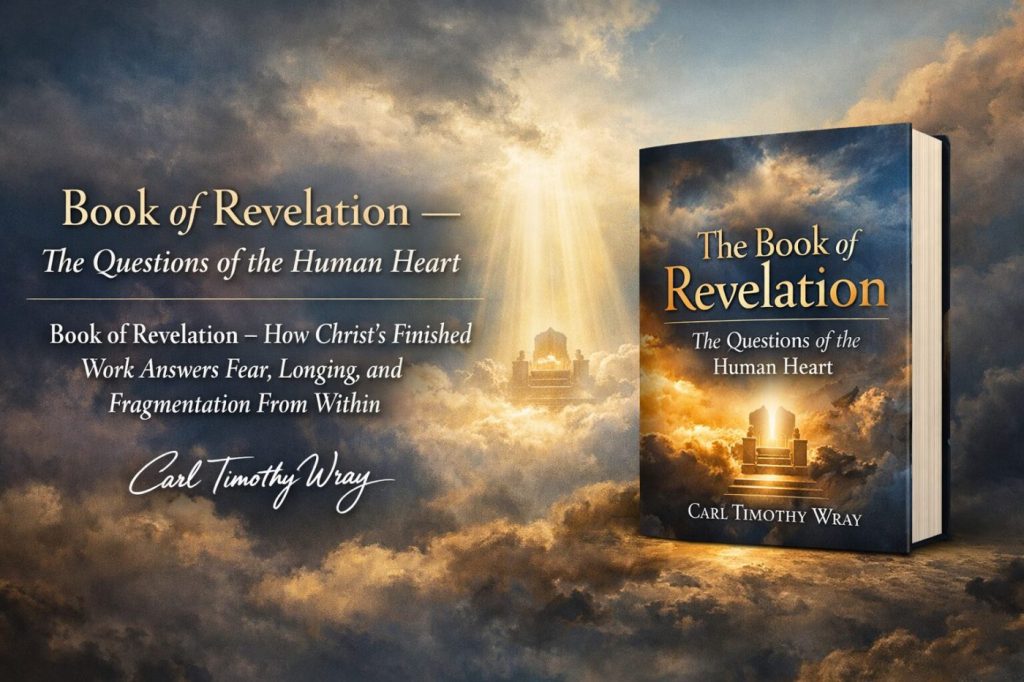
🧭 Book of Revelation — How Christ’s Finished Work Answers Fear, Longing, and Fragmentation From Within
✍️ Book of Revelation: Author
By Carl Timothy Wray
Carl Timothy Wray writes from a lifelong pursuit of seeing Scripture as one unified, finished, and coherent revelation rather than a fragmented collection of doctrines shaped by fear, delay, or speculation. His work centers on unveiling the Finished Work of Christ as the governing reality of all Scripture — eternally settled in God’s counsel, revealed through the Plan of the Ages, and manifested until God is all in all. With spiritual clarity and restorative precision, Wray presents the Book of Revelation not as a source of terror or escape, but as the healing administration of Christ’s completed victory within the human heart.
🔍
The Book of Revelation is often approached as a book of fear, timelines, and future catastrophe. But when read through Christ’s Finished Work and the Full Counsel of God, Revelation reveals itself as a deeply human book — answering fear, healing inner fragmentation, and fulfilling the deepest longings of the heart. This book presents Revelation not as a warning of doom, but as the unveiling of how a finished victory restores coherence, peace, and union from within, until God is all in all.
📘 Book of Revelation: INTRODUCTION
The Book of Revelation has long been treated as Scripture’s most intimidating book — a landscape of symbols, judgments, beasts, and cosmic upheaval that leaves readers either fearful, confused, or disengaged. For many, Revelation feels distant from everyday life, disconnected from the gospel of grace, and out of step with the declaration that Christ’s work is already finished.
Yet beneath every question asked about Revelation lies a deeper question asked by the human heart.
Why am I still afraid if Christ has already won?
Why does the world feel fractured if God is sovereign?
Why does Scripture feel disjointed instead of whole?
Why do I long for something I can’t quite name?
These are not academic questions. They are human ones.
Revelation does not ignore them.
It answers them.
The Book of Revelation is not primarily a book about future events — it is a book about present unveiling. The word “revelation” means unveiling, not destruction. It is the removal of coverings so that what was always true can finally be seen. When read through the Finished Work of Christ, Revelation reveals how what was eternally settled in God’s counsel is applied, administered, and manifested — not only in history, but within the human heart itself.
This book approaches Revelation from that inner vantage point.
Rather than asking, “What terrible things are coming?”
it asks, “What is being healed?”
Rather than framing judgment as punishment, it reveals judgment as truth restoring order.
Rather than portraying Christ as a distant figure returning to fix what failed, it unveils Christ as the One already reigning — drawing all things into coherence, peace, and union.
Revelation answers fear by unveiling sovereignty.
It heals fragmentation by restoring order.
It fulfills longing by revealing union.
This is not escapist theology.
It is participatory revelation.
The visions of seals, trumpets, vials, Babylon’s fall, Zion’s rise, the Man-Child, the Overcomers, and the New Jerusalem are not random symbols or future threats. They are divine operations — the progressive unveiling of how Christ’s finished work restores humanity and creation from the inside out.
The Book of Revelation does not end with believers leaving the world.
It ends with God dwelling within it.
And it does not begin with answers shouted from heaven.
It begins with questions arising from the heart — questions Christ Himself is eager to answer.
This book exists to trace those questions honestly, gently, and thoroughly — and to show how Revelation resolves them not through fear or speculation, but through the unveiling of a finished, victorious, and restorative Christ.
What follows is not a new interpretation of Revelation.
It is a return to its true purpose.
📖 Chapter 1
Why Am I Still Afraid If Christ Has Already Won?
Key Scripture
“Fear not; I am the first and the last: I am He that liveth, and was dead; and, behold, I am alive for evermore, Amen; and have the keys of hell and of death.”
— Revelation 1:17–18
Clear, Plain Explanation
One of the most common and unspoken questions behind every reading of the Book of Revelation is this:
If Jesus already won, why am I still afraid?
Many believers affirm Christ’s victory in doctrine, yet still experience anxiety, instability, and fear when reading Revelation. The imagery of seals, trumpets, beasts, judgment, and cosmic upheaval often feels at odds with the peace promised in the gospel.
This tension does not exist because Christ’s work is incomplete.
It exists because victory has not yet been fully unveiled to the heart.
The Book of Revelation opens not with warnings, timelines, or disasters, but with a revelation of who Jesus already is. Before any seal is opened, before any trumpet sounds, before any judgment is described, Christ reveals Himself as the One who has already overcome death and holds the keys of all authority.
Fear arises when events are interpreted without seeing who is governing them.
Revelation does not introduce uncertainty — it removes it.
The reason fear lingers is not because Christ is still fighting for victory, but because the human heart has not yet seen the fullness of what His victory means. Revelation was given to unveil that reality, not to threaten believers with what might happen next.
When fear is present, revelation is incomplete — not Christ.
Revelatory Unveiling
Fear is not the evidence of danger.
Fear is the evidence of distance from sight.
John does not fall at Jesus’ feet because the future is terrifying.
He falls because glory has been unveiled.
The first response to revelation is often fear — not because judgment is coming, but because illusion is leaving.
Fear survives where authority is misunderstood.
The Book of Revelation begins by dismantling the deepest falsehood in the human heart:
that something is still out of control.
When Christ says, “Fear not,” He does not say it as reassurance from uncertainty. He says it as a declaration from dominion. He does not promise to gain authority — He reveals that He already possesses it.
Fear exists where we imagine Christ reacting to history rather than governing it.
This is why Revelation must begin with the risen Christ in the midst of the lampstands. He is not distant. He is not waiting. He is not absent. He is present, reigning, walking among His people — addressing fear at its source.
Fear dissolves when revelation becomes personal.
The Lamb does not conquer by violence.
He conquers by unveiling truth until fear has nowhere left to stand.
Revelation does not threaten the fearful — it heals them.
Declaration
Christ is not approaching victory.
Christ is administering one.
Fear does not mean the end is near.
Fear means sight is still forming.
The Lamb stands — keys in hand — before a single seal is opened.
Call to Action
If fear still speaks louder than peace, the solution is not more preparation —
it is more unveiling.
Do not read Revelation looking for danger.
Read it looking for who is governing.
Let the Lamb be seen before the visions are interpreted.
The Book of Revelation does not begin with terror.
It begins with authority revealed.
📖 Chapter 2
Why Does Revelation Sound Violent If God Is Love?
Key Scripture
“For our God is a consuming fire.”
— Hebrews 12:29
“And the light shineth in darkness; and the darkness comprehended it not.”
— John 1:5
Clear, Plain Explanation
One of the most troubling tensions readers experience in the Book of Revelation is this:
If God is love, why does Revelation sound violent?
Fire. Wrath. Judgment. Plagues. Blood.
These images seem incompatible with the Jesus who forgave enemies, healed the broken, and laid down His life in love.
Many resolve this tension by dividing God into versions —
a loving Jesus in the Gospels and a severe God in Revelation.
But Scripture does not present two Gods.
It reveals one God seen from different angles of unveiling.
The violence people perceive in Revelation is not God attacking humanity — it is truth confronting deception. Revelation describes what happens when reality presses against systems built on lies. When light appears, darkness does not negotiate — it collapses.
Judgment in Revelation is not emotional rage.
It is order being restored.
Fire is not cruelty.
Fire is purification.
Revelation sounds violent only when it is read as punishment rather than correction, and as destruction rather than healing. The same fire that refines gold destroys chaff — not because fire hates chaff, but because chaff cannot survive what is real.
God’s love does not avoid judgment.
It expresses itself through it.
Revelatory Unveiling
Love is not passive.
Love confronts whatever destroys union.
What appears violent in Revelation is actually mercy refusing to coexist with illusion.
Wrath is not anger released —
it is truth applied.
The Lamb does not lose His gentleness when He judges.
Judgment is His gentleness aimed at restoration.
Babylon is not destroyed because God despises people.
Babylon falls because false systems cannot remain standing once truth is unveiled.
The reason Revelation feels severe is because lies feel safe until they are exposed.
Fire does not chase people — it consumes what people hide behind.
Judgment in Revelation is not God breaking things apart.
It is God separating what never belonged together.
This is why Revelation never shows God delighting in destruction. It shows heaven rejoicing when deception ends, when oppression collapses, when death loses its grip.
Love does not tolerate captivity.
Love dismantles it.
Revelation is not violence from heaven —
it is liberation arriving without apology.
Declaration
God’s love is not threatened by truth.
God’s love is truth.
What cannot survive love was never life.
Judgment does not end relationship.
It clears the way for it.
Call to Action
Do not fear the fire of Revelation.
Fear only what resists it.
Let judgment be seen for what it is —
love restoring order where chaos once ruled.
When love confronts illusion, something always falls.
But what falls was never you.
📖 Chapter 3
Why Does the World Still Feel Out of Control?
Key Scripture
“And I beheld, and, lo, in the midst of the throne… stood a Lamb as it had been slain.”
— Revelation 5:6
“The Lord reigneth; let the earth rejoice.”
— Psalm 97:1
Clear, Plain Explanation
Even after understanding that Christ has won and that judgment serves restoration, a deeper question remains:
If Christ reigns, why does the world still feel chaotic?
Wars continue. Systems collapse. Injustice persists. Nations rage. Creation groans. For many believers, this creates a quiet contradiction: Christ is said to be sovereign, yet history appears uncontrolled.
Revelation answers this question not by denying chaos, but by revealing where authority actually resides.
In Revelation 4 and 5, John is invited to see heaven’s perspective before he is shown earth’s turmoil. He does not see panic in heaven. He sees a throne — and a Lamb already standing in victory.
The chaos of the world is not evidence of God’s absence.
It is evidence that multiple systems are being judged and replaced.
Revelation shows that Christ reigns not by preventing all disorder instantly, but by governing history toward alignment. Authority does not always feel like control when it is dismantling what never belonged.
What feels like disorder is often transition.
The Lamb does not react to chaos.
Chaos reacts to the Lamb.
Revelatory Unveiling
Control is not the same as sovereignty.
Control suppresses symptoms.
Sovereignty transforms foundations.
The world feels out of control because it is being unseated.
Revelation reveals that Christ reigns by allowing systems built on fear, power, and illusion to expose themselves — and then collapse under the weight of truth. The throne in heaven does not tremble when the earth shakes.
The Lamb governs by patience, not panic.
When seals are opened, chaos is not released — exposure is. What was hidden is revealed. What was unstable is uncovered. What was false is allowed to show its limits.
This is why Revelation shows judgment proceeding in stages. Truth does not arrive as a shockwave; it arrives as an unveiling. The world is not spiraling — it is being clarified.
The feeling of disorder comes from watching lies lose their grip.
Christ’s authority is not proven by preventing shaking.
It is proven by remaining unmoved while everything else shakes.
Revelation does not show a God rushing to regain control.
It shows a Lamb calmly reigning while control itself is redefined.
Declaration
The throne has never been empty.
The Lamb has never been threatened.
What feels unstable is not God’s kingdom —
it is everything that cannot inherit it.
The world is not losing direction.
It is losing illusion.
Call to Action
Do not measure Christ’s reign by the noise of the earth.
Measure it by the calm of the throne.
Let Revelation reframe chaos as alignment in progress.
What is falling was never eternal.
What remains is being revealed.
📖 Chapter 4
Why Does Scripture Feel Fragmented Instead of Whole?
Key Scripture
“Having made known unto us the mystery of His will, according to His good pleasure which He hath purposed in Himself.”
— Ephesians 1:9
“All Scripture is given by inspiration of God.”
— 2 Timothy 3:16
Clear, Plain Explanation
Many believers do not struggle with Scripture because they reject it.
They struggle because it feels disconnected.
Law seems to conflict with grace.
Judgment appears to oppose mercy.
The Gospels feel gentle, while Revelation feels severe.
The Old Testament sounds different from the New.
This fragmentation does not arise from Scripture itself.
It arises from how Scripture is read.
When the Bible is approached as a collection of separate doctrines, competing dispensations, or isolated covenants, it inevitably feels fractured. But Scripture was never given as disconnected parts. It was given as one revelation, unfolded progressively.
Revelation does not introduce a new message at the end of the Bible.
It gathers every message into coherence.
The Book of Revelation functions like the final lens through which all Scripture is brought into focus. What appeared fragmented before is revealed as ordered. What seemed contradictory is shown to be progressive. What looked unfinished is unveiled as complete.
Fragmentation disappears when Scripture is read through completion rather than sequence.
Revelatory Unveiling
Fragmentation is not a biblical problem.
It is a vision problem.
Truth appears divided when it is viewed in pieces rather than purpose.
God never spoke in fragments.
He spoke in layers.
The Law was not cancelled by grace.
Grace fulfilled what the Law prepared.
The prophets were not guessing the future.
They were echoing eternity.
Revelation does not override earlier Scripture —
it harmonizes it.
This is why Revelation must be read backward as well as forward. It gathers Genesis, the prophets, the Psalms, the Gospels, and the Epistles into a single unveiling of Christ. What began in seed form is seen in fullness.
Fragmentation exists only when Christ is not seen as the center.
When Christ is revealed as the Finished Work — eternally settled, legally accomplished, vitally imparted, and progressively manifested — Scripture stops arguing with itself.
The Bible becomes one voice.
Revelation is the moment when the orchestra resolves into harmony.
Declaration
Scripture is not divided.
Sight is.
What looks fragmented is actually layered.
What feels unfinished is unfolding.
The Lamb does not contradict Himself.
He completes Himself.
Call to Action
Do not read Scripture as scattered pieces.
Read it as one unveiling.
Let Revelation gather what fear divided.
When Christ is seen as the Finished Work,
every page finds its place.
📖 Chapter 5
Why Do I Feel Divided Inside If I’m Redeemed?
Key Scripture
“For the flesh lusteth against the Spirit, and the Spirit against the flesh.”
— Galatians 5:17
“A double minded man is unstable in all his ways.”
— James 1:8
Clear, Plain Explanation
One of the most personal questions Revelation brings to the surface is this:
If I am redeemed, why do I still feel divided inside?
Many believers experience a deep internal tension — a sense of conflict between what they believe to be true and what they still feel, fear, or struggle with. This division is often interpreted as failure, hypocrisy, or incomplete salvation.
Revelation addresses this experience not by denying it, but by explaining it.
Redemption installs life.
Revelation unveils it.
The presence of division does not mean Christ’s work failed. It means the work is being revealed and applied. What was settled in Christ must still be brought into alignment within the human soul.
The Book of Revelation describes beasts, Babylon, false prophets, and internal wars not merely as external entities, but as patterns of consciousness that resist truth. These patterns do not disappear instantly when life is imparted. They are exposed progressively as truth rises.
Division exists where truth has entered, but illusion has not yet been removed.
Revelatory Unveiling
The war Revelation describes is not primarily fought in history —
it is fought in identity.
The beast represents distorted self-rule.
Babylon represents mixture — truth entangled with fear, power, and performance.
Double-mindedness is not moral failure.
It is unintegrated revelation.
Christ does not redeem half a person.
But He reveals wholeness in order.
This is why Revelation unfolds in cycles. Truth does not overwhelm the soul. It confronts it layer by layer. The inner division you feel is not resistance to Christ — it is Christ confronting what does not belong.
When the Lamb opens seals, He is not creating conflict.
He is revealing it so it can be resolved.
The divided self is not condemned in Revelation.
It is invited into coherence.
Overcoming is not striving harder.
It is allowing truth to unify what fear separated.
Declaration
Division is not your identity.
It is a signal of integration in progress.
What feels like inner war
is truth pressing toward wholeness.
The Lamb does not accuse the divided.
He heals them.
Call to Action
Do not condemn the tension you feel.
Let it be interpreted.
Revelation is not exposing you to shame you.
It is unveiling you to heal you.
Wholeness is not achieved by effort.
It is revealed by truth.
📖 Chapter 6
Why Does Revelation Seem Confusing Instead of Clarifying?
Key Scripture
“The revelation of Jesus Christ, which God gave unto Him, to shew unto His servants things which must shortly come to pass; and He sent and signified it…”
— Revelation 1:1
“I have yet many things to say unto you, but ye cannot bear them now.”
— John 16:12
Clear, Plain Explanation
Many readers approach the Book of Revelation expecting clarity — and instead encounter confusion.
Symbols repeat.
Visions cycle.
Scenes overlap.
Timelines seem to restart.
This leads to frustration and the assumption that Revelation is intentionally obscure or impossible to understand.
But Revelation was not given to confuse.
It was given to reveal.
The confusion arises when Revelation is read as a linear report instead of a progressive unveiling. Revelation does not move like a news broadcast. It moves like truth entering the human mind — patiently, symbolically, and repeatedly.
Repetition in Revelation is not redundancy.
It is reinforcement.
Cycles are not contradictions.
They are depth.
Revelation revisits the same realities — judgment, authority, resistance, victory — from multiple angles so that understanding can mature. What is confusing at first becomes clear through exposure, not explanation alone.
Truth does not arrive all at once.
It arrives as capacity allows.
Revelatory Unveiling
Confusion is not evidence of absence.
It is evidence of transition.
Revelation confuses the natural mind because it bypasses it.
The book is “signified” — spoken in signs — because signs speak to the heart before they speak to logic. Revelation is not coded to hide truth from believers; it is encoded to protect them from overload.
Understanding unfolds the same way healing does — in layers.
This is why Revelation circles rather than races. Each cycle presses the same truth deeper until resistance dissolves. What feels unclear is often truth dismantling false frameworks.
Confusion arises when the soul tries to master Revelation instead of letting Revelation master the soul.
Revelation is not asking to be solved.
It is asking to be seen.
When the Lamb opens understanding, confusion gives way to coherence — not suddenly, but surely.
Declaration
Revelation is not unclear.
Sight is still forming.
Truth does not hurry.
It heals.
What confuses the mind
is clarifying the heart.
Call to Action
Do not rush Revelation.
Let it work.
Return to the Lamb before returning to the symbols.
Clarity comes not by decoding signs,
but by yielding to unveiling.
📖 Chapter 7
What Am I Really Longing For Beneath All These Questions?
Key Scripture
“As the hart panteth after the water brooks, so panteth my soul after thee, O God.”
— Psalm 42:1
“Come unto Me, all ye that labour and are heavy laden, and I will give you rest.”
— Matthew 11:28
Clear, Plain Explanation
Beneath fear, confusion, and fragmentation lies something deeper:
Longing.
Many people approach the Book of Revelation with questions about judgment, timing, symbols, and outcomes. But these questions are rarely the root. They are expressions of a deeper ache — a desire for meaning, stability, belonging, and rest.
Revelation does not merely answer questions about the future.
It answers the longing of the human heart.
This longing is not sinful.
It is God-given.
The human heart longs for:
- coherence instead of chaos
- union instead of separation
- permanence instead of instability
- rest instead of striving
Revelation reveals that this longing is not pointing toward escape from the world, but toward fulfillment within it. The visions of a city, a bride, a kingdom, and God dwelling with humanity are not abstractions — they are answers to desire.
Revelation does not awaken longing.
It names it.
Revelatory Unveiling
Longing is not lack.
Longing is memory.
The soul longs because it has tasted origin.
Revelation unveils not a future wish, but a remembered destiny — God and humanity in union. Every image in Revelation is shaped around this pull: the Bride longing for the Bridegroom, creation groaning for release, humanity aching for home.
The heart is not asking for more information.
It is asking for integration.
This is why Revelation’s imagery is relational rather than mechanical. A city adorned as a bride. A throne with a Lamb. A river of life. A dwelling with God. These are not symbols of reward — they are symbols of restored belonging.
Longing persists until union is seen as inevitable.
Revelation does not postpone fulfillment.
It unveils the path toward it.
The questions fade when longing is recognized — not as something to suppress, but as something already being answered.
Declaration
Your longing is not misplaced.
It is prophetic.
What you ache for
is what Revelation reveals.
Rest is not ahead of you.
It is drawing you.
Call to Action
Do not silence your longing.
Let it be interpreted.
Revelation is not feeding curiosity —
it is fulfilling desire.
What you are searching for
has been searching for you.
📖 Chapter 8
Why Does Revelation Keep Pointing to a City, a Bride, and a Body?
Key Scripture
“And I John saw the holy city, new Jerusalem, coming down from God out of heaven, prepared as a bride adorned for her husband.”
— Revelation 21:2
“Now ye are the body of Christ, and members in particular.”
— 1 Corinthians 12:27
Clear, Plain Explanation
As readers move deeper into the Book of Revelation, a pattern becomes impossible to ignore.
The imagery keeps returning to:
- a city
- a bride
- a body
- a dwelling place
This repetition raises an important question:
Why does Revelation describe God’s purpose in relational and corporate images instead of abstract doctrines or individual rewards?
The answer is simple: Revelation is revealing union, not escape.
A city speaks of shared life, order, and belonging.
A bride speaks of love, intimacy, and covenant.
A body speaks of unity, coordination, and life flowing through many members.
These images are not separate ideas.
They are different angles of the same reality.
Revelation is not moving toward isolated believers receiving personal outcomes. It is moving toward God and humanity brought into visible, shared union. What began as longing now takes shape as community, identity, and habitation.
Revelation does not end with souls going to heaven.
It ends with heaven dwelling within humanity.
Revelatory Unveiling
God does not reveal Himself as an idea.
He reveals Himself as a dwelling.
The city is not architecture.
It is order.
The bride is not metaphorical romance.
It is union without fear.
The body is not organizational language.
It is life shared without separation.
Revelation reveals that God’s desire has always been corporate, not individualistic. From Eden to Zion, from tabernacle to temple, from Christ to His body, the movement has been the same: God making a home.
This is why Revelation’s final vision is not a throne alone in heaven, but a city filled with light — God dwelling with humanity, not ruling from distance.
The bride is not waiting to be rescued.
She is being prepared to contain glory.
The body is not waiting for instruction.
It is learning to express life.
Revelation’s repeated imagery is not redundancy — it is insistence. God will not settle for visitation. He intends habitation.
Union is the goal.
Participation is the method.
Love is the atmosphere.
Declaration
God is not building a place for you.
He is building with you.
You are not waiting for the city.
You are part of it.
Union is not symbolic.
It is inevitable.
Call to Action
Do not read Revelation as distant imagery.
See yourself within it.
The city is forming.
The bride is awakening.
The body is coming into coherence.
What God reveals,
He intends to inhabit.
📖 Chapter 9
Where Is Christ Appearing — In the Sky or Within His People?
Key Scripture
“Christ in you, the hope of glory.”
— Colossians 1:27
“Behold, He cometh with clouds; and every eye shall see Him.”
— Revelation 1:7
Clear, Plain Explanation
Few questions generate more confusion, fear, or debate than this one:
Is Christ appearing outwardly in the sky — or inwardly within His people?
Many readers assume these ideas must compete. Either Christ appears externally at the end of time, or He appears internally through spiritual growth. This false choice has fractured interpretation and created endless division.
Revelation does not force a choice.
It reveals order.
Christ’s appearing is not singular in expression, but progressive in revelation. Scripture consistently shows God revealing Himself first internally, then corporately, and finally openly. What is inwardly installed is outwardly manifested.
Christ does not appear instead of His people.
He appears through them.
Revelation begins with Christ walking among the lampstands — present, speaking, governing within the church. Only later does Revelation describe cosmic visibility. The order matters.
Revelation is not about Christ arriving to begin His reign.
It is about Christ being revealed as already reigning.
Revelatory Unveiling
Appearing is not arrival.
Appearing is visibility.
Christ has never been absent.
He has been unseen.
The clouds of Revelation are not meteorology.
They are witnesses, glory, and presence.
“Every eye shall see Him” does not describe distance being crossed — it describes veils being removed.
This is why Revelation places Christ’s appearing alongside the unveiling of His body. A head without a body cannot appear fully. Revelation does not climax with Christ acting alone, but with Christ revealed in many.
The appearing of the Lord is not escapism.
It is embodiment.
Christ rises first in revelation within His people, then in clarity through them, until the world itself sees what has been forming all along.
This is not delay.
It is maturation.
The appearing of Christ is the moment when inner reality becomes outer visibility — when what was believed becomes seen.
Declaration
Christ is not waiting to appear.
He is being revealed.
What is forming within
will not remain hidden.
The appearing of the Lord
is truth becoming undeniable.
Call to Action
Do not look outward for what is being formed inwardly.
Let Christ be revealed where He has already taken residence.
Revelation does not announce a distant arrival.
It unveils a present reign coming into view.
📖 Chapter 10
What Does It Mean for God to Be “All in All”?
Key Scripture
“Then cometh the end, when He shall have delivered up the kingdom to God, even the Father… that God may be all in all.”
— 1 Corinthians 15:24, 28
“Behold, the tabernacle of God is with men, and He will dwell with them.”
— Revelation 21:3
Clear, Plain Explanation
The Book of Revelation does not end with destruction.
It ends with rest.
The final phrase governing Revelation’s conclusion is simple, yet profound:
God all in all.
This does not mean God replaces creation.
It means God fills it.
Revelation culminates not in believers leaving the earth, but in God dwelling with humanity. There is no temple because God Himself is the dwelling. There is no night because nothing remains hidden. There is no separation because nothing resists union.
“All in all” describes completion — not annihilation.
Everything that began fragmented is gathered.
Everything that was partial is fulfilled.
Everything that resisted life is removed.
The end Revelation speaks of is not the end of existence, but the end of distance.
Revelatory Unveiling
“All in all” is not domination.
It is integration.
God does not conquer creation by force.
He fills it by presence.
This is the final answer to every question Revelation raises.
Fear ends because nothing is unknown.
Fragmentation ends because nothing is divided.
Longing ends because union is complete.
“All in all” means God is no longer approached —
He is inhabited.
The Lamb does not cease reigning.
He completes His reign by sharing it.
This is why Revelation ends with no more mediation. No veil. No distance. No temple. God is not visited. God is lived.
The human story resolves not in escape, but in indwelling.
God does not stand over creation.
He lives within it.
This is the rest the heart was always seeking.
Declaration
God does not finish by ending things.
He finishes by filling them.
What was begun in seed
ends in fullness.
The goal was never survival.
The goal was union.
Call to Action
Read Revelation from the end backward.
Let “God all in all” interpret every seal, trumpet, and judgment.
Nothing in Revelation exists to threaten you.
Everything exists to bring you home.
This is not the end of the world.
It is the end of separation.

Book of Revelation Series
- Book of Revelation
- The Finished Work of Christ: Meaning, Key Scriptures & FAQs
- The Finished Work of Christ — God’s Full Counsel Revealed Through the Plan of the Ages
- Book of Revelation: Explained Through the Full Counsel of God
- Book of Revelation — The Ten Questions Many Are Asking, Answered
- Join Our Facebook Page