 📺
📺
The Book of Revelation — Showing How a Completed Work Is Being Administered in Our Lives Day by Day
Book of Revelation: Author and Mission
“the living administration of a finished victory”
This book is written as part of a larger calling: to restore clarity to the Gospel by proclaiming the finished work of Christ, unveiling the Plan of the Ages, and bringing believers into the vital, lived reality of what Jesus is actively administering today.
Our mission is not to speculate about the future, but to testify to what God has already accomplished, how Christ is governing history now, and how the Kingdom of God is being revealed in real time until God becomes all in all.
The Book of Revelation is not a prediction of unfinished future events, but the unveiling of how Jesus Christ’s finished work is being administered through time. When read through the finished work of Christ, the Plan of the Ages, and the full counsel of God, Revelation reveals a living, active Kingdom governed by the Lamb. This book explains how a victory already accomplished at the cross is being applied day by day in the lives of believers, bringing heaven and earth into alignment and leading creation toward God all in all.
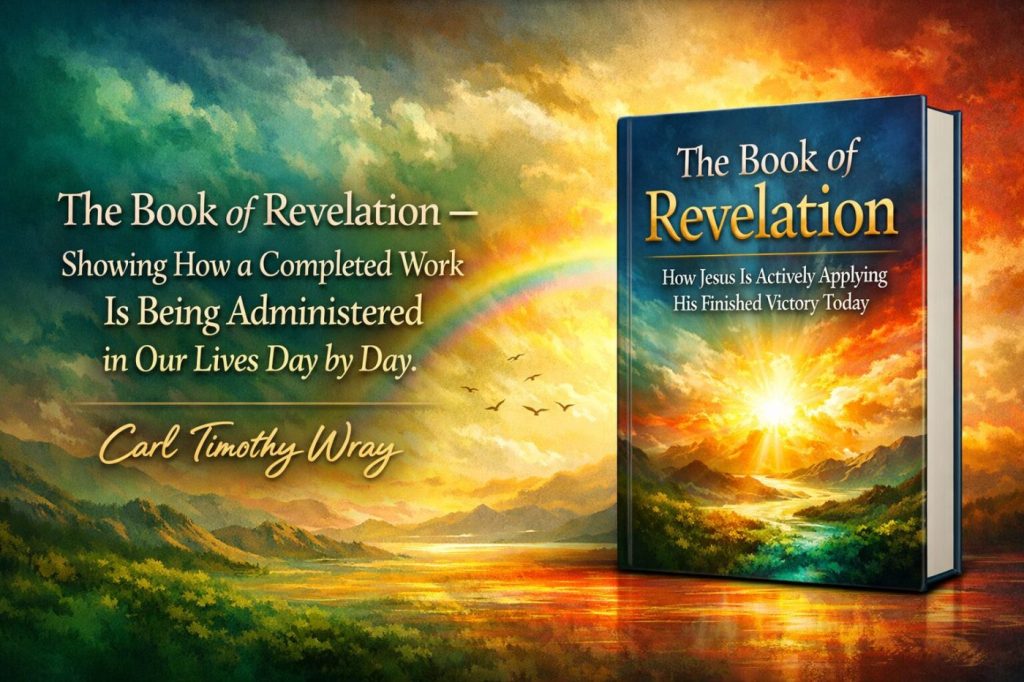
- Book of Revelation: New Book 2. Book of Revelation: Download PDF 3. Book of Revelation Series: 4. Book of Revelation Homepage
Book of Revelation: INTRODUCTION
The Book of Revelation has long been treated as a mysterious roadmap to the end of the world, filled with fear, speculation, and delay. Many have been taught to read it as a warning about what might happen someday, rather than a revelation of what Jesus Christ is doing now. As a result, Revelation has often been separated from daily life, pushed into the future, or confined to abstract interpretations that never touch the present moment.
But Revelation calls itself something very specific: the revelation of Jesus Christ. It is not primarily the revelation of events, symbols, or timelines — it is the unveiling of a Person. And that Person is not waiting to act. He is reigning.
Jesus did not leave the cross saying, “It will be finished.” He declared, “It is finished.” The victory was accomplished. Sin was judged. Death was defeated. Reconciliation was secured. What remained was not completion, but administration — the unfolding, application, and manifestation of that finished work through the Plan of the Ages.
This book is written to show that Revelation is the record of that administration. It reveals Jesus as the Lamb in the midst of the throne, actively governing history, shepherding His people, judging systems of darkness, and bringing His completed victory into lived experience. The Kingdom of God is not postponed, distant, or abstract — it is present, active, and alive.
As you read, you are not being invited to escape the world or decode hidden timelines. You are being invited to see where you already stand, to recognize the voice that is leading you now, and to follow the Lamb in real time. Revelation does not pull us out of life — it brings life under the rule of Christ.
This is not the final word. It is today’s bread. And it is given so that faith may live, rest may increase, and the Kingdom may be known — until God is all in all. This is the Book of Revelation revealed through the finished work of Christ and the living administration of His Kingdom.
Chapter 1 — Nothing Is Pending: The Victory Is Finished
The Book of Revelation does not begin with fear, confusion, or unfinished business. It begins with a declaration: this is the revelation of Jesus Christ. Before anything is said about seals, trumpets, beasts, or judgments, Scripture establishes the subject — a Person, not a prediction.
That matters.
Jesus Christ did not step out of history leaving loose ends behind. When He cried, “It is finished,” He was not announcing exhaustion or defeat. He was declaring completion. Sin was judged. Death was confronted. Reconciliation was secured. The legal work was done. Nothing remained undecided in the mind of God.
Revelation does not reopen the question of victory — it reveals how that victory is administered.
This is where many have been confused. They have read Revelation as if God were still trying to win a war, still reacting to chaos, still waiting for the right moment to act. But the book itself presents a very different picture. From the opening chapter, Jesus is shown as alive, glorified, and authoritative — walking among the churches, speaking with clarity, and holding the keys of death and the grave.
Keys mean access.
Keys mean authority.
Keys mean the matter is settled.
Nothing is pending.
Revelation does not show Jesus waiting for history to catch up. It shows Him governing history. The Lamb stands in the midst of the throne, not struggling to obtain power, but exercising it. The scroll is not sealed because something is missing — it is opened because Someone is worthy.
This establishes the legal foundation of everything that follows. Whatever unfolds in Revelation unfolds from a finished victory, not toward one. Judgment is not uncertainty; it is administration. Authority is not postponed; it is exercised. The Kingdom is not delayed; it is revealed.
For the believer, this changes everything.
If the victory is finished, then faith is no longer striving to achieve something God has not yet done. Faith becomes agreement with what is already true. Rest replaces anxiety. Direction replaces confusion. Revelation replaces speculation.
This is why Revelation begins with Jesus speaking to His people, not warning them to escape, but calling them to see, hear, and overcome. Overcoming does not mean winning the victory — it means living from it.
The finished work of Christ is the rock beneath the entire book. Remove it, and Revelation becomes fear-driven and chaotic. See it clearly, and Revelation becomes what it was always meant to be: the unveiling of a reigning Christ bringing His completed victory into expression.
Nothing is hanging in the balance.
Nothing is waiting on human performance.
Nothing is uncertain in heaven.
The work is finished.
The King is alive.
And the administration has already begun.
This is the Book of Revelation revealed through the finished work of Christ and the living administration of His Kingdom.
Chapter 2 — The Living Administrator in the Midst of His People
The Book of Revelation does not reveal Jesus as distant, silent, or removed from the lives of His people. It reveals Him present. The first vision John sees is not of global catastrophe or future destruction, but of a living Christ walking among the lampstands.
This is intentional.
Before Revelation speaks of seals, trumpets, or bowls, it shows us where Jesus is. He is not observing history from afar. He is not waiting for the right time to intervene. He is in the midst of His churches, actively speaking, correcting, strengthening, and governing.
This is administration.
Administration is not reaction. It is not emergency management. Administration flows from authority that already exists. Jesus does not walk among the churches asking permission or seeking validation. He speaks as One who knows their works, understands their condition, and has the authority to address them.
He holds the stars in His right hand.
He walks among the lampstands.
He speaks with eyes of fire and a voice like many waters.
This is not symbolism meant to terrify — it is revelation meant to clarify. The risen Christ is actively engaged with His people. He knows what is alive, what is dying, what must be strengthened, and what must be removed. Nothing escapes His awareness.
This is why Revelation cannot be read as a distant future book. The administration begins immediately. The first act of the reigning Christ is not judgment on the world, but government within His house. He speaks to the churches because the Kingdom of God is administered from the inside out.
Here we see the Plan of the Ages come into view.
A finished work does not mean inactivity. It means the work shifts from accomplishment to application. What was secured at the cross is now being applied through relationship, correction, endurance, and growth. Jesus administers His victory by forming a people who live in alignment with it.
This administration is personal.
He speaks differently to each church because each is at a different place in its journey. Some are faithful but weary. Some are alive in reputation but dead in reality. Some are enduring under pressure. Others have compromised. The Lord addresses each one precisely, not generically.
This reveals something essential: the Kingdom is not administered by formula, but by presence.
Jesus does not give the churches a timeline. He gives them Himself. He does not call them to escape tribulation. He calls them to overcome by remaining aligned with Him. The overcoming He speaks of is not heroic effort, but faithful participation in what He is already doing.
This is the living administration of the finished work.
The same Christ who finished the work at the cross now applies that victory through truth, light, correction, and endurance. He is not building something new; He is bringing what is finished into order. He is not reacting to chaos; He is removing it by the authority of His word.
For the believer, this brings Revelation into daily life.
If Jesus is administering His Kingdom now, then our lives are not interruptions to God’s plan — they are the place where His plan is being worked out. Faith becomes attentiveness. Obedience becomes alignment. Growth becomes cooperation with the living Christ who is present and active.
Revelation shows us that Jesus is not waiting for the end to rule. He is ruling now. He is not preparing to administer His Kingdom someday. He is administering it today.
And where He walks, light increases.
Where He speaks, order returns.
Where He governs, life emerges.
This is the Kingdom as living reality — not postponed, not abstract, but present and active — administered by the Lamb in the midst of His people.
Chapter 3 — The Plan of the Ages: A Finished Work Unfolding Through Time
When people hear the phrase Plan of the Ages, they often imagine a complicated timeline filled with uncertainty, pauses, and postponed promises. But Revelation does not present God as improvising His way through history. It reveals a plan that was settled before time, accomplished in Christ, and now unfolding with precision.
Time, in Revelation, is not a problem God is trying to manage.
Time is the arena in which a finished work is revealed.
This is where confusion has often entered. Many have assumed that if something unfolds through time, it must not yet be complete. But Scripture shows us something different. A work can be finished in purpose and still be revealed progressively. The cross completed the work. The ages reveal it.
Revelation gives language to this unfolding without ever suggesting uncertainty. The Lamb takes the scroll not to decide what will happen, but to open what has already been written. The seals do not create new outcomes — they unveil what was already contained within God’s counsel.
This is administration through time.
The Plan of the Ages is not God changing His mind. It is God revealing His mind. Each age, each movement, each unveiling serves the same finished purpose: to bring all things into alignment with Christ. Revelation gathers every previous age — Law, Prophets, Gospel, Church — and shows how they converge in a single governing truth.
Nothing is random.
Nothing is reactive.
Nothing is delayed.
Judgment, in this context, is not punishment for unpredictability; it is the removal of what cannot remain. As truth advances, lies lose their place. As light increases, darkness collapses. This is not chaos — it is order being restored.
The seals, trumpets, and bowls do not represent different plans or repeated failures. They reveal the same victory from different angles as it presses deeper into creation. What was accomplished legally is now applied historically. What was settled in heaven is now manifested in the earth.
This is why Revelation does not move in a straight line like a human schedule. It moves in layers. The same truth is shown again and again as it touches different realms — spiritual, social, personal, and cosmic. Each unveiling brings clarity, not confusion.
For the believer, this changes how time is understood.
We are not waiting for God to act. We are living inside an action that is already underway. Faith is not anticipation of a distant future; it is alignment with present administration. Hope is not escape; it is confidence that the plan cannot fail.
The Plan of the Ages assures us that nothing in our lives is wasted or out of place. Every season, every challenge, every growth is part of an unfolding that began before we were born and is moving steadily toward God’s ultimate intention.
Revelation shows us that history is not spiraling out of control — it is being shepherded. The Lamb who finished the work is the same Lamb who opens the scroll. He does not rush the ages, and He does not stall them. He reveals exactly what is needed, when it is needed, until everything reaches its appointed fullness.
This is why Revelation never calls believers to panic. It calls them to endure, see, and trust. The plan is intact. The victory is secure. The unfolding is intentional.
The work was finished in Christ.
The plan was set in eternity.
And the ages are faithfully revealing what God has already decided.
This is the Book of Revelation revealed through the finished work of Christ and the living administration of His Kingdom.
Chapter 4 — The Vital Realm: Where the Kingdom Is Lived Day by Day
If the finished work establishes what is true, and the Plan of the Ages explains how it unfolds, then the vital realm reveals where it is lived. Revelation does not leave the victory in heaven or suspend it in theory. It brings it into the daily experience of those who are led by the Spirit of God.
This is where Revelation becomes personal.
The Kingdom of God is not merely a decree issued from a throne; it is a life imparted, sustained, and matured. Jesus does not administer His finished work from a distance. He applies it within people — in hearts, minds, decisions, endurance, and growth. The vital realm is where the administration of the Kingdom becomes tangible.
This is why Revelation continually addresses those who have ears to hear. Hearing is not intellectual understanding alone; it is responsive life. The Spirit speaks, and life adjusts. Light comes, and alignment follows. Revelation is not received once and archived — it is received again and again as life unfolds.
The vital realm operates on daily bread.
Jesus taught His disciples to pray, “Give us this day our daily bread,” because life in the Kingdom is sustained by present provision, not stored revelation. What was finished does not need to be repeated, but it does need to be applied afresh. Revelation feeds the soul the same way bread feeds the body — regularly, simply, and faithfully.
This is why Revelation never calls believers to live in yesterday’s light or tomorrow’s anxiety. It brings them into the eternal now, where faith operates. Faith is not trying to make something happen; it is trusting what is already happening under Christ’s rule.
The vital realm also explains endurance.
To endure does not mean to survive until escape. It means to remain aligned while the Kingdom is being worked out. Revelation calls believers to overcome, not by force or effort, but by staying joined to the Lamb. Victory is not achieved through striving, but through participation in what Jesus is administering.
This is where the Kingdom becomes visible.
As the finished work is applied in real lives, character is formed, truth is established, and light increases. The Kingdom advances not through spectacle, but through transformation. Every act of obedience, every moment of trust, every adjustment to truth is evidence of the administration at work.
Revelation reveals that the vital realm is not secondary — it is essential. God is not merely resolving cosmic questions; He is forming a people. The Lamb is not only reconciling creation; He is shepherding sons and daughters into maturity.
This is why the book speaks repeatedly of overcoming, perseverance, and faithfulness. These are not requirements for earning victory; they are the expressions of a life rooted in a victory already won. The vital realm is where faith learns to rest, listen, and walk in step with the Spirit.
Here, the Kingdom breathes.
Here, heaven and earth meet.
Here, the finished work becomes lived reality.
Here, administration becomes experience.
Revelation shows us that the Kingdom of God is not waiting for us at the end of time — it is meeting us in the middle of life. And as the Lamb continues to administer His victory, the vital realm becomes the place where God’s purpose moves steadily toward its ultimate fulfillment.
Chapter 5 — Following the Lamb Wherever He Goes
Revelation does not portray the people of God as spectators watching history unfold from a safe distance. It describes a people who follow the Lamb wherever He goes. This is not poetic language meant to inspire admiration; it is a description of how the Kingdom is lived under active administration.
To follow the Lamb is to move with Him in real time.
The Lamb does not stand still. He leads. And His leading is not confined to heaven, nor postponed until the end of the age. He moves through history, through the churches, and through individual lives — guiding, correcting, strengthening, and bringing His finished victory into expression.
Following implies trust.
Following implies attentiveness.
Following implies alignment.
This is why Revelation places such emphasis on hearing His voice. Those who follow the Lamb are not guided by fear, speculation, or timelines. They are guided by relationship. They recognize His voice because they live near Him. Their eyes are fixed, not on events, but on the One who governs them.
This kind of following removes distraction.
When eyes remain on the Lamb, the chaos of the world loses its power to confuse. When attention stays fixed on Him, the future no longer feels threatening. The Lamb is not reacting to darkness; He is leading His people through it with authority and purpose.
Following the Lamb also explains overcoming.
Overcomers are not those who conquer circumstances by force. They are those who refuse to be separated from the Lamb’s leadership. They overcome by remaining aligned with truth while the Kingdom advances. Their victory is not independent — it is shared. They overcome because they are joined to the One who already has.
This is why Revelation says they overcome by the blood of the Lamb and by the word of their testimony. The blood speaks of what is finished. The testimony speaks of how that finished work is lived. Following the Lamb unites both — settled truth and present obedience.
The Lamb’s path is not always comfortable, but it is always purposeful.
He leads His people through correction, endurance, and growth — not to delay fulfillment, but to prepare capacity. The administration of the Kingdom shapes hearts before it reshapes the world. Those who follow learn discernment, patience, and faith not as religious disciplines, but as expressions of trust.
Revelation shows us that following the Lamb keeps life clear.
There is no need to chase revelation, predict outcomes, or control results. The Lamb sets the pace. He reveals what is needed when it is needed. Those who follow are not anxious about missing something — they know that staying near Him keeps them aligned with everything that matters.
This is how the Kingdom advances without confusion.
The Lamb moves.
The people follow.
The victory unfolds.
Revelation presents this not as a future ideal, but as a present reality. Following the Lamb is how the finished victory becomes visible in time. It is how heaven and earth remain connected. It is how God’s purpose continues its steady movement toward fullness.
To follow the Lamb wherever He goes is to live in the flow of divine administration. It is to trust that the One who finished the work is also faithful to lead it into manifestation.
And as long as eyes remain fixed on Him, the path remains clear.
This is the Book of Revelation revealed through the finished work of Christ and the living administration of His Kingdom.
Chapter 6 — The Kingdom Filling All Things
Revelation does not move toward collapse; it moves toward fullness. The direction of the book is not loss, but completion. As the Lamb continues to administer His finished victory, the result is not fragmentation, but the steady filling of all things with the life and rule of God.
This is where many readings of Revelation have missed the heart of the matter.
They have focused on what is being shaken without seeing why it is being shaken. They have emphasized removal without recognizing what is being revealed. But Scripture is clear: whatever cannot remain is removed so that what can remain may stand. Judgment serves life. Administration serves restoration.
The Kingdom of God advances by displacement, not destruction.
As Christ’s authority is applied, darkness loses ground. As truth increases, deception collapses. As life is revealed, death is swallowed up. This is not violence; it is order asserting itself. The Kingdom fills all things not by force, but by presence.
Revelation shows heaven and earth moving toward harmony.
This does not mean heaven replaces earth, nor that earth is discarded. It means the separation between the two dissolves. What was once unseen becomes visible. What was once spiritual becomes embodied. The reign of Christ brings alignment, not escape.
This is why Revelation speaks of the New Jerusalem coming down, not souls going up. God’s dwelling is not removed from creation — it is established within it. The administration of the Kingdom does not abandon the world; it heals it.
The Lamb’s victory is comprehensive.
It does not stop with individuals, though it begins there. It extends into communities, systems, and creation itself. Revelation portrays a Kingdom that touches every realm — spiritual, social, historical, and cosmic — until nothing remains untouched by the life of God.
This is the natural outcome of a finished work being faithfully administered.
What began at the cross moves through time until it fills space. What was secured legally unfolds historically. What was revealed spiritually becomes visible corporately. The Kingdom does not arrive suddenly as an interruption; it grows steadily as an administration.
For believers, this brings confidence.
We are not laboring toward an uncertain end. We are participating in a movement that cannot fail. Every act of faith, every moment of alignment, every expression of love contributes to the visible advance of the Kingdom. Nothing done in Christ is wasted.
Revelation assures us that God’s purpose is not partial.
The Lamb does not stop halfway. He does not abandon creation once salvation is secured. He continues until the work reaches its intended fullness. The Kingdom fills all things because the One administering it is faithful, patient, and complete.
This is why Revelation ends where it does — not in fear, but in vision.
A reconciled world.
A healed creation.
A dwelling place prepared.
A people formed.
The Kingdom of God is not an interruption in history. It is the meaning of history. And as the Lamb continues to administer His finished victory, the Kingdom expands until heaven and earth are no longer divided.
What was once hidden becomes known.
What was once broken becomes whole.
What was once separated becomes one.
The Kingdom fills all things — because the Lamb reigns.
Chapter 7 — God All in All: The Open Fulfillment
The Book of Revelation does not end with exhaustion or escape. It ends with fullness. The final vision is not of God withdrawing from creation, but of God dwelling within it. What began as a finished work at the cross unfolds through administration until it reaches its intended expression: God all in all.
This phrase does not describe a distant future detached from the present. It names the direction of everything God is doing now. Revelation shows us the steady movement toward a reality where nothing remains outside the life, light, and love of God. The Lamb who finished the work continues to administer it until every separation dissolves.
God all in all is not the disappearance of creation — it is its healing.
Revelation’s closing vision reveals a city, not an evacuation. A dwelling, not a delay. God does not abandon what He made; He fills it. Heaven does not replace earth; it unites with it. The administration of the Kingdom culminates in communion, not conquest.
This is why the book ends with God dwelling among humanity.
No veil.
No distance.
No mediation through shadow.
The work of administration reaches maturity when God’s presence is no longer interrupted by fear, deception, or death. What was once administered through correction and endurance now rests in harmony. The Lamb’s leadership has accomplished its purpose — not by force, but by faithfulness.
God all in all is the fruit of a finished victory faithfully applied.
Everything that could not remain has been removed.
Everything that belongs has been restored.
Everything that was broken has been healed.
This is not a moment where God suddenly acts differently. It is the natural outcome of the same administration that began the moment Jesus declared, “It is finished.” Revelation simply allows us to see where that administration is going.
For the believer, this brings peace.
We are not striving toward an unknown end. We are walking inside a purpose that is already decided. Our lives are not interruptions in God’s plan; they are the places where His plan is taking shape. Every step of obedience, every moment of trust, every act of love participates in a movement that leads toward fullness.
God all in all does not cancel daily life — it gives it meaning.
The daily bread we receive now is not disconnected from the ultimate fulfillment. Each day of faith is a seed of the coming fullness. Each act of alignment is a sign of where creation is headed. Revelation teaches us to live today in light of what God is bringing forth.
This is why the book does not close with fear, but with invitation.
“Come.”
“Drink freely.”
“Behold.”
The Spirit and the bride speak together because the administration has accomplished its aim — a people formed, a dwelling prepared, a creation restored. God all in all is not an ending to wait for; it is a reality unfolding, drawing everything into harmony under Christ. This is the Book of Revelation revealed through the finished work of Christ and the living administration of His Kingdom.
The Lamb reigns.
The work is finished.
The administration continues.
And the fullness is sure.
This is the revelation of Jesus Christ — not only what He has done, but what He is faithfully bringing to pass until God is all in all.
Book of Revelation By Carl Timothy Wray

Book of Revelation Series
- Book of Revelation
- The Finished Work of Christ — God’s Full Counsel Revealed Through the Plan of the Ages
- The Finished Work of Christ: Meaning, Key Scriptures & FAQs
- The Book of Revelation — The Administration of a Finished Work
- The Book of Revelation — Built on Three Realms: Legal, the Plan of the Ages, and the Vital
- Book of Revelation — Built According to the Pattern: Legal, the Plan of the Ages, and Vital
- Join Our Facebook Page: