
The Throne of God: How Christ’s Finished Work Governs Creation Through Grace, Judgment, and Life
The Throne of God: AUTHOR
The Throne of God is not a distant symbol of future judgment—it is the present center of divine authority governing all creation through Christ’s finished work. In the Book of Revelation, the throne is revealed as the single seat from which grace, judgment, and life flow together as one unified administration. This book unveils how the reign of Christ is exercised not through separation or delay, but through indwelling life, righteous order, and the ongoing flow of the Spirit.
Drawing directly from the testimony of Revelation, this work reveals the Throne of God and of the Lamb as the operational heart of the new creation. From this throne proceeds the River of Life, healing the nations, judging what opposes life, and administering God’s purposes in perfect harmony. Written for those seeking clarity beyond religious confusion, this book establishes the throne as the governing center of Christ’s victory—where authority is settled, life is dispensed, and creation is brought into divine order.
The Throne of God and of the Lamb in the Book of Revelation is the present center of divine authority, established through Christ’s finished work. From this single throne flow grace, judgment, and life as one unified administration governing heaven and earth. The River of Life proceeds from the throne, revealing how Christ reigns—not from distance, but through indwelling life—bringing healing to the nations and order to the new creation. Judgment flows from the same throne as grace, not as condemnation or delay, but as righteous administration after victory. Those in union with Christ participate in this reigning life, experiencing the ongoing flow of the Spirit from the throne into all creation.
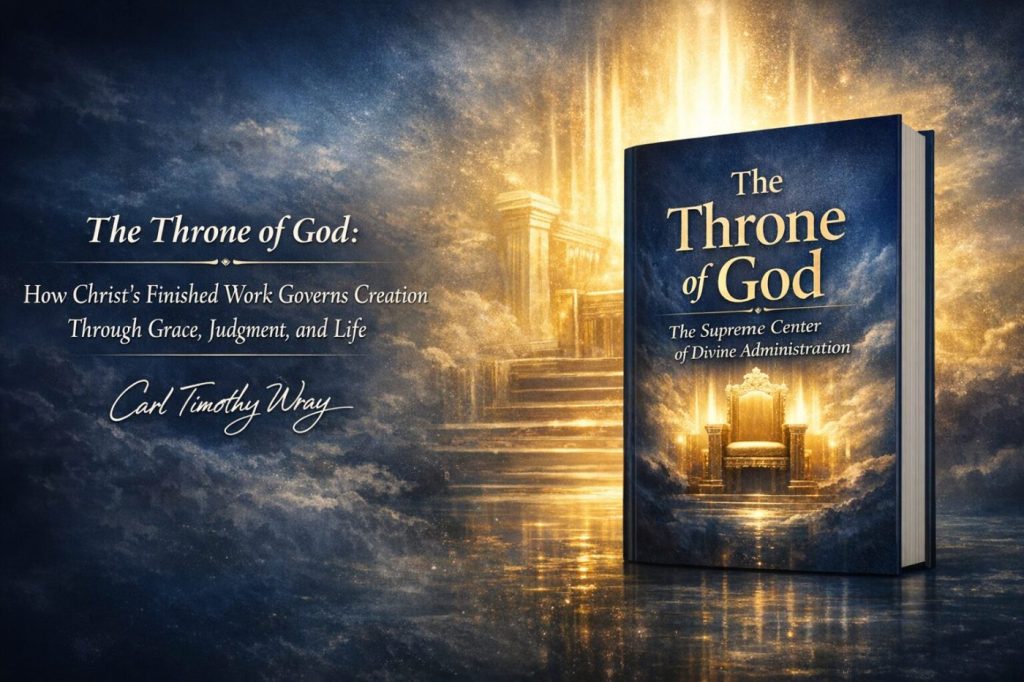
The Throne of God: INTRODUCTION
For generations, the throne of God has been presented as distant—set in a far-off heaven, reserved for a future reckoning, disconnected from the present life of believers and the finished work of Christ. In religious thought, the throne often becomes a place of fear, postponement, or unresolved judgment. Yet the Book of Revelation reveals something altogether different.
The Throne of God and of the Lamb is shown as the present center of divine authority, established because the work of redemption is complete. Christ is seated not because He is waiting, but because He has finished. From this single throne flows a unified administration—grace that supplies life, judgment that removes what opposes life, and authority that orders all things according to God’s eternal purpose.
Revelation unveils that the throne governs not by distance, but by indwelling. From the throne proceeds the River of Life, carrying the Spirit of God into creation, healing the nations and restoring order where corruption once reigned. Judgment is not separated from grace, nor is it opposed to life. It flows from the same throne as a righteous administration after victory, ensuring that death, deception, and disorder have no lasting dominion.
This book is written to establish clarity where confusion has reigned. It presents the throne as Scripture reveals it—one throne, one administration, one finished authority. As you move through these pages, you will see how the reign of Christ is not merely something to be anticipated, but something already governing; not something external and imposed, but something shared through union. The throne stands, the Lamb reigns, and the River is flowing.
Chapter 1 — The Throne of God Defined
The Supreme Center of Divine Administration
The Throne Is Not a Symbol, but a Seat of Government
The Book of Revelation opens not with chaos on the earth, but with clarity in heaven. Before seals are opened, before judgments are released, before nations are addressed, John is shown a throne. This order is intentional. Scripture establishes the throne of God first because all authority, action, and administration flow from it.
The throne of God is not presented as a poetic image or distant mystery. It is revealed as the supreme center of divine administration—the governing seat from which God orders creation according to His will. Everything that follows in Revelation flows from this throne, including grace, judgment, life, and restoration.
To misunderstand the throne is to misunderstand the entire book.
One Throne, Not Many Authorities
John does not see multiple thrones competing for control. He sees one throne. This single throne establishes unity, not division. It declares that heaven is not conflicted, undecided, or waiting for outcomes to be determined. The throne is already occupied, and authority is already settled.
The presence of one throne reveals that all divine action flows from a single source. Grace does not originate in one place while judgment originates in another. Life does not flow independently of authority. Everything proceeds from the same throne, governed by the same will, executed through the same administration.
This is why Revelation consistently speaks of the throne of God and of the Lamb—not two thrones, but one shared seat of authority.
The Throne Established by the Finished Work
The throne seen in Revelation is not vacant, provisional, or awaiting a future event. It is established because Christ’s work is finished. Jesus is seated because redemption has been accomplished, sin has been judged, and death has been defeated.
A seated Christ signifies completed labor. Scripture never presents Christ pacing heaven in uncertainty or waiting for permission to reign. He sits because authority has already been secured. The throne does not anticipate victory; it governs from victory.
This is why Revelation does not begin with judgment on the earth—it begins with authority in heaven.
Administration, Not Delay
The throne of God does not exist to postpone action but to administer it. Administration implies execution, order, and distribution. What has been accomplished through Christ is now governed, applied, and manifested through divine administration.
Grace flows from the throne as supply.
Judgment flows from the throne as righteous order.
Life flows from the throne as restoration.
These are not competing functions. They are expressions of one administration flowing from one seat.
The Throne as the Source of All Flow
Revelation later reveals a river flowing from the throne of God and of the Lamb. This is not accidental imagery. It shows that authority does not remain static; it flows. The throne governs by releasing life, not by withholding it.
The River of Life reveals how Christ reigns—not from distance, but through indwelling presence. The throne is not removed from creation; it supplies creation. It heals, orders, and restores by what flows from it.
The throne governs not by fear, but by life.
Why the Throne Must Be Defined First
Before seals are opened…
Before trumpets are sounded…
Before vials are poured out…
The throne is shown.
This establishes a critical truth: everything that happens in Revelation happens under authority already established, not authority being formed. The throne is not reactive. It is directive. It does not respond to chaos—it governs it.
Understanding the throne as the supreme center of divine administration brings clarity to every chapter that follows. Without this foundation, Revelation becomes fragmented, fearful, and misunderstood. With it, the book becomes orderly, victorious, and coherent.
The throne of God is the supreme center of divine administration, from which Christ’s finished work governs creation through grace, judgment, and life.
Chapter 2 — The Throne and the Finished Work of Christ
Authority Established, Not Pending
The Seated Christ Reveals a Completed Work
In Scripture, position reveals condition. When a king stands, action is underway. When a priest sits, the work is finished. The Book of Revelation reveals Jesus Christ not striving, not waiting, not preparing—but seated. This posture is deliberate. It testifies that the authority flowing from the throne rests upon a work already accomplished.
Christ does not ascend to the throne to finish redemption. He ascends because redemption is finished. The throne is not a place of effort; it is the seat of execution for what has already been secured through the cross.
A seated Christ means there is no unfinished labor in heaven—only administration on earth.
The Throne Is the Proof of Victory
The cross is where victory was won.
The throne is where victory is enforced.
Revelation does not present the throne as a reaction to human failure or satanic resistance. It presents the throne as the governing seat of a victory already achieved. The Lamb appears in the midst of the throne “as though slain,” revealing that authority does not replace sacrifice—it proceeds from it.
The wounds of Christ do not disqualify Him from ruling; they authorize Him to rule.
This is why the Lamb is worthy to open the scroll. Authority is not granted because of power alone, but because of faithful completion. The throne belongs to the One who finished what He was sent to do.
Finished Does Not Mean Inactive
Religious thinking often confuses finished with inactive. Scripture does not. The finished work of Christ does not end movement—it begins administration. What is finished in redemption must be distributed, applied, and manifested within creation.
The throne exists precisely because the work is finished. Administration follows accomplishment. Government follows victory. The throne does not add to the work of Christ; it enforces it.
Grace flows because the work is finished.
Judgment flows because the work is finished.
Life flows because the work is finished.
Nothing flows from uncertainty. Everything flows from completion.
The Scroll and the Throne
In Revelation, a sealed scroll represents the unfolding of God’s purpose within time. No one is found worthy to open it until the Lamb appears. This reveals a crucial truth: only a finished work can govern unfolding history.
The throne does not invent the future—it administers what has already been secured. The Lamb does not write new outcomes; He reveals and executes what has already been written.
This is why the throne and the scroll are inseparable. Authority governs revelation. Revelation executes purpose. Both rest upon the finished work of Christ.
Why Judgment Flows After the Victory
Judgment is often misunderstood because it is separated from completion. In Revelation, judgment flows from the throne only after the Lamb has prevailed. This order matters. Judgment is not an attempt to secure victory—it is the application of victory.
Because sin has been judged at the cross, judgment now removes what opposes life.
Because death has been defeated, judgment now exposes what resists resurrection.
Because Christ reigns, judgment now restores order.
Judgment is not punishment seeking justification; it is administration enforcing righteousness.
The Throne Is Present Because the Work Is Finished
The throne of God and of the Lamb is not future tense. It is present reality. Heaven does not wait for history to resolve before it governs history. Christ does not delay His reign until conditions improve. He reigns because the decisive act has already occurred.
This is why Revelation begins with worship, not warfare.
Authority is settled before conflict is addressed.
Victory is established before opposition is confronted.
The throne stands because the work is done.
The throne of God is established through Christ’s finished work, governing creation not from uncertainty or delay, but from completed victory through grace, judgment, and life.
Chapter 3 — Grace Flowing From the Throne
Why the Throne Is a Throne of Grace
Grace Is Not Permission, It Is Supply
Grace is often treated as leniency, allowance, or divine tolerance. In Scripture, grace is none of these. Grace is the active supply of divine life flowing from the throne of God. It is not a suspension of authority—it is the means by which authority operates.
When Revelation reveals the throne, it does not present grace as an alternative to rule. It presents grace as the form rule takes in the new creation. Grace flows because the throne stands. Grace is not opposed to government; it is government expressed through life.
The throne is called a throne of grace because authority now administers life instead of condemnation.
Grace Established by the Finished Work
Grace flows because judgment has already occurred. Christ bore judgment fully at the cross, removing every legal barrier between God and man. Because judgment is complete, grace can now be administered freely, continuously, and without interruption.
Grace does not postpone justice—it flows from justice satisfied.
This is why grace is strong, not soft. It rests on finished judgment, not unresolved sin. The throne does not weaken to dispense grace; it is strengthened by the completed work that makes grace possible.
Grace as Administrative Flow
In Revelation, nothing flows randomly. Grace flows from the throne because the throne is the administrative center of God’s kingdom. Grace is not released emotionally; it is released governmentally.
Grace supplies:
- life where death once ruled
- strength where weakness once reigned
- order where chaos once dominated
This supply does not bypass authority—it carries authority with it. Grace does not ask permission from resistance; it overcomes resistance by imparting life.
The Throne of Grace Is Not Separate From Judgment
Many imagine two thrones: one of grace and one of judgment. Revelation shows only one throne. Grace and judgment flow from the same seat because they serve the same purpose—the restoration of creation under divine order.
Grace removes what judgment has already settled.
Judgment removes what resists the flow of grace.
They do not compete. They cooperate.
Grace gives life; judgment protects life. Both flow from the throne.
Access Without Distance
Grace flowing from the throne removes distance between heaven and earth. Believers are not invited to observe the throne from afar; they are invited to draw near. Access is not earned—it is granted because the work is finished.
Grace is the bridge between authority and intimacy. Through grace, the throne is no longer distant. Authority becomes accessible. Government becomes relational. Power becomes indwelling.
This is why grace does not intimidate—it transforms.
Grace Governs Through Union
Grace is not merely given; it is shared. Those in union with Christ do not receive grace as outsiders—they participate in it as members of the reigning body. Grace flows into believers not to excuse immaturity, but to produce maturity.
Union means the throne’s supply becomes the believer’s life-source. Grace trains, strengthens, corrects, and empowers. It produces sons who rule not by force, but by life.
The throne governs through those who live by grace.
Grace Prepares the Way for Life to Flow
Grace clears the channels through which life flows. It removes condemnation, heals division, and restores fellowship so the River of Life can proceed unhindered. Grace is the administrative preparation for the full manifestation of life.
Without grace, life would remain obstructed.
With grace, life flows freely.
The throne of grace is therefore the foundation of the new creation.
Grace flows from the throne of God as the administrative supply of Christ’s finished work, governing creation through life, access, and restored order.
Chapter 4 — Judgment Flowing From the Same Throne
Righteous Administration After Victory
Judgment Is Not Opposition to Grace
Judgment has been one of the most misunderstood words in Scripture because it has been separated from victory. When judgment is viewed as something God uses to achieve righteousness, it becomes fearful, harsh, and uncertain. Revelation reveals judgment differently. Judgment flows from the throne after righteousness has already been secured through Christ.
The throne from which grace flows is the same throne from which judgment flows. There is no division, no contradiction, and no competing authority. Grace and judgment serve the same purpose—the establishment of divine order through life.
Judgment does not interrupt grace. Judgment protects what grace produces.
Judgment Established by the Finished Work
Christ did not leave judgment unresolved. Sin was judged at the cross. Death was judged in the resurrection. The old man was judged and put away. Because judgment has already occurred in Christ, the judgment flowing from the throne is not punitive—it is administrative.
Judgment now enforces what the cross accomplished.
This means judgment does not ask, “Will victory happen?”
It declares, “Victory has happened—now let order follow.”
Judgment flows not to condemn humanity, but to remove everything that contradicts life.
Judgment as Separation, Not Destruction
In Revelation, judgment consistently functions as separation. Light is separated from darkness. Truth is separated from deception. Life is separated from death. Judgment removes what cannot inherit life so that life may remain unobstructed.
This is why judgment and life flow together. Judgment clears the way for life. It exposes, removes, and dissolves what resists resurrection.
Judgment does not destroy what God intends to restore.
Judgment destroys what prevents restoration.
The White Throne Is Not a Different Authority
The Great White Throne is often presented as a different throne with a different purpose. Revelation never presents two thrones. It presents one throne expressing authority in different stages of administration.
The same throne that dispenses grace also dispenses judgment. The difference is not in the throne—it is in what is being addressed. Judgment does not negate grace; it completes its work by ensuring nothing remains that opposes life.
The throne remains consistent. The administration adapts according to what must be dealt with.
Judgment After Victory, Not Before
Order matters. Revelation never shows judgment attempting to secure victory. Victory is declared first. The Lamb prevails. The throne stands. Worship erupts. Only then does judgment unfold.
This order reveals the heart of God. Judgment is never uncertain, reactive, or angry. It is measured, purposeful, and restrained by love. It flows from a throne already established in righteousness.
Judgment is not God trying to win.
Judgment is God enforcing what has already been won.
Judgment Serves the New Creation
Judgment in Revelation always points forward, never backward. It prepares the way for the new heaven and the new earth. It removes corruption so that creation can function as God intended.
Judgment is not the end of the story—it is the clearing of the stage for life to reign. It ensures that death, deception, and disorder do not have the final word.
The goal of judgment is not exclusion, but restoration through order.
Why Judgment Must Be Understood Correctly
If judgment is misunderstood, the throne becomes fearful. If judgment is understood correctly, the throne becomes trustworthy. Revelation reveals a throne that governs wisely, not violently; decisively, not recklessly.
Judgment reveals the throne’s commitment to life. It proves that God will not allow corruption to coexist indefinitely with resurrection.
Judgment is love refusing to compromise with death.
Judgment flows from the throne of God as righteous administration after victory, removing what opposes life so grace and restoration may reign without resistance.
Chapter 5 — The River of Life
How the Throne Governs Through Flow, Not Distance
Authority That Moves as Life
Revelation does not end with a throne standing alone. It reveals something proceeding from it. From the throne of God and of the Lamb flows a river—clear as crystal, full of life, unstoppable in its course. This image is not poetic decoration; it is divine explanation. It reveals how the throne governs.
The throne does not rule by isolation or separation. It rules by flow. Authority does not remain static in heaven while creation struggles below. Authority moves outward as life, carrying the will of God into every place it reaches.
The River of Life is the administration of the throne in motion.
The River Proceeds From One Throne
Scripture is precise: the river flows from the throne of God and of the Lamb. There is one source, one authority, one administration. Life does not originate independently of government; it proceeds from it.
This reveals a crucial truth—life is not an alternative to authority. Life is the expression of authority in the new creation. The throne governs by releasing life where death once ruled, truth where deception once held sway, and order where chaos once reigned.
The throne is the source. The river is the method.
The Nature of the River
The River of Life is described as clear, pure, and living. It carries no mixture, no corruption, no darkness. This clarity reveals that what flows from the throne is uncontaminated by fear, uncertainty, or delay.
The river does not meander aimlessly. It flows with purpose. Wherever it goes, it brings restoration. Wherever it touches, it imparts life. This is not symbolic optimism—it is governmental reality.
Life flows because authority wills it to flow.
Healing the Nations
Revelation declares that the leaves of the tree of life are for the healing of the nations. This healing does not originate from human reform or religious effort. It flows from the throne through the river.
Nations are healed not by coercion, but by life overcoming corruption. The throne does not dominate creation—it restores it. Healing is the fruit of righteous administration, not the suspension of authority.
Where the river flows, division gives way to wholeness, and disorder gives way to peace.
Life Governing From Within
The River of Life reveals that Christ reigns not from distance, but from indwelling presence. Authority enters creation through life implanted within it. The throne is not far away; its influence is internal.
This is why union matters. Those joined to Christ become conduits of the river. Life flows through them, not around them. The reign of Christ becomes experiential, not theoretical.
The throne governs by inhabiting creation, not hovering over it.
The River and Judgment
The river does not bypass judgment—it follows it. Judgment clears the channel so life can flow unhindered. Where corruption is removed, life advances. Where resistance is exposed, healing follows.
Judgment and life are not opposites; they are sequential. Judgment removes what obstructs the river. Life fills what remains.
This is righteous administration in motion.
The River Reveals the Goal of the Throne
The throne is not revealed merely to assert power. It is revealed to supply life. The river reveals the heart of divine government—the full restoration of creation under God’s rule.
The throne stands so the river may flow.
The river flows so life may reign.
Life reigns so God may be all in all.
The River of Life flows from the throne of God and of the Lamb, revealing how Christ’s finished authority governs creation through indwelling life, healing the nations and ordering the new creation.
Chapter 6 — Reigning Through Union
How Christ’s Authority Is Shared, Not Delegated
Union Is the Method of the Throne
The throne of God does not govern creation by delegation alone—it governs through union. Christ does not merely issue commands from heaven; He reigns by sharing His life with those joined to Him. Authority in the new creation is not external control, but internal participation.
Revelation reveals that Christ reigns in the midst. His authority flows through union, not separation. Those who are joined to Him are not distant subjects—they are living members of His body, sharing in His life and rule.
The throne governs by becoming life within those who reign with Christ.
Authority Shared Through Life, Not Office
Union replaces hierarchy. Authority is not transferred through position, title, or office—it is shared through life. The Lamb reigns because He lives. Those in union with Him reign because His life lives in them.
This is why Revelation speaks of kings and priests reigning with Christ. Their authority does not originate in themselves. It flows from union with the One seated on the throne.
Reigning is not achieved by striving upward—it is received by abiding inward.
Seated With Christ
Scripture declares that believers are seated with Christ in heavenly places. This is not metaphorical encouragement—it is governmental truth. To be seated is to participate in completed authority.
Those seated with Christ do not reign from anxiety or urgency. They reign from rest. Rest is not inactivity; it is confidence in completed work. Union allows believers to govern from peace, not pressure.
The throne is shared by those who share His life.
Union Transforms Obedience Into Expression
In union, obedience is no longer compliance—it is expression. The will of God flows naturally through those who live by His life. Authority is not imposed; it is manifested.
This is why the reign of Christ looks different from earthly rule. It does not rely on force, fear, or domination. It operates through truth, life, and transformation.
Union causes authority to appear as love in action.
The Throne Extending Through the Body
The throne does not multiply—it extends. Christ remains the Head, but His body becomes the means through which His reign is expressed in the earth. Where His life flows, His authority is present.
This is how the throne reaches into creation. Through union, believers become conduits of grace, instruments of judgment that restores, and carriers of life that heals.
The throne touches the earth through living people.
Reigning Now, Not Later
Union places reigning in the present tense. Believers do not wait for authority to arrive—they participate in it now. Christ’s reign is not postponed until a future age; it is presently administered through those joined to Him.
This does not eliminate future fullness, but it establishes present reality. The kingdom is not delayed; it is growing. The reign of Christ is not absent; it is expanding.
Union makes the reign of the throne experiential.
Union Prepares the Way for Full Manifestation
Union is not the final destination—it is the pathway. Through union, life matures, authority deepens, and governance becomes visible. What begins inwardly eventually manifests outwardly.
The throne governs through union until creation fully reflects the life of the One seated upon it. This is how the kingdom advances—not by replacement, but by transformation.
Union is the womb of manifestation.
The throne of God governs through union with Christ, sharing His finished authority with those who live by His life and reign through indwelling presence.
Chapter 7 — The Throne and the New Creation
Administration Completed in Life
The Goal of the Throne Is a Living Creation
The throne of God is not revealed merely to establish authority; it is revealed to complete creation. From Genesis to Revelation, God’s purpose has never been domination, but habitation. The throne stands so that life may reign fully, freely, and finally throughout all things.
Revelation closes not with destruction, but with renewal. The throne remains, the river flows, and creation lives. This reveals the true end of divine administration—not control, but communion; not suppression, but saturation with life.
The throne governs until creation reflects the life of the One who sits upon it.
The Throne in the Midst of the New Creation
In the final vision of Revelation, the throne is not distant or elevated above creation. It stands in the midst of the New Jerusalem. Authority and life are no longer separated. Government and communion have become one reality.
The throne is not imposed upon the new creation—it is embedded within it. God does not rule from afar; He dwells among His people. His authority is expressed as presence, and His government is experienced as life.
This is administration fully realized.
No Curse, No Resistance
Scripture declares that in the new creation there is no curse. This does not mean authority has ceased—it means authority has succeeded. Judgment has done its work. Corruption has been removed. Resistance has been dissolved.
Where there is no curse, there is no opposition to life. Where there is no opposition, administration becomes effortless. Life flows freely because nothing remains to obstruct it.
The absence of the curse is the evidence of successful governance.
Seeing His Face
The ultimate sign of completed administration is unveiled fellowship. Revelation declares that His servants shall see His face. This is not poetic language—it is governmental conclusion. Authority no longer needs enforcement when life is fully shared.
Seeing His face speaks of unhindered union, clear identity, and restored intimacy. When creation sees God as He is, obedience becomes instinctive, and order becomes natural.
The throne no longer needs to correct—life fully aligns.
Reigning Forever Without Strain
Revelation declares that His servants shall reign forever and ever. This reign is not endless labor—it is sustained life. Reigning in the new creation is not about maintaining order against resistance, but enjoying order without resistance.
The reign continues because life continues. Authority remains because love remains. The throne does not fade—it abides as the source of life for eternity.
This is eternal administration: effortless, joyful, and complete.
God All in All
The final outcome of the throne’s administration is simple and profound—God all in all. Nothing remains outside His life. Nothing resists His presence. Nothing contradicts His will.
This is not the loss of individuality; it is the fulfillment of identity. Creation does not disappear—it comes alive fully. The throne does not overpower creation—it fills it.
God is not everything by force, but by life.
The Throne Stands Forever
The book ends where it began—with the throne. Not because nothing has changed, but because everything has been restored. The throne remains because its work has succeeded. Life flows unhindered. Authority rests peacefully. Creation rejoices.
The throne of God stands as the eternal center of divine administration—not ruling over death, but supplying life; not correcting rebellion, but sustaining harmony.
This is the finished goal of the finished work.
The throne of God completes its divine administration in the new creation, where Christ’s finished work fills all things with life, restores perfect order, and brings God to be all in all.
The Throne of God: By Carl Timothy Wray
Carl Timothy Wray is a Bible teacher with over forty years of experience teaching Scripture, with a focus on the Finished Work of Christ, the Throne of God, and the Book of Revelation. Since 2025, he has published over 300 books presenting a unified, Scripture-based explanation of Revelation and Christ’s present reign.

The Throne of God Series
- The Throne of God
- The Throne of God — Grace, Judgment, and the River of Life Governing Through Administration
- The Throne of God — Governing Through Administration
- The Throne of God — One Throne, One Administration
- Throne of God Meaning
- The Finished Work of Christ: Meaning, Key Scriptures & FAQs
- Join Our Facebook Page