Book of Revelation — Revelation Is the Unveiling of Jesus Christ Governing History, Judgment, the Church, and Creation from a Finished Throne — Not Striving Toward One
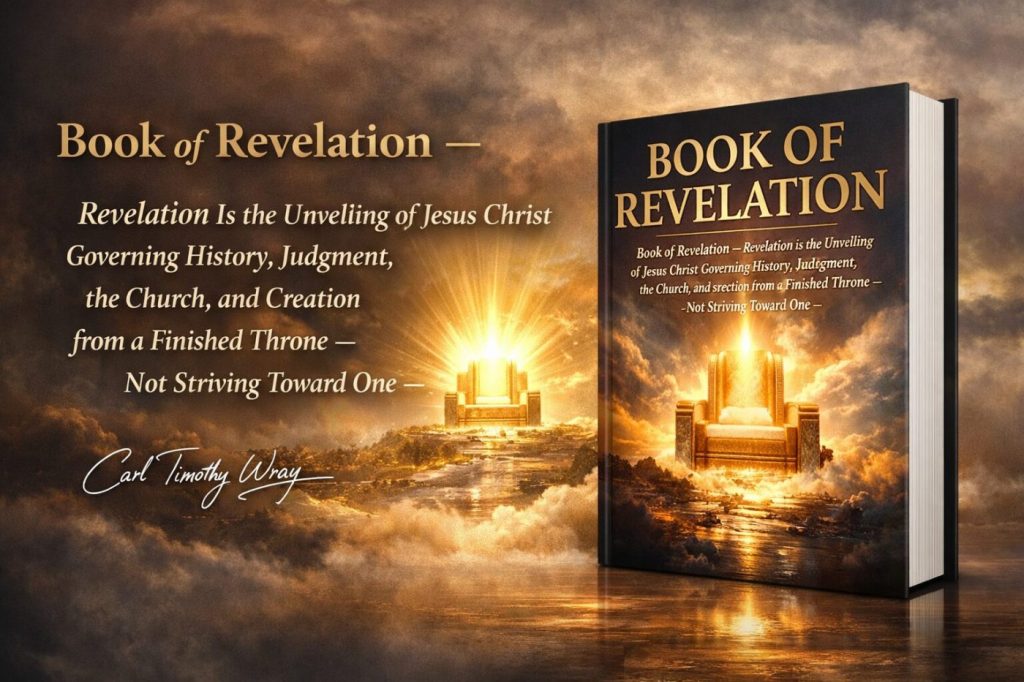
Book of Revelation: AUTHOR
By Carl Timothy Wray
Carl Timothy Wray writes from the conviction that Scripture is not a collection of competing doctrines or unfinished promises, but one unified revelation governed by the finished work of Christ. His teaching centers on the Full Counsel of God — showing how what was eternally settled in Christ is progressively revealed in history until God becomes all in all. Wray approaches the Book of Revelation not as a book of fear, speculation, or delay, but as the calm unveiling of Jesus Christ already reigning.
Book of Revelation
The Book of Revelation is not a prediction of chaos, the rise of evil, or a future struggle for control. It is the unveiling of Jesus Christ already governing history, judgment, the Church, and creation from a finished throne. From its opening words, Revelation announces authority, not uncertainty — revealing how Christ’s completed work is administered through time, not how He strives to obtain dominion. Read correctly, Revelation removes fear, ends speculation, and restores order by showing who is already reigning.
Book of Revelation: INTRODUCTION
For centuries, the Book of Revelation has been approached as the most mysterious and misunderstood book in Scripture. It has been treated as a code to be cracked, a timeline to be mapped, or a warning meant to frighten believers into vigilance. As a result, Revelation has often been avoided, feared, or fragmented into competing interpretations that leave readers more anxious than assured.
But Revelation was never given to confuse the Church.
It was given to unveil Jesus Christ.
The very word revelation means unveiling — not concealment, not prediction, and not speculation. Revelation does not reveal what might happen if Christ succeeds; it reveals what is happening because Christ has already succeeded. The Lamb is not presented as striving toward authority, but as already slain, already enthroned, and already opening the seals of history.
This book approaches Revelation according to the Full Counsel of God — the unified witness of Scripture from beginning to end. Within this counsel, the Cross is not a partial victory, the throne is not future, and Christ’s government is not contested. Judgment is therefore not destructive wrath, but administrative order. The Church is not a threatened remnant, but a governed people. Creation is not abandoned, but being brought into alignment with a reign already established.
Revelation does not ask who will rule in the end.
It reveals who has ruled all along.
When Revelation is read from this finished throne, fear dissolves, symbols come into focus, and history finds its meaning. What once appeared chaotic is seen as ordered. What seemed delayed is revealed as unfolding. And what looked like a future struggle is recognized as the present administration of a completed victory.
This book invites the reader to stop striving, stop speculating, and stop waiting — and instead to see clearly the Christ who is already reigning.
Chapter 1
The Revelation of Jesus Christ — Not Events
The opening words of the Book of Revelation settle its meaning before interpretation ever begins:
“The revelation of Jesus Christ.”
Revelation does not announce disasters.
It does not introduce timelines.
It does not begin with beasts, judgments, or future speculation.
It begins with a Person unveiled.
This is where misunderstanding starts — not because Revelation is unclear, but because it is often approached with the wrong expectation. Many come to Revelation looking for information about what will happen next. But Revelation is not concerned with what will happen until it first reveals who is governing.
Revelation is not a book about events.
It is a book about authority.
Unveiling, Not Predicting
The word revelation means unveiling — the removal of a covering. It does not mean forecasting, coding, or encrypting future scenarios. An unveiling does not add information; it reveals what was already present but unseen.
Revelation does not unveil a future Christ.
It unveils the true Christ.
This distinction matters. When Revelation is read as prediction, readers search for signs. When it is read as unveiling, readers receive clarity. The difference between fear and peace in Revelation is not the content of the book, but the vantage point from which it is read.
Revelation is written from heaven’s perspective, not earth’s anxiety.
Why Jesus Christ Is Revealed First
Before seals are opened, before judgments unfold, before churches are addressed, Revelation establishes one unshakable truth: Jesus Christ is already reigning.
John does not see a Christ striving toward authority.
He sees a Christ standing in authority.
Christ is revealed as:
- Faithful Witness
- Firstborn from the dead
- Ruler of the kings of the earth
These are not future titles.
They are present realities.
Revelation begins by grounding everything that follows in completed authority. Nothing that happens afterward challenges this rule. Everything flows from it.
This is why Revelation never portrays history as out of control. What appears chaotic to human eyes is being administered under a throne already established.
The Throne Comes Before the Drama
One of the most overlooked truths about Revelation is this:
One of the most overlooked truths about Revelation is this:
The throne is revealed before the conflict is explained.
John is not first shown beasts, wars, or judgments. He is shown the throne room. Worship precedes warfare. Authority precedes activity. Government precedes judgment.
This order is intentional.
Revelation teaches us how to interpret everything else by showing us where Christ is seated before showing us what is happening on the earth.
If the throne were future, anxiety would be justified.
But because the throne is present, fear is unnecessary.
Why Revelation Is Calm, Not Urgent
Many approach Revelation with urgency — as if something must happen quickly or be figured out before it is too late. But Revelation itself is not written urgently. It is written deliberately.
There is no panic in heaven.
No confusion in the throne room.
No uncertainty in Christ’s posture.
Judgment unfolds slowly, in order, measured and purposeful — because judgment in Revelation is not retaliation. It is administration.
Christ does not react to history.
He governs it.
The Lamb Already Slain
One of the most decisive images in Revelation appears early: the Lamb slain.
The Lamb is not slain at the end of the book.
He is revealed as slain before anything else unfolds.
This means the Cross is not the solution that arrives later.
It is the foundation already laid.
Every seal opened, every judgment released, every power exposed flows from a victory already secured. Revelation does not show Christ fighting to win. It shows Christ administering what He already won.
This is why Revelation is not a striving book.
Why This Changes Everything
Once Revelation is understood as the unveiling of Jesus Christ rather than a catalog of events, everything shifts:
- Fear gives way to assurance
- Symbols gain coherence
- Judgment finds its purpose
- History regains meaning
- The Church finds its identity
Revelation becomes what it was always meant to be — not a book to be feared, but a book that ends fear.
The Foundation for the Rest of the Book
This chapter establishes the foundation for everything that follows:
- Revelation unveils a reigning Christ
- Authority is present, not pending
- The throne is finished, not contested
- History unfolds under government, not chaos
If this foundation is missed, Revelation will always feel threatening.
If it is seen clearly, Revelation becomes the most peaceful book in Scripture.
Because nothing is more calming than knowing who is already in control.
Chapter 2
The Finished Throne — Why Christ Is Not Striving Toward Authority
One of the greatest misunderstandings carried into the Book of Revelation is the assumption that Jesus Christ is still moving toward dominion. Many read Revelation as though Christ is advancing, contending, or struggling to establish His reign against opposing powers.
But Revelation never presents Christ that way.
It presents Him as already seated.
The throne in Revelation is not introduced as a future possibility. It is revealed as an existing reality. Everything that unfolds in the book proceeds from a throne that is already occupied, already authoritative, and already unchallenged in its legitimacy.
Revelation is not about Christ becoming King.
It is about Christ administering Kingship.
Sitting Down Means the Work Is Complete
Throughout Scripture, one action consistently signals completion: sitting down.
When priests under the old covenant stood daily, it was because their work was never finished. Sacrifice followed sacrifice. Effort followed effort. Nothing ever truly concluded.
But Christ is described differently.
After offering Himself once, He sat down.
Sitting is not a posture of waiting.
It is a posture of rule.
Christ did not sit because He was tired.
He sat because nothing remained to be accomplished.
The throne is therefore not a goal Revelation moves toward.
It is the starting point Revelation assumes.
All Authority Has Already Been Given
Jesus did not say, “All authority will one day be given to Me.”
He said, “All authority in heaven and on earth has been given to Me.”
That statement alone removes striving from Revelation.
If all authority has already been given, then:
- Judgment is not a battle for control
- History is not undecided
- Evil is not competing for sovereignty
- The future is not open-ended
Revelation unfolds within settled authority, not contested territory.
This is why Revelation never asks who will win.
It reveals how authority is exercised.
The Cross Ended the Contest
The Cross did not make victory possible.
It made victory final.
At the Cross:
- Sin was judged
- Death was defeated
- Principalities were disarmed
- Authority was transferred
The resurrection did not reverse a loss.
It manifested a victory already secured.
Revelation therefore does not portray Jesus striving to overcome enemies. It portrays enemies being exposed, limited, and ultimately removed under authority already established.
Striving belongs to uncertainty.
Finished work belongs to confidence.
Why Revelation Is Written Without Panic
Because Christ is not striving toward a throne, heaven is calm.
There is no alarm in Revelation’s throne room.
No emergency council.
No frantic strategy sessions.
Worship surrounds the throne because rule is settled.
Judgment unfolds because order must be restored, not because power is in danger. Evil is permitted to appear so that it can be exposed — not because it is equal to Christ’s authority.
Revelation is slow, measured, and deliberate because nothing is at risk.
Striving Is a Human Projection, Not a Divine Reality
When readers feel urgency, fear, or pressure in Revelation, it is not coming from the text — it is coming from the lens through which the text is read.
Striving enters Revelation when:
- The Cross is treated as partial
- Authority is assumed to be future
- The throne is viewed as contested
- Christ is imagined as reacting to events
But Revelation corrects all of this by showing Christ before the drama begins.
Once the throne is seen as finished, everything else finds its place.
The Meaning of “Not Striving Toward One”
When this book declares that Christ is reigning from a finished throne — not striving toward one — it is not minimizing future manifestation.
It is clarifying source.
Revelation does not deny unfolding.
It denies uncertainty.
What unfolds in Revelation does not determine the throne.
The throne determines what unfolds.
That is the difference between fear and faith.
Between speculation and revelation.
Between striving and rest.
Why This Chapter Matters
If Christ were striving toward authority, Revelation would be a book of suspense.
But because Christ is already enthroned, Revelation becomes a book of assurance.
This chapter establishes the legal ground for everything that follows:
- Judgment serves life, not chaos
- History is governed, not random
- The Church is preserved, not threatened
- Creation is reconciled, not abandoned
Nothing in Revelation happens to decide who rules.
Everything happens because Someone already does.
A Settled Foundation
With the throne established as finished, the reader is now prepared to see Revelation clearly.
No fear.
No panic.
No speculation.
Only administration.
Only order.
Only the calm unfolding of a reign that has never been in doubt.
Chapter 3
Judgment That Serves Life — Why Revelation Is Not a Book of Destruction
Few words provoke more fear in the Book of Revelation than the word judgment. For many readers, judgment immediately conjures images of destruction, punishment, and divine rage. Revelation is often assumed to be God’s final outburst against a rebellious world.
But Revelation itself does not treat judgment that way.
Judgment in Revelation is not reactionary.
It is administrative.
It flows from a finished throne, not from wounded authority. And because the throne is settled, judgment serves a purpose far greater than destruction.
Judgment serves life.
Judgment Begins with the Throne, Not with Wrath
In Revelation, judgment never appears in isolation. It always proceeds from the throne. That order matters.
Judgment does not arise because God has lost patience.
It arises because order must be restored.
Everything judged in Revelation is judged because it resists life, truth, and reconciliation. Judgment does not exist to annihilate creation, but to remove what corrupts it.
This is why Revelation’s judgments are progressive, measured, and purposeful. They are not explosions of anger. They are stages of exposure.
Exposure Is the First Act of Judgment
The first thing judgment does in Revelation is reveal.
- False authority is exposed
- Deception is uncovered
- Pretended power is unmasked
- Systems built on lies are shown for what they are
Judgment does not immediately destroy.
It first tells the truth.
Darkness is not overcome by force.
It is overcome by light.
Revelation shows judgment functioning exactly this way — light increasing until lies can no longer hide.
Why Judgment Feels Severe to the Flesh
Judgment feels violent only to what depends on deception to survive.
When truth arrives:
- False systems collapse
- Unjust power loses legitimacy
- Exploitation is revealed
- Fear-based authority dissolves
To the flesh, this feels like destruction.
To life, it is liberation.
This is why judgment is often resisted, misunderstood, or feared. But Revelation shows judgment as a necessary servant — clearing space for what is true, living, and whole.
Judgment Is Targeted, Not Random
One of the clearest signs that Revelation’s judgment is restorative is its precision.
Judgment is never indiscriminate.
It always addresses:
- Lies
- False worship
- Corrupt systems
- Accusatory power
Judgment does not fall on creation itself.
It falls on what distorts creation.
That distinction changes everything.
Revelation does not portray God attacking the world.
It portrays God freeing the world from what enslaves it.
Why Judgment and Salvation Appear Together
In Revelation, judgment and salvation are never separated. They unfold side by side.
As lies fall, truth rises.
As false authority is removed, rightful authority appears.
As darkness is exposed, healing follows.
Judgment is therefore not the opposite of salvation.
It is the pathway through which salvation becomes visible.
Revelation’s judgments do not end with emptiness.
They consistently lead toward restoration, clarity, and alignment.
The Church and Judgment
The Church is not portrayed as the target of judgment in Revelation, but as its witness.
Judgment purifies vision.
It removes fear.
It separates truth from mixture.
Rather than threatening the Church, judgment prepares the Church to stand clearly in the light.
Judgment removes what cannot inherit life so that what can may flourish.
Why Fear Has No Place in Judgment
Fear assumes judgment is unpredictable.
But Revelation shows judgment flowing from:
- A known throne
- A revealed Christ
- A settled authority
- A finished work
There is no randomness in divine judgment.
There is no loss of control.
There is no escalation born of desperation.
Judgment moves calmly because nothing is uncertain.
Judgment as Mercy in Motion
This is the truth Revelation quietly teaches:
Judgment is mercy applied to reality.
It confronts lies so truth can heal.
It dismantles oppression so freedom can emerge.
It exposes death so life can reign.
Judgment does not oppose love.
It protects love.
Why This Chapter Matters
If judgment is misunderstood, Revelation becomes terrifying.
But when judgment is seen clearly, Revelation becomes hopeful — not because evil is ignored, but because it is addressed properly.
This chapter establishes a crucial truth for everything that follows:
Judgment in Revelation is not about destruction.
It is about restoration through truth.
A Calm Conclusion
Revelation does not reveal a God losing control.
It reveals a God restoring order.
Judgment does not signal failure.
It signals authority in action.
And because that authority flows from a finished throne, judgment never threatens life — it clears the way for it.
Chapter 4
Governing History — Not Escaping It
One of the most persistent assumptions carried into the Book of Revelation is that history is something believers must escape. Revelation is often read as a roadmap out of the world rather than a revelation of how Christ governs within it.
But Revelation never teaches escape from history.
It reveals authority over history.
Revelation does not present the earth as abandoned, doomed, or disposable. It presents history as the stage upon which a finished throne administers truth, judgment, and restoration.
Christ is not trying to rescue His people from history.
He is ruling through it.
Why History Is Central to Revelation
Revelation does not float above time. It speaks directly into it.
John writes to real churches, facing real pressures, under real political and religious systems. Rome, persecution, economic control, and social compromise are not symbols detached from reality — they are historical expressions of deeper spiritual principles.
Revelation does not deny history.
It interprets it.
History in Revelation is not random chaos. It is the visible outworking of invisible governance.
Babylon: A System, Not a Surprise
Babylon in Revelation is not a sudden future invention. It is a recurring pattern — a system built on mixture, domination, deception, and self-exaltation.
Babylon represents:
- Power without truth
- Prosperity without justice
- Religion without life
- Authority without accountability
Revelation does not treat Babylon as an unexpected enemy. It treats Babylon as a system already known, already weighed, and already marked for exposure.
Babylon does not fall because Christ suddenly reacts.
Babylon falls because its time is complete.
Why Persecution Does Not Mean Defeat
Revelation never equates persecution with loss of authority.
The early believers were not persecuted because Christ was failing to rule. They were persecuted because His rule was threatening false authority.
Persecution is not evidence that Christ’s kingdom is weak.
It is evidence that counterfeit power has been challenged.
Revelation reframes persecution not as abandonment, but as contrast — light standing against darkness until darkness exposes itself.
The Myth of Escapism
Many interpretations of Revelation assume the solution to corruption is removal — that God’s answer to broken systems is evacuation.
But Revelation consistently shows the opposite.
God confronts systems.
He judges them.
He exposes them.
He removes their legitimacy.
And then He heals what remains.
Revelation does not end with an empty earth.
It ends with renewed creation.
History Under Administration
The seals, trumpets, and bowls of Revelation are often treated as escalating disasters. But when read from the finished throne, they appear as phases of administration.
Each stage:
- Reveals truth
- Limits deception
- Constrains false authority
- Advances clarity
History does not spiral downward in Revelation.
It is brought into alignment.
The drama is not about whether Christ will rule, but about how long lies can persist before truth becomes unavoidable.
Why Time Exists at All
If Christ is already enthroned, why does history continue?
Because revelation unfolds by capacity.
History is not delay.
It is disclosure.
Time allows truth to mature, contrast to sharpen, and deception to exhaust itself. Revelation shows history as the mercy of God — giving space for repentance, exposure, and alignment.
Striving ends when capacity is reached.
The Church’s Place in History
The Church in Revelation is not a refugee community waiting for extraction. It is a witness community standing in the midst of history with clarity.
Lampstands shine in darkness.
Witnesses testify amid resistance.
The Bride prepares while Babylon collapses.
The Church is not hidden from history.
It is positioned within it.
Why This Chapter Matters
If Revelation is read as an escape plan, fear dominates.
But when Revelation is read as the governance of history, peace returns.
This chapter establishes a crucial truth:
History is not something to flee.
It is something Christ governs.
Nothing in history surprises Him.
Nothing escapes His authority.
Nothing outlasts His truth.
A Settled Conclusion
Revelation does not teach us how to leave the world behind.
It teaches us how to see the world clearly —
under a throne that has never been shaken.
Christ does not abandon history.
He finishes it.
Chapter 5
The Church Under Rule — Not Under Threat
One of the quiet fears shaping how many read the Book of Revelation is the assumption that the Church stands perpetually on the edge of collapse. Revelation is often framed as a warning that believers are barely surviving, barely enduring, and barely holding on until rescue arrives.
But Revelation does not present the Church as fragile.
It presents the Church as governed.
The Church in Revelation is not shown as a victim waiting for relief, but as a people being ordered, refined, and revealed under a throne already established.
Lampstands, Not Hiding Places
Revelation introduces the Church as lampstands.
Lampstands are not shelters.
They are not bunkers.
They are not escape routes.
Lampstands exist for one purpose: to bear light.
The Church is not positioned in Revelation to retreat from darkness, but to stand within it with clarity. Light is not afraid of darkness. Darkness is exposed by light.
This single image dismantles fear-based interpretations of the Church’s role.
Authority Comes Before Correction
When Christ addresses the churches, He does not begin with threats. He begins with authority.
Each letter opens with a revelation of who Christ already is — not who He is becoming. Only after authority is established does correction appear.
Correction flows from care.
Order flows from love.
Revelation does not threaten the Church into obedience. It invites alignment with what is already true.
Why Removal of Lampstands Is About Light, Not Rejection
The removal of a lampstand is often misread as rejection of the Church itself.
But Revelation never says Christ removes people.
He removes what no longer bears light.
Lampstands exist to illuminate. When light is compromised by mixture, fear, or compromise, correction follows — not to destroy the Church, but to restore its function.
Judgment begins with the house of God not because God is hostile toward His people, but because clarity must start where light is meant to shine brightest.
The Church as a Witness, Not a Target
Throughout Revelation, the Church is portrayed as a witness.
Witnesses testify.
They speak truth.
They stand calmly under pressure.
Witnessing is not about domination.
It is about visibility.
The Church does not overcome by force, but by truth expressed through faithfulness. Revelation does not glorify suffering; it gives suffering meaning by placing it under a reigning Christ.
The Bride Is Prepared, Not Threatened
One of the most beautiful images in Revelation is the Church as the Bride.
A bride is not terrified of her wedding day.
She is being prepared for it.
Preparation is not punishment.
It is alignment.
Revelation presents the Church being clothed, cleansed, and adorned — not to survive wrath, but to participate in union.
The Church’s future is not escape.
It is communion.
Why Fear Distorts Church Identity
Fear causes believers to see themselves as small, embattled, and barely preserved.
But Revelation consistently shows the Church:
- Walking with Christ
- Bearing witness
- Shining light
- Preparing for union
- Standing before the throne
Fear belongs to those uncertain of authority.
Confidence belongs to those who know who rules.
The Church Under Government Is the Church at Rest
When the Church understands itself as governed rather than threatened:
- Anxiety dissolves
- Speculation fades
- Identity stabilizes
- Mission clarifies
The Church does not need to invent strategies to survive the end of the world. It needs to stand clearly in the light of a finished throne.
Revelation does not call the Church to panic.
It calls the Church to presence.
Why This Chapter Matters
If the Church is seen as threatened, Revelation becomes a survival manual.
But if the Church is seen as governed, Revelation becomes a formation book — shaping identity, sharpening vision, and restoring confidence.
This chapter establishes a crucial truth:
The Church is not enduring Revelation.
The Church is revealing Christ through it.
A Calm Conclusion
Revelation does not portray the Church hiding from history.
It portrays the Church standing within it —
illumined, ordered, and at rest under a throne that does not shake.
The Church is not under threat.
The Church is under rule.
And that rule is already settled.
Chapter 6
Creation Brought into Alignment — Why Revelation Ends in Healing, Not Abandonment
One of the most enduring assumptions surrounding the Book of Revelation is that creation itself is ultimately discarded. Revelation is often imagined as God’s exit strategy — a dramatic finale in which the world is destroyed and only a few are removed to safety.
But Revelation does not end with abandonment.
It ends with alignment.
From beginning to end, Revelation assumes that creation matters, history matters, and nations matter — not as disposable scenery, but as participants in a restoration governed by a finished throne.
Creation Was Never the Problem
Revelation never treats creation as evil.
It treats corruption as the intruder.
The earth is not judged because it exists.
It is healed because it has been distorted.
This distinction is crucial. When creation is seen as the enemy, destruction feels logical. But Revelation never points its judgment at the created order — it targets deception, false authority, and death itself.
Creation does not need replacement.
It needs restoration.
The Nations Are Not Forgotten
One of the most overlooked truths in Revelation is its consistent concern for the nations.
Nations appear throughout the book:
- Being deceived
- Being judged
- Being shaken
- And ultimately being healed
Revelation does not erase the nations at the end. It brings them into alignment.
The kings of the earth do not vanish.
They bring their glory.
The nations are not annihilated.
They are healed.
This alone dismantles interpretations that frame Revelation as a story of escape rather than reconciliation.
Judgment Clears the Way for Healing
The healing of the nations does not occur instead of judgment.
It occurs because of it.
Judgment removes what blocks life:
- Lies that enslave
- Systems that exploit
- Powers that accuse
- Structures that corrupt
Once these are exposed and removed, healing becomes possible.
Revelation shows judgment and healing working together — not as opposites, but as partners.
Why the River Flows Outward
Near the close of Revelation, life is pictured not as static perfection, but as movement.
A river flows.
Trees bear fruit.
Leaves heal nations.
This imagery is intentional.
Life does not retreat inward.
It flows outward.
Revelation does not end with heaven sealed off from earth. It ends with heaven permeating earth — God dwelling with humanity, not escaping from it.
The End of Separation Between Heaven and Earth
Revelation’s final vision is not evacuation.
It is union.
Heaven and earth are no longer divided.
God dwells among people.
Light replaces the need for lesser lights.
This is not destruction.
It is completion.
The distance between realms is closed not by force, but by fulfillment.
Why Death Is the Final Enemy Addressed
Revelation does not culminate in the defeat of nations, cultures, or peoples.
It culminates in the defeat of death.
Death is the true enemy.
Death is what distorts creation.
Death is what fractures relationships.
When death is removed, creation does not collapse — it comes alive.
This is why Revelation’s final judgment is not against the world, but against the grave.
Creation Under a Finished Throne
Because Christ reigns from a finished throne, creation’s future is not uncertain.
Nothing in Revelation suggests God loses interest in what He made. Everything suggests He brings it to its intended conclusion.
Creation is not replaced.
It is redeemed.
History is not erased.
It is fulfilled.
Why This Chapter Matters
If creation is viewed as disposable, Revelation becomes a story of loss.
But when creation is viewed as aligned, Revelation becomes a story of hope — not shallow optimism, but grounded assurance that nothing God made is wasted.
This chapter establishes a crucial truth:
Revelation does not end with absence.
It ends with presence.
A Calm Conclusion
The final movement of Revelation is not fire consuming the earth.
It is life flowing through it.
Nations healed.
Creation restored.
God dwelling with humanity.
This is not the abandonment of the world.
It is the fulfillment of it.
Chapter 7
The Lamb at the Center of Everything — Why Revelation Ends in Rest**
The final truth revealed in the Book of Revelation is not a final event, a final battle, or a final catastrophe.
It is a final center.
From beginning to end, Revelation steadily removes distractions until only one reality remains visible: the Lamb.
Not the dragon.
Not the beast.
Not Babylon.
Not judgment.
Not history.
The Lamb stands at the center — and everything else finds its meaning in relation to Him.
Why the Lamb, Not the Lion, Dominates Revelation
Although Christ is revealed as the Lion of the tribe of Judah, Revelation does not center on conquest through force. It centers on victory through self-giving life.
The Lamb is not introduced as threatening.
He is introduced as slain.
This matters.
Power in Revelation is not raw domination.
It is authority rooted in love, sacrifice, and truth.
The Lamb governs not because He overpowers creation, but because He redeems it.
The Lamb Ends All Striving
Striving ends when the center is clear.
As long as power is ambiguous, fear persists.
As long as authority is contested, anxiety thrives.
But Revelation removes ambiguity by returning again and again to the Lamb.
Every seal opened.
Every judgment administered.
Every system exposed.
Every healing released.
All of it flows from the Lamb who was slain and yet lives.
There is no rivalry at the center of Revelation.
There is no competition for the throne.
There is only recognition.
Why Worship Replaces Explanation
As Revelation progresses, explanation gives way to worship.
Not because understanding decreases — but because clarity increases.
When the Lamb is fully seen:
- Questions lose urgency
- Fear loses momentum
- Speculation loses relevance
Worship is not ignorance.
It is rest in recognition.
Revelation does not end with answers because answers belong to questions.
It ends with worship because worship belongs to truth revealed.
The Removal of All Lesser Lights
In Revelation’s final vision, there is no need for sun or moon.
This is not poetic excess.
It is theological precision.
When the Lamb is fully revealed, all secondary lights become unnecessary.
Prophecy gives way to presence.
Signs give way to sight.
Mediators give way to union.
Nothing competes with the Lamb — because nothing needs to.
Why Nothing Is Missing at the End
Revelation does not end with longing.
It ends with completion.
- God dwells with humanity
- Tears are wiped away
- Death is removed
- Separation ends
Nothing is postponed.
Nothing is unresolved.
Nothing is left undone.
This is why Revelation never feels rushed toward its conclusion. It moves steadily because everything is already decided.
The Lamb as the Measure of All Things
At the end of Revelation, the Lamb is not merely present — He becomes the measure.
- Life is measured by Him
- Truth is measured by Him
- Authority is measured by Him
- Judgment is measured by Him
Anything that cannot align with the Lamb cannot remain.
Not because the Lamb is hostile —
but because life cannot coexist with death once death is exposed.
Why This Book Ends in Peace
Revelation does not end in silence because the story has run out of words.
It ends in peace because nothing more needs to be said.
The Lamb stands revealed.
The throne stands secure.
Creation stands aligned.
Fear has no future.
Striving has no purpose.
Delay has no authority.
A Final Word to the Reader
If this book has done its work, Revelation is no longer frightening.
It is settling.
It does not push you forward in anxiety.
It draws you inward into clarity.
The Lamb does not invite you to survive the end.
He invites you to see clearly.
The Rest of the Matter
Revelation does not conclude with instructions.
It concludes with vision.
And once the Lamb is seen at the center of everything, the universe no longer needs explanation.
It needs only alignment.
By Carl Timothy Wray

Book of Revelation Series
- Book of Revelation
- The Finished Work of Christ — God’s Full Counsel Revealed Through the Plan of the Ages
- The Finished Work of Christ: Meaning, Key Scriptures & FAQs
- Join Our Facebook Page: