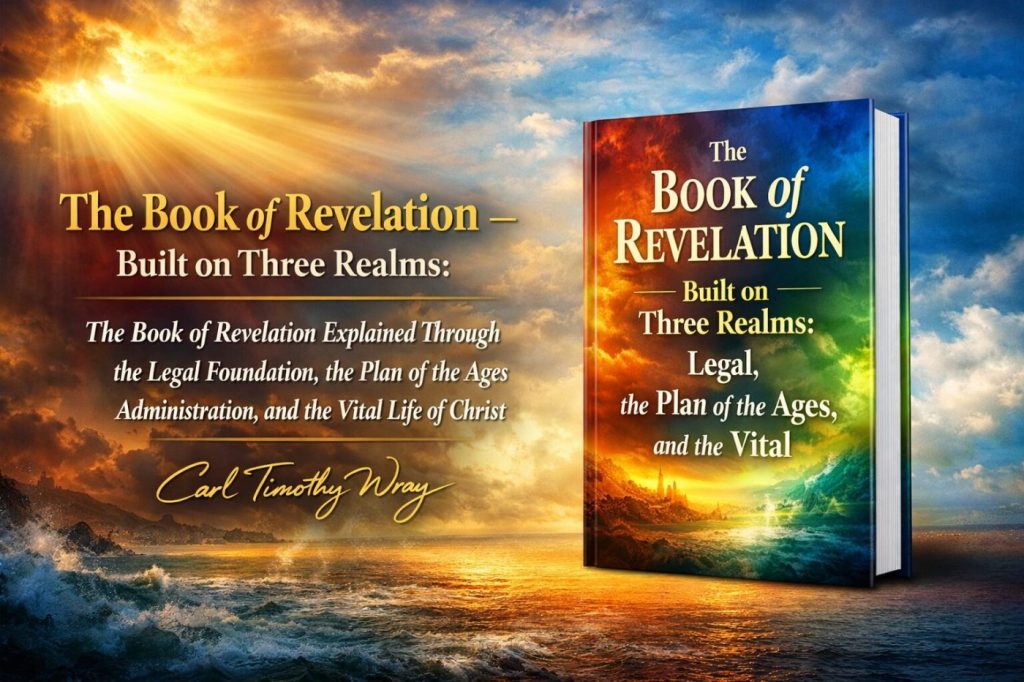
📘 The Book of Revelation Explained Through the Legal Foundation, the Plan of the Ages Administration, and the Vital Life of Christ
✍️ Book of Revelation: AUTHOR
The Book of Revelation was never given to confuse the Church, frighten believers, or postpone hope into an uncertain future. It was given to unveil Jesus Christ reigning — not working toward redemption, but revealing what was already finished from the foundation of the world. This book exists to restore clarity where fragmentation has ruled, and to establish the simple, unshakable structure God Himself used to reveal His final testimony: what is legally finished, what is unveiled through the plan of the ages, and what is actively governed by the life of Christ now.
The Book of Revelation must be understood through three governing realms to be read clearly and correctly: the legal realm, the plan of the ages, and the vital realm. When Revelation is read without this structure, it is often misinterpreted as a book of fear, delay, or future speculation. When it is read through these three realms, Revelation is revealed as the orderly unveiling of Jesus Christ reigning from a finished throne. This book explains the Book of Revelation through the legal foundation of Christ’s finished work, the plan of the ages that administers its unfolding, and the vital life of Christ actively governing what is being unveiled now. Rather than predicting uncertainty, Revelation reveals certainty — showing how what is legally settled is unfolded through the ages and manifested through living governance until God becomes all in all.
📖 Book of Revelation: INTRODUCTION
Why Revelation Requires Structure Before Detail
The Book of Revelation is one of the most quoted, debated, and misunderstood books in Scripture — not because it is unclear, but because it is rarely approached according to its design. Many readers come to Revelation looking for timelines, predictions, or symbolic puzzles, while missing the foundational structure that governs the entire book. When structure is ignored, Revelation feels chaotic. When structure is restored, it becomes the most orderly and peaceful book in Scripture.
Revelation was not written to introduce new redemption, revise the finished work of Christ, or reveal a God reacting to history. It was written to unveil — to remove the veil from what was already accomplished, already settled, and already reigning. The confusion surrounding Revelation does not come from the content of the book, but from reading it without the three realms through which it was given.
Every revelation in Scripture operates within order. Truth is established, administered, and then unveiled in life. Revelation is no different. It is built upon a legal foundation that secures what is true, governed by the plan of the ages that orders how truth unfolds, and animated by the vital life of Christ that actively governs the unveiling in the present.
When any one of these realms is isolated, Revelation collapses into fear, speculation, delay, or mysticism. When all three are held together, the book becomes stable, coherent, and deeply reassuring. The Lamb is seen reigning, not scrambling. The unfolding is understood as administration, not uncertainty. Life is recognized as government, not delay.
This book is written to establish that structure clearly and simply — not to exhaust Revelation’s symbols, but to install the framework required to read them rightly. Before seals, trumpets, bowls, or visions can be understood, the rock beneath them must be set.
That rock is threefold:
the Legal,
the Plan of the Ages,
and the Vital.
📘 CHAPTER ONE
Why the Book of Revelation Is So Often Misread
(The Problem of Fragmented Realms)
The Book of Revelation is rarely misread because of bad intent. It is misread because it is almost always read in fragments. When Revelation is approached through a single lens — whether legal judgment, future chronology, or spiritual experience — the book loses its balance and begins to produce confusion instead of clarity.
Some read Revelation almost entirely through a legal lens. In doing so, they emphasize judgment, finality, and verdicts, but detach those truths from life and unfolding. The result is often fear, rigidity, and a view of God that feels distant or severe. Revelation becomes a courtroom without a living King.
Others read Revelation primarily through the plan of the ages. They focus on sequence, stages, and timing, but without anchoring those stages in a finished work. The result is delay theology — a belief that redemption is still pending, victory is still future, and fulfillment is always just ahead. Revelation becomes a schedule instead of a testimony.
Still others read Revelation almost entirely through a vital or experiential lens. They see movement, spiritual activity, and present application, but without legal grounding. The result is instability, subjectivity, and shifting interpretations that lack assurance. Revelation becomes fluid but unanchored.
Each of these approaches contains truth — but isolated truth becomes distortion.
Revelation was never meant to be read through one realm alone. It was given through all three simultaneously. The Lamb is revealed as legally victorious, administratively governing the unfolding of the ages, and vitally reigning through life. When these realms are separated, Revelation feels unstable. When they are reunited, it becomes clear.
This is why so many interpretations contradict one another. They are not disagreeing over symbols — they are operating from incomplete frameworks. One realm is emphasized while the others are ignored. The result is tension where there should be peace, speculation where there should be assurance, and fear where there should be rest.
Revelation itself does not support fragmentation. It opens by unveiling a reigning Christ, unfolds through ordered stages, and operates as a living book — removing veils, exposing lies, and aligning creation with truth. It demands to be read legally, administratively, and vitally at the same time.
Until this structure is restored, Revelation will continue to feel confusing and unresolved. Once it is restored, the book settles into its proper place — not as a threat to the believer, but as the clearest testimony that Christ reigns, truth is governed, and life is faithfully bringing all things to their appointed end.
With the problem now clearly identified, we can move forward — not into detail, but into foundation. Before Revelation can be unfolded, it must be anchored.
That anchoring begins with the legal realm: what is already finished.
Chapter 2 — The Legal Realm: What Is Already Finished
(The Foundation Revelation Cannot Contradict)
Before the Book of Revelation can be read as an unfolding unveiling, it must first be anchored in what is already settled. Revelation does not introduce uncertainty, renegotiate redemption, or reopen the work of Christ. It begins from a legal reality that cannot be altered, expanded, or reversed: the finished work of Jesus Christ.
The legal realm establishes what is true regardless of appearance, process, or timing. It is the realm of decree, verdict, and completion. In Scripture, legality does not mean cold judgment or distance; it means finality. What is legally established is no longer in question. It does not fluctuate with circumstance, nor does it depend on future events to become valid. It stands because it has already been accomplished.
This is where many interpretations of Revelation go wrong. When the legal realm is not firmly established, Revelation is read as though God is still attempting to accomplish redemption. The seals, trumpets, and bowls are then interpreted as corrective measures, emergency responses, or escalating efforts to fix a failing world. This turns Revelation into a book of instability and portrays God as reacting rather than reigning.
But Revelation itself refuses this reading.
The book opens by unveiling Jesus Christ — not as a Savior striving to win victory, but as the One who has already overcome. He is revealed as Alpha and Omega, the beginning and the end, the One who was dead and is alive forevermore. He is not shown working toward authority; He is shown possessing it. He does not stand before the throne awaiting permission; He stands in the midst of the throne as the Lamb who has already been slain.
This imagery is legal, not emotional. The Lamb appears “as slain” because the work that secured authority is complete. His position is not earned during the unfolding of Revelation; it is assumed from the beginning. Everything that follows flows from this settled reality.
The legal realm declares this plainly:
redemption is finished,
judgment has been rendered,
reconciliation has been accomplished,
and authority has been secured.
Nothing in Revelation contradicts this. The book does not reopen the Cross, revisit the verdict, or introduce new conditions for victory. It unveils the implications of a work that was already complete before history began.
This is why the scroll in Revelation is already written. It is sealed, not because the outcome is uncertain, but because it is settled. The Lamb does not write the scroll — He opens it. He does not determine outcomes — He reveals them. The scroll does not contain contingency plans; it contains established truth awaiting unveiling.
Understanding the legal realm immediately removes fear from Revelation. If the work is finished, then nothing revealed can threaten its completion. If the verdict is final, then nothing unfolding can overturn it. Revelation is not a record of God struggling with evil; it is the testimony of evil being exposed and removed under an already-reigning Christ.
The legal realm also protects the reader from delay theology. When legality is ignored, people assume that unfolding implies incompletion. But legal completion does not require immediate visibility. A verdict can be final even while its implications are still being carried out. Revelation does not delay fulfillment; it reveals the administration of what is already fulfilled.
This is why Scripture consistently speaks of believers as already justified, already reconciled, already seated with Christ. These are legal realities, not future possibilities. Revelation does not revoke them; it confirms them. The book assumes the finished work and builds upon it without contradiction.
The legal realm must always come first. Without it, Revelation feels unstable. With it, the entire book rests on an unshakable foundation. Nothing is missing. Nothing is pending. Nothing is being renegotiated.
Revelation begins from completion, not lack.
With this legal foundation firmly in place, a natural question arises — not one of doubt, but of understanding:
If everything is finished, why does Revelation still unfold?
That question does not undermine the legal realm. It invites the next one.
That answer is found in the plan of the ages — the orderly administration of what has already been secured.
Chapter 3 — The Plan of the Ages: Order Without Delay
(How the Finished Work Is Unfolded)
Once the legal realm is firmly established, a question inevitably arises in the human heart — not from doubt, but from honest observation:
If everything is finished, why does Revelation still unfold?
This question has produced more confusion than almost any other in Christian theology. When it is answered incorrectly, believers fall into one of two extremes. Some assume that God must still be working to complete what Christ began. Others conclude that nothing meaningful is happening now and that fulfillment must be postponed into the future. Both errors arise from misunderstanding the plan of the ages.
The plan of the ages exists not because something is unfinished, but because what is finished must be revealed in order. God does not reveal fullness all at once, not because He lacks power, but because wisdom governs revelation. Order is not delay. Administration is not postponement. Sequence does not imply uncertainty.
The plan of the ages is the orderly administration of a completed work.
Scripture consistently reveals that God establishes truth in eternity and unveils it in time. What is settled before the foundation of the world is revealed progressively within history. Time is not God’s workshop where He fixes unfinished business; it is His unveiling stage where finished truth is made known according to purpose and capacity.
This distinction is crucial for reading the Book of Revelation. When unfolding is mistaken for incompletion, Revelation is misread as a record of God reacting to events, adjusting outcomes, or escalating responses. But Revelation does not depict a God responding to history; it reveals a God unveiling what He already determined.
The plan of the ages explains why Revelation moves in stages, cycles, and patterns. The seals, trumpets, and bowls are not evidence of God trying again and again to achieve victory. They are successive unveilings of the same finished reality, revealed from different angles and depths as understanding matures. The repetition in Revelation is not failure; it is refinement.
Administration does not mean delay. A king who governs in stages is not uncertain about his rule. He is ordering its expression. In the same way, God unfolds revelation according to wisdom, not urgency. Truth is unveiled when it will produce life, not confusion.
This is why Scripture repeatedly shows that believers can be complete in Christ while still growing in understanding. Completion refers to legal reality. Growth refers to revelation. One does not cancel the other. The plan of the ages exists to protect this harmony, ensuring that what is finished is revealed without overwhelming those receiving it.
The plan of the ages also removes fear from time itself. When time is misunderstood, it becomes an enemy — something to escape, survive, or endure. But when time is understood as administration, it becomes a servant of revelation. Time does not threaten fulfillment; it serves it.
Revelation assumes this framework throughout. The book does not rush. It does not panic. It does not hurry toward an uncertain outcome. It unfolds deliberately, confidently, and repeatedly, because nothing is at risk. The outcome is already known. The purpose of unfolding is not to determine the end, but to reveal it.
This is why Revelation can be intense without being unstable. Exposure increases as truth is unveiled. Judgment appears as lies are confronted. But none of this suggests uncertainty. It suggests order. The plan of the ages governs the pace of unveiling so that life is preserved while truth is revealed.
Understanding the plan of the ages protects believers from two destructive errors: believing that God is late, or believing that nothing is happening. In reality, God is neither delayed nor inactive. He is administering what He has already accomplished.
The plan of the ages answers the question the legal realm raises without contradicting it. It explains how completion and unfolding coexist in perfect harmony. What is finished remains finished, even as it is revealed in sequence.
Yet even with legality settled and administration understood, another tension often remains. People may agree that redemption is finished and that it unfolds in order, yet still struggle to understand what God is actively doing now.
That tension reveals the need for a third realm — one that connects finished truth and ordered unfolding to lived reality.
That realm is the vital.
Chapter 4 — The Vital Realm: Life Governing the Unveiling
(The Missing Middle Between Truth and Visibility)
Even when the legal realm is firmly established and the plan of the ages is clearly understood, many believers still experience an unresolved tension. They know redemption is finished. They understand that truth unfolds in order. Yet they struggle to discern what God is actively doing now. This tension does not come from contradiction; it comes from a missing category.
That missing category is the vital realm.
The vital realm is the necessary middle between what is legally true and what is visibly revealed. Without it, finished truth feels static and distant, while unfolding events feel disconnected from assurance. People are left oscillating between two extremes: freezing truth in the past or postponing fulfillment into the future. The vital realm resolves this tension by revealing how life itself governs the unveiling of what is already true.
The vital realm is not a correction to the finished work, nor is it an extension of it. It does not add to truth, revise truth, or complete what Christ has already finished. The vital is the life of Christ actively operating within the boundaries of what has been legally established and administratively ordered. Life is not what God turns on after truth is declared; life is how truth moves.
This distinction is essential. When the vital realm is misunderstood, it is often mistaken for delay. People assume that if something is still unfolding, it must not yet be complete. But Scripture never equates life with postponement. Life does not wait to rule; life reigns. Growth does not imply lack. Process does not imply failure. Movement does not imply uncertainty.
The vital realm explains why Scripture can speak of believers as already complete while still being transformed, already seated while still growing, already possessing all things while still maturing in understanding. These are not contradictions. They are descriptions of life operating between settled truth and visible manifestation.
Without the vital realm, theology becomes brittle. Everything may be correct on paper, yet disconnected from lived reality. Faith becomes agreement without movement. Assurance becomes static instead of alive. On the other hand, when the vital is emphasized without legal grounding, experience becomes unstable, subjective, and unanchored. The vital must always operate within the legal and the plan of the ages to remain safe and governed.
The vital realm functions in the present tense. It expresses what is ready to be seen now while carrying forward what will be unveiled next. These are not two separate activities. They are the same life moving faithfully forward. Life never pauses between expression and preparation. What is not yet visible is not absent; it is simply still being unveiled.
This is why growth should never be interpreted as delay. Growth is evidence of life, not proof of incompletion. A seed contains the full tree, yet the tree does not appear all at once. Nothing is missing in the seed. In the same way, nothing is missing in the finished work. The vital realm governs how that fullness comes to visibility without confusion or harm.
In the Book of Revelation, the vital realm is everywhere present. The book announces itself as an unveiling, not a creation of new truth. The Lamb is shown reigning, not striving. He opens the scroll not to decide outcomes, but to reveal what is written. Every unveiling serves life by exposing what is incompatible with truth and aligning what remains.
This is why Revelation can feel intense without being unstable. As life increases, exposure increases. As light shines brighter, darkness is revealed — not because darkness is winning, but because it is being overcome. Judgment in Revelation serves life by removing lies, not by threatening completion.
The vital realm stabilizes the reader. Fear dissolves because nothing is uncertain. Striving fades because nothing is missing. Waiting loses its pressure because life is already moving. Revelation is no longer read as a book of delay or destruction, but as a living testimony of Christ faithfully governing the unveiling of His finished reign.
The vital does not replace the legal, and it does not override the plan of the ages. It fulfills them in motion. It is the life of Christ ensuring that what is true is revealed wisely, safely, and completely.
Yet one misunderstanding still remains — the belief that if life is still operating, then fulfillment must still be postponed. That assumption quietly turns the vital into a substitute for delay.
To remove that confusion completely, one final clarification is needed.
The vital is not delay.
It is government.
That is where we turn next.
Chapter 5 — Why All Three Realms Must Be Held Together
(The Structure That Stabilizes Revelation)
The Book of Revelation does not allow itself to be understood in fragments. It resists isolation, specialization, and partial frameworks. Every attempt to read Revelation through a single realm — legal, administrative, or experiential — ultimately produces imbalance. Only when all three realms are held together does the book settle into clarity, peace, and coherence.
The legal realm establishes what is true.
The plan of the ages explains how what is true is unfolded.
The vital realm governs how life actively carries that truth into visibility.
Remove any one of these, and Revelation collapses.
When the legal realm is isolated, Revelation becomes rigid and frightening. Judgment is emphasized without life, authority without tenderness, and finality without reassurance. Truth may be correct, but it feels distant and severe. Revelation becomes a verdict without a living King.
When the plan of the ages is isolated, Revelation turns into delay theology. Fulfillment is always future, victory is always pending, and hope is perpetually postponed. The unfolding of truth is mistaken for uncertainty, and administration is confused with hesitation. Revelation becomes a schedule instead of a testimony.
When the vital realm is isolated, Revelation loses stability. Experience replaces foundation, movement replaces certainty, and interpretation becomes subjective. Life may feel active, but it is no longer anchored. Revelation becomes fluid but unreliable.
Each realm, when isolated, distorts the book. Together, they restore it.
Revelation itself demands this threefold reading. It opens by unveiling a Christ who has already overcome. It unfolds through ordered stages that reflect deliberate administration. And it operates as a living book — removing veils, exposing lies, and aligning creation with truth through life. These are not separate emphases; they are simultaneous realities.
The Lamb in Revelation embodies all three realms at once. He reigns because the work is finished. He opens the scroll according to order. He governs unveiling through life. Nothing in the book contradicts this unity. Everything in Revelation flows from it.
This is why Revelation becomes peaceful when read correctly. Fear dissolves because the verdict is settled. Anxiety fades because unfolding is ordered. Striving ends because life is governing. The book no longer feels chaotic or unresolved; it feels anchored, intentional, and complete.
Holding all three realms together also protects the reader from extremes. It prevents cold finality without compassion, delay without assurance, and movement without foundation. It keeps theology stable, experience grounded, and hope secure.
Most importantly, this structure leads Revelation to its true conclusion. The book does not end in endless process, endless unveiling, or endless administration. It ends in fullness. When the legal work has been fully unveiled through the plan of the ages and governed faithfully by life, unveiling reaches its appointed end.
That end is God all in all.
Revelation does not conclude with suspense. It concludes with rest. The temple is no longer needed because God dwells openly. Night is no more because nothing remains hidden. The Lamb does not continue unveiling because nothing remains veiled. Life has accomplished its purpose.
This is not the end of life.
It is the end of unveiling.
When Revelation is read through the legal realm, the plan of the ages, and the vital realm together, the book finally rests where it was always meant to rest — not in fear, speculation, or delay, but in the steady assurance of Christ reigning from beginning to end.
With this structure firmly established, Revelation is no longer a mystery to be feared or postponed. It is the clearest testimony in Scripture that what God finished, He governs; what He governs, He unveils; and what He unveils, He brings home to fullness.
God is all in all.

Book of Revelation Series
- Book of Revelation
- Book of Revelation: The Vital Realm Revealed
- Book of Revelation — Built According to the Pattern: Legal, the Plan of the Ages, and Vital
- The Finished Work of Christ: Meaning, Key Scriptures & FAQs
- Join Our Facebook Page