The Book of Revelation Revealing How Christ’s Finished Victory Reigns, Judges, and Renews Creation
Book of Revelation: AUTHOR
By Carl Timothy Wray
Carl Timothy Wray writes from within the Finished Work of Christ—not as a theory to be defended, but as a reality to be seen, lived, and administered. His work centers on the unified mind of God revealed from Genesis to Revelation, showing how what was eternally settled in Christ is revealed through the Plan of the Ages, made vital within the sons, unveiled by revelation, and manifested through divine administration. Wray’s writings are not speculative or sensational; they are ordered, pastoral, and aimed at removing fear, delay, and confusion so readers may see Christ reigning now.
Book of Revelation: THE WITNESS
If the victory of Christ is truly finished—if the Lamb has already overcome, the throne is already occupied, and the kingdom is already established—then the remaining question is not when something will happen, but how what has already happened now operates. The Book of Revelation was never given to announce a delayed triumph, but to unveil the administration of a victory already secured. This book is written to meet that question honestly and plainly: How does the finished work of Christ govern history, judge systems, and renew creation without waiting for a future catastrophe?
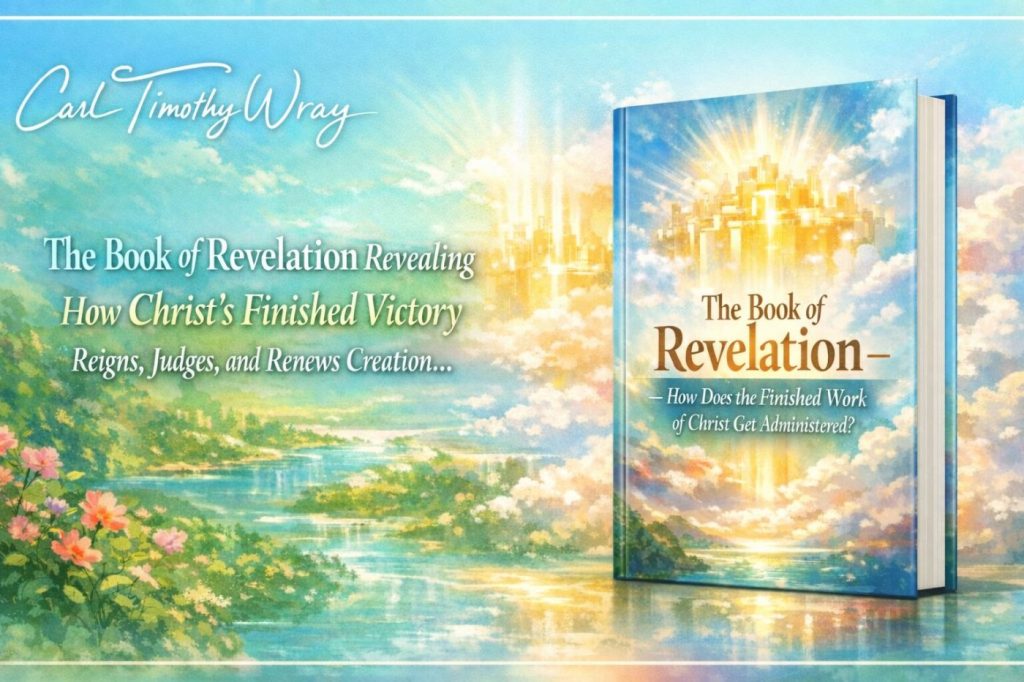
- Book of Revelation New Book 2. Book of Revelation Download PDF 2. Book of Revelation Series 4. Book of Revelation Homepage
Book of Revelation: INTRODUCTION
For many believers, the Book of Revelation creates a quiet contradiction.
On one hand, Scripture proclaims that Christ has finished His work—sin dealt with, death defeated, authority given, and victory secured. On the other hand, Revelation is often taught as though that victory has been postponed, locked behind future events, catastrophic judgments, and a final intervention yet to come. The result is a faith that believes in a finished work while living as though nothing has yet been administered.
This confusion does not arise from the book itself, but from the lens through which it has been read.
Revelation is not a timeline predicting when Christ will rule; it is an unveiling showing how Christ rules. It does not describe Jesus becoming victorious, but reveals how His already-finished victory is enforced, revealed, and manifested within creation. The judgments of Revelation are not delays of mercy, nor are they acts of divine panic. They are the orderly administration of truth, light, and authority proceeding from a throne that is already established.
This book follows the divine pattern revealed throughout Scripture: what was legally settled in Christ is unveiled through the Plan of the Ages, made vital within the people of God, revealed by apocalyptic sight, and then administered within history, systems, and creation itself. Revelation stands at the point of administration—not waiting for victory, but revealing how victory governs.
As you read, you will not be asked to brace for disaster, decode symbols, or await interruption. You will be invited to see how judgment functions as light, how Babylon falls through exposure, how Christ “comes” through unveiling rather than absence, and how the New Jerusalem appears as union rather than relocation. Most importantly, you will see how the finished work of Christ moves from belief into authority—from something confessed into something administered. The Book of Revelation is not a mystery meant to delay believers into the future, but a divine unveiling given to show how Christ’s finished work actively governs history, judgment, and renewal now.
This is not a book about waiting.
It is a book about seeing.
Chapter 1 — The Finished Work and the Question of Administration
The gospel announces something startling: it is finished.
Not partially complete.
Not provisionally accomplished.
Finished.
Sin judged.
Death defeated.
Authority given.
Christ seated.
Yet for many believers, this confession immediately collides with experience. If the work is finished, why does the world still groan? Why do systems of deception remain? Why does judgment appear delayed, righteousness contested, and creation unsettled?
This chapter exists to answer that tension—not by weakening the finished work, but by rightly locating it.
Finished Does Not Mean Inactive
When Jesus cried, “It is finished,” He did not declare the end of God’s activity, but the end of redemption’s uncertainty. The work was completed legally, settled once and for all in the counsel of God and accomplished through the cross. Nothing can be added to it. Nothing can improve it. Nothing can reverse it.
But a finished work still requires administration.
A king may win a war decisively in one moment, yet the peace secured by that victory must be administered over time. Laws are enforced. Enemies are exposed. Order is restored. The victory does not grow stronger—but its effects become visible as it is applied.
Revelation was given not to question whether Christ won, but to unveil how His victory governs.
The Mistake of Confusing Completion with Delay
Much confusion arises when believers assume that if something is finished, it must also be immediately visible everywhere. When visibility lags, theology compensates by pushing fulfillment into the future.
This is how delay doctrine is born.
Instead of asking how a finished victory is being applied, the church has often asked when it will finally arrive. Revelation is then misread as a book announcing a postponed reign rather than unveiling a present one.
But Scripture does not teach that Christ’s victory waits for permission from time. It teaches that time unfolds what eternity has already settled.
Revelation’s Assignment Is Not Achievement, but Unveiling
The very first words of the book tell us its purpose:
“The Revelation of Jesus Christ…”
Not the prediction of events.
Not the invention of authority.
The unveiling of a reality already true.
Revelation does not describe Christ becoming King.
It reveals the King who already reigns.
It does not announce judgment that has not yet been authorized.
It reveals judgment proceeding from a throne already established.
This means the book stands at the point of administration, not anticipation.
Administration Is How Victory Touches Creation
Administration answers questions such as:
- How does truth dismantle deception?
- How does light judge darkness?
- How do systems fall without violence?
- How does Christ “come” without leaving heaven?
- How does renewal occur without restarting creation?
These are not future questions.
They are present ones.
Revelation shows how the finished work of Christ moves:
- from heaven into earth
- from decree into manifestation
- from authority into effect
Not by force, but by unveiling.
Why This Question Matters Now
The church does not need more proof that Christ has won.
It needs sight into how that victory now operates.
Without administration, victory becomes abstract.
Without administration, believers wait instead of govern.
Without administration, Revelation becomes either terrifying or irrelevant.
This book is written to restore the missing link—to show that what was finished at the cross is now actively ruling, judging, and renewing through truth revealed.
The victory is not waiting.
It is being administered.
And Revelation was given so the church could finally see it.
The Book of Revelation answers the tension between a finished cross and an unfolding world by revealing how completed victory is administered rather than postponed.
Chapter 2 — The Throne Is Not Waiting
One of the quiet assumptions carried into the Book of Revelation is that the throne of God is somehow anticipatory—as though heaven itself is waiting on history to catch up before authority can be exercised. This assumption shapes much of end-time teaching, even when it is not spoken aloud. Christ is seen as victorious in principle, yet restrained in practice. The throne is acknowledged, but its rule is postponed.
Revelation immediately corrects this misunderstanding.
Before a seal is opened, before a trumpet sounds, before Babylon is named or judged, the throne is already established.
“Behold, a throne was set in heaven, and One sat on the throne.”
The throne is not introduced as a future development. It is not erected in response to chaos. It is not occupied after conflict. It is simply there—settled, occupied, and governing.
This is the starting point of Revelation’s vision.
Authority Precedes Manifestation
In Scripture, authority is never reactive. God does not respond to events by scrambling to rule. His reign is not triggered by crisis. Authority always precedes manifestation.
This is why Revelation does not begin with beasts, wars, or judgments. It begins with:
- a seated throne
- a sealed scroll
- a worthy Lamb
Everything that follows proceeds from that center.
If the throne were waiting, then judgment would be improvisational.
If the throne were delayed, then history would be uncertain.
If the throne were reactive, then fear would be reasonable.
But the throne is already occupied.
The Lamb Does Not Approach the Throne to Become Worthy
Revelation 5 does not depict Jesus earning authority.
It reveals authority already His.
The Lamb approaches the throne not to win victory, but because He has already prevailed. His worthiness is not produced in Revelation—it is unveiled there. The scroll is not sealed because the plan is unfinished, but because its opening requires the unveiling of the One who already holds authority over it.
The question in heaven is not, “Who will become worthy?”
It is, “Who is worthy?”
And the answer is immediate.
A Seated Christ Means a Finished Conflict
In biblical imagery, a seated king is not waiting for battle. He is ruling after victory. Enemies are not fought at the throne; they are judged from it.
This is why Scripture repeatedly emphasizes that Christ is seated:
- seated at the right hand of God
- seated far above all rule and authority
- seated until all enemies are placed under His feet
The seating of Christ does not signal inactivity.
It signals completion.
What remains is not conquest, but administration.
Why Delay Theology Misreads the Throne
When believers assume the throne is waiting, they reinterpret Revelation as a book about postponement:
- authority delayed
- judgment deferred
- renewal suspended
This creates a theology where evil appears temporarily sovereign and Christ’s reign appears symbolic rather than operative. The church is then taught to endure history rather than participate in governance.
But Revelation never portrays the throne as symbolic.
It portrays it as central.
Every seal, trumpet, and bowl proceeds from it. Every judgment flows from it. Every collapse of Babylon is traced back to it. The throne does not intervene at the end—it governs from the beginning.
Administration Flows From a Resting Throne
Because the throne is settled, administration is orderly.
Nothing in Revelation is chaotic from heaven’s perspective. What appears disruptive on earth is the exposure of what cannot stand in the light of truth. Judgment is not heaven losing patience; it is reality asserting itself.
This is why Revelation does not show Christ pacing.
It shows Him reigning.
And this reign is not future-tense.
It is present.
Seeing the Throne Changes Everything
Once the throne is seen as established rather than waiting, the entire book shifts:
- Judgment becomes revelation, not retaliation
- Babylon’s fall becomes inevitable, not dramatic
- Christ’s coming becomes unveiling, not interruption
- The New Jerusalem becomes appearance, not arrival
The throne is not waiting on time.
Time is unfolding under the throne.
Revelation was given so the church could finally see that distinction.
The throne is not waiting.
It is ruling.
At its foundation, the Book of Revelation begins not with chaos or crisis, but with a throne already occupied, declaring authority as present rather than pending.
Chapter 3 — Judgment as Light, Not Delay
Few words in Scripture have been more burdened by fear than the word judgment. For many readers, judgment immediately suggests postponement—something held back until the end, reserved for a final reckoning, delayed until history runs its course. Revelation is often read through that assumption, turning judgment into a future threat rather than a present function.
But Revelation does not present judgment as delay.
It presents judgment as light.
Judgment in Revelation is not God finally deciding to act. It is the inevitable effect of truth being unveiled in a world built on deception.
Judgment Begins With Seeing
Revelation never introduces judgment apart from revelation. Before anything is shaken on earth, something is revealed in heaven. Before Babylon falls, she is exposed. Before the beast is judged, it is unmasked. Before systems collapse, their lies are brought into the open.
This is because judgment is not first an action—it is an exposure.
Light does not attack darkness.
It reveals it.
When light appears, darkness loses its hiding place. What cannot survive truth begins to disintegrate—not because it is struck, but because it is seen.
This is how judgment functions throughout Revelation.
Why Delay Theology Misunderstands Judgment
When judgment is framed as a future event, it must be delayed to preserve the illusion that evil still has legitimacy. Delay theology assumes that deception can coexist with truth indefinitely, waiting for a final moment when God will intervene and correct things by force.
Revelation rejects that framework.
Judgment does not wait because truth does not wait. The moment truth is unveiled, judgment begins—not violently, but inexorably. Systems built on lies cannot endure sustained exposure to reality.
This is why Revelation describes judgment unfolding in stages. It is not God changing His mind; it is light advancing.
Seals, Trumpets, and Bowls: Progressive Exposure
The judgments of Revelation are often divided into seals, trumpets, and bowls. These are not escalating acts of divine anger, but progressive unveilings of truth.
- The seals reveal what has been hidden.
- The trumpets announce what has been exposed.
- The bowls complete what can no longer be sustained.
At every stage, judgment follows revelation. What is seen cannot be unseen. What is exposed cannot return to secrecy. What is revealed must either repent or collapse.
This is why repentance is repeatedly offered during judgment scenes. Judgment is not exclusion; it is confrontation with truth.
Judgment Falls on Systems, Not Sons
One of the most important shifts Revelation brings is the relocation of judgment’s target. Judgment in Revelation is directed toward systems, powers, and structures of deception, not toward the sons of God.
Babylon is judged.
The beast is judged.
False prophecy is judged.
But the Lamb stands in the midst of His people.
This distinction matters deeply. When judgment is misunderstood as punishment of individuals, fear takes root. When judgment is seen as exposure of systems, clarity replaces fear.
The sons are not being destroyed.
The lie they were trapped in is.
Light Is the Instrument of Judgment
Revelation consistently uses imagery of brightness, fire, eyes like flame, and words like swords. These are not symbols of violence, but of penetrating truth.
Fire burns what cannot remain.
Light reveals what cannot hide.
The Word divides what cannot coexist.
Judgment is not something God does to creation.
It is something truth does within creation.
This is why Revelation can declare that God’s judgments are true and righteous without portraying God as unstable or wrath-driven. Truth is righteous by nature. When it appears, unrighteousness is judged simply by being revealed.
Why Judgment Feels Disruptive
To those invested in deception, judgment feels catastrophic. When systems of power, religion, or economy are built on lies, exposure feels like destruction. But from heaven’s perspective, judgment is restoration.
What is being judged is not life—but death masquerading as life.
Revelation does not celebrate collapse. It reveals why collapse is unavoidable when truth is unveiled.
Judgment Is Already Active
This is the key shift Revelation brings.
Judgment is not waiting at the end of history.
Judgment is active wherever truth is revealed.
Every unveiling of Christ judges something.
Every revelation of the Lamb destabilizes a lie.
Every increase of light shortens the lifespan of Babylon.
The church does not wait for judgment.
The church participates in it by bearing truth.
Seeing Judgment Clearly Restores Peace
When judgment is understood as light rather than delay, fear loses its power. Believers stop bracing for disaster and start recognizing reality. Revelation becomes a book of confidence, not dread.
The question is no longer:
“When will God finally judge?”
The question becomes:
“What is being revealed—and what can no longer stand in its presence?”
That is how judgment works.
And that is why Revelation places unveiling before collapse.
The Book of Revelation reveals judgment not as delayed punishment, but as the present exposure of truth that dismantles deception wherever light appears.
Chapter 4 — Babylon Falls by Exposure
Babylon does not fall because it is attacked.
Babylon falls because it is seen.
This is one of the most misunderstood truths in the Book of Revelation. Babylon is often imagined as a future city, a political empire, or a single end-time government destined to be violently overthrown. But Revelation presents Babylon very differently. She is exposed, lamented, and abandoned—not invaded.
Her fall is the consequence of revelation, not retaliation.
Babylon Is a System Sustained by Deception
Babylon represents a system that thrives on mixture:
- truth blended with lies
- power divorced from righteousness
- religion without life
- commerce without conscience
She is called “the great city” not because of geography, but because of influence. Babylon sits on many waters because she draws strength from peoples, multitudes, nations, and tongues. Her power is relational and ideological, not territorial.
This is why Babylon cannot be destroyed by force.
Force would only strengthen her illusion of legitimacy.
Babylon survives by agreement, not dominance.
Exposure Is Babylon’s Judgment
Revelation does not describe Babylon being stormed or conquered. Instead, she is:
- named
- described
- unveiled
Heaven announces her fall before it is seen on earth because the fall begins the moment her true nature is revealed.
“Babylon the great is fallen, is fallen.”
This declaration is not a prediction—it is a verdict. Once the truth is spoken, Babylon’s fate is sealed. She may continue to exist outwardly for a season, but her authority has already collapsed.
When people see her for what she is, they withdraw their allegiance. And Babylon cannot survive without participation.
Why the Kings and Merchants Weep
One of the most revealing scenes in Revelation is not Babylon’s destruction, but the reaction to it.
The kings weep.
The merchants mourn.
The system’s beneficiaries stand at a distance and lament.
Why?
Because Babylon did not fall by violence.
She fell by loss of belief.
No one comes to defend her.
No one fights for her survival.
They only mourn what they can no longer profit from.
This is the clearest sign that Babylon’s power was never real—it was borrowed.
Religion Is Babylon’s Most Subtle Garment
Babylon is not merely economic or political. She is also religious. She knows how to speak God’s language without carrying God’s life. She knows how to quote Scripture without submitting to truth. She knows how to create systems of devotion that never lead to transformation.
This is why Babylon is called a harlot. She sells intimacy without covenant, spirituality without union, authority without submission to the Lamb.
Her judgment comes when her mixture is exposed.
Once people see the difference between:
- Christ reigning
- and systems claiming authority
Babylon loses her grip.
“Come Out of Her” Is an Invitation to See
When Revelation calls God’s people to “come out of her,” it is not calling for relocation. It is calling for discernment.
You cannot come out of what you have not yet recognized.
Separation happens first in sight, then in allegiance. As truth is unveiled, the sons of God naturally disengage from systems that cannot survive the light. This is not rebellion—it is clarity.
Babylon falls because her covering is removed.
Why Babylon Falls Without Resistance
Revelation never shows Babylon fighting back.
That is not weakness—it is exposure.
Once her deception is revealed, there is nothing left to defend. Her power depended on secrecy, intimidation, and illusion. Revelation strips all three.
What remains collapses under its own weight.
The Lamb Does Not Wrestle Babylon
This is crucial.
Christ does not descend to battle Babylon.
He reveals Himself.
And in His light:
- lies dissolve
- fear evaporates
- systems crumble
Babylon is judged simply by being unable to coexist with truth.
This is administration.
Babylon’s Fall Is Already Underway
Babylon does not fall all at once because exposure spreads progressively. As truth advances, more people withdraw. As more withdraw, the system weakens. As the system weakens, its voice grows desperate.
Revelation shows us the end so we can recognize the process.
Babylon falls by exposure.
Always has.
Always will.
Through the fall of Babylon, the Book of Revelation shows how systems built on illusion collapse when unveiled by the authority of Christ’s finished work.
Chapter 5 — How Christ “Comes” Without Leaving
One of the greatest tensions in the Book of Revelation is the language of Christ’s coming. For many readers, this word immediately suggests absence followed by return—as though Jesus must first leave heaven, traverse distance, and then arrive to intervene in history. This assumption shapes nearly every futurist reading of Revelation and reinforces the idea that Christ’s authority is suspended until His arrival.
But Revelation does not describe Christ returning to take authority.
It reveals authority being unveiled.
Christ does not “come” because He was absent.
He comes because He is revealed.
Coming Is an Apocalyptic Term, Not a Travel One
Revelation is apocalyptic literature. Its language is revelatory, not geographical. Words like coming, appearing, and revealing describe shifts in perception, not changes in location.
To “come” in Revelation is to be unveiled where one was already present but unseen.
This is why Revelation begins not with Christ arriving, but with Christ revealed:
- walking in the midst of the churches
- holding the stars in His hand
- speaking with authority already possessed
He is not approaching the churches.
He is already among them.
“Behold, I Come Quickly” Means Suddenly Revealed
When Christ declares, “Behold, I come quickly,” the emphasis is not on speed of travel, but on suddenness of unveiling. The word translated quickly does not mean “soon in time,” but “suddenly, without delay once it occurs.”
In other words:
When Christ is revealed, He is revealed all at once.
There is no gradual arrival.
There is no partial coming.
There is an unveiling that changes everything immediately.
This is why Revelation’s moments of “coming” are always tied to:
- eyes opening
- truth confronting
- systems collapsing
Christ comes as light comes—instantly.
Presence Precedes Appearing
Throughout Scripture, God’s presence is often acknowledged before it is recognized. The burning bush was present before Moses saw it. The risen Christ walked with the disciples before they recognized Him. The Lord stood in the midst of Israel long before they understood who He was.
Revelation follows this same pattern.
Christ’s presence precedes His appearing.
His authority precedes its recognition.
His reign precedes its manifestation.
Coming is not the beginning of rule—it is the recognition of rule.
Why “Coming” Feels Like Judgment
When Christ is revealed, systems that relied on His absence are immediately judged. Deception depends on invisibility. When the truth appears, lies lose their ground.
This is why Christ’s coming is described as:
- fire
- a sword
- lightning
Not because He attacks, but because truth is decisive.
Nothing remains hidden.
Nothing survives ambiguity.
Nothing resists clarity.
The “coming” of Christ is judgment because it exposes what cannot endure reality.
Christ Comes Through Revelation, Not Interruption
Revelation does not present Christ as interrupting history from outside. It presents Him as unveiling Himself within history.
He comes:
- in messages to the churches
- in the opening of the seals
- in the exposure of Babylon
- in the appearing of the New Jerusalem
Each coming is a deeper unveiling, not a separate visit.
This is why Revelation speaks of Christ coming again and again. These are not multiple returns—they are layers of revelation.
Why Waiting Theology Misses the Moment
When believers are taught to wait for Christ to come, they often miss Christ revealing Himself now. Expectation replaces perception. Delay replaces discernment.
Revelation was not given to keep the church waiting.
It was given to open their eyes.
The church is not waiting for Christ to arrive.
The church is learning to recognize Him.
Coming Without Leaving Explains Everything
Once Christ’s coming is understood as unveiling rather than travel:
- the throne remains occupied
- judgment becomes present
- Babylon’s fall makes sense
- New Jerusalem appears without relocation
Christ never left His throne.
He never abdicated authority.
He never withdrew from creation.
He simply remained unseen by many.
Revelation changes that.
The Greatest Shift Revelation Brings
The shift is simple but profound:
From:
“Christ will come and then rule.”
To:
“Christ reigns—and Revelation shows us how that reign appears.”
This is not semantic.
It is transformative.
When Christ’s coming is seen as unveiling, the church stops waiting and starts seeing. Authority moves from future hope into present clarity.
The Book of Revelation reframes Christ’s “coming” as unveiling rather than absence, revealing authority that was always present but unseen.
Chapter 6 — The New Jerusalem: Where Administration Appears
The New Jerusalem is often treated as the final reward at the end of time—a distant city descending after history concludes. In this reading, the city is postponed, the dwelling of God delayed, and union reserved for later. But Revelation does not introduce the New Jerusalem as a replacement for a failed world. It reveals her as the visible form of a completed union.
The New Jerusalem does not arrive to begin God’s dwelling.
She appears because God is already dwelling.
A City That Comes “Down” Without Traveling
Revelation says the city comes down out of heaven from God. This language has been misread as movement through space rather than unveiling of reality. Heaven is not a location above the clouds; it is a realm of rule. When something comes “down” in Revelation, it is being revealed within visibility, not relocated.
The city descends because what was hidden becomes seen.
The New Jerusalem is not built after judgment.
She is revealed once judgment has done its work.
The City Is a People, Not a Place
Revelation makes this unmistakable:
“I saw the holy city… prepared as a bride adorned for her husband.”
The city is a bride.
A bride is not infrastructure—it is relationship.
The New Jerusalem is the corporate expression of union between God and man. It is the life of Christ fully integrated into a people, governing from within rather than ruling from above.
This is why the city has:
- no temple (because God dwells within)
- no sun or moon (because illumination comes from the Lamb)
- open gates (because fear and exclusion are gone)
The city does not need protection.
It needs visibility.
Administration Happens Through Union
The New Jerusalem is where administration becomes tangible.
God does not govern creation from a distance. He governs through union. The throne is not external to the city—it is within it. Authority flows through shared life, not imposed control.
This explains why:
- the nations are healed by the river
- the leaves of the tree restore, not destroy
- kings bring their glory into the city
Administration here is not domination.
It is life flowing outward.
Why the City Appears After Babylon Falls
Babylon and New Jerusalem are not two cities competing for the future. They are two systems that cannot coexist.
Babylon is sustained by:
- secrecy
- hierarchy
- exploitation
New Jerusalem is sustained by:
- transparency
- union
- shared life
Babylon must fall for the city to appear—not because God is replacing one city with another, but because sight must be restored before union can be recognized.
The city was always there in Christ.
It becomes visible when Babylon’s illusion collapses.
No Temple Means No Mediation
One of the most radical statements in Revelation is that the New Jerusalem has no temple. This means:
- no intermediary structures
- no priestly gatekeepers
- no separation between sacred and common
Administration here is immediate.
God governs from within His people.
This is the fulfillment of everything Scripture promised:
- God dwelling with man
- law written on hearts
- life flowing freely
The city does not wait for permission to rule.
She rules because she lives.
The City Is Present, Not Postponed
Revelation does not say the New Jerusalem will be the dwelling of God. It declares:
“Behold, the dwelling of God is with men.”
This is announcement, not anticipation.
The city appears when eyes are opened. The bride is revealed when union is recognized. Administration begins when life is seen as shared rather than distant.
Seeing the City Changes Governance
Once the New Jerusalem is seen as present reality rather than future reward:
- authority becomes relational
- judgment becomes restorative
- leadership becomes service
- power becomes light
The city does not conquer nations.
She heals them.
This is administration in its highest form.
Why Revelation Ends With a City
Revelation does not end with destruction.
It ends with habitation.
God’s goal was never evacuation.
It was indwelling.
The New Jerusalem is not where history goes when it ends.
It is where creation goes when union is unveiled.
In the appearing of the New Jerusalem, the Book of Revelation reveals where divine administration becomes visible through union rather than relocation.
Chapter 7 — Time Submits to Eternity
One of the greatest misunderstandings surrounding the Book of Revelation is the belief that time governs God. When Revelation is read as a schedule of future events, time becomes the master and God the responder—waiting for moments to arrive before acting. This inversion quietly reshapes theology, turning the finished work of Christ into a promise still constrained by chronology.
Revelation corrects this by revealing a different order altogether.
Time does not govern eternity.
Eternity governs time.
Eternity Is Not Endless Time
Eternity is often imagined as time stretched infinitely forward. But Scripture does not define eternity as duration—it defines eternity as realm. Eternity is the dimension of God’s completed counsel, where purpose is settled before manifestation unfolds.
This is why Scripture can speak of things:
- finished before the foundation of the world
- known before they appear
- accomplished before they are revealed
Eternity does not wait for time.
Time unfolds what eternity has already settled.
The Scroll Was Written Before It Was Opened
In Revelation 5, the scroll does not contain developing plans. It contains a finished counsel that must be unveiled in sequence. The seals do not create events—they reveal them.
This is crucial.
The unfolding of the seals does not mean God is deciding what to do next. It means creation is being brought into alignment with what was already decided.
Time is not the author of events.
It is the servant of revelation.
Why Revelation Appears Sequential
Revelation is often read as a linear progression because time-bound minds require sequence to understand reality. The visions unfold in order not because God is bound to process, but because human perception is.
Sequence is for the observer, not the throne.
This is why Revelation can:
- repeat scenes from different angles
- overlap judgments
- return to the same truths multiple times
It is not circling confusion—it is layering revelation.
“Soon” and “Quickly” Belong to Eternity
When Revelation says things will happen “soon” or “quickly,” the mistake is assuming these words belong to human calendars. In apocalyptic language, they refer to certainty and suddenness, not delay.
What eternity has settled will manifest:
- decisively
- without resistance
- without reversal
When it appears, it appears fully.
This is why Revelation can speak of victory as both accomplished and appearing. The victory does not grow stronger in time—it grows clearer.
Time Exists to Serve Manifestation
Time is not an obstacle to God’s will; it is the stage on which God’s will is revealed. The ages are not pauses—they are administrative phases.
This is the Plan of the Ages:
- Law prepared the vessel
- Grace installed the life
- Fullness manifests the sons
Each age unveils what was already true in Christ.
Revelation sits at the point where time is being confronted by eternity’s truth. What cannot survive eternity’s light begins to collapse within time.
Why Delay Theology Persists
Delay theology persists because it mistakes unfolding for postponement. When people see process, they assume incompletion. When they see sequence, they assume uncertainty.
Revelation dismantles that assumption.
Process does not negate completion.
Sequence does not cancel authority.
A finished work can still be revealed progressively without being incomplete.
Time Bows to the Throne
Revelation never shows God racing against time.
It shows time yielding to God.
The throne stands outside chronology, administering truth into history at the proper measure. What seems slow to impatience is precise to wisdom.
The issue is not whether Christ’s victory will manifest.
It is whether creation will recognize it.
Time will eventually confess what eternity already knows.
Seeing This Frees the Church
When believers realize that time submits to eternity:
- fear loses urgency
- waiting loses dominance
- hope becomes confident
The church stops asking, “How long?”
and starts declaring, “It is written.”
Revelation is not counting down to an end.
It is unveiling what was settled from the beginning.
The Final Tension Resolved
Revelation resolves the tension between:
- already finished
- still unfolding
Not by choosing one over the other, but by revealing their order.
Finished in eternity.
Revealed in time.
Administered through unveiling.
This is how Christ’s finished work governs without delay.
The Book of Revelation demonstrates that time does not govern Christ’s victory, but unfolds what eternity has already settled and secured.
Chapter 8 — From Waiting to Governing
The greatest shift the Book of Revelation brings is not informational—it is positional.
Revelation does not merely change what believers know.
It changes where they stand.
For generations, the church has been taught to wait—wait for Christ to return, wait for judgment to arrive, wait for evil to be removed, wait for the kingdom to come. Waiting became a spiritual posture, and expectation replaced authority. Faith was reduced to endurance, and hope was postponed into the future.
But Revelation was never written to create waiters.
It was written to reveal governors.
Waiting Is the Language of Uncertainty
Waiting assumes something is unfinished.
It implies authority has not yet been released.
It conditions believers to interpret delay as faithfulness.
But Revelation never presents the church as waiting for permission. It presents the church as standing in the midst of a reigning Christ, hearing His voice, and responding to His unveiling.
The letters to the churches do not say, “Hold on until I arrive.”
They say, “He who has an ear, let him hear.”
Hearing—not waiting—is the requirement.
Governing Begins With Sight
No one governs what they cannot see.
This is why Revelation is first and foremost an unveiling. Before authority is exercised, Christ is revealed. Before administration occurs, perception is restored. When believers see Christ reigning, their posture changes automatically.
They stop bracing for the future.
They start discerning the present.
Governance flows from recognition, not effort.
The Church’s Role in Administration
Christ does not administer His finished work alone. Revelation reveals a shared administration:
- priests who reign
- kings who serve
- witnesses who testify
The church does not produce judgment—it bears truth. And truth does the judging.
When the church speaks clearly:
- deception loses cover
- systems lose legitimacy
- Babylon weakens
- healing flows
This is governance by light, not force.
Authority Is Exercised Through Union
Revelation never shows the church ruling independently of Christ. Authority flows from union, not position. The throne remains central, but it is shared life—not delegated power—that administers the kingdom.
This is why overcoming is described relationally:
- abiding
- bearing witness
- remaining faithful
Faithfulness here is not passive loyalty.
It is alignment with what is real.
Why Governing Feels Unfamiliar
Many believers hesitate to embrace governance because they associate it with domination or control. But Revelation redefines authority entirely.
Christ governs by unveiling truth.
The Lamb conquers by revealing Himself.
The city rules by radiating life.
This kind of governance feels unfamiliar because it is not carnal. It does not coerce. It transforms.
The End of Waiting Theology
Revelation closes with an invitation—not to wait longer, but to see clearly.
“Come.”
This is not a cry of desperation.
It is an invitation into participation.
The Spirit and the bride speak together because governance has become shared. Administration is no longer external. Life flows freely because fear has been removed.
Waiting ends where sight begins.
What Changes When This Is Seen
When the church moves from waiting to governing:
- fear gives way to peace
- endurance gives way to clarity
- hope becomes confident
- prayer becomes alignment
- worship becomes agreement
The finished work of Christ stops being a doctrine to defend and becomes a reality to administer.
The Final Witness of Revelation
Revelation does not leave the reader looking ahead.
It leaves the reader standing in light.
The victory is finished.
The throne is occupied.
Judgment is active.
Babylon is falling.
The city is present.
Time is submitting.
Nothing is waiting.
The only remaining question was never when.
It was always how.
And now it has been unveiled.
Ultimately, the Book of Revelation moves the church from waiting into governing by unveiling how Christ’s finished work is administered through truth, light, and shared authority.
By Carl Timothy Wray: The Book of Revelation — How Does the Finished Work of Christ Get Administered?

Book of Revelation Series
- The Book of Revelation — What It Reveals When Seen Clearly
- The Book of Revelation — Seen from Christ’s Victory
- Book of Revelation
- The Finished Work of Christ — God’s Full Counsel Revealed Through the Plan of the Ages
- The Finished Work of Christ: Meaning, Key Scriptures & FAQs: Book of Revelation
- ZION UNIVERSITY FREE SCHOOL OF THE SPIRIT
- Join Our Facebook Page : Book of Revelation