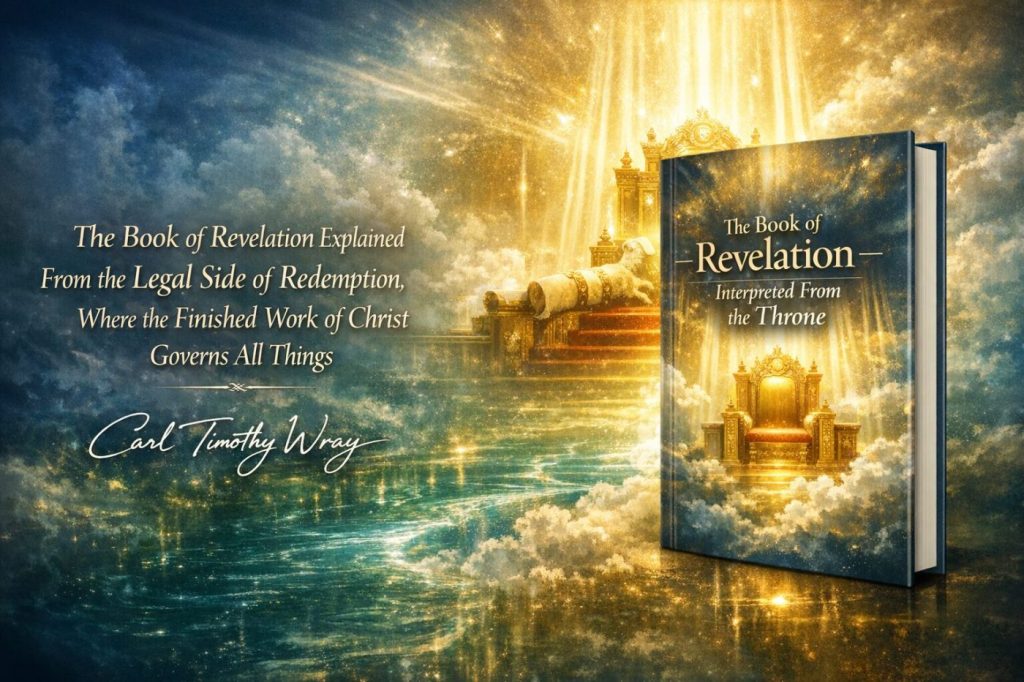
The Book of Revelation Explained From the Legal Side of Redemption, Where the Finished Work of Christ Governs All Things
Book of Revelation: AUTHOR
Most interpretations of the Book of Revelation begin in fear, speculation, or futurism. This book begins where Revelation itself begins — with a throne already set and occupied. Written by Carl Timothy Wray, this work unveils Revelation not as an unresolved prophecy, but as the administration of a victory already finished in Christ, flowing lawfully from God’s eternal counsel into lived, vital reality.
The Book of Revelation is not a prediction of future chaos but the unveiling of how Jesus Christ administers His finished work from a throne already occupied. Interpreted from the legal side of redemption, Revelation reveals Christ reigning as the Lamb, executing judgment, exposing deception, governing the church, and bringing creation into alignment with what was settled before the foundation of the world. This book explains Revelation as present administration, not delayed fulfillment, showing how the finished work of Christ governs history, the church, judgment, and the ultimate purpose of God to be all in all.
Book of Revelation: INTRODUCTION
A Throne Was Set
The Book of Revelation does not open with war, beasts, judgment, or mystery. It opens with a throne.
Before a seal is broken, before a trumpet is sounded, before a beast is seen or Babylon is judged, John is taken by the Spirit to a single, governing reality: “A throne was set in heaven, and One sat on the throne.” Revelation begins not with uncertainty, but with authority. Not with anticipation, but with administration. Not with something about to happen, but with something already settled.
This is where Revelation must be read from — or it will never be read correctly.
The great error in much of Revelation interpretation is not misunderstanding symbols; it is mislocating authority. When Revelation is read as a future struggle for dominion, the throne is subconsciously moved into the future. When the throne is delayed, everything else becomes unstable — judgment becomes reactionary, victory becomes conditional, and redemption becomes incomplete. But Revelation itself refuses that framework. The throne is not emerging. The throne is not contested. The throne is already set.
This throne represents the legal authority of a finished redemption. Christ does not ascend to rule in Revelation; He is revealed ruling. The Lamb does not qualify Himself through future conquest; He is worthy because He was slain. The scroll is not being written in time; it is already written and sealed, awaiting unveiling. Revelation is not the story of God trying to bring history under control — it is the unveiling of how history is governed from a control already established.
Everything in Revelation proceeds from this center. Sounds, lightnings, voices, judgments, and restorations all flow from the throne. The church is addressed from the throne. Deception is exposed from the throne. Satan is judged from the throne. Life flows from the throne. Healing proceeds from the throne. And in the end, the throne fills all things as God becomes all in all.
To interpret Revelation from anywhere else is to misread it.
This book is not written to teach about the throne, but to establish the throne as the interpretive center of the entire revelation. From this center, every symbol finds its place, every judgment its meaning, every conflict its limitation, and every outcome its certainty. Revelation is not a book of suspense — it is a book of administration. It is the working out, in time and creation, of what was legally settled in Christ before the world began.
From Alpha to Omega, Revelation does not move toward a throne.
It flows from one.
This book establishes the Book of Revelation as the administration of Christ’s finished work, interpreted from the throne, where Jesus reigns now from the legal authority of redemption already accomplished.
Chapter 1 — God’s Dream Before Creation
The Alpha That Governs the End
Before there was time, there was intent.
Before there was creation, there was counsel.
Before there was a fall, there was a finished purpose in God.
The Alpha of Scripture is not Adam.
The Alpha is God’s dream.
To begin the Book of Revelation correctly, we must begin where God began — not with human failure, not with cosmic conflict, and not with historical reaction, but with the settled desire of God within Himself. Revelation cannot be understood as the resolution of a problem unless it is first understood as the fulfillment of a purpose. God did not create in order to respond; He created in order to reveal.
Scripture declares that Christ was “the Lamb slain from the foundation of the world.” This does not mean God anticipated sin and prepared a contingency. It means that redemption was not an emergency — it was the predetermined path through which God would reveal Himself to creation. The cross was not God fixing history; it was God unveiling what He had already decided before history existed.
God’s dream was never merely to create servants.
It was to bring forth sons.
It was to share life, not merely command obedience.
It was to dwell, not merely rule.
From the beginning, God’s intention was union — God with man, God in man, and ultimately God all in all. Creation was designed to participate in God’s life, not merely observe His power. The heavens and the earth were formed as a theater for the manifestation of divine life, righteousness, and glory. Everything that unfolds in Scripture flows from this original intent.
This is why the Alpha must be understood before Revelation is approached.
When the Alpha is misunderstood, Revelation becomes a book of crisis management — a story of God struggling to regain control over a broken world. But when the Alpha is seen correctly, Revelation is revealed as the administration of a dream that was never in danger. God is not repairing a failure; He is unveiling a fulfillment.
The plan of the ages exists because God chose to bring what was settled in eternity into lived experience within time. The ages were not random dispensations or delays; they were deliberate stages through which the invisible purpose of God would become visible, tangible, and experiential. Law did not contradict grace. Grace did not negate fullness. Each age served the same eternal intent — the manifestation of God’s life in creation.
The finished work of Christ stands at the center of this plan, not as a reaction to sin, but as the means by which God would reconcile all things to Himself. In Christ, what was known in God before creation entered time, took form, and was completed. The work was finished legally, eternally, and decisively — before it was ever worked out vitally in human experience.
This is why Scripture can command believers to “work out your salvation” without contradiction. One cannot work out what has not already been placed within. Vital experience flows from legal reality. Manifestation flows from settlement. Life flows from truth already established.
Revelation, therefore, does not move toward an unknown end. It unfolds from a known beginning. The Alpha already contains the Omega. God did not begin creation hoping for a conclusion; He began with the conclusion already secured within Himself.
The Book of Revelation is the final unveiling of this truth — not the creation of God’s outcome, but the disclosure of how God brings His dream into full expression. The throne revealed in Revelation does not represent a late-stage takeover of authority; it represents the public manifestation of an authority that was never absent.
Before seals are opened, before judgments proceed, before history reaches its visible conclusion, Revelation takes us back — not forward — to what was already true. It re-centers all things in God’s original intent and declares that nothing in time has the power to undo what was settled in eternity.
This is the Alpha.
And because the Alpha is secure, the end is not in question.
The throne that governs Revelation does not arise from conflict — it arises from purpose. And it is from this Alpha that the entire book must now be read.
The Book of Revelation must be read from God’s eternal purpose, revealing that the finished work of Christ was settled before creation and unfolds according to God’s original dream.
Chapter 2 — The Finished Work Before the Ages
The Legal Side of Redemption
If Revelation is to be interpreted from the throne, then the legal ground upon which that throne rests must be established beyond dispute. Authority does not arise from power alone; it arises from lawfully completed work. The throne in Revelation is not a throne of potential — it is a throne of settled jurisdiction.
Before anything was worked out in time, something was finished in eternity.
Scripture declares that Christ was “slain from the foundation of the world.” This statement does not belong to poetry or metaphor alone; it belongs to legal reality. It tells us that redemption was not decided after sin entered the world. It was settled before the world was ever formed. The cross did not surprise God, and redemption did not emerge as a reaction to failure. The work was complete in God’s counsel before the ages were framed.
This is the legal side of redemption.
Legal does not mean cold or mechanical. It means settled, binding, and unalterable. In the legal realm, a finished work cannot be undone by later events. Once a verdict is rendered, history does not renegotiate it. This is why Scripture speaks of Christ’s victory in past tense even while its effects unfold across time. The work was accomplished once; its administration spans the ages.
This distinction is essential. Without it, Revelation becomes unstable.
When the legal side of redemption is ignored, Revelation is misread as a future battlefield where outcomes remain undecided. Judgment appears reactive. Authority seems threatened. Victory is postponed. But Revelation itself assumes the opposite. It presupposes that the legal case has already been closed. What remains is not resolution, but execution — not in violence, but in truth, exposure, and restoration.
The finished work of Christ resolved every legal question that could ever arise between God and creation. Sin was judged. Death was defeated. Satan was stripped of legitimate authority. Separation was abolished. Reconciliation was secured. These were not progressive achievements; they were decisive acts. Nothing in time adds to them. Nothing in history improves them. Nothing in Revelation completes them.
This is why Christ can declare, “It is finished,” without qualification. The phrase does not mean that experience ended — it means that the legal work was done. What follows in Scripture, including Revelation, is the working out of what is already true.
The plan of the ages exists precisely because the legal side was settled first. God did not design history to discover an outcome; He designed it to administer an outcome already known. The ages are not attempts; they are expressions. Law revealed the need. Grace installed the life. Fullness manifests what was always intended. At no point does God revise His verdict.
This is why believers are described as justified, reconciled, seated, and complete — even while being transformed. These are legal realities that precede vital experience. One does not become justified by experience; one experiences life because justification has already been granted. The vital realm rests entirely upon the legal realm.
Revelation assumes this framework without apology.
When John sees the throne, it is already occupied. When the scroll appears, it is already written and sealed. When the Lamb takes the scroll, He is already worthy. When judgment proceeds, it proceeds lawfully from authority already established. Revelation never depicts Christ earning dominion. It reveals Him exercising dominion He already possesses.
This is the error of futurism: it places legal authority at the end of the story instead of at the beginning. But Revelation refuses that placement. The book opens by declaring Christ as the faithful witness, the firstborn from the dead, and the ruler of the kings of the earth. These are not promises — they are declarations of present authority.
The finished work before the ages is the immovable foundation beneath every symbol in Revelation. Beasts can appear, but they cannot threaten the verdict. Judgment can unfold, but it cannot reverse redemption. Conflict can be revealed, but it cannot destabilize the throne.
Everything that follows in Revelation must be interpreted in light of this truth:
the legal work was already finished before the book was ever written.
Revelation is not God deciding what to do.
It is God revealing what He has already done.
And because the legal side is settled, the throne stands unchallenged — not as a place of uncertainty, but as the lawful center from which all administration proceeds. This chapter confirms that the Book of Revelation assumes the finished work of Christ as a legal reality already completed before the ages began.
Chapter 3 — The Plan of the Ages
From Intangible Counsel to Vital Reality
What is settled in God does not remain hidden forever.
What is finished legally does not remain abstract.
God’s eternal counsel moves — deliberately and lawfully — from the intangible into the vital, where it is lived, experienced, and manifested.
This movement is the plan of the ages.
Without understanding the plan of the ages, Revelation becomes confusing and unnecessary. If redemption were only about a legal verdict, there would be no need for history to unfold. But God’s purpose was never merely to declare truth; it was to manifest life. The ages exist because God chose to bring what was complete in Himself into expression within creation.
The ages are not delays.
They are not corrections.
They are not God “waiting things out.”
They are administrative stages through which eternal reality becomes experiential reality.
Before time began, the work was finished in God. In Christ, that finished work entered time. Through the ages, that finished work is worked out — not to complete it, but to reveal it, inhabit it, and express it. This is the difference between legal settlement and vital manifestation.
Legal truth answers the question: What is true?
Vital truth answers the question: What is lived?
God determined both.
This is why Scripture can hold together statements that appear contradictory to natural reasoning. Believers are declared righteous — and yet they grow in righteousness. They are seated with Christ — and yet they walk on earth. They are complete — and yet they are being transformed. These are not contradictions; they are the natural result of a plan that moves from settled reality into experienced reality.
The command to “work out your salvation” only makes sense if salvation is already present within. One does not work toward salvation; one works out what has already been installed. The vital realm never produces truth — it expresses truth that already exists. Experience does not create reality; it manifests reality.
This is the framework Revelation assumes.
Revelation is not concerned with establishing redemption. It is concerned with administering redemption through time. It shows how what was finished in Christ is applied, enforced, revealed, and manifested in the church, in the nations, and ultimately in creation itself.
This is why Revelation belongs at the end of Scripture — not because it finishes the work, but because it reveals the working out of the finished work. Genesis reveals God’s intent. The Gospels reveal God’s accomplishment. Revelation reveals God’s administration.
The plan of the ages explains why conflict can appear in a world where victory is already won. Truth entering darkness produces resistance. Light does not struggle because it is weak; it is resisted because it is strong. The ages are the stages through which light is introduced, resisted, exposed, and finally embraced. Revelation records the final unveiling of this process.
But the key is this:
the ages do not determine the outcome.
The outcome determines the ages.
God did not enter history hoping to achieve something. He entered history to reveal something already achieved. Each age brings greater clarity, greater exposure, and greater participation in what has always been true. Revelation does not introduce a new phase of uncertainty; it unveils the culmination of an orderly plan.
This is why the throne appears so early in Revelation. Before administration begins, authority is shown. Before experience unfolds, reality is established. Before judgment proceeds, jurisdiction is declared. Revelation does not ask the reader to wonder where God stands; it shows where God sits.
The plan of the ages ensures that what was invisible becomes visible, what was spiritual becomes experiential, and what was known in God becomes known in creation. Revelation is the unveiling of this process at its highest level — where heaven and earth, time and eternity, counsel and manifestation converge.
The Alpha contained the Omega.
The legal contained the vital.
The counsel contained the manifestation.
And because the plan of the ages is orderly, nothing in Revelation is chaotic, accidental, or reactionary. Every unveiling, every judgment, every exposure flows from a plan already complete in the mind of God.
This is why Revelation must now be interpreted from the throne.
The throne is not a later development in the ages — it is the source of them.
With the Alpha settled, the legal work complete, and the plan of the ages understood, Revelation can now be read correctly — not as a future crisis, but as the lawful administration of a finished redemption, moving creation toward the fulfillment of God’s eternal dream. The Book of Revelation reveals how God’s finished redemption moves through the plan of the ages from eternal counsel into vital, lived experience.
Chapter 4 — A Throne Was Set
The Center From Which All Things Proceed
Revelation does not begin by explaining events.
It begins by establishing location.
Before John sees seals, trumpets, beasts, judgments, or restorations, he is taken by the Spirit to a single, immovable reality:
“A throne was set in heaven, and One sat on the throne.”
This statement is not descriptive — it is governing.
Revelation does not ask whether the throne will be occupied.
It does not suggest the throne is contested.
It does not portray a struggle for authority.
The throne is already set.
The throne is already occupied.
The throne is already ruling.
Everything else in the book must now be interpreted from this center — or it will be misread.
This is where most interpretations of Revelation go astray. They begin with symbols and attempt to locate authority later. Revelation does the opposite. It establishes authority first, then unveils symbols as expressions of that authority. The throne is not one image among many; it is the axis upon which every image turns.
The throne represents the legal authority of God exercised through Christ. It is not merely a seat of power — it is the seat of jurisdiction. Thrones do not exist for spectacle; they exist for governance. When Scripture reveals a throne, it reveals that decisions have already been made and are now being administered.
John is not shown a God preparing to reign.
He is shown a God already reigning.
This is critical.
If the throne is already set, then nothing that follows can be interpreted as uncertain. Judgment cannot be reactive. Conflict cannot be existential. Redemption cannot be partial. The throne precedes them all and defines them all.
The throne appears before any action because authority always precedes administration. God does not act first and then establish rule; He rules first and then acts. Revelation respects this order. Before history is interpreted, authority is located. Before outcomes are unveiled, jurisdiction is established.
Around the throne, everything is positioned properly. The elders are seated — not striving, not anxious, not contending. They wear crowns because authority has been delegated. They are clothed in white because righteousness has already been granted. Nothing around the throne suggests urgency or instability. The atmosphere is settled because the work is settled.
From the throne proceed lightnings, voices, and thunderings. These are not signs of chaos; they are signs of lawful administration. In Scripture, such manifestations accompany covenantal authority. They signify that what unfolds flows from a legitimate source. Revelation’s judgments do not arise from crisis; they proceed from authority.
Before John sees the scroll, the throne is already there.
Before the Lamb takes the scroll, the throne is already there.
Before seals are opened, the throne is already there.
Before beasts are revealed, the throne is already there.
The throne does not react to unfolding events — unfolding events answer to the throne.
This is why Revelation must be interpreted from the throne rather than toward it. When the throne is placed at the end of the story, Revelation becomes a struggle for dominion. When the throne is established at the beginning, Revelation becomes an explanation of how dominion is exercised.
The throne also reveals something deeper: the legal side of redemption is complete. Thrones rest on verdicts. A throne that is already occupied testifies that the case has already been decided. Christ does not ascend to the throne through Revelation; He is revealed on the throne because His work already qualified Him.
The Lamb does not win authority by future conquest.
He holds authority because He was slain.
This is the legal foundation beneath the throne.
The scroll that appears in Revelation is not being written in time. It is already written, sealed, and complete. The throne holds the scroll because the decree already exists. Revelation is not about creating outcomes; it is about unveiling what has been decreed and administering it through time.
Every seal broken, every trumpet sounded, every vial poured out must be read as an action proceeding from a throne that is not in question. The throne is not responding to rebellion; it is exposing rebellion. It is not scrambling to regain control; it is revealing the nature of what has already been judged.
The greatest mistake a reader can make is to treat Revelation as a battlefield where God’s authority is being contested. Revelation is not the story of God winning authority — it is the story of authority being revealed and enforced.
This is why John must first see the throne.
Until the throne is seen, symbols confuse.
Once the throne is seen, symbols clarify.
The throne becomes the interpretive lens through which everything else must pass. Beasts are not threats; they are subjects under judgment. Babylon is not an equal power; it is a system exposed by truth. Satan is not a rival; he is a defeated adversary whose deception is being dismantled.
Nothing in Revelation rises above the throne.
Nothing escapes the throne.
Nothing alters what the throne has settled.
The throne stands at the center of the book because it stands at the center of reality. It represents the finished work of Christ expressed as governing authority. From it flows administration, judgment, life, healing, and restoration. In the end, the same throne that governs Revelation will fill all things as God becomes all in all.
Revelation does not move toward the throne.
It moves from it.
And once the throne is seen as set, occupied, and reigning, the reader is finally free to read the book without fear, without speculation, and without uncertainty.
Everything that follows now has a center.
The Book of Revelation is interpreted correctly only when the throne is seen as already set, occupied, and governing all things through Christ’s finished work.
Chapter 5 — The Throne and the Legal Authority of Redemption
Why the Lamb Rules
A throne without legal authority is only a seat of power.
But the throne revealed in the Book of Revelation is not upheld by force — it is upheld by finished redemption. The authority exercised from the throne does not originate in domination; it originates in lawfully completed work.
This is why Revelation does not reveal a Lion conquering to become worthy.
It reveals a Lamb who is worthy because He was slain.
When John weeps because no one is found worthy to open the scroll, the crisis is not about strength; it is about qualification. Worthiness is a legal question. Authority does not belong to the strongest, but to the one who has lawfully satisfied the requirements of redemption. The Lamb steps forward not to win the right to rule, but to exercise a right already earned.
The throne and the Lamb cannot be separated.
The throne represents jurisdiction.
The Lamb represents legal fulfillment.
Together, they reveal why Christ reigns: not because He overpowered creation, but because He reconciled it.
The scroll in the right hand of Him who sits on the throne is already written and sealed. This detail is decisive. A sealed scroll indicates a decree that is complete, authoritative, and unalterable. Nothing is added to the scroll in Revelation. Nothing is revised. Nothing is corrected. The Lamb does not write history; He unveils what has already been decreed.
This is the legal nature of redemption.
The Lamb is declared worthy because He has redeemed. The song in heaven does not celebrate future conquest; it celebrates past accomplishment:
“You were slain, and have redeemed us to God by Your blood…”
Every verb is past tense.
Redemption is not anticipated.
It is acknowledged.
Because the Lamb was slain, authority is now exercised. Because the work is finished, administration proceeds. This is why Revelation does not depict Christ ascending to power through stages of conflict. It reveals Him already possessing the keys of death and hell. Authority is not gradually accumulated; it is openly manifested.
The elders fall down before the Lamb because they recognize legal authority. Worship in Revelation is not emotional response; it is judicial recognition. Heaven acknowledges that the verdict has been rendered and that the rightful ruler now administers what has been decided.
This is the courtroom language of Revelation.
The throne is not waiting for validation from history. History answers to the throne because the case has already been decided in Christ. The Lamb’s blood is not a plea for mercy; it is the legal basis upon which mercy, reconciliation, and restoration are lawfully released.
This is why Revelation can speak simultaneously of judgment and victory without contradiction. Judgment does not threaten redemption; it enforces it. Judgment in Revelation is not God undoing creation — it is God removing what stands in contradiction to what has already been redeemed.
The throne administers redemption, not uncertainty.
This legal framework explains why Revelation never portrays the Lamb losing ground. Beasts may arise, but they arise under limitation. Babylon may boast, but her fall is already announced. Satan may deceive, but his authority is already stripped. Nothing in Revelation is portrayed as an equal power to the throne.
Because the Lamb rules from the throne, every conflict is asymmetrical. There is no cosmic struggle between equals. There is exposure, restraint, judgment, and removal — all proceeding from lawful authority.
The throne also reveals the nature of God’s government. God does not rule creation through coercion; He rules through reconciliation. The Lamb governs because He gave His life. Authority flows from self-giving love, not domination. This is why the throne is surrounded by worship rather than fear. Heaven recognizes that the rule of the Lamb is righteous, just, and good.
The legal authority of redemption explains why Revelation ends not in destruction but in restoration. Because redemption is legally complete, creation can be healed without compromising justice. Because the Lamb has satisfied the law, mercy can flow without contradiction. Because authority is grounded in finished work, the end can be God all in all.
This is the meaning of the throne joined to the Lamb.
The throne is not arbitrary power.
It is redeemed authority.
It is law fulfilled.
It is justice satisfied.
It is life released.
From this throne, Revelation unfolds — not as a drama of uncertainty, but as the lawful administration of a redemption already accomplished.
And because the Lamb reigns from this throne, nothing that follows can ever be read as unfinished, undecided, or out of control.
The throne stands because the work is finished.
The Book of Revelation reveals that Jesus reigns from the throne because the legal work of redemption was fully satisfied by the Lamb who was slain.
Chapter 6 — Everything Proceeds From the Throne
How to Read the Book of Revelation
Once the throne is seen, Revelation changes permanently.
The throne is not a scene to admire; it is a source. It is the place from which all authority flows, all judgments proceed, all unveilings occur, and all outcomes are governed. Revelation does not unfold independently and then return to the throne for resolution. It unfolds from the throne because the authority governing history is already established.
This is the interpretive key of the entire book.
If something in Revelation proceeds from the throne, it cannot contradict the finished work. If it flows from the throne, it cannot threaten redemption. If it issues from the throne, it cannot represent chaos or uncertainty. Thrones do not release confusion; they release administration.
Revelation itself insists on this order.
Lightnings, thunderings, and voices proceed from the throne. The scroll is opened before the throne. Judgments are announced from the throne. Worship is directed toward the throne. Life flows out of the throne. The river of life does not begin in the wilderness; it begins at the throne. Even the New Jerusalem is organized around the throne at its center.
This is not repetition for emphasis — it is structure.
Everything in Revelation either happens:
- before the throne
- around the throne
- from the throne
Nothing happens apart from it.
This means Revelation cannot be read as a collection of independent visions or escalating crises. It must be read as throne-administered reality. Seals are not random judgments; they are lawful unveilings. Trumpets are not reactions to rebellion; they are proclamations of truth. Bowls are not explosions of wrath; they are the final applications of what has already been judged.
The throne governs sequence, meaning, and limitation.
Because everything proceeds from the throne, Revelation is not describing events spinning out of control. It is describing the controlled exposure of everything that contradicts the finished work. Deception is allowed to manifest only so that it can be judged. Darkness is revealed only so that it can be dispelled. Resistance is permitted only so that truth can be vindicated.
This is why Revelation often appears intense to those who do not see the throne. Without the throne, symbols feel violent, chaotic, and threatening. With the throne established, those same symbols are seen as measured, restrained, and purposeful.
Nothing in Revelation surprises the throne.
The seals are opened one by one because authority regulates disclosure. Truth is unveiled in stages because humanity receives in stages. Revelation is not sudden devastation; it is progressive clarity. Each unveiling removes another layer of illusion until reality stands exposed in full light.
This explains why Revelation is given to the church. It is not written to frighten the world but to stabilize the saints. The church must know that everything unfolding in history is governed, limited, and purposeful. The throne does not tremble when deception rises. It simply unveils it.
Once the reader understands that everything proceeds from the throne, the entire book settles. Beasts lose their terror. Babylon loses her mystery. Judgment loses its threat. Satan loses his mystique. Everything finds its proper place — under authority.
This chapter is the turning point where Revelation stops being read emotionally and starts being read juridically. It teaches the reader not what to think about each symbol, but how to locate each symbol in relation to the throne.
If a symbol contradicts the finished work, it has been misread.
If a judgment appears unjust, it has been detached from the throne.
If a conflict appears uncertain, authority has been misplaced.
The throne corrects all misreadings.
From this point forward, Revelation no longer needs to defend the victory of Christ. That victory is assumed. The rest of the book simply shows how that victory is administered through time, applied in the church, enforced against deception, and ultimately manifested in creation.
This is why Revelation is not a book of fear for those who see the throne. It is a book of clarity. It removes suspense from history and replaces it with certainty. It shows that nothing unfolds outside of God’s authority and nothing delays God’s purpose.
The throne does not rush.
The throne does not panic.
The throne does not react.
The throne administers.
And because everything proceeds from the throne, the reader is now equipped to walk through the remaining symbols of Revelation without speculation, without anxiety, and without contradiction.
The center has been established.
The lens has been set.
Everything that follows now falls into place.
Every symbol in the Book of Revelation proceeds from the throne, demonstrating that all judgment, authority, and administration flow from Christ’s finished redemption.
Chapter 7 — The Throne and the Church
Authority Expressed Through Lampstands
The throne in Revelation does not rule creation from a distance.
It governs through union.
From the opening chapters of Revelation, the authority of Christ is not directed first toward nations, beasts, or judgment — it is directed toward lampstands. This is not incidental. The church is not an afterthought in Revelation; it is the primary instrument through which throne authority is expressed in the earth.
John is told that the lampstands are the churches, and that Christ walks among them. This is not symbolic poetry; it is governmental reality. The One seated on the throne is also present within His body. Authority does not bypass the church; it flows through it.
This corrects a major misunderstanding.
Many read Revelation as though Christ rules from heaven while the church merely survives on earth. Revelation presents something entirely different: Christ reigns from the throne and manifests His authority through a people who share His life, His testimony, and His position.
The church is not striving to become authoritative.
It is learning to function from authority already granted.
This is why the letters to the churches precede the unveiling of seals and judgments. Before Revelation addresses global systems, it addresses local lampstands. Before deception is exposed in the world, Christ exposes mixture in His people. Administration always begins at the house of God.
The messages to the churches are not threats; they are adjustments. They do not question Christ’s authority — they apply it. The throne is not insecure; the lampstands are being aligned to express it accurately. Revelation shows Christ governing His body so that His body can govern in the earth.
This is where the concept of the overcomer emerges.
Overcomers are not spiritual elites. They are believers who agree with what is already true. They overcome not by effort, but by alignment. Scripture declares that they overcome by the blood of the Lamb and the word of their testimony. The blood speaks of finished redemption. The testimony speaks of agreement with that redemption. Overcoming is not conquest — it is confession aligned with reality.
This is why the church is entrusted with testimony. Testimony is legal language. It establishes witness. It enforces truth. The church does not invent authority; it bears witness to authority that already exists. As the church testifies to the finished work of Christ, deception loses ground and truth advances.
The throne governs the church so that the church can govern deception.
This is also why Revelation depicts the saints as kings and priests. Kings exercise authority. Priests mediate life. The church is not waiting for a future reign; it is learning to function in its present calling. The throne has already shared its authority. The issue is not access — it is understanding.
The lampstands represent light-bearing presence. They do not generate light; they hold it. Christ is the light. The church bears that light into the world. Revelation shows that when the church functions correctly, darkness does not prevail — it is exposed.
This is why persecution, pressure, and tribulation appear in Revelation alongside victory. Light entering darkness produces resistance. That resistance does not mean the throne is threatened; it means truth is advancing. The church does not endure tribulation because it lacks authority, but because authority is being exercised.
The throne remains secure while the church is refined.
Revelation never depicts the church as abandoned during administration. It shows Christ speaking, correcting, encouraging, and promising. Even when judgment unfolds in the world, the church is sealed, protected, and identified. Authority does not bypass relationship. Governance does not replace intimacy.
The ultimate goal is not domination but manifestation — the revealing of sons who bear the nature, authority, and life of the One on the throne. The church is not merely preparing for heaven; it is participating in heaven’s government now.
This chapter establishes a crucial truth:
the throne does not rule instead of the church — it rules through the church.
When this is seen, Revelation is no longer read as a story of escape, but as a call to alignment. The church is not waiting for history to end; it is participating in how history is governed.
From the throne flows authority.
Through the church flows expression.
And when the church functions as lampstand, witness, and overcomer, creation begins to feel the effects of a throne already set.
The Book of Revelation shows the throne governing through the church as overcomers walk in the authority of Christ’s finished work.
Chapter 8 — The Throne and the Exposure of Deception
Judgment as Revelation, Not Destruction
Judgment in the Book of Revelation does not begin in anger.
It begins in truth.
When Revelation is read apart from the throne, judgment appears violent, reactive, and destructive. But when Revelation is interpreted from the throne, judgment is revealed as something far more precise: the lawful exposure of deception. The throne does not lash out; it unveils. It does not destroy indiscriminately; it reveals what cannot stand in the light.
This is why Scripture declares that “judgment was given to the saints.” Judgment is not chaos unleashed — it is discernment exercised. It is truth confronting falsehood and removing its legitimacy.
Beasts, Babylon, false prophets, and deceiving systems are not introduced in Revelation as rival powers equal to God. They are revealed as systems of deception that operate only where truth has not yet been seen. Their power is not intrinsic; it is derivative. They exist by concealment, not by authority.
This is why they must be revealed.
The throne governs judgment by revelation. When truth appears, deception loses its power automatically. Darkness does not need to be attacked; it needs to be exposed. Revelation does not portray God violently dismantling Babylon — it portrays Babylon collapsing when she is seen for what she is.
“Babylon the Great is fallen, is fallen” is not a cry of warfare; it is a declaration of exposure. Her fall is the result of her unveiling. Once illusion is removed, her authority evaporates.
This is the nature of throne judgment.
The beasts of Revelation represent false authority — systems, ideologies, and identities that claim power apart from the finished work of Christ. They rise only where the throne is misunderstood. Their dominion is temporary and conditional because it is built on deception. Revelation reveals them not to frighten the saints, but to disarm fear by showing their true nature.
Notice this carefully:
the throne never fights the beasts directly.
It judges them by truth.
The sword that proceeds from the mouth of Christ is not a weapon of violence; it is the Word that divides reality from illusion. When the Word speaks, false systems are “slain” — not by force, but by loss of credibility. This is why Revelation’s warfare is ideological, not geographical; spiritual, not carnal.
Judgment, therefore, is not the undoing of creation — it is the undoing of lies.
This also explains the intensity of Revelation’s imagery. When truth confronts entrenched deception, exposure feels catastrophic to the lie. What collapses is not life, but false structure. What burns is not humanity, but false identity. The lake of fire imagery speaks of complete judgment — the final removal of everything that contradicts God’s life — not endless punishment of creation.
The throne does not seek to destroy what it has redeemed.
It seeks to purify what has been corrupted.
This is why judgment in Revelation always moves toward restoration. After exposure comes clarity. After judgment comes healing. After Babylon falls, a city of life appears. After deception is silenced, truth fills the earth. Revelation never leaves creation in ruins; it leads creation into renewal.
This chapter is critical because it removes fear from the heart of the reader. Once judgment is understood as exposure flowing from the throne, Revelation becomes coherent and hopeful. The saints are not awaiting devastation; they are witnessing the removal of what never belonged.
The throne is not threatened by deception.
It permits deception only until truth is ready to be revealed.
When this is understood, the reader no longer asks, “Will evil win?”
The question becomes, “How long until it is fully exposed?”
Revelation answers that question calmly, confidently, and lawfully.
Everything exposed was already judged at the cross.
Everything judged is being removed through revelation.
Everything removed makes room for life.
This is the work of the throne.
Judgment is not God losing patience.
Judgment is God revealing reality.
And when reality is revealed, deception cannot survive.
Chapter 9 — The Throne and the Final Unraveling
The End of Deception, Not the Return of Conflict
If Revelation is interpreted from the throne, then the final scenes of the book cannot be read as a resurgence of defeated powers. The throne does not lose authority at the end of the story — it completes its administration. What is unveiled in the later chapters of Revelation is not a last desperate battle, but the final exposure and removal of deception itself.
This is where many interpretations falter.
When the throne is forgotten, Revelation 20 is read as if Satan regains influence, gathers strength, and threatens God’s purpose one final time. But Revelation never presents Satan as a rival power equal to the throne. It presents him as a defeated adversary whose authority has already been stripped and whose influence remains only where deception still exists.
The key word is deception.
Satan’s power has never been intrinsic. It has always depended on blindness, lies, and false perception. Once truth is revealed, his influence collapses. Revelation shows this collapse not as a sudden event, but as a process of exposure governed by the throne.
When Scripture speaks of Satan being bound, it is not describing a physical restraint; it is describing the loss of deceptive authority. A bound adversary is one whose lies no longer govern. The binding of Satan means that the truth of the finished work restricts his ability to deceive the nations. His voice no longer defines reality.
Yet deception does not disappear instantly everywhere, because revelation is received progressively. Where truth has not yet been embraced, illusion can still operate. Revelation 20 describes the final unveiling of this truth — the moment when deception is fully seen for what it is and can no longer masquerade as power.
The so-called “final rebellion” is not a return of authority; it is the last gasp of exposed deception. It reveals what was already judged, not something newly empowered. The throne does not scramble to respond. Fire proceeds from God and devours the deception — not by struggle, but by clarity. What cannot survive truth is removed by truth.
This is the pattern Revelation has followed throughout.
- The dragon is cast down when his accusations are exposed.
- The beast is judged when his authority is revealed as false.
- Babylon falls when her illusion is unveiled.
None of these are battles between equals. They are moments of unmasking.
The lake of fire imagery represents the completeness of judgment. Fire in Scripture is not merely punitive; it is purifying and final. It consumes what has no place in God’s life. The lake of fire does not threaten God’s creation; it removes what contradicts God’s nature. Death, deception, falsehood, and separation are judged so that life may remain without rival.
This is why Scripture declares that death itself is cast into the lake of fire. Death is not an eternal counterforce; it is a defeated enemy whose existence is terminated. Revelation does not end with death reigning — it ends with death abolished.
The throne oversees this entire process calmly and lawfully.
At no point does Revelation portray the throne reacting in fear or urgency. Authority never wavers. The end does not introduce uncertainty; it resolves it. Everything that remained hidden is brought into the light. Everything that relied on deception loses ground. Everything that contradicts the finished work is removed.
This is not chaos — it is completion.
The final unraveling reveals the truth that has been present all along: evil has no independent existence apart from deception. Once deception is gone, evil has nothing left to stand on. Revelation does not glorify conflict; it exhausts it. It does not prolong darkness; it eliminates it.
The throne remains.
What changes is not authority, but perception.
When all deception is removed, creation no longer resists truth. What was restrained by blindness is now free to align fully with reality. Revelation’s final judgment scenes are therefore not about punishment for its own sake; they are about clearing the way for unhindered life.
The throne does not conquer again at the end.
It simply finishes revealing what has already been true.
Satan does not lose authority at the end —
he is shown to have had none all along.
This chapter brings Revelation to the brink of fulfillment. The administration of the throne has accomplished its purpose. Nothing remains hidden. Nothing remains undecided. Nothing remains unresolved.
The stage is now clear for the final movement — not judgment, not war, but manifestation.
When deception is fully unraveled, life can fully flow.
Chapter 10 — The Throne Filling Creation
From Administration to Manifestation
Revelation does not end with judgment.
It ends with life.
Once deception has been fully exposed and removed, the work of the throne does not cease — it transitions. Administration gives way to manifestation. What was governed now becomes inhabited. What was enforced now becomes enjoyed. What was held in legal certainty now flows freely as lived reality.
This is the moment Revelation has been moving toward all along.
The throne that governed history now fills creation.
John is shown a river of water of life, clear as crystal, proceeding from the throne of God and of the Lamb. This image is not poetic flourish; it is theological completion. The same throne from which judgments flowed now releases life. The source has not changed — only the function. The throne was never opposed to creation; it was opposed to deception that prevented creation from receiving life.
Now that deception is gone, nothing restricts the flow.
The river does not trickle cautiously. It proceeds boldly, openly, unhindered. Life flows from the throne into every dimension of existence. Healing is no longer partial. Restoration is no longer resisted. The nations are healed not by conquest, but by life received.
This is the fulfillment of God’s original dream.
The tree of life appears again — not guarded, not forbidden, not withdrawn. What was lost in perception at the beginning is restored in reality at the end. Humanity is not returned to innocence; it is brought into maturity. The throne does not reset creation — it completes it.
Notice what is absent.
There is no temple.
There is no separation.
There is no mediation by system or structure.
The Lord God Almighty and the Lamb are the temple. Authority is no longer external because life is now internal. Governance no longer needs enforcement because alignment is complete.
The throne fills everything because everything now agrees with it.
This is why Revelation ends in light rather than law. Night is gone, not because time has stopped, but because deception has been fully removed. The Lamb is the light, and light does not need to defend itself once darkness is absent.
Here we see the ultimate expression of the finished work. What was settled before the foundation of the world is now fully manifested in creation. The legal work that established redemption has produced its intended result: union without obstruction.
Creation is no longer groaning.
Creation is resting.
The nations walk in the light of the city because nothing blinds them anymore. Kings bring their glory into it because authority has found its proper place. Diversity is not erased; it is harmonized. The throne does not flatten creation — it fills it with meaning.
This chapter marks the turning point from administration to enjoyment. Revelation no longer speaks of overcoming because nothing remains to be overcome. It no longer speaks of judgment because nothing remains hidden. It no longer speaks of warfare because nothing remains opposed.
What remains is life.
The throne has not moved.
Creation has.
What was once governed from above is now shared within. What was once administered through stages is now lived without resistance. The throne does not step down — it indwells.
This is not the end of God’s work; it is the fulfillment of it.
Everything that began in counsel has arrived in expression. Everything that was promised has become presence. Everything that was administered has become nature.
The throne has filled creation.
Chapter 11 — God All in All
The Omega That Matches the Alpha
The Book of Revelation does not end with escape, destruction, or separation.
It ends with completion.
The Omega is not a surprise ending — it is the unveiling of what was present in God from the beginning. What was conceived in counsel, settled in redemption, administered through the ages, and manifested in creation now stands revealed in fullness:
God is all in all.
This phrase is not poetic closure. It is theological finality.
When Revelation reaches its conclusion, nothing new is introduced. Nothing is revised. Nothing is added. The end does not contradict the beginning — it confirms it. The Alpha and the Omega meet, not in tension, but in harmony. The dream God held before creation is now fully realized within creation.
This is the goal toward which the throne has always governed.
The throne does not exist merely to rule over something external to God. It exists to bring creation into perfect alignment and union with God’s life. Authority was never an end in itself; it was the means by which love, life, and righteousness could fully inhabit all things.
When Revelation declares that God is all in all, it announces that:
- Nothing remains outside His life
- Nothing remains opposed to His nature
- Nothing remains hidden from His presence
- Nothing remains unresolved in His purpose
The finished work has produced its intended fruit.
The legal side of redemption is now fully expressed in lived reality. What was true in verdict has become true in experience. What was governed from the throne is now shared throughout creation. The distinction between heaven and earth dissolves, not by annihilation, but by union.
God does not absorb creation into Himself.
He fills creation with Himself.
This is the mystery Scripture has been pointing toward from the beginning — Christ in you, the hope of glory. Revelation simply shows this truth at its fullest scale. What was true in the believer becomes true in the universe. What was true in the church becomes true in creation. What was true in Christ becomes true in all.
There is no longer a need for mediation because there is no longer separation. There is no longer a need for law because life now governs instinctively. There is no longer a need for judgment because truth is fully embraced. The throne has completed its work — not by stepping aside, but by filling everything.
This is why Revelation does not end with God ruling over creation, but with God dwelling within creation. Dominion gives way to communion. Governance gives way to rest. Administration gives way to shared life.
The Lamb remains at the center, not as a reminder of suffering, but as the eternal revelation of love. The scars that once testified of sacrifice now testify of victory completed and purpose fulfilled. Redemption does not fade into history; it becomes the eternal atmosphere of existence.
Here, the words “Behold, I make all things new” reach their full meaning. New does not mean unfamiliar — it means fully aligned with what God always intended. Creation does not become something else; it becomes what it was meant to be.
This is the Omega.
Not delay.
Not suspense.
Not fear.
But fulfillment.
The Book of Revelation has now completed its task. It has not predicted catastrophe; it has unveiled administration. It has not threatened the future; it has revealed authority. It has not magnified conflict; it has exhausted deception. And now, at the end, it reveals rest.
God is all in all.
The throne remains — not because it must enforce order, but because order has become nature. Authority remains — not because it must restrain rebellion, but because rebellion no longer exists. Life remains — because it has finally filled everything without resistance.
This is the destiny of creation.
This is the fulfillment of redemption.
This is the end that was present in the beginning.
The Alpha has met the Omega.
The dream has become reality.
And all things now rest in God.

Book of Revelation Series
- Book of Revelation
- The Finished Work of Christ — God’s Full Counsel Revealed Through the Plan of the Ages
- The Finished Work of Christ: Meaning, Key Scriptures & FAQs
- The Book of Revelation — How Jesus Is Actively Applying His Finished Victory Today
- The Book of Revelation — The Administration of a Finished Work
- Join Our Facebook Page: