Book of Revelation — The Word That Smites the Nations, Dethrones the Kings of Death, and Abolishes the Grave
Book of Revelation: AUTHOR
Carl Timothy Wray is a teacher of the Full Counsel of God, devoted to unveiling the finished work of Christ from Genesis to Revelation. His writings focus on exposing religious delay, revealing the reign of Christ within the sons of God, and declaring the abolition of death through the Word of Truth. He writes to awaken the elect, not by effort, but by revelation.
The sword does not come from His hand — it comes from His mouth.
This is not a weapon of violence, but of verdict.
When the Word speaks, death does not resist, kings do not negotiate, and nations are reordered by truth.
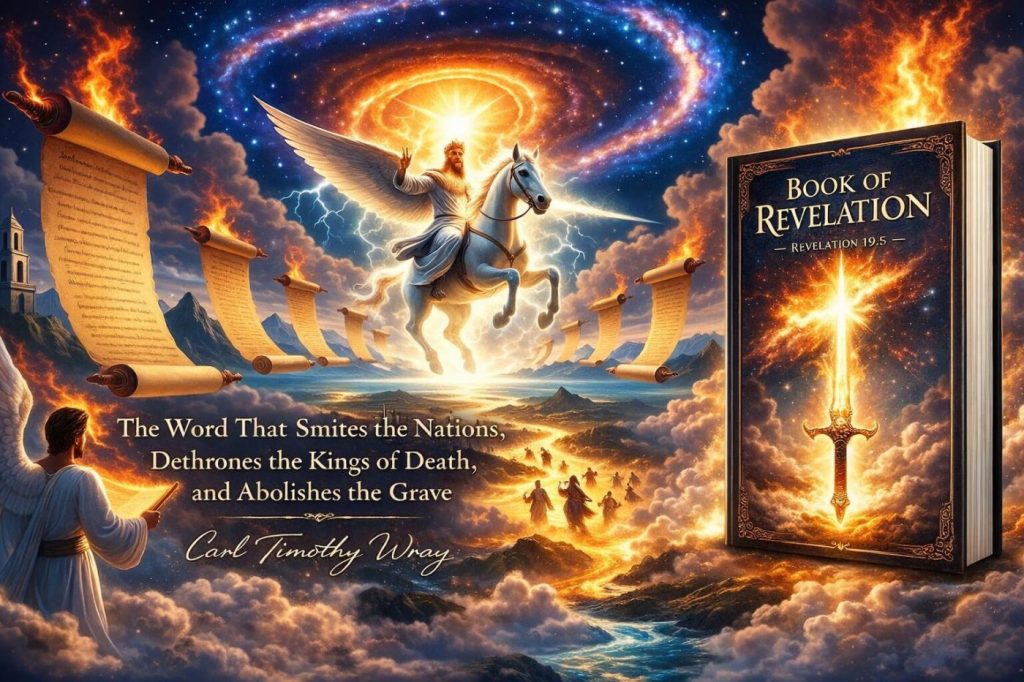
- Book of Revelation Read Here: 2. Book of Revelation: Download Free PDF: 3. Book of Revelation Series:
Book of Revelation: INTRODUCTION
The Book of Revelation does not reveal destruction — it reveals authority.
It does not announce chaos — it announces the reign of Christ.
At the center of that reign stands a striking image:
“And out of His mouth goeth a sharp sword.”
This sword is not symbolic poetry, nor is it future speculation. It is the living Word of God proceeding from Christ Himself — the same Word that spoke creation into being, judged the lie in Eden, and now speaks the final verdict over death. Revelation does not show Christ struggling for victory; it reveals Him enforcing a victory already won.
Scripture is clear: death is not a mystery, a tool, or a permanent boundary. Death is an enemy — and enemies are not managed, they are abolished. The apostle Paul declares that Christ appeared to abolish death and bring life and immortality to light, and that He must reign until every enemy is placed beneath His feet. Revelation shows us how that reign speaks, how it judges, and how it removes the rulers that once governed the fallen order.
This book will show that the sword of His mouth strikes not people, but systems; not flesh, but false kings; not nations of geography, but nations of thought, belief, and governance. These are the kings that ruled through fear, corruption, division, and mortality — and they are being dethroned by life.
What follows is not a call to warfare by human effort, but a revelation of divine order. When the Word is revealed, death loses jurisdiction. When truth is spoken, kings fall. When Christ reigns, the grave is emptied of authority.
This is the testimony of the sword. This is not speculation or symbolism delayed to another age — this is the unveiling of authority, life, and truth as revealed in the Book of Revelation.
Chapter One
Identifying the Sword
Before anything is smitten, the weapon must be recognized.
Revelation does not open with chaos, beasts, or judgment — it opens with a voice. And that voice has an edge.
“And out of His mouth goeth a sharp sword…”
— Revelation 19:15
This sword is not held.
It is spoken.
John does not see Christ wielding steel in His hand, but truth proceeding from His mouth. This immediately tells us what kind of battle this is — not physical, not political, not carnal. The weapon of Christ’s reign is the Word revealing reality as God sees it.
The sword is not an instrument of destruction; it is an instrument of division. It divides truth from lie, life from death, reality from illusion. Where this sword speaks, false authority collapses — not by force, but by exposure.
Jesus Himself defined this sword long before Revelation was written:
“The words that I speak unto you, they are spirit, and they are life.”
— John 6:63
Life does not flow from effort, ritual, or discipline. Life flows from the Word spoken in truth. The sword of His mouth is not new in Revelation — it has always been the way God governs.
The Sword Is the Word — Not Symbolism
Hebrews removes all ambiguity:
“For the word of God is quick, and powerful, and sharper than any two-edged sword…”
— Hebrews 4:12
This is not metaphor layered on metaphor. Scripture interprets Scripture. The sword is the Word — living, active, discerning, and authoritative. It pierces not bodies, but beliefs. It judges not people, but the thoughts and intents of the heart.
That tells us something critical:
If death is to be abolished, it will not be done by power displays or future events alone — it will be done by truth revealed.
Death reigns where lies are believed.
Death retreats where truth is spoken.
Why the Sword Comes From His Mouth
The mouth represents authority and decree. Kings rule by what they say, not by what they swing. In Scripture, creation itself came forth by speech:
“And God said…”
Likewise, redemption was declared by speech:
“It is finished.”
The same mouth that declared the work complete now declares its enforcement. Revelation does not present Christ fighting for victory — it presents Him speaking victory into manifestation.
This is why Paul says:
“He must reign, till He hath put all enemies under His feet.”
— 1 Corinthians 15:25
The reign of Christ is not silent. It speaks. And when it speaks, enemies are not debated — they are judged.
The Sword Does Not Smite Flesh
Revelation is often misunderstood because readers assume the sword targets people. But Scripture is clear:
“We wrestle not against flesh and blood…”
— Ephesians 6:12
The sword strikes rulers, powers, governments, and false authorities — not human beings. These rulers operate through systems of fear, corruption, division, and mortality. They govern the fallen order by convincing humanity that death is normal, necessary, and inevitable.
That lie is what the sword cuts.
The Purpose of the Sword
Revelation 19 tells us why the sword proceeds:
“…that with it He should smite the nations.”
“Nations” here are not merely geographic entities. They are ordered systems of thought and rule — ways life has been governed apart from God. These nations are ruled by kings, and those kings are not fleshly monarchs, but principles that administer death.
The sword does not wound these kings.
It removes their authority.
This is why the sword must come first in this book. Before death can be abolished, before kings can be dethroned, before life can reign openly, the weapon of truth must be clearly identified.
What This Chapter Establishes
This chapter establishes a foundation:
The sword is the Word of Truth
It proceeds from Christ’s authority
It judges systems, not people
It removes false kings, not sons
It prepares the way for the abolition of death
Nothing that follows in this book can be understood unless the sword is seen clearly. Revelation is not chaos unleashed — it is truth spoken without restraint.
And truth, once spoken, cannot be unsaid.
The sword has already come out of His mouth.
What remains is to see what it strikes next.
The sword is not future, hidden, or symbolic — it is the living Word already proceeding from Christ, clearly revealed in the Book of Revelation.
Chapter Two
Death — The Last Enemy Named
The sword does not swing blindly.
It strikes with precision — and Scripture names its final target.
“The last enemy that shall be destroyed is death.”
— 1 Corinthians 15:26
Death is not a mystery.
It is not a teacher.
It is not a necessary stage of God’s plan.
Death is an enemy.
And enemies are not managed, balanced, or accommodated — they are abolished.
From the beginning of Scripture to the end of Revelation, death is consistently treated as an intruder, not a feature. It does not originate in God; it enters through deception. It does not serve life; it opposes it. And it does not endure forever — it is destined for removal.
This chapter exists to do one thing clearly:
name death as the enemy the sword is striking.
Death Was Never God’s Design
In the beginning, God did not create death. He created life.
“And God saw every thing that He had made, and, behold, it was very good.”
— Genesis 1:31
There is no death in “very good.”
There is no decay in life proceeding from God.
Death enters Scripture only after the lie is believed. It comes not by God’s command, but by separation from truth. From that moment forward, death becomes a ruling force — not because it is powerful, but because it is accepted.
The reign of death is rooted in deception.
Death Rules by Fear, Not Authority
Hebrews exposes how death governs:
“Through fear of death were all their lifetime subject to bondage.”
— Hebrews 2:15
Death does not rule because it has authority.
It rules because it produces fear.
Fear creates survival.
Survival creates selfishness.
Selfishness creates division.
Division produces corruption.
Death is not just an event at the end of life — it is a governing principle over fallen humanity. Wherever fear of death exists, death already reigns.
That is why abolishing death is not merely about ending dying — it is about ending the rule of fear.
Christ Did Not Negotiate With Death
The gospel does not present Christ bargaining with death or postponing its defeat. Scripture uses decisive language:
“That through death He might destroy him that had the power of death.”
— Hebrews 2:14
Destroy means render powerless.
Not delay.
Not weaken.
Not suspend.
Death’s power was broken at the cross.
Its authority was exposed in the resurrection.
Its end is guaranteed by Christ’s reign.
Paul declares this plainly:
“Who hath abolished death, and hath brought life and immortality to light through the gospel.”
— 2 Timothy 1:10
Abolished is not future tense.
Abolished is not conditional.
Abolished is a completed verdict.
The sword has already struck death legally. What remains is the revelation and enforcement of that verdict.
Why Death Is Called “The Last Enemy”
Death is last because it is the foundation enemy.
Every other ruler feeds from it:
Sin draws strength from fear of death
Law empowers death by condemnation
Flesh reacts to death by survival instinct
Corruption thrives where death is accepted
Paul explains it simply:
“The sting of death is sin.”
— 1 Corinthians 15:56
Remove death, and sin loses its leverage.
Abolish death, and its administrators collapse.
This is why the sword must strike death itself — not merely its symptoms.
Death Is Not Eternal — God Is
Revelation makes the final verdict unmistakable:
“And death and hell were cast into the lake of fire.”
— Revelation 20:14
Death is not reigning forever.
Death is not preserved.
Death is not upgraded.
Death is removed.
And Scripture tells us exactly why:
“Then cometh the end… that God may be all in all.”
— 1 Corinthians 15:28
God cannot be all in all while death remains.
Death is incompatible with fullness.
What This Chapter Establishes
This chapter establishes an unmovable truth:
Death is an enemy
Death entered through deception
Death rules through fear
Death has been legally abolished
Death is awaiting full exposure and removal
The sword of His mouth is not vague about its target. It names death plainly and strikes it decisively.
The reign of Christ does not coexist with death.
It ends it.
And if death is falling, then everything that ruled through it must fall as well.
That is where the sword goes next.
Death is not a mystery to be tolerated, but an enemy already judged and exposed by the truth declared in the Book of Revelation.
Chapter Three
The Kings Death Ruled
Death never ruled alone.
It reigned through kings.
Scripture does not present death as a solitary force, but as a governing power that installs rulers beneath it — administrators that enforce its reign in daily life. If death is the enemy, then these kings are its officers, carrying out its will through behavior, belief, and identity.
Paul names them plainly.
“Now the works of the flesh are manifest, which are these…”
— Galatians 5:19
What follows is not a random list of moral failures. It is a registry of rulers — governing principles that exercise authority wherever death is believed, feared, or accepted.
These are the kings the sword strikes.
Why Paul Calls Them “Works”
Paul does not call these mistakes, struggles, or weaknesses. He calls them works — active operations.
Each one:
Produces predictable outcomes
Governs responses
Shapes identity
Preserves the reign of death
They function as systems, not accidents.
And there are seventeen of them.
The Seventeen Kings Named
Paul lists them without apology, because truth does not negotiate.
Kings of the Body — Ruled by Mortality
Adultery
Fornication
Uncleanness
Lasciviousness
These kings govern through appetite, corruption, and fear of loss. They treat the body as temporary, disposable, and driven by survival. Wherever mortality is believed to be final, these kings thrive.
Kings of the Mind — Ruled by False Power
Idolatry
Witchcraft
These do not rule through pleasure, but through control. Witchcraft, rooted in manipulation and pharmakeia, represents counterfeit power — using substances, systems, or spiritual practices to replace trust in life itself.
Kings of the Heart — Ruled by Conflict
Hatred
Variance
Emulations
Wrath
Strife
These kings govern through division. They thrive on comparison, offense, competition, and retaliation. They exist because fear demands defense — and fear flows from death.
Kings of the Social Order — Ruled by Separation
Seditions
Heresies
These are system builders. They fracture communities, harden identities, and construct camps of “us versus them.” Death multiplies itself best by division.
Kings of the Soul — Ruled by Escape
Envyings
Murders
Drunkenness
Revellings
These kings rule through consumption — numbing pain, stealing joy, or destroying what reminds the soul of lack. They are attempts to silence the ache created by separation from life.
Why These Kings Cannot Inherit the Kingdom
Paul concludes the list with a statement that is often misunderstood:
“They which do such things shall not inherit the kingdom of God.”
This is not a threat of exclusion.
It is a declaration of jurisdiction.
The kingdom of God is the reign of life.
These kings only function under death.
Life and death cannot govern the same throne.
You do not inherit life while ruled by death’s administrators. That inheritance begins when the kings are dethroned — not by discipline, but by revelation.
The Kings Are Dethroned, Not Improved
Paul does not instruct believers to reform these kings. He declares their end:
“They that are Christ’s have crucified the flesh with the affections and lusts.”
— Galatians 5:24
Crucifixion is not behavior modification.
It is removal of authority.
These kings do not die because you resist them.
They die because death itself has been abolished.
When death loses jurisdiction, its rulers starve.
The Immediate Replacement Government
Paul does not leave a vacuum.
Immediately after naming the kings of death, he reveals the government of life:
“But the fruit of the Spirit is…”
Notice — fruit, singular. One source. One life. One throne.
Life does not need seventeen kings.
Life reigns from one Spirit.
Against this government, Paul says:
“There is no law.”
Why?
Because death has no claim here.
What This Chapter Establishes
This chapter establishes a crucial truth:
Death ruled through kings
The kings governed daily life
The kings fed on fear of death
Death has been abolished
Therefore, the kings are falling
The sword does not swing at random. It strikes rulers, dethrones administrations, and clears the way for life to reign unchallenged.
The fall of death begins with the fall of its kings.
And Revelation shows us where those kings are judged next.
The kings that ruled through death are named, exposed, and losing authority as the light of Christ shines through the Book of Revelation.
Chapter Four
The Sword That Judges the Kings
Kings do not fall by argument.
They fall by verdict.
Revelation does not show Christ debating rulers, negotiating power, or persuading death to step aside. It shows Him speaking — and when He speaks, judgment occurs.
“And out of His mouth goeth a sharp sword, that with it He should smite the nations.”
— Revelation 19:15
The sword does not investigate the kings.
It judges them.
This chapter is where the execution becomes visible.
Judgment Is Revelation, Not Punishment
In Scripture, judgment is not primarily punishment — it is exposure. To judge something is to reveal what it truly is.
Jesus said:
“For judgment I am come into this world, that they which see not might see.”
— John 9:39
Judgment happens when truth appears.
And when truth appears, false authority collapses.
The kings of death do not fall because they are attacked.
They fall because they are seen.
Why the Sword Must Be Sharp
A dull blade wounds; a sharp blade separates.
Hebrews explains this precision:
“The word of God is quick, and powerful, and sharper than any two-edged sword… a discerner of the thoughts and intents of the heart.”
— Hebrews 4:12
The sword does not condemn the heart — it discerns it.
This matters because the kings of death hide behind:
motives
excuses
religious coverings
moral language
The sword cuts through all of it and names the source.
Once the source is exposed, the king has no throne left.
The Sword Judges Systems, Not Sons
Revelation’s imagery can be frightening if misunderstood. But Scripture consistently guards us from confusion:
“God sent not His Son into the world to condemn the world; but that the world through Him might be saved.”
— John 3:17
The sword is not against humanity.
It is against what enslaved humanity.
The kings are judged so the sons may be free.
This is why Revelation repeatedly distinguishes between:
those who dwell on the earth (identity rooted in mortality)
and those whose names are written in heaven (identity rooted in life)
The sword separates identities — it does not destroy people.
How the Kings Are Judged
The judgment of the kings follows a pattern:
Truth is spoken
False authority is exposed
Fear loses power
Behavior loses fuel
Life emerges naturally
This is why Paul never tells believers to fight the kings directly. He tells them to walk in the Spirit.
Life displaces death.
Light expels darkness.
Truth removes lies.
Judgment is automatic once revelation arrives.
The Sword and the Lake of Fire
Revelation later shows the final destination of these rulers:
“And death and hell were cast into the lake of fire.”
— Revelation 20:14
The lake of fire is not a torture chamber — it is consuming truth. Fire in Scripture refines, purifies, and removes what cannot endure reality.
What cannot live in truth is not preserved.
Death cannot survive revelation.
The kings cannot survive exposure.
The sword prepares them for this end by stripping them of authority before they are removed completely.
Why the Kings Resist the Sword
The kings resist because their reign depends on ignorance.
Jesus said:
“Ye shall know the truth, and the truth shall make you free.”
— John 8:32
Freedom does not come by effort.
It comes by knowing.
This is why religious systems often avoid Revelation — not because it is unclear, but because it reveals too much. Revelation removes the masks rulers depend on.
Once the sword speaks, nothing can hide.
What This Chapter Establishes
This chapter establishes that:
Judgment is revelation
The sword exposes rulers
Kings fall when truth appears
Sons are liberated, not condemned
Death’s administration collapses under light
The sword is not waiting to strike.
It has already spoken.
What remains is the manifestation of its judgment — the visible collapse of death’s reign and the rising of life in its place.
That brings us to the next movement.
Judgment is not destruction but revelation, and the Word that exposes false rulers is unmistakably revealed in the Book of Revelation.
Chapter Five
The Reign That Enforces the Verdict
A verdict spoken must be enforced.
And Christ’s reign is not ceremonial — it is executive.
Scripture does not say Christ will reign once the enemies are defeated. It says He reigns until they are placed beneath His feet.
“For He must reign, till He hath put all enemies under His feet.”
— 1 Corinthians 15:25
This tells us something critical:
the reign of Christ is not about achieving victory — it is about applying a victory already secured.
The cross settled the matter.
The resurrection confirmed it.
The reign enforces it.
Reign Is Not Waiting — It Is Active
Many imagine Christ’s reign as passive, distant, or postponed until a future age. Paul presents the opposite. Christ reigns now, not to gain authority, but because authority already belongs to Him.
“All power is given unto Me in heaven and in earth.”
— Matthew 28:18
Authority that is given does not need to be earned.
It needs to be exercised.
The reign of Christ is the ongoing expression of truth into time — where every lie, every false ruler, and every enemy of life is brought into alignment with what is already finished.
What “Under His Feet” Means
To place something under one’s feet in Scripture is not humiliation — it is subjugation. It means something has lost the right to govern.
“Thou hast put all things under His feet.”
— Psalm 8:6
Enemies underfoot do not disappear instantly; they lose authority to rule. They are present, but powerless.
This explains why death can still be seen even though it has been abolished. Its right to reign has been removed, even while its presence is being exposed.
Reign precedes removal.
The Order of Enforcement
Paul gives us the divine order clearly:
Christ the firstfruits
Then those who are Christ’s
Then the end
“But every man in his own order…”
— 1 Corinthians 15:23
This is not delay — it is sequence.
Life appears first in Christ.
Life then manifests through those who belong to Him.
Finally, life fills all things until death has nowhere left to stand.
The reign spreads not by conquest, but by manifestation.
Why Death Is Last
Death is last because it is the deepest lie.
Every other ruler collapses when death is exposed as illegitimate. Sin loses its sting. Fear loses its grip. Corruption loses its urgency.
This is why Paul calls death the final enemy — not because it is strongest, but because it is the foundation lie beneath all others.
Once death is underfoot, the rest follow naturally.
The Reign Is Expressed Through the Sons
Christ’s reign is not solitary.
“They shall reign in life by One, Jesus Christ.”
— Romans 5:17
Reign is shared, not hoarded.
Life governs through union.
This is why Revelation presents not only a Lamb on the throne, but a company — kings and priests reigning with Him. Not replacing Him, but expressing His life.
The enforcement of the verdict happens as life rises within humanity itself.
The End of the Reign Is Fullness
The reign does not go on forever in its current form. It has a destination.
“Then cometh the end… that God may be all in all.”
— 1 Corinthians 15:28
When God is all in all:
No enemy remains
No death governs
No ruler competes
No fear survives
The reign has completed its purpose.
What This Chapter Establishes
This chapter establishes that:
Christ reigns now
The reign enforces a finished verdict
Enemies are placed underfoot by truth
Death is losing authority progressively
The reign ends in fullness, not delay
The sword spoke the verdict.
The reign applies it.
And as the reign continues, death finds fewer places to stand — until it has none.
Christ reigns not to gain victory but to enforce it, a present reality made unmistakably clear in the Book of Revelation.
Chapter Six
Death Cast Down — The End of Its Authority
Death does not fade away quietly.
It is cast down.
Revelation does not describe death retiring or transforming into something useful. It shows death losing its seat, its jurisdiction, and its right to rule.
“And death and hell were cast into the lake of fire.”
— Revelation 20:14
This is not poetic exaggeration.
This is judicial removal.
Death is not corrected.
Death is not rehabilitated.
Death is ended as an authority.
Casting Down Is Not the Same as Erasing
To cast something down in Scripture means to remove it from rule, not merely from visibility.
Jesus used this language Himself:
“I beheld Satan as lightning fall from heaven.”
— Luke 10:18
Satan did not cease to exist in that moment — he ceased to rule. Authority shifted. Jurisdiction changed. Power structures collapsed.
The same pattern applies to death.
Death is cast down before it is fully removed because authority always falls before presence disappears.
The Lake of Fire — What It Actually Is
The lake of fire has been misunderstood because it is read through fear instead of Scripture.
Fire in the Bible does not preserve enemies — it consumes what cannot survive truth.
“Our God is a consuming fire.”
— Hebrews 12:29
Fire represents:
purity
exposure
refinement
the removal of what is incompatible with God
When death is cast into the lake of fire, it is not being tortured — it is being consumed. Death cannot live in the unveiled presence of God.
Fire is not God’s anger.
Fire is God’s reality.
Why Death and Hell Are Thrown Together
Revelation says:
“Death and hell were cast into the lake of fire.”
Hell (Hades) is the realm of death’s administration. Where death ruled, hell functioned. Where death loses authority, hell has no purpose.
They fall together because they functioned together.
Once death is abolished:
hell has no captives
the grave has no claim
separation has no foundation
This is why Revelation calls it:
“The second death.”
Not the death of people —
the death of death itself.
Death Cannot Survive God All in All
Paul’s final vision explains why death must fall:
“That God may be all in all.”
— 1 Corinthians 15:28
God cannot be all in all while death remains:
death contradicts life
death opposes fullness
death denies union
As long as death rules anywhere, God is not fully revealed everywhere.
The casting down of death is not optional — it is necessary for God’s purpose.
What Happens When Death Loses Authority
When death is cast down:
fear loses its grip
survival identity collapses
corruption loses urgency
love no longer competes with loss
Life no longer needs to defend itself.
This is why Scripture says:
“There shall be no more death.”
— Revelation 21:4
Not managed death.
Not delayed death.
No more death.
Why This Is Good News — Not Threat
This chapter is often avoided because it is read as punishment. In truth, it is liberation.
The removal of death is the removal of:
fear
separation
decay
accusation
The casting down of death is the final mercy — the end of the last enemy that plagued creation.
What This Chapter Establishes
This chapter establishes that:
Death loses authority before it disappears
The lake of fire consumes what cannot live in truth
Hell exists only while death reigns
The second death is the death of death
God’s goal is total fullness, not partial victory
Death is not being threatened.
Death has been judged.
The sword spoke.
The reign enforced.
The authority fell.
What remains is the rising of life.
The casting down of death is not symbolic or delayed, but the decisive removal of its authority revealed in the Book of Revelation.
Chapter Seven
Life Reigns — Immortality Revealed
When death falls, life does not struggle to take its place.
Life reigns by nature.
Scripture does not present immortality as a reward at the end of effort, nor as an escape from creation. It presents immortality as the revealing of what has always been true in Christ.
“Who hath abolished death, and hath brought life and immortality to light through the gospel.”
— 2 Timothy 1:10
Notice the language carefully.
Life and immortality were not created later.
They were brought to light.
What is brought to light already exists.
Immortality Is Revelation, Not Invention
The gospel did not invent life.
It unveiled it.
From the beginning, God’s intent was never survival — it was participation in His life.
“In Him was life; and the life was the light of men.”
— John 1:4
Life was always the source.
Death was the interruption.
When Christ appears, He does not introduce a new plan — He restores the original one. Immortality is not a future concept waiting for permission; it is life revealed where death once ruled.
Why Immortality Appears After Death Falls
Immortality cannot reign while death governs. The two are mutually exclusive.
Paul explains this transformation:
“This mortal must put on immortality.”
— 1 Corinthians 15:53
This is not replacement language — it is clothing language. Mortality is not annihilated by effort; it is overclothed by life.
When life reigns, mortality is swallowed.
“Death is swallowed up in victory.”
— 1 Corinthians 15:54
Victory here is not struggle — it is overflow.
Life Reigns Through Union, Not Effort
Immortality is not sustained by discipline or resistance. It flows from union.
“Christ in you, the hope of glory.”
— Colossians 1:27
Hope here is not wishful thinking.
It is expectation rooted in presence.
Life reigns because Christ lives.
Immortality manifests because union exists.
This is why Scripture never instructs believers to fight death directly. It instructs them to abide in life.
Where life abides, death has no jurisdiction.
The Government of Life
Paul contrasts the old rule with the new:
“They which receive abundance of grace and of the gift of righteousness shall reign in life by One, Jesus Christ.”
— Romans 5:17
Notice — reign in life, not reign over life.
Life is not something to be managed.
It is something to be expressed.
The reign of life is effortless because it aligns with truth. It does not react to death; it simply outlasts it.
Immortality Is Not Escape — It Is Fulfillment
The promise of immortality is often distorted into escapism — leaving the earth, abandoning creation, or transcending humanity. Scripture teaches the opposite.
“Behold, the tabernacle of God is with men.”
— Revelation 21:3
Immortality does not remove humanity from creation.
It restores creation to its intended state.
Life reigning means:
bodies animated by Spirit
creation freed from corruption
humanity expressing divine life openly
This is not departure — it is arrival.
The End Result: God All in All
Life reigns until nothing contradicts it.
“That God may be all in all.”
— 1 Corinthians 15:28
Immortality is not about living forever in isolation.
It is about full participation in God’s life — without fear, decay, or separation.
When life reigns:
death has no language
fear has no voice
corruption has no foothold
Everything that once resisted life is absorbed into fullness.
What This Chapter Establishes
This chapter establishes that:
Immortality is revealed, not earned
Life reigns naturally once death falls
Union, not effort, sustains life
Immortality fulfills creation’s purpose
God’s end is fullness, not escape
The sword removed death.
The reign enforced the verdict.
Now life stands unopposed.
This is not the end of the story —
it is the beginning of manifestation.
Life reigns where death once ruled, and immortality is revealed not as promise but as reality in the Book of Revelation.
The End of the Matter
The sword has spoken.
The verdict has been rendered.
The reign is not pending.
This book does not close with warning, speculation, or delay — it closes with rest.
From the beginning, the testimony has been consistent: the Word that created all things is the same Word that redeems them. The mouth that said “Let there be” is the mouth that said “It is finished.” And the mouth that finished the work is the mouth from which the sharp sword now proceeds — not to destroy creation, but to free it.
Death has been named.
Death has been judged.
Death has been abolished.
What once ruled by fear no longer has authority. What once governed through corruption has been exposed. The kings that administered death have been dethroned, not by human resistance, but by divine truth revealed.
This is the nature of Christ’s reign.
He does not conquer by force.
He reigns by reality.
Truth does not need assistance. It only needs to be seen. And once seen, it cannot be unseen.
That is why Revelation does not end in battle — it ends in presence.
“Behold, the tabernacle of God is with men.”
Life does not flee the earth.
Life fills it.
The abolition of death is not the loss of humanity — it is the fulfillment of it. The reign of life does not erase creation; it restores it to what it was always meant to be. When death falls silent, love speaks without interruption. When fear is removed, union stands revealed.
This is why the final word of Scripture is not judgment, but invitation.
“The Spirit and the bride say, Come.”
Not “try.”
Not “wait.”
Not “someday.”
Come.
Come into life.
Come into rest.
Come into the reign already established.
Come into the truth already spoken.
Nothing is missing.
Nothing is delayed.
Nothing is required.
The sword has already gone forth from His mouth.
The reign is already active.
The grave has already lost its authority.
What remains is not another enemy to defeat —
but a people willing to see.
And when the truth is seen, death has nowhere left to stand.
Amen.
Book of Revelation: About the Author
Carl Timothy Wray is a teacher of the Full Counsel of God, devoted to unveiling the reign of Christ as a present reality revealed through Scripture. His writings confront religious delay, expose the lie of death’s dominion, and proclaim the finished work of Christ from Genesis to Revelation. With a prophetic yet grounded voice, he writes to awaken the elect to life, authority, and immortality already secured in Christ.
Book of Revelation Series
- The Book of Revelation — The Judgment of the Spirit of Jezebel and the Rise of Zion’s Sons
- The Book of Revelation — In Him All Things Consist: The Universe Inside the Lamb
- The Book of Revelation — The Spirit of Jezebel: Her Works, Her Seduction, and Her Signs
- Join our Facebook Page: