📖 The Book of Revelation Explained Through Christ’s Finished Work,
Not Fear, Forecasts, or Speculation
✍️ Book of Revelation: AUTHOR
By Carl Timothy Wray
Carl Timothy Wray writes from the conviction that God’s mind is one, His purpose unified, and His work complete. His teaching is grounded in the Finished Work of Christ, revealed through the Full Counsel of God — from Genesis to Revelation — without contradiction, fragmentation, or delay. Rather than approaching Scripture as competing covenants or unfolding uncertainties, Wray presents the Bible as a single, ordered revelation moving steadily toward one consummation: God all in all.
⚓ Book of Revelation: THE GOVERNING CENTER
This book is written from a simple but decisive position: Christ has already won. The Book of Revelation is not a forecast of future disasters, nor a coded warning about the end of the world. It is an unveiling of Jesus Christ reigning from a finished throne. Every vision, symbol, and judgment must therefore be read from victory — not toward it. When Revelation is seen through the Finished Work of Christ and the Full Counsel of God, fear dissolves, contradiction collapses, and Scripture reveals a single, unified purpose unfolding in perfect order. Nothing in this book stands outside that purpose, and nothing in God’s mind is double-minded, fragmented, or unresolved.
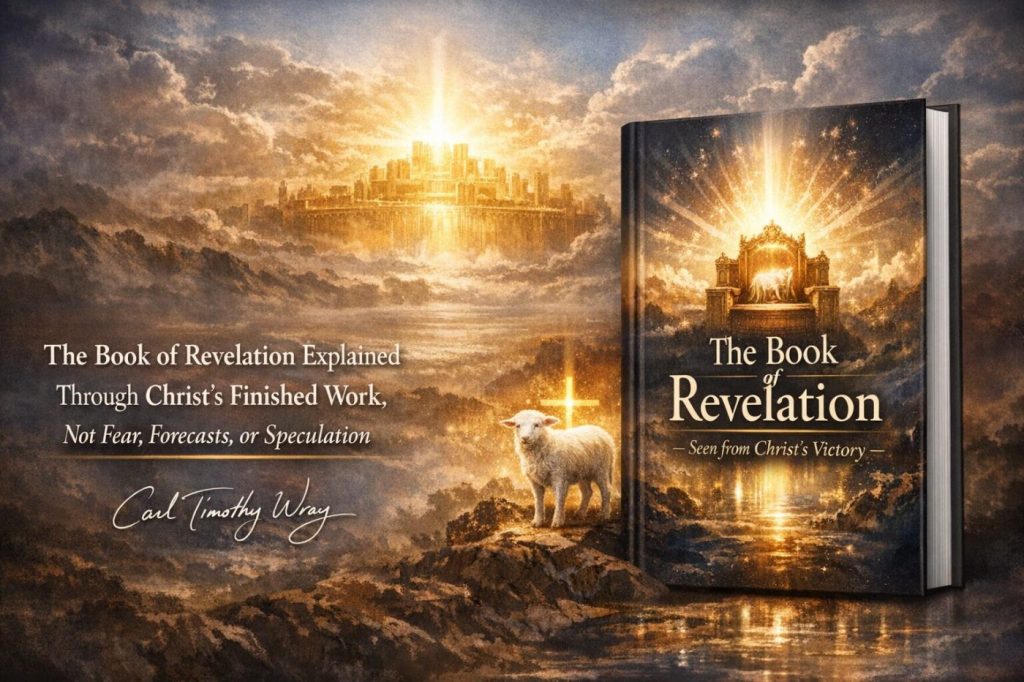
- Book of Revelation: New Book 2. Book of Revelation Free PDF Copy 3. Book of Revelation Series 4. Home Page:
📜 Book of Revelation: INTRODUCTION
The Book of Revelation has long been treated as the most mysterious, divisive, and intimidating book in Scripture. For many, it has become a source of fear rather than faith, confusion rather than clarity, speculation rather than rest. Charts, timelines, theories, and warnings have multiplied — yet peace has not.
This confusion does not come from the book itself.
It comes from where the book is read from.
Revelation was not written from uncertainty.
It was written from a throne.
Before a single seal was opened, before a trumpet sounded, before a bowl was poured out, the Lamb was already seated. His victory was not approaching — it was established. The Cross was not provisional. The resurrection was not partial. The ascension was not symbolic. Christ’s work was finished, His authority secured, and His reign inaugurated.
Revelation, then, does not announce how Christ will win.
It unveils what His victory looks like when administered in creation.
When read from Christ’s victory, judgment is no longer random destruction but purposeful separation — flesh from spirit, lie from truth, death from life. Symbols are no longer puzzles to decode but compressed revelations meant to be seen. Time is no longer an enemy but a servant. And God is no longer reacting to history but revealing what He settled before the foundation of the world.
From Genesis to Revelation, God has never changed His mind — only unveiled it. His purpose has always moved toward one end: the reconciliation of all things in Christ, the removal of everything that cannot inherit life, and the fulfillment of creation in union with its Creator.
This book is written to help the reader see Revelation clearly, calmly, and coherently — not as a book of fear, but as the final unveiling of a finished victory, until God is all in all.
Chapter One
Revelation Is Seen from a Throne, Not a Timeline
The Book of Revelation does not begin with catastrophe.
It does not open with warnings, disasters, or predictions.
It opens with a throne.
Before seals are opened, before trumpets are sounded, before bowls are poured out, John is first brought upward — not forward in time. He is not shown what will happen next; he is shown where everything is governed from.
This is the first and most important correction Revelation makes.
Revelation is not primarily about when things happen.
It is about from where they are seen.
The Error of Reading from the Ground
Much confusion surrounding Revelation comes from reading it as though we are standing on the earth, looking ahead, trying to predict what is coming.
From that position:
- time becomes dominant
- fear becomes reasonable
- judgment looks destructive
- symbols feel chaotic
- God appears reactive
When Revelation is read from the ground, everything feels unstable because the reader is trying to interpret heaven from earth instead of earth from heaven.
But John was not left on the ground.
The Call to “Come Up Here”
Early in the visions, John hears a simple instruction:
“Come up here.”
This was not a change of location for John’s body.
It was a change of vantage.
John is brought into the realm where:
- Christ is already enthroned
- authority is already settled
- victory is already secured
- history is already known
From this position, Revelation makes sense.
Without it, Revelation becomes terrifying.
The Throne Comes First
The throne is not revealed after judgment.
It is revealed before anything unfolds.
This is deliberate.
The message is clear:
Nothing in Revelation happens outside of Christ’s reign.
Judgment does not interrupt the throne.
The throne interprets judgment.
The Lamb does not react to events.
Events unfold because the Lamb reigns.
Revelation is not the story of God trying to regain control of a failing world.
It is the unveiling of how a finished victory is administered in creation.
Why Timelines Always Fail
Timelines fail because they assume:
- victory is future
- authority is pending
- fulfillment is delayed
- the outcome is uncertain
But Revelation assumes the opposite.
Christ is not moving toward dominion — He is governing from it.
This is why Scripture can say:
- the Lamb was slain before the foundation of the world
- the kingdom was prepared before time
- the end was known from the beginning
Time does not complete God’s work.
Time reveals what God settled.
Judgment Seen from the Throne
When judgment is seen from earth, it looks like destruction.
When judgment is seen from the throne, it looks like separation.
Not the destruction of creation —
but the removal of everything that cannot remain.
Judgment separates:
- flesh from spirit
- lie from truth
- death from life
- mixture from purity
Judgment is not God losing patience.
It is God fulfilling purpose.
From the throne, judgment is not chaos —
it is clarity.
A Finished Victory Being Revealed
The Book of Revelation does not describe Christ becoming victorious.
It describes His victory being revealed.
This is why Revelation is called an unveiling.
Nothing new is being accomplished.
What was finished is being shown.
The Cross settled the issue.
The resurrection sealed it.
The ascension established it.
Revelation simply removes the veil.
Why This Changes Everything
Once Revelation is read from the throne:
- fear loses its voice
- speculation loses authority
- contradiction disappears
- Scripture becomes unified
- God’s mind is seen as one
Genesis and Revelation stop arguing with each other.
Judgment and mercy stop competing.
Love and holiness stop clashing.
Everything begins to move in one direction.
The End Governs the Beginning
This is the rule we will follow throughout this book:
Any interpretation of Revelation must be able to arrive at God’s ultimate purpose.
And that purpose is not endless division.
Not eternal fragmentation.
Not unresolved conflict.
The purpose is reconciliation.
Completion.
Union.
Conclusion of Chapter One
Revelation is not read to discover what God will do.
It is read to see what God has done.
It is not a book of fear, but of unveiling.
Not a forecast, but a revelation.
Not chaos, but order.
Every vision, every judgment, every symbol moves creation toward one end:
Until every shadow is swallowed by light,
every enemy by truth,
every fragment by wholeness —
until God is all in all.
That is the throne Revelation is seen from.
And from here on, that is where we will read.
Chapter Two
The Lamb Was Seated Before the Book Was Opened
One of the most overlooked truths in the Book of Revelation is also one of the most decisive:
The Lamb is already seated before anything begins.
Before seals.
Before trumpets.
Before bowls.
Before judgment is ever described.
The throne is not the outcome of Revelation.
The throne is the starting point.
This single observation dismantles most fear-based interpretations at the root.
The Order Revelation Establishes
Revelation does not begin with chaos on the earth.
It begins with clarity in heaven.
John is not first shown beasts, disasters, or turmoil.
He is first shown a Lamb standing as though slain — alive, victorious, and enthroned.
This order matters.
If the Lamb were not already victorious, the book would read like a struggle.
If authority were still contested, judgment would look like desperation.
But Revelation assumes none of that.
Christ is not fighting for control.
He is administering it.
Why the Lamb Is Central
The Lamb is not symbolic of weakness.
He is the embodiment of victory through completion.
The Lamb:
- has already overcome
- has already been slain
- has already risen
- has already ascended
- has already taken the scroll
Nothing in Revelation happens until the Lamb takes the book — and when He does, heaven does not panic.
Heaven worships.
This tells us everything we need to know about the nature of what follows.
The Scroll Does Not Decide the Outcome
The scroll does not determine history.
It reveals it.
The Lamb does not open the seals to find out what will happen.
He opens them to unveil what has been settled.
This is why fear-based prophecy collapses under scrutiny.
If the Lamb is already seated, then:
- nothing can threaten His reign
- nothing can undo His work
- nothing can escape His purpose
Revelation is not the story of a fragile plan at risk.
It is the unveiling of a completed counsel being brought into full expression.
Judgment Flows from Victory, Not Uncertainty
Judgment does not arise because God is angry or surprised.
It flows because victory must be applied.
Victory without application leaves disorder in place.
Judgment is the means by which victory removes what cannot remain.
From the throne:
- judgment is not punitive chaos
- it is purposeful separation
The Lamb opens the seals not to destroy creation, but to free it from corruption, deception, and death.
Judgment is not an interruption of grace.
It is grace completing its work.
Why This Terrifies Fear-Based Theology
Fear-based theology needs:
- unresolved outcomes
- future victories
- pending authority
- threats of loss
But a seated Lamb removes all leverage.
If Christ has already won:
- fear has no authority
- delay has no purpose
- destruction has no final word
This is why Revelation is so often moved into the future — because fear needs distance to survive.
But Revelation refuses to cooperate.
It places the Lamb on the throne now.
The Seated Lamb and the Finished Work
The Lamb’s posture tells the story.
He is not striving.
He is not standing in alarm.
He is not pacing heaven.
He is seated.
Seating speaks of:
- completion
- authority
- rest
- confidence
This posture echoes the Finished Work of Christ.
What was accomplished at the Cross is not being renegotiated in Revelation.
It is being revealed.
Why Nothing Can Stand Against This View
Once Revelation is seen from a seated Lamb:
- timelines lose control
- fear loses traction
- judgment gains meaning
- Scripture gains unity
Genesis no longer contradicts Revelation.
The prophets no longer compete with the apostles.
Judgment no longer conflicts with reconciliation.
Everything begins to move toward one conclusion.
Conclusion of Chapter Two
The Book of Revelation does not describe Christ taking control.
It reveals Him exercising it.
The Lamb is not crowned at the end of the book.
He is enthroned at the beginning.
From that throne:
- judgment serves restoration
- separation serves union
- revelation serves completion
Nothing unfolds outside His purpose.
Nothing escapes His design.
Nothing contradicts His end.
And that end is not fragmentation, fear, or endless division.
It is the fulfillment of all things in Christ —
until every enemy is swallowed by truth,
every shadow by light,
every fragment by wholeness —
until God is all in all.
That is the Lamb who opens the book.
And that is the victory Revelation reveals.
Chapter Three
An Unveiling, Not a Warning
One of the greatest misunderstandings about the Book of Revelation is the belief that it was given as a final warning to humanity.
This assumption shapes everything that follows.
If Revelation is a warning, then fear becomes appropriate.
If it is a warning, judgment must be threatening.
If it is a warning, the outcome must still be uncertain.
But Revelation never calls itself a warning.
It calls itself an unveiling.
What “Revelation” Actually Means
The word “revelation” means to uncover, to unveil, to make visible what was already present.
An unveiling does not introduce something new.
It reveals what was hidden.
Warnings are issued when danger is approaching.
Unveilings are given when truth is ready to be seen.
This distinction is everything.
Why Fear Became the Dominant Lens
Fear entered the Book of Revelation not because of the text, but because of the assumptions brought to it.
When Revelation is approached as:
- a prediction of catastrophe
- a map of future disasters
- a threat of divine retaliation
then fear feels justified.
But fear does not come from revelation.
Fear comes from reading unveiling through uncertainty.
Revelation assumes victory.
Fear assumes risk.
They cannot coexist.
The Lamb Does Not Warn — He Reveals
Warnings belong to law.
Revelation flows from fulfillment.
The Lamb does not appear in Revelation to threaten the world.
He appears to uncover reality.
What is uncovered:
- the true nature of power
- the exposure of deception
- the end of mixture
- the collapse of false authority
- the reign of life over death
None of this requires fear.
It requires sight.
Why Judgment Is Mistaken for Warning
Judgment feels like warning only when its purpose is misunderstood.
If judgment is believed to exist to:
- punish endlessly
- exclude permanently
- destroy irreversibly
then fear is the natural response.
But if judgment exists to:
- separate flesh from spirit
- remove what cannot inherit life
- expose lies so truth can remain
- free creation from corruption
then judgment becomes clarifying, not threatening.
Judgment is not God shouting danger.
It is God turning on the light.
Unveiling Always Precedes Transformation
Nothing is transformed before it is revealed.
Darkness is not defeated by force.
It is defeated by exposure.
This is why Revelation is given at the end of Scripture.
Not because it predicts the end —
but because it reveals what everything has been moving toward.
The unveiling does not create the outcome.
It shows it.
Why Warnings Produce Exhaustion
A warning-based Revelation produces:
- anxiety
- speculation
- vigilance without rest
- holiness through fear
- obedience through threat
And eventually, avoidance.
This is why so many Christians avoid the Book of Revelation.
They are not rebellious — they are weary.
Fear does not sustain faith.
It fractures it.
Unveiling Produces Rest
An unveiling does something warnings never can.
It stabilizes the soul.
When truth is seen:
- striving stops
- confusion dissolves
- trust returns
- clarity emerges
The unveiling of Christ does not pressure the reader.
It anchors them.
Revelation is not meant to alarm the saints.
It is meant to steady them.
Why Revelation Must Be Read This Way
If Revelation were a warning, it would contradict:
- the Finished Work of Christ
- the Cross as completion
- the resurrection as victory
- reconciliation as God’s purpose
But Scripture does not contradict itself.
Revelation must harmonize with Genesis, the prophets, the Gospels, and the apostles.
And it does — when read as unveiling.
Conclusion of Chapter Three
The Book of Revelation was not given to frighten the world.
It was given to reveal Christ.
Not to warn of loss —
but to unveil victory.
Not to threaten destruction —
but to expose what cannot remain.
Not to create fear —
but to remove it.
Warnings shout from uncertainty.
Revelation speaks from completion.
And what it reveals moves all things toward one end:
The removal of everything that opposes life,
the reconciliation of all things in Christ,
and the fulfillment of creation —
until God is all in all.
This is not a warning.
It is an unveiling.
And unveiling always leads to completion.
Chapter Four
Why Revelation Speaks in Symbols
One of the first objections people raise about the Book of Revelation is this:
“Why is it so symbolic?”
Beasts, horns, lamps, seals, trumpets, bowls, numbers, colors — for many readers, the symbols feel overwhelming, confusing, even unnecessary. Some conclude the book is intentionally obscure, meant only for experts or future generations.
But symbols are not used in Revelation to hide truth.
They are used to carry it.
Symbols Are Not Puzzles
Modern readers often approach symbols as riddles to be decoded.
This mindset turns Revelation into:
- a guessing game
- a codebook
- a prophecy puzzle
- a test of intellectual sharpness
But biblical symbols were never meant to function that way.
A symbol is not a puzzle piece.
It is a container.
Symbols compress meaning so it can travel across:
- generations
- cultures
- languages
- spiritual maturity
A symbol can hold layers of truth without being exhausted by one explanation.
Why God Uses Symbolic Language
God does not speak symbolically because He is unclear.
He speaks symbolically because truth is larger than literal language.
Literal language describes objects.
Symbolic language reveals realities.
For example:
- a throne speaks of authority
- light speaks of life and truth
- darkness speaks of ignorance and deception
- beasts speak of corrupt power
- fire speaks of purification
These images do not need decoding — they need discernment.
Symbols Protect Truth from Reduction
One reason Revelation uses symbols is to prevent truth from being reduced to:
- timelines
- political charts
- historical trivia
- sensational predictions
Symbols keep revelation alive.
A timeline can be exhausted.
A symbol cannot.
As long as flesh and spirit still contend,
as long as truth still confronts lies,
as long as light still exposes darkness —
the symbols of Revelation remain relevant.
Symbols Speak to the Spirit, Not Just the Mind
Revelation was not written to satisfy curiosity.
It was written to awaken perception.
Symbols bypass:
- purely intellectual analysis
- emotional fear reactions
- religious conditioning
They speak directly to the inner man.
This is why Revelation frustrates the flesh.
The flesh wants control and certainty.
But symbols require sight, not control.
Why Literalism Always Breaks Revelation
When symbols are forced into strict literal interpretations:
- beasts become headlines
- numbers become calendars
- judgments become disasters
- Christ becomes delayed
Literalism turns revelation into speculation.
The problem is not that symbols are unclear —
it is that literalism refuses to see spiritually.
Revelation itself tells us it is signified — communicated through signs.
To insist on literalism is to ignore the book’s own instruction.
Symbols and the Finished Work
Symbols do not contradict the Finished Work of Christ.
They express it.
Each symbol in Revelation serves one function:
- to expose what opposes life
- to reveal the reign of Christ
- to separate what cannot remain
- to move creation toward fulfillment
Symbols do not introduce chaos.
They organize reality around Christ’s victory.
When read from the throne, every symbol finds its place.
Why Fear Enters When Symbols Are Misused
Fear enters when symbols are used to:
- threaten instead of reveal
- predict instead of unveil
- control instead of clarify
Fear thrives when symbols are detached from Christ’s victory.
But when symbols are anchored in a seated Lamb, fear has no foothold.
Symbols then become:
- clarifying
- illuminating
- steadying
- purposeful
They reveal order, not panic.
Symbols End Where God Ends
The meaning of every symbol in Revelation is governed by its conclusion.
If an interpretation leads to:
- endless destruction
- permanent division
- unresolved conflict
- God not being all in all
then the symbol has been misread.
Symbols must be interpreted by destination.
And the destination is clear.
Conclusion of Chapter Four
The symbols of Revelation are not meant to confuse the faithful.
They are meant to train sight.
They carry truth across ages,
protect revelation from reduction,
and unveil reality in a way literal language never could.
Symbols do not point us toward fear.
They point us toward fulfillment.
They expose what cannot remain,
reveal what must endure,
and move all things toward one purpose —
The removal of every lie,
the swallowing up of death by life,
the reconciliation of all things in Christ —
until God is all in all.
This is why Revelation speaks in symbols.
And this is why, when seen from Christ’s victory,
every symbol finds its peace.
Chapter Five
Judgment Seen from Christ’s Victory
Few words have been more distorted, feared, or misunderstood than the word judgment.
For many, judgment means:
- punishment without end
- divine retaliation
- God losing patience
- destruction as a goal
Because of this, judgment is often treated as something opposed to grace, mercy, and love.
But Revelation does not present judgment that way.
It presents judgment as the application of Christ’s victory.
Judgment Does Not Decide the Outcome
One of the most important truths Revelation establishes is this:
Judgment does not determine who wins.
Judgment reveals who already has.
If judgment were deciding the outcome, fear would be justified.
But Revelation never portrays judgment as uncertain.
Judgment flows from a throne that is already occupied,
from a Lamb who has already overcome.
The outcome is not in question.
Only the removal of what cannot remain is in process.
Judgment as Separation, Not Destruction
When judgment is read from the ground, it looks like chaos.
When judgment is read from the throne, it looks like separation.
Throughout Scripture, judgment consistently separates:
- light from darkness
- truth from lie
- spirit from flesh
- life from death
Judgment does not exist to destroy what God loves.
It exists to remove what prevents love from reigning fully.
This is why Revelation’s judgments are progressive, ordered, and purposeful.
Nothing is random.
Nothing is excessive.
Nothing is meaningless.
The Seals, Trumpets, and Bowls in Order
The judgments of Revelation are not competing events.
They are stages of unveiling.
Each cycle reveals the same reality at a deeper level:
- exposure
- shaking
- purification
- completion
Judgment is not escalation for escalation’s sake.
It is clarity increasing until deception has nowhere left to hide.
From Christ’s victory, judgment is not wrath exploding —
it is truth advancing.
Why Fear-Based Judgment Cannot Reach God’s End
Any interpretation of judgment that leads to:
- endless torment
- permanent exclusion
- irreversible division
- unresolved enemies
cannot arrive at God’s declared purpose.
Scripture is clear about the end:
- death is swallowed up
- enemies are subdued
- creation is reconciled
- God becomes all in all
Judgment that never resolves contradiction
contradicts the very God it claims to defend.
True judgment does not preserve division.
It ends it.
Judgment as Mercy in Action
Mercy is not the suspension of judgment.
Mercy is judgment accomplishing its work without losing its purpose.
To leave deception untouched is not mercy.
To allow death to reign is not love.
To preserve corruption is not kindness.
Judgment is mercy removing what destroys.
This is why judgment and reconciliation are never enemies in Scripture.
Judgment clears the way for reconciliation to stand.
Why Revelation’s Judgment Is Good News
When Revelation is read from Christ’s victory, judgment becomes good news because it means:
- evil has an expiration date
- lies cannot last forever
- death does not get the final word
- corruption is not eternal
- darkness will not coexist with light indefinitely
Judgment announces that nothing opposed to life can survive.
That is not terror.
That is hope.
Flesh Must Yield to Spirit
At its deepest level, judgment is not about destroying people —
it is about removing fleshly systems, identities, and powers that resist God’s life.
Judgment separates:
- Adam from Christ
- self-rule from sonship
- independence from union
This is why judgment is necessary.
Without it, transformation would never complete.
Conclusion of Chapter Five
Judgment in Revelation is not God acting out of anger.
It is God acting out of purpose.
It removes what cannot inherit life,
exposes what cannot remain hidden,
and clears the way for fulfillment.
Judgment does not oppose grace.
It serves it.
Judgment does not contradict love.
It completes it.
And every act of judgment moves creation closer to one end —
The end of death,
the end of deception,
the end of division —
and the fulfillment of all things in Christ,
until God is all in all.
Seen from Christ’s victory, judgment is not something to fear.
It is something to trust.
Because it never misses its destination.
Chapter Six
Past, Present, and Future Reconciled
One of the most persistent questions surrounding the Book of Revelation is this:
Is it about the past, the present, or the future?
Entire schools of interpretation have been built on answering that question — and then defending the answer at all costs. Some insist Revelation was fulfilled in the first century. Others claim it is unfolding now. Still others push it entirely into the future.
The result has not been clarity.
The result has been division.
The problem is not which time period Revelation belongs to.
The problem is the assumption that Revelation must be trapped in one.
Why the Time Debate Never Ends
Time debates never resolve because they ask Revelation to do something it was never designed to do.
Revelation was not given to locate God in time.
It was given to reveal God above time.
When time becomes the controlling lens:
- interpretation fractures
- confidence weakens
- fear re-enters
- unity disappears
Time-based readings force Revelation to compete with itself.
But Revelation does not compete.
It harmonizes.
God Is Not Learning as Time Passes
One of the quiet assumptions behind time-based theology is that God is discovering outcomes as history unfolds.
But Scripture reveals the opposite.
God declares the end from the beginning.
His works are known before time begins.
What unfolds in time does not surprise Him.
Time is not where God decides.
Time is where God reveals.
This changes everything.
Revelation Speaks from Eternity into Time
Revelation is not anchored to a moment on the calendar.
It is anchored to eternal purpose.
Because of this:
- it can speak to the first-century church
- it can speak to believers today
- it can speak to future generations
Not because it predicts their events —
but because it reveals the same victory confronting different expressions of flesh, power, and deception.
The symbols remain relevant because the conflict between flesh and spirit remains until resolved.
Why Past, Present, and Future All Contain Truth
Each time-based approach sees something real — but not the whole.
- The past view sees historical fulfillment
- The present view sees ongoing application
- The future view sees ultimate completion
But none of these stand alone.
Revelation is not limited to one layer of fulfillment.
It unfolds the same truth across time, until the purpose is fully expressed.
What changes is not God’s plan —
what changes is what remains to be removed.
Time Serves Purpose, Not the Other Way Around
Time exists to serve revelation.
Each season exposes:
- different forms of resistance
- different expressions of flesh
- different structures opposed to life
Judgment addresses them in order, not because God is slow, but because removal happens according to wisdom, not impulse.
Nothing is rushed.
Nothing is delayed.
Everything moves with precision.
The Danger of Making Revelation Future-Only
When Revelation is pushed entirely into the future:
- responsibility is postponed
- transformation is delayed
- fear is preserved
- victory feels distant
Christ becomes someone who will reign instead of someone who does.
This posture weakens faith and magnifies uncertainty.
Revelation was not written to create distance.
It was written to anchor the present.
The Danger of Making Revelation Past-Only
When Revelation is locked entirely in the past:
- ongoing application is lost
- present transformation is minimized
- judgment feels irrelevant
- fulfillment feels theoretical
The book becomes history instead of living revelation.
But Revelation is not a museum piece.
It is an active unveiling.
How Time Is Healed in Revelation
Time is reconciled the same way everything else is reconciled —
by being brought under Christ.
Past finds meaning.
Present finds stability.
Future finds certainty.
None compete.
All serve.
Revelation does not belong to time.
Time belongs to Revelation.
Conclusion of Chapter Six
The Book of Revelation is not confined to the past, trapped in the present, or postponed to the future.
It speaks from eternity into time.
It reveals what was settled,
applies it where resistance remains,
and completes it where fulfillment is required.
Time does not determine God’s work.
God’s work gives time its meaning.
And as every age yields,
every resistance is removed,
and every shadow gives way to light,
creation moves steadily toward one end —
The reconciliation of all things in Christ,
the swallowing up of death by life,
the union of heaven and earth —
until God is all in all.
That is where time is going.
And that is where Revelation has always been pointing.
Chapter Seven
Revelation as the Administration of a Finished Work
At this point, one truth should be unmistakably clear:
The Book of Revelation does not complete Christ’s work.
It administers it.
This is the distinction that removes all contradiction.
Revelation is not God fixing what the Cross failed to finish.
It is God applying what the Cross already accomplished.
Finished in Counsel, Revealed in Order
God’s work has always followed the same pattern:
- Settled in counsel
- Accomplished in Christ
- Revealed in order
- Applied until complete
The Finished Work of Christ was not partial, provisional, or symbolic.
It was total.
Nothing in Revelation adds to it.
Nothing corrects it.
Nothing competes with it.
Revelation simply unfolds it.
Why Administration Is Necessary
A finished victory still requires administration.
For example:
- A law passed still needs to be enforced
- A judgment issued still needs to be applied
- A kingdom established still needs to be ordered
Administration does not imply weakness in the victory.
It demonstrates confidence in it.
Revelation is heaven’s administration of Christ’s triumph
until nothing remains outside its reach.
What Revelation Administers
Revelation administers the Finished Work in three primary ways:
1. Exposure
Everything opposed to life is brought into the light.
Nothing hidden remains hidden.
2. Separation
What cannot inherit life is removed.
What belongs to Christ is purified.
3. Reconciliation
Once resistance is removed, union follows.
Judgment clears the way for restoration.
This is not chaos.
It is order.
Why This Ends All Fragmentation
Most theological confusion comes from treating Revelation as:
- a different gospel
- a harsher God
- a new phase of divine temperament
But God does not change between books.
If Revelation contradicts the Cross, then Scripture contradicts itself.
But Scripture does not contradict itself.
Revelation must therefore agree with:
- Genesis’ purpose
- the prophets’ hope
- Christ’s finished work
- the apostles’ teaching
And it does — when read as administration, not escalation.
Judgment as Administrative Action
Judgment is not God “doing something new.”
It is God enforcing what is already true.
If Christ has defeated death,
then death must be removed.
If Christ has exposed the lie,
then deception must be judged.
If Christ has reconciled the world,
then everything opposing reconciliation must be addressed.
Judgment is not emotional.
It is procedural.
Why Fear Cannot Survive This View
Fear only survives where outcomes are uncertain.
But administration assumes certainty.
You do not administer a victory you are unsure of.
You do not enforce a judgment you might lose.
Revelation is calm because heaven is confident.
There is no panic in the seals.
No anxiety in the trumpets.
No loss of control in the bowls.
Everything moves with restraint, precision, and purpose.
The Finished Work Governs the End
This is why Revelation never ends in destruction.
It ends in:
- reconciliation
- union
- restoration
- fulfillment
The Finished Work determines the conclusion.
Revelation ensures the conclusion is reached.
Nothing remains unaddressed.
Nothing remains unresolved.
Nothing remains outside Christ.
Conclusion of Chapter Seven
The Book of Revelation is not the story of God finishing His work.
It is the story of God administering what He finished.
Every seal, trumpet, and bowl serves one purpose:
to bring creation into alignment with what Christ already accomplished.
Revelation does not introduce a new goal.
It carries the original one to completion.
And that goal has never changed:
The removal of everything that resists life,
the reconciliation of all things in Christ,
the full expression of divine union —
until God is all in all.
This is the administration of a finished work.
And nothing can stop it,
because nothing can undo what Christ has already done.
Chapter Eight
Reading Revelation Without Fear
Fear has never been the fruit of true revelation.
Fear enters when truth is fragmented, when purpose is hidden, and when God is portrayed as uncertain or divided in His intentions. This is why so many believers approach the Book of Revelation with anxiety, avoidance, or dread.
But fear is not produced by Revelation itself.
Fear is produced by where Revelation is read from.
When Revelation is read from the ground — from speculation, timelines, and unresolved outcomes — fear feels unavoidable.
But when Revelation is read from Christ’s victory, fear has nowhere to stand.
Fear Is a Symptom of Misalignment
Fear does not indicate humility.
It indicates misalignment.
If Christ is victorious, fear has no authority.
If the throne is occupied, fear has no jurisdiction.
If the end is settled, fear has no future.
Fear survives only where:
- outcomes feel uncertain
- judgment feels uncontrolled
- God appears divided
- purpose feels fragmented
Revelation corrects all of this — not by explaining everything, but by revealing the One who governs everything.
Why Revelation Was Never Meant to Frighten the Saints
The Book of Revelation was written to persecuted believers — not to terrify them, but to steady them.
It did not say, “Hold on, you might lose.”
It said, “Behold, He reigns.”
It did not say, “Watch for collapse.”
It said, “Lift your eyes to the throne.”
Revelation strengthens faith not by predicting danger, but by revealing dominion.
Fear fades when dominion is seen.
Rest Comes from Seeing the End Clearly
Striving exists where the end is unclear.
But Scripture does not leave the end ambiguous.
The end is not endless conflict.
Not eternal division.
Not unresolved rebellion.
The end is fulfillment.
Creation reconciled.
Death swallowed by life.
Every knee brought into truth.
Every tongue aligned with reality.
Heaven and earth united.
This is not wishful thinking.
This is declared purpose.
When the end is clear, the journey becomes bearable.
When the purpose is known, the process becomes meaningful.
Judgment Without Fear
When judgment is seen as purposeful, fear dissolves.
Judgment no longer means:
- God losing patience
- love being suspended
- mercy running out
Judgment becomes:
- truth removing the lie
- light exposing darkness
- life consuming death
- spirit separating from flesh
Judgment does not threaten God’s children.
It liberates them.
Revelation Trains the Saints to See Clearly
Revelation does not demand fear-based obedience.
It trains discernment.
It teaches the saints:
- how to recognize false power
- how to identify deception
- how to trust God’s timing
- how to rest in Christ’s authority
Fear dulls discernment.
Revelation sharpens it.
This is why Revelation belongs to a mature church — not because it is frightening, but because it requires clarity of sight.
The Final Rest of the Book
Revelation does not end with terror.
It ends with a city.
Not a ruined world —
a restored one.
Not separation —
union.
Not God withdrawing —
God dwelling.
The final word of Revelation is not warning.
It is welcome.
“Behold, the dwelling of God is with man.”
This is not threat language.
This is fulfillment language.
Final Conclusion
The Book of Revelation is not a book to fear.
It is a book to rest in.
It does not reveal an unstable God,
but a unified mind.
It does not expose a fragile plan,
but a finished purpose.
It does not magnify chaos,
but order.
It does not threaten creation,
but heals it.
From Genesis to Revelation, God has been moving steadily, patiently, wisely toward one end — without contradiction, without panic, without failure.
And that end is not destruction.
It is fullness.
When every lie has been exposed,
every enemy has been subdued,
every resistance has been removed,
and every fragment has been reconciled —
God will be all in all.
This is the rest Revelation brings.
This is the clarity it offers.
And this is the peace it leaves behind.
The unveiling is complete.
Book of Revelation by Carl Timothy Wray

Book of Revelation Series
- Book of Revelation
- Book of Revelation — The Unveiling of Jesus Christ Governing History, Judgment, the Church, and Creation From a Finished Throne
- Book of Revelation — Revelation Is the Unveiling of Jesus Christ Governing History, Judgment, the Church, and Creation from a Finished Throne — Not Striving Toward One
- The Finished Work of Christ — God’s Full Counsel Revealed Through the Plan of the Ages
- Join Our Facebook Page: