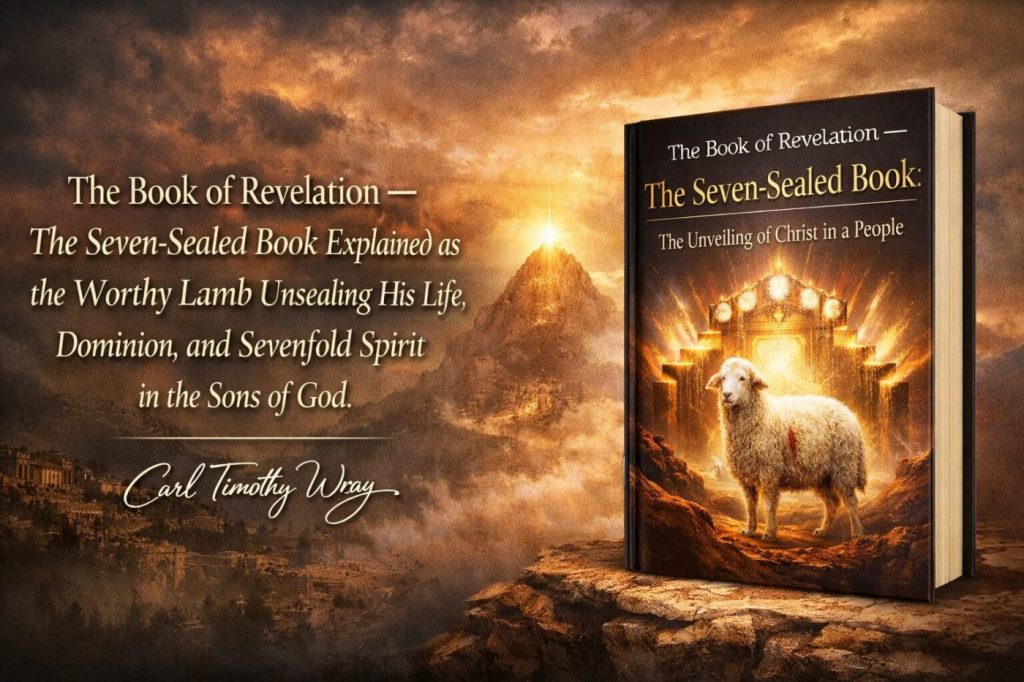
The Book of Revelation — The Seven-Sealed Book Explained as the Worthy Lamb Unsealing His Life, Dominion, and Sevenfold Spirit in the Sons of God
Book of Revelation: Author
📖 Book of Revelation
What is the seven-sealed book in Revelation 5?
Is it a literal scroll in heaven? A prophetic timeline of world events? A title deed to the earth? Or is it something far deeper?
In The Book of Revelation — The Seven-Sealed Book: The Unveiling of Christ in a People, Carl Timothy Wray presents a spiritually grounded, Christ-centered interpretation of Revelation 5 that moves beyond futurism and fear-driven eschatology. Anchored firmly in the Book of Revelation, this work unveils the scroll in the right hand of Him who sits upon the throne as the hidden fullness of Christ written within His elect — sealed by divine process and opened only by the Worthy Lamb.
Journey through:
- The scroll written within and without
- The crisis of “no man found worthy”
- The Lion who appears as a slain Lamb
- The Lambkin company on Mount Zion
- The seven spirits of God sent forth into all the earth
- The manifestation of Christ’s life, dominion, and glory through a matured sonship people
This book reveals that the seals are not merely prophetic catastrophes — they are the breaking of Adamic consciousness and the unveiling of Christ within. The Lamb does not merely open a scroll; He opens a people.
This is not speculation.
This is not sensationalism.
This is the Book of Revelation seen through the throne.
In this in-depth study of the Book of Revelation, Carl Timothy Wray explains the true meaning of the seven-sealed book in Revelation 5, the identity of the Worthy Lamb, and the spiritual significance of the scroll written within and without. Discover how the Lion of the tribe of Judah appears as a slain Lamb, how the seven seals relate to the unveiling of Christ in the sons of God, and how the seven spirits of God are sent forth into all the earth. This Christ-centered interpretation of the Book of Revelation offers a spiritual understanding of the scroll, the seals, and the manifestation of God’s kingdom beyond traditional futurist or symbolic speculation.
✍️ Book of Revelation: Introduction
The Scroll in the Right Hand
The fifth chapter of the Book of Revelation opens with a scene of breathtaking majesty. The apostle John, “in the Spirit,” beholds a throne set in heaven. Radiance surrounds it. Authority emanates from it. Government proceeds from it. And in the right hand of Him who sits upon the throne rests a book — written within and on the backside — sealed with seven seals.
This scroll has stirred centuries of debate.
Some have declared it to be a prophetic timeline of global catastrophe. Others have described it as the title deed to the earth. Still others have treated it as a mysterious heavenly document containing the fate of nations.
Yet the question still echoes through the ages:
What is the seven-sealed book?
And why does heaven fall silent when a mighty angel cries with a loud voice, “Who is worthy to open the book, and to loose the seals thereof?”
John weeps.
He weeps not out of curiosity, but out of recognition. For he understands that the destiny of God’s purpose in creation hangs upon the opening of that scroll. If no one can open it, then the promises of restoration, redemption, and the triumph of the kingdom must remain forever sealed.
But then comes the voice: “Weep not.”
“Behold, the Lion of the tribe of Judah… hath prevailed.”
John turns, expecting to see a Lion.
Instead, he beholds a Lamb — as it had been slain — standing in the midst of the throne.
Here begins one of the greatest revelations in all of Scripture.
The Lion conquers as a Lamb.
The Lamb stands in the throne.
And the scroll is opened not by force, but by sacrifice.
This book proposes that the seven-sealed scroll is not a literal parchment in a distant heaven. It is the fullness of Christ written within a people — inscribed in their minds, sealed in their hearts, held secure in the sovereign hand of God until the appointed unveiling. The seals represent the divine process by which the outer man is broken, the Adamic consciousness judged, and the hidden Christ revealed.
The scroll is written within — the inner life of Christ.
It is written without — the outward manifestation of that life.
It is sealed — not to prevent revelation, but to preserve it until the Lamb prevails.
No man can open the book.
No human strength can produce the manifestation of sonship.
No religious system can force the kingdom into visibility.
No revivalistic zeal can unseal what only the Lamb can open.
But the Lion-Lamb within prevails.
As the seals are broken, Christ is unveiled.
As Christ is unveiled, the sevenfold Spirit is released.
As the sevenfold Spirit is sent forth, the earth is filled with the knowledge of the glory of the Lord.
The Book of Revelation is not merely a forecast of events. It is an unveiling — an apocalypse — of Jesus Christ. And that unveiling reaches its crescendo when the Lamb stands in the midst of the throne and opens the book that reveals His life in a people.
This work invites you to behold the throne, to hear the cry of heaven, to see the Lion who is a Lamb, and to understand the scroll that must be opened.
For the seven-sealed book is not merely prophecy.
It is Christ.
And the unveiling has begun.
Chapter 1
The Throne, the Right Hand, and the Scroll
1. The Setting of Revelation 5
Before the seven-sealed book can be understood, the setting in which it appears must be carefully examined.
The fifth chapter of the Book of Revelation does not begin in chaos. It does not begin with war, beasts, or judgment. It begins with a throne.
In Revelation 4, John writes:
“After this I looked, and, behold, a door was opened in heaven… and immediately I was in the Spirit: and, behold, a throne was set in heaven, and one sat on the throne.”
Everything that follows in Revelation 5 flows from this throne.
This is not incidental. It is foundational.
The throne represents divine government — absolute sovereignty, supreme authority, unchallenged dominion. The Book of Revelation is not centered first on tribulation, antichrist systems, or global upheaval. It is centered on the throne of God.
If the throne is misunderstood, the scroll will be misunderstood.
2. “In the Spirit” — The Realm of Vision
John explicitly states that he was “in the Spirit.”
This phrase establishes the interpretive framework for everything he sees. The throne, the living creatures, the elders, the scroll, the Lamb — all are revealed within a spiritual dimension.
This does not mean they are unreal. It means they are seen from the realm of divine reality rather than earthly limitation.
The throne is not described in anthropomorphic detail. John does not see a physical form of God. Instead, he sees brilliance, radiance, and light “like a jasper and a sardine stone.” Around the throne is a rainbow. Lightning proceeds from it. Lamps burn before it.
The emphasis is not physical structure but manifested attributes.
The One upon the throne is not defined by shape, but by glory.
This is critical. The Book of Revelation does not present God as an enlarged human figure seated upon a celestial chair. It presents Him as sovereign Spirit radiating authority and majesty.
Therefore, the scroll in His right hand must also be understood within this same spiritual framework.
3. The Right Hand of Authority
Revelation 5:1 declares:
“And I saw in the right hand of him that sat on the throne a book written within and on the backside, sealed with seven seals.”
In Scripture, the right hand consistently symbolizes authority, power, and executive action.
- The right hand of God delivers Israel.
- The right hand exalts.
- Christ is seated at the right hand of the Father.
The right hand is not merely location; it is position of dominion.
Therefore, the scroll is not resting casually. It is held within the realm of sovereign authority. It is governed, preserved, and secured within divine purpose.
Nothing written in that scroll is subject to human alteration.
Nothing in it is accidental.
It is held in omnipotent control.
4. The Scroll Written Within and Without
John describes the scroll as:
“written within and on the backside.”
This detail is not ornamental; it is revelatory.
In the ancient world, scrolls were typically written on one side. Writing on both sides indicated fullness — nothing more could be added. The document was complete.
This scroll is filled.
It contains no empty spaces.
It is not awaiting future editing.
It is not a developing plan.
It is complete in its inscription.
Theologically, this speaks to the completeness of God’s eternal purpose. The scroll does not represent improvisation in history. It represents a finished intention written from before the foundation of the world.
What is written within speaks of inward reality — nature, identity, divine life.
What is written without speaks of outward expression — manifestation, action, visibility.
This dual inscription foreshadows a profound truth: God’s purpose is both inward and outward. It concerns transformation within and expression without.
The scroll contains nothing less than the fullness of divine intention concerning Christ and His corporate expression.
5. Sealed with Seven Seals
The scroll is not open. It is sealed — and not merely with one seal, but with seven.
Seven in biblical symbolism denotes completeness, fullness, and divine perfection. The seven seals indicate total containment.
Nothing in the scroll can be accessed prematurely.
Nothing can be tampered with.
Nothing can be partially revealed by human effort.
The seals are not merely barriers. They are safeguards.
They ensure that what is written can only be unveiled by divine authorization.
This immediately establishes tension in the narrative. If the scroll contains the fullness of God’s purpose, and if it remains sealed, then creation waits.
Heaven waits.
Earth waits.
History waits.
And the question arises:
Who is worthy to open the book?
6. The Central Question of Revelation 5
Revelation 5 is not primarily about catastrophe. It is about worthiness.
A strong angel proclaims with a loud voice:
“Who is worthy to open the book, and to loose the seals thereof?”
Notice carefully — the question is not who is strong enough, intelligent enough, or powerful enough.
It is who is worthy.
Worthiness speaks of character. Qualification. Moral and spiritual fitness.
The opening of the scroll is not an act of brute force. It is an act requiring perfect alignment with the throne.
No created being immediately steps forward.
And John weeps.
His weeping reveals that he understands the stakes. If no one opens the scroll, the fullness of God’s purpose remains concealed.
The seals must be broken.
The scroll must be opened.
The content must be revealed.
But not by man.
7. Establishing the Thesis
At this stage, we establish the theological trajectory of this book:
The seven-sealed scroll is not a random prophetic document. It is the comprehensive expression of God’s eternal purpose centered in Christ.
It is written within and without because God’s purpose concerns both inner transformation and outward manifestation.
It is sealed because its unveiling requires divine worthiness.
And the drama of Revelation 5 revolves around the unveiling of that purpose.
The throne governs it.
The right hand secures it.
The seals protect it.
And heaven waits for the Worthy One.
In the next chapter, we will examine more closely the nature of what is written within and without — and why the scroll cannot be reduced to mere prophetic events.
For the seven-sealed book is not merely about history.
It is about Christ.
And Christ must be unveiled.
Chapter 2
Written Within and Without
The Inner Life and the Outer Manifestation of Christ
1. The Significance of the Double Inscription
Revelation 5:1 states that the scroll was “written within and on the backside.”
This phrase demands careful theological reflection.
In the ancient world, scrolls were normally written on the inner surface only. The outer surface was typically left blank unless space was insufficient. A scroll written on both sides signified fullness. Nothing further could be added.
The content was complete.
This detail is not incidental. It communicates that what God has written concerning His purpose in Christ is not partial, progressive, or subject to revision. It is finished in intention, even if not yet fully manifested in history.
The scroll is full because the purpose of God is full.
The double inscription reveals two dimensions of divine intention:
- An inward reality.
- An outward expression.
The scroll speaks to both.
2. Written Within — The Interior Work of Christ
To be written “within” speaks first of interior inscription.
Scripture consistently presents God’s ultimate purpose as an inward work before it becomes an outward one.
Jeremiah prophesied of a new covenant in which God would write His law upon the heart. Ezekiel spoke of a new spirit placed within. The apostle Paul declared that believers are “epistles… written not with ink, but with the Spirit of the living God; not in tables of stone, but in fleshy tables of the heart.”
God’s redemptive plan is not merely external governance; it is internal transformation.
Therefore, the scroll written within signifies the implanted life, nature, and mind of Christ. It represents divine character formed in human vessels. It is the mystery of “Christ in you, the hope of glory.”
The scroll is not merely information.
It is incarnation.
God’s eternal purpose is not simply to announce decrees from heaven but to reproduce His Son within a people.
The inner writing represents:
- The law of the Spirit replacing the law of sin.
- The mind of Christ replacing Adamic consciousness.
- The life of the Lamb supplanting self-centered identity.
Before Christ can be manifested outwardly in dominion, He must be formed inwardly in nature.
The scroll is written within first.
3. Written Without — The Visible Expression of the Hidden Life
The scroll is also written on the backside.
This outward writing signifies manifestation.
What God writes within must eventually be read without.
The inward life of Christ is not meant to remain hidden in private spirituality. It is designed to become visible expression — character demonstrated, authority exercised, righteousness embodied.
Throughout Scripture, inward transformation precedes outward authority.
David was anointed long before he reigned.
Christ was declared Son before He was manifested in power.
The apostles were filled before they were sent.
God never reverses this order.
The outward inscription represents:
- The manifestation of sonship.
- The revelation of divine nature through human life.
- The visible display of the kingdom.
The scroll written without indicates that what is formed within will eventually be seen, known, and read by others.
The world will read what God has written.
4. The Scroll as Corporate Christ
If the scroll contains both inward life and outward manifestation, what precisely is written?
It cannot merely be a sequence of future events. Events do not require inward inscription. Nor are historical timelines described as written within and without.
The language suggests something living.
Theologically, the scroll represents the fullness of Christ — not merely Christ as an individual, but Christ expressed corporately in His body.
The apostle Paul spoke of “the mystery which hath been hid from ages and from generations, but now is made manifest… which is Christ in you.”
This mystery was hidden. It was sealed. It was concealed within divine purpose.
The scroll, therefore, signifies the comprehensive revelation of Christ — His life, authority, dominion, and glory — written within His elect and destined for outward unveiling.
It is Christ formed in a people.
It is the destiny of sonship inscribed before the foundation of the world.
It is the corporate expression of the Lamb.
5. Why the Scroll Must Be Sealed
If the scroll represents such fullness, why is it sealed?
Because premature manifestation would distort divine purpose.
God does not unveil maturity before process. He does not release dominion before character. He does not reveal glory before conformity.
The seals preserve the integrity of the inscription.
They ensure that what is written within is not brought forth through human ambition, religious enthusiasm, or spiritual presumption.
The history of the church reveals repeated attempts to manifest power without maturity, authority without brokenness, dominion without the Lamb-nature.
The seals forbid this.
They restrain the outward revelation until the inward writing is complete.
6. The Tension Between Promise and Manifestation
Every believer senses this tension.
The fullness of Christ has been given in seed. Scripture declares that all things are ours in Him. Yet the visible manifestation of that fullness remains incomplete.
This tension is reflected in the sealed scroll.
The purpose is written.
The destiny is inscribed.
The inheritance is secure.
But the seals remain until the Worthy One opens them.
The scroll reveals that God’s ultimate intention is not partial redemption. It is total conformity to the image of His Son.
Until that conformity reaches its appointed maturity, the fullness remains sealed.
7. The Scroll Is Not External to the People of God
It is critical to state clearly: the scroll is not a document separate from the redeemed community.
The language of inward and outward writing strongly suggests embodiment rather than abstraction.
God’s purpose is not stored in an archive. It is inscribed in lives.
The scroll is held in the right hand of authority because its unveiling is governed by divine sovereignty. But its content concerns the transformation and manifestation of a people.
The seals do not hide information; they restrain manifestation.
When the seals are broken, what is revealed is not merely knowledge but life.
8. Preparing for the Crisis of Worthiness
At this point, a central theological problem emerges.
If the scroll contains the fullness of Christ in a people, and if its unveiling requires maturity, who can open it?
Human effort cannot force divine manifestation.
Religious systems cannot engineer sonship.
Spiritual gifts cannot produce full conformity.
The scroll cannot be opened by zeal, discipline, intellect, or ritual.
The question of worthiness now moves to the forefront.
Heaven searches.
And no man is found worthy.
In the next chapter, we will examine the nature of the seven seals themselves — what they represent, why they must be broken, and why their breaking produces both rejoicing in heaven and upheaval on earth.
For the seals are not arbitrary judgments.
They are the divine processes by which the inner inscription becomes outward revelation.
And only the Worthy Lamb can break them.
Chapter 3
Sealed with Seven Seals
Divine Process and the Breaking of Adamic Consciousness
1. The Meaning of the Seven Seals
Revelation 5:1 declares that the scroll was “sealed with seven seals.”
The number seven in Scripture consistently represents completeness, fullness, and divine perfection. The seven seals therefore signify total containment. Nothing within the scroll is accessible until every seal is broken.
The seals do not indicate partial concealment. They indicate comprehensive restraint.
The scroll is fully written. The purpose of God is complete. Yet it remains inaccessible until the seals are loosed.
This tension between completed intention and restrained manifestation is central to understanding Revelation 5.
God’s purpose in Christ is eternal and settled. But its visible unveiling unfolds progressively through divine process.
The seals represent that process.
2. Seals as Safeguards, Not Obstacles
It is important to distinguish between obstruction and protection.
The seals are not barriers erected against redemption. They are safeguards protecting the integrity of what has been written.
If the scroll represents the fullness of Christ expressed in a people, then the seals prevent premature manifestation. They ensure that outward authority does not precede inward conformity.
Throughout Scripture, God never releases power without preparation.
Israel was delivered before it was disciplined in the wilderness.
David was anointed before he was processed in obscurity.
The disciples were called before they were sifted.
The pattern is consistent: promise, process, manifestation.
The seals belong to the process.
3. Why the Breaking of the Seals Produces Upheaval
When the Lamb begins to open the seals in Revelation 6, the imagery is dramatic: conquest, conflict, famine, death, cosmic disturbance.
These symbols have often been interpreted exclusively as geopolitical events. While they may carry historical implications, their deeper theological meaning lies in what they represent spiritually.
The breaking of the seals signifies the dismantling of the old order.
If the scroll represents Christ written within a people, then the seals represent the restraints imposed by the dominance of Adamic consciousness — the outer man, the carnal mind, the inherited nature of self-rule.
When the Lamb opens the seals, He does not simply reveal information. He initiates transformation.
Transformation is never passive.
The old must be displaced for the new to emerge.
The self-centered mind must be judged for the mind of Christ to prevail.
The structures of fleshly identity must collapse for divine identity to manifest.
Thus, what appears as turmoil from the standpoint of the outer man is rejoicing from the standpoint of heaven.
Heaven rejoices because Christ is being unveiled.
Earth trembles because Adam is being dethroned.
4. The Seals and the Adamic Order
Paul describes the human condition in Romans as a conflict between two laws: the law of sin operating in the members and the law of the Spirit of life in Christ Jesus.
The seven seals can be understood as representing the complete containment of Christ’s life within the limitations of Adamic identity.
The outer man — shaped by fear, self-preservation, pride, ambition, and mortality — forms the experiential barrier to the full expression of the inner Christ.
The seals are not merely external judgments; they are the divine dealings that expose, confront, and dismantle the structures of this old consciousness.
When the Lamb breaks a seal, something in the old order loses ground.
The conquest of the white horse challenges false authority.
The red horse confronts misplaced power.
The black horse exposes scarcity consciousness.
The pale horse reveals the mortality inherent in Adam.
These are not random disasters; they are the systematic unseating of the old mind.
The Lamb opens the seals so that Christ may emerge.
5. Heaven’s Rejoicing and Earth’s Distress
One of the striking features of Revelation is that heaven worships while earth trembles.
From the natural perspective, the breaking of the seals appears catastrophic. From the throne’s perspective, it is redemptive.
Why?
Because the suffering associated with the breaking of the seals belongs primarily to the old nature. It is the shaking of that which cannot remain.
Hebrews speaks of a shaking so that what is temporary may be removed, leaving only what is unshakable.
The seals initiate this shaking.
They strip away reliance on flesh.
They dismantle illusions of autonomy.
They expose the inadequacy of self-rule.
What is shaken is not the new creation. It is the old.
Heaven rejoices because the Lamb’s work is advancing.
6. No Seal Is Broken by Human Effort
The narrative of Revelation 5 makes clear that no created being is capable of opening the scroll.
This includes:
- Those in heaven.
- Those on earth.
- Those under the earth.
No spiritual advancement, no religious office, no prophetic insight, and no apostolic authority qualifies one to break the seals.
The unveiling of Christ cannot be engineered.
The history of Christianity includes many attempts to accelerate manifestation through revivalism, organization, or declaration. Yet the fullness remains sealed until opened by the Worthy One.
The seals remind us that divine purpose unfolds under divine authority.
Only the Lamb prevails.
7. The Progressive Nature of Unsealing
The breaking of the seals is sequential.
This progression indicates that the unveiling of Christ in a people is not instantaneous in its fullness. It unfolds through stages of process.
Each seal removed exposes deeper layers of identity and purpose.
Each stage confronts remaining aspects of Adamic consciousness.
Each step moves creation closer to the full revelation of what has been written within.
The ultimate goal is not destruction but disclosure.
The seals are broken so that the scroll may be read.
The scroll is opened so that Christ may be seen.
8. The Purpose Behind the Process
It is essential to remember that the Lamb who opens the seals is the same Lamb who was slain.
The process is governed by sacrificial love, not arbitrary severity.
The breaking of the seals is not punitive; it is purifying.
It is not wrath against the redeemed; it is liberation from the old identity.
The Lamb opens the seals because He has prevailed — not by force, but by self-giving obedience.
Thus, the divine process is rooted in redemptive love.
The seals fall because the Lamb has overcome.
And as they fall, what was hidden becomes manifest.
9. Moving Toward the Crisis of Worthiness
The theological weight of Revelation 5 now becomes clearer.
The scroll contains the fullness of Christ’s corporate expression.
The seals represent the comprehensive process required to unveil that fullness.
The breaking of the seals dismantles the Adamic order and prepares for manifestation.
But the central question remains:
Who is worthy?
John weeps because no man is found capable.
The opening of the seals requires more than power. It requires moral and spiritual victory.
In the next chapter, we will examine the proclamation of the strong angel and the silence that follows — the moment in which all creation is searched and no man is found worthy to open the book.
For until the Worthy One appears, the scroll remains sealed.
And creation waits.
Chapter 4
Who Is Worthy to Open the Book?
The Proclamation That Shook Heaven
1. The Strong Angel and the Loud Voice
Revelation 5:2 declares:
“And I saw a strong angel proclaiming with a loud voice, Who is worthy to open the book, and to loose the seals thereof?”
The scene shifts from the sealed scroll to a universal summons.
A strong angel — a figure representing divine authority and proclamation — issues a challenge that reverberates through all realms of existence.
The question is not whispered. It is proclaimed “with a loud voice.” The Greek expression conveys force, urgency, and universality. This is no private inquiry. It is a declaration addressed to heaven, earth, and the underworld.
The entire created order is summoned.
The scroll must be opened.
The seals must be loosed.
The purpose of God must advance.
But the decisive question is asked:
Who is worthy?
2. Worthiness Defined
It is crucial to note what the angel does not ask.
He does not ask:
- Who is intelligent enough?
- Who is powerful enough?
- Who is spiritually gifted enough?
He asks who is worthy.
Worthiness implies moral qualification, spiritual fitness, and victorious integrity. The opening of the scroll is not an act of raw strength but of rightful authority.
To open the book is to execute the purposes of God. It is to unveil the fullness of Christ written within a people. It is to initiate the final movement of divine intention toward manifestation.
This task requires more than ability. It requires perfect alignment with the throne.
Only one whose nature is fully conformed to divine righteousness can open what God has written.
3. The Search of All Realms
Revelation 5:3 continues:
“And no man in heaven, nor in earth, neither under the earth, was able to open the book, neither to look thereon.”
The language encompasses every dimension of created existence.
In heaven — the realm of spiritual beings and exalted saints — none are found worthy.
On earth — among rulers, prophets, apostles, and religious leaders — none qualify.
Under the earth — representing the realm of the dead or the depths of fallen humanity — no candidate emerges.
The search is exhaustive.
No created being can open the scroll.
No human attainment can access its contents.
No spiritual rank can authorize its unveiling.
This is a theological crisis.
If the scroll contains the fullness of Christ’s manifestation, and no one can open it, then the purpose remains sealed.
Creation waits in suspended anticipation.
4. The Inadequacy of Human Effort
This moment in Revelation exposes a fundamental truth: human effort cannot produce divine manifestation.
Religious systems cannot generate sonship maturity.
Spiritual disciplines cannot force divine unveiling.
Prophetic insight cannot substitute for worthiness.
The history of redemption reveals repeated attempts to accelerate God’s purposes through human initiative.
Israel sought kingship through natural desire.
Religious leaders sought righteousness through law.
Movements have sought revival through structure.
Yet the scroll remains sealed until the Worthy One appears.
The silence of heaven in response to the angel’s proclamation underscores the inadequacy of all created ability.
No man can open the book.
5. John’s Weeping
Revelation 5:4 records:
“And I wept much, because no man was found worthy to open and to read the book, neither to look thereon.”
John’s response is not trivial. He does not weep out of curiosity. He weeps out of comprehension.
He understands what is at stake.
If the scroll remains sealed:
- The full revelation of Christ remains hidden.
- The ultimate restoration of creation remains incomplete.
- The destiny of sonship remains unrealized.
John’s tears reflect the longing of creation described by Paul in Romans — the earnest expectation waiting for the manifestation of the sons of God.
The apostle’s weeping embodies this groaning.
He perceives that if no one opens the scroll, history remains unresolved.
The promises of God hang in suspense.
6. Theological Implications of “No Man”
The phrase “no man” is decisive.
Not one individual from among humanity or created spirits qualifies.
Even those dwelling in heavenly realms are excluded.
This is significant. Spiritual experience alone does not confer worthiness. Even exalted states of consciousness or proximity to divine presence do not qualify a being to open the scroll.
The opening requires more than position. It requires victory.
The scroll cannot be opened by one who has not overcome every dimension of the fall.
The worthiness demanded here is absolute.
Only one who has conquered sin, death, and the adversary at their roots can break the seals.
7. The Transition from Despair to Revelation
John’s weeping marks the lowest point in the scene.
The proclamation has been made.
The search has failed.
The silence is complete.
Creation appears suspended between promise and impossibility.
But Revelation 5 does not end in tears.
The next verse introduces a decisive interruption.
An elder speaks:
“Weep not.”
This command does not dismiss John’s grief. It answers it.
The silence is about to be broken.
The crisis of worthiness is about to be resolved.
The search is about to conclude.
The proclamation of the strong angel sets the stage for the unveiling of the One who alone qualifies.
8. Preparing for the Worthy One
The drama of Revelation 5 hinges on this moment.
The scroll exists.
The seals remain intact.
No man can open them.
The weight of divine purpose presses upon creation.
Then comes the revelation:
“Behold, the Lion of the tribe of Judah… hath prevailed.”
The term prevailed indicates victory already accomplished.
The Worthy One does not emerge through competition. He prevails because He has already overcome.
In the next chapter, we will examine the paradox that defines this victory — John is told to behold a Lion, yet he sees a Lamb.
For the one who is worthy to open the scroll conquers not by force, but by sacrificial obedience.
And in that paradox lies the key to the unveiling of Christ in a people.
Chapter 5
No Man Was Found Worthy
The Limits of Heaven, Earth, and Flesh
1. The Absolute Statement
Revelation 5:3–4 declares:
“And no man in heaven, nor in earth, neither under the earth, was able to open the book, neither to look thereon. And I wept much, because no man was found worthy…”
The language is unqualified. It is not that few were worthy. It is not that the right candidate had not yet stepped forward.
No man was found worthy.
This is one of the most sweeping statements in Scripture concerning the limitation of created beings.
It encompasses:
- The heavenly realm.
- The earthly realm.
- The underworld.
Every sphere of created existence is searched, and none qualify.
The conclusion is inescapable: the unveiling of God’s ultimate purpose lies beyond the capacity of all created life.
2. “In Heaven” — The Limits of Spiritual Attainment
The phrase “no man in heaven” demands careful reflection.
Heaven here represents the realm of spiritual beings and those dwelling in divine presence. If even that realm cannot produce one worthy to open the scroll, then spiritual experience alone is insufficient.
This confronts a subtle but persistent assumption: that advancement in spiritual perception or exalted position automatically confers authority to fulfill divine purpose.
The text refutes this.
No level of spiritual attainment, no matter how elevated, qualifies a created being to execute the final unveiling of Christ’s fullness.
This is not a deficiency of heaven; it is a declaration that the scroll requires more than proximity to God. It requires complete victory over the fall.
The worthiness demanded is not positional; it is redemptive.
3. “On Earth” — The Limits of Human Leadership
The search also includes “no man… in earth.”
This encompasses rulers, prophets, apostles, reformers, and spiritual leaders throughout history.
Human leadership, no matter how gifted or anointed, cannot open the scroll.
History demonstrates repeated cycles of renewal and decline. Movements arise with zeal and vision. They produce fruit. Yet none bring the fullness of manifested sonship across the earth.
Why?
Because no human system or personality possesses the intrinsic worthiness required to unseal the scroll.
The scroll cannot be opened by charisma, intellect, organization, or revivalistic fervor.
The text is categorical.
No man on earth is able.
4. “Under the Earth” — The Limits of Fallen Power
The phrase “neither under the earth” extends the search to the depths — the realm associated with death, corruption, and the powers opposed to God.
No fallen power can open the scroll.
No adversarial force can co-opt or prematurely expose what God has sealed.
This reinforces the sovereignty of the throne.
The scroll is secure from both human presumption and demonic interference.
What God has written remains under His authority until the Worthy One acts.
5. The Inability to “Look Thereon”
The text adds an additional detail:
No man was able “to look thereon.”
The inability is not merely to open the scroll but even to look upon it.
This suggests that the contents are inaccessible to created comprehension apart from divine qualification.
Human speculation cannot penetrate it.
Religious curiosity cannot decode it.
Prophetic imagination cannot unveil it.
The scroll’s meaning is bound to the person of the Worthy One.
Without Him, even insight is barred.
6. The Crisis of Manifestation
Theologically, this moment exposes the gap between promise and manifestation.
The purpose of God is written.
The destiny of sonship is inscribed.
The inheritance is secured in the right hand of authority.
Yet manifestation remains sealed.
Throughout history, believers have sensed this tension.
The Spirit has been poured out, yet the earth is not filled with the knowledge of the Lord in fullness.
The gospel has advanced, yet corruption persists.
Revival has come, yet death remains.
The scroll symbolizes the completion of God’s redemptive purpose — Christ fully unveiled in a people and through them into creation.
If no one can open it, then the fullness cannot arrive.
This is why John weeps.
7. The Failure of Self-Generated Manifestation
John’s tears also represent the frustration of self-effort.
Humanity has repeatedly attempted to produce what only divine worthiness can release.
There have been declarations of arrival, claims of completed manifestation, assertions of having entered the fullness. Yet history continues to testify that the complete unveiling remains future.
The reason is not lack of sincerity. It is lack of qualification.
The opening of the scroll requires more than enthusiasm or doctrinal accuracy. It requires a victorious life that has triumphed over sin, death, and the adversary at their roots.
No man possesses that victory inherently.
Thus, the scroll remains sealed.
8. The Weight of John’s Weeping
John’s weeping is described as intense. The language suggests audible sobbing rather than quiet tears.
Why such depth of emotion?
Because he perceives that without the opening of the scroll, creation remains incomplete.
He understands that the manifestation of the sons of God, the liberation of creation, and the consummation of redemption hinge upon this moment.
His tears express:
- The longing of the Spirit.
- The groaning of creation.
- The burden of unfinished purpose.
Yet his weeping also reveals a limit.
Groaning alone does not open the scroll.
Desire alone does not break the seals.
Spiritual hunger alone does not produce manifestation.
Something greater is required.
9. The Threshold of Revelation
Revelation 5 has now reached its point of maximum tension.
The scroll is sealed.
The search has failed.
No man qualifies.
The apostle weeps.
The narrative stands at a threshold.
Then, in the next verse, an elder speaks:
“Weep not.”
This is not comfort rooted in denial. It is comfort rooted in triumph.
The worthiness that no man possesses has already been secured by Another.
The crisis of inability prepares for the revelation of victory.
In the next chapter, we will examine this turning point — the announcement of the Lion of the tribe of Judah and the paradox of the Lamb who stands as slain.
For the solution to the crisis of worthiness lies not in the elevation of man, but in the revelation of the Lamb.
Chapter 6
Weep Not
The Revelation of the Prevailing One
1. The Divine Interruption
Revelation 5:5 begins with a decisive interruption:
“And one of the elders saith unto me, Weep not…”
Heaven does not allow John’s weeping to continue unanswered.
The command is not dismissive. It is revelatory.
The elder does not say, “Weep not, because it does not matter.”
He says, “Weep not,” because the answer already exists.
The crisis of worthiness has been resolved.
John weeps because no man is worthy. The elder speaks because One has prevailed.
This marks the turning point of Revelation 5.
2. “Behold, the Lion of the Tribe of Judah”
The elder continues:
“Behold, the Lion of the tribe of Judah, the Root of David, hath prevailed to open the book, and to loose the seven seals thereof.”
The command to “behold” signals revelation. John is instructed to shift his focus.
The Lion of the tribe of Judah evokes royal authority and messianic fulfillment. The reference to Judah recalls Jacob’s prophecy that the scepter would not depart from that tribe. The Root of David signifies both origin and authority — the One who is David’s source and heir.
The titles communicate kingship, dominion, and victory.
But the critical word is prevailed.
The Greek term indicates conquest, overcoming, victory already achieved.
The scroll can be opened because the battle has been won.
The worthiness required to break the seals is not prospective; it is accomplished.
3. The Expectation of Power
At this moment, John has every reason to expect a Lion.
The symbolism is deliberate. The Lion represents strength, majesty, fearlessness, and kingly rule. It is the image of decisive authority that subdues opposition.
If the scroll requires victory over sin, death, and the adversary, then a Lion seems appropriate.
The narrative builds anticipation for visible force.
But Revelation often reveals truth through paradox.
John turns to see the Lion.
He sees something else.
4. “And I Beheld… a Lamb”
Revelation 5:6 declares:
“And I beheld, and, lo, in the midst of the throne… stood a Lamb as it had been slain.”
The Lion is revealed as a Lamb.
The symbol shifts, but the identity does not.
This is one of the most profound theological revelations in Scripture: the power that prevails is sacrificial.
The Lamb is not merely present. He is standing. Though slain, He lives. Though sacrificed, He reigns.
The marks of death are visible, yet death has not prevailed.
The Lamb stands in the midst of the throne.
This is not weakness enthroned. It is victorious sacrifice enthroned.
5. The Nature of True Victory
The paradox of Lion and Lamb reveals the nature of divine conquest.
The Lion prevails as a Lamb.
Christ’s victory was not achieved through coercion but through obedience. He overcame not by crushing enemies through force, but by absorbing sin and overcoming death through self-giving love.
The cross is not a detour from victory; it is the means of victory.
Only one who has:
- Conquered sin without succumbing,
- Entered death without remaining,
- Disarmed principalities without compromise,
can be declared worthy.
The Lamb qualifies because He has prevailed through complete obedience to the will of the Father.
His worthiness is rooted in redemptive triumph.
6. The Lamb in the Midst of the Throne
The Lamb is seen “in the midst of the throne.”
This detail carries immense theological weight.
The Lamb is not at the edge of authority. He stands at its center.
Divine government is inseparable from sacrificial love.
The throne is not ruled by arbitrary power but by crucified glory.
The marks of the Lamb’s slaying are not erased in resurrection. They remain as testimony of how victory was achieved.
This establishes a foundational principle:
The unveiling of Christ’s life in a people will occur through the same pattern by which Christ prevailed.
Authority flows from obedience.
Dominion flows from surrender.
Glory flows from sacrifice.
7. The Seven Horns and Seven Eyes
Revelation 5:6 continues:
“having seven horns and seven eyes, which are the seven spirits of God sent forth into all the earth.”
The Lamb is not diminished by His sacrificial identity. He possesses seven horns — complete authority — and seven eyes — perfect perception.
The imagery communicates fullness of power and fullness of wisdom.
The Lamb is neither passive nor powerless. He embodies complete dominion, but dominion expressed through righteousness and love.
The seven spirits signify the fullness of divine operation proceeding from the Lamb.
Thus, the One who opens the scroll does so with:
- Absolute authority,
- Perfect insight,
- Complete alignment with the throne.
8. The Resolution of the Crisis
The elder’s declaration resolves the tension of Revelation 5.
No man is worthy.
But the Lamb is.
No created being qualifies.
But the incarnate Son, who has conquered sin and death, prevails.
The scroll can now be opened.
The seals can now be broken.
The purpose of God can now advance toward manifestation.
John’s weeping ceases because the ground of despair — human inability — has been replaced by divine victory.
9. Implications for the Unveiling of Christ in a People
If the scroll represents the fullness of Christ written within a people, and if only the Lamb can open it, then the unveiling of that fullness cannot originate from human initiative.
The Lamb must open what God has written.
This means:
- The manifestation of sonship flows from participation in the Lamb’s victory.
- The breaking of the seals unfolds through conformity to His nature.
- The authority exercised in the earth must reflect the character of the slain yet standing Lamb.
The Lion-Lamb within must prevail.
The crisis of worthiness teaches that self-generated elevation cannot open the scroll.
Only union with the victorious Lamb can.
10. Preparing for the Corporate Revelation
Revelation 5 does not end with the Lamb merely holding the scroll.
He takes it from the right hand of Him who sits upon the throne.
This act signifies transfer of authority to execute what has been written.
The opening of the scroll will initiate the progressive unveiling of Christ’s purpose — not only in Himself as Head, but in His body.
In the next chapter, we will examine more deeply the paradox of the Lion and the Lamb and how their union defines the nature of divine government.
For the One who opens the scroll is both kingly and sacrificial.
And in that union lies the pattern for the people in whom He will be revealed.
Chapter 7
Behold the Lion… and I Saw a Lamb
Power Perfected Through Sacrifice
1. The Symbolic Reversal
Revelation 5:5–6 presents one of the most deliberate symbolic reversals in Scripture:
“Behold, the Lion of the tribe of Judah… hath prevailed…
And I beheld… a Lamb as it had been slain.”
John is told to look for a Lion.
He turns — and sees a Lamb.
The text does not correct itself. It does not say the Lion disappeared and a Lamb appeared instead. Rather, the Lion is the Lamb.
The titles are not contradictory. They are revelatory.
The Lion speaks of royal authority.
The Lamb speaks of sacrificial obedience.
Together they reveal the true nature of divine power.
2. The Lion of the Tribe of Judah
The image of the Lion originates in Genesis 49, where Jacob blesses Judah:
“Judah is a lion’s whelp… the sceptre shall not depart from Judah.”
The Lion represents kingship, sovereignty, courage, and dominion. In the natural world, the lion is regarded as the king of beasts — majestic, fearless, and uncontested in strength.
To call Christ the Lion of Judah is to declare Him the rightful King.
It is to affirm:
- His authority over all principalities.
- His dominion over death.
- His entitlement to rule.
The scroll requires one who can execute divine government. The Lion imagery answers that requirement.
But Revelation does not stop with kingship.
3. The Lamb as It Had Been Slain
When John turns, he sees:
“a Lamb as it had been slain.”
The Greek term used in Revelation for “Lamb” (arnion) carries the sense of a little lamb — a sacrificial lamb.
The imagery is unmistakable. The Lamb bears the marks of slaughter. Yet He stands.
This is resurrection life marked by sacrifice.
The Lamb is not merely gentle. He is slain. The victory He has achieved was won through death.
This reveals the paradox of the kingdom:
The Lion conquers as a Lamb.
Authority is secured through surrender.
Victory is achieved through sacrifice.
4. The Pattern of Divine Conquest
Christ did not prevail by avoiding suffering. He prevailed by enduring it.
Philippians 2 describes His self-emptying obedience, culminating in death — “even the death of the cross.” It is precisely because of this obedience that God highly exalted Him.
The Lion-Lamb union reveals that divine authority flows from redemptive obedience.
The Lamb stands in the throne because He was slain.
This pattern is not incidental. It is foundational to the unveiling of Christ in a people.
If the scroll represents the corporate manifestation of Christ, then the way it is opened reflects the way that manifestation will unfold.
The people in whom Christ is revealed must share in the Lamb-nature if they are to share in the Lion-authority.
5. The Lamb in the Midst
Revelation emphasizes that the Lamb stands:
- In the midst of the throne,
- In the midst of the four living creatures,
- In the midst of the elders.
The Lamb occupies the center.
Divine government, heavenly administration, and redeemed representation all converge around Him.
This positioning communicates a crucial theological truth: sacrificial love is not peripheral to divine rule — it is central to it.
The throne is governed by the Lamb.
Therefore, any expression of authority that is not Lamb-like is misaligned with the throne.
6. The Destruction of Adamic Power
The Lion-Lamb revelation also exposes the nature of Adamic power.
The fallen mind associates authority with dominance, self-assertion, and coercion. It seeks to secure position by force or manipulation.
But the Lamb reveals another order.
The Lamb conquers not by devouring enemies but by disarming them through righteousness. He triumphs not by self-exaltation but by obedience unto death.
Thus, the breaking of the seals dismantles the Adamic conception of power.
The outer man resists weakness.
The Lamb embraces it.
The outer man seeks control.
The Lamb submits to the Father.
The unveiling of Christ requires the dethroning of the old understanding of authority.
7. The Corporate Implication
If the scroll concerns Christ written within a people, then the Lion-Lamb nature must also be corporate in expression.
The manifestation of sonship cannot be rooted in arrogance, triumphalism, or domination.
It must reflect:
- Courage without cruelty.
- Authority without pride.
- Strength without violence.
- Victory without self-exaltation.
The people in whom Christ is unveiled must bear both images simultaneously — Lion and Lamb.
The Lion represents divine authority exercised in righteousness.
The Lamb represents divine life poured out in love.
When these are separated, distortion occurs. When they are united, the kingdom advances.
8. The Lamb’s Worthiness
The elder declares that the Lion has prevailed. John sees that the Lamb is worthy.
The worthiness of the Lamb is rooted in His obedience, humility, and triumph over death.
Revelation 5:9 records the heavenly song:
“Thou art worthy… for thou wast slain, and hast redeemed us to God by thy blood.”
The basis of worthiness is sacrificial redemption.
The scroll is opened by the One who has:
- Fully obeyed the Father,
- Fully borne sin,
- Fully conquered death,
- Fully aligned with divine righteousness.
No other being qualifies.
The Lamb alone prevails.
9. The Way Forward
The symbolic reversal of Lion and Lamb sets the theological trajectory for the remainder of the book.
The opening of the seals will not advance through earthly might but through the Lamb’s authority.
The victory over beasts, false prophets, and dragon will ultimately be the victory of the Lamb.
Revelation 17:14 declares:
“These shall make war with the Lamb, and the Lamb shall overcome them: for he is Lord of lords, and King of kings…”
The Lamb conquers.
This is the paradox at the heart of the kingdom.
10. Preparing for the Lambkin Revelation
The vision of the Lamb standing in the midst of the throne opens a further dimension.
Revelation later speaks of the Lamb upon Mount Zion — not alone, but with a company.
The One who prevails individually becomes the Head of a corporate expression.
The Lion-Lamb is not merely an individual reality. It is the pattern for the many.
In the next chapter, we will examine the concept of the Lambkin — the little Lamb — and the emergence of a people conformed to His image, standing with Him upon Mount Zion.
For the scroll is opened not only by the Lamb as Head, but for the unveiling of Christ in His body.
And the Lambkin company must reflect the same union of authority and sacrifice.
Chapter 8
The Slain Lamb in the Midst of the Throne
Authority Governed by Sacrificial Love
1. The Central Position of the Lamb
Revelation 5:6 declares:
“And I beheld, and, lo, in the midst of the throne… stood a Lamb as it had been slain…”
The phrase “in the midst” is not incidental. It is repeated deliberately. The Lamb is not adjacent to the throne. He is not beneath it. He stands in its midst.
This positioning establishes a governing principle: divine authority is inseparable from the Lamb’s nature.
The throne represents sovereign government.
The Lamb represents sacrificial redemption.
The Lamb standing in the midst reveals that redemption and rule are united.
Authority in the kingdom of God is not detached from love. It is defined by it.
2. Slain Yet Standing
The Lamb is described as “slain,” yet He stands.
This imagery conveys both completed sacrifice and victorious resurrection.
The marks of death remain visible, but death has no dominion.
This is not a Lamb awaiting restoration. It is a Lamb who has passed through death and stands in triumph.
Theologically, this affirms that the authority exercised from the throne flows from finished redemption.
Christ’s rule is not established by raw power but by accomplished atonement.
The Lamb stands because He has overcome.
3. The Seven Horns — Complete Authority
Revelation 5:6 continues:
“having seven horns…”
In biblical symbolism, horns represent strength and authority. The number seven signifies fullness or completeness.
The Lamb possesses complete authority.
This authority is not partial. It is not delegated in fragments. It is total.
The paradox is striking: the One who was slain holds absolute power.
This dismantles the human assumption that vulnerability negates authority.
In the kingdom of God, the deepest surrender becomes the highest authority.
4. The Seven Eyes — Perfect Vision
The text also describes the Lamb as having:
“seven eyes, which are the seven spirits of God sent forth into all the earth.”
Eyes signify perception, insight, and awareness. The Lamb’s authority is not blind force. It is informed by perfect vision.
The seven spirits indicate the fullness of divine operation — wisdom, understanding, counsel, might, knowledge, reverence, and the Spirit of the Lord as described in Isaiah 11.
Thus, the Lamb’s governance is marked by:
- Complete power (seven horns),
- Complete perception (seven eyes),
- Complete spiritual operation (seven spirits).
Authority and discernment are united.
5. The Throne Reinterpreted
At this point, the throne must be reinterpreted in light of the Lamb.
The throne is not a symbol of domination detached from compassion. It is the seat of crucified glory.
The Lamb governs the throne.
This reframes divine judgment. The judgments that proceed in Revelation do not originate from arbitrary wrath but from the righteous authority of the slain yet living Lamb.
The breaking of the seals, the sounding of the trumpets, the pouring of the bowls — all unfold under the authority of the Lamb.
Sacrificial love governs redemptive justice.
6. The Pattern for Corporate Authority
If the scroll represents the unveiling of Christ in a people, then the Lamb in the midst of the throne establishes the pattern for their authority.
The manifestation of the sons of God cannot be separated from the Lamb’s character.
The people who share in His authority must share in His nature.
Authority in the kingdom flows through:
- Obedience rather than ambition,
- Humility rather than pride,
- Service rather than self-assertion.
The Lion-Lamb union is not merely doctrinal. It is formative.
The corporate expression of Christ must reflect the same paradox — strength perfected through surrender.
7. The Relationship Between Head and Body
Christ as the Lamb stands in the throne as Head.
Yet the New Testament reveals that the Head is inseparable from the body.
The unveiling of Christ is not confined to the individual Jesus of Nazareth. It extends to His corporate body, conformed to His image.
If the Head reigns as Lamb, the body must function in Lamb-like character.
The authority given to the redeemed is never autonomous. It flows from union with the enthroned Lamb.
This prevents distortion.
Authority divorced from sacrificial love degenerates into oppression.
Sacrificial love divorced from authority degenerates into passivity.
The Lamb unites both.
8. The Lamb as the Key to the Scroll
Revelation 5:7 records:
“And he came and took the book out of the right hand of him that sat upon the throne.”
The Lamb does not seize the scroll; He receives it.
The action is deliberate and orderly.
The transfer signifies authorization.
The Lamb is entrusted with executing what the Father has written.
This is not rebellion against the throne. It is perfect alignment with it.
The One who humbled Himself unto death is now entrusted with the full outworking of divine purpose.
The scroll changes hands, but not authority. The Lamb operates as the perfect expression of the Father’s will.
9. Worship as Recognition of Worthiness
Immediately after the Lamb takes the scroll, heaven erupts in worship.
The four living creatures and the elders fall down before the Lamb, singing:
“Thou art worthy…”
Worship follows revelation.
The worthiness of the Lamb is not theoretical. It is acknowledged by all heavenly administration.
This worship affirms that the opening of the scroll is not merely procedural. It is redemptive.
The Lamb is praised because through His sacrifice He has redeemed a people to God and made them kings and priests.
The scroll’s content concerns this redeemed company.
10. The Implications for the Unveiling of Christ
The Lamb in the midst of the throne establishes the unalterable foundation for the remainder of the book.
All manifestation flows from the Lamb.
All authority is governed by His nature.
All unveiling is rooted in His victory.
The scroll will now be opened.
The seals will be broken.
But everything that unfolds does so under the governance of the slain yet standing Lamb.
This ensures that the ultimate goal is not destruction but restoration.
In the next chapter, we will examine the Lambkin revelation — the little Lamb — and the emergence of a company standing with Him upon Mount Zion.
For the unveiling of Christ in a people means that the nature of the Lamb must be multiplied.
And the One who stands in the throne will not stand alone.
Chapter 9
The Lambkin Company on Mount Zion
The Corporate Expression of the Slain Yet Standing Lamb
1. From Individual Victory to Corporate Manifestation
Revelation 5 reveals the Lamb standing in the midst of the throne, taking the scroll and opening its seals. The victory is individual, decisive, and complete.
Yet Revelation does not end with an individual Lamb reigning alone.
Revelation 14:1 declares:
“And I looked, and, lo, a Lamb stood on the mount Sion, and with him an hundred forty and four thousand…”
The Lamb who stood alone in Revelation 5 now stands with a company.
This transition from solitary victory to corporate manifestation is not accidental. It is the unfolding of what was written within the scroll.
The scroll concerns not merely the triumph of Christ as an individual but the unveiling of Christ in a people.
The Lamb who prevailed now stands with those conformed to His image.
2. Mount Zion — The Realm of Mature Sonship
Mount Zion in Scripture represents the seat of divine rule.
It is not merely a geographic hill in Jerusalem. It symbolizes the realm of covenant fulfillment and kingly authority.
Hebrews 12 speaks of believers coming to “Mount Sion… the city of the living God… the heavenly Jerusalem.”
Zion represents:
- Established sonship,
- Confirmed identity,
- Mature authority under divine government.
The Lamb standing on Zion signifies that His victory has found corporate expression.
The authority exercised from the throne now stands manifested in a people.
3. The Lamb and the Lambkins
The term used for Lamb in Revelation 14 is the same diminutive form used in Revelation 5 — the little Lamb (arnion).
The Lamb who prevailed stands with a company who bear His name.
Revelation 14:1 continues:
“…having his Father’s name written in their foreheads.”
The inscription upon their foreheads signifies identity, ownership, and likeness.
The scroll written within and without now finds living expression.
What was inscribed in the divine purpose is now inscribed upon a people.
They bear His name because they share His nature.
They stand with the Lamb because they have followed the Lamb.
4. The Marks of the Lambkin Company
Revelation 14 describes distinctive qualities of this company:
- They follow the Lamb whithersoever He goeth.
- They are redeemed from among men.
- They are called firstfruits unto God and to the Lamb.
- In their mouth is found no guile.
These characteristics reflect conformity to the Lamb’s character.
To follow the Lamb wherever He goes implies obedience through suffering, faithfulness through testing, and alignment through process.
Firstfruits signify maturity — the earliest portion of a harvest representing the whole.
The absence of guile indicates integrity — no duplicity, no divided allegiance.
The Lambkin company is not defined by external display but by internal conformity.
5. The Breaking of the Seals and the Formation of the Company
The opening of the seven seals in Revelation 6 initiates processes that dismantle the old order.
These processes are not ends in themselves. They prepare for manifestation.
The breaking of the seals removes what hinders.
The Lambkin company emerges on the other side of process.
The seals dismantle Adamic consciousness.
The trumpets expose remaining resistance.
The bowls complete divine dealing.
What stands upon Zion has passed through the Lamb’s process.
This is not a company formed by ambition. It is a company shaped by divine dealings.
6. Corporate Authority Without Arrogance
The Lambkin company stands with the Lamb, but they do not replace Him.
Their authority is derivative, not independent.
Revelation 5:10 declares that the redeemed are made “kings and priests.”
Yet they reign with the Lamb, not apart from Him.
This prevents distortion.
Corporate manifestation does not produce self-exaltation. It produces alignment.
The Lambkin company shares His authority because they share His nature.
They exercise dominion without departing from humility.
They govern without abandoning sacrifice.
7. The Name Written in the Forehead
The inscription of the Father’s name upon their foreheads recalls the scroll written within and without.
What was written in divine intention becomes written in human identity.
The forehead symbolizes mind — consciousness, perception, thought.
The Lambkin company bears transformed consciousness.
The Adamic mind has been replaced by the mind of Christ.
The breaking of the seals has given way to the writing of divine identity.
The scroll is no longer sealed. It is embodied.
8. The Song of the Redeemed
Revelation 14 speaks of a new song sung before the throne.
Only the Lambkin company can learn this song.
This suggests experiential knowledge rather than theoretical understanding.
They sing what they have lived.
The new song is not merely praise; it is testimony.
It declares that the Lamb’s victory has become their victory.
The scroll’s content has moved from inscription to expression.
9. The Purpose of the Scroll Fulfilled
If the seven-sealed scroll represents the fullness of Christ written within and without, then the Lambkin company represents its corporate unveiling.
The Lion-Lamb prevailed individually in Revelation 5.
The Lamb stands corporately in Revelation 14.
The scroll is not opened merely to reveal future events. It is opened to produce a people.
The purpose of God is not abstract. It is incarnational.
The unveiling of Christ in a people is the culmination of the scroll.
10. Preparing for the Final Movement
The Lambkin company standing on Zion does not signal the end of the narrative but its maturation.
From Zion proceeds authority.
From Zion flows instruction.
From Zion emerges kingdom expression.
The One who stood alone now stands with many.
The scroll that was sealed is now embodied.
In the final chapter of this book, we will gather these threads together and examine the ultimate goal — the unveiling of Christ not only in a company but through that company into creation, until God is all in all.
For the seven-sealed book was never merely about judgment.
It was about revelation.
And the revelation is Christ — in a people.
Chapter 10
The Unveiling of Christ in a People
From Throne to Earth
1. The Scroll Fully Opened
The drama of Revelation 5 began with a sealed scroll in the right hand of Him who sat upon the throne.
It ends with the scroll opened.
The Lamb has taken the book.
The seals have been broken.
The process has unfolded.
The company stands upon Zion.
The question now is: What is the ultimate objective?
The opening of the scroll was never an end in itself.
It was always unto manifestation.
What was written within and without in divine intention now stands embodied in a people. The unveiling of Christ has moved from throne vision to earthly expression.
2. From Heavenly Vision to Earthly Reality
Revelation does not confine its imagery to heaven. The seven spirits are sent forth into all the earth. The seals affect the earth. The Lamb stands upon Zion in visible authority.
The movement is clear:
- The purpose originates in the throne.
- The victory is secured by the Lamb.
- The process unfolds through the breaking of the seals.
- The manifestation appears in a company.
- The authority extends into creation.
The unveiling of Christ is not limited to mystical awareness. It has earthly consequence.
The scroll is opened so that what is written in heaven may be read in earth.
3. The Manifestation of the Sons
Paul writes in Romans that creation waits for the manifestation of the sons of God.
This waiting corresponds to John’s weeping.
Creation groans because the scroll remains sealed.
But when the Lamb opens the book, the process begins that leads to manifestation.
The Lambkin company on Zion represents the beginning of visible fulfillment.
This manifestation is not self-assertion. It is Christ expressed.
The sons do not reveal themselves. They reveal Him.
The unveiling of Christ in a people answers the groaning of creation.
4. Authority as Restoration
The authority exercised by the Lamb and His company is restorative, not destructive.
The breaking of the seals dismantles what cannot remain. But the goal is not ruin. It is renewal.
The judgments of Revelation culminate in:
- A new heaven,
- A new earth,
- The holy city descending,
- God dwelling with humanity.
The scroll’s purpose moves toward reconciliation.
The Lion-Lamb reign results in restoration.
Authority in the kingdom is always unto life.
5. The Name Fully Written
The Father’s name written upon the Lambkin company signifies completed identity.
What began as inscription in divine intention is now inscribed in consciousness.
The mind of Christ replaces the mind of Adam.
The life of the Lamb replaces the instinct of self-preservation.
The authority of the throne replaces autonomous striving.
The scroll is no longer external.
It is embodied.
The unveiling of Christ in a people means that divine intention has become lived reality.
6. From Zion to the Nations
Scripture consistently portrays Zion as the source from which instruction and governance proceed.
From Zion flows the word of the Lord.
From Zion comes stability and righteousness.
The Lambkin company standing with the Lamb does not withdraw from creation. It becomes a channel of kingdom expression.
This is not political domination. It is spiritual administration.
Light displaces darkness.
Truth displaces deception.
Life displaces death.
The unveiling of Christ in a people becomes the means by which creation is progressively restored.
7. The Completion of the Scroll’s Purpose
The scroll that was sealed in Revelation 5 ultimately points toward Revelation 21 and 22.
The holy city — described as the bride — descends from God out of heaven.
This city is not constructed of literal stone alone. It represents a people prepared.
The throne appears again in Revelation 22, and the Lamb remains central.
The river of life flows.
The curse is removed.
His servants reign.
The beginning and the end converge.
The throne that held the sealed scroll now presides over a manifested kingdom.
8. The Unveiling Is Christ
The Book of Revelation opens with the phrase:
“The Revelation of Jesus Christ…”
The unveiling is not primarily events. It is a Person.
The seven-sealed book concerns the progressive disclosure of that Person in fullness.
Christ unveiled:
- In the throne,
- In the Lamb,
- In the breaking of the seals,
- In the Lambkin company,
- In the New Jerusalem,
- In the restored creation.
The scroll is Christ written in divine purpose.
The seals are the processes that guard His manifestation.
The Lamb opens what He alone fulfilled.
The result is Christ in a people.
9. The Final Alignment
The unveiling of Christ in a people does not terminate in human glory.
It culminates in divine fullness.
Revelation concludes with God dwelling among humanity, with no more curse, no more death, no more separation.
The scroll’s purpose reaches completion when:
- The Lamb reigns openly,
- The sons reflect His image,
- Creation participates in His life.
The unveiling of Christ in a people leads to the reconciliation of all things under divine government.
10. The Worthy Lamb and the Open Scroll
We began with a sealed book and a weeping apostle.
We conclude with an open scroll and a reigning Lamb.
No man was found worthy.
The Lamb prevailed.
The seals were broken.
The company stood upon Zion.
The throne extended into earth.
The seven-sealed book was never about catastrophe alone. It was about revelation.
The unveiling of Christ in a people is the answer to John’s tears.
The Lamb stands.
The scroll is open.
And the purpose written within and without moves toward its consummation — until the knowledge of the glory of the Lord fills the earth.
Book of Revelation: By Carl Timothy Wray

Book of Revelation Series
- Book of Revelation
- The Throne of God
- The Finished Work of Christ — God’s Full Counsel Revealed Through the Plan of the Ages
- The Finished Work of Christ: Meaning, Key Scriptures & FAQs
- Join Our Facebook Page