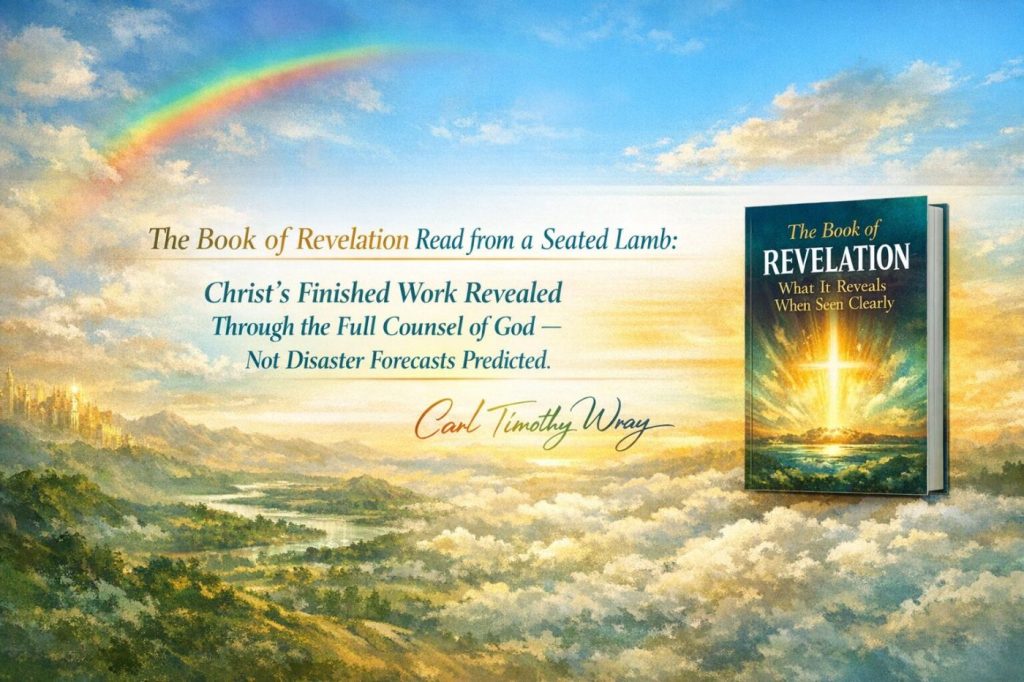
The Book of Revelation Read from a Seated Lamb:
Christ’s Finished Work Revealed Through the Full Counsel of God —
Not Disaster Forecasts Predicted
Book of Revelation: AUTHOR
By Carl Timothy Wray
Carl Timothy Wray writes from the conviction that God’s mind is one, His Word is settled, and His work is finished. Rooted in the Finished Work of Christ and the Full Counsel of God, Wray approaches Scripture not as a collection of competing timelines or unfolding uncertainties, but as a single, unified revelation moving steadily toward one consummation: God all in all.
Rather than reading the Book of Revelation through fear, speculation, or delay, Wray reads it from the vantage of a seated Lamb — revealing Revelation as the administration of a victory already secured, not a struggle still in question.
What the Book of Revelation Is Really Revealing
The Book of Revelation is often misunderstood as a book of disaster, fear, and future catastrophe. Many readers approach it expecting predictions of the end of the world, charts of global collapse, or warnings of divine retaliation. Yet this approach consistently produces confusion, division, and anxiety rather than clarity and rest.
When read through the Finished Work of Christ and the Full Counsel of God, the Book of Revelation reveals something entirely different.
It reveals:
- Christ already victorious
- Authority already established
- Judgment already purposeful
- The end already known
Revelation does not describe Christ becoming King.
It unveils Christ reigning.
This book presents the Book of Revelation as the unveiling of Jesus Christ governing history, judgment, the Church, and creation from a finished throne. Every symbol, vision, and judgment is interpreted from that settled reality — not toward it.
Key themes explored include:
- The Book of Revelation explained through Christ’s finished work
- Judgment as separation, not destruction
- The seated Lamb as the interpretive center
- Revelation as unveiling, not warning
- God’s eternal purpose fulfilled: God all in all
Book of Revelation: INTRODUCTION
The Book of Revelation has long been treated as the most mysterious, divisive, and intimidating book in Scripture. For many, it has become a source of fear rather than faith, speculation rather than stability, and confusion rather than clarity. Timelines multiply. Interpretations compete. Anxiety grows.
Yet the problem has never been the book itself.
The problem has always been where it is read from.
Revelation was not written from uncertainty.
It was written from a throne.
Before a single seal was opened, before a trumpet sounded, before a bowl was poured out, the Lamb was already seated. His victory was not approaching — it was established. The Cross was not provisional. The resurrection was not partial. The ascension was not symbolic. Christ’s authority was settled, His reign inaugurated, and His purpose secured.
Revelation, therefore, does not announce how Christ will win.
It unveils what His victory looks like when administered in creation.
When the Book of Revelation is read from a seated Lamb — through the Finished Work of Christ and the Full Counsel of God — fear dissolves, contradiction collapses, and Scripture reveals a single, unified purpose unfolding in perfect order. Judgment is no longer random destruction but purposeful separation. Symbols are no longer puzzles to decode but revelations to be seen. Time is no longer an enemy but a servant.
From Genesis to Revelation, God has never changed His mind — only unveiled it. His purpose has always moved toward one end: the reconciliation of all things in Christ, the removal of everything that cannot inherit life, and the fulfillment of creation in union with its Creator.
This book is written to help the reader see the Book of Revelation clearly, calmly, and coherently — not as a book of fear, but as the unveiling of a finished victory, until the declared end is fully manifest:
“That God may be all in all.” — Holy Bible, 1 Corinthians 15:28
CHAPTER ONE
Revelation Is Seen Clearly Only from the Rock
There are only two places from which a man can read the Book of Revelation.
He can read it standing on a rock,
or he can read it hovering over a bottomless pit.
There is no middle ground.
The clarity or confusion a reader experiences in Revelation is not determined by intelligence, sincerity, or effort. It is determined by foundation. Revelation does not yield itself to curiosity, fear, or speculation. It yields itself only to revelation received.
This is why Jesus, when speaking to Peter, did not say He would build His house on learning, study, or tradition. He said He would build it upon revelation. Flesh and blood did not reveal it. Heaven did.
Zion is built on this rock.
And Revelation can only be seen clearly from Zion.
The Rock Is Revelation, Not Information
Information accumulates.
Revelation settles.
A man can collect facts forever and never arrive.
But when revelation comes, wandering ends.
This is the difference between sand and rock.
Sand shifts with pressure.
Rock bears weight.
When Revelation is approached as information to be decoded, it becomes unstable. Timelines multiply. Interpretations compete. Fear increases. The reader never arrives — only circles.
But when Revelation is received as revelation — truth unveiled from above — it produces rest. It anchors the soul. It quiets speculation. It establishes certainty.
This is why so many are exhausted by the Book of Revelation.
They are not rebellious.
They are unfounded.
They are trying to stand on explanations instead of revelation.
The Bottomless Pit as the Nature of a Lie
Scripture describes deception as a bottomless pit for a reason.
A lie has no Alpha.
A lie has no Omega.
It has no beginning grounded in truth and no ending that resolves reality. Because of this, a lie must keep moving. It must keep explaining. It must keep adjusting. It must keep threatening.
If it ever stopped talking, you would notice there is nothing underneath it.
This is why lies produce:
- endless timelines
- constant revisions
- conditional outcomes
- escalating warnings
- motion without progress
A lie cannot bring a man to rest.
It can only keep him wandering.
This is the wilderness condition.
Forty years moving, yet never entering.
Circling the same mountain.
Eating bread without understanding its meaning.
Always asking, “What does this mean?” — and never arriving.
The wilderness is not about distance.
It is about foundation.
Revelation Ends Wandering
Revelation does not add movement.
It ends it.
When revelation comes, a man stops circling and starts standing.
This is why Revelation is dangerous to fear-based systems. It removes the leverage of uncertainty. It exposes the lack of foundation beneath the lie. It shows that the journey was never endless — the footing was just false.
The moment a man sees from the rock:
- fear loses authority
- speculation loses necessity
- judgment gains purpose
- Scripture gains unity
Revelation does not confuse the faithful.
It stabilizes them.
John Was Not Left on the Ground
This is why the Book of Revelation does not begin with beasts, disasters, or judgment.
It begins with a throne.
Before John sees anything unfold, he is brought upward. Not forward in time — upward in vantage. He is shown where everything is governed from.
This is the book’s first correction.
Revelation is not about when things happen.
It is about from where they are seen.
When Revelation is read from the ground:
- time dominates
- fear feels reasonable
- judgment looks destructive
- God appears reactive
But when Revelation is read from the throne:
- authority is already settled
- victory is already secured
- judgment serves purpose
- history obeys eternity
John is not taught to predict events.
He is taught to see clearly.
Zion’s Perspective
Zion is not a future location.
It is a present vantage.
Zion is where revelation governs interpretation.
Zion is where the Word is already settled.
Zion is where the end is already known.
This is why Scripture can say, “Rejoice, ye heavens, and ye that dwell in them.”
The heavens rejoice because they see from above.
Those who dwell there rejoice because they know the outcome.
They are not celebrating chaos on the earth.
They are declaring the glory of what is already finished according to the Full Counsel of God.
Joy is the sound of certainty.
Conclusion of Chapter One
The Book of Revelation cannot be understood by effort alone.
It must be received from the right place.
Read from the ground, it produces fear.
Read from the rock, it produces rest.
Read from speculation, it creates wandering.
Read from revelation, it ends it.
There are only two places to stand:
- the rock of revelation
- or the bottomless pit of uncertainty
This book will be read from the rock.
From here on, we will read Revelation from a finished Christ, a seated Lamb, and a settled counsel — not wandering toward an outcome, but unveiling what has already been secured.
From Zion.
From victory.
From rest.
And from here, Revelation begins to speak clearly.
CHAPTER TWO
The Seated Lamb Comes Before Everything Else
One truth governs the entire Book of Revelation, and yet it is one of the most overlooked:
The Lamb is already seated before anything begins.
Before seals are opened.
Before trumpets are sounded.
Before bowls are poured out.
Before judgment is described.
The throne is not the result of Revelation.
The throne is the starting point.
This single order dismantles fear at the root.
Authority Is Assumed, Not Contested
Revelation does not open with a struggle for control.
It does not present heaven reacting to chaos on the earth.
It does not portray Christ racing to regain authority.
It opens with a throne — occupied.
The Lamb is not introduced as someone who might overcome.
He is introduced as One who has.
This is why heaven does not panic when the scroll appears.
Heaven worships.
If the outcome were uncertain, worship would be premature.
But worship erupts because authority is already settled.
The Lamb Is Central Because the Work Is Complete
The Lamb is not a symbol of weakness.
He is the embodiment of victory through completion.
He appears as:
- slain — meaning the work is finished
- standing — meaning the victory is alive
- seated — meaning authority is established
Nothing in Revelation is written to complete the Cross.
Nothing in Revelation repairs a failure.
Nothing in Revelation compensates for a delay.
Revelation assumes the Cross worked.
The Scroll Does Not Decide History — It Reveals It
The scroll does not determine what will happen.
It unveils what has already been settled.
The Lamb does not open the seals to find out what comes next.
He opens them to reveal what heaven already knows.
This is why fear-based prophecy collapses under scrutiny.
If the Lamb is seated:
- nothing threatens His reign
- nothing escapes His purpose
- nothing alters the end
You do not administer a victory you are unsure of.
Judgment Flows from Victory, Not Uncertainty
Judgment in Revelation does not arise because God is alarmed.
It arises because victory must be applied.
A finished victory still requires administration.
Judgment is not emotional reaction.
It is procedural clarity.
It removes what cannot remain.
It separates what cannot inherit life.
It exposes what resists truth.
From the throne, judgment is not chaos —
it is order advancing.
Why Fear Theology Cannot Survive a Seated Lamb
Fear-based theology requires:
- unresolved outcomes
- delayed authority
- future victory
- threatened loss
A seated Lamb removes every one of those pillars.
If Christ is already enthroned:
- fear has no leverage
- delay has no meaning
- destruction has no final word
This is why Revelation is often pushed into the future —
because fear needs distance to survive.
But Revelation refuses to cooperate.
It places Christ on the throne now.
Seated Means Finished
The posture of Christ tells the story.
He is not pacing.
He is not standing in alarm.
He is not striving.
He is seated.
Seating speaks of:
- completion
- authority
- rest
- confidence
This posture echoes the Finished Work of Christ.
What was accomplished at the Cross is not renegotiated in Revelation.
It is revealed.
Why This Reorders the Entire Book
Once the Lamb is seen as seated:
- timelines lose control
- fear loses traction
- judgment gains meaning
- Scripture regains unity
Genesis no longer contradicts Revelation.
The prophets no longer compete with the apostles.
Judgment no longer conflicts with reconciliation.
Everything moves in one direction.
Conclusion of Chapter Two
The Book of Revelation does not describe Christ taking control.
It reveals Christ exercising it.
The Lamb is not crowned at the end of the book.
He is enthroned at the beginning.
From that throne:
- judgment serves restoration
- separation serves union
- revelation serves completion
Nothing unfolds outside His purpose.
Nothing contradicts His end.
And that end has never changed:
Life swallowing death.
Truth swallowing the lie.
Creation brought into union with its Creator.
The Lamb opens the book because the work is finished.
And from this seated Lamb,
everything that follows makes sense.
CHAPTER THREE
An Unveiling, Not a Warning
One of the greatest misunderstandings surrounding the Book of Revelation is the belief that it was given as a final warning to humanity.
That assumption quietly governs how the entire book is read.
If Revelation is a warning, then fear is appropriate.
If it is a warning, then judgment must be threatening.
If it is a warning, then the outcome must still be undecided.
But Revelation never calls itself a warning.
It calls itself an unveiling.
This distinction is not semantic.
It is foundational.
What “Revelation” Actually Means
The word revelation means to uncover, to unveil, to make visible what was already present.
An unveiling does not introduce something new.
It reveals what has been hidden.
Warnings are issued when danger is approaching.
Unveilings are given when truth is ready to be seen.
This tells us immediately where Revelation is speaking from.
Revelation does not assume risk.
It assumes completion.
How Fear Entered the Book
Fear did not come from Revelation itself.
It came from reading unveiling through uncertainty.
When Revelation is approached as:
- a prediction of catastrophe
- a map of future disasters
- a threat of divine retaliation
- a sequence of possible outcomes
fear feels justified.
But fear does not come from revelation.
Fear comes from reading revelation as if the outcome were still in doubt.
Revelation assumes Christ has already prevailed.
Fear assumes He has not.
They cannot coexist.
The Lamb Does Not Warn — He Reveals
Warnings belong to law.
Revelation flows from fulfillment.
The Lamb does not appear in Revelation to frighten the world into submission.
He appears to expose reality.
What is unveiled includes:
- the true nature of power
- the exposure of deception
- the end of mixture
- the collapse of false authority
- the reign of life over death
None of these require fear.
They require sight.
Why Judgment Is Mistaken for Warning
Judgment only feels like warning when its purpose is misunderstood.
If judgment is believed to exist in order to:
- punish endlessly
- exclude permanently
- destroy irreversibly
then fear becomes the natural response.
But Scripture consistently presents judgment as something else entirely.
Judgment exists to:
- separate flesh from spirit
- expose lies so truth may remain
- remove what cannot inherit life
- free creation from corruption
Judgment is not God shouting danger.
It is God turning on the light.
Unveiling Always Precedes Transformation
Nothing is transformed before it is revealed.
Darkness is not defeated by force.
It is defeated by exposure.
This is why Revelation appears at the end of Scripture.
Not because it predicts the end —
but because it reveals what everything has been moving toward.
The unveiling does not create the outcome.
It shows it.
Why Warning-Based Revelation Produces Exhaustion
A warning-based Revelation produces:
- anxiety without rest
- vigilance without peace
- holiness driven by fear
- obedience motivated by threat
And eventually, avoidance.
This is why so many sincere believers avoid the Book of Revelation.
They are not rebellious.
They are weary.
Fear does not sustain faith.
It fractures it.
Unveiling Produces Rest
An unveiling does what warnings never can.
It stabilizes the soul.
When truth is seen:
- striving stops
- confusion dissolves
- trust returns
- clarity emerges
Revelation does not pressure the reader.
It anchors them.
This is why Revelation was given to a persecuted church —
not to terrify them,
but to steady them.
It does not say, “Brace yourself.”
It says, “Behold.”
Why Revelation Must Be Read This Way
If Revelation were a warning, it would contradict:
- the Finished Work of Christ
- the Cross as completion
- the resurrection as victory
- reconciliation as God’s purpose
But Scripture does not contradict itself.
Revelation must therefore harmonize with Genesis, the prophets, the Gospels, and the apostles.
And it does — when read as unveiling.
Conclusion of Chapter Three
The Book of Revelation was not given to frighten the world.
It was given to reveal Christ.
Not to warn of loss —
but to unveil victory.
Not to threaten destruction —
but to expose what cannot remain.
Not to create fear —
but to remove it.
Warnings speak from uncertainty.
Revelation speaks from completion.
And what it reveals moves all things toward one end:
The removal of everything that opposes life,
the reconciliation of all things in Christ,
and the fulfillment of creation —
until God is all in all.
This is not a warning.
It is an unveiling.
And unveiling always leads to completion.
CHAPTER FOUR
Why Revelation Speaks in Symbols
One of the first objections people raise about the Book of Revelation is simple:
“Why is it so symbolic?”
Beasts. Horns. Lamps. Seals. Trumpets. Bowls. Numbers. Colors.
To many readers, the symbols feel confusing, excessive, even unnecessary.
Some assume the book was meant to obscure truth.
Others believe it was written only for specialists or future generations.
But symbols are not used in Revelation to hide truth.
They are used to carry it.
Symbols Are Not Puzzles
Modern readers often treat symbols like riddles to be solved.
This turns Revelation into:
- a guessing game
- a codebook
- a prophetic crossword
- a test of intellectual cleverness
But biblical symbols were never meant to function that way.
A symbol is not a puzzle piece.
It is a container.
Symbols compress meaning so truth can travel across:
- generations
- cultures
- languages
- levels of spiritual maturity
A timeline can be exhausted.
A symbol cannot.
Why God Uses Symbolic Language
God does not speak symbolically because He is unclear.
He speaks symbolically because truth is larger than literal language.
Literal language describes objects.
Symbolic language reveals realities.
For example:
- a throne speaks of authority
- light speaks of life and truth
- darkness speaks of deception
- beasts speak of corrupt power
- fire speaks of purification
These images do not need decoding.
They need discernment.
Symbols bypass surface reasoning and speak directly to perception.
Symbols Protect Truth from Reduction
One of the reasons Revelation uses symbols is to prevent truth from being reduced to:
- timelines
- political charts
- historical trivia
- sensational predictions
Reduction weakens revelation.
Symbols keep truth alive because they cannot be locked into one moment, one headline, or one system. As long as flesh and spirit still contend, as long as truth still confronts lies, as long as light still exposes darkness, the symbols of Revelation remain relevant.
Symbols preserve range.
Symbols Speak to the Spirit, Not the Flesh
Revelation was not written to satisfy curiosity.
It was written to awaken sight.
Symbols bypass:
- fleshly analysis
- emotional panic
- religious conditioning
They speak to the inner man.
This is why Revelation frustrates the flesh.
The flesh wants control, certainty, and predictability.
Symbols require trust.
They require vision.
They require a vantage above the ground.
Why Literalism Always Breaks Revelation
When symbols are forced into strict literal readings:
- beasts become headlines
- numbers become calendars
- judgments become disasters
- Christ becomes delayed
Literalism turns unveiling into speculation.
The problem is not that symbols are unclear —
the problem is that literalism refuses to see spiritually.
Revelation itself tells us it is signified — communicated through signs.
To insist on literalism is to ignore the book’s own instruction.
Symbols and the Finished Work
Symbols do not contradict the Finished Work of Christ.
They express it.
Every symbol in Revelation serves one function:
- to expose what opposes life
- to reveal Christ’s reign
- to separate what cannot remain
- to move creation toward fulfillment
Symbols do not introduce chaos.
They organize reality around Christ’s victory.
When read from the throne, every symbol finds its place.
Why Fear Enters When Symbols Are Misused
Fear enters when symbols are used to:
- threaten instead of reveal
- predict instead of unveil
- control instead of clarify
Fear thrives when symbols are detached from a seated Lamb.
But when symbols are anchored in Christ’s victory:
- fear loses footing
- speculation collapses
- purpose becomes visible
Symbols then become:
- clarifying
- illuminating
- steadying
They reveal order, not panic.
Symbols Must Be Interpreted by the End
Every symbol in Revelation must be interpreted by destination.
If an interpretation leads to:
- endless destruction
- permanent division
- unresolved enemies
- God not being all in all
then the symbol has been misread.
Symbols must arrive where God arrives.
And God’s end is clear.
Conclusion of Chapter Four
The symbols of Revelation are not meant to confuse the faithful.
They are meant to train sight.
They carry truth across ages,
protect revelation from reduction,
and unveil reality in a way literal language never could.
Symbols do not point us toward fear.
They point us toward fulfillment.
They expose what cannot remain,
reveal what must endure,
and move all things toward one purpose —
The swallowing up of death by life,
the reconciliation of all things in Christ,
and the union of heaven and earth —
until God is all in all.
This is why Revelation speaks in symbols.
And this is why, when seen from Christ’s victory,
every symbol finds its peace.
CHAPTER FIVE
Judgment Seen from Christ’s Victory
Few words in Scripture have been more misunderstood than the word judgment.
For many, judgment immediately evokes:
- punishment without end
- divine retaliation
- God losing patience
- destruction as a goal
Because of this, judgment is often treated as the opposite of grace, mercy, and love.
But Revelation never presents judgment that way.
Revelation presents judgment as the application of Christ’s finished victory.
Judgment Does Not Decide the Outcome
The first correction Revelation makes about judgment is decisive:
Judgment does not determine who wins.
Judgment reveals who already has.
If judgment were deciding the outcome, fear would be justified.
But Revelation never portrays judgment as uncertain.
Judgment flows from a throne that is already occupied,
from a Lamb who has already overcome.
The outcome is not in question.
Only the removal of what cannot remain is in process.
Judgment as Separation, Not Destruction
When judgment is seen from the ground, it looks like chaos.
When judgment is seen from the throne, it looks like separation.
Throughout Scripture, judgment consistently separates:
- light from darkness
- truth from lie
- spirit from flesh
- life from death
Judgment does not exist to destroy what God loves.
It exists to remove what prevents love from reigning fully.
This is why Revelation’s judgments are ordered, measured, and purposeful.
Nothing is random.
Nothing is excessive.
Nothing is meaningless.
Exposure Is Judgment’s First Work
Judgment begins with exposure.
Before anything is removed, it is revealed.
This is why Scripture says the man of sin must be revealed — exposed — before he is taken out of the way. Carnality does not rule because it is powerful. It rules because it is hidden.
Truth does not need to fight the lie.
It only needs to expose it.
Once exposed, the lie has no foundation.
This is judgment at work.
What Is Taken Out of the Way
Judgment does not remove people from God’s purpose.
It removes what withholds the appearing of Christ.
What withholds glory is not humanity.
It is deception, fleshly identity, false power, and corrupted systems.
Judgment separates the dross from the true —
not to destroy the vessel,
but to free it for glory.
This is why judgment is necessary.
Without separation, fullness cannot appear.
Judgment Is Mercy Completing Its Work
Mercy is not the absence of judgment.
Mercy is judgment accomplishing its purpose.
To leave deception untouched is not mercy.
To allow death to reign is not love.
To preserve corruption is not kindness.
Judgment is mercy removing what destroys.
This is why judgment and reconciliation are never enemies in Scripture.
Judgment clears the way for reconciliation to stand.
Why Judgment Is Good News
When judgment is read from Christ’s victory, it becomes good news.
Judgment declares:
- evil has an expiration date
- lies cannot last forever
- death does not get the final word
- corruption is not eternal
Judgment announces that nothing opposed to life can survive.
That is not terror.
That is hope.
Flesh Must Yield to Spirit
At its deepest level, judgment is not about destroying people.
It is about removing fleshly rule so spiritual life may reign.
Judgment separates:
- Adam from Christ
- self-rule from sonship
- independence from union
Without judgment, transformation would never complete.
Judgment is not God rejecting humanity.
It is God liberating it.
Conclusion of Chapter Five
Judgment in Revelation is not God acting out of anger.
It is God acting out of purpose.
It removes what cannot inherit life,
exposes what cannot remain hidden,
and clears the way for fulfillment.
Judgment does not oppose grace.
It serves it.
Judgment does not contradict love.
It completes it.
And every act of judgment moves creation closer to one end —
The end of death,
the end of deception,
the end of division —
and the fulfillment of all things in Christ,
until God is all in all.
Seen from Christ’s victory, judgment is not something to fear.
It is something to trust.
Because it never misses its destination.
CHAPTER SIX
Taken Out of the Way: What Withholds the Appearing
One of the clearest explanations of judgment’s purpose is given not in symbols, but in plain apostolic language.
Paul tells us plainly that something must be revealed before it can be removed — and that its removal serves one purpose: the appearing of Christ.
This chapter does not introduce a new doctrine.
It unveils a principle that has always governed how God works.
“Let No Man Deceive You”
Paul begins with a warning — not of destruction, but of deception.
“Let no man deceive you by any means.”
Deception is the true threat because deception obscures foundation. A deceived mind cannot see clearly, and a man who cannot see clearly cannot stand.
Paul is not preparing the church for fear.
He is preparing them for revelation.
The “First” That Must Fall Away
Paul says the day will not appear unless something happens first.
When Scripture speaks of first in connection with a man, it is not speaking numerically — it is speaking order.
The first man.
The Adamic man.
The man of sin.
Paul immediately identifies him:
- the man of sin
- the son of perdition
This is not a future monster rising out of history.
This is carnality identified and exposed.
The “falling away” is not people abandoning faith.
It is the first man losing his place.
Revelation Is What Reveals the Man of Sin
Paul does not say the man of sin is defeated by force.
He says he is revealed.
What reveals him?
Truth.
Truth exposes carnality by contrast.
Light reveals darkness by presence alone.
The moment truth appears, the lie is identified.
And once identified, it has no authority to remain.
This is judgment in its purest form.
“Now You Know What Withholds”
This is one of the most important statements Paul makes.
“And now you know what withholds…”
He does not say who withholds.
He says what withholds.
What withholds the appearing of Christ is not God’s reluctance.
It is not a delayed plan.
It is not missing prophecy.
It is mixture.
Carnality mixed with truth.
Adam mixed with Christ.
Flesh occupying a place only spirit can fill.
Once this is revealed, Paul says something remarkable:
Now you know.
Revelation has occurred.
Revealed in Order, Removed in Time
Paul says the man of sin is revealed in his time.
Time does not determine revelation.
Revelation determines how time is used.
Exposure happens first.
Removal follows.
Appearing comes next.
This is not destruction.
It is sequence.
The lie is not annihilated.
It is taken out of the way.
And once the obstruction is gone, glory appears naturally.
Judgment Removes What Withholds Glory
Judgment’s target is never God’s purpose.
It is what obstructs it.
Judgment separates:
- dross from gold
- flesh from spirit
- false identity from true sonship
This is why Paul can say that through this revelation, the church now understands what was withholding.
Judgment does not delay glory.
It makes room for it.
Truth Is the Only Hope
Nothing but truth can do this work.
Force cannot expose deception.
Threats cannot remove mixture.
Fear cannot produce clarity.
Only truth reveals.
Only truth separates.
Only truth frees.
“You shall know the truth, and the truth shall make you free.”
Freedom does not come by escape.
It comes by exposure.
Why This Matters for Revelation
This Pauline principle governs the entire Book of Revelation.
Judgment in Revelation is not random destruction.
It is exposure in stages.
Each seal, trumpet, and bowl reveals something that cannot remain — not because God is angry, but because glory is imminent.
What withholds must be removed.
What obscures must be exposed.
What resists must yield.
Then Christ appears — not externally, but unhindered.
Conclusion of Chapter Six
The man of sin is not defeated by violence.
He is defeated by revelation.
Carnality does not fall by force.
It falls by exposure.
Judgment does not destroy the vessel.
It removes what withholds glory.
And once what withholds is taken out of the way,
the appearing of Christ is no longer delayed —
it is unveiled.
This is not postponement.
This is preparation.
This is how God brings His purpose to completion.
Not by panic.
Not by threat.
Not by wandering.
But by truth revealed,
obstruction removed,
and glory appearing —
exactly as it was settled from the beginning.
CHAPTER SEVEN
Revelation as the Administration of a Finished Work
At this point, one truth should be unmistakably clear:
The Book of Revelation does not finish Christ’s work.
It administers it.
This single distinction removes nearly every contradiction that has ever been projected onto the book.
Revelation is not God correcting a failure.
It is not heaven improvising a solution.
It is not Christ completing what the Cross left undone.
It is the orderly administration of a victory already secured.
Finished in Counsel, Accomplished in Christ, Revealed in Order
God’s work has always followed the same divine pattern:
- Settled in counsel before the foundation of the world
- Accomplished in Christ at the Cross
- Revealed in order through time
- Applied until complete in creation
The Finished Work of Christ was not partial.
It was not provisional.
It was not symbolic.
It was total.
Nothing in Revelation adds to it.
Nothing repairs it.
Nothing renegotiates it.
Revelation simply unveils and applies what was already finished.
Why Administration Is Necessary
A finished victory still requires administration.
A law that is passed must still be enforced.
A judgment that is issued must still be applied.
A kingdom that is established must still be ordered.
Administration does not imply weakness in the victory.
It demonstrates confidence in it.
Revelation is heaven’s administration of Christ’s triumph
until nothing remains outside its reach.
What Revelation Administers
Revelation administers the Finished Work in three primary ways:
1. Exposure
Everything opposed to life is brought into the light.
Nothing hidden remains hidden.
2. Separation
What cannot inherit life is removed.
What belongs to Christ is purified.
3. Reconciliation
Once resistance is removed, union follows.
Judgment clears the way for restoration.
This is not chaos.
It is order.
Judgment as Administrative Action
Judgment in Revelation is not God “doing something new.”
It is God enforcing what is already true.
If Christ has defeated death, then death must be removed.
If Christ has exposed the lie, then deception must be judged.
If Christ has reconciled the world, then everything opposing reconciliation must be addressed.
Judgment is not emotional.
It is procedural.
Heaven is not reacting.
Heaven is administering.
Why Fear Cannot Survive Administration
Fear only survives where outcomes are uncertain.
Administration assumes certainty.
You do not administer a victory you might lose.
You do not enforce a judgment you are unsure of.
You do not reveal a plan that could fail.
Revelation is calm because heaven is confident.
There is no panic in the seals.
No anxiety in the trumpets.
No loss of control in the bowls.
Everything moves with restraint, precision, and purpose.
The Finished Work Governs the End
This is why Revelation does not end in destruction.
It ends in:
- reconciliation
- union
- restoration
- fulfillment
The Finished Work determines the conclusion.
Revelation ensures the conclusion is reached.
Nothing remains unresolved.
Nothing remains unaddressed.
Nothing remains outside Christ.
Revelation Does Not Introduce a New Goal
Revelation does not change God’s purpose.
It carries the original one to completion.
From Genesis onward, the goal has never shifted:
- life overcoming death
- truth swallowing the lie
- creation brought into harmony with its Creator
Revelation is simply the final unveiling of how that purpose is fully applied.
Conclusion of Chapter Seven
The Book of Revelation is not the story of God finishing His work.
It is the story of God administering what He finished.
Every seal, trumpet, and bowl serves one purpose:
to bring creation into alignment with what Christ already accomplished.
Revelation does not introduce uncertainty.
It removes it.
It does not magnify chaos.
It orders reality.
And it does not leave creation fragmented, fearful, or unresolved.
It carries everything — patiently, wisely, irresistibly —
toward the end God declared from the beginning:
The reconciliation of all things in Christ,
the swallowing up of death by life,
and the full expression of divine union —
until God is all in all.
CHAPTER EIGHT
From Wilderness to Zion: Entering Rest
Every false reading of the Book of Revelation produces the same condition:
wandering.
Always learning.
Never arriving.
Always adjusting.
Never resting.
This is not accidental.
It is the natural fruit of reading from a foundation that cannot hold weight.
The wilderness was never about geography.
It was about perspective.
Israel did not wander because the promise was unclear.
They wandered because they could not see from where God was speaking.
Revelation corrects this.
Wilderness Is Motion Without Foundation
The wilderness is characterized by movement without progress.
Circling the same mountain.
Revisiting the same questions.
Repeating the same fears.
Living on provision without understanding its purpose.
Bread fell from heaven, yet they still asked, “What is it?”
That question reveals the wilderness mindset.
When there is no Alpha clearly seen,
and no Omega clearly known,
movement never resolves.
This is why lies multiply explanations, timelines, contingencies, and threats.
A lie has no beginning grounded in truth
and no ending that brings fulfillment.
So it must keep moving.
Zion Is Standing on Revelation
Zion is the opposite of wilderness.
Zion is not frantic.
Zion is not speculative.
Zion is not anxious.
Zion is settled.
Zion is built on revelation — not information, not fear, not prediction. It is built on truth unveiled from heaven, truth that carries both beginning and end within itself.
This is why Zion produces rest.
When a man sees clearly:
- where God began
- and where God is going
he stops wandering.
Revelation does not add motion.
It ends it.
Alpha and Omega Reunited
Revelation heals wandering by reuniting Alpha and Omega.
It begins where God began:
with a Word settled in the heavens.
And it ends where God always intended:
with creation fully reconciled.
When Alpha and Omega are both seen:
- process gains meaning
- judgment gains purpose
- time becomes a servant
- fear loses its voice
The vital unfolding of history is no longer mistaken for delay.
It is understood as revelation catching up with settlement.
Judgment Brings Arrival, Not Delay
Judgment does not keep creation in the wilderness.
It brings it out.
Judgment removes what causes wandering:
- deception
- mixture
- false identity
- fleshly rule
Once these are taken out of the way, movement resolves into arrival.
This is why Revelation does not end in conflict.
It ends in rest.
The City That Ends the Journey
Revelation ends with a city, not a battlefield.
A dwelling, not a warning.
Union, not division.
God with man — not God distant from creation.
The city represents completion.
Purpose fulfilled.
Journey ended.
No more circling.
No more wondering.
No more wilderness questions.
Only knowing.
God’s Dream Fulfilled
This is the Omega Scripture toward which everything has been moving:
“That God may be all in all.” — Holy Bible, 1 Corinthians 15:28
This is not a poetic hope.
It is a declared conclusion.
God did not lose His universe.
God did not abandon His creation.
God did not settle for partial victory.
God won.
Every enemy subdued.
Every lie exposed.
Every obstruction removed.
Every fragment reconciled.
Not by force —
but by truth.
Not by panic —
but by purpose.
The Rest Revelation Brings
The Book of Revelation is not a book to fear.
It is a book to rest in.
It does not reveal an unstable God,
but a unified mind.
It does not announce an uncertain future,
but a settled end.
It does not magnify chaos,
but order.
It does not threaten creation,
but heals it.
When Revelation is read from a finished Christ,
through the Full Counsel of God,
from a seated Lamb,
and toward God all in all —
wandering ends.
Standing begins.
Final Conclusion
The Book of Revelation does not tell us what God might do.
It shows us what God has done,
what He is administering,
and where everything is going.
From Alpha to Omega.
From settlement to fulfillment.
From wilderness to Zion.
From process to rest.
This is the unveiling of Jesus Christ.
And when the unveiling is complete,
when every veil has been removed,
when every resistance has yielded,
when every shadow has given way to light —
God is all in all.
That is the end.
That is the rest.
That is the victory.
—
The Book of Revelation
By Carl Timothy Wray

Book of Revelation Series
- Book of Revelation
- The Book of Revelation — Seen from Christ’s Victory
- Book of Revelation — The Unveiling of Jesus Christ Governing History, Judgment, the Church, and Creation From a Finished Throne
- The Finished Work of Christ — God’s Full Counsel Revealed Through the Plan of the Ages
- The Finished Work of Christ: Meaning, Key Scriptures & FAQs
- Join Our Facebook Page: