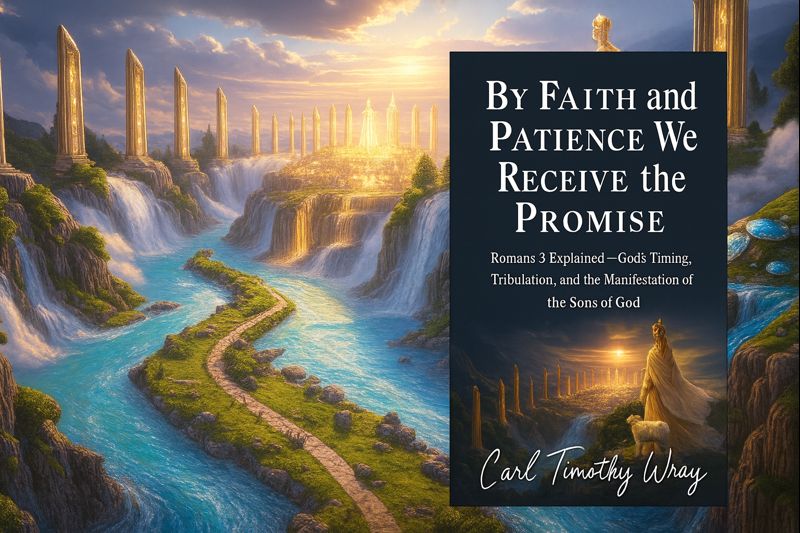
By Faith and Patience: Romans 8 Explained — God’s Timing, Tribulation, and the Manifestation of the Sons of God
By Faith and Patience: AUTHOR
Carl Timothy Wray is a teacher of the Full Counsel of God, committed to unveiling the harmony of God’s mind from Genesis to Revelation.
His writings bring balance to faith, patience, promise, and manifestation, revealing not only what God has spoken, but how His word matures and appears in the earth according to divine order.
- By Faith and Patience: Read Now: 2. By Faith and Patience: Download Free PDF Copy: 3. Read By Faith and Patience Series Here:
By Faith and Patience: INTRODUCTION
God has never struggled to give promises.
What has always challenged men is understanding how those promises move from the invisible realm of faith into visible manifestation.
Scripture is clear that every promise of God is already yes and amen in Christ. Faith receives immediately, without evidence, without delay, and without apology. But Scripture is equally clear that manifestation follows a different law—through faith and patience we inherit the promise. Faith secures the promise; patience governs the timing. One receives it. The other prepares it to appear.
Paul understood this tension better than anyone. In Romans 8, he is not wavering, retreating, or redefining truth. He is already seated in heavenly places by faith, already persuaded of Christ’s victory, already proclaiming life over death. Yet he groans—not in unbelief, but in travail—awaiting a specific sign God had promised: to wit, the redemption of our body. This groaning is not doubt. It is pregnancy. It is the pressure of promise preparing to manifest.
From Genesis onward, God has always spoken first and manifested later. Abraham believed while his body was dead. The prophets prophesied while fulfillment tarried. Jesus Himself was declared Son long before glory appeared. Paul does not introduce a new way—he explains the way God has always worked. Faith receives immediately. Patience matures what faith has received. Fire proves the vessel. And in the fullness of God’s appointed times, the promise steps out of the invisible and into the earth.
This book restores that balance. It answers why tribulation works patience, why patience produces experience, and why experience anchors hope. It reveals why God is sovereign over timing, why sons are formed before glory is revealed, and why manifestation is never accidental or premature.
Here, faith and patience are no longer enemies.
They are partners in the unfolding wisdom of God.
And when patience finishes its work, the promise does not remain hidden.
It appears—exactly as God intended. What Paul unveils is not delay, denial, or contradiction, but a divine order — that every promise of God is received by faith and patience, moving from invisible assurance to visible manifestation according to the purpose of the ages.
Chapter 1 — Faith Receives the Promise Immediately
God has never required time to speak a promise.
Time is required only for that promise to be manifested.
This distinction is essential to understanding the ways of God. Faith does not operate in the realm of delay. Faith operates in the realm of now. Scripture never says faith will be. It says, “Now faith is.” Faith receives what God has spoken the moment it is promised, without waiting for evidence, confirmation, or outward agreement from the natural world.
This is where many misunderstand God. They assume that because manifestation has not appeared, the promise has not been received. Paul never thought that way. He understood that faith and manifestation do not occupy the same realm. Faith lays hold of invisible reality first. Manifestation follows later, governed by patience and God’s appointed times.
Paul states this principle plainly:
“For all the promises of God in Him are yea, and in Him Amen…”
Paul does not say the promises will be yes and amen.
He says they are.
Faith does not negotiate with circumstances. Faith agrees with God.
God Gives Promises Without Evidence
From the beginning, God has spoken before anything existed to support what He said.
Light was spoken before the sun existed.
Abraham was promised a son while his body was dead.
Israel was promised deliverance while still enslaved.
Resurrection was promised while Christ was still in the grave.
This is not inconsistency—it is design.
God intentionally gives promises in a way that leaves no room for sight, so that faith alone is exercised. If evidence came first, faith would be unnecessary. Faith exists precisely because God speaks ahead of manifestation.
Paul understood this perfectly. That is why he could preach finished realities while still living in an unfinished world. He was not confused. He was aligned.
Faith Is Not Waiting
One of the greatest errors in religious thinking is equating faith with waiting.
Faith does not wait.
Faith receives.
Waiting belongs to patience, not faith.
Paul never said he was waiting for faith to arrive. He already had it. He had received the promise. He was persuaded. He was settled. Faith had done its work the moment God spoke.
This is why Paul could declare truths that offended carnal reasoning:
Death is abolished
We are seated in heavenly places
The law of the Spirit of life has made us free
None of these statements depended on outward confirmation. They were faith-realities—received instantly because God had spoken them.
Faith does not need proof.
Faith needs a word.
Faith Carries the Promise in the Invisible
When faith receives a promise, it does not place it on display immediately. It carries it internally.
Scripture often describes this as conception or pregnancy. The promise is real, alive, and working—but unseen. This is where misunderstanding often arises. Carnal sight looks for immediate manifestation and assumes absence equals failure. Faith knows better.
Paul describes this internal reality clearly:
“We walk by faith, not by sight.”
Walking by faith means living from what God has said, not from what the senses report. Faith speaks from heaven while standing on earth. It calls things that are not yet visible as already true, because God has declared them.
This is not denial of reality.
It is agreement with a higher one.
Why Faith Alone Is Not the Inheritance Mechanism
While faith receives the promise immediately, Paul is careful to explain that receiving and inheriting are not the same operation.
Hebrews states plainly:
“That ye be not slothful, but followers of them who through faith and patience inherit the promises.”
Faith receives.
Patience governs inheritance.
Paul never separates the two, but he never confuses them either. Faith secures the promise. Patience carries it through God’s process until manifestation appears. One without the other produces imbalance—either denial or delay theology.
Paul refuses both.
Romans 8: Faith Already Possessed, Patience Still Working
By the time Paul writes Romans 8, he is already settled in faith. There is no uncertainty in his declarations. There is no retreat from truth. Yet he speaks of groaning—not because faith is lacking, but because manifestation is approaching.
The promise has been received.
The timing is still God’s.
This is the tension Paul lives in—not frustration, but expectancy under authority. Faith has done its work. Now patience is at work, shaping, proving, and preparing what faith has already secured.
This is not contradiction.
This is maturity.
Faith Is the Beginning, Not the End
Faith is never the problem. God never asks for more faith to fix timing. Faith receives immediately because faith agrees with God.
But faith was never designed to control manifestation.
That belongs to God.
Faith says, “I have the promise.”
Patience says, “God will reveal it in His time.”
Paul held both truths without tension because he understood God’s ways.
Faith receives the promise instantly.
Patience prepares it to appear.
This is the foundation upon which everything else stands.
And until this order is understood, God’s dealings will always seem confusing. Thus, the promise does not fail, the Word does not change, and the timing is never random, for God has ordained that His sons receive the inheritance by faith and patience, until the manifestation appears in the earth.
Chapter 2 — Why Patience Is Required
If faith receives the promise immediately, the next question is unavoidable:
Why does God require patience at all?
This is where many stumble. They assume patience exists because something went wrong—because faith was weak, obedience was incomplete, or timing was missed. Paul teaches the opposite. Patience is not a remedy for failure; it is a designed companion to faith.
God never gives a promise without also assigning a process.
Patience Is Not Delay — It Is Government
Patience does not exist because God is slow.
Patience exists because God governs manifestation.
Scripture says plainly:
“He that believeth shall not make haste.”
Haste is the enemy of formation. Anything rushed bypasses maturity. God is never interested in producing something quickly if it cannot endure what it is called to carry.
Faith receives instantly.
Patience ensures what faith received is fit to appear.
Inheritance Requires More Than Reception
Paul is precise with his language. He does not say promises are inherited by faith alone.
He says:
“Through faith and patience we inherit the promises.”
Receiving is not inheriting.
Conceiving is not birthing.
Believing is not reigning.
Inheritance implies readiness, stewardship, and alignment with God’s purpose. Patience is the means by which God brings a believer into that alignment.
Without patience, faith would produce premature manifestation—and premature manifestation always collapses.
Why God Will Not Release What Is Not Ready
God does not withhold promises to test obedience.
He withholds manifestation to protect purpose.
Everything God releases must be able to survive the realm it enters. Glory requires capacity. Authority requires maturity. Manifestation requires preparation.
This is why Scripture repeatedly says:
“Let patience have her perfect work”
“After ye have done the will of God, ye might receive the promise”
“The vision is yet for an appointed time”
Patience is not passive waiting.
It is active formation.
Patience Works Where Faith Cannot
Faith believes God.
Patience changes the believer.
Faith lays hold of what God has spoken. Patience deals with everything in the believer that cannot yet carry it. This is why patience often feels uncomfortable—it exposes areas faith does not address.
Patience works in the soul.
Patience works in motives.
Patience works in identity.
Faith says, “This is mine.”
Patience asks, “Are you ready to carry it?”
Tribulation Is Assigned to Patience
Paul does not leave patience undefined. He explains exactly how it is formed:
“Tribulation worketh patience.”
This is not punishment language.
This is construction language.
Tribulation applies pressure, and pressure reveals substance. Whatever cannot endure pressure cannot be trusted with glory. God does not use tribulation to destroy faith; He uses it to prove it.
Faith is received instantly.
Patience is forged over time.
And what patience produces is not delay—it is depth.
Patience Anchors Hope
Paul continues:
“Patience, experience; and experience, hope.”
Hope here is not wishful thinking. It is confident expectation rooted in proven character. Patience creates a history with God. That history stabilizes hope so that it cannot be shaken by circumstance or time.
A believer without patience may believe correctly but collapse under pressure. A believer formed by patience stands immovable.
This is why God refuses shortcuts.
God Is Sovereign Over Timing
Perhaps the hardest truth patience teaches is this:
Timing belongs to God alone.
Scripture speaks of:
“The fullness of the times”
“The due time”
“The appointed season”
Faith does not dictate timing.
Obedience does not dictate timing.
Urgency does not dictate timing.
Only God does.
Paul understood this deeply. That is why he could live fully persuaded of the promise while submitting completely to God’s timetable. This is not resignation—it is trust.
Patience Protects the Promise
Without patience:
Faith becomes frustration
Promise becomes entitlement
Revelation becomes pride
With patience:
Faith matures
Promise stabilizes
Revelation humbles
Patience guards the promise until it is safe to appear.
God is not slow.
God is thorough.
The Necessary Companion of Faith
Faith without patience becomes presumption.
Patience without faith becomes delay theology.
Paul holds both.
Faith receives immediately.
Patience governs manifestation wisely.
This is not contradiction.
This is the wisdom of God.
And until patience finishes its work, the promise remains hidden—not because it is uncertain, but because it is being prepared to appear without failure. Thus, the promise does not fail, the Word does not change, and the timing is never random, for God has ordained that His sons receive the inheritance by faith and patience, until the manifestation appears in the earth.
Chapter 3 — Tribulation Worketh Patience
Paul does not leave patience abstract.
He tells us exactly how patience is formed.
“Tribulation worketh patience;
and patience, experience;
and experience, hope…”
This is not the language of punishment.
It is the language of process.
Tribulation is not evidence that God is displeased. It is evidence that God is working. Nothing in Paul’s teaching suggests tribulation exists to break the believer. It exists to form what faith has already received.
Tribulation Is Pressure, Not Wrath
Tribulation is pressure applied to what is already alive.
Pressure does not create substance.
Pressure reveals substance.
Gold does not become gold in the fire. It is proven gold in the fire. In the same way, tribulation does not give faith—it exposes whether faith is rooted deeply enough to endure.
God never applies pressure randomly.
He applies it purposefully.
Why Tribulation Is Necessary
Without tribulation, patience would remain theoretical. Patience is not learned by agreement—it is learned by endurance. Endurance cannot exist without resistance.
This is why Paul teaches that tribulation works patience. The word “works” implies deliberate production, not accidental suffering.
Tribulation removes:
impatience
self-reliance
urgency driven by fear
dependence on circumstances
What remains is stability.
Fire Does Not Destroy the Promise
Many fear tribulation because they believe fire threatens the promise. Scripture teaches the opposite.
Fire does not touch the promise.
Fire touches the vessel.
God never refines the seed.
He refines the soil.
Whatever is of God remains untouched. Whatever is mixture is exposed. Tribulation burns away false supports so that the promise stands on God alone.
Tribulation Is Temporary — Formation Is Eternal
Paul never presents tribulation as permanent.
“For our light affliction, which is but for a moment…”
Momentary pressure produces lasting formation. God allows short seasons of pressure to establish long-term stability. What patience forms in the believer endures long after the pressure passes.
This is why God is not impressed by speed. He is committed to endurance.
Experience Is Formed Under Pressure
Paul says patience produces experience.
Experience is not information.
It is tested knowledge.
Experience means you have walked with God through pressure and found Him faithful. That history becomes internal confidence that cannot be shaken by delay, opposition, or silence.
A believer without experience relies on emotion.
A believer with experience relies on God.
Hope That Cannot Be Ashamed
Paul concludes:
“Hope maketh not ashamed.”
This hope is not fragile optimism. It is expectation anchored in proven faithfulness. Because patience has done its work, hope no longer fears disappointment.
Why?
Because hope is no longer rooted in timing—it is rooted in God.
Tribulation Separates Sons from Children
Children want relief.
Sons endure formation.
Tribulation exposes maturity levels. Not everyone interprets pressure the same way. Some interpret it as rejection. Sons recognize it as preparation.
This is why Paul connects tribulation to sonship and glory. Glory is not given to the untested. Authority is not entrusted to the unproven.
God’s Fire Is Governed
Tribulation is not chaos.
It is measured.
Scripture says God sits as a refiner. A refiner never leaves the fire unattended. He watches constantly, knowing exactly when the process is complete.
God does not overheat the vessel.
God does not abandon the process.
The fire ends the moment formation is complete.
Tribulation Prepares for Manifestation
Tribulation is not the opposite of promise.
It is the pathway to manifestation.
Faith receives the promise.
Tribulation forms patience.
Patience prepares the vessel.
And when patience finishes its work, manifestation follows naturally—without collapse, without corruption, without regret.
This Is Not Suffering Theology
Paul is not glorifying pain.
He is explaining purpose.
Tribulation is not good in itself.
It is useful in God’s hands.
The moment it has accomplished its purpose, it ends.
The Wisdom of God Revealed
Tribulation worketh patience because patience is the only condition under which God releases what He has promised.
Not because God is withholding.
But because God is protecting.
What He is preparing is too valuable to release prematurely.
And this is why tribulation is never evidence of failure—it is evidence that formation is underway. Thus, the promise does not fail, the Word does not change, and the timing is never random, for God has ordained that His sons receive the inheritance by faith and patience, until the manifestation appears in the earth.
Chapter 4 — The Wind Tunnel of God
There is a dimension of God’s work that cannot be seen from the outside.
It is not visible, measurable, or immediately explainable—but it is decisive.
This is the season Scripture calls patience.
Patience is not inactivity. It is not silence from God. It is not delay caused by resistance. Patience is intense internal activity, even when nothing appears to be happening externally.
Paul understood this, which is why he never interpreted waiting as stagnation. He knew something was being formed beneath the surface.
Patience Is a Wind Tunnel, Not a Waiting Room
A waiting room implies passivity.
A wind tunnel implies testing.
In a wind tunnel, pressure is applied intentionally. Resistance increases gradually. Weak points are exposed. Structural flaws are revealed. Only what is sound remains.
This is what patience does to the believer.
God does not place His sons in storage while they wait.
He places them under controlled pressure.
What Patience Is Working Inside You
While the promise is unseen, patience is actively shaping:
Motives
Identity
Endurance
Authority
Dependence on God
Patience removes the need to rush, prove, or perform. It kills urgency driven by fear and replaces it with confidence rooted in God’s faithfulness.
Faith says, “I have the promise.”
Patience says, “I can carry it.”
Why God Works Below the Surface
God rarely manifests first.
He almost always forms first.
Roots are established before fruit appears. Foundations are laid before weight is applied. Capacity is built before glory is revealed.
This is why Scripture says:
“Let patience have her perfect work.”
Patience is doing work even when you cannot feel it. The silence is not absence—it is concentration.
The Inner Man Is Being Strengthened
Paul prays repeatedly for believers to be strengthened in the inner man. This strengthening does not occur through excitement or breakthrough moments. It occurs through endurance.
Patience stabilizes the inner man so that outward conditions no longer dictate inward reality. This is essential for manifestation. Anything released outward must already be governed inwardly.
If authority has not been settled inside, it cannot be trusted outside.
Why Impatience Breaks What Faith Receives
Impatience always seeks relief.
Patience seeks readiness.
Impatience asks, “When will this change?”
Patience asks, “Who am I becoming?”
God is far more interested in the latter.
Impatience pulls at doors God has not yet opened. Patience waits until the door opens naturally—without force, without resistance.
God never releases manifestation into instability.
The Silence Is Strategic
Many believers misinterpret silence as distance. Paul did not. He knew that silence often accompanies the deepest work.
Just as a craftsman works quietly when precision is required, God often removes noise so that formation is undisturbed.
Silence trains trust.
Silence deepens reliance.
Silence removes dependence on sensation.
By the time God speaks again, the believer no longer needs reassurance—only instruction.
This Is Where Sons Are Distinguished
Children demand answers.
Sons endure formation.
Children interpret pressure emotionally.
Sons interpret pressure purposefully.
Patience reveals who is governed by circumstances and who is governed by God.
This is why Scripture connects patience with sonship. Only sons are entrusted with inheritance. And inheritance requires stability.
The Promise Is Not at Risk
At no point during patience is the promise endangered.
God is not deciding whether to fulfill it.
God is deciding when it is safe to reveal it.
The promise is settled.
The timing is intentional.
Patience does not question the promise—it prepares the carrier.
When the Wind Tunnel Ends
A wind tunnel is temporary. It ends the moment testing is complete.
God does not keep His people under pressure unnecessarily. The moment formation is finished, pressure is removed and movement begins.
Patience always has an endpoint.
This Is Why Paul Was at Peace While Groaning
Paul groaned in Romans 8 not because he doubted the outcome, but because he understood the process. He knew the pressure was purposeful. He knew formation was occurring. He knew manifestation was approaching.
Groaning is not despair.
Groaning is expectancy under pressure.
What Emerges from the Wind Tunnel
When patience finishes its work, what emerges is not merely a fulfilled promise—but a transformed vessel.
Stronger.
Steadier.
Rooted.
Prepared.
And when manifestation finally appears, it does not collapse under its own weight—because patience has already done its work.
This is the wisdom of God. Thus, the promise does not fail, the Word does not change, and the timing is never random, for God has ordained that His sons receive the inheritance by faith and patience, until the manifestation appears in the earth.
Chapter 5 — Romans 8 and the Groaning Creation
Romans 8 is one of the most misunderstood chapters in Scripture—not because it is unclear, but because it is rarely read as a process.
Many read Romans 8 as a collection of spiritual declarations without recognizing that Paul is explaining transition. He is not wavering between victory and delay. He is describing the movement of a promise from faith into manifestation.
Paul is not confused here.
He is precise.
Paul Is Already in Faith
By the time Paul reaches Romans 8, he has already established several unshakable truths:
There is no condemnation in Christ
The law of the Spirit of life has made us free
We are sons of God
We are heirs and joint-heirs with Christ
These are not future statements. They are present realities received by faith. Paul is not waiting to become a son. He already is one. He is not waiting to be seated in heavenly places. He already is.
Faith has already done its work.
So Why the Groaning?
Paul then introduces language that confuses many:
“For the earnest expectation of the creation waiteth for the manifestation of the sons of God.”
Groaning does not mean doubt.
Waiting does not mean unbelief.
Paul is describing pregnancy, not hesitation.
Creation is not groaning because God failed.
Creation is groaning because something is about to be born.
The Whole Creation Is in Travail
Paul says:
“For the whole creation groaneth and travaileth in pain together until now.”
Travail is not suffering for punishment.
Travail is labor for birth.
This is crucial.
Paul deliberately uses childbirth language to explain what is happening in the earth. The promise has already been conceived. Now it is pressing toward manifestation.
Nothing groans for something unreal.
Nothing travails for something uncertain.
Travail only occurs when life is present and pressing to appear.
Even Those with the Spirit Groan
Paul makes this even clearer:
“And not only they, but ourselves also, which have the firstfruits of the Spirit, even we ourselves groan within ourselves…”
This destroys the idea that groaning equals lack.
Those with the Spirit groan.
Those with the promise groan.
Those with faith groan.
Why?
Because faith has already received what patience is now carrying.
“To Wit, the Redemption of Our Body”
Paul removes all ambiguity when he defines exactly what he is groaning for:
“Waiting for the adoption, to wit, the redemption of our body.”
“To wit” means specifically.
Paul is not talking generally.
He is not speaking symbolically.
He is naming the sign.
The promise Paul has received by faith is pressing toward a visible manifestation: the redemption of the body.
This is the moment where promise becomes evidence.
Saved in Hope — Not Uncertainty
Paul continues:
“For we are saved by hope: but hope that is seen is not hope…”
This is not uncertainty language.
This is process language.
Hope operates only where something is promised but not yet visible. Once manifestation appears, hope gives way to sight.
Hope is not weak faith.
Hope is faith held patiently.
Why Patience Is Required Here
Paul concludes:
“But if we hope for that we see not, then do we with patience wait for it.”
This is not resignation.
This is alignment.
Paul is not questioning whether the promise will manifest. He is submitting to when it will manifest. Faith has already answered the “if.” Patience governs the “when.”
The Groaning Is a Sign, Not a Problem
Groaning is often treated as something to escape. Paul treats it as something to interpret.
Groaning means:
Formation is complete
Pressure is increasing
Manifestation is approaching
Groaning happens at the end of patience—not the beginning.
Pentecost Had a Sign — So Does This
When the day of Pentecost fully came, there was no guessing.
There was sound
There was fire
There was speech
There was power
The promise announced itself.
Paul is saying the same principle applies here. God does not fulfill dispensational promises invisibly. He gives signs.
Romans 8 is not waiting forever.
It is waiting for the right moment.
Paul Is Balanced — Not Extreme
Paul does not deny faith to explain patience.
And he does not deny patience to defend faith.
He holds both in perfect harmony.
Faith has received the promise.
Patience is carrying it to term.
Groaning signals imminent manifestation.
This is not confusion.
This is the wisdom of God unfolding in order.
The Creation Is Waiting for Sons, Not Escapes
Paul does not say creation is waiting for believers to leave the earth.
Creation is waiting for sons to be revealed.
This tells us everything.
The promise is not abandonment of creation.
The promise is its restoration.
And the sign of that restoration is the manifestation of the sons of God.
Romans 8 Is the Bridge
Romans 8 stands between Pentecost and fullness.
It explains:
Why faith can be settled while manifestation is not yet seen
Why patience is necessary even when the promise is sure
Why groaning precedes glory
Paul is not delaying hope.
He is explaining its arrival.
The Promise Is Pressing Toward the Earth
Romans 8 is not a chapter of postponement.
It is a chapter of expectancy.
The promise has been received.
The vessel has been prepared.
The pressure has increased.
Now creation groans—not because God is absent, but because manifestation is near.
This is not the failure of faith.
This is the moment before birth. Thus, the promise does not fail, the Word does not change, and the timing is never random, for God has ordained that His sons receive the inheritance by faith and patience, until the manifestation appears in the earth.
Chapter 6 — To Wit: The Redemption of Our Body
Paul does something decisive in Romans 8 that few are willing to slow down and hear.
He defines the sign.
“Waiting for the adoption, to wit, the redemption of our body.”
Those three words—to wit—end speculation.
Paul is not speaking poetically.
He is not speaking generally.
He is not leaving room for abstraction.
“To wit” means that is to say, specifically, namely.
Paul is telling us exactly what the manifestation looks like when the promise steps out of the invisible.
The Promise Is Not Vague — The Sign Is Defined
Many are comfortable with promises as long as they remain undefined. Undefined promises never require accountability. But Paul refuses ambiguity.
He does not say:
“Some future glory”
“A heavenly condition”
“A spiritual experience only”
He says:
the redemption of our body.
That phrase alone anchors Romans 8 in the realm of manifestation.
Why the Body Matters
The body is where Adam’s fall manifested.
The body is where death reigns.
The body is where corruption is seen.
If redemption does not reach the body, then redemption is incomplete.
Paul is not diminishing the spirit.
He is finishing the work.
Spirit redemption began at Pentecost.
Soul transformation progresses through patience.
Body redemption is the sign that fullness has arrived.
Adoption Is Not Status — It Is Revelation
Paul uses the word adoption carefully.
Adoption in Scripture is not about becoming a son. Paul already established that believers are sons.
Adoption is about public placement.
It is the revealing of what already exists.
This is why Paul links adoption directly to the redemption of the body. Sonship is not hidden forever. It is eventually made visible.
Why This Must Be a Sign
God never transitions dispensations silently.
Egypt ended with signs
Pentecost began with signs
Jesus’ resurrection was witnessed
God announces fulfillment.
If Pentecost had a visible sign, then fullness must also have one. Paul is not guessing—he is applying a consistent divine pattern.
The redemption of the body is not a private experience.
It is a corporate sign.
This Is Why Creation Is Waiting
Creation does not groan for doctrine.
Creation groans for manifestation.
Paul says creation waits for the manifestation of the sons of God—not for improved theology, not for better morals, not for religious reform.
It waits for appearance.
The redemption of the body is the moment where invisible sonship becomes undeniable.
Why This Does Not Cancel Faith
Some fear that emphasizing manifestation undermines faith. Paul shows the opposite.
Faith received the promise.
Patience carried it.
Manifestation confirms it.
Manifestation does not replace faith—it vindicates it.
When Pentecost manifested, it did not negate faith. It proved it.
Why Paul Could Teach Death Is Destroyed
Paul’s bold declarations about death only make sense if Romans 8 has an endpoint.
If death reigns forever in the body, then Paul’s gospel collapses into abstraction. But Paul never taught abstraction. He taught victory moving toward manifestation.
The redemption of the body is where:
Death’s authority ends
Corruption loses ground
Life reigns visibly
This is why Paul was unashamed of his message.
This Is the Firstfruit Principle
Paul calls those who groan firstfruits.
Firstfruits are never the whole harvest.
They are the sign that harvest has begun.
The redemption of the body does not eliminate resurrection hope—it initiates it.
What appears first becomes the pattern for what follows.
Why Timing Still Matters
Even though the sign is defined, the timing remains sovereign.
Paul does not say when the redemption of the body manifests. He says what it is.
This preserves balance:
No denial of promise
No manipulation of timing
No confusion about the outcome
God governs the season.
Paul reveals the sign.
This Is Not Speculation — It Is Expectation
Paul does not teach this as theory. He teaches it as expectancy.
He is not asking if the redemption of the body will come.
He is explaining why creation groans until it does.
The promise is not invisible forever.
It has an appointed appearance.
The Bridge Between Promise and Fulfillment
“To wit, the redemption of our body” stands as the bridge between what faith receives and what the earth eventually sees.
This is not extreme teaching.
This is Pauline clarity.
Faith receives the promise.
Patience prepares the vessel.
And when the fullness of the time arrives, the promise steps into the body.
This is the sign Paul gave us.
Not to confuse the church—
but to anchor hope in something real. Thus, the promise does not fail, the Word does not change, and the timing is never random, for God has ordained that His sons receive the inheritance by faith and patience, until the manifestation appears in the earth.
Chapter 7 — Pentecost Had a Sign, Tabernacles Has a Sign
God has never fulfilled a major promise without announcing it.
This is one of the most consistent patterns in Scripture, yet it is often ignored. Whenever God transitions from promise to fulfillment—especially at the level of dispensation—He does not leave His people guessing. He provides a sign.
Not a rumor.
Not a theory.
A manifestation.
Pentecost Was Not Ambiguous
Before Pentecost, the promise was clear.
Jesus said:
“Ye shall receive power”
“Tarry until”
“The promise of the Father”
Faith received it immediately. The disciples believed. They waited—not in doubt, but in obedience.
And when the day of Pentecost fully came, no one wondered whether it had happened.
There was:
A sound from heaven
Cloven tongues like fire
Speaking in other tongues
Visible power
The promise announced itself.
No one walked the streets of Jerusalem asking, “Do you think Pentecost happened?”
The sign answered the question.
God Does Not Change His Ways
What God did once, He does again—according to order.
If Pentecost had:
A promise
A season of waiting
A sudden manifestation
A visible sign
Then fullness must follow the same divine logic.
God does not fulfill promises invisibly forever.
He reveals fulfillment openly.
Tabernacles Is Not Guesswork
Just as Pentecost marked the outpouring of the Spirit, Tabernacles marks the fullness of what the Spirit produces.
Pentecost began with Spirit baptism.
Tabernacles culminates in sonship manifestation.
Paul does not invent this framework—he interprets it. Romans 8 does not speculate about a sign; it defines one.
“To wit, the redemption of our body.”
This is not mystical language.
It is measurable, visible, and tangible.
Why God Gives Signs
Signs are not given to satisfy curiosity.
They are given to mark completion.
A sign says:
The waiting is over
The season has changed
The promise has matured
The time has arrived
God does not expect His people to recognize fulfillment by emotion or intuition alone. He confirms it with manifestation.
Why This Does Not Undermine Faith
Some fear signs because they believe signs replace faith. Scripture teaches the opposite.
Faith receives the promise before the sign appears.
The sign confirms what faith already held.
Pentecost did not create faith—it validated it.
In the same way, the sign of sonship does not replace believing. It confirms that believing has finished its work.
Dispensations Transition with Evidence
Scripture speaks of:
“The fullness of the dispensation of times”
“Due season”
“Appointed time”
These are not abstract concepts. They describe historical moments where God’s eternal purpose breaks into the visible world.
When dispensations shift, something happens that can be pointed to.
No major move of God remains theoretical.
Why the Church Is Confused Here
Much confusion exists because people are taught to expect fulfillment without definition. Undefined fulfillment can never be identified. Paul refuses that ambiguity.
He defines the sign so that:
Hope has an anchor
Faith is not abused
God is not accused of delay
Believers are not trapped in endless waiting
This is not extremism.
This is mercy.
The Pattern Is Consistent
Promise → Faith → Patience → Sign
This is how God works.
Pentecost followed this pattern.
So does the manifestation of the sons.
Anything that denies the need for a sign contradicts God’s revealed ways.
Tabernacles Completes What Pentecost Began
Pentecost began inward transformation.
Tabernacles completes outward manifestation.
Pentecost filled vessels.
Tabernacles reveals them.
Pentecost was power within.
Tabernacles is glory without.
And glory must be seen.
The Earth Is Waiting for the Sign
Creation does not wait for sermons.
It waits for revelation.
Paul does not say creation waits for believers to explain truth better. He says creation waits for sons to be manifested.
Manifestation is the sign.
God Will Not Leave This Undefined
Just as Pentecost announced itself unmistakably, so will the fulfillment Paul describes.
God will not require interpretation to recognize completion.
When the sign appears, it will answer every question at once.
The Wisdom of God’s Timing
Until the sign appears:
Faith stands firm
Patience continues working
Groaning intensifies
Expectation rises
But when the sign arrives, patience gives way to fulfillment—just as it always has.
This Is Why Paul Was Certain
Paul did not write Romans 8 tentatively.
He wrote it with expectation.
Not because he knew the date—
but because he knew the pattern.
Pentecost had a sign.
Tabernacles has a sign.
And God has never failed to announce when His promise has fully come. Thus, the promise does not fail, the Word does not change, and the timing is never random, for God has ordained that His sons receive the inheritance by faith and patience, until the manifestation appears in the earth.
Chapter 8 — The Fullness of the Dispensation of Times
Every question about timing eventually comes to this phrase:
“In the fullness of the dispensation of times…”
Paul does not use this language casually. He uses it to explain why promises are not random, why manifestations are not rushed, and why God is never late.
Timing is not a mystery in God.
It is a government.
Dispensation Means Administration
A dispensation is not a delay—it is an administration of purpose.
God does not simply promise and then wait. He governs eras, seasons, and transitions according to a wisdom that spans generations. Dispensations are how eternal purpose unfolds in time.
This is why Scripture speaks of:
“Times and seasons”
“Due season”
“Appointed time”
“The time of reformation”
These are not poetic phrases. They are markers of divine order.
Why Manifestation Is Collective, Not Isolated
The fullness of the dispensation of times is never about a single individual’s readiness alone. It involves corporate alignment.
Pentecost did not fall on one disciple.
It fell on a body.
In the same way, the manifestation Paul describes is not an isolated breakthrough—it is a corporate appearing.
This explains why:
Faith can be present long before manifestation
Individuals can be ready while the dispensation is not
God waits for alignment, not enthusiasm
God governs fulfillment at the level of purpose, not preference.
God Is Sovereign Over Timing — Not Urgency
Paul never appeals to urgency to force manifestation.
He appeals to sovereignty.
Urgency belongs to the soul.
Timing belongs to God.
This is why Scripture says:
“He hath put the times and the seasons in His own power.”
Faith does not override sovereignty.
Obedience does not override sovereignty.
Revelation does not override sovereignty.
God releases manifestation when His purpose—not human pressure—is satisfied.
Why This Protects God’s Character
Without this understanding, people accuse God of delay, inconsistency, or failure. Paul’s teaching removes those accusations.
God is not withholding.
God is administering.
He is aligning heaven and earth, Spirit and body, promise and vessel, purpose and timing.
When the dispensation changes, everything moves at once.
The Fullness Is Not Gradual — It Is Sudden
Dispensations mature gradually, but they change suddenly.
Pentecost was prepared over centuries, but it manifested in a moment.
The fullness of times works the same way:
Long preparation
Quiet formation
Then sudden manifestation
This is why Scripture often uses the language of “suddenly.”
Why Patience Submits to Sovereignty
Patience is the believer’s agreement with God’s timing.
Patience says:
“I trust Your calendar more than my clock.”
This is not passivity.
It is alignment.
Those who lack patience try to force what God has not yet released. Those who possess patience rest in the knowledge that when the fullness arrives, resistance disappears.
Paul Refuses to Date-Set
Paul never sets dates.
He sets order.
He teaches believers how to recognize fulfillment when it comes, not how to manipulate its arrival.
This keeps hope alive without creating disappointment.
The Dispensation Ends When Purpose Is Met
A dispensation does not end because time passes.
It ends because purpose is fulfilled.
Pentecost ended one administration and began another. The manifestation of the sons marks the completion of a greater purpose—bringing creation into alignment with God’s intent.
This is why Paul says God will “gather together in one all things in Christ.”
This is not escape theology.
This is restoration.
Why God’s Timing Always Vindicates Him
When the fullness arrives:
Faith is proven
Patience is justified
God is vindicated
Doubt is silenced
God does not rush to satisfy critics.
He waits to reveal truth fully.
The Wisdom of the Ages at Work
Paul calls this “the wisdom of God” hidden for ages and now revealed. It is not hidden because God is secretive. It is hidden because it requires maturity to understand.
Timing is one of God’s deepest revelations.
The Promise Has an Appointed Moment
The promise will not drift into manifestation by accident.
It has:
A moment
A season
A fullness
And when that moment arrives, it will not need explanation.
This Is Where Faith Rests
Faith does not rest in timelines.
Faith rests in God.
Patience is not resignation—it is trust anchored in sovereignty.
Paul lived this balance:
Fully persuaded
Fully submitted
Fully expectant
This is why his teaching endures.
The Fullness Is Certain
The fullness of the dispensation of times is not theoretical.
It is as certain as Pentecost was—before it came.
Faith holds it.
Patience carries it.
God releases it.
And when He does, all things move together. Thus, the promise does not fail, the Word does not change, and the timing is never random, for God has ordained that His sons receive the inheritance by faith and patience, until the manifestation appears in the earth.
Chapter 9 — Tried by Fire Until the Full Ear Appears
God never releases fullness into mixture.
This is one of the clearest principles in all of Scripture, yet one of the least preached. Fire is not God’s reaction to failure; it is His method of preparation. Wherever God intends to reveal glory, He first ensures that what appears can endure what it reveals.
Paul understood this. That is why he never separated promise from proving.
Fire Is Proof, Not Punishment
Scripture is consistent:
“Every man’s work shall be tried by fire.”
Fire is not sent to destroy what is of God.
Fire is sent to expose what is not.
Gold does not fear fire.
Chaff cannot survive it.
God does not refine the promise.
He refines the carrier.
Why Fire Is Necessary Before Manifestation
Anything God manifests must stand without collapsing under attention, authority, or weight. Premature manifestation produces pride, confusion, and corruption. God refuses all three.
Fire removes:
self-exaltation
false confidence
mixed motives
dependence on flesh
identity built on gifting instead of nature
What survives fire is safe to reveal.
Seed, Blade, Ear, Full Ear
Jesus gave the pattern long before Paul explained it.
“First the blade, then the ear, after that the full corn in the ear.”
The blade does not look like the harvest.
The ear does not carry fullness.
Only the full ear contains mature life.
Fire protects the process from being interrupted at an immature stage.
God does not celebrate the blade as the harvest.
God waits for the full ear.
Why God Will Not Release Early
Early release always damages both the vessel and those affected by it.
This is why Scripture says:
“Let patience have her perfect work.”
Perfect means complete, finished, lacking nothing.
Fire accelerates maturity without rushing timing. It forces everything into alignment with truth. Nothing can pretend under fire.
Fire Tests Identity, Not Performance
Fire does not test how much you can do.
Fire tests who you are when everything unnecessary is stripped away.
When gifting is removed, who remains?
When affirmation disappears, what endures?
When timelines collapse, what holds?
Fire answers those questions.
The Full Ear Cannot Be Burned
When the full ear appears, fire no longer threatens it.
Why?
Because everything combustible has already been removed.
This is why Scripture speaks of a people who:
walk through fire unharmed
endure trials without loss
carry glory without corruption
Fire no longer works on them.
Fire works through them.
Why This Protects the Promise
God is not withholding manifestation to test faith. Faith has already been proven.
He is ensuring that when manifestation appears:
it cannot be hijacked
it cannot be corrupted
it cannot collapse
it cannot be misused
Fire is God’s safeguard.
This Is Why Delay Is Mercy
What men call delay, God calls protection.
If God released what He promised before fire finished its work, the promise itself would become a burden instead of a blessing.
Fire ensures that manifestation arrives as inheritance, not pressure.
Paul’s Confidence in Fire
Paul never asked God to remove the fire.
He understood its role.
That is why he could say:
“None of these things move me.”
Fire had already settled him.
When the Fire Ends
Fire is not permanent.
It ends the moment it has accomplished its purpose.
When nothing remains that can be consumed, fire has no more work to do.
That is when the full ear appears.
The Full Ear Signals Readiness
The appearance of the full ear means:
faith has received
patience has matured
fire has refined
mixture has been removed
At that point, manifestation is no longer risky.
It is inevitable.
Fire Is the Final Gate Before Glory
Before God reveals what He has promised, fire stands as the last gatekeeper.
Not to stop the promise—
but to ensure it appears without compromise.
This is not severity.
This is wisdom.
The Full Ear Will Not Fail
When God releases what has been fully tried by fire, it does not collapse under scrutiny, opposition, or time.
It stands.
Because nothing that could burn remains.
This Is the Final Preparation
Fire does not mean the promise is uncertain.
Fire means the promise is almost ready.
The closer manifestation draws, the hotter refinement becomes.
Not because God is angry—
but because glory is near. Thus, the promise does not fail, the Word does not change, and the timing is never random, for God has ordained that His sons receive the inheritance by faith and patience, until the manifestation appears in the earth.
Chapter 10 — When the Promise Steps Out of the Invisible
Every promise God gives begins invisible.
But no promise God gives is meant to remain invisible forever.
Faith receives what cannot be seen.
Patience carries it through God’s process.
And when the fullness of the time arrives, the promise does what it has been prepared to do—
it appears.
Manifestation Is Not Created — It Is Revealed
When the promise steps out of the invisible, nothing new is being invented.
What appears has already existed:
in God’s intent
in Christ’s victory
in faith’s possession
Manifestation is not God changing His mind.
It is God unveiling what has long been settled.
This is why Scripture speaks of revelation, not construction.
Faith Does Not End — It Transitions
When manifestation appears, faith does not disappear.
Faith changes function.
Faith that once received now governs.
Faith that once believed now walks.
Just as faith received the promise without sight, faith now carries responsibility for what has appeared. The promise no longer needs to be believed—it must be stewarded.
Patience Has Finished Its Work
Scripture says:
“Let patience have her perfect work.”
When manifestation appears, patience has completed its assignment.
This does not mean patience is no longer needed in life—but it does mean patience is no longer governing that promise. The season of formation has ended. The season of function has begun.
Patience gives way to responsibility.
The Invisible Was Always More Real
The visible world did not create the promise.
It receives it.
Everything God brings into the earth comes from a realm more solid, more enduring, and more authoritative than what can be seen. This is why manifestation does not feel fragile when it arrives. It feels inevitable.
The invisible prepared it.
The visible simply receives it.
When the Sign Appears, Questions Cease
When Pentecost manifested, questions stopped.
No one debated whether the Spirit had been poured out.
The manifestation answered every argument.
In the same way, when the promise Paul described steps into visibility, it will not require defense. It will not need explanation. It will not depend on persuasion.
The sign will speak for itself.
God Is Vindicated in Manifestation
When the promise appears:
faith is proven
patience is justified
fire is explained
God’s timing is vindicated
Everything that once seemed slow, confusing, or severe suddenly makes sense.
The wisdom of God is not understood while formation is occurring.
It is understood after manifestation appears.
This Is Why God Is Not in a Hurry
God is not slow because He lacks power.
He is deliberate because He intends permanence.
What He releases at fullness does not collapse.
What He reveals at the appointed time does not need revision.
God is not interested in momentary breakthroughs.
He is establishing realities.
The Promise Steps Out Whole
When the promise appears, it does not arrive partially formed.
It steps out:
complete
stable
prepared
able to endure
This is why God refuses premature release.
He does not want the promise to struggle for survival.
The Earth Recognizes What Heaven Prepared
Creation has been waiting for this moment—not consciously, but spiritually.
When the promise steps into the visible, creation recognizes alignment. The groaning ceases not because expectation failed, but because expectation has been answered.
What was hoped for is now present.
This Is Not the End — It Is the Beginning of Function
Manifestation is not the conclusion of God’s purpose.
It is the beginning of its expression.
What was hidden now serves.
What was prepared now operates.
What was formed now governs.
This is why sons are revealed—not celebrated.
Revelation leads to responsibility.
Why God’s Way Was Worth It
Looking back, the believer sees clearly:
why faith had to stand alone
why patience could not be rushed
why fire could not be skipped
why timing could not be forced
Nothing was wasted.
Every stage was necessary.
The Harmony of God’s Mind Revealed
From Genesis to Revelation, God has done the same thing:
Spoken promises before evidence
Required faith without sight
Applied patience through time
Proven vessels by fire
Revealed fullness in season
Nothing in this process contradicts God’s nature.
It reveals it.
The Final Word
God does not tease with promises.
He does not forget what He has spoken.
He does not abandon what He has conceived.
When the promise steps out of the invisible, it does so because everything is ready—the time, the vessel, the purpose, and the earth.
Faith has received.
Patience has matured.
Fire has refined.
Now the promise appears.
Not prematurely.
Not partially.
But exactly as God intended. Thus, the promise does not fail, the Word does not change, and the timing is never random, for God has ordained that His sons receive the inheritance by faith and patience, until the manifestation appears in the earth.
End of Book
By Carl Timothy Wray
✍️By Faith and Patience: AUTHOR
Carl Timothy Wray is a teacher of the New Covenant and the Full Counsel of God, devoted to unveiling the ways of God from Genesis to Revelation. His writings restore balance to faith by revealing God’s timing, purpose, and process, calling believers out of confusion and into understanding. He writes to the elect, the hungry, and all who seek the manifestation of God’s promises without religious mixture or delay-driven fear.

Read By Faith and Patience and Book of Revelation Series Here:
- He Abolished Death
- The Revelation of Jesus Christ — The Kingdom Revealed
- The Great Tribulation — Babylon’s Interpretation vs. God’s Revelation of Himself
- Join our Facebook Page Here: