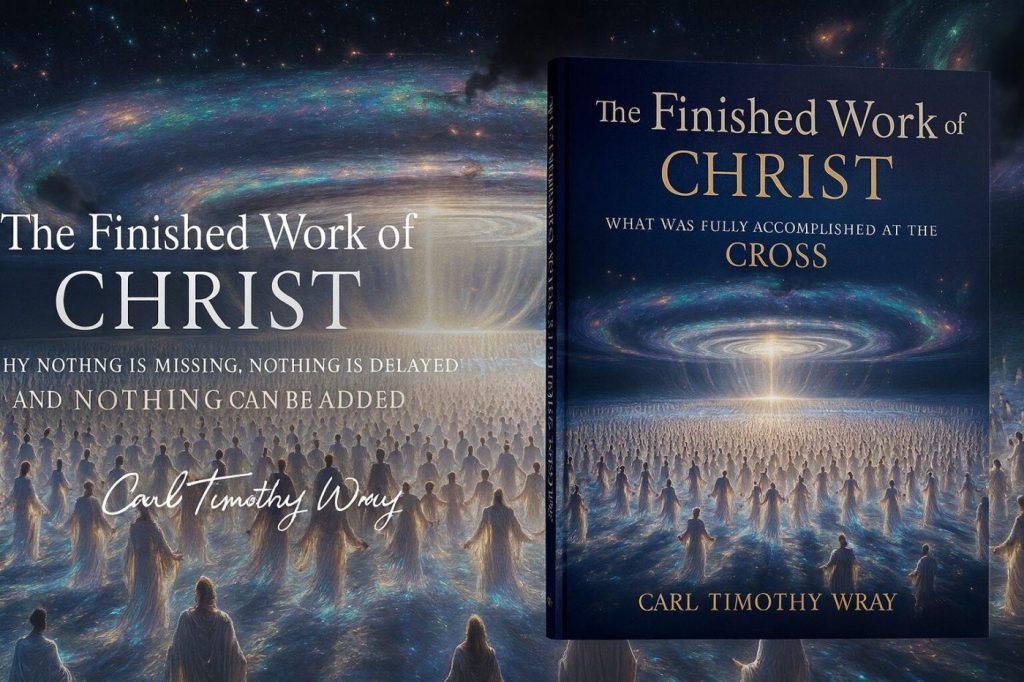
The Finished Work of Christ — Why Nothing Is Missing, Nothing Is Delayed, and Nothing Can Be Added
The Finished Work of Christ: AUTHOR: By Carl Timothy Wray
Carl Timothy Wray is a teacher of Scripture devoted to unveiling the full counsel of God from Genesis to Revelation. His writings focus on the finished work of Christ—revealing what God fully accomplished at the cross and how that completed reality governs faith, rest, and lived Kingdom experience. With clarity and balance, he harmonizes Scripture to free believers from striving, delay, and religious mixture.
- The Finished Work of Christ: 2. Download The Finished Work of Christ: 3. Read The Finished Work of Christ: Series
The Finished Work of Christ: INTRODUCTION
The cross of Christ did not begin a process—it ended one.
When Jesus declared, “It is finished,” He was not expressing relief at the end of suffering, nor announcing the possibility of future completion. He was making a legal, covenantal declaration: the work entrusted to Him by the Father had been fully accomplished, perfectly executed, and forever settled. Nothing was left undone. Nothing was left pending. Nothing was left for humanity to improve, complete, or supplement.
Yet despite this declaration, confusion has persisted for generations.
Many believers affirm that the work is finished in theory, while living as though something essential is still missing in practice. Others believe the work was completed, but only partially effective—requiring human effort, spiritual performance, or prolonged delay to activate its benefits. Still others accept the cross as sufficient for forgiveness, but not for rest, victory, reconciliation, or authority. As a result, faith becomes strained, patience becomes burdensome, and the gospel subtly shifts from good news to ongoing obligation.
This book exists to end that confusion.
The finished work of Christ is not a poetic phrase or a theological slogan—it is a defined, completed reality with specific accomplishments and eternal consequences. At the cross, redemption was secured, reconciliation was achieved, peace was established, righteousness was bestowed, and a new creation was inaugurated. These were not provisional outcomes awaiting human cooperation to become valid; they were decisive acts accomplished once, for all, and forever.
Understanding what was finished is essential to understanding how believers are meant to live. When the substance of the finished work is clearly seen, striving gives way to rest, faith regains its simplicity, patience finds its purpose, and confidence replaces fear. The gospel returns to its rightful center—not what man must do for God, but what God has already done for man in Christ.
This book will carefully unfold what was fully accomplished at the cross, why nothing is lacking, why nothing has been delayed, and why nothing can ever be added. When the finished work of Christ is seen clearly, it no longer needs to be defended, extended, or repaired—it simply needs to be believed, rested in, and lived from.
Chapter 1 — “It Is Finished” (Tetelestai): The Declaration That Ended All Additions
The final words Jesus spoke from the cross were not a whisper of exhaustion—they were a declaration of completion.
“It is finished.”
— John 19:30
In the original Greek, the word Jesus used was tetelestai. This was not a religious phrase and not a poetic expression. It was a legal, commercial, and covenantal term meaning paid in full, completed, accomplished, brought to its intended end. It was written across contracts when a debt was fully satisfied and no further payment could ever be demanded.
When Jesus spoke this word, He was not announcing the possibility of salvation. He was announcing the completion of the work.
Nothing remained outstanding.
Nothing remained conditional.
Nothing remained incomplete.
The cross did not begin redemption—it concluded it.
Finished Means Finished—Not Started
Much confusion enters the gospel when people unconsciously redefine finished to mean made available. But Scripture does not support that downgrade. Jesus did not say, “It is now possible,” or “It is now accessible,” or “It is now waiting on response.”
He said, “It is finished.”
The work entrusted to Him by the Father was not a cooperative effort requiring future human contribution. It was a singular, decisive act accomplished by the Son alone. Redemption was not handed back to humanity for completion—it was secured entirely in Christ.
This is why Scripture speaks of salvation, reconciliation, and righteousness as accomplished realities, not ongoing negotiations.
“By one offering He hath perfected for ever them that are sanctified.”
— Hebrews 10:14
One offering.
One act.
One completion.
Forever settled.
Why the Cross Ends All Additions
Any attempt to add to the finished work—whether through works, rituals, performance, or spiritual striving—quietly contradicts Jesus’ declaration. To add is to imply lack. To supplement is to suggest insufficiency. To improve is to deny completion.
This is why Scripture is uncompromising on this point:
“If righteousness come by the law, then Christ is dead in vain.”
— Galatians 2:21
The issue is not sincerity.
The issue is sufficiency.
The cross does not tolerate helpers.
Once tetelestai was spoken, the entire religious economy built on earning, maintaining, or proving righteousness was brought to an end. From that moment forward, all access to God would rest on what Christ finished, not what man attempted.
Finished Does Not Mean Inactive
Some mistakenly believe that if the work is finished, nothing is happening. But Scripture never confuses completion with inactivity.
A foundation can be finished while a building rises upon it.
A contract can be completed while its benefits are distributed.
A victory can be secured while its effects unfold through time.
The finished work is the cause, not the contradiction, of unfolding experience.
What Christ finished at the cross does not need to be repeated—it needs to be revealed, applied, and lived. Time does not add to the work; time reveals the work.
This is why Scripture speaks of what has been accomplished while also describing how believers grow into its reality.
The Cross Closed the Account Forever
When Jesus said tetelestai, heaven recorded the transaction as complete.
Sin was judged.
Death was defeated.
Separation was ended.
Peace was established.
Access was opened.
Inheritance was secured.
The cross did not leave room for later adjustments.
God did not plan to revisit the work.
He did not schedule revisions.
He did not anticipate amendments.
The finished work of Christ stands as the unchangeable foundation upon which all faith, patience, transformation, and manifestation rest.
To understand this declaration is to be freed from striving.
To believe it is to enter rest.
To live from it is to walk in peace.
And until this word—finished—is allowed to mean exactly what it says, the gospel will always be reduced to effort instead of rest, process instead of peace, and obligation instead of inheritance.
The cross ended all additions. Everything that follows flows from what was already finished.
Chapter 2 — The Cross as a Completed Transaction: Paid in Full, Settled Forever
The cross was not a symbol of potential redemption.
It was a transaction.
When Jesus cried tetelestai, heaven did not record an intention—it recorded a settlement. The language of Scripture is deliberate: redemption was purchased, reconciliation was made, peace was established, and righteousness was bestowed. These are not verbs of possibility; they are verbs of completion.
A transaction is only a transaction when nothing remains outstanding.
Redemption Was Not Promised — It Was Purchased
Scripture never speaks of redemption as a loan or a lease. It speaks of it as a purchase.
“Ye are bought with a price.”
— 1 Corinthians 6:20
Buying implies finality. Once a purchase is made, ownership transfers. The former debt-holder no longer has authority. The account is closed.
The cross was the moment where humanity’s debt was fully paid—not partially reduced, not conditionally forgiven, not temporarily covered. The price was exact, sufficient, and final.
Jesus did not make a down payment.
He did not leave a balance.
He did not require installments.
He paid in full.
The Difference Between Purchase and Possession
One of the greatest sources of confusion in the Church is failing to distinguish between what has been purchased and what is being possessed.
Purchase happens once.
Possession unfolds over time.
A man may legally own land the moment the deed is signed, even if he has not yet walked every acre. His lack of experience does not invalidate his ownership. In the same way, the finished work of Christ established legal reality before experiential awareness.
The cross secured the inheritance.
Faith receives it.
Patience walks it into lived experience.
But the transaction itself never waits on experience to be valid.
Heaven Records Completion Before Earth Understands It
Scripture consistently presents heaven as the realm where truth is settled before it appears in history.
“Forever, O Lord, thy word is settled in heaven.”
— Psalm 119:89
The cross was recorded in heaven as complete the moment Jesus declared it finished. Earth’s confusion does not reopen heaven’s books. Delay in understanding does not reverse divine settlement.
This is why Scripture can speak of believers as:
redeemed
reconciled
justified
sanctified
seated in heavenly places
—all while they are still learning to live from those realities.
The ledger is closed.
The benefits are being revealed.
Why Nothing Can Be Added to a Finished Transaction
To add to a completed transaction is to deny its sufficiency.
If works could improve redemption, then the price was insufficient.
If effort could enhance righteousness, then the blood was incomplete.
If time could finalize what the cross did not, then Christ did not finish His assignment.
Scripture is relentless here:
“And if by grace, then is it no more of works: otherwise grace is no more grace.”
— Romans 11:6
Grace and addition cannot coexist.
Completion and supplementation cannot occupy the same space.
The cross did not invite assistance—it declared finality.
The Conscience and the Closed Account
One of the clearest proofs that the transaction was complete is found in what it accomplished within the human conscience.
“For by one offering He hath perfected forever them that are sanctified.”
— Hebrews 10:14
If the conscience still required repeated payment, the work would not be finished. But Scripture tells us the opposite: the conscience was cleansed, not managed. The worshiper was perfected in standing, not kept on probation.
A cleansed conscience is the evidence of a settled account.
Religion keeps accounts open.
The cross closes them.
Why This Changes Everything
When the cross is understood as a completed transaction, the entire posture of faith shifts.
Prayer no longer begs.
Faith no longer strives.
Patience no longer fears loss.
Believers stop trying to earn what was already paid for and begin learning how to live from what has been secured. Confidence replaces insecurity because the outcome no longer depends on human performance.
Nothing can be repossessed.
Nothing can be revoked.
Nothing can be undone.
The finished work of Christ stands as a settled transaction in heaven, and everything that unfolds in the earth does so because the account was closed forever at the cross.
The work was not left open-ended.
It was paid in full.
Chapter 3 — The Blood and the Conscience: Why Nothing Is Missing
If anything were missing from the finished work of Christ, the conscience would know it.
Scripture consistently presents the conscience as the final witness of whether redemption has truly been accomplished. If guilt remains unresolved, if condemnation still governs the inner man, then the work would be incomplete. But the New Covenant makes a staggering claim: the blood of Christ did not merely forgive sin—it cleansed the conscience itself.
This is the line the cross crossed that religion never could.
The Old Covenant Managed Sin — It Never Removed It
Under the Law, sin was covered but never erased. Sacrifices were offered continually, not because they failed, but because they could never finish the work they represented.
“For it is not possible that the blood of bulls and of goats should take away sins.”
— Hebrews 10:4
If those sacrifices had actually completed the work, Scripture tells us something critical would have happened:
“Would they not have ceased to be offered? because that the worshippers once purged should have had no more conscience of sins.”
— Hebrews 10:2
The persistence of guilt was proof of incompletion.
As long as the conscience still accused, the work was not finished.
The Blood of Christ Did What No Other Blood Could Do
The New Covenant announces a decisive shift:
“How much more shall the blood of Christ… purge your conscience from dead works to serve the living God?”
— Hebrews 9:14
This is not symbolic language. This is functional language.
The blood of Christ did not merely change God’s posture toward humanity—it changed humanity’s inner condition before God. The conscience was not instructed to behave differently; it was cleansed.
Cleansed means washed.
Cleansed means cleared.
Cleansed means no residue remains.
If guilt still governs, it is not because the blood failed—it is because the finished work has not yet been believed.
Why the Conscience Matters
The conscience is the courtroom where accusation either stands or collapses.
If the cross left anything unresolved, accusation would remain legitimate. But Scripture declares the opposite:
“There is therefore now no condemnation to them which are in Christ Jesus.”
— Romans 8:1
No condemnation does not mean reduced condemnation.
It means none.
Condemnation cannot coexist with a finished work.
Why Religion Keeps the Conscience Active
Religion thrives on an active conscience. It teaches people to monitor themselves, assess themselves, repair themselves, and improve themselves. This produces endless cycles of confession, effort, and fear of falling short.
But Scripture tells us that the finished work did something radical:
“Their sins and iniquities will I remember no more.”
— Hebrews 10:17
If God remembers no more, the conscience has no legal authority to accuse.
A conscience that continues to accuse is not aligned with heaven’s verdict.
The Difference Between Conviction and Condemnation
Some confuse a cleansed conscience with moral indifference. Scripture does not support that fear. Conviction draws us toward God; condemnation drives us away.
Conviction says, “Come.”
Condemnation says, “Hide.”
The blood of Christ removed condemnation—not transformation. Transformation flows freely only when condemnation is gone. A heart that is no longer defending itself can finally be changed.
This is why the New Covenant produces deeper holiness than the old—not through pressure, but through peace.
Nothing Is Missing Where the Conscience Is Clean
If the conscience has been cleansed:
Access is open
Relationship is secure
Rest is justified
Confidence is legitimate
Anything that teaches believers to live under perpetual guilt quietly denies the finished work.
The cross did not leave unfinished business inside the human heart.
The blood reached the deepest place.
The verdict was rendered.
The conscience was cleared.
Nothing is missing.
And until believers live from a cleansed conscience, the finished work of Christ will remain a doctrine instead of a dwelling place.
The blood was sufficient.
The conscience was purged.
The work was complete.
Chapter 4 — The Law Fulfilled, Not Suspended
If anything were still required from man to complete redemption, then the Law would still have authority.
The cross did not suspend the Law.
It fulfilled it.
This distinction is critical. Suspension implies postponement. Fulfillment means completion. And completion means the Law no longer stands as an active system governing righteousness, identity, or access to God.
Jesus did not come to negotiate with the Law.
He came to finish its assignment.
The Law Was a Tutor, Not an Heir
Paul explains the role of the Law with precision:
“Wherefore the law was our schoolmaster to bring us unto Christ, that we might be justified by faith.”
— Galatians 3:24
A schoolmaster does not rule forever.
A tutor does not inherit.
A guide does not remain once the destination is reached.
The Law was never designed to complete redemption. It was designed to expose the need for it. Once Christ arrived and finished the work, the Law’s role ended—not because it was evil, but because it had accomplished its purpose.
To remain under the Law after the cross is not humility.
It is misunderstanding.
Christ Fulfilled Every Requirement Personally
Scripture does not say Christ helped us keep the Law.
It says He kept it Himself.
“Christ is the end of the law for righteousness to every one that believeth.”
— Romans 10:4
End here does not mean termination without fulfillment.
It means goal, completion, finish line.
Every demand of the Law was met in Him, not distributed back to believers in pieces. Righteousness is no longer measured by performance, because performance has already been rendered—once, fully, and perfectly.
If righteousness still depended on obedience to commandments, then the cross would be partial.
But Scripture is clear: righteousness is now imputed, not earned.
Why Mixing Law and Grace Always Produces Confusion
Any mixture of Law and grace produces instability.
Law says, “Do, and live.”
Grace says, “Live, and do.”
Law works from the outside in.
Grace works from the inside out.
When believers are taught that grace forgives but Law governs, they live in constant tension—saved by Christ, but sustained by effort. This creates insecurity, fear, and endless self-evaluation.
Paul calls this mixture spiritual regression:
“Having begun in the Spirit, are ye now made perfect by the flesh?”
— Galatians 3:3
If perfection could be achieved by returning to Law, Christ died in vain.
The Cross Ended Legal Obligation, Not Moral Transformation
Some fear that fulfilling the Law removes accountability. Scripture teaches the opposite.
The Law could command behavior, but it could not change the heart. Grace changes the heart, and changed hearts naturally produce righteousness without compulsion.
“For what the law could not do, in that it was weak through the flesh, God sending his own Son…”
— Romans 8:3
The Law was not weak in instruction.
It was weak in power.
Grace supplies what the Law never could: life.
Why the Law Cannot Be Reactivated
Once a covenant is fulfilled, it cannot be revived.
Scripture states plainly:
“In that he saith, A new covenant, he hath made the first old. Now that which decayeth and waxeth old is ready to vanish away.”
— Hebrews 8:13
The Law has not been improved.
It has been completed.
To return to it as a governing system is not reverence—it is retreat.
Rest Is the Evidence of Fulfillment
The clearest evidence that the Law has been fulfilled is rest.
“Wherefore there remaineth therefore a rest to the people of God. For he that is entered into his rest, he also hath ceased from his own works…”
— Hebrews 4:9–10
Ceased from works does not mean ceased from obedience.
It means ceased from earning.
Rest is not laziness.
Rest is confidence that nothing remains unfinished.
Nothing Is Missing Because the Law Is Finished
If the Law were still active, something would still be required.
If something were still required, something would be missing.
But Christ declared otherwise:
“It is finished.”
The Law was satisfied.
Justice was fulfilled.
Righteousness was completed.
Nothing is suspended.
Nothing is pending.
Nothing is awaiting human contribution.
The finished work of Christ did not leave the Law hovering over believers.
It laid it to rest—honored, fulfilled, and complete.
And until believers live from that fulfillment, the cross will be admired but not inhabited.
The Law has spoken.
Christ has answered.
The work is done.
Chapter 5 — The Veil Torn: Access Fully Restored
If anything still separates man from God, then the veil was never truly torn.
But Scripture does not say the veil was weakened.
It says it was rent in twain from top to bottom.
That detail matters.
Man did not tear the veil upward.
God tore it downward.
This was not symbolism.
It was declaration.
The Veil Represented Distance, Not Mystery
The veil in the temple was not about secrecy.
It was about separation.
It stood as a physical testimony that access to God was restricted. Only one man, one day a year, with blood not his own, could pass beyond it—and even then, not without fear.
The veil preached a message:
“You may approach, but you may not enter.”
When Christ died, God answered that message.
“And, behold, the veil of the temple was rent in twain from the top to the bottom…”
— Matthew 27:51
Heaven initiated the tearing.
Earth received the consequence.
Access Was Restored, Not Improved
The tearing of the veil did not create new access.
It restored original access.
Adam did not need a priest.
Abraham did not need a veil.
Moses spoke with God face to face.
The veil was never God’s ideal—it was God’s concession to a fallen system. When Christ finished the work, God removed what He had never intended to remain.
Access was not upgraded.
It was fully restored.
Why No Priesthood Can Replace the Veil
Once the veil was torn, the Levitical priesthood lost its function.
Scripture says:
“Having therefore, brethren, boldness to enter into the holiest by the blood of Jesus, by a new and living way…”
— Hebrews 10:19–20
If access is bold, mediated authority collapses.
If access is direct, hierarchy dissolves.
If access is complete, nothing stands between God and man.
Any system that reinserts intermediaries—titles, offices, rituals, or permissions—quietly rebuilds the veil Christ destroyed.
The Presence Is No Longer Localized
Under the old covenant, God’s presence was confined to a place.
Under the new covenant, God’s presence inhabits a people.
“Know ye not that ye are the temple of God, and that the Spirit of God dwelleth in you?”
— 1 Corinthians 3:16
A torn veil means God is no longer behind something.
He is within someone.
This is why Jesus said the hour was coming when worship would no longer be tied to location—but to spirit and truth.
Why Guilt Cannot Survive Open Access
Guilt requires distance.
Shame requires hiding.
Fear requires uncertainty.
The veil’s removal destroys all three.
If God has invited you in,
If the blood has opened the way,
If access is permanent—
Then guilt becomes accusation without authority.
This is why Hebrews says the conscience is purified.
Not numbed.
Not managed.
Cleansed.
Nothing Is Delayed Because Access Is Immediate
You do not approach God gradually.
You do not earn proximity.
You do not wait for permission.
You enter.
Now.
“Let us therefore come boldly unto the throne of grace…”
— Hebrews 4:16
Boldness is not confidence in self.
It is confidence in completion.
The throne is not future.
The invitation is not conditional.
The access is not delayed.
The Torn Veil Is God’s Final Answer
Every religious system that teaches distance contradicts the torn veil.
Every doctrine that teaches separation denies the cross.
Every practice that teaches partial access questions Christ’s declaration.
The veil is gone.
The way is open.
The work is finished.
God did not tear the veil to invite discussion.
He tore it to announce completion.
And once the veil is gone, nothing—no sin, no system, no doctrine—has the authority to hang it back up again.
Chapter 6 — Righteousness Fully Bestowed, Not Progressively Earned
If righteousness must still be earned, then the cross did not finish its work.
But Scripture does not say righteousness is in process.
It says righteousness was given.
This distinction separates gospel truth from religious effort.
Righteousness Is a Gift, Not a Goal
Paul is unambiguous:
“For if by one man’s offence death reigned by one; much more they which receive abundance of grace and of the gift of righteousness shall reign in life by one, Jesus Christ.”
— Romans 5:17
Righteousness is not presented as something to be achieved through time, discipline, or spiritual maturity.
It is presented as a gift received.
Gifts are not earned.
They are accepted.
If righteousness were progressive, Paul would have used language of development.
Instead, he uses the language of transfer.
The Cross Did Not Create Potential Righteousness
The cross did not make righteousness possible.
It made righteousness actual.
Jesus did not die so that believers could one day become righteous.
He died so that believers could be made righteous immediately.
“For he hath made him to be sin for us, who knew no sin; that we might be made the righteousness of God in him.”
— 2 Corinthians 5:21
Made.
Not becoming.
Not approaching.
Not qualifying.
This is a finished exchange.
Why Righteousness Cannot Be Partial
If righteousness were partial, access would still be limited.
If righteousness were incomplete, conscience would remain unstable.
If righteousness were conditional, peace would be fragile.
But Scripture says:
“Being justified by faith, we have peace with God…”
— Romans 5:1
Peace is the evidence of completion.
Partial righteousness produces anxiety.
Finished righteousness produces rest.
Identity Precedes Behavior
Righteousness is not the result of right behavior.
Right behavior is the fruit of righteousness.
Religion reverses the order.
The gospel restores it.
You do not live righteously to become righteous.
You live righteously because you are righteous.
When identity is settled, conduct follows naturally.
When identity is uncertain, behavior becomes forced.
Why God Does Not Impute Sin
Paul states something radical:
“Blessed is the man to whom the Lord will not impute sin.”
— Romans 4:8
God does not overlook sin.
He dealt with it fully.
Imputation ended because payment was complete.
God does not revisit what has been settled.
If sin were still being counted, righteousness could not be established.
But righteousness stands precisely because sin has been removed.
Growth Is Not the Earning of Righteousness
Growth is real.
Maturity matters.
Transformation occurs.
But none of these are about earning righteousness.
They are about expressing what has already been given.
Righteousness is the root.
Growth is the fruit.
Confusing the two leads to perpetual striving and spiritual insecurity.
Why Righteousness Must Be Finished
If righteousness were still pending, salvation would remain uncertain.
If righteousness could be increased, it could also be diminished.
If righteousness depended on performance, peace would be impossible.
But righteousness is finished because Christ’s obedience was complete.
One act.
One sacrifice.
One verdict.
“By one offering he hath perfected for ever them that are sanctified.”
— Hebrews 10:14
Perfected.
Forever.
Living from Completion, Not Toward It
The finished work of Christ establishes righteousness as a settled reality, not a moving target.
You do not wake up hoping to be righteous.
You wake up from righteousness.
This changes prayer.
This changes worship.
This changes endurance.
This changes confidence.
You are not striving to qualify.
You are learning to live aligned.
And once righteousness is understood as fully bestowed, fear loses its leverage, guilt loses its voice, and faith finally rests in what God has already declared complete.
Chapter 7 — Rest Is the Evidence That the Work Is Finished
God never asks men to rest in unfinished work.
Rest is not a command given to effort.
It is a response produced by completion.
Where rest is absent, something is still believed to be undone.
Rest Is God’s Declaration, Not Man’s Discipline
From the beginning, rest follows completion.
“And on the seventh day God ended His work which He had made; and He rested…”
— Genesis 2:2
God did not rest because He was tired.
He rested because nothing remained to be done.
Rest is heaven’s signal that a work is finished.
When Jesus cried, “It is finished,” He was not announcing exhaustion.
He was announcing completion—and rest followed.
Why Unbelief Cannot Rest
Hebrews makes this painfully clear:
“They could not enter in because of unbelief.”
— Hebrews 3:19
Unbelief is not merely doubting God’s power.
It is doubting God’s completion.
As long as someone believes something is still required—repentance, performance, suffering, purification—rest remains impossible.
Unbelief always keeps something unfinished.
Faith rests because it knows nothing is missing.
Rest Does Not Mean Inactivity
Biblical rest is not passivity.
It is confidence without anxiety.
Jesus rested while walking, teaching, healing, and confronting opposition.
His rest was internal, not circumstantial.
Rest means you are no longer trying to secure what has already been secured.
You work from peace, not toward peace.
Striving Reveals a Competing Gospel
Whenever believers strive to:
- maintain acceptance
- preserve righteousness
- secure favor
- complete salvation
they are not responding to the finished work.
They are responding to a counterfeit gospel.
The true gospel does not produce fear-driven obedience.
It produces rest-driven fruit.
The Sabbath Was Always a Sign
The Sabbath was never about a day.
It was about a state.
Hebrews reveals the truth:
“There remaineth therefore a rest to the people of God.”
— Hebrews 4:9
This rest is entered by faith, not by calendars.
It is entered by believing that God’s work is complete.
Christ did not remove the Sabbath.
He fulfilled it.
Why Rest Offends Religion
Religion survives on human contribution.
Rest removes the need for it.
When rest enters, boasting dies.
Comparison ends.
Hierarchy collapses.
This is why religious systems resist rest.
Rest exposes dependence on works, rituals, and performance.
Grace levels the ground.
Rest seals it.
Rest Produces Stability Under Pressure
Those who rest are not easily shaken.
They endure trials without panic.
They face delay without fear.
They encounter opposition without retreat.
Why?
Because rest is anchored in completion, not outcomes.
If the work is finished, circumstances cannot undo it.
Jesus Invited the Weary, Not the Worthy
Jesus did not say, “Come unto me, all ye who have improved.”
He said:
“Come unto me, all ye that labour and are heavy laden, and I will give you rest.”
— Matthew 11:28
Rest is given, not earned.
The invitation is not to do more,
but to stop carrying what was never yours to complete.
Rest Is the Proof of Finished Faith
Faith that still strives is incomplete understanding.
Faith that rests has seen the cross clearly.
You do not rest because you feel secure.
You rest because Christ is sufficient.
Rest is not laziness.
It is trust perfected.
And when rest is present, it testifies to heaven and earth alike that the finished work of Christ is not a doctrine to be defended, but a reality to be lived.
Chapter 8 — Judgment Satisfied, Not Postponed
If judgment is still pending for those in Christ, then the cross did not finish its work.
But Scripture declares the opposite:
judgment has already occurred—and it was satisfied completely.
Judgment Did Not Disappear — It Was Executed
God did not ignore sin.
He judged it.
“And the Lord hath laid on him the iniquity of us all.”
— Isaiah 53:6
Judgment was not delayed to the end of time.
It was poured out at the cross.
If judgment were still awaiting believers, then Christ would have suffered incompletely.
But the gospel proclaims a finished judgment, not a postponed one.
No Condemnation Means Judgment Has Ended
Paul makes a definitive statement:
“There is therefore now no condemnation to them which are in Christ Jesus.”
— Romans 8:1
No condemnation does not mean leniency.
It means no remaining verdict.
Condemnation cannot coexist with finished judgment.
If judgment had not been satisfied, condemnation would still speak.
Silence is the proof that judgment has been answered.
Why Christ Was Judged Once
Scripture is explicit:
“So Christ was once offered to bear the sins of many.”
— Hebrews 9:28
Once.
Not repeatedly.
Not partially.
Judgment was concentrated into a single, sufficient event.
God does not double-charge what has already been paid.
If judgment were to return, justice itself would be violated.
The Cross Ended Fear-Based Theology
Fear thrives where judgment is unresolved.
But Scripture says:
“Perfect love casteth out fear: because fear hath torment.”
— 1 John 4:18
Fear remains only where punishment is expected.
When judgment is satisfied, fear loses its legal basis.
Believers are not waiting for a future reckoning.
They are living from a settled verdict.
Why the Judgment Seat Does Not Reopen the Case
Many confuse evaluation with condemnation.
The judgment seat of Christ does not determine salvation.
It reveals stewardship.
Works are examined.
Identity is not questioned.
A settled verdict cannot be retried.
A finished work cannot be reversed.
Justice and Mercy Met at the Cross
The cross is not mercy bypassing justice.
It is justice fulfilled through mercy.
God did not lower the standard.
He met it.
Every demand of righteousness was satisfied.
Every claim of the law was silenced.
Every accusation was answered.
Nothing remains unresolved.
Why Believers Live Without Threat
Threat-based faith is incompatible with the finished work.
You do not obey to avoid judgment.
You obey because judgment has already passed.
Obedience flows from gratitude, not fear.
Holiness grows from security, not terror.
The Finished Verdict
Judgment is not approaching for those in Christ.
It has already been rendered.
Sin judged.
Debt canceled.
Accusation silenced.
Conscience cleansed.
This is not optimism.
It is gospel finality.
And once judgment is understood as fully satisfied, the believer no longer lives under the shadow of tomorrow’s reckoning, but in the light of a verdict that has already been declared righteous forever.
Chapter 9 — Death Defeated, Not Merely Delayed
If death still reigns as an unbroken authority, then Christ did not finish His work.
But Scripture proclaims something far stronger:
death has been defeated, not postponed.
Death Was an Enemy, Not a Tool
Paul is clear:
“The last enemy that shall be destroyed is death.”
— 1 Corinthians 15:26
Death was never part of God’s redemptive strategy.
It entered through sin and ruled through fear.
Christ did not come to manage death.
He came to abolish it.
The Cross Struck Death at Its Root
Death’s power was not physical first.
It was legal.
Sin gave death its authority.
Remove sin, and death loses its claim.
This is why Scripture says:
“For this purpose the Son of God was manifested, that he might destroy the works of the devil.”
— 1 John 3:8
The work of death was dismantled at the cross, not rescheduled.
Resurrection Was the Proof, Not the Beginning
The resurrection did not start Christ’s victory.
It revealed it.
When Jesus rose, death did not retreat temporarily.
It was exposed as powerless.
Resurrection is not a pause in death’s reign.
It is the announcement that death’s reign has ended.
Why Death No Longer Has Dominion
Paul states plainly:
“Death hath no more dominion over him.”
— Romans 6:9
Dominion speaks of authority.
Death no longer holds lawful power.
What remains is manifestation, not legality.
What lingers is experience, not rule.
The authority of death was broken before its final appearance disappears.
Abolished Means Abolished
Paul uses uncompromising language:
“Who hath abolished death, and hath brought life and immortality to light through the gospel.”
— 2 Timothy 1:10
Abolished does not mean restrained.
It does not mean postponed.
It means rendered powerless.
Death was defeated at the level of authority.
Life now governs the outcome.
Why Believers Die Without Death Reigning
Physical death does not mean death reigns.
Many experience death while death itself has lost its authority—just as believers still experience sin while sin no longer reigns.
Reign and presence are not the same.
Authority and manifestation are not identical.
Death’s defeat is settled.
Its disappearance unfolds.
The Fear of Death Was the Real Bondage
Hebrews reveals the deeper victory:
“That through death he might destroy him that had the power of death… and deliver them who through fear of death were all their lifetime subject to bondage.”
— Hebrews 2:14–15
Fear was death’s primary weapon.
Once fear is removed, bondage ends.
Believers do not live toward death.
They live from life.
The Gospel Is a Life Message
The gospel does not glorify dying.
It proclaims life.
Christ did not triumph to secure a better death.
He triumphed to restore life.
Death is no longer a master.
It is a defeated trespasser.
Victory Declared, Manifestation Advancing
The finished work of Christ declares death judged, dethroned, and defeated.
What remains is not uncertainty, but outworking.
Not legality, but revelation.
Not fear, but expectancy.
And as life continues to be revealed, death loses ground until nothing remains but the fullness of what Christ has already accomplished—life reigning where death once ruled.
Chapter 10 — Nothing Can Be Added, Because Everything Was Finished
The final proof that the work of Christ is finished is this simple truth:
there is nothing left for man to complete.
If anything could still be added, then Christ’s declaration was premature.
If anything remained unfinished, then “It is finished” would have been aspirational—not final.
But the cross did not begin a process.
It ended one.
“It Is Finished” Was a Legal Declaration
When Jesus said, Tetelestai, He was not expressing relief.
He was announcing completion.
In the ancient world, tetelestai was stamped on a debt ledger to declare:
paid in full — nothing owed.
Jesus did not say, “I have done my part.”
He said, “It is finished.”
No balance remained.
No future payment was expected.
No human contribution was invited.
Why Additions Always Reveal Unbelief
Any system that adds requirements to the cross is not honoring it.
It is correcting it.
Whether those additions come in the form of:
- extra purification
- continued condemnation
- progressive justification
- future judgment threats
- fear-based obedience
they all share the same root:
the belief that Christ’s work was insufficient.
Additions do not strengthen the gospel.
They expose distrust in it.
The Law Ended Because Fulfillment Came
Scripture states plainly:
“Christ is the end of the law for righteousness to every one that believeth.”
— Romans 10:4
The law did not fade.
It concluded.
Once fulfillment arrives, continuation becomes rebellion.
To return to law is not humility—it is denial of completion.
Why Grace Leaves No Room for Mixture
Grace is not God helping man finish the work.
Grace is God announcing that the work is already done.
This is why Paul speaks so strongly:
“If righteousness come by the law, then Christ is dead in vain.”
— Galatians 2:21
Even a small addition empties the cross of meaning.
Grace cannot coexist with contribution.
The Finished Work Produces Confidence, Not Carelessness
The accusation against grace has always been the same:
“If nothing can be added, people will live however they want.”
Paul answers this without hesitation:
“Shall we continue in sin, that grace may abound? God forbid.”
Grace does not produce lawlessness.
It produces new nature.
Only insecurity needs rules to restrain it.
A transformed heart does not require threats.
Why God Will Not Accept Human Supplements
God does not reject additions because they are offensive.
He rejects them because they are unnecessary.
You do not decorate a completed masterpiece.
You do not reinforce a finished foundation.
You do not improve perfection.
Any attempt to add reveals a failure to see what was accomplished.
The Gospel Ends Striving Forever
The finished work of Christ removes the need to prove, earn, maintain, or protect acceptance with God.
You are not working toward approval.
You are working from approval.
You are not laboring to be accepted.
You are resting because you already are.
This is the crown of the gospel.
Completion Is the Glory of God
God is not glorified by human effort completing divine work.
He is glorified when humanity finally believes Him.
Faith is not effort.
Faith is agreement.
And agreement with God’s finished work is the highest form of worship.
The Final Word
Nothing is missing.
Nothing is delayed.
Nothing can be added.
The cross spoke once—and spoke forever.
What Christ finished does not need defense.
It needs belief.
And when belief rests fully in completion, striving ends, fear dissolves, and life finally flows—not from what we hope God will do, but from what He has already done.
The Finished Work of Christ: Author
Carl Timothy Wray is a teacher and author devoted to unveiling the Finished Work of Christ as a completed, unalterable reality settled at the cross. His writings reveal the harmony of God’s mind from Genesis to Revelation, dismantling delay-based theology and restoring confidence in what Christ fully accomplished. Through clear Scripture alignment and spiritual precision, he calls believers out of striving and into rest, assurance, and lived Kingdom reality.
Read Our: The Finished Work of Christ Series:
- The Finished Work of Christ — Settled in Heaven, Unfolding in the Earth
- By Faith and Patience We Receive the Promise
- He Abolished Death
- Join Our Facebook Page: