The Finished Work of Christ — What “It Is Finished” Truly Means — And Why Nothing Is Missing, Delayed, or Incomplete
AUTHOR
Carl Timothy Wray is a Bible teacher and author devoted to unveiling the finished work of Christ from Genesis to Revelation. His writings focus on the completed victory of the cross, the revelation of sonship, and the rest that flows from Christ’s accomplished work. With clarity and boldness, he writes to reconcile Scripture with Scripture and to free believers from religious striving into the rest of Christ.
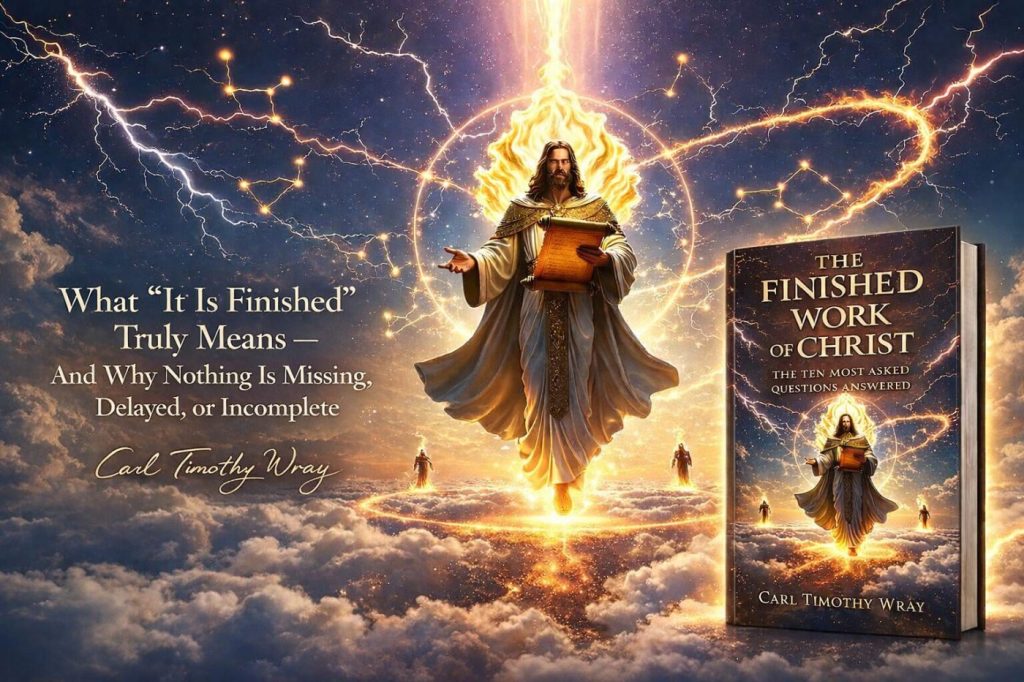
- The Finished Work of Christ Book Here: 2. The Finished Work of Christ Download PDF Here: 3. The Finished Work of Christ Series:
The Finished Work of Christ: INTRODUCTION
When Jesus cried out, “It is finished,” He was not speaking poetically, emotionally, or symbolically. He was making a final declaration that echoed through heaven and earth — a statement of completion, not invitation, not possibility, not delay.
Yet two thousand years later, Christianity is filled with unanswered questions. Believers are told the work is finished, yet they are taught to strive, wait, qualify, and improve what Christ has already completed. The result is confusion: if everything is finished, why does so much still feel unfinished?
This book exists to answer that tension honestly and thoroughly. Drawing directly from Scripture, each chapter addresses one of the ten most asked questions surrounding the finished work of Christ — questions that surface repeatedly in sermons, studies, searches, and conversations across the world. These are not abstract theological debates; they are the very questions that determine whether a believer lives from rest or from striving.
The finished work of Christ is not a partial achievement awaiting human cooperation. It is a completed victory that calls for understanding, agreement, and rest. Nothing is missing. Nothing is delayed. Nothing is incomplete. This book is written to make that truth unmistakably clear.
Chapter One
What Does “It Is Finished” Really Mean?
When Jesus cried out, “It is finished,” He was not speaking in relief, resignation, or poetic symbolism. He was issuing a declaration of completion — a legal, covenantal, and cosmic announcement that something had reached its absolute end.
The phrase recorded in John 19:30 comes from the Greek word tetelestai. It was not a religious word. It was a commercial and legal term, commonly written across a bill or ledger to signify that a debt had been fully paid. Nothing remained outstanding. No balance was left. No further payment could be demanded.
Jesus did not say, “I have done my part.”
He did not say, “Now it is possible.”
He did not say, “The rest is up to you.”
He said, “It is finished.”
That single declaration tells us something vital about the nature of the cross: the cross was not the beginning of a process — it was the conclusion of an age.
Finished Means Completed — Not Suspended
One of the greatest misunderstandings surrounding the finished work of Christ is the idea that “finished” really means initiated, set in motion, or made available. Yet Scripture does not support that interpretation.
A work that is finished is not waiting for activation.
A work that is finished is not dependent on improvement.
A work that is finished is not awaiting fulfillment at some later date.
Finished means complete.
The cross did not create a provisional salvation that must be completed by human effort, discipline, or consistency. It accomplished redemption in full — once, decisively, and without remainder.
This is why Scripture repeatedly speaks of Christ’s work in the past tense:
He obtained eternal redemption
He perfected forever those who are sanctified
He reconciled all things to Himself
He abolished death and brought life to light
The language is settled because the work is settled.
What Was Finished at the Cross?
When Jesus declared the work finished, several things ended simultaneously:
The reign of Adamic condemnation
The dominion of sin as a governing power
The authority of the law to accuse and condemn
The separation between God and man
The sacrificial system and its shadows
The cross did not merely address individual sins; it dealt with the entire Adamic order. It brought an age to a close and inaugurated a new creation reality in Christ.
This is why Scripture never presents the cross as a partial victory. There is no verse that suggests Christ accomplished most of redemption and left the rest for humanity to complete. Such an idea would contradict the very word He chose to speak at the moment of completion.
Why This Matters So Deeply
If “It is finished” does not truly mean finished, then nothing in the gospel is secure. Faith becomes anxiety. Grace becomes probation. Salvation becomes conditional maintenance.
But if the work truly is finished, then faith is not striving — it is agreement.
Rest is not passivity — it is alignment with truth.
Obedience is not payment — it is fruit.
The finished work of Christ is not an excuse to do nothing; it is the foundation that makes everything else possible without fear, guilt, or condemnation.
The Cross Ended Something Before It Began Anything
Before resurrection life could be revealed, death had to be dealt with.
Before sonship could appear, Adam had to end.
Before rest could be entered, labor had to cease.
Jesus did not rise from the cross to finish the work later.
He rose from the grave because the work was already finished.
The resurrection was not the completion of the work — it was the proof of it.
Declaration
The work is finished.
Not mostly finished.
Not spiritually finished but practically pending.
Finished.
Nothing is missing.
Nothing is delayed.
Nothing is incomplete.
Call to the Reader
If the work is finished, then the question is no longer “What must I do?”
The question becomes, “What has already been done?”
This book is written to answer that question clearly, patiently, and completely — one question at a time.
In the next chapter, we will confront the contradiction that still troubles millions:
If the work is finished, why is Christianity still trying to finish it?
Chapter Two
If the Work Is Finished, Why Is Christianity Still Trying to Finish It?
There is a quiet contradiction at the heart of modern Christianity. With one breath, believers confess that Christ finished the work at the cross. With the next, they are taught to complete, maintain, preserve, or prove what Christ already accomplished.
This contradiction is not usually intentional. It is inherited. It flows from systems built on mixture — part grace, part effort; part faith, part fear; part completion, part probation.
If the work is truly finished, then why does so much of Christianity still feel unfinished?
The Difference Between Revelation and Religion
Religion always moves toward something.
Revelation always flows from something.
Religion says:
Try harder
Do better
Stay faithful or you may lose what you have
Endure long enough and you might arrive
Revelation says:
It is done
You are included
Stand in what has already been accomplished
Let fruit grow from rest
Christianity struggles to rest in the finished work because religion thrives on process, not completion. A finished work leaves no room for religious control, hierarchy, or leverage. Once something is complete, it can no longer be used as a measuring stick.
Why Finished Work Makes Systems Uncomfortable
A finished work removes fear as a motivator.
When fear is removed:
Guilt loses its power
Condemnation collapses
Performance-based identity fails
Control mechanisms weaken
This is why systems often redefine finished to mean available, accessible, or potential. That subtle shift allows religion to continue managing behavior rather than revealing identity.
But Scripture never presents salvation as something believers must maintain through effort. It presents it as something believers awaken to through truth.
The Error of “Maintaining” What Christ Completed
One of the most damaging teachings in modern Christianity is the idea that believers must maintain their salvation through consistent performance. This turns faith into pressure and grace into surveillance.
Yet Scripture declares the opposite:
Christ obtained eternal redemption
Believers are kept by the power of God
Nothing can separate us from His love
The work was finished once for all
A work that must be maintained by human effort was never finished to begin with.
Why Striving Feels Spiritual — But Isn’t
Striving often disguises itself as devotion. Effort masquerades as holiness. Anxiety pretends to be responsibility.
But striving is not spiritual — it is unbelief wearing religious clothing.
Striving says:
“What Christ did is not enough unless I add my consistency to it.”
Faith says:
“What Christ did is enough — therefore I can rest.”
The difference between striving and obedience is origin.
Striving comes from fear.
Obedience flows from rest.
What Christianity Is Actually Trying to Finish
When Christianity tries to “finish” the work, it is usually attempting to:
Complete what it does not understand
Improve what it does not trust
Control what it does not believe is secure
The issue is not the cross.
The issue is sight.
Believers do not struggle because the work is unfinished.
They struggle because they have not yet seen the work clearly.
The Finished Work Removes the Need for Religious Performance
Performance is always a substitute for assurance.
When assurance is absent:
Fear enters
Striving begins
Religion takes over
But when assurance is present:
Rest follows
Identity stabilizes
Fruit appears naturally
The finished work of Christ does not produce lazy believers.
It produces secure sons.
Declaration
The work is not waiting on me.
It is not incomplete without me.
It does not improve through my effort.
Christ finished the work.
I stand in what He completed.
I live from rest — not toward it.
Call to the Reader
If Christianity is still trying to finish what Christ completed, then the issue is not effort — it is understanding.
In the next chapter, we will address one of the most important questions of all:
Did Jesus finish salvation — or did He only make it possible?
This is where the difference between religion and revelation becomes unmistakably clear.
Chapter Three
Did Jesus Finish Salvation — Or Did He Only Make It Possible?
This question sits at the core of nearly every theological disagreement in Christianity. Most believers would say, “Jesus finished the work,” yet many are unknowingly taught that salvation itself is only a possibility — something offered, proposed, or made available, but not actually accomplished.
The difference between these two views is not small. It determines whether salvation is a completed reality or a conditional opportunity.
Scripture is unmistakably clear:
Jesus did not make salvation possible.
He accomplished it.
The Language of Scripture Is Not Hypothetical
If salvation were only made possible at the cross, the New Testament would speak in the language of potential. It would say Christ enabled, offered, or attempted redemption.
Instead, Scripture speaks in completed terms:
He saved us
He redeemed us
He reconciled us
He forgave us
He delivered us
He justified us
These are not invitations. They are declarations.
Salvation is never presented as a future achievement waiting for human validation. It is presented as an accomplished work into which humanity is awakened through faith.
The Error of “Possibility Theology”
Possibility theology teaches that the cross created an opportunity that must be activated by correct belief, proper behavior, or sustained faithfulness. While this may sound reasonable, it subtly shifts the weight of salvation away from Christ and back onto man.
In this framework:
The cross initiates
Man completes
God responds
Salvation remains uncertain
But Scripture reverses that order completely.
Christ finished the work.
Faith receives what is finished.
Works follow as fruit — not as proof.
A salvation that depends on human completion was never finished in the first place.
What Faith Actually Does
Faith does not complete salvation.
Faith does not validate salvation.
Faith does not maintain salvation.
Faith agrees with salvation.
Faith is the human response to a divine reality already established in Christ. It does not create the work — it recognizes it.
This is why Scripture never says we are saved by faith alone in the sense of faith being the cause. It says we are saved by grace, through faith. Grace is the source. Faith is the doorway of awareness.
The Cross Did Not Create Potential — It Ended Separation
If salvation were only possible after the cross, then separation would still exist until man responded correctly. But Scripture declares that reconciliation occurred before belief.
God was in Christ reconciling the world to Himself, not counting their trespasses against them.
That reconciliation was not conditional. It was an accomplished act.
Faith does not reconcile us to God.
Reconciliation reveals that God already reconciled us.
Why This Truth Is Resisted
A finished salvation removes leverage.
If salvation is complete:
Fear loses its control
Guilt loses its voice
Threat-based teaching collapses
Religious hierarchy weakens
This is why salvation is often reduced to possibility. Possibility allows management. Completion produces freedom.
But freedom is exactly what Christ purchased.
Finished Salvation Produces Secure Identity
When salvation is finished:
Identity becomes stable
Obedience becomes joyful
Growth becomes organic
Love becomes fearless
Believers no longer live under constant evaluation. They live from acceptance, not toward it.
Salvation finished does not weaken holiness — it strengthens it, because holiness no longer flows from fear of loss but from love and gratitude.
Declaration
Jesus did not make salvation possible.
He accomplished it.
I am not trying to be saved.
I am awakening to what has already been done.
Grace finished the work.
Faith agrees with it.
Love expresses it.
Call to the Reader
If salvation is finished, then the cross did not open a door to uncertainty — it closed the door on separation forever.
In the next chapter, we will clarify something many have quietly wondered but rarely asked:
What was fully accomplished at the cross — and what wasn’t?
This question brings clarity where confusion has long reigned.
Chapter Four
What Was Fully Accomplished at the Cross — And What Wasn’t?
One of the most important questions surrounding the finished work of Christ is not whether something was accomplished at the cross, but what exactly was accomplished — and just as importantly, what people often assume was not.
Confusion thrives where definition is absent. Many believers feel uncertain not because the cross was incomplete, but because they have never been clearly taught what the cross actually finished.
The cross was not vague. It was precise.
What the Cross Fully Accomplished
- Sin Was Dealt With — Completely
The cross did not merely cover sin; it removed it as a ruling power.
Jesus did not die to manage sin behavior — He died to end sin’s authority. Sin was judged, condemned, and stripped of its right to govern humanity. This does not mean believers never miss the mark, but it does mean sin no longer reigns as a master.
Sin was addressed at the root, not merely at the surface.
- Condemnation Was Ended
Condemnation did not survive the cross.
There is no verse in the New Testament that presents condemnation as an ongoing tool for God’s people. Condemnation belonged to the old covenant system of accusation and judgment. At the cross, that system ended.
Conviction leads to life.
Condemnation leads to hiding.
The finished work removed condemnation entirely.
- Separation Between God and Man Was Removed
The cross did not bridge a gap temporarily — it removed the gap entirely.
God was not waiting on humanity to close the distance. He closed it Himself in Christ. The veil was torn not as an invitation, but as a declaration: access was no longer restricted.
Separation ended at the cross.
Union began.
- The Adamic Order Was Brought to an End
The cross did not simply forgive Adam — it ended Adam.
Jesus did not die as an improvement to the old man. He died as the final answer to it. The Adamic nature, with its guilt, fear, striving, and separation, was judged and concluded.
What emerged was not a repaired Adam, but a new creation in Christ.
- The Law’s Authority to Accuse Was Removed
The law did not fail. It fulfilled its purpose.
The law exposed sin, identified the problem, and pointed toward Christ. Once Christ came and finished the work, the law’s role as an accuser and judge ended.
This does not remove righteousness — it establishes it on a higher foundation: life, not law.
What the Cross Did Not Accomplish
Clarity requires honesty.
The cross did not instantly mature believers in understanding.
It did not immediately eliminate ignorance.
It did not force humanity to see what was accomplished.
The work was finished — the revelation of the work unfolds.
There is a difference between completion and comprehension.
The cross ended the old order in truth, but the human mind still learns to align with that truth. Growth is not finishing the work — it is awakening to it.
Why This Distinction Matters
Many assume that because growth is progressive, the work must be incomplete. But progress does not indicate lack — it indicates discovery.
A house can be fully built while its occupants are still learning how to live in it.
The cross finished the work.
The Spirit teaches us to live from it.
The Cross Settled Heaven — Renewal Happens in the Mind
The cross settled everything in the realm of origin. Nothing remained undecided in heaven. Nothing was left unresolved in God.
What unfolds in time is not completion — it is manifestation through understanding.
This is why Scripture speaks of:
Renewal of the mind
Growth in grace
Increase in understanding
None of these finish the work.
They reveal it.
Declaration
The cross finished what heaven required.
Nothing was left undone.
Nothing was left unresolved.
What grows is not redemption —
what grows is sight.
Call to the Reader
If the cross finished sin, condemnation, separation, and the old man, then the question becomes deeply personal:
Does the finished work of Christ include healing and wholeness — or only forgiveness?
Chapter Five
Does the Finished Work of Christ Include Healing and Wholeness?
For many believers, the finished work of Christ is accepted intellectually but limited practically. Forgiveness is embraced. Reconciliation is affirmed. Yet when the conversation turns to healing, wholeness, or restoration, certainty often gives way to hesitation.
The question arises quietly but persistently:
Did the cross deal only with sin — or did it address the whole condition of humanity?
Scripture answers clearly: the finished work of Christ was not partial. It addressed the entire human condition.
Redemption Was Never Fragmented
God has never redeemed man in pieces.
From the beginning, humanity was created whole — spirit, soul, and body — and the fall affected the whole man. Sin did not merely damage morality; it introduced corruption, decay, and death into every dimension of human life.
If redemption only addressed guilt, then the fall would remain only partially undone.
But the cross did not restore part of man.
It addressed man completely.
Healing Is Not a Side Issue — It Is a Redemptive Issue
Throughout the ministry of Jesus, healing was not treated as an optional blessing or a separate category from salvation. It flowed naturally from His authority and compassion.
Jesus did not forgive sins one day and heal bodies another. He did both as expressions of the same kingdom life. Healing was not presented as a reward for faithfulness but as a sign of restoration breaking into a broken world.
The cross did not change God’s posture toward sickness. It revealed it fully.
The Cross Dealt With the Root — Not Just the Symptom
Sickness is not merely physical malfunction; it is part of the larger condition of mortality and decay introduced through Adam. Where death reigns, weakness follows.
The finished work of Christ did not simply forgive sin; it struck at death itself. Healing, therefore, is not an add-on to redemption — it is a witness that death’s authority has been challenged.
This does not mean every believer instantly experiences full bodily restoration. But it does mean sickness has no divine right to rule.
Wholeness Is the Direction of Redemption
The New Testament consistently points toward wholeness — not fragmentation.
Salvation language includes:
Restoration
Renewal
Life
Strength
Soundness
These words describe more than moral standing. They describe a movement toward completeness.
Healing is not the destination — wholeness is.
Why Confusion Still Exists
Many struggle with this question because they confuse provision with manifestation.
The cross provided redemption in full.
The manifestation of that redemption unfolds as understanding, faith, and alignment grow.
This does not mean healing is uncertain or selective. It means revelation matures progressively, while the work itself remains complete.
Provision is settled.
Experience unfolds.
The Finished Work Establishes the Right to Life
If the finished work of Christ truly defeated death, then life must be present. Healing is not proof that the cross worked — the cross is proof that healing belongs.
Believers are not trying to convince God to heal.
They are learning to agree with what the cross already declared.
Declaration
The finished work of Christ addressed my whole condition.
Nothing in me was excluded from redemption.
Life has authority where death once ruled.
Healing and wholeness are not separate from the cross —
they flow from it.
Call to the Reader
If healing and wholeness are included in the finished work, then the next question naturally follows:
What does it actually mean to rest in the finished work of Christ?
Rest is not inactivity — it is alignment with completion.
That is what we will explore in the next chapter.
Chapter Six
What Does It Mean to Rest in the Finished Work of Christ?
Rest is one of the most misunderstood words in Christianity. For some, rest sounds like disengagement. For others, it feels irresponsible, even dangerous. Yet Scripture presents rest not as retreat, but as arrival.
To rest in the finished work of Christ is not to stop living, obeying, or growing. It is to stop striving to become what Christ has already made you.
Rest Is Agreement, Not Inactivity
Biblical rest is not inactivity — it is agreement with reality.
Striving begins when a person believes something essential is still lacking. Rest begins when that belief is replaced with truth. The finished work of Christ establishes a reality that faith agrees with rather than tries to produce.
Rest says:
“What Christ finished, I no longer try to improve.”
This is not laziness. It is trust.
Why Rest Feels Difficult at First
Many believers struggle with rest because they were trained to relate to God through effort. Performance-based systems teach people to measure their standing by consistency, discipline, or visible progress.
When effort is removed, fear often surfaces:
Am I doing enough?
Will I lose what I’ve received?
What if I fail?
Rest confronts these fears directly by declaring that security does not come from performance — it comes from completion.
Rest Ends Religious Anxiety
Anxiety thrives where outcome depends on effort.
But the finished work removes uncertainty. Nothing essential is at risk. Nothing vital is fragile. Salvation, acceptance, and identity are not hanging in the balance of human consistency.
Rest does not eliminate responsibility — it repositions it.
Responsibility moves from fear-driven maintenance to love-driven expression.
Rest Produces Fruit Naturally
Jesus never taught that effort produces fruit. He taught that abiding does.
Fruit grows when life flows unhindered. Striving interrupts flow; rest restores it.
When believers rest:
Obedience becomes joyful
Growth becomes organic
Transformation becomes natural
Rest is not the absence of action — it is the presence of life.
The Difference Between Rest and Passivity
Passivity disengages.
Rest anchors.
Passivity avoids responsibility.
Rest removes fear from responsibility.
Those who truly rest are often the most effective, because their actions flow from assurance rather than insecurity.
Entering Rest Is a Shift of Mind
Scripture speaks of rest as something entered, not achieved. Entry requires recognition, not effort.
The mind ceases its labor when it accepts that the work is complete. From that point, life flows without pressure.
Rest is not found by trying harder to relax.
It is found by seeing clearly.
Declaration
I rest because the work is finished.
I am not striving for acceptance.
I am living from it.
Faith agrees.
Love flows.
Rest remains.
Call to the Reader
If rest is agreement with completion, then one troubling question still lingers for many believers:
If everything is finished, why do we still struggle with sin?
That question will be answered clearly in the next chapter — without shame, without denial, and without contradiction.
Chapter Seven
If Everything Is Finished, Why Do Believers Still Struggle With Sin?
This question troubles sincere believers more than almost any other. If the work of Christ is truly finished, then why do struggles still exist? Why do old habits resurface? Why does weakness still show itself?
The problem is not that the work is unfinished.
The problem is that finished work is often misunderstood.
Finished Does Not Mean Instantly Understood
The cross ended sin’s authority, but it did not instantly educate the human mind. A completed work does not automatically produce completed understanding.
Sin once ruled humanity as a master. At the cross, that mastery ended. But the mind, long trained under that rule, does not instantly forget its former patterns.
Struggle does not prove sin still reigns.
Struggle proves conditioning still exists.
Sin No Longer Reigns — But Habits Can Remain
Scripture is careful with its language. It never says believers are incapable of missing the mark. It says sin no longer has dominion.
Dominion speaks of authority, not presence.
A dethroned ruler may still shout commands, but his voice no longer carries legal power. In the same way, sin can still attempt influence, but it no longer governs identity, destiny, or standing.
The cross removed sin’s right to rule.
Renewal teaches the mind to live in that reality.
The Difference Between Identity and Behavior
Many believers confuse behavior with identity.
Under the old covenant, behavior defined standing. Under the new covenant, identity produces behavior.
Struggle occurs when behavior is examined without first anchoring identity. When a believer sees themselves as a forgiven sinner rather than a new creation, old patterns find room to operate.
The finished work does not call you a sinner trying to be holy.
It declares you holy, learning to walk in what is already true.
Why Shame Keeps the Struggle Alive
Shame does not remove sin — it reinforces it.
Shame teaches a believer to hide, withdraw, and self-focus. But the finished work removed shame by removing condemnation. There is no fear-driven distance left between God and man.
When shame is present, struggle intensifies.
When assurance is restored, freedom increases.
The answer to struggle is not harsher discipline — it is clearer sight.
Transformation Flows From Revelation, Not Pressure
Pressure produces compliance.
Revelation produces transformation.
The New Testament never instructs believers to fight sin to earn victory. It instructs them to reckon, know, see, and believe what is already true in Christ.
As the mind renews:
Old patterns lose attraction
New desires emerge
Freedom becomes natural
Growth is not finishing the work — it is aligning with it.
Struggle Is Not Proof of Failure
Struggle often signals transition.
It appears when old patterns are losing their grip and new life is asserting itself. The presence of struggle does not mean sin is winning. It often means sin is losing influence.
Victory is not the absence of conflict — it is the certainty of outcome.
Declaration
Sin no longer reigns over me.
I am not defined by struggle.
I am defined by Christ’s finished work.
What was dethroned cannot rule.
What was finished cannot be undone.
Call to the Reader
If sin no longer reigns, then the next question moves us forward into daily life:
How do we actually live from the finished work — instead of always striving toward it?
That is where belief becomes embodiment.
Chapter Eight
How Do We Live From the Finished Work — Not Toward It?
Most believers live their lives facing forward, trying to reach something just ahead of them. They pray toward victory, work toward freedom, and strive toward rest — all while confessing that the work is finished.
Living toward the finished work creates tension.
Living from the finished work produces peace.
The difference between the two is not effort — it is orientation.
Living From Completion Changes Everything
To live from the finished work means the starting point has shifted.
Instead of beginning with lack, life begins with fullness.
Instead of beginning with distance, life begins with union.
Instead of beginning with uncertainty, life begins with assurance.
When the starting point changes, the entire journey changes.
You no longer ask, “How do I get there?”
You begin asking, “How do I walk out what is already true?”
Faith Does Not Move Toward Victory — It Stands In It
Faith is often misunderstood as a force that reaches for what is not yet present. But biblical faith stands on what has already been established in Christ.
Faith does not chase outcomes.
Faith agrees with reality.
When believers live from the finished work:
Prayer shifts from begging to agreement
Obedience flows from identity, not fear
Growth becomes discovery, not construction
Faith does not build the house.
It lives in it.
The Mind Must Be Reoriented
Living from the finished work requires a renewed mind. The mind trained under effort-based religion instinctively moves toward earning, proving, and qualifying.
Renewal teaches the mind to:
Start from acceptance
Act from assurance
Respond from rest
This reorientation does not happen overnight. But as truth replaces old assumptions, behavior naturally follows.
You do not force yourself to live from completion.
You see it, and life adjusts.
Daily Life Flows From Identity
When identity is settled, decisions become simpler.
A person unsure of their standing is constantly negotiating.
A person secure in Christ acts freely.
Living from the finished work means:
Saying no without fear
Saying yes without pressure
Loving without self-protection
Obedience is no longer transactional.
It is relational.
Failure Loses Its Power
One of the greatest freedoms of living from the finished work is how failure is handled.
Failure no longer threatens belonging.
Mistakes no longer trigger fear of rejection.
Correction becomes instruction, not punishment.
When identity is secure, growth accelerates.
Fear slows transformation.
Assurance fuels it.
Life Becomes an Expression, Not a Test
Religion treats life as a test to pass.
The finished work reveals life as an expression to live.
Believers are not being evaluated for worthiness. They are learning to express a life already given.
The pressure lifts.
The flow begins.
Declaration
I do not live toward acceptance.
I live from it.
I do not strive for completion.
I walk from completion.
The work is finished.
My life expresses what is already true.
Call to the Reader
If we truly live from the finished work, then one final question presses itself forward — a question many have never dared to ask:
Does the finished work of Christ include resurrection life now?
That question will be addressed in the next chapter, where completion meets life itself.
Chapter Nine
Does the Finished Work of Christ Include Resurrection Life Now?
This question marks a turning point. It is one many believers sense inwardly but hesitate to voice openly. If the work of Christ is truly finished, and if death was truly defeated, then a simple, unavoidable question follows:
Where is resurrection life meant to be experienced?
Scripture does not present resurrection as a distant reward alone. It presents it as a present reality revealed in Christ.
Resurrection Is Not an Afterthought
Resurrection was not God’s response to the cross — it was the confirmation of the cross.
Jesus did not rise to finish the work later.
He rose because the work was already finished.
The resurrection did not add something missing. It revealed what had already been accomplished: death had been dealt with, and life now held authority.
If death still held the final word, resurrection would not have occurred.
Life Was Released When Death Was Defeated
Scripture does not separate the defeat of death from the release of life. They are inseparable realities.
If death was abolished, then life must be present.
If the grave was conquered, then resurrection must be active.
The finished work of Christ did not merely promise life — it released it.
This does not mean resurrection life is fully manifested in every believer’s body at once. But it does mean resurrection life is present, active, and working within the new creation.
Resurrection Life Begins in Union
The New Testament repeatedly describes believers as being:
Raised with Christ
Seated with Him
Alive together with Him
These are not future promises. They are present declarations.
Resurrection life begins at the point of union — when Christ’s victory becomes the believer’s reality. Life is not waiting in heaven for later distribution. It is already at work, renewing, strengthening, and transforming from within.
Why This Truth Feels Unsettling
Many hesitate to embrace resurrection life now because it challenges long-held assumptions. If resurrection life is present:
Fear loses its grip
Death loses its authority
Hopelessness loses its voice
This truth shifts the focus from surviving until heaven to living from heaven now.
Resurrection life does not deny the reality of weakness — it introduces a greater reality within it.
Resurrection Life Is the Seed of Wholeness
Resurrection life is not merely about the future raising of the body; it is the life of the age to come breaking into the present.
This life renews:
The mind
The heart
The inner man
As understanding grows, this life increasingly governs how believers live, think, and respond.
The finished work did not stop at forgiveness.
It released life itself.
Life Has Authority Where Death Once Ruled
Death once reigned through fear. Resurrection life reigns through assurance.
Believers no longer live under the shadow of inevitable loss. They live under the light of accomplished victory. The presence of resurrection life means death no longer defines reality — life does.
Declaration
Resurrection life is not postponed.
It is present.
Death has been defeated.
Life now reigns.
I live from the victory of Christ —
not toward it.
Call to the Reader
If resurrection life is present now, then the final question becomes clear and unavoidable:
What does the finished work of Christ ultimately produce — a belief system, or a new creation?
That is the question we will answer in the final chapter, where everything comes together.
Chapter Ten
What Does the Finished Work Produce — A Belief System or a New Creation?
At the end of every question surrounding the finished work of Christ lies one final, decisive issue: What was the intended result?
Did the cross produce a refined belief system — or did it give birth to an entirely new creation?
Scripture leaves no ambiguity.
The finished work of Christ did not create a religion.
It produced a new humanity.
Christianity Is Not the Product of the Cross
Religion organizes behavior.
The cross transforms nature.
If the finished work merely produced a belief system, then Christianity would be an improved moral framework — a better way to think, behave, and worship. But Scripture never describes the gospel in those terms.
The cross did not reform the old man.
It ended him.
What emerged was not a better sinner, but a new creation in Christ.
The Language of the New Testament Is Ontological, Not Ideological
The New Testament does not speak primarily about adopting beliefs. It speaks about becoming something new.
It declares:
Old things passed away
All things became new
A new man was created
A new covenant was established
A new life now operates
These are not metaphors for mindset alone. They describe a change of being, not merely thinking.
Belief is important — but belief serves transformation, not replacement.
Why Religion Always Pulls Back Toward Belief Alone
Belief systems are easier to manage than new creation life.
Beliefs can be taught, tested, debated, and controlled. New creation life must be lived, trusted, and allowed to grow. Religion prefers systems because systems maintain authority.
But the finished work removed the need for external control by placing life within.
The law written on stone was replaced by life written in the heart.
The Finished Work Produced Sons, Not Adherents
God’s intention was never to gather followers of doctrine alone. His intention was to reveal sons who share His life.
Sons do not live by rule enforcement.
They live by shared nature.
The finished work did not bring humanity into better alignment with commandments — it brought humanity into union with Christ.
From that union flows:
Obedience without fear
Holiness without striving
Love without insecurity
This is not moral improvement.
It is life reproduction.
Why This Changes Everything
If the finished work produced a belief system, then Christianity is primarily about agreement. But if it produced a new creation, then Christianity is about participation.
Participation in:
Christ’s life
Christ’s righteousness
Christ’s victory
Christ’s rest
This is why Scripture speaks of believers as being in Christ, not merely convinced about Him.
The Work Is Finished — The Life Continues
The finished work of Christ does not end movement; it ends striving. Life continues to unfold, mature, and manifest — not to finish the work, but to express it.
Growth does not add to redemption.
It reveals it.
The new creation does not work toward completion.
It lives from it.
Final Declaration
The work is finished.
The old man is ended.
The new creation has begun.
I am not holding a belief system —
I am living from a finished work.
Nothing is missing.
Nothing is delayed.
Nothing is incomplete.
Final Call to the Reader
If Christ truly finished the work, then the invitation is no longer to strive, qualify, or prove.
The invitation is to rest, see, and live.
This book was written to answer the world’s most asked questions about the finished work of Christ — not to create debate, but to establish clarity.
The work is finished.
Now live from it.
Author
By Carl Timothy Wray
Carl Timothy Wray is a Bible teacher and author devoted to unveiling the finished work of Christ with clarity, balance, and Scripture harmony. His writings focus on what was fully accomplished at the cross—freeing believers from religious striving and restoring them to rest, identity, and life in Christ. Known for answering difficult theological questions with simplicity and precision, Wray writes to reconcile Scripture with Scripture and to reveal a gospel where nothing is missing, delayed, or incomplete.

The Finished Work of Christ Series
- The Finished Work of Christ — Settled in Eternity, Lived Out in Life Daily
- The Finished Work of Christ — He Must Reign Until Death Is Abolished
- The Finished Work of Christ — From Alpha to Omega
- Join Our Facebook Page: