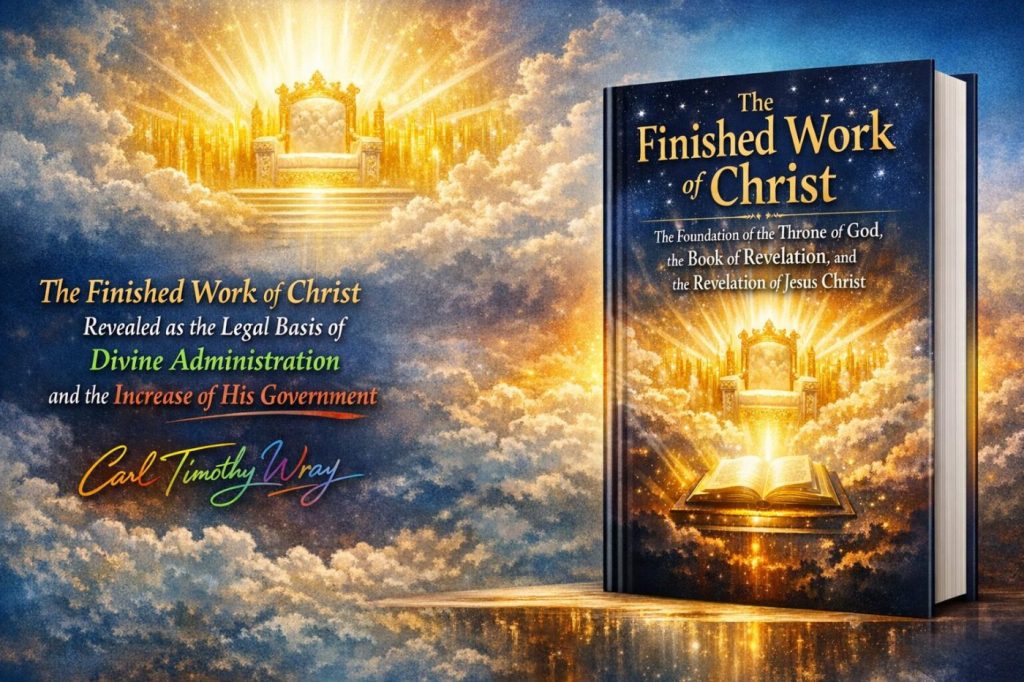
The Finished Work of Christ Revealed as the Legal Basis of Divine Administration and the Increase of His Government
The Finished Work of Christ: Author — Carl Timothy Wray
Carl Timothy Wray has spent more than four decades immersed in the study of Scripture, tracing the unified mind of God from Genesis to Revelation. What readers are witnessing now is not a sudden emergence, but the unveiling of a lifetime of meditation, prayer, study, and spiritual reasoning brought into ordered expression.
Over the past eight months, Carl has released hundreds of structured, interconnected works through The Finished Work of Christ platform—establishing doctrinal continuity across themes such as the Finished Work, the Throne of God, the Book of Revelation, divine administration, sonship, reconciliation, and God being all in all. His writings are marked by architectural coherence: legal foundation, administrative unfolding, progressive revelation, and ultimate consummation.
Rather than chasing trends, Carl builds mountains—layer upon layer—until Scripture harmonizes as one seamless testimony. His aim is not speculation, but clarity; not fear, but order; not fragmentation, but unity in the full counsel of God.
This book continues that lifelong pursuit: revealing the Finished Work of Christ as the unshakable foundation beneath the Throne, the Book of Revelation, and the unveiling of Jesus Christ Himself.
The Finished Work of Christ is not merely a doctrine of salvation—it is the eternal foundation of divine government. In this book, Carl Timothy Wray demonstrates how the Finished Work of Christ establishes the Throne of God, unlocks the true meaning of the Book of Revelation, and reveals the Revelation of Jesus Christ as the progressive increase of His government.
Moving from eternity past to God being all in all, this work presents a unified theological framework: the Finished Work legally settled before time, the Throne of God administrating what is complete, the Book of Revelation unveiling divine government, and the Revelation of Jesus Christ manifesting within His people.
Readers will discover:
- How the Finished Work of Christ functions as the legal basis of divine administration
- Why the Throne of God governs from completion, not reaction
- How the Book of Revelation reveals administration, not catastrophe
- What it means for the Revelation of Jesus Christ to increase within the earth
- How judgment and grace flow from one Throne
- Why the ultimate goal of divine government is that God may be all in all
This book is for those seeking clarity, order, and continuity in Scripture. It is not speculation—it is structure. It is not fragmentation—it is foundation.
Finished Work of Christ: INTRODUCTION — From Foundation to Fulfillment
The Finished Work of Christ as the Beginning
Before there was history, there was intention.
Before there was administration, there was decree.
Before there was unveiling, there was completion.
The Finished Work of Christ did not begin at Calvary. Calvary revealed what was eternally settled in the counsel of God. Scripture speaks of the Lamb slain from the foundation of the world, revealing that redemption was not an emergency response—it was an eternal determination.
If the work was finished in the heart of God before time began, then everything that unfolds in history must be the administration of what is already complete.
This is where clarity begins.
The Throne of God as the Administration of What Is Finished
The Throne of God is not a seat of improvisation.
It is not reactionary.
It does not adjust to crisis.
The Throne executes what the Finished Work secured.
From this Throne flows judgment, grace, order, and light. The Throne governs not to create completion, but to reveal and administer what was legally established in Christ.
Divine administration is not uncertainty—it is the progressive unveiling of settled purpose.
The Book of Revelation as the Unveiling of Government
The Book of Revelation does not introduce a new plan.
It unveils the administration of the Finished Work.
When John saw the Throne, he saw the center of government. When the Lamb took the scroll, he witnessed the unfolding of divine economy. Seals, trumpets, and bowls are not chaos; they are phases of administration—light increasing, order being established, truth overcoming distortion.
The Revelation of Jesus Christ is not merely prophecy. It is the unveiling of the Administrator Himself.
The Revelation of Jesus Christ as the Person of the Government
Government is not an abstract force.
It rests upon a Person.
The Revelation of Jesus Christ reveals the One upon whose shoulders the government rests. His reign is not merely future; it is increasing. His authority is not imposed through fear; it expands through light and internal transformation.
The increase of His government and peace has no end because what was finished legally is administered progressively until it fills all things.
From Increase to God All in All
Divine administration has a goal.
It is not endless process.
It is fulfillment.
The ages unfold. Light increases. Judgment establishes order. Grace restores alignment. And at the culmination of all administration, Christ delivers the kingdom to the Father—so that God may be all in all.
This book will trace that arc:
From Finished Work.
To Throne.
To Revelation.
To Increase.
To Omega.
One foundation.
One government.
One unveiling.
One consummation.
Let us begin at the foundation.
Chapter 1 — The Finished Work of Christ Settled Before Time (Alpha)
The Finished Work of Christ Before Creation
The Finished Work of Christ did not originate in Bethlehem.
It did not begin at Calvary.
It was not triggered by the fall of man.
It was settled before time.
Scripture declares that Christ was the Lamb slain from the foundation of the world. This statement reveals something profound: redemption was not reactionary—it was intentional. The cross was not God’s emergency response; it was the visible unveiling of an eternal decree.
Before there was sin, there was solution.
Before there was fall, there was foundation.
Before there was time, there was completion.
The Finished Work of Christ was legally established in the counsel of God before history unfolded.
The Eternal Counsel and the Legal Decree
The Finished Work of Christ is first legal before it is historical.
In the heart and mind of God, the outcome was already determined. The Son would redeem. The Lamb would overcome. The government would rest upon His shoulders. The kingdom would increase without end.
This means that history does not determine the Finished Work.
The Finished Work determines history.
The Throne of God does not react to events; it administers what was eternally settled.
The decree precedes the drama.
The Alpha of Divine Government
If Christ is Alpha, then the Finished Work is the beginning of divine government.
Government does not begin with judgment.
It begins with purpose.
The Finished Work of Christ establishes the legal right for God to administer His universe in righteousness, peace, and order. Everything that follows in Scripture—the Throne, the Book of Revelation, the unveiling of Jesus Christ—flows from what was settled in the beginning.
Alpha is not merely the first letter.
Alpha is foundation.
The Finished Work of Christ is the Alpha of divine administration.
The Lamb Slain and the Throne Established
The Lamb and the Throne are inseparable.
Because the work was finished in the eternal counsel of God, the Throne of God stands secure. Authority flows from redemption. Administration flows from completion.
The cross did not grant Christ authority.
It revealed the authority already His.
When we understand that the Finished Work of Christ was settled before time, we stop viewing redemption as fragile. We stop seeing government as unstable. We recognize that divine administration is grounded in eternal certainty.
The Throne governs from completion—not from uncertainty.
From Eternal Settlement to Historical Unfolding
If the Finished Work of Christ was settled before time, then history is the unveiling of what was already complete.
This changes how we read Scripture.
The Book of Revelation does not introduce a new plan. It reveals the administration of the Finished Work. The Revelation of Jesus Christ does not create authority; it unveils the Administrator.
Everything unfolds from Alpha.
The Finished Work is not merely a doctrine of salvation—it is the legal foundation of divine government.
And because it was settled before time, it cannot fail in time.
Alpha is secure.
And what begins in Alpha must end in Omega.
The foundation has been laid.
Chapter 2 — The Finished Work of Christ and the Throne of God
The Throne of God as the Center of Divine Administration
If the Finished Work of Christ was settled before time, then the Throne of God exists to administer what was already completed.
The Throne is not a place of improvisation.
It is not a courtroom of uncertainty.
It is not a seat of emotional reaction.
The Throne of God is the administrative center of a finished decree.
From this Throne proceeds judgment, grace, authority, and order—not to invent redemption, but to execute what the Finished Work of Christ legally secured.
Divine government is not unstable.
It is grounded in completion.
The Throne Governs from Completion, Not Crisis
Many imagine the Throne responding to chaos, adjusting to rebellion, or scrambling to regain control. But the Finished Work of Christ tells a different story.
The decree was settled before the ages began. The Lamb was slain before the foundation of the world. That means the Throne governs history from certainty, not anxiety.
Nothing surprises the Throne.
The administration of God unfolds in time what was settled in eternity. Seals open. Trumpets sound. Bowls are poured. Yet none of these represent crisis management. They are phases of divine administration—order being restored according to eternal purpose.
The Throne does not panic.
The Throne executes.
Grace and Authority United in One Throne
Because the Finished Work of Christ is the foundation, the Throne of God is both grace and judgment.
Grace flows because the work is complete.
Judgment flows because order must be established.
These are not competing thrones. They are one Throne administering one purpose.
The same Throne that invites boldly to receive mercy also opens the books of light. The same authority that corrects also restores. The Finished Work of Christ guarantees that judgment is not destructive rage but administrative alignment.
Authority without grace becomes tyranny.
Grace without authority becomes disorder.
But in Christ, grace and authority are one.
The Lamb in the Midst of the Throne
When the Book of Revelation unveils the Throne, it reveals the Lamb in the midst of it. This image is critical.
The Lamb—symbol of the Finished Work—stands at the center of administration. Government rests upon redemption. Authority flows from sacrifice.
This means divine government is not mechanical; it is relational. The Throne is not detached power; it is crucified authority.
The Finished Work of Christ is not merely forgiveness—it is the legal right for Christ to administer all things.
The Throne is secure because the Lamb has prevailed.
Administration as the Unfolding of What Is Finished
The Throne of God does not create redemption; it reveals it.
Divine administration is progressive light shining into darkness. It is truth confronting distortion. It is order emerging from confusion. But all of it flows from what is already complete in Christ.
The Finished Work of Christ is the legal foundation.
The Throne of God is the administrative expression.
When we see this clearly, we stop fearing divine government. We begin to understand that every movement of the Throne serves the increase of His government and peace.
The foundation remains unshaken.
The Throne stands secure.
And what was settled in Alpha now begins to unfold in history.
Chapter 3 — The Finished Work of Christ and the Book of Revelation
The Book of Revelation as the Unveiling of What Is Finished
If the Finished Work of Christ was settled before time and administered from the Throne of God, then the Book of Revelation must be the unveiling of that administration.
Revelation does not introduce a new plan.
It reveals the execution of an eternal decree.
Too often the Book of Revelation is read as catastrophe. Yet its opening line defines it clearly: it is the revelation of Jesus Christ. That means it is the unveiling of the Person who administers what was finished.
The Book of Revelation is not chaos—it is clarity.
It is not panic—it is process.
It is not improvisation—it is administration.
The Finished Work of Christ is the foundation beneath every seal, trumpet, and bowl.
The Throne at the Center of Revelation
From chapter four onward, the Book of Revelation centers upon the Throne.
Before seals are opened, the Throne is seen.
Before trumpets sound, the Throne governs.
Before bowls are poured, the Throne stands secure.
This order is deliberate.
The Throne is revealed first because everything that follows flows from divine administration. The Lamb takes the scroll—not to create a future—but to unfold what was already written.
The scroll represents divine economy: God’s plan and arrangement to bring history into alignment with His Finished Work.
The Book of Revelation shows the Throne executing completion.
Seals, Trumpets, and Bowls as Phases of Administration
When the seals are opened, light increases.
When the trumpets sound, truth is announced.
When the bowls are poured, distortion collapses.
These are not random disasters.
They are administrative stages.
Each movement in the Book of Revelation exposes what cannot stand in the light of what Christ has already accomplished. The Finished Work of Christ acts like a measuring rod—everything is evaluated against it.
The Book of Revelation does not reveal uncertainty about the future. It reveals certainty about the outcome.
Because the work is finished, the unveiling must follow.
The Revelation of Jesus Christ in the Midst of History
The Book of Revelation is not merely about events—it is about unveiling the Administrator.
Christ walks among the lampstands.
Christ holds the keys.
Christ opens the scroll.
Christ reigns from the Throne.
The Revelation of Jesus Christ is the unveiling of His present authority, not merely His future arrival.
This is critical.
If the Finished Work of Christ is complete, then Revelation is not about winning—it is about revealing that He has already prevailed.
History unfolds under the authority of a victorious Lamb.
Revelation as Increase, Not Interruption
The increase of His government and peace has no end. That increase is revealed progressively in the Book of Revelation.
Light intensifies.
Authority becomes clearer.
Alignment deepens.
Darkness loses ground.
Revelation is progressive unveiling—not sudden disruption.
The Finished Work of Christ guarantees the outcome. The Book of Revelation unveils the pathway from decree to manifestation.
What was settled before time is now revealed within time.
The Throne governs.
The Lamb prevails.
The scroll unfolds.
And the government increases.
Chapter 4 — The Finished Work of Christ as the Revelation of Jesus Christ
The Revelation of Jesus Christ as the Unveiling of the Person
The Finished Work of Christ is not merely an event—it is the revelation of a Person.
The Book of Revelation opens with a simple yet profound declaration: it is the revelation of Jesus Christ. This means that everything unveiled—every movement of the Throne, every unfolding of the scroll, every phase of administration—exists to reveal Him.
Government is not abstract power.
It rests upon a Person.
The Finished Work of Christ secures authority legally. The Revelation of Jesus Christ unveils that authority visibly.
He is not merely Savior.
He is Administrator.
He is not merely Redeemer.
He is King.
The Government Upon His Shoulders
The prophet declared that the government would rest upon His shoulders and that of the increase of His government and peace there would be no end.
This is not symbolic language alone—it is administrative truth.
The Finished Work of Christ establishes His legal right to rule. The Revelation of Jesus Christ unveils the One who governs from completion. His authority does not grow because He becomes more powerful; it increases because it becomes more fully revealed.
The increase is not expansion of effort.
It is expansion of unveiling.
The more He is revealed, the more His government becomes visible within hearts, communities, and ultimately creation itself.
Internal Revelation and Divine Government
The Revelation of Jesus Christ is not confined to heavenly scenes or prophetic symbols. It is internal.
As Christ is unveiled within the believer, His government increases. His righteousness begins to order thought. His peace begins to align emotion. His truth begins to reorder perception.
Divine administration is not only cosmic—it is personal.
The Finished Work of Christ legally secured redemption. The Revelation of Jesus Christ manifests that redemption progressively within His people.
Government increases wherever revelation deepens.
From Unveiling to Alignment
When Christ is revealed, alignment follows.
Darkness cannot remain where light intensifies. Disorder cannot persist where truth governs. Fear diminishes where authority is understood.
The Revelation of Jesus Christ is transformative because it unveils the Administrator who already reigns.
He does not wait to become King.
He is revealed as King.
The Finished Work of Christ ensures that His authority is unshakable. The Revelation of Jesus Christ ensures that His authority becomes visible.
The Person at the Center of All Things
Every pillar—Finished Work, Throne of God, Book of Revelation—ultimately converges on one reality: the unveiling of Jesus Christ Himself.
He is the foundation.
He is the Throne’s authority.
He is the One who opens the scroll.
He is the increase of government.
Divine administration is not impersonal machinery. It is the expression of the Son.
The Finished Work of Christ secures the foundation. The Revelation of Jesus Christ reveals the Person who governs from that foundation.
And as He is unveiled, His government expands without force—through light.
The increase has begun.
Chapter 5 — Divine Administration Flowing from What Is Finished
Divine Administration as the Unfolding of Eternal Purpose
If the Finished Work of Christ was settled before time, and the Throne of God administers what is complete, and the Book of Revelation unveils that administration, then we must understand the nature of divine administration itself.
Divine administration is not the attempt to complete what is unfinished.
It is the unfolding of what was already decreed.
God does not manage history hoping for a good outcome.
He administers history from a secured outcome.
The Finished Work of Christ is the legal foundation. Divine administration is the progressive revelation of that foundation within time.
The Scroll in the Hand of the Lamb
In the vision of the Throne, a scroll appears—sealed and waiting to be opened.
The scroll represents divine economy: God’s arrangement, His ordered plan to bring all things into alignment with what Christ has accomplished.
When the Lamb takes the scroll, it is not a moment of uncertainty—it is a declaration of authority. Only the One who finished the work can unfold its administration.
The seals open not to create destiny, but to unveil it.
Divine administration flows from the Lamb who prevailed.
The Ages as the Progressive Unveiling of the Finished Work
History is not random.
The ages unfold according to divine order.
Light increases in stages.
Truth is revealed line upon line.
Authority becomes clearer generation by generation.
The Finished Work of Christ was settled once. Its unveiling, however, unfolds progressively.
Divine administration operates through capacity. As hearts expand, revelation deepens. As understanding grows, government becomes visible.
The increase of His government does not contradict the Finished Work—it reveals it.
Administration Is Not Endless Process
There is a difference between progress and wandering.
Divine administration is progressive, but it is purposeful.
Each phase moves toward fulfillment. Each unveiling brings alignment. Each correction establishes order. The Throne does not administer indefinitely without direction—it administers toward consummation.
The Finished Work of Christ guarantees the destination. Divine administration governs the journey.
The scroll unfolds with precision, not confusion.
Light, Judgment, and Alignment
When divine administration moves, it often appears as judgment.
But judgment in its truest form is light exposing what cannot remain.
The Finished Work of Christ becomes the standard by which everything is measured. Whatever aligns remains. Whatever contradicts collapses.
This is not destruction for its own sake.
It is restoration of order.
Administration exposes darkness so that righteousness may increase. It removes distortion so that peace may expand.
The Throne governs in harmony with the Finished Work.
The Harmony of Completion and Process
Some struggle with the tension between what is finished and what is unfolding.
But there is no contradiction.
The Finished Work of Christ is complete legally.
Divine administration unfolds it experientially.
What was secured eternally is revealed progressively.
The Throne governs.
The Lamb administers.
The Book of Revelation unveils.
The Revelation of Jesus Christ manifests.
All of it flows from what was already complete.
Divine administration is not uncertainty.
It is the orderly unveiling of eternal certainty.
Chapter 6 — The Increase of His Government and Peace
The Increase as the Evidence of What Is Finished
If the Finished Work of Christ is the foundation, and divine administration is the unfolding of what was settled, then increase is the visible evidence of that unfolding.
The prophet declared that of the increase of His government and peace there would be no end. Increase is not effort; it is expansion. It is not struggle; it is manifestation.
The Finished Work of Christ guarantees the outcome. The increase of His government reveals the pathway.
Increase does not mean that Christ becomes more powerful.
It means His authority becomes more visible.
Government Increasing Within Hearts
The first arena of increase is internal.
When the Revelation of Jesus Christ deepens within a person, His government increases in that life. Thoughts begin to align with truth. Desires begin to submit to righteousness. Fear gives way to peace.
Divine government expands through revelation.
This is why the Book of Revelation unveils the Person of Christ before it reveals the progression of events. The increase of His government begins with the unveiling of who He is.
The more clearly He is seen, the more naturally He is obeyed.
Increase is revelation made practical.
Peace as the Fruit of Administration
The prophet joined government and peace together deliberately.
True government produces peace.
Where divine administration operates correctly, confusion decreases. Disorder weakens. Fragmentation dissolves. Peace grows not because circumstances vanish, but because alignment strengthens.
The Finished Work of Christ establishes righteousness legally. The Throne of God administers that righteousness. The result is peace.
Increase of government is increase of order.
Increase of order is increase of peace.
The Expanding Horizon of Divine Authority
The increase of His government is not confined to personal experience. It extends outward.
Families experience alignment. Communities experience clarity. Nations encounter truth. Creation itself responds to divine administration.
The Book of Revelation portrays this widening circle—light expanding, authority being recognized, kingdoms confronted, systems evaluated.
Yet all of it flows from one foundation: the Finished Work of Christ.
Increase is not chaotic expansion. It is structured manifestation.
No End to the Increase
There shall be no end.
This does not mean endless process without fulfillment. It means inexhaustible depth.
The government of Christ does not reach a ceiling. Peace does not expire. Righteousness does not diminish. As light continues to shine, revelation continues to deepen.
The Finished Work of Christ was complete in decree. Its richness unfolds without exhaustion.
Increase continues until administration reaches consummation.
From Expansion to Fulfillment
The increase of His government is not an endless loop—it moves toward fullness.
As divine administration progresses, alignment deepens. As alignment deepens, resistance weakens. As resistance weakens, peace prevails.
The Throne governs from completion.
The Revelation unveils progressively.
The government increases steadily.
And what increases without end moves ultimately toward God being all in all.
Increase is not uncertainty.
It is unfolding certainty.
The foundation remains secure.
Chapter 7 — The Throne of Judgment as Administrative Completion
Judgment as the Expression of Divine Order
If the Finished Work of Christ is the legal foundation, and divine administration is the unfolding of what was settled, then judgment must be understood correctly.
Judgment is not divine anger out of control.
It is not emotional retaliation.
It is not uncertainty about the outcome.
Judgment is administrative alignment.
The Throne of God governs from completion. When judgment proceeds from that Throne, it exposes what cannot remain in the light of what Christ has already finished.
Judgment is light applied.
The Throne of Judgment in the Book of Revelation
In the Book of Revelation, we see the Throne consistently positioned at the center of divine administration. When the books are opened and all things are revealed, this is not chaos—it is clarity.
The throne of judgment represents the culmination of divine administration.
Everything hidden is brought into light.
Every distortion is measured against truth.
Every work is revealed for what it truly is.
Because the Finished Work of Christ stands secure, judgment does not threaten the foundation—it reveals alignment with it.
The Great White Throne as Completion, Not Panic
The scene often called the Great White Throne is not the beginning of judgment—it is the culmination of administration.
It is white because it is pure.
It is great because it is supreme.
It is a throne because it is authoritative.
When the books are opened, light shines fully. When death and Hades are cast down, it is not an act of rage—it is the removal of the last enemy.
The throne of judgment reveals what the Finished Work of Christ has already secured: the defeat of death and the triumph of righteousness.
This is administrative completion.
Judgment and Grace from One Throne
The same Throne that invites boldly for mercy also unveils the books.
This is not contradiction.
Grace establishes righteousness legally. Judgment enforces righteousness administratively.
The Finished Work of Christ guarantees that judgment is never arbitrary. It is precise. It is purposeful. It is measured.
Judgment removes what opposes alignment.
Grace restores what aligns with truth.
Both flow from one foundation.
The Opening of the Books as Revelation of Truth
When the books are opened, truth is made visible.
The light of Christ exposes motives, works, and systems. Nothing remains hidden. The measure is not human opinion; it is the Finished Work of Christ.
What harmonizes remains.
What contradicts collapses.
Judgment is not destruction for spectacle. It is exposure for restoration of order.
The Throne does not tremble. It reveals.
Death Cast Down and Order Established
One of the most powerful images of judgment is the casting down of death itself.
Death is not preserved; it is removed.
Darkness is not enthroned; it is exposed.
Chaos is not tolerated; it is confronted.
The throne of judgment demonstrates that divine administration has a goal: the elimination of everything that contradicts the Finished Work.
Judgment completes what administration has been unfolding.
Completion, Not Endless Condemnation
Divine judgment is not endless uncertainty. It is decisive clarity.
Because the Finished Work of Christ is secure, judgment leads toward fulfillment. It clears the ground for peace. It removes resistance to increase.
The throne of judgment does not undo grace—it vindicates it.
Administrative completion prepares the way for consummation.
The Throne stands firm.
The books are opened.
Light prevails.
And what was settled in Alpha moves closer to Omega.
Chapter 8 — Grace Flowing from the Throne
The Throne as the Source of the River of Life
If Chapter 7 revealed the Throne of Judgment as administrative completion, Chapter 8 must reveal the other dimension of that same Throne.
From the Throne flows a river.
This river does not originate in human effort. It does not flow from religious striving. It proceeds from the Throne of God and of the Lamb.
Grace is not sentimental softness.
Grace is divine life flowing from sovereign authority.
The Finished Work of Christ establishes the legal right for this river to flow. The Throne administers it. The Revelation unveils it. The increase of His government spreads it.
Grace and government are not opposites. They are harmonized in one source.
The Throne of Grace and the Throne of Judgment Are One
Many separate grace and judgment as though they flow from different administrations.
But there is only one Throne.
The Throne that opens the books is the same Throne that invites bold access. The Throne that casts down death is the same Throne from which the river of life proceeds.
Grace establishes alignment.
Judgment enforces alignment.
Both serve the Finished Work of Christ.
When the Throne judges, it removes distortion.
When the Throne gives grace, it strengthens alignment.
This is divine government in balance.
Grace as the Empowerment of Administration
Grace is not permission to drift.
Grace is empowerment to align.
Because the Finished Work of Christ is complete, grace does not strive to achieve redemption—it applies redemption. It strengthens hearts. It renews minds. It enables obedience.
Divine administration would feel oppressive if not for grace. But grace ensures that the government of Christ expands through transformation rather than coercion.
The increase of His government spreads through light and life—not fear.
The New Jerusalem as the Fruit of Administration
When the Book of Revelation unveils the New Jerusalem, it reveals the result of divine administration.
The city is illuminated.
The gates are open.
The river flows.
The tree heals.
This is not the abandonment of government—it is its fulfillment.
The Finished Work of Christ produced the foundation. The Throne administered the unfolding. The Revelation unveiled the process. Judgment removed what resisted alignment. Grace nourished what remained.
The result is a city ordered by light.
Authority That Restores
True authority restores what belongs and removes what corrupts.
The Throne does not exist to dominate but to establish righteousness. Grace flows because righteousness is secure. Peace increases because order is administered.
Divine government is not mechanical control. It is life flowing from alignment with the Finished Work of Christ.
The river proves that the Throne is not cold power—it is living authority.
Grace as Preparation for Consummation
Grace flowing from the Throne prepares creation for its ultimate purpose.
As the river spreads, healing follows. As healing follows, resistance weakens. As resistance weakens, alignment strengthens.
The Finished Work of Christ ensures that grace is never fragile. It flows from completion. It operates under authority. It prepares the way for the final fulfillment of divine purpose.
Judgment clears.
Grace fills.
Government increases.
And the Throne stands as both the center of authority and the source of life.
What began in Alpha now moves toward Omega—not through force, but through flowing grace.
Chapter 9 — The Finished Work of Christ — God All in All (Omega)
Omega as the Fulfillment of What Began in Alpha
If the Finished Work of Christ was settled before time, and the Throne of God has administered its unfolding, and the Book of Revelation has unveiled its increase, then there must be a consummation.
Divine administration does not exist for endless management.
It exists for fulfillment.
The One who is Alpha is also Omega. What began as decree must end as manifestation. What was finished legally must be fulfilled vitally.
Omega is not cancellation of process.
Omega is the completion of purpose.
Christ Delivering the Kingdom
There comes a moment in the unfolding of divine administration when the kingdom, fully aligned, is delivered to the Father.
This does not diminish Christ’s authority.
It reveals the success of His administration.
The Son governs until all enemies are subdued—not merely restrained, but brought into alignment. The last enemy, death, is removed. Distortion is exposed. Disorder is silenced.
When administration has completed its work, the kingdom stands ordered.
This is not retreat.
It is triumph.
The End of Administrative Tension
As long as divine administration is unfolding, correction is necessary. Judgment clarifies. Grace empowers. Increase continues.
But Omega is the moment when alignment is no longer partial.
There is no need for further exposure because nothing remains hidden. There is no need for further correction because order is complete.
The Finished Work of Christ reaches its manifested fullness.
Government no longer increases through resistance—it rests in harmony.
God All in All
The ultimate purpose of the Finished Work of Christ is not endless administration.
It is fullness.
When Christ delivers the kingdom fully aligned, the result is that God is all in all.
Not partially present.
Not selectively revealed.
Not intermittently manifested.
All in all.
This is not annihilation of individuality. It is the complete permeation of divine life. It is the fulfillment of the increase of His government. It is peace without interruption.
The Throne has accomplished its purpose.
The Revelation has unveiled its fullness.
The government has reached its consummation.
From Foundation to Fulfillment
This book has traced one arc:
- The Finished Work of Christ settled before time.
- The Throne of God administering what was finished.
- The Book of Revelation unveiling divine government.
- The Revelation of Jesus Christ increasing within creation.
- The Throne of Judgment completing alignment.
- Grace flowing from authority.
- God all in all as the ultimate purpose.
There is no fragmentation in this progression.
One foundation.
One Throne.
One Revelation.
One Government.
One Fulfillment.
The Confidence of Omega
Because the Finished Work of Christ was settled in Alpha, Omega is not uncertain.
The outcome is not fragile.
Divine administration is not wandering. It is purposeful. It moves steadily from decree to manifestation.
The increase of His government and peace leads ultimately to fullness.
What was spoken before time will stand beyond time.
Alpha secured it.
Administration unfolded it.
Revelation unveiled it.
Judgment completed it.
Grace sustained it.
Omega fulfills it.
And in that fulfillment, God is all in all.

The Finished Work of Christ Series
- The Finished Work of Christ — God’s Full Counsel Revealed Through the Plan of the Ages
- The Throne of God
- Book of Revelation
- The Revelation of Jesus Christ
- The Finished Work of Christ: Meaning, Key Scriptures & FAQs
- Join Our Facebook Page