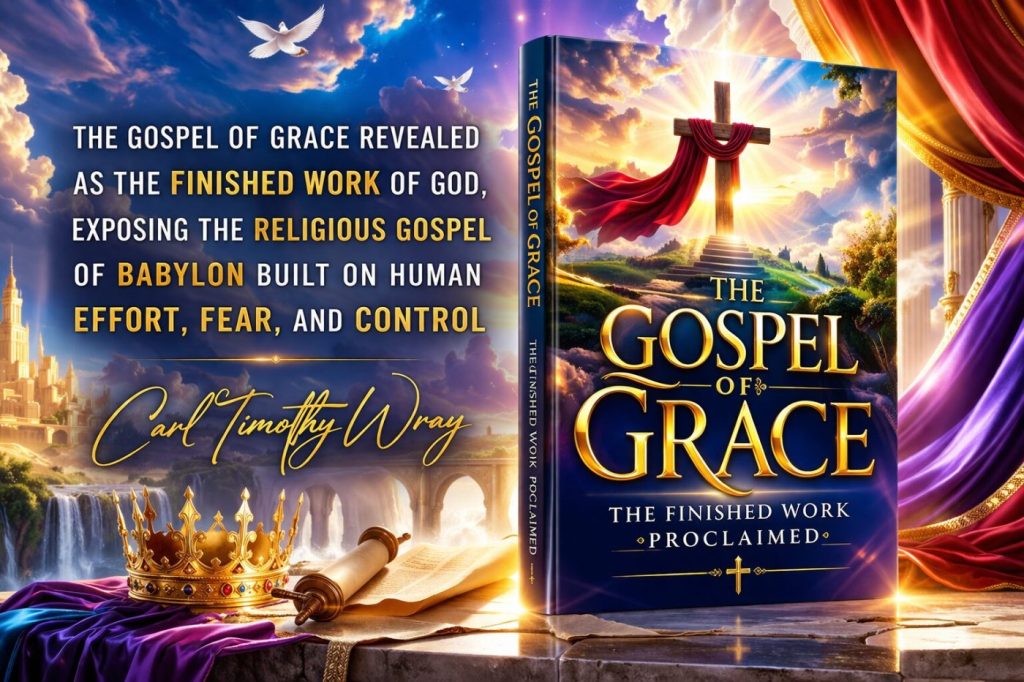
📖 The Gospel of Grace Revealed as the Finished Work of God, Exposing the Religious Gospel of Babylon Built on Human Effort, Fear, and Control
✍️ BY CARL TIMOTHY WRAY
🔥 The Gospel of Grace: AUTHOR
Carl Timothy Wray is a teacher and author devoted to unveiling the full counsel of God from Genesis to Revelation. His writings focus on the finished work of Christ, the atonement as the legal mind of God, and the progressive revelation of God’s eternal purpose through the plan of the ages.
Through hundreds of books, teachings, and resources, he has committed his life to bringing clarity to the Gospel—revealing that salvation is not rooted in human effort, but in the completed work of God in Christ. His message calls believers out of confusion, mixture, and religious striving, and into rest, sonship, and the manifestation of divine life.
His work centers on one unshakable truth: what God has finished must now be revealed.
🔍
The Gospel of Grace is the good news of what God has already finished through Jesus Christ—not what man must do to be accepted. In this book, The Gospel of Grace — The Finished Work Proclaimed, Carl Timothy Wray reveals the true meaning of the Gospel of Grace from Genesis to Revelation, exposing the contrast between God’s completed work and the religious gospel of Babylon built on human effort, fear, and control. This teaching answers essential questions such as “what is the gospel of grace,” “gospel of grace vs works,” and “false gospel in the Bible,” while establishing a clear foundation rooted in the finished work of Christ. Readers will discover how grace is not merely help, but divine power, and how faith receives what God has already accomplished.
🔥 The Gospel of Grace: INTRODUCTION
There are not many gospels in the earth—there are only two.
One is the Gospel of Grace, born from the heart of God, finished in Christ, and revealed by the Spirit. The other is a religious gospel, built by men, sustained by effort, and enforced through fear.
One produces sons who live from union.
The other produces servants striving for acceptance.
One declares, “It is finished.”
The other insists, “It is up to you.”
From the beginning, God did not leave redemption in the hands of man. Before the foundation of the world, He established a plan—complete, perfect, and lacking nothing. The Lamb was slain in the mind of God before sin ever entered the world, revealing that grace was never a reaction to failure, but the eternal intention of God.
Yet through the ages, another message has risen alongside the truth. A system built on mixture. A gospel that speaks of Christ, yet subtly shifts the burden back onto man. It calls men to perform, to qualify, to maintain what God has already finished. This is the religious gospel—the system Scripture calls Babylon.
This book is not written to condemn, but to reveal.
It is written to draw a clear line between what God has done and what man has tried to add to it. It is written to bring the reader out of striving and into rest, out of confusion and into clarity, out of mixture and into truth.
The Gospel of Grace is not an offer waiting on man’s response—it is a proclamation of what God has already accomplished.
Faith does not make it true.
Faith receives what is true.
And when this Gospel is seen—not merely heard, but revealed—the striving stops, the fear dissolves, and a new life begins. Not a life of effort, but a life of participation in the Father’s dream.
We are not servants trying to become sons.
We are sons who now serve.
We serve not to gain position, but because we have been given one. We serve not from fear, but from love. We serve not to build something for God, but to reveal what God has already finished.
The Lord has graced us with the divine ability to reveal Zion in the earth—not as men striving to construct something new, but as sons awakening to what has already been established.
Zion is not built by man.
Zion is revealed by grace.
This is the Gospel.
And this is the line that must be drawn in this generation.
📖 Chapter 1 — The Gospel Defined: What Is the Gospel of Grace?
Definition — The Gospel Is the Good News of What God Has Done
The Gospel of Grace is not the announcement of what man must do—it is the proclamation of what God has already done.
From the beginning, the word “gospel” has always meant good news. Not advice. Not instruction. Not a system of improvement. It is the declaration that something has already been accomplished.
“For I am not ashamed of the gospel of Christ: for it is the power of God unto salvation to every one that believeth…” — Romans 1:16
The Gospel is not powerless information—it is the power of God. Not toward those who perform, but toward those who believe.
“For by grace are ye saved through faith; and that not of yourselves: it is the gift of God: not of works, lest any man should boast.” — Ephesians 2:8–9
Salvation is not of yourself. It is not sustained by you. It is not completed by you. It is the gift of God.
“And if by grace, then is it no more of works: otherwise grace is no more grace…” — Romans 11:6
This is the dividing line.
Grace and works cannot coexist as partners. One cancels the other.
“I marvel that ye are so soon removed from him that called you into the grace of Christ unto another gospel: which is not another…” — Galatians 1:6–7
There is a gospel of grace—and there is another gospel that is not truly the Gospel at all.
“For the grace of God that bringeth salvation hath appeared to all men.” — Titus 2:11
Grace is not hidden. Grace has appeared. Grace brings salvation.
The Gospel of Grace declares that salvation is not rooted in human effort, but in divine accomplishment.
The Gospel does not say, “Do this and live.”
The Gospel says, “It is finished—now receive life.”
Revelation — Grace Is Not an Offer, It Is a Finished Reality
The religious mind hears the Gospel as an invitation.
The Spirit reveals it as a proclamation.
Religion says:
“God has made a way—now it is up to you.”
Grace says:
“God has finished the work—now it must be revealed.”
This is where many stumble. They have heard the Gospel, but they have not seen it.
The Gospel is not potential—it is reality.
Faith does not create truth—it receives truth.
Grace is not waiting on man.
Grace is revealing what God has already completed.
The Gospel of Grace is not something God is trying to do.
It is something God has done.
And when this is seen, everything changes.
Striving loses its power.
Fear loses its voice.
Effort gives way to rest.
Because what man was trying to accomplish has already been accomplished in Christ.
Declaration — The Gospel Has Been Settled by God
The Gospel of Grace is not waiting to be completed.
It is not developing.
It is not progressing toward fulfillment.
It has been finished.
“When Jesus therefore had received the vinegar, he said, It is finished: and he bowed his head, and gave up the ghost.” — John 19:30
This is not a statement of hope.
This is a declaration of completion.
The Gospel is not fragile. It does not depend on man to uphold it. It stands because God has established it.
And every other gospel—every message that places the burden back on man—is a departure from this truth.
There are not many gospels.
There is the Gospel of Grace.
And there is another gospel.
One brings rest.
The other produces striving.
One reveals Christ.
The other magnifies man.
Call to Action — Come Out of Striving and Into Rest
The question is not whether the Gospel is true.
The question is: Have you seen it?
Have you seen that your effort cannot add to what God has finished?
Have you seen that your performance cannot improve what Christ has completed?
This is the invitation—not to work, but to awaken.
“There remaineth therefore a rest to the people of God.
For he that is entered into his rest, he also hath ceased from his own works, as God did from his.” — Hebrews 4:9–10
This is the call—to cease from your own works.
To come out of striving.
To come out of fear.
To come out of the pressure of trying to become what God has already declared.
You are not called to finish the work.
You are called to believe it.
To receive it.
To walk in it.
This is the beginning of rest.
What Is the Gospel of Grace?
The Gospel of Grace is the message that salvation is the finished work of God through Jesus Christ, not the result of human effort or works. It answers the question “what is the gospel of grace” by revealing that grace is not an offer, but a completed reality that must be received by faith. In contrast to the religious gospel of Babylon, which emphasizes performance, fear, and control, the true Gospel of Grace proclaims that God has already accomplished redemption, and believers are called to rest in what has been finished.
📖 Chapter 2 — Before Time Began: Grace in the Heart of God
Definition — Grace Was Established Before the World Began
The Gospel of Grace did not begin at the cross.
It did not begin with man’s failure.
It did not begin when sin entered the world.
Grace began in the heart of God before time ever started.
“Who hath saved us, and called us with an holy calling, not according to our works, but according to his own purpose and grace, which was given us in Christ Jesus before the world began.” — 2 Timothy 1:9
Grace was not given after you failed.
Grace was given before you existed.
This means the Gospel is not God reacting to man—
it is God revealing what He already determined.
“According as he hath chosen us in him before the foundation of the world…” — Ephesians 1:4
Before there was sin…
Before there was law…
Before there was effort…
There was a choice already made in Christ.
“Known unto God are all his works from the beginning of the world.” — Acts 15:18
Nothing God has done is accidental.
Nothing is reactive.
Everything flows from what He already knew and established.
Revelation — The Lamb Was Slain Before Sin Appeared
The cross was not God’s backup plan.
It was not an emergency response.
It was the revelation of something eternal.
“The Lamb slain from the foundation of the world.” — Revelation 13:8
Before sin entered the earth, the Lamb was already slain in the mind of God.
This changes everything.
Grace is not God fixing a problem.
Grace is God revealing His nature.
“Forasmuch as ye know that ye were not redeemed with corruptible things… but with the precious blood of Christ… who verily was foreordained before the foundation of the world.” — 1 Peter 1:18–20
Redemption was not an afterthought.
It was foreordained.
This means:
- God was not surprised by the fall
- God was not delayed by sin
- God was not waiting to see what man would do
Grace was already in place.
The Gospel of Grace is not a temporary solution—it is the eternal intention of God being revealed in time.
Declaration — God Finished It Before You Began
If grace was given before the world began, then your salvation was never dependent on your works.
If the Lamb was slain before the foundation, then the cross is not the beginning—it is the manifestation of what was already true.
This means:
God did not wait for you to qualify.
God did not wait for you to respond.
God did not wait for you to get it right.
He established it.
Before you lived.
Before you failed.
Before you believed.
Grace was already given.
The Gospel is not God trying to save—it is God revealing that He has saved.
Call to Action — Rest in What Was Settled Before You Arrived
If this is true—and it is—then the question changes.
You are no longer asking:
“What must I do to be accepted?”
You begin to see:
“It has already been given—now I must see it.”
The pressure lifts.
The striving fades.
Because what you were trying to accomplish in time…
was already settled in eternity.
“For we which have believed do enter into rest…” — Hebrews 4:3
This is the call:
Enter the rest of what God finished before you ever began.
Stop trying to complete what has already been completed.
Stop trying to earn what has already been given.
Grace is not ahead of you waiting to be reached.
Grace is behind you, beneath you, and within you—
already established.
The Gospel of Grace Before the Foundation of the World
The Gospel of Grace reveals that salvation was not an afterthought, but the eternal purpose of God established before the foundation of the world. Scriptures like 2 Timothy 1:9, Ephesians 1:4, and Revelation 13:8 show that grace was given in Christ before time began, proving that redemption is not based on human works but on God’s finished plan. Understanding the Gospel of Grace in this way answers key questions about predestination, the finished work of Christ, and God’s eternal purpose, revealing that salvation is something God completed before man ever existed and is now being revealed through faith.
📖 Chapter 3 — The Fall: Why Man Could Not Save Himself
Definition — The Fall Revealed Man’s Total Inability
If the Gospel of Grace is the good news of what God has done, then the fall of man reveals why that news was necessary.
Man did not fall into weakness.
Man fell into death, separation, and inability.
“And when the woman saw that the tree was good for food… she took of the fruit thereof, and did eat, and gave also unto her husband with her; and he did eat.
And the eyes of them both were opened, and they knew that they were naked…” — Genesis 3:6–7
The moment man sinned, something deeper than behavior changed—
his nature, perception, and condition were altered.
“Wherefore, as by one man sin entered into the world, and death by sin; and so death passed upon all men…” — Romans 5:12
Sin was not just an act.
It became a condition that passed to all.
“There is none righteous, no, not one:
There is none that understandeth, there is none that seeketh after God.” — Romans 3:10–11
Man did not become slightly flawed.
Man became unable to produce righteousness on his own.
Revelation — Man’s Problem Was Not Behavior, But Nature
Religion treats sin as something man can manage.
Grace reveals sin as something man could never escape.
“The heart is deceitful above all things, and desperately wicked: who can know it?” — Jeremiah 17:9
The issue was not just what man did—
it was what man became.
A corrupt nature cannot produce a pure life.
“And you hath he quickened, who were dead in trespasses and sins;
Wherein in time past ye walked according to the course of this world…” — Ephesians 2:1–2
Man was not sick—
he was dead.
And a dead man cannot revive himself.
This is where the Gospel of Grace becomes necessary.
Because if man could fix himself, grace would not be needed.
If man could recover himself, Christ would not have to come.
Declaration — No Man Can Save Himself
The fall settled something once and for all:
Man cannot save himself.
Not by effort.
Not by discipline.
Not by religion.
Not by knowledge.
“Can the Ethiopian change his skin, or the leopard his spots? then may ye also do good, that are accustomed to do evil.” — Jeremiah 13:23
Nature cannot change itself.
This destroys the foundation of the religious gospel.
Because religion says:
“Try harder, do better, improve yourself.”
But the truth is:
You cannot improve what must be replaced.
You cannot fix what must be made new.
This is why grace is not optional—
it is the only answer.
Call to Action — Stop Trying to Fix What Only God Can Replace
If man could not save himself, then every attempt to do so is rooted in misunderstanding.
The call of the Gospel is not:
“Fix yourself so God will accept you.”
The call is:
“Receive what God has already done.”
“Not by works of righteousness which we have done, but according to his mercy he saved us…” — Titus 3:5
Salvation is not the reward for effort.
It is the result of mercy.
This is where striving ends.
Because once you see:
- you cannot save yourself
- you cannot change your nature
- you cannot produce righteousness
Then you are ready to receive grace.
Grace is not help for your effort.
Grace is God doing what you could never do.
The Fall of Man and the Need for Grace
The fall of man reveals why the Gospel of Grace is necessary, showing that sin is not just an action but a condition that brought death and separation into the world. Scriptures like Genesis 3:6–7, Romans 5:12, and Ephesians 2:1–2 demonstrate that man is unable to save himself, making the finished work of Christ essential. Understanding the fall answers key questions about human nature, sin, and salvation, proving that righteousness cannot be achieved through effort but must be received through the grace of God.
📖 Chapter 4 — The Law: The Schoolmaster Leading to Grace
Definition — The Law Was Given to Reveal, Not to Save
The law was never given to make man righteous.
It was given to reveal that man could not become righteous on his own.
“Therefore by the deeds of the law there shall no flesh be justified in his sight: for by the law is the knowledge of sin.” — Romans 3:20
The law does not remove sin—it exposes it.
It shines light on what is wrong, but it gives no power to fix it.
“Wherefore the law was our schoolmaster to bring us unto Christ, that we might be justified by faith.” — Galatians 3:24
The law was a teacher, not a savior.
It was pointing forward to something greater.
“For the law having a shadow of good things to come, and not the very image of the things…” — Hebrews 10:1
The law was a shadow—
a picture of what was coming, but not the substance itself.
Revelation — The Law Demanded What It Could Not Produce
The law told man what was right, but it gave him no ability to do it.
“For what the law could not do, in that it was weak through the flesh…” — Romans 8:3
The weakness was not in the law—
the weakness was in man.
The law required perfection, but man could not produce it.
“Cursed be he that confirmeth not all the words of this law to do them.” — Deuteronomy 27:26
The standard was absolute.
Not partial obedience.
Not improvement.
Not effort.
All… or nothing.
And this is where the law fulfilled its purpose.
It brought man to the end of himself.
It revealed:
- You cannot meet this standard
- You cannot produce this righteousness
- You cannot fulfill this requirement
And in doing so, it prepared the way for grace.
Declaration — The Law Was Never the Answer, Only the Pointer
The law was not given to save man—it was given to shut every mouth.
“Now we know that what things soever the law saith… that every mouth may be stopped, and all the world may become guilty before God.” — Romans 3:19
The law silences every argument.
It removes every excuse.
It destroys every claim of self-righteousness.
It proves once and for all:
Man cannot justify himself.
And when man reaches that point—
when every effort fails and every excuse is gone—
he is ready to receive grace.
The law does not lead to life.
The law leads to the realization that you need life from somewhere else.
Call to Action — Stop Living Under What Was Meant to Lead You Out
Many are still trying to live under the law, even after grace has come.
They measure themselves.
They strive to perform.
They live under pressure.
But the law was never meant to be your dwelling place.
It was meant to lead you out.
“For Christ is the end of the law for righteousness to every one that believeth.” — Romans 10:4
Christ did not assist the law.
He fulfilled it and brought it to its end.
You are not called to live under what exposed your weakness.
You are called to live in what supplies your life.
The law showed you what you could not do.
Grace reveals what God has already done.
Leave the schoolmaster.
Come to the Son.
The Law and the Gospel of Grace
The law in the Bible was never given to save man, but to reveal sin and lead people to Christ. Scriptures like Romans 3:20, Galatians 3:24, and Romans 10:4 show that the law exposes human inability and points to the need for the Gospel of Grace. Understanding the relationship between law and grace answers key questions such as “grace vs law in the Bible” and “what was the purpose of the law,” revealing that righteousness does not come through works but through the finished work of Jesus Christ.
📖 Chapter 5 — The Cross: Where Grace Finished the Work
Definition — The Cross Was the Completion, Not the Beginning
The cross is not where God started the work of redemption—
it is where He finished it in time.
What was in the heart of God before the foundation of the world was brought into full manifestation at the cross.
“When Jesus therefore had received the vinegar, he said, It is finished: and he bowed his head, and gave up the ghost.” — John 19:30
This was not a partial victory.
This was not the beginning of a process.
This was the declaration that everything required for redemption had been completed.
“By the which will we are sanctified through the offering of the body of Jesus Christ once for all.” — Hebrews 10:10
Once for all.
Not repeatedly.
Not progressively through human effort.
Finished.
“For by one offering he hath perfected for ever them that are sanctified.” — Hebrews 10:14
The cross did not make perfection possible—
it established it.
Revelation — The Cross Did What Man Could Never Do
The law exposed sin.
The fall revealed inability.
But the cross removed the barrier completely.
“And you, being dead in your sins… hath he quickened together with him, having forgiven you all trespasses;
Blotting out the handwriting of ordinances that was against us… and took it out of the way, nailing it to his cross.” — Colossians 2:13–14
Everything that stood against man was not improved—it was removed.
“To wit, that God was in Christ, reconciling the world unto himself, not imputing their trespasses unto them…” — 2 Corinthians 5:19
God was not counting sin.
God was reconciling.
This is the revelation of the cross:
It did not make reconciliation possible—
it accomplished reconciliation.
“But he was wounded for our transgressions, he was bruised for our iniquities… and with his stripes we are healed.” — Isaiah 53:5
Not “we might be healed.”
Not “we can be healed.”
We are healed.
The cross speaks in finished terms.
Declaration — Nothing Is Left for Man to Complete
If the cross finished the work, then nothing is left for man to complete.
There is no missing piece.
There is no unfinished requirement.
There is no additional condition.
The religious gospel says:
“Christ did His part—now you must do yours.”
But the Gospel of Grace declares:
Christ did not do part of the work.
He did all of it.
“Much more then, being now justified by his blood, we shall be saved from wrath through him.” — Romans 5:9
Justified—not becoming justified.
“Who his own self bare our sins in his own body on the tree…” — 1 Peter 2:24
Sin was not left in place.
It was borne and dealt with.
This is the finality of the cross.
Call to Action — Stop Adding to What Has Been Finished
If the work is finished, then striving to complete it is not faith—it is misunderstanding.
You are not called to add to the cross.
You are called to believe it.
“For we which have believed do enter into rest…” — Hebrews 4:3
Faith does not help finish the work.
Faith enters what has already been finished.
This is where many struggle:
They are trying to complete what Christ has already completed.
They are trying to earn what has already been given.
They are trying to maintain what God has already secured.
But the call of grace is simple:
Stop adding.
Stop striving.
Stop completing.
Receive.
Rest.
Walk in what has already been done.
The Cross and the Finished Work of Christ
The cross of Jesus Christ is where the Gospel of Grace reveals the finished work of God, not a partial effort requiring human completion. Scriptures like John 19:30, Hebrews 10:10–14, and Colossians 2:13–14 show that redemption, forgiveness, and reconciliation were fully accomplished through Christ’s sacrifice. Understanding the cross answers key questions such as “what did Jesus finish on the cross” and “is salvation complete,” revealing that believers are not called to complete the work, but to receive and walk in what has already been finished.
📖 Chapter 6 — Another Gospel: The Religious System of Babylon
Definition — There Is Another Gospel, But It Is Not the Gospel
The greatest deception is not the absence of a gospel.
It is the presence of another gospel that looks like the true one—but is not.
“I marvel that ye are so soon removed from him that called you into the grace of Christ unto another gospel:
Which is not another; but there be some that trouble you, and would pervert the gospel of Christ.” — Galatians 1:6–7
This “other gospel” is not openly opposed to Christ.
It speaks His name.
It uses His language.
But it subtly shifts the focus—from what God has done… to what man must do.
This is the religious system Scripture calls Babylon.
Revelation — Babylon Mixes Grace with Works
Babylon does not deny grace—it mixes it.
It says:
“Yes, Christ died… but now you must…”
It takes a finished work and turns it into an ongoing requirement.
“Knowing that a man is not justified by the works of the law, but by the faith of Jesus Christ…” — Galatians 2:16
Justification is not by works.
But Babylon reintroduces works in a different form:
- performance
- effort
- maintaining
- qualifying
“Are ye so foolish? having begun in the Spirit, are ye now made perfect by the flesh?” — Galatians 3:3
This is the system:
Begin with grace…
then return to effort.
Start in the Spirit…
then try to finish in the flesh.
“For they bind heavy burdens and grievous to be borne, and lay them on men’s shoulders…” — Matthew 23:4
Religion always produces burden.
Because it places responsibility back on man.
“This people draw near me with their mouth… but have removed their heart far from me…” — Isaiah 29:13
Outward form.
Inward distance.
This is Babylon.
Declaration — Babylon Keeps Man in Striving
The religious gospel cannot produce rest—
because it is built on effort.
It always leaves man asking:
- Have I done enough?
- Am I qualified?
- Did I get it right?
But the Gospel of Grace removes those questions entirely.
“Having a form of godliness, but denying the power thereof…” — 2 Timothy 3:5
Babylon has form—but no power.
It speaks of God—but does not reveal Him.
It teaches about Christ—but does not reveal what He finished.
Because if the work is truly finished…
then man cannot control it.
And control is the foundation of religious systems.
Call to Action — Discern the Difference and Come Out
The call is not to attack religion.
The call is to see clearly.
Because once you see the difference, you cannot remain the same.
“Come out of her, my people, that ye be not partakers of her sins…” — Revelation 18:4
This is not a physical movement.
This is a spiritual awakening.
To come out of:
- mixture
- striving
- performance
- fear
And to come into:
- grace
- rest
- truth
- finished work
You cannot live in both systems.
You cannot mix grace and works.
You cannot stand in both gospels.
One must be left behind.
The False Gospel vs the Gospel of Grace
The Bible warns about another gospel that distorts the true Gospel of Grace by mixing human effort with God’s finished work. Scriptures like Galatians 1:6–7, Galatians 3:3, and Matthew 23:4 reveal how religious systems create burden, striving, and control, rather than rest and freedom. Understanding the difference between the true Gospel of Grace and the false religious gospel helps answer key questions such as “what is a false gospel,” “grace vs works,” and “Babylon in the Bible,” showing that salvation is not maintained by effort but revealed through the finished work of Christ.
📖 Chapter 7 — Grace vs Works: The Great Divide
Definition — Grace and Works Cannot Be Mixed
There is a line in the Gospel that cannot be crossed without losing the truth.
That line is between grace and works.
They are not partners.
They are not complementary.
They are not two sides of the same system.
They are opposites.
“Now to him that worketh is the reward not reckoned of grace, but of debt.
But to him that worketh not, but believeth on him that justifieth the ungodly, his faith is counted for righteousness.” — Romans 4:4–5
If you work for it, it becomes a wage.
If it is grace, it must be a gift.
“And if by grace, then is it no more of works: otherwise grace is no more grace…” — Romans 11:6
This is absolute.
If works are added, grace is removed.
If grace is present, works cannot remain as the foundation.
There is no mixture here.
Revelation — Works Belong to Effort, Grace Belongs to God
Works always originate from man.
Grace always originates from God.
Works say:
“I will do.”
Grace says:
“It is done.”
“Knowing that a man is not justified by the works of the law, but by the faith of Jesus Christ…” — Galatians 2:16
Justification is not achieved—it is received.
“Christ is become of no effect unto you… whosoever of you are justified by the law; ye are fallen from grace.” — Galatians 5:4
The moment a man returns to works as his foundation, he steps out of grace.
Not because grace disappeared—
but because he is no longer standing in it.
“And be found in him, not having mine own righteousness, which is of the law, but that which is through the faith of Christ…” — Philippians 3:9
There are two righteousnesses:
- One that comes from man
- One that comes from God
Only one is accepted.
Declaration — You Cannot Earn What Must Be Given
If righteousness comes by grace, then it cannot be earned.
If it is earned, then it is no longer grace.
“But we are all as an unclean thing, and all our righteousnesses are as filthy rags…” — Isaiah 64:6
Man’s best effort cannot produce what God requires.
Not improved effort.
Not refined effort.
Not disciplined effort.
Because the issue is not effort—it is source.
Righteousness must come from God.
Grace does not assist your righteousness.
Grace replaces it.
Call to Action — Choose Your Foundation
Every man stands on one of two foundations:
- Grace
- Works
There is no middle ground.
You must choose:
Will you stand on what you do?
Or will you stand on what Christ has done?
Because the foundation determines everything.
If you stand on works, you will:
- strive
- measure
- doubt
- fear
If you stand on grace, you will:
- rest
- receive
- trust
- walk in peace
The call is simple:
Leave the foundation of works.
Stand in grace.
Because what God gives cannot be earned—
it must be received.
Grace vs Works in the Gospel of Grace
The Bible clearly teaches the difference between grace and works, showing that salvation cannot be earned but must be received as a gift. Scriptures like Romans 4:4–5, Romans 11:6, and Galatians 5:4 reveal that grace and works cannot be mixed, answering key questions such as “grace vs works,” “is salvation by works,” and “what does the Bible say about grace.” The Gospel of Grace declares that righteousness comes from God, not from human effort, and that believers are called to stand in the finished work of Christ rather than striving to earn acceptance.
📖 Chapter 8 — Grace as Power: The Life of God Within
Definition — Grace Is Not Permission, It Is Power
Grace is not God excusing sin.
Grace is God imparting His life.
Many have reduced grace to mercy alone—
as if grace simply overlooks failure.
But grace is far greater than pardon.
Grace is power.
“For the grace of God that bringeth salvation hath appeared to all men,
Teaching us that, denying ungodliness and worldly lusts, we should live soberly, righteously, and godly…” — Titus 2:11–12
Grace does not lower the standard.
Grace produces the life that fulfills it.
“For sin shall not have dominion over you: for ye are not under the law, but under grace.” — Romans 6:14
Grace is not weakness.
Grace is dominion.
Revelation — Grace Is God Working Within You
Religion tells man to try harder.
Grace reveals that God is working within you.
“My grace is sufficient for thee: for my strength is made perfect in weakness.” — 2 Corinthians 12:9
Grace is not dependent on your strength.
Grace is revealed in your weakness.
“For it is God which worketh in you both to will and to do of his good pleasure.” — Philippians 2:13
This is the mystery:
It is not you trying to live for God—
it is God living through you.
“A new heart also will I give you, and a new spirit will I put within you…
And I will put my spirit within you, and cause you to walk in my statutes…” — Ezekiel 36:26–27
Grace does not command from the outside.
Grace transforms from the inside.
This is the difference between law and grace:
- Law demands behavior
- Grace produces nature
Declaration — The Life You Need Has Already Been Given
Grace does not tell you to become something.
Grace reveals that something has already been given to you.
The life required to live righteously…
is not something you must generate.
It is something you must receive and walk in.
You are not trying to produce righteousness.
You are learning to yield to the life that produces it.
Grace is not assistance.
Grace is participation in the life of God.
Call to Action — Stop Trying, Start Yielding
If grace is God working in you, then the answer is not more effort.
The answer is surrender.
Stop trying to produce what only God can produce.
Stop striving to become what has already been placed within you.
Instead:
Yield.
Trust.
Rest.
Walk.
Grace is not something you activate by effort.
Grace is something you yield to by faith.
This is how the life of God becomes visible.
What Is Grace in the Bible?
The Bible reveals that grace is not just forgiveness, but the power of God working within believers to produce righteous living. Scriptures like Titus 2:11–12, Romans 6:14, and Philippians 2:13 show that grace teaches, empowers, and transforms from the inside out. Understanding grace answers key questions such as “what is grace in the Bible” and “does grace give power over sin,” revealing that grace is not permission to sin but the divine life of God enabling believers to live in righteousness through the finished work of Christ.
📖 Chapter 9 — Sons Who Serve: Living for the Father’s Dream
Definition — From Servants to Sons Who Serve
The Gospel of Grace does not remove service—
it transforms the one who serves.
Under the law, man served as a servant trying to gain a place.
Under grace, man is made a son—and now serves from that place.
“And because ye are sons, God hath sent forth the Spirit of his Son into your hearts, crying, Abba, Father.
Wherefore thou art no more a servant, but a son; and if a son, then an heir of God through Christ.” — Galatians 4:6–7
You are not serving to become a son.
You are a son—and therefore you serve.
“For ye have not received the spirit of bondage again to fear; but ye have received the Spirit of adoption, whereby we cry, Abba, Father.” — Romans 8:15
This is the shift:
From bondage… to relationship.
From fear… to sonship.
From striving… to identity.
Revelation — The Son Is the One Who Serves Freely
The greatest revelation of sonship is not position—
it is posture.
And the posture of a true son is service.
“Jesus knowing that the Father had given all things into his hands, and that he was come from God, and went to God;
He riseth from supper, and laid aside his garments; and took a towel, and girded himself.
After that he poureth water into a bason, and began to wash the disciples’ feet…” — John 13:3–5
Jesus knew who He was.
He knew where He came from.
He knew where He was going.
He knew what had been given to Him.
And because of that—He served.
“Ye call me Master and Lord: and ye say well; for so I am.
If I then, your Lord and Master, have washed your feet; ye also ought to wash one another’s feet.” — John 13:13–14
He did not serve to become the Son.
He served because He was the Son.
Declaration — Sons Serve from Identity, Not for It
There is a difference between a servant and a son who serves.
A servant works for a place.
A son works from a place.
A servant serves to be accepted.
A son serves because he is accepted.
“Let this mind be in you, which was also in Christ Jesus:
Who, being in the form of God… took upon him the form of a servant…” — Philippians 2:5–7
Christ did not lose His identity when He served.
He revealed it.
This is the truth:
Only a son can truly kneel without losing his identity.
And this is why grace produces true service.
Because it removes insecurity.
It removes striving.
It removes the need to prove anything.
And what remains… is love.
Call to Action — Serve the Father’s Dream from Sonship
You are not called to serve to gain position.
You are called to serve because you have been given one.
You are not working to be accepted.
You are accepted—and now you participate.
“The Son can do nothing of himself, but what he seeth the Father do…” — John 5:19
This is sonship:
Not independence.
Not self-effort.
But union with the Father’s will.
Say it clearly:
I am a son who serves my Father’s dream.
You are not building your own purpose.
You are participating in His.
And this is where true service flows:
Not from pressure…
but from love.
Not from fear…
but from identity.
Not from striving…
but from rest.
Sons of God and Servants in the Bible
The Bible reveals that believers are no longer servants under bondage, but sons of God who serve from identity and relationship. Scriptures like Galatians 4:6–7, Romans 8:15, and John 13:3–5 show that true service flows from sonship, not from striving or fear. Understanding the difference between servants and sons answers key questions such as “what does it mean to be a son of God” and “servant vs son in the Bible,” revealing that grace transforms believers into sons who serve God’s purpose from love, union, and acceptance through the finished work of Christ.
📖 Chapter 10 — Come Out of Babylon: Entering the Rest of Grace
Definition — The Call to Come Out Is a Call Into Truth
The Gospel of Grace does not just reveal what God has done—
it calls you out of everything that contradicts it.
There is a system in the earth that looks like truth, speaks like truth, and uses the language of truth…
but it is built on mixture.
Scripture calls it Babylon.
“And I heard another voice from heaven, saying, Come out of her, my people, that ye be not partakers of her sins…” — Revelation 18:4
This is not a call to leave a place.
This is a call to leave a way of thinking.
To come out of:
- striving
- performance
- fear
- religious effort
And to come into:
- grace
- rest
- truth
- finished work
Revelation — Babylon Keeps You Working, Grace Brings You Into Rest
Babylon is built on effort.
It teaches:
- You must maintain your standing
- You must prove your worth
- You must keep yourself in position
But grace reveals something entirely different:
The work has already been finished.
“There remaineth therefore a rest to the people of God.
For he that is entered into his rest, he also hath ceased from his own works, as God did from his.” — Hebrews 4:9–10
Rest is not inactivity.
Rest is ceasing from your own works.
It is no longer you trying to accomplish what God has already accomplished.
“If the Son therefore shall make you free, ye shall be free indeed.” — John 8:36
Freedom is not found in trying harder.
Freedom is found in what Christ has already done.
Declaration — Grace Is the Place Where Striving Ends
The Gospel of Grace leads to one place:
Rest.
Not partial rest.
Not temporary relief.
But a deep, unshakable knowing:
It is finished.
You are not maintaining your salvation.
You are not holding yourself together.
You are not completing what God started.
God has done it.
And now you stand in it.
“Christ in you, the hope of glory.” — Colossians 1:27
This is the final revelation:
The life you were striving to reach…
is already within you.
Call to Action — Enter the Rest and Walk in It
The call is simple—but it requires seeing.
Come out of Babylon.
Come out of mixture.
Come out of striving.
Come out of fear.
And enter into what has already been finished.
“Let us labour therefore to enter into that rest…” — Hebrews 4:11
The only labor left…
is to enter rest.
To believe.
To receive.
To walk in what God has already established.
This is the Gospel of Grace.
Come Out of Babylon Meaning and the Rest of Grace
The Bible’s call to “come out of Babylon” in Revelation 18:4 represents leaving religious systems built on human effort, fear, and performance, and entering into the rest of God’s finished work. Scriptures like Hebrews 4:9–11, John 8:36, and Colossians 1:27 reveal that true freedom and rest are found in the Gospel of Grace, not in striving. Understanding this teaching answers key questions such as “come out of Babylon meaning” and “rest in God,” showing that believers are called to cease from their own works and walk in the completed work of Christ.
The Gospel of Grace — The Finished Work Proclaimed
By Carl Timothy Wray

The Gospel of Grace Series
- The Finished Work of Christ: Meaning, Key Scriptures & FAQs
- Join Our Facebook Page and Group