 📺
📺
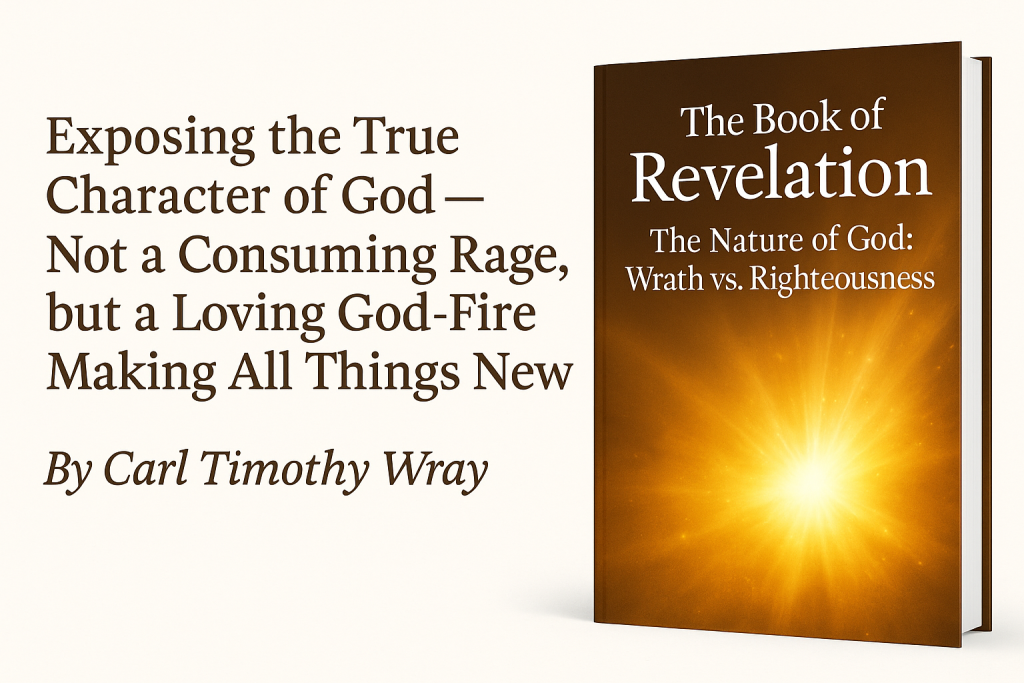
The Book of Revelation — Exposing the True Character of God — Not a Consuming Rage, but a Loving God-Fire Making All Things New
Book of Revelation: By Carl Timothy Wray
Book of Revelation: Introduction —
Book of Revelation: Babylon’s Lie About God Is Ending
For centuries, Babylon’s teachers have painted God in the image of man’s fallen anger — a cosmic tyrant, ready to destroy, whose “wrath” was mistaken for emotional rage instead of holy righteousness. This distorted theology has ruled pulpits and filled the minds of generations, producing fear-based religion instead of love-based transformation. But the Book of Revelation was never written to confirm Babylon’s nightmare — it was written to end it.
The Nature of God: Wrath vs. Righteousness unveils the difference between the false image of an angry deity and the radiant truth of divine love revealed in the Lamb. The so-called “wrath of God” is not vindictive destruction but restorative fire — the love of righteousness consuming everything unlike itself until nothing remains but light.
From the lake of fire to the throne of judgment, every symbol that Babylon has twisted into terror is being restored to its original glory. The wrath of the Lamb is the passion of Love setting creation free. The judgment of God is the alignment of all things with His nature. The fire that Babylon feared is the same eternal flame that purifies, heals, and makes all things new.
This Revelation exposes the greatest lie ever told about the heart of God and proclaims the truth hidden from the foundation of the world: God’s wrath and God’s righteousness are one and the same — love in motion, burning away the lie.
Welcome to the unveiling of His true character.
Welcome to the hour when the fire of God is understood at last.
Welcome to The Nature of God — Wrath vs. Righteousness.
Chapter 1 — Babylon’s God vs. Zion’s God
Key Verse: “For the wrath of man worketh not the righteousness of God.” — James 1:20
I. Definition — Teaching for the Nations
For centuries religion has portrayed God as an unpredictable ruler whose mood swings between love and fury. Babylon’s theology taught that when mankind sins, God’s patience collapses and punishment begins. This image of a divided deity — half love, half anger — became the foundation of fear-based religion. But the Book of Revelation unveils a God whose nature never changes. His wrath is not an emotional reaction but the radiant outworking of His righteousness.
Babylon’s God: separated, offended, demanding sacrifice to be appeased.
Zion’s God: united with creation, pure love revealed as consuming light that restores, not destroys.
When Revelation says, “the wrath of the Lamb,” it does not reveal a contradiction between mercy and judgment but their union. The Lamb is not angry at man; He is passionate to free man from the lie that God was ever angry at him.
II. Revelation — Unveiling for the Elect
Babylon’s interpretation of wrath was born in the carnal mind — a projection of Adam’s guilt onto heaven. When man fell, he began to see God through the lens of shame. Every thunder sounded like rejection; every judgment looked like vengeance. But in the Spirit, wrath is simply love encountering resistance. Wherever the lie resists the truth, friction is felt as “wrath,” yet its purpose is always reconciliation.
In Zion’s understanding, the wrath of God is the pressure of love insisting that nothing in creation remain unlike itself. It is the purging heat of divine righteousness melting the elements of corruption until only purity remains. The Lamb’s fire is not sent to destroy humanity but to dissolve the illusion of separation.
The Cross was the meeting place of these two perceptions: Babylon’s belief that God required death, and Zion’s revelation that God was willing to enter death to end it. What looked like anger was love’s ultimate descent to rescue man from his own darkness. Thus the wrath of God and the righteousness of God were revealed as one flame — holy love made visible.
III. Declaration: Prophetic Voice
We declare to Babylon: Your angry God is overthrown.
The thunder you feared was the heartbeat of mercy.
The lightning that struck your doctrines was the brightness of His appearing.
The One you called Judge is the same One who restores.
His wrath is not rejection — it is resurrection.
His righteousness is not distance — it is union.
Behold, the Lamb upon the throne: the fire of love has triumphed!
IV. Call to Action
Come out of Babylon’s confusion. Lay down the image of a divided God and behold the Lamb who reveals the Father’s heart. Download this scroll, study it with the Spirit of Revelation, and enter Zion University — where the fire of understanding will rewrite your mind. Let the lie burn and the truth rise within you. The mystery unveiled in this scroll reveals the true Nature of God within the Book of Revelation.
Chapter 2 — The Wrath of the Lamb
Key Verse: “Hide us from the face of Him that sitteth on the throne, and from the wrath of the Lamb.” — Revelation 6:16
I. Definition — Teaching for the Nations
At first glance, the phrase “wrath of the Lamb” sounds contradictory. How can a Lamb, the gentlest of creatures, have wrath? Babylon’s interpretation turned this into a picture of Christ returning in rage to punish humanity. Yet the Spirit reveals a higher truth: the Lamb’s wrath is not revenge but revelation.
In Babylon’s theology, wrath means destruction; in Zion’s revelation, wrath means transformation. The Lamb’s “anger” is the intensity of divine love confronting everything that hides truth. The very One who was slain now shines with burning compassion — consuming death, pride, and deception until nothing remains but light.
The wrath of the Lamb is the exposure of falsehood by the brilliance of truth. When His face appears, the masks of Babylon melt away.
II. Revelation — Unveiling for the Elect
The Lamb’s wrath is the inner apocalypse of the soul. It is the unveiling of Christ within, where every shadow of self is judged by light. This is not the rage of a deity, but the divine collision between what is true and what pretends to be.
The wrath of the Lamb is love’s laser — gentle in essence, unstoppable in purpose. When He appears within the saints, His presence exposes every Babylonian thought that said, “God is angry with you.” It dissolves doctrines of fear and purges the consciousness of separation.
On the Cross, the Lamb absorbed mankind’s hatred and returned only mercy. That mercy, once misunderstood as wrath, now stands revealed as the power that ends sin by forgiving it. The wrath of the Lamb is love insisting that nothing false remain unhealed. It is the violent tenderness of redemption completing its work.
Where Babylon saw vengeance, Zion sees victory. The wrath that terrifies the carnal mind is the same fire that sanctifies the sons. This is the unveiling of divine passion — “many waters” roaring through creation until every voice echoes the Lamb’s own love.
III. Declaration: Prophetic Voice
Behold, the Lamb whose wrath is love!
He burns, not to kill, but to cleanse.
He thunders, not to terrify, but to transform.
Every eye shall see Him, and every lie shall flee.
The mountains of pride melt like wax before the face of mercy.
Babylon falls beneath the brightness of His smile.
The wrath of the Lamb has come — and behold, all things are made new!
IV. Call to Action
Let the Lamb’s fire search your heart. Welcome His wrath as healing light, not punishment. Download this scroll, meditate on His unveiled nature, and share it with those still trapped in Babylon’s fear. Enter Zion University and walk in the revelation that judgment has already become redemption. The Lamb’s wrath is love unveiled—the central truth shining through the Book of Revelation.
Chapter 3 — Fire from the Throne
Key Verse: “Out of the throne proceeded lightnings and thunderings and voices: and there were seven lamps of fire burning before the throne, which are the seven Spirits of God.” — Revelation 4:5
I. Definition — Teaching for the Nations
In Babylon’s theology, “fire” means punishment — an eternal blaze prepared for sinners. Fear has been the system’s greatest weapon. Yet in Zion’s revelation, fire is not condemnation; it is communication. The fire that flows from God’s throne is the radiance of His nature, the sevenfold Spirit burning with life, wisdom, and purification.
Babylon teaches that God sends fire to destroy His enemies. Zion sees that the fire is God — a living flame of love that transforms enemies into sons. From Genesis’ flaming sword to Revelation’s sea of glass mingled with fire, the symbol has always meant presence, not penalty.
The throne of God is not surrounded by wrathful smoke but by the brightness of uncreated light. His judgments are like lightning — instant illumination that reveals truth in a flash. Every spark from the throne carries the purpose of restoration.
II. Revelation — Unveiling for the Elect
When John saw the fire before the throne, he was beholding the essence of divine government — righteousness in motion. The throne is not a seat of retaliation; it is the fountain of transformation. The seven lamps of fire are the seven Spirits of God — the complete operation of divine intelligence refining creation.
Babylon’s fire torments; Zion’s fire teaches. The sons of God are baptized in this fire until every element of the Adamic nature is consumed. This is why the throne emits lightning and voices — revelation and testimony proceeding together. The voice of God is always clothed in flame because truth cannot be spoken apart from purity.
In the spiritual realm, fire represents awareness. The more the Lamb is revealed within, the more the inner fire burns — enlightening conscience, cleansing perception, and igniting communion. When this fire fills the temple of man, death and darkness have no dwelling place. The throne in heaven becomes the throne within.
Thus the “fire from the throne” is not an external punishment descending upon earth; it is the internal illumination rising within the saints, establishing divine order in every cell of being.
III. Declaration: Prophetic Voice
Behold the throne that burns with love!
Its lightning shatters the doctrines of fear.
Its thunder silences the accusers of Babylon.
The sevenfold flame now blazes in the hearts of sons.
We are the lamps before the throne, the living fire of His appearing.
No longer shall the nations tremble at wrath — they shall shine with righteousness!
The fire from the throne has come — and the throne has come to dwell in man!
IV. Call to Action
Let the fire from His throne burn within you. Invite the seven Spirits of God to illuminate your understanding. Read this scroll aloud, download the PDF, and meditate on every phrase until Babylon’s fear is swallowed in flame. Then step into Zion University, where revelation becomes reality and the sons learn to rule by light, not fear. From the throne of fire flows the mercy that governs the entire Book of Revelation.
Chapter 4 — The Righteous Judgment of God
Key Verse: “Because He hath appointed a day, in the which He will judge the world in righteousness by that Man whom He hath ordained.” — Acts 17:31
I. Definition — Teaching for the Nations
Babylon teaches judgment as a final courtroom of condemnation — a gavel of fear where God separates the “good” from the “bad.” Generations were taught to dread a day when their every failure would be exposed for punishment.
But in Zion’s revelation, the judgment of God is not condemnation; it is correction. Judgment is how love sets things right. It is God’s righteous order bringing every heart into alignment with His own nature. The word “judge” in Scripture means to govern, to make right, to restore balance.
When Revelation speaks of “the throne of judgment,” it shows the same throne we saw flaming with love in the previous chapter. The Judge is the Lamb, and His verdict is life. Judgment is love’s administration — righteousness establishing harmony where confusion once reigned.
II. Revelation — Unveiling for the Elect
Babylon’s judgment separates; Zion’s judgment reconciles. Babylon’s judge wields a sword of fear; Zion’s Judge wields the Sword of Truth dividing darkness from light within man’s own being.
The Day of Judgment is not a date on the calendar; it is a dawning within. When Christ arises in you, every false thought, motive, and image is weighed in His righteousness. The “books” are opened — the memories and beliefs of the soul — and the “Book of Life” (Christ within) interprets them correctly. This is not punitive fire but the refining process of divine awareness.
Judgment begins at the house of God because it is the unveiling of sons who judge righteous judgment. They do not condemn men; they discern truth. The more light you carry, the more accurately you perceive reality. God’s judgment is His mercy exposing illusion until nothing remains but truth.
Thus the “Great White Throne” is not marble and terror but purity and illumination. White speaks of transparency; the throne speaks of rule. The One seated is Love, judging not against the world but for it — to make all things new.
III. Declaration: Prophetic Voice
Behold the Righteous Judge!
His sentence is restoration.
His verdict is victory.
The light of His eyes burns away confusion.
The gavel of His Word strikes only falsehood.
Let the nations rejoice: the Judge has come, and His judgment is righteousness!
Babylon trembles, but Zion sings — for truth has taken the throne!
IV. Call to Action
Lay down every image of a condemning God. Let His judgment cleanse your inner courts until love governs every thought. Download this scroll, meditate on His righteous order, and enter Zion University to learn the justice of mercy. Share this revelation — that judgment is not wrath against man but righteousness for creation. Every righteous judgment is love setting creation in order, exactly as revealed in the Book of Revelation.
Chapter 5 — The Mystery of His Patience
Key Verse: “The Lord is not slack concerning His promise, as some men count slackness; but is longsuffering to us-ward, not willing that any should perish, but that all should come to repentance.” — 2 Peter 3:9
I. Definition — Teaching for the Nations
Babylon has always mistaken God’s patience for passivity. When judgment didn’t fall immediately, she mocked, saying, “Where is the promise of His coming?” To the carnal mind, delay means indifference. But to the mind of Christ, delay is mercy unfolding.
God’s patience is not the absence of action — it is the perfection of purpose. His timing is love stretched through eternity so that no soul is left unvisited by grace. What Babylon calls procrastination, heaven calls preparation. Every moment of delay is the Lamb giving creation time to awaken.
The mystery of His patience is this: God’s wrath and God’s mercy are not opposites. His wrath is love’s intensity; His patience is love’s duration. One burns away corruption; the other waits until every heart is ready to receive it.
II. Revelation — Unveiling for the Elect
Patience is the eternal tempo of divine order. The Lamb does not rush because all things are already His. The “delay” between promise and fulfillment is the gestation of glory — the hidden pregnancy of immortality within the sons.
Babylon’s impatience births confusion. She cannot discern process; she wants manifestation without maturity. But Zion understands that patience is prophetic incubation — the seed of God germinating beneath the soil of time. When Revelation declares that the “mystery of God should be finished,” it is speaking of patience reaching its perfect work: every false system exposed, every elect son unveiled.
God’s patience is not the postponement of justice; it is the space mercy gives for transformation. He endures contradiction from sinners not because He is weak but because His love is relentless. The same patience that waited through the ages for Calvary is now waiting in His saints until Christ be formed in them.
The sons of Zion mirror this nature. They do not retaliate when rejected; they remain steadfast in love. For they know that patience is not delay — it is divine confidence that everything is already complete in the Finished Work.
III. Declaration: Prophetic Voice
Behold the long-suffering of the Lord!
Time itself bows to His patience.
Babylon scoffs, but Zion understands.
The ticking clock is not denial; it is invitation.
He waits, not because He must — but because He wills that none be lost.
Every second drips with mercy; every season is pregnant with redemption.
The mystery of His patience is the rhythm of His reign!
IV. Call to Action
Let patience have her perfect work in you. Do not mistake silence for absence or delay for denial. The Lord’s timing is love maturing in secret. Download this scroll, meditate on His divine pace, and enter Zion University — where revelation replaces anxiety, and waiting becomes worship. His patience is the hidden rhythm of redemption unfolding through the Book of Revelation.
Chapter 6 — From Anger to Atonement
Key Verse: “God was in Christ, reconciling the world unto Himself, not imputing their trespasses unto them.” — 2 Corinthians 5:19
I. Definition — Teaching for the Nations
Babylon’s gospel begins with an angry God who demanded payment for sin before He could love again. She taught that the Cross satisfied divine rage, as though blood cooled a temper. This lie became the cornerstone of fear-based religion: a God appeased rather than revealed.
But Zion proclaims the truth — atonement was not to change God’s heart toward man; it was to change man’s mind about God. The Cross is not God’s rage released, but God’s love displayed. Christ did not die to convince the Father to forgive; He died to reveal that the Father always had.
Atonement means “at-one-ment” — the union of God and man restored through revelation. The veil of separation was torn, not because anger ended, but because illusion died. The wrath that fell was not fury upon humanity, but the consuming of sin itself.
II. Revelation — Unveiling for the Elect
Babylon projected her own guilt into heaven and called it divine wrath. She imagined God offended by her failure and built systems of sacrifice to soothe Him. Yet the Lamb came, not to appease wrath, but to expose its lie.
At Calvary, two perceptions met:
Babylon’s view: God demanded death for sin.
Zion’s view: God entered death to destroy sin.
The Cross was the collision of fear and love. The “anger of God” was revealed to be love’s resistance to corruption — righteousness burning through the veil of darkness. When Jesus cried, “It is finished,” He did not end a payment plan; He ended the illusion of distance.
Atonement unveiled that there was never hostility in heaven — only misunderstanding on earth. The Son did not persuade the Father to forgive; He persuaded creation to believe it was forgiven. This is the wrath transformed into righteousness, the lightning of mercy striking the altar of flesh until only spirit remained.
Now the Lamb reigns from within humanity, reconciling every realm. The same fire that once appeared as anger now shines as compassion. The Cross was not God against man — it was God for man, in man, through man — destroying enmity forever.
III. Declaration: Prophetic Voice
Behold the Lamb who turned wrath into reconciliation!
His blood speaks better things than vengeance.
His wounds are not evidence of fury but fountains of forgiveness.
The veil is torn — the distance is dead.
Babylon’s altar of appeasement has fallen, and the mercy seat has stood up in power.
Love has conquered anger; atonement has swallowed accusation.
The Cross is the end of hostility — and the dawn of union!
IV. Call to Action
Lay down the image of an offended deity. Behold the Lamb who reveals the Father’s heart. Let every trace of guilt be consumed in His light. Download this scroll, study it line by line, and enter Zion University to learn the mystery of at-one-ment — where wrath becomes righteousness and judgment becomes joy. The Cross transformed anger into atonement, fulfilling the eternal purpose written in the Book of Revelation.
Chapter 7 — The Cup of Indignation Explained
Key Verse: “The same shall drink of the wine of the wrath of God, which is poured out without mixture into the cup of His indignation.” — Revelation 14:10
I. Definition — Teaching for the Nations
For ages Babylon has preached that the cup of indignation is God’s rage poured out upon the world in the last days — a punishment for sinners too late to repent. To her, the wine of wrath means vengeance; the cup means torment. This misunderstanding has painted heaven as a courtroom of fury and the Gospel as an escape plan from divine punishment.
But in Zion’s revelation, the cup of indignation is truth confronting delusion. God’s “wine” is His pure essence — love, light, and righteousness — poured out without mixture of human compromise. Babylon drank the wine of her fornication — the intoxication of false doctrine — so now she must drink the antidote: the wine of truth that sobers the nations.
This cup is not destruction but disclosure — the unveiling of what Babylon has hidden. The “wrath” is the heat of love cleansing corruption from the systems of religion and politics until nothing remains but the purity of the Lamb.
II. Revelation — Unveiling for the Elect
The “cup of indignation” is symbolic of internal exposure. When light fills the temple of man, everything that fed on darkness begins to tremble. Babylon’s intoxication was mixture — half truth and half lie. God’s cup is without mixture because divine nature cannot coexist with deception.
When the Lamb pours out this cup, He is not punishing flesh; He is purifying consciousness. Each “vial” of Revelation is a truth poured into the earth-realm — the realm of human perception — until the lie collapses. Babylon drinks the cup and staggers, because her doctrines cannot stand in the presence of undiluted light.
The elect drink of another cup — the New Covenant wine of union. Yet the two are one in purpose: one destroys illusion, the other fills with truth. The cup of indignation is the mirror image of the cup of salvation. One empties the old; the other overflows the new.
When you discern this, wrath loses its terror. The same fire that consumes the lie illuminates the believer. The cup that Babylon dreads is the same glory that Zion celebrates. The indignation of God is His unwavering refusal to leave the world in darkness.
III. Declaration: Prophetic Voice
Babylon, the cup is in your hand — drink, and awaken!
Your intoxication ends; your confusion burns away.
This is not the rage of a tyrant but the passion of Truth.
The nations shall reel under revelation until sobriety returns.
The wine of wrath is love undiluted, truth unveiled, righteousness unstoppable.
The Lord has poured out His cup — and behold, the earth is being healed by light!
IV. Call to Action
Do not fear the cup — drink deeply of His light. Let every doctrine of fear dissolve in the wine of truth. Download this scroll, study the symbolism of the cup, and enter Zion University where revelation replaces intoxication. Share this word with those still trembling under Babylon’s shadow, and show them that wrath is love unfiltered. The cup of indignation becomes the wine of restoration within the Book of Revelation.
Chapter 8 — Love’s Judgment Seat
Key Verse: “For we must all appear before the judgment seat of Christ; that every one may receive the things done in his body, according to that he hath done, whether it be good or bad.” — 2 Corinthians 5:10
I. Definition — Teaching for the Nations
For Babylon, the Judgment Seat is a tribunal of terror. She imagines Christ seated on a high bench, separating souls into eternal reward or punishment, each trembling before His gavel. This vision has filled generations with dread, not reverence.
But Zion reveals the truth: the Judgment Seat is not a courtroom of condemnation but a mercy seat of illumination. The same throne where justice reigns is the same mercy seat where love intercedes. It is the place where truth unveils every motive, not to shame, but to heal.
To “appear before the judgment seat” means to stand unveiled before love Himself. His gaze does not destroy; it restores. Every hidden work is tested by the fire of truth, and only what is eternal remains. The purpose is not punishment but purification — the refinement of sons into full likeness with the Lamb.
II. Revelation — Unveiling for the Elect
The judgment seat of Christ is the throne of self-discovery. When the Lamb appears within, light floods the soul and every shadow surrenders. Babylon’s mind called this exposure “wrath,” but Zion knows it as redemption in operation.
This is the same seat Ezekiel saw as sapphire, and John saw as white — both speaking of clarity and union. The sons stand before this seat daily, not awaiting a distant event, but living in continuous unveiling. Each revelation of Christ judges the false image, and each surrender births new glory.
Love’s judgment is not God deciding who belongs; it is God revealing who He has always been in us. The works “done in the body” are not criminal records; they are consciousness patterns. When the fire tests them, the hay burns, but the gold gleams.
Babylon fears exposure; Zion welcomes it. For to be judged by love is to be measured by mercy. The Great White Throne and the Mercy Seat are one — white for purity, mercy for motive. The Judge is the Savior; the sentence is sonship.
III. Declaration: Prophetic Voice
Behold the Judgment Seat of Love!
The fire that reveals also redeems.
The eyes that search also save.
No hiding, no shame — only unveiling.
Babylon trembles before exposure, but Zion stands radiant in union.
This is not condemnation — it is coronation!
The Judge wears scars of mercy, and His verdict is, “You are Mine.”
IV. Call to Action
Step into the light without fear. Let the eyes of Love read every page of your heart. Download this scroll and let it minister cleansing and confidence. Enter Zion University where judgment is taught as joy — where the saints learn to discern, not to condemn. Share this revelation until the world knows the Judgment Seat as the Throne of Grace. Love’s judgment seat turns fear into freedom for all who awaken to the Book of Revelation.
Chapter 9 — The Fire That Saves
Key Verse: “For our God is a consuming fire.” — Hebrews 12:29
I. Definition — Teaching for the Nations
Babylon trembles at the thought of fire. She has turned it into a threat — a symbol of eternal torment, the place where the lost scream forever under divine anger. Fear has replaced revelation. But Zion knows the fire differently. The fire of God is not an inferno of hatred; it is the essence of His nature — love in motion, light in purity, righteousness in power.
When Scripture calls Him a consuming fire, it means that God consumes everything that is not of Himself. The consuming is not for destruction but for transformation. The fire of God is the purifier of gold, the refiner of motives, the healer of hearts. It burns away dross so that the true image can shine.
In Revelation, the fire is not sent to torment humanity but to transfigure creation. It is the glory of the Lamb filling all things until no darkness remains. This fire is salvation in its highest form — not saving man from God, but saving man into God.
II. Revelation — Unveiling for the Elect
The fire that saves is the eternal energy of divine love. It is not quenched because love never ceases. Babylon’s torment is her resistance to this flame; Zion’s joy is her surrender to it. When the sons yield to the fire, the consuming becomes communion. They burn, yet are not destroyed — just as the bush burned before Moses yet was not consumed.
This is the mystery of divine transformation: the same fire that destroys the lie also divinizes the believer. What the old man experiences as loss, the new man experiences as glory. The lake of fire, seen rightly, is the ocean of God’s being — truth dissolving illusion, light absorbing darkness, love converting death into life.
Every judgment in Revelation is a fire-event — a wave of divine energy purging the realm of thought and consciousness. Babylon’s systems collapse, not because God hates them, but because love will not coexist with deception. The wrath of God is simply the intensity of love meeting resistance. But once resistance ends, the fire is felt only as warmth and union.
Thus, “our God is a consuming fire” becomes the gospel’s highest revelation: salvation through purification. The Lamb’s eyes of fire are not weapons — they are windows of mercy reflecting the face of perfect love.
III. Declaration: Prophetic Voice
Behold the Fire that Saves!
It does not destroy creation — it redeems it.
It does not end life — it unveils it.
The flames that once terrified now testify: God is love, and love never fails.
Babylon’s smoke fades, but Zion’s flame grows brighter.
The earth shall be filled with the knowledge of the Lord — not by flood, but by fire!
Let the sons burn with the flame that heals nations.
IV. Call to Action
Step into the fire of His love without fear. Let every false identity burn away until only sonship remains. Download this scroll, meditate on its revelation, and enter Zion University — where fire is understood as fullness and wrath as restoration. Share this word and let it ignite hearts around the world. The fire that saves burns eternally in the heart of God throughout the Book of Revelation.
Chapter 10 — The Nature of God Revealed in the Lamb
Key Verse: “He that hath seen Me hath seen the Father.” — John 14:9
I. Definition — Teaching for the Nations
All the mysteries of Revelation find their answer in a single image — the Lamb. From the opening vision to the final throne, He is central, unchanging, radiant. Yet Babylon could never comprehend why heaven’s ultimate symbol of power was not a lion devouring prey, but a Lamb bearing wounds.
Babylon’s interpretation paints God as a conqueror through force; Zion’s revelation shows Him as a ruler through love. The Lamb reveals that power in heaven is meekness manifested, and wrath in heaven is righteousness revealed. Where Babylon saw domination, Zion sees redemption.
To behold the Lamb is to see the true nature of God — self-giving, self-emptying, eternally forgiving. He overcomes not by crushing enemies, but by transforming them. Every vision of fire, thunder, and judgment flows from His heart; every act of glory is love in expression. The Lamb is the visible revelation of the invisible Father.
II. Revelation — Unveiling for the Elect
The Lamb is the eternal language of God. He is meekness enthroned, the expression of omnipotence through humility. All divine power is contained in this paradox: the One who could destroy all chose instead to die for all — and in dying, filled all with life.
When John beheld “a Lamb as it had been slain,” he saw the eternal pattern: the Cross is not an event in time; it is the posture of God forever. Love’s willingness to pour itself out is what sustains creation. This is why the Lamb stands in the midst of the throne — the center of government, the axis of all reality.
Babylon worships strength; Zion worships surrender. Babylon crowns kings; Zion crowns servants. The Lamb reveals that divine rule is servanthood perfected. This is the end of wrath, the unveiling of righteousness. God’s ultimate revelation is not fury, but Fatherhood — a heart so pure it burns away every shadow of separation.
In the Lamb we see that God has never been divided between mercy and justice; they are one in Him. Justice is love correcting; mercy is love embracing; righteousness is love reigning. The throne, the fire, the vials, the light — all converge in the face of the Lamb. Here, at last, wrath and righteousness kiss.
III. Declaration: Prophetic Voice
Behold the Lamb of God!
The Lion that roars through gentleness.
The Fire that burns as mercy.
The Throne that reigns by love.
He is the end of wrath and the beginning of righteousness.
He is the Alpha and the Omega, the Wrath that Restores, the Righteousness that Reigns.
Every tear falls into His hands; every nation shall see His light.
The Lamb reigns — and love is all in all!
IV. Call to Action
Look upon the Lamb until all fear melts into adoration. Let His eyes of fire redefine your vision of God. Download this scroll, meditate on every chapter, and enter Zion University — where students of the Spirit behold the Lamb and become as He is. Share this final word with the world: the Nature of God is the Nature of the Lamb. The Lamb stands victorious, revealing the full Nature of God—this is the glory of the Book of Revelation.
Book of Revelation: ✍️ Author
By Carl Timothy Wray — author of The Finished Work of Christ and founder of Zion University, unveiling the Revelation of Jesus Christ from Genesis to Glory. His writings expose Babylon’s lies and reveal the nature of God as perfect love—righteous, consuming, and making all things new. Discover hundreds of prophetic books, blogs, and scrolls at thefinishedworkofchrist.com.
Read Our New Book of Revelation Series Here:
- The Book of Revelation — The 144,000, the Man-Child, and the Kings and Priests Who Reign on Earth
- The Book of Revelation — The Unveiling of Christ Within
- Man Appointed Once to Die — The Death of Adam and the Dawn of Immortality