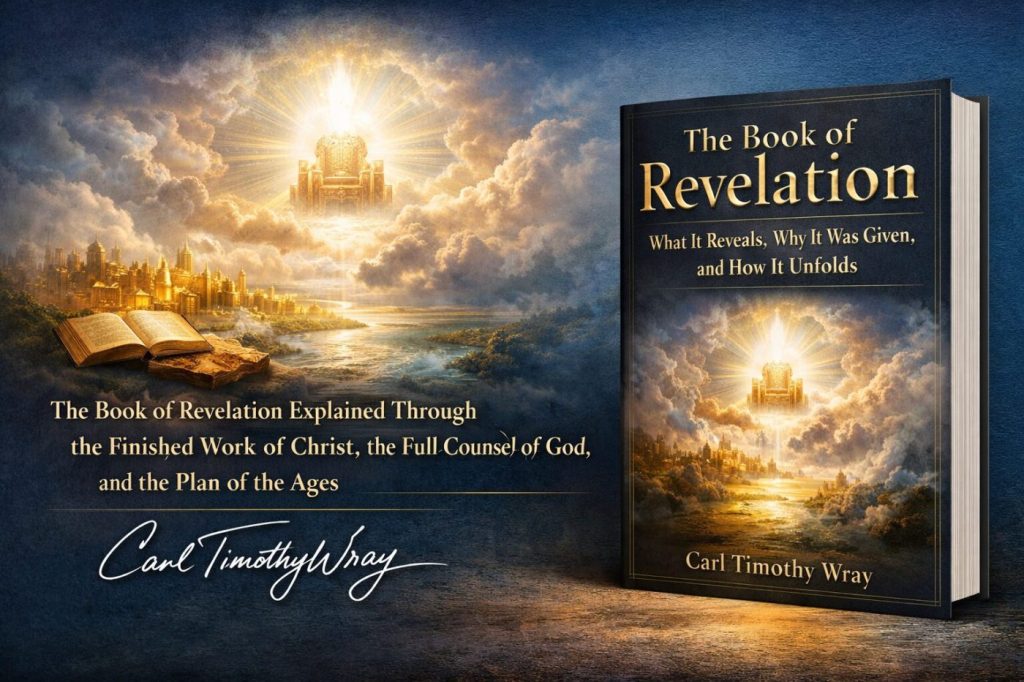
The Book of Revelation Explained Through the Finished Work of Christ, the Full Counsel of God, and the Plan of the Ages
Book of Revelation: AUTHOR
Carl Timothy Wray writes from a lifelong pursuit of seeing Scripture as one unified revelation rather than a collection of fragmented doctrines or competing end-time theories. His work centers on the Finished Work of Christ — eternally settled in God’s counsel, fully accomplished through Christ, and progressively revealed through the Plan of the Ages.
With clarity and spiritual precision, Wray approaches the Book of Revelation not as a prediction of disaster, but as the orderly unveiling of Christ’s completed victory and its administration in heaven and earth. He emphasizes revelation over speculation, union over escape, and sonship over survival — guiding readers beyond fear and confusion into a Christ-centered understanding of Scripture.
Through the Full Counsel of God framework, Carl Timothy Wray reveals how Revelation unfolds from eternal settlement to manifested fullness, leading to the ultimate purpose of God: Christ revealed in His people, and God becoming all in all.
The Book of Revelation is not difficult because it is mysterious — it is difficult because it has been approached from the wrong posture. Fear has replaced understanding. Speculation has replaced revelation. Timelines have replaced truth. As a result, the final book of Scripture has become the most debated, avoided, and misunderstood book in the Bible — not because it is unclear, but because it has been severed from the finished work of Christ that gives it meaning.
Revelation was never given to frighten the Church.
It was given to unveil Jesus Christ.
Book of Revelation: INTRODUCTION
From the moment its name is spoken, the Book of Revelation provokes reaction. For some, it signals catastrophe. For others, it represents persecution, political upheaval, or the end of the world. Still others reduce it to symbolism, history, or speculation about future events. Yet all of these approaches share one fatal flaw: they treat Revelation as something God is still trying to accomplish, rather than something He has already finished and is now unveiling.
The Book of Revelation does not introduce a new plan.
It reveals the administration of a completed one.
Scripture opens by declaring that this is “The Revelation of Jesus Christ.” This means Revelation is not primarily about beasts, seals, judgments, or future disasters — it is about Christ revealed. Not Christ struggling toward victory, but Christ standing in the midst of the throne, having already overcome. The visions that follow do not describe how Jesus will win; they unveil how His finished victory unfolds through time until it fills heaven and earth.
This is why Revelation cannot be understood through fear, speculation, or fragmented timelines. It must be read through the same lens that governs all Scripture: the unified mind of God. The finished work of Christ was eternally settled before time, legally accomplished through the cross, and progressively revealed through the plan of the ages. Revelation is the final book because it reveals the final administration — not of destruction, but of union, where God becomes all in all.
Within these pages, judgment is not presented as punishment for humanity, but as the removal of everything that resists life. Symbols are not riddles meant to confuse, but spiritual language designed to unveil truth to those ready to see. Time is not divided into past, present, and future conflicts, but gathered into one unfolding revelation centered in Christ.
This book was written to form sons, not frighten servants.
It was given to reveal maturity, not manage survival.
It unveils not escape from the earth, but heaven revealed within it.
This work approaches the Book of Revelation through the Finished Work of Christ, the Full Counsel of God, and the Plan of the Ages — showing how what was settled in eternity is revealed in time, until the victory of Christ is fully manifested in creation. When Revelation is read this way, fear dissolves, confusion lifts, and the unveiling does exactly what it was sent to do:
Reveal Jesus Christ — and the sons who are conformed to His image.
Chapter 1 — What “The Revelation of Jesus Christ” Actually Means
The Plain Meaning
The opening words of the final book of Scripture are not symbolic, mysterious, or hidden. They are direct and unmistakable:
“The Revelation of Jesus Christ…” — Revelation 1:1
This statement tells us exactly what the book is before anything else is said. It is not a revelation about events. It is not a revelation of disasters. It is not a revelation of future timelines. It is the revelation of a Person — Jesus Christ.
The word revelation comes from the Greek word apokalypsis, which means unveiling, uncovering, or making visible what was previously hidden. It does not mean destruction. It does not mean catastrophe. It does not mean secrecy. It means something that already exists is now being revealed.
This immediately corrects the most common misunderstanding of the book. Revelation is not about predicting what Christ will do in the future; it is about unveiling who Christ already is — and what He has already accomplished.
Before seals are opened, before beasts appear, before judgments are described, Scripture establishes the subject: Jesus Christ revealed.
If this foundation is missed, everything that follows will be misread.
The Unveiling Beneath the Words
Revelation does not reveal new information about Christ — it reveals Christ Himself in fullness. This distinction is critical.
Jesus did not become victorious in Revelation.
He is revealed as victorious.
The book does not show Christ moving toward triumph; it unveils Him already standing in the midst of the throne. The Lamb is not introduced as one who will overcome, but as one who has already overcome. Revelation therefore does not announce a battle plan — it unveils an administration.
This is why Revelation must be read through the Finished Work of Christ. A finished work does not need to be repeated, improved, or completed later. It only needs to be revealed, applied, and manifested. Revelation is the final book because it reveals the final stage of God’s purpose: the unveiling of what was eternally settled.
The unveiling of Jesus Christ is also the unveiling of His body. Christ cannot be revealed apart from His fullness. As the Head is unveiled, the body comes into view. As the Son is revealed, sons are revealed. This is why Revelation speaks not only of Christ, but of overcomers, kings, priests, and a corporate people bearing His image.
Revelation is therefore not a book about the end of the world — it is a book about the end of concealment.
What was hidden in promise is now revealed in glory.
What was planted in seed is now brought into maturity.
What was settled in eternity is now unveiled in time.
Declaration
Revelation does not introduce fear — it removes it.
It does not announce defeat — it unveils victory.
It does not predict Christ’s success — it reveals His completion.
When Jesus Christ is revealed correctly, everything else falls into place.
Call to Action
If you have approached the Book of Revelation with hesitation, fear, or confusion, this chapter invites you to begin again — not from speculation, but from Christ Himself. Read every vision, symbol, and judgment through this single lens:
Jesus Christ is already revealed as victorious.
As you continue, let this unveiling reshape how you see Scripture, time, judgment, and your own identity in Christ. Revelation was written not to terrify the Church, but to form sons who see clearly.
👉 Continue to the next chapter, where we answer why the Book of Revelation was given at all — and why it could only be written after the work was finished.
Chapter 2 — Why the Book of Revelation Was Given
The Plain Reason
The Book of Revelation was not given because the Church needed more information about the future. It was given because the work of Christ was complete, and the time had come for that finished victory to be revealed.
Revelation does not appear at the beginning of Scripture because it depends on everything that came before it. You cannot unveil what has not first been accomplished. The cross had to be finished. Resurrection had to be secured. Ascension had to be completed. Authority had to be seated. Only then could Revelation be given.
This is why Revelation opens with confidence, not concern. It does not say what might happen. It speaks of what must be shown. The book exists because something already exists that now needs to be made visible to the servants of God.
Revelation was given:
- Not to warn believers of failure
- Not to predict chaos
- Not to threaten the faithful
- But to unveil the victory already won
The Church did not need a survival manual.
It needed an unveiling.
The Deeper Purpose
Revelation was given because God’s work was finished — but not yet fully seen.
This is the difference between completion and manifestation. A finished work can exist without being understood. A victory can be secured without being embodied. Revelation was given to bridge that gap — not by adding to the work of Christ, but by unveiling it until it governs the minds, hearts, and lives of His people.
The book was written to servants, not spectators. Servants must see clearly to serve rightly. Revelation therefore reveals how heaven sees, not how earth fears. It lifts the reader out of temporal confusion and places them in the throne-room perspective where Christ is already reigning.
This is why Revelation intensifies conflict only after Christ is revealed as enthroned. The unveiling of victory exposes resistance. Light does not create darkness — it reveals it. Revelation was not given because darkness was winning, but because light was now ready to shine without restraint.
Judgment appears in Revelation not because God lost patience, but because truth confronts lies when revelation increases. Every seal, trumpet, and vial flows from the Lamb who has already overcome. Nothing in Revelation is reactionary. Everything is administrative.
Revelation was given so the Church would stop waiting for victory and begin living from it.
Declaration
Revelation exists because Christ reigns.
It was given because the work is finished.
It unveils victory so sons can walk in authority.
Nothing in Revelation is unfinished.
Nothing in Revelation is uncertain.
Everything unfolds from a throne already occupied.
Call to Action
If you have read Revelation as a warning about what might go wrong, this chapter calls you to read it again as a revelation of what cannot go wrong. Christ is seated. The victory stands. The unveiling continues.
As you move forward, let this truth settle firmly:
Revelation was given because the work was done.
👉 In the next chapter, we will answer the question that troubles many believers: How can a work be finished and still be revealed? This is where eternity and time meet — and where confusion finally dissolves.
Chapter 3 — How a Finished Work Can Still Be Revealed
The Apparent Tension
One of the greatest points of confusion in the Church comes from a single question:
If Christ finished the work, why does Scripture still speak of things unfolding?
Many believers sense the contradiction but never resolve it. On one hand, Scripture declares the work complete. On the other, it speaks of growth, judgment, unveiling, and fulfillment. This tension has caused generations to assume that the finished work must be partial, delayed, or incomplete.
But the contradiction is not in Christ.
It is in how time is understood.
A work can be finished in its origin and still be revealed in its expression. Completion does not require immediate visibility. A seed can be fully formed while remaining hidden beneath the soil. The absence of manifestation does not mean the absence of completion.
Revelation exists because the work is finished — not because it is unfinished.
Eternity, Time, and Unveiling
The finished work of Christ was settled in eternity before time ever began. Scripture consistently reveals that God does not decide in time; He reveals in time what He has already settled. Time is not where God experiments — time is where God unveils.
This is why Revelation does not add to the work of Christ. It administers it.
The cross accomplished everything legally. Resurrection secured everything vitally. Ascension seated everything in authority. What remains is not completion, but revelation — the progressive unveiling of that finished reality until it governs creation.
Revelation functions like light entering a dark room. The furniture was already there. The light does not create it; it reveals it. As light increases, more becomes visible. Nothing new is added — clarity increases.
This is why Revelation unfolds in stages. Not because God is still acting, but because humanity is still seeing. Each unveiling removes another layer of blindness, resistance, or immaturity. Revelation does not move Christ forward — it brings creation into alignment with where Christ already is.
This also explains judgment. Judgment is not God fixing what failed; it is truth confronting what refuses to yield. When a finished reality is revealed, anything out of alignment is exposed. Revelation is therefore confrontational — not because God is angry, but because truth cannot remain hidden once unveiled.
Revelation reveals what has always been true.
Declaration
A finished work does not end revelation — it requires it.
Victory does not eliminate unfolding — it governs it.
What is settled in eternity must still be revealed in time.
Christ is not becoming Lord.
He is being revealed as Lord.
Call to Action
If you have struggled to reconcile the finished work of Christ with the unfolding nature of Scripture, let this chapter settle the matter. Nothing in Revelation contradicts completion. It unveils it.
As you continue, read Revelation not as a story moving toward victory, but as a light increasing in brightness until everything is seen as it truly is.
👉 In the next chapter, we will explore the Plan of the Ages — the divine order through which a finished work unfolds without delay, contradiction, or failure.
Chapter 4 — The Plan of the Ages: How Revelation Unfolds
God’s Order Is Not Confusion
God does not reveal everything at once. He never has.
From Genesis to Revelation, Scripture unfolds through order, not interruption. Truth is revealed progressively, not because God withholds it, but because humanity grows into the capacity to receive it. Revelation follows this same pattern. It is not a sudden explosion of information; it is the final administration of a long-established plan.
This plan is not hidden. Scripture names it clearly:
the plan of the ages.
Revelation does not introduce a new age. It unveils the culmination of all ages. Everything God spoke through the Law, the Prophets, the Gospels, and the Apostles converges here — not to start something new, but to bring everything into alignment with what was always intended.
When Revelation is read without this order, it appears chaotic. When it is read through the plan of the ages, it becomes clear, consistent, and unified.
The Divine Pattern of Unfolding
The plan of the ages reveals how a finished work matures without contradiction. God does not rush manifestation. He prepares vessels. Revelation sits at the end because it reveals maturity, not infancy.
Scripture consistently unfolds through these divine patterns:
Law → Grace → Fullness
Law revealed the standard and exposed limitation.
Grace imparted life and transformation.
Fullness manifests what grace installed.
Faith → Patience → Inheritance
Faith receives immediately.
Patience governs development.
Inheritance appears when life is ready to be embodied.
Thirtyfold → Sixtyfold → One Hundredfold
Not rankings of people, but measures of maturity.
Life received.
Life administered.
Life manifested.
Revelation is not about the beginning of faith — it is about the manifestation of inheritance. It does not teach how to receive life; it reveals how life governs once matured. This is why Revelation speaks of thrones, authority, judgment, and dominion. These are not themes for children; they are expressions of sons.
This is also why Revelation recapitulates. It does not move forward linearly because it is not narrating history. It reveals the same victory from multiple angles until the reader sees clearly. Each cycle is not a delay — it is clarification.
Revelation unfolds because maturity unfolds.
Declaration
God unfolds what He has already settled.
Revelation does not interrupt the plan of the ages — it completes its unveiling.
What was promised in seed is revealed in fullness.
Nothing is rushed.
Nothing is delayed.
Everything unfolds in perfect order.
Call to Action
If Revelation has ever felt overwhelming or disjointed, this chapter offers rest. God is not reacting. He is revealing. The plan has never changed — only the clarity with which it is seen.
As you continue, read Revelation through maturity, not urgency. Through order, not alarm. Through the plan of the ages, not fragmented timelines.
👉 In the next chapter, we will address why Revelation is written in signs and symbols — and why this language is a mercy, not a mystery.
Chapter 5 — Why Revelation Is Written in Signs and Symbols
What the Text Actually Says
The Book of Revelation tells us how it will communicate before it ever shows us what it will reveal.
“He sent and signified it by His angel unto His servant John…” — Revelation 1:1
The word signified means to communicate by signs. Revelation openly declares that it is written in symbolic language. This is not a hidden detail — it is the stated method of the book.
Symbols are not used because truth is unclear.
They are used because truth is too weighty for surface language.
Throughout Scripture, God has always used symbols, parables, visions, and figures to communicate spiritual realities. Revelation does not introduce a new method; it brings the method to fullness. When readers attempt to read Revelation literally without recognizing its signified nature, confusion is guaranteed.
Symbols are not puzzles to decode — they are windows meant to reveal.
Why God Uses Symbolic Language
Symbols do not obscure truth; they protect it.
Revelation speaks in signs because it addresses spiritual realities that transcend time, culture, and language. Literal language is bound to one moment. Symbolic language carries truth across generations without losing power. A beast, a dragon, a throne, a lamb — these images communicate identity, authority, nature, and function in ways plain speech cannot.
This is also why Revelation reveals different things to different readers. Symbols require spiritual perception. They invite maturity. They bypass the intellect and speak directly to the inner man. The same image that frightens the immature will comfort the mature, because perception determines meaning.
Revelation’s symbols are not meant to be dissected mechanically. They must be viewed as wholes. A beast is not biology. A trumpet is not an instrument. A seal is not wax. These images communicate spiritual realities, not physical predictions.
This is where both literalism and historicism fail. Literalism demands material fulfillment. Historicism locks symbols into past events. Both approaches collapse living revelation into dead categories. Revelation’s symbols are alive — they speak wherever the same spiritual realities exist.
This is why Revelation continues to speak without changing. Symbols are not dated. Truth is not seasonal. What Revelation unveils is eternal.
Declaration
Symbols do not hide truth — they unveil it to the ready.
Revelation is written in signs because it speaks from heaven’s language.
Those who see spiritually are not confused by symbols — they are awakened by them.
Call to Action
If symbols in Revelation have ever caused fear or frustration, this chapter invites you to release the demand for literal fulfillment and receive spiritual understanding. Revelation is not asking you to calculate events — it is inviting you to see reality as heaven sees it.
As you continue, read every image as a revelation of identity, authority, and nature — not as a prediction of physical spectacle.
👉 In the next chapter, we will address one of the most misunderstood aspects of Revelation: judgment — and why it always serves life.
Chapter 6 — Judgment in Revelation: Why It Serves Life
Clearing the Misunderstanding
Few words provoke more fear than judgment. For many, judgment immediately means punishment, wrath, and destruction. When this assumption is carried into the Book of Revelation, the entire book becomes terrifying rather than illuminating.
But Revelation never presents judgment as chaos or loss of control. Judgment flows from the Lamb, not from rage. Every act of judgment in Revelation proceeds from a throne already occupied by Christ. This alone tells us something crucial: judgment is not reaction — it is administration.
Judgment in Revelation is not about God abandoning creation.
It is about God reclaiming it.
If judgment were destructive by nature, Revelation would end in ruin. Instead, it ends in renewal, restoration, and union. Therefore, judgment cannot be the enemy of life — it must be the servant of life.
Judgment as the Removal of What Resists Life
Judgment in Revelation is aimed at death, deception, and resistance, not humanity.
The Lamb judges because He loves. Light judges darkness simply by shining. Truth judges lies by being revealed. Life judges death by overcoming it. Revelation does not show God destroying creation; it shows God removing everything that prevents creation from fully participating in life.
This is why judgment intensifies as Revelation unfolds. The closer truth comes to full manifestation, the more resistance is exposed. Judgment is not escalation of anger — it is escalation of clarity. When a finished work is unveiled, anything out of alignment must either yield or be removed.
This is also why judgment in Revelation is described symbolically: seals, trumpets, bowls. These are not weapons of cruelty; they are processes of unveiling. Each stage removes another layer of deception, another refuge of lies, another system built on death.
Judgment is therefore redemptive in purpose, even when it is severe in effect. It is not designed to annihilate sons, but to strip away everything that prevents sonship from being revealed.
The Lamb does not judge to win.
He judges because He already has.
Declaration
Judgment in Revelation serves life.
It removes what cannot live so life can reign.
It confronts lies so truth can dwell without resistance.
The Lamb judges — not to destroy creation — but to heal it.
Call to Action
If judgment has caused you fear, let this chapter reset your vision. Judgment is not God turning against humanity; it is God turning toward creation with truth that refuses to coexist with death.
As you continue, read every act of judgment as life asserting its rightful place. Revelation is not the story of God losing patience — it is the unveiling of life conquering everything that opposed it.
👉 In the next chapter, we will confront a question that has divided believers for generations: Is Revelation about the past, the present, or the future? And we will expose why that question itself misses the point.
Chapter 7 — Past, Present, or Future? The False Question Exposed
Why the Question Never Resolves
One of the most common questions asked about the Book of Revelation is simple on the surface:
Is Revelation about the past, the present, or the future?
Entire theological systems have been built trying to answer this. Some insist Revelation was fulfilled in the past. Others claim it is unfolding now. Still others push everything into the future. Each camp presents evidence. Each camp refutes the others. And the debate never ends.
The reason is simple:
the question itself is flawed.
Revelation was never written to fit inside a single segment of time. It does not submit to past, present, or future categories because it speaks from the perspective of eternity intersecting time.
When Revelation is forced into a timeline, it fractures. When it is read from the throne, it unifies.
Revelation Speaks From the Throne, Not the Clock
Revelation opens with Jesus Christ already exalted, already reigning, already victorious. This immediately removes Him from linear time. From the throne, Christ does not look forward or backward — He is.
This is why Revelation can speak of things that have been, are, and are to come without contradiction. It is not shifting timelines; it is revealing one reality from multiple dimensions at once.
What was true in the first century remains true today. What unfolds in the earth does not change what is settled in heaven. Revelation therefore speaks wherever the same spiritual conditions exist. Babylon is not confined to one empire. The beast is not limited to one ruler. The Lamb is not waiting for authority.
Revelation is not a history book written in advance. It is a revelation of eternal truth expressed within time. This is why it continues to apply without being rewritten. The same unveiling confronts every generation at the level of its maturity.
Past, present, and future are not competing interpretations — they are layers of the same unveiling.
Declaration
Revelation is not locked in the past.
It is not suspended in the future.
It is alive wherever Christ is being revealed.
The throne is timeless.
The unveiling is continual.
Call to Action
If you have been pulled into debates about timelines, this chapter invites you to step out of the argument and into clarity. Revelation does not ask when Christ reigns. It reveals that He reigns.
As you continue, read Revelation from the throne, not the clock. From eternity, not anxiety.
👉 In the next chapter, we will explore the Church, the overcomer, and the son — and why Revelation was written to produce maturity, not merely endurance.
Chapter 8 — The Church, the Overcomer, and the Son
What Revelation Is Addressing
The Book of Revelation is written to churches, but it is not written to keep them as churches. This distinction is critical.
Revelation opens with messages to seven churches, yet it does not end with churches at all. It ends with a mature people, reigning, dwelling, and ruling with God. This alone tells us Revelation is not about maintaining institutional Christianity — it is about producing maturity.
Within every message to the churches, the same phrase appears:
“To him that overcometh…”
Revelation is not calling believers merely to survive persecution or endure hardship. It is calling them to overcome — to grow beyond a state of dependence, mixture, and immaturity.
The Church is addressed because it is the starting place.
The overcomer is revealed because growth is required.
The son appears because maturity is the goal.
From Church to Sonship
The Church represents life received.
The overcomer represents life tested and matured.
The son represents life expressed without resistance.
Revelation is not written to keep believers in perpetual struggle. It is written to move them forward. This is why the promises escalate. Each promise to the overcomer points toward authority, inheritance, and union — not escape.
Overcoming is not about willpower. It is about alignment. A believer overcomes when the life of Christ governs the soul without contradiction. The battle Revelation describes is not merely external; it is internal. Thrones, beasts, and false prophets represent competing authorities within and without — all of which must yield to the Lamb.
This is why Revelation culminates in sonship imagery. Sons are not managed by external law. They rule by nature. Sons do not resist God’s will; they embody it. Revelation does not end with servants awaiting instructions, but with a people who reign in union.
The Church is necessary.
Overcoming is essential.
Sonship is inevitable.
Declaration
Revelation was not written to preserve immaturity.
It was written to reveal maturity.
The goal is not endurance — it is expression.
Christ is revealed — and sons are revealed with Him.
Call to Action
If you have read Revelation as a warning to survive, this chapter invites you to see it as a call to grow. God is not looking for fearful servants hiding from the world. He is revealing sons who reflect His image within it.
As you continue, let Revelation challenge not your security, but your capacity. The book was written to bring believers out of limitation and into likeness.
👉 In the next chapter, we will see where Revelation ends — not in escape or destruction, but in union, where heaven and earth meet and God becomes all in all.
Chapter 9 — Revelation Ends Where God Intended: Union
How the Book Actually Ends
Despite all the imagery of conflict, judgment, and confrontation, the Book of Revelation does not end in destruction. It ends in union.
The final vision is not of believers escaping the earth, nor of creation being discarded. It is of God dwelling with humanity. Heaven and earth are not separated; they are joined. God does not abandon creation — He fills it.
This alone corrects countless assumptions. If Revelation were about annihilation, its conclusion would be emptiness. Instead, it culminates in fullness. The goal was never survival through chaos, but restoration through revelation.
Revelation ends exactly where Scripture has always been heading:
God with man.
Man in God.
Creation filled with divine life.
Union as the Fulfillment of the Finished Work
Union is not a last-minute idea. It is the purpose behind everything.
From Genesis onward, God’s desire has been to dwell within His creation without resistance. Sin did not cancel this purpose; it delayed its expression. Christ did not come merely to forgive humanity — He came to restore union. Revelation unveils what that union looks like when fully revealed.
This is why Revelation speaks of a city, a bride, a body — these are not structures, but states of union. The New Jerusalem is not a location descending from the sky; it is humanity transformed, heaven and earth reconciled within a people.
There is no temple in the final vision because God Himself dwells fully within. There is no night because darkness has nothing left to hide. There is no curse because death has been removed. Judgment has done its work — not by destroying creation, but by cleansing it of everything that resisted life.
Union is the proof that the work was finished from the beginning. What was settled in Christ is finally seen without obstruction. God does not become all in all at the end because He struggled toward it — He is revealed as all in all because nothing remains to contradict it.
Revelation ends with life reigning where death once ruled.
Declaration
Revelation does not end in separation.
It ends in union.
It does not conclude with escape.
It concludes with indwelling.
God’s desire is fulfilled.
Creation is healed.
Life reigns without resistance.
Call to Action
If you have read Revelation expecting destruction, let this chapter correct your vision. The end of the book reveals the beginning God always intended. Everything Revelation unveils moves toward this moment — not chaos, but communion.
As you prepare to read the final chapter, let this truth settle deeply:
Union is not the reward at the end of Revelation — it is the reason Revelation was written.
👉 In the final chapter, we will answer the most practical question of all: How must the Book of Revelation be read today, so it forms sons rather than spectators?
Chapter 10 — How the Book of Revelation Must Be Read Today
Milk — The Right Posture
The Book of Revelation does not demand intelligence first — it requires posture.
Many read Revelation looking for information: timelines, signs, predictions, confirmations of what they already believe. Others read it defensively, afraid of being misled or proven wrong. Both approaches miss the purpose of the book.
Revelation must be read:
- Not with fear
- Not with speculation
- Not with argument
- But with revelation-centered faith
This book is not meant to be mastered intellectually before it is received spiritually. It is written to servants who are willing to see from heaven’s perspective rather than earth’s anxiety.
To read Revelation rightly, one must begin where the book begins:
Jesus Christ revealed.
Meat — Reading Revelation Through Christ, Not Crisis
Revelation must be read from the throne, not from the headlines.
When current events become the interpretive key, Revelation turns into endless revision. Every generation rewrites it to fit its fears. But when Christ remains the center, Revelation never needs updating — it remains eternally relevant.
Revelation must also be read corporately, not individually. It unveils a body, a bride, a city, a people. Isolated interpretation produces fear. Corporate vision produces clarity. This is why Revelation consistently speaks in plural terms — churches, overcomers, kings, priests.
Most importantly, Revelation must be read as formation, not information.
The book does not exist to inform believers about the future; it exists to form sons in the present. It shapes how one sees authority, judgment, suffering, victory, and identity. It trains the inner man to rule from union rather than react from fear.
When Revelation is read this way:
- Fear loses its grip
- Judgment is understood as life-serving
- Symbols become clear
- Time arguments dissolve
- Christ remains central
- Sons emerge naturally
This is the fruit of reading Revelation rightly.
Declaration
Revelation is not a puzzle to solve.
It is an unveiling to receive.
It was not written to produce watchers.
It was written to produce rulers.
Those who see Christ clearly will see everything else rightly.
Final Call to Action
If you have walked through this book and felt fear lift, clarity rise, and hunger awaken, then Revelation has done its work. Do not close this scroll and return to old lenses. Carry this unveiling forward.
Read Scripture through Christ.
Read time through eternity.
Read judgment through life.
Read yourself through sonship.
The Book of Revelation is not behind you.
It is now within you.
👉 Continue into the deeper scrolls.
👉 Download the PDF and study it again.
👉 Enter Zion University and walk further into the revelation of Christ unveiled.
This unveiling is not ending — it is unfolding.

Book of Revelation Series:
- Book of Revelation
- Book of Revelation — The Appearing of the Lord in Revelation’s Questions
- The Book of Revelation — Why a Finished Work Is Still Being Revealed
- Book of Revelation — The Ten Questions Many Are Asking, Answered
- The Finished Work of Christ: Meaning, Key Scriptures & FAQs
- Join Our Facebook Page