The Throne of God Revealed as the Order That Carries the Finished Work to Full Manifestation
The Throne of God: AUTHOR
By Carl Timothy Wray
Carl Timothy Wray has spent more than four decades studying and writing on the finished work of Christ, tracing God’s eternal purpose with clarity, patience, and consistency. With over 300 published works, his writings reflect a long-form devotion to Scripture shaped by time, experience, and revelation rather than trends or speculation.
Central to his work is the throne of God, presented as the present center of divine administration governing creation through grace, judgment, and life. His teaching emphasizes order over urgency, explanation over emotion, and divine administration over religious delay.
Drawing consistently from the Book of Revelation, Wray approaches Scripture as the unveiling of Christ’s finished authority in operation, offering readers a clear and settled understanding of God’s purpose unfolding toward completion.
The Throne of God does not govern through confusion, urgency, or fear, but through clear order, patient administration, and life that knows exactly where it is going. From this Throne, nothing is rushed, nothing is postponed, and nothing is uncertain. What God has settled eternally through the finished work of Christ is carried forward deliberately, administered wisely, and brought to full manifestation at the proper time. The Throne of God is not a reactionary seat responding to human events, but the steady center of divine administration through which grace, judgment, revelation, and life flow in perfect order until God becomes all in all.
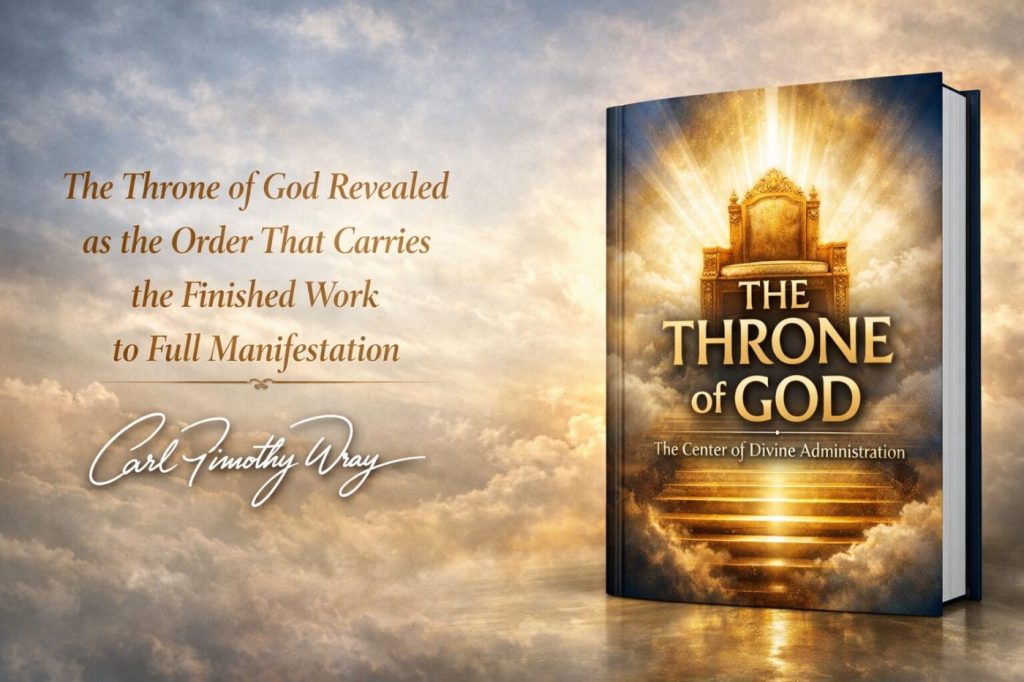
1. Enjoy New Book 2. Download Free PDF Copy
The Throne of God: INTRODUCTION
Much has been written about the Throne of God as a symbol of authority, judgment, or future fulfillment. Yet Scripture presents the Throne not merely as an image to be admired or feared, but as the active center of divine administration governing all things according to God’s eternal purpose. The Throne of God is not distant, suspended in a future age, nor reserved for a final moment of reckoning. It is the present seat from which the finished work of Christ is being carried forward into visible expression.
In recent writings, the Throne of God has been unveiled in its authority, grace, and present reign. This book does not introduce a new vision of the Throne, nor does it seek to expand revelation through complexity. Instead, it brings order to what has already been revealed. It explains how the Throne governs what was settled before time, how it unfolds that settlement through the plan of the ages, how it installs life within creation, and how it administers growth, understanding, and manifestation without contradiction or delay.
Confusion often arises when eternal settlement, historical unfolding, inward life, outward manifestation, and final completion are treated as competing truths rather than coordinated operations. Scripture never presents these as rivals. The Throne of God resolves this confusion by revealing that every stage proceeds from one governing seat, moving steadily and purposefully toward one intended end.
This book presents the Throne of God as the organizing center of divine activity — the place where legal settlement, vital life, revelation, and manifestation are not fragmented doctrines, but ordered expressions of a single finished work. By seeing the Throne in this way, the reader is invited into rest rather than urgency, patience rather than speculation, and assurance rather than confusion. Everything flows from the Throne, and everything is being carried exactly where it was always meant to arrive.
Chapter 1 — The Throne of God: Legal Settlement
The Throne Was Occupied Before Anything Moved
Scripture never presents God reacting to history. From beginning to end, the Throne of God is revealed as the settled center from which all things proceed. Before time unfolded, before ages were measured, before creation breathed, the Throne was already occupied. Nothing about God’s purpose began in response to sin, failure, or delay. Everything began in settled intention.
The Throne of God is not established after events occur. It stands as the place where outcomes are determined before events ever appear.
Legal Settlement Is Determination, Not Delay
The finished work of Christ is not first revealed at the cross; it is revealed through the cross. The cross does not initiate completion — it manifests what was already determined in the heart of God. Legal settlement refers to what is established by authority before it is seen in experience.
In Scripture, legal does not mean abstract or distant. It means sure. It means immovable. It means that what has been decreed cannot be overturned by time, resistance, or appearance. The Throne of God operates first in this realm — not by urgency, reaction, or emotion, but by decree.
Sitting Signifies Completion, Not Waiting
When Christ sat down at the right hand of God, it did not signal the beginning of His reign, but the confirmation of it. Sitting signifies completion. It declares that nothing remains undecided. The Throne does not wait to see how history unfolds; it governs history because the outcome is already known.
Legal settlement means the end was present in the beginning, and the beginning was shaped by the end.
Eternal Completion and Temporal Process Are Not Contradictions
Confusion arises when eternal settlement and historical unfolding are treated as competing truths. Scripture never places contradiction at the Throne — it places order.
What is legally settled does not require immediate visibility. It requires faithful administration. Eternal completion and temporal process are not enemies; they are coordinated operations of the same governing seat.
The Throne Holds Settlement and Process Without Tension
The Throne of God does not confuse settlement with manifestation. What is complete in decree may still be unfolding in time. Judgment does not undo settlement. Delay does not weaken authority. Process does not imply uncertainty.
Legal settlement answers the question: Is the outcome secure?
The Throne answers: Yes.
Nothing that unfolds in time threatens what was established in eternity.
Why Legal Settlement Must Come First
If legal settlement is misunderstood, everything that follows appears unstable. But when the Throne is seen as the place where the work was settled before time, clarity replaces confusion. Peace replaces urgency. Order replaces speculation.
The finished work of Christ can be proclaimed without fear or pressure, because it does not depend on human effort to become true. It depends only on divine administration to become visible.
The Throne Has Already Spoken
The Throne of God does not begin by asking what must be done.
It begins by declaring what has already been decided.
From that declaration, all things move.
Chapter 2 — The Throne of God: The Plan of the Ages
What Is Settled Eternally Is Unfolded Deliberately in Time
The Throne of God does not rush what it has already secured. What is settled in eternity is unfolded in time through order, not delay. The plan of the ages is not evidence that the work is unfinished; it is evidence that the work is being administered wisely.
God did not choose immediacy over maturity. He chose order. The Throne governs not only outcomes, but the means by which those outcomes are revealed.
The Plan Does Not Create Truth — It Reveals It
The plan of the ages does not add to what God has decided. It does not improve the finished work. It reveals what was already complete by bringing it into view progressively.
Seed, blade, ear, and full grain are not stages of uncertainty — they are stages of unveiling. Each stage carries the same life, the same outcome, and the same certainty. The difference is visibility, not reality.
The Throne of God governs revelation by capacity, not by urgency.
Time Is the Servant of the Throne, Not Its Master
Time does not pressure the Throne. The Throne governs time.
Ages exist because God chose order over confusion, patience over haste, and maturity over spectacle. What appears to human observation as delay is, in truth, measured progression. The Throne does not work against time; it works through time.
The plan of the ages is how eternity walks into visibility without distortion.
Why Process Does Not Threaten Completion
Many stumble at this point, assuming that process implies incompleteness. Scripture never makes that assumption. Completion belongs to decree. Process belongs to administration.
A building may be legally completed on paper before a single stone is laid. The construction does not question the design; it fulfills it. In the same way, the plan of the ages does not question what God has settled. It carries it forward.
The Throne holds completion and process without tension.
Law, Grace, and Fullness Are Administrative Movements
The ages are not competing covenants fighting for relevance. They are coordinated movements of one governing Throne.
- Law prepared the vessel
- Grace installed the life
- Fullness reveals the manifestation
None of these contradict the finished work. Each serves it.
The Throne of God administers each age according to purpose, not preference.
Why the Throne Chooses Order Over Instant Manifestation
Instant manifestation would bypass formation. Formation is not delay; it is preparation.
The Throne is not interested in producing displays — it is interested in producing sons. Sons require growth, understanding, and alignment. The plan of the ages provides the environment where life can mature without being forced.
What is forced fractures.
What is administered endures.
The Plan Guarantees the Outcome Without Rushing the Process
The plan of the ages answers a different question than legal settlement.
Legal settlement answers: Is the outcome secure?
The plan answers: How will it be revealed without distortion?
The Throne ensures that nothing arrives prematurely and nothing fails to arrive at all.
The Throne Is Never Behind Schedule
From the Throne’s perspective, nothing is late. Nothing is early. Everything is on time.
What God settled before time is appearing exactly as intended. The ages are not obstacles to completion; they are the path by which completion becomes visible, inhabitable, and permanent.
The Throne of God governs the ages so that what was finished eternally can be revealed faithfully.
Chapter 3 — The Throne of God: Vital Life
The Throne Does Not Merely Decree — It Installs Life
The Throne of God does not govern creation from a distance. What is settled legally and unfolded through the plan of the ages is not left external to the vessel. The Throne installs life. Vital life is the means by which the finished work moves from decree into living reality.
The purpose of the Throne has never been to manage creation through command alone, but to fill creation with life that carries the command within itself. Vital life is not information about Christ; it is Christ Himself indwelling.
Vital Life Is the Finished Work Made Internal
The finished work of Christ is not complete merely because it is declared true. It is complete because it is imparted as life. Vital life is the finished work taking residence within the vessel.
This is where many misunderstand the nature of divine completion. They assume that if something is finished, it must already be visible. Scripture teaches otherwise. What is finished legally is first installed vitally. Visibility follows installation, not the other way around.
The Throne governs this movement with precision.
Life Precedes Expression
Vital life is present before it is expressed. The seed contains the full tree long before branches appear. In the same way, the indwelling Christ contains the fullness of God long before that fullness is manifested outwardly.
The Throne of God does not measure reality by appearance. It measures reality by life. Where life has been installed, the outcome is already certain, even if the expression has not yet appeared.
Life does not announce itself.
It grows.
Why Indwelling Must Come Before Administration
The Throne never administers what it has not first installed. Government follows life, not effort. Authority flows from nature, not position.
If Christ were only declared from heaven and not imparted within, administration would require external control. But because life is installed, administration becomes internal, gentle, and precise.
Vital life is what makes divine government possible without coercion.
Vital Life Is Not the End — It Is the Beginning of Government
Receiving life is not the same as manifesting authority. Vital life does not instantly produce maturity; it produces capacity. Capacity is what the Throne administers next.
This is why Scripture speaks of growth, increase, transformation, and renewal. These are not signs of incompletion; they are signs that life is present and active.
The Throne does not rush life into visibility. It allows life to take root.
Why Many Confuse Life With Manifestation
Confusion arises when life and manifestation are treated as the same operation. When manifestation does not appear immediately, people question whether life is present at all.
The Throne never makes that mistake.
Life can be fully present while expression is still forming. The absence of manifestation does not mean the absence of life. It means administration has not yet completed its work.
The Throne Guards Life Until It Is Ready to Be Seen
The Throne of God protects what it installs. Life is often hidden before it is revealed, not because it is weak, but because it is precious.
Vital life grows quietly under the watchful administration of the Throne, forming stability, alignment, and capacity. What emerges prematurely fractures. What emerges under order endures.
Life Makes Manifestation Inevitable, Not Forced
Vital life guarantees manifestation without forcing it. What is alive will grow. What grows will mature. What matures will appear.
The Throne does not command life to manifest before it is ready. It administers conditions in which manifestation becomes natural.
Life does not strive.
Life unfolds.
The Throne Has Already Installed What It Will Later Reveal
The presence of vital life means the future is already present in seed form. The Throne is not waiting to add something later. It has already placed within creation everything needed to reach the intended end.
What remains is not addition, but administration.
Chapter 4 — The Throne of God: Divine Administration
Administration Is How the Throne Governs What It Has Installed
The Throne of God does not abandon what it has settled, planned, and installed. Divine administration is how the Throne actively governs life once it has been imparted. Administration is not interruption; it is continuation. It is the steady oversight that ensures life matures without distortion.
Where legal settlement establishes certainty, and vital life establishes presence, administration establishes order. The Throne does not merely decree outcomes — it governs the path by which those outcomes are realized.
Administration Is Not Control — It Is Care
Divine administration is often misunderstood as control or restriction. Scripture presents it differently. Administration is care applied with authority. It is the Throne ensuring that life grows according to purpose rather than impulse.
Correction, discipline, judgment, and adjustment are not signs of failure. They are signs that life is present and valuable. The Throne administers because it intends to preserve what it has installed.
What is ignored decays.
What is administered matures.
Why Life Requires Administration
Life left to itself does not mature into fullness. Growth requires order, timing, and direction. The Throne administers life so that it develops capacity, stability, and alignment.
Without administration, life may exist, but it will not govern. Divine administration transforms life from mere presence into functioning authority. This is how sons are formed — not through urgency, but through oversight.
The Throne governs life patiently, not forcefully.
Judgment as an Expression of Administration
Judgment, when seen from the Throne, is not punishment — it is discernment applied to preserve life. Divine judgment separates what aligns with purpose from what hinders it. It removes distortion so that life can continue unhindered.
Judgment does not threaten the finished work. It serves it. The Throne judges not to destroy what it has installed, but to protect it.
Administration always works toward increase, never annihilation.
Why Administration Precedes Revelation
Revelation without administration produces confusion. Understanding must be carried by capacity. The Throne administers growth before unveiling clarity.
This is why many truths are hidden until the vessel is prepared to carry them. The Throne withholds nothing out of secrecy, but out of wisdom. Revelation arrives when administration has formed stability.
Order always precedes illumination.
Administration Is Continuous, Not Seasonal
Divine administration does not occur only in moments of crisis. It is constant. The Throne governs every stage of growth, every adjustment, and every transition.
The absence of visible intervention does not mean the absence of administration. Much of the Throne’s work is quiet, internal, and unseen — yet precise.
The Throne never abdicates its role.
Why Administration Is the Turning Point
This chapter stands at the center because administration connects life to manifestation. Without it, life remains internal and unexpressed. With it, life is shaped into authority.
Administration is where the Throne ensures that what is alive becomes functional, what is functional becomes stable, and what is stable becomes visible.
This is where the inward work becomes ready to appear.
The Throne Governs Without Hurry
The Throne of God does not accelerate administration to satisfy observation. It governs according to readiness. Readiness, not desire, determines progression.
What matures under administration will not collapse under manifestation.
Administration Guarantees the Outcome
Divine administration answers the question: How does the Throne ensure nothing fails?
The answer is simple:
Nothing is left unmanaged.
The Throne oversees every stage between installation and appearance, ensuring that what was settled before time reaches full expression without loss, distortion, or contradiction.
Chapter 5 — The Throne of God: Revelation
Revelation Is Recognition, Not Information
Revelation does not introduce something new. It recognizes what is already present. The Throne of God does not reveal truth to create reality, but to unveil reality that has already been established, installed, and administered.
Understanding follows order. What has been governed internally can now be perceived consciously. Revelation is not sudden insight detached from life; it is clarity that arises when life has been prepared to carry it.
Why Revelation Follows Administration
The Throne never reveals what the vessel cannot yet bear. Revelation is entrusted to capacity, not curiosity. Administration forms the capacity; revelation fills it.
Without administration, revelation produces imbalance. Insight without formation leads to pride, confusion, or fragmentation. The Throne governs revelation carefully, ensuring that what is seen can be held without distortion.
Order always precedes illumination.
Seeing Is Governed by the Throne
Scripture consistently teaches that seeing is not a function of intelligence, education, or effort. Seeing is granted. Revelation comes from the Throne.
Eyes are opened when the Throne determines readiness. This is why two people can hear the same words and perceive entirely different realities. Revelation is not withheld arbitrarily; it is administered wisely.
The Throne governs sight.
Revelation Does Not Change Truth — It Changes Perception
Truth does not become true when it is revealed. It was true before it was seen. Revelation does not improve the finished work; it clarifies it.
When revelation comes, nothing new is added. What changes is understanding. Confusion dissolves, contradiction resolves, and fragments fall into place. Revelation brings coherence, not novelty.
The Throne reveals to settle, not to excite.
Why Revelation Is Often Quiet
True revelation rarely announces itself. It brings calm rather than urgency. When understanding arrives from the Throne, it does not provoke haste; it produces rest.
Clarity does not shout. It stabilizes.
This is why revelation can be overlooked by those expecting spectacle. The Throne does not compete for attention. It unveils truth in a way that invites alignment, not reaction.
Revelation Is Given to Sustain Order
The purpose of revelation is not to create movements or divisions, but to sustain divine order. What the Throne reveals strengthens patience, confirms process, and deepens trust.
Revelation aligns the inner life with the outward unfolding. It allows the vessel to cooperate with administration rather than resist it. Understanding becomes a partner to governance.
Why Revelation Does Not Equal Manifestation
Seeing is not the same as appearing. Revelation precedes manifestation, but it does not force it. Understanding prepares the vessel for visibility, but does not rush it.
The Throne reveals so that manifestation, when it comes, is stable rather than sudden. What is understood inwardly will not collapse outwardly.
Revelation Produces Agreement, Not Pressure
When revelation comes from the Throne, it produces agreement with God’s order. Pressure to perform disappears. Anxiety about timing fades. The soul aligns with what the Throne is already doing.
Revelation does not ask, “How can I make this happen?”
It says, “Now I understand what is happening.”
The Throne Reveals What It Is Ready to Bring Forth
Revelation is the quiet signal that administration has done its work. What is seen can soon be expressed, not because it is forced, but because it is prepared.
The Throne does not reveal prematurely. It reveals precisely.
Understanding Is the Final Preparation for Appearance
Revelation marks the final inward stage before manifestation. Once understanding is established, resistance gives way to cooperation. The vessel no longer fights the process; it trusts it.
Seeing completes the inward work.
Chapter 6 — The Throne of God: Manifestation
Manifestation Is Appearance, Not Achievement
Manifestation is not something the vessel produces. It is something that appears when preparation is complete. The Throne of God does not command manifestation through effort or urgency. It allows manifestation to emerge when life, order, and understanding have reached maturity.
What appears was already present. Manifestation does not add reality; it reveals it.
Why Manifestation Comes Last
Manifestation follows legal settlement, planning, vital life, administration, and revelation for a reason. Visibility without preparation fractures. Appearance without order collapses.
The Throne never brings something into view before it can stand. Manifestation is the final inward work becoming outwardly evident, not the beginning of the work.
Order precedes visibility.
Manifestation Is Governed, Not Forced
The Throne does not accelerate manifestation to satisfy observation or expectation. What is forced may appear impressive, but it will not endure. What is administered appears quietly and remains.
True manifestation carries weight because it rests on what has already been settled and formed. It does not require defense, explanation, or maintenance through effort.
It simply is.
Why Manifestation Often Appears Suddenly
To the observer, manifestation may seem sudden. In reality, it is the result of long, unseen preparation. When alignment is complete, visibility requires no delay.
Sudden appearance is not haste; it is readiness revealed.
The Throne moves swiftly only when nothing remains unfinished.
Manifestation Is the Throne Making the Invisible Visible
Manifestation is the Throne allowing what was governed internally to be expressed outwardly. It is heaven and earth agreeing without resistance.
This is why manifestation is not dramatic. It is natural. What has been ruled inwardly now functions outwardly.
The Throne does not showcase power.
It releases order into view.
Why Manifestation Does Not Belong to the Impatient
Impatience seeks appearance without formation. The Throne never responds to impatience. It responds to readiness.
What appears prematurely must be sustained artificially. What appears under divine administration sustains itself.
The Throne values permanence over immediacy.
Manifestation Reveals Sonship, Not Performance
What manifests is not ability, gifting, or display — it is sonship. Manifestation reveals maturity, alignment, and authority that no longer need supervision.
The Throne does not manifest servants striving to perform. It manifests sons who govern by nature.
Manifestation Is Cooperative, Not Competitive
True manifestation does not compete for recognition. It does not displace others. It does not announce superiority.
It simply occupies the space prepared for it.
What comes from the Throne does not need comparison.
Why Manifestation Does Not End the Work
Manifestation is not the conclusion of God’s purpose; it is the beginning of function. What appears is now able to participate consciously in divine administration.
Manifestation does not end dependence on the Throne — it deepens it.
The Throne Manifests What It Intends to Keep
The Throne does not manifest what it plans to discard. What appears has already passed through every necessary stage of formation.
This is why manifestation under the Throne is irreversible.
Manifestation Is the Evidence of Order Completed
Manifestation answers the question: When does the finished work become visible?
The answer is simple:
When nothing remains out of order.
The Throne of God reveals what has fully aligned.
Chapter 7 — The Throne of God: God All in All
The Throne Governs Toward One End
The Throne of God has never governed toward endless process. From the beginning, its administration has been moving steadily toward a defined conclusion. That conclusion is not escape, replacement, or abandonment of creation. It is fullness.
God all in all is not a new phase introduced at the end of history. It is the original intention now fully realized. The Throne governs every stage so that what God began in purpose is completed in expression.
God All in All Is Completion, Not Cancellation
Completion does not mean that creation disappears. It means that nothing remains outside of divine life and order. God all in all is not God replacing creation, but God filling creation.
What the Throne settles, plans, installs, administers, reveals, and manifests is not temporary. It is enduring. The end does not undo the beginning; it fulfills it.
Nothing is discarded.
Everything is filled.
Why Administration Has an End
Divine administration exists because there is something still coming into alignment. When alignment is complete, administration has achieved its purpose.
God all in all marks the point where nothing resists divine life, nothing contradicts divine order, and nothing operates independently of the Throne. Government does not cease — it is no longer needed in corrective form.
Administration gives way to harmony.
The Throne Does Not Rule Forever Against Resistance
The Throne of God does not exist to perpetually subdue opposition. It exists to transform opposition into agreement. Judgment, correction, and discipline are temporary functions serving an eternal outcome.
God all in all means that every enemy has been overcome not by destruction, but by absorption into life. Death is not managed forever; it is abolished.
The Throne governs until nothing remains out of order.
Why God All in All Is the Measure of Success
Success is not defined by how long God rules, but by what His rule produces. Eternal rulership that never achieves harmony would be endless administration without completion.
The Throne measures success by fullness. When God is all in all, nothing remains incomplete, unresolved, or fractured. The work is not merely finished in decree — it is finished in experience.
The Throne and the Sons Share the Same End
Sons are not manifested to replace God’s rule, but to express it. When God becomes all in all, sons do not disappear — they are fulfilled.
What the Throne has produced through life, order, and manifestation now functions effortlessly. Authority no longer needs enforcement. Righteousness no longer needs correction. Life no longer needs protection.
Everything simply is.
Why Rest Is the Final Expression of Authority
Rest is not inactivity. It is completion without tension. God all in all is the ultimate rest — not because nothing exists, but because nothing resists.
The Throne rests because its purpose has been achieved. Creation rests because it is fully aligned. Rest is the final proof that administration has succeeded.
God All in All Reveals the Nature of the Throne
The Throne of God was never about control. It was about completion. From legal settlement to final fullness, the Throne has governed patiently, precisely, and without haste.
What began in certainty ends in harmony.
The Throne Remains — Its Work Complete
Even when administration reaches its intended end, the Throne remains. Authority does not vanish; it is no longer opposed.
God all in all does not mean the absence of the Throne. It means the Throne is fully expressed everywhere.
The End Matches the Beginning
What God intended before time is now visible in fullness. The beginning and the end agree. Nothing has been lost along the way.
The Throne of God has carried the finished work of Christ from eternal settlement to complete manifestation — and now, God is all in all.

The Throne of God Series: By Carl Timothy Wray
- The Throne of God
- The Throne of God — The Supreme Center of Divine Administration
- The Throne of God — Grace, Judgment, and the River of Life Governing Through Administration
- The Throne of God — Governing Through Administration
- The Throne of God — One Throne, One Administration
- Throne of God Meaning
- Join Our Facebook Page