The Throne of God Explained Through the Finished Work of Christ and the Full Counsel of God
Author
By Carl Timothy Wray
Carl Timothy Wray is a teacher and writer devoted to unveiling the Finished Work of Christ through the Full Counsel of God, harmonizing Scripture from Genesis to Revelation without contradiction or division. His writings focus on restoring clarity where religious systems have fractured truth—revealing one unified mind of God, one redemptive purpose, and one divine administration governing all things through Christ. With a particular emphasis on the Book of Revelation, the Throne of God, and the consummation of God’s eternal plan, Wray’s work calls readers out of fear-based theology and into the settled authority of Christ’s completed victory.
The Throne of God is not a distant symbol of future judgment, nor a fragmented concept divided into separate thrones of grace, condemnation, and final reckoning. Scripture reveals one Throne, one seat of authority, and one divine administration governing all creation. From this single Throne flow grace, judgment, righteousness, and life—administered through the Finished Work of Christ and revealed progressively through the Full Counsel of God. The Great White Throne is not a contradiction of grace, but the same Throne fully unveiled after Christ’s victory, where judgment proceeds from accomplished redemption, not unresolved wrath. To understand the Throne rightly is to see that God has never ruled in fragments, never judged apart from mercy, and never administered His kingdom outside of Christ.
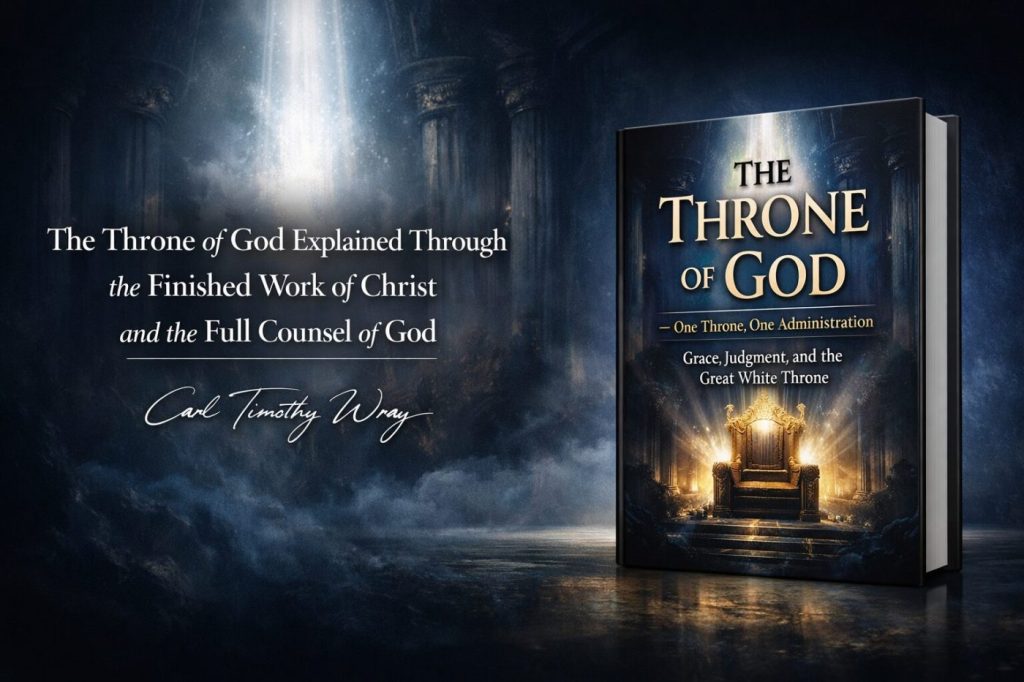
The Throne of God: INTRODUCTION
Few subjects in Scripture have been more misunderstood—or more fragmented—than the Throne of God. For generations, believers have been taught to view the Throne as a shifting seat: gracious in one passage, severe in another, merciful now but terrifying later. The Throne of Grace is preached as an invitation, while the Great White Throne is feared as a separate tribunal altogether. Yet this divided vision does not come from Scripture; it comes from reading Scripture without the Full Counsel of God.
The Bible never presents multiple thrones competing for authority. It reveals one Throne set in heaven—unchanging, eternal, and absolute. What changes is not the Throne, but humanity’s relationship to it. Under the Old Covenant, the Throne appeared as judgment. Through the Finished Work of Christ, that same Throne is approached as grace. And at the consummation of the ages, it is revealed as the Great White Throne—not to undo redemption, but to administer its final victory.
This book is written to restore coherence where theology has introduced contradiction. It does not soften judgment, nor does it diminish holiness. Instead, it places judgment back where Scripture places it: inside the victory of Christ, administered by the Lamb who was slain, and governed by the same Throne from which the river of life flows. By tracing the Throne of God through the Finished Work of Christ and the Full Counsel of God, this study reveals grace, judgment, and the Great White Throne as expressions of one divine administration—working toward one end: God all in all.
Chapter 1
The Throne of God — The Supreme Center of Divine Administration
Before grace can be understood, before judgment can be interpreted, and before the Great White Throne can be approached without fear, one truth must be settled beyond debate: there is only one Throne. Scripture does not reveal a collection of divine seats competing for authority, nor does it present God as ruling from different positions depending on the age. From Genesis to Revelation, the testimony is consistent—one Throne governs all things.
The Throne of God is the supreme center of divine administration. It is not merely a symbol of sovereignty, nor a poetic image used to inspire reverence. It is the governing seat from which God orders creation, executes His purpose, and administers life, righteousness, and judgment throughout the universe. Every act of God—whether mercy or correction, patience or judgment—flows from this single, unchanging seat.
When John writes, “Behold, a throne was set in heaven, and One sat on the throne,” he is not describing a future installation. He is unveiling an eternal reality. The Throne was not established in Revelation; it is revealed there. Heaven does not scramble for authority, nor does God react to events in time. The Throne is already set, already occupied, and already governing.
The Throne Is Administrative, Not Reactionary
A common error in religious thinking is to treat judgment as God’s response to human failure, as though events on earth force heaven to act. Scripture presents the opposite. The Throne of God is not reactive; it is administrative. God governs according to an eternal plan, not emotional impulse.
Administration implies order, intention, and purpose. From the Throne, God does not merely punish wrongdoing; He governs outcomes. Judgment in Scripture is never arbitrary—it is purposeful, corrective, and aligned with God’s eternal intention. Even when judgment appears severe, it is never detached from God’s overarching goal: the restoration of order, the defeat of death, and the filling of all things with His life.
This is why Revelation consistently presents lightning, thunder, and voices proceeding from the Throne. These are not symbols of chaos, but of active governance. The Throne is not passive. It administers.
One Throne Throughout All Ages
The Throne of God did not change between covenants. What changed was humanity’s access to it.
Under the Old Covenant, the Throne appeared distant, veiled, and fear-inducing—not because God was different, but because man was not yet reconciled. Access was restricted, not due to God’s unwillingness, but due to unfinished redemption. The Throne remained the same; man’s position before it did not.
Through the Finished Work of Christ, the veil was removed—not from the Throne, but from humanity. The same seat once approached with fear is now approached with boldness. This is why Scripture can speak of a Throne of Grace without introducing a new throne. Grace does not relocate God’s authority; it restores man’s access to it.
The Throne of Grace is not a different throne. It is the Throne of God approached through completed redemption.
The Throne as the Source of Life
Revelation reaches its climax not with destruction, but with life flowing from the Throne. “Out of the throne of God and of the Lamb proceeded a river of water of life.” This detail is critical. Life does not flow around judgment; it flows from the same Throne that administers it.
This reveals the heart of divine administration. God does not rule creation through death, but through life. Judgment clears the way; life fills the space. Correction removes what opposes life; grace establishes what endures. The Throne governs both processes without contradiction.
If life flows from the Throne, then judgment cannot be opposed to life. It must serve it.
Why This Foundation Matters
If the Throne is misunderstood at the beginning, everything downstream becomes distorted. Grace becomes sentimental, judgment becomes terrifying, and the Great White Throne becomes a threat rather than a revelation. But when the Throne is established rightly—as one, eternal, administrative seat—Scripture comes into harmony.
This chapter establishes what must never be lost sight of as we proceed: God has never ruled from multiple thrones, never governed with divided intentions, and never administered His kingdom apart from Christ. Grace, judgment, and the Great White Throne are not competing doctrines; they are expressions of one Throne carrying out one finished, victorious administration.
In the next chapter, we will confront the error that has fractured this vision—the idea of divided authority—and show why Scripture leaves no room for a throne that contradicts itself.
Chapter 2
One Throne, Not Many — The Error of Divided Authority
Once the Throne of God is established as the supreme center of divine administration, a single question exposes one of the greatest errors in modern theology: Why has God been presented as ruling from different thrones with conflicting purposes? Scripture never introduces this division. It is the result of interpretation, not revelation.
The idea of multiple thrones—one for grace, one for judgment, and another for final condemnation—did not arise from the Bible itself, but from reading isolated passages without the Full Counsel of God. When Scripture is fragmented, authority is fragmented. When authority is fragmented, fear replaces confidence, and contradiction replaces clarity.
God does not rule in pieces.
How Divided Authority Was Introduced
The separation usually follows a familiar pattern:
- The Throne of Grace is taught from Hebrews as a present, comforting reality.
- The Great White Throne is taught from Revelation as a future, terrifying exception.
- The Throne of God is left undefined—treated as a general symbol rather than an administrative seat.
This creates an unspoken conclusion: God rules one way now and another way later.
But Scripture does not support this conclusion. It contradicts it.
If God’s Throne is eternal, then its nature cannot change. If Christ’s work is finished, then judgment cannot later undo what redemption accomplished. Divided authority quietly implies either an unfinished Christ or a changing God—both of which Scripture explicitly denies.
The Throne Never Contradicts Itself
A throne represents authority, not mood. Governments may change policies, but God’s Throne does not change character. Righteousness and justice are described as the foundation of His Throne—not occasional expressions of it. Mercy does not replace justice, and justice does not cancel mercy. They coexist because they flow from the same seat.
When grace and judgment are separated into different thrones, grace becomes permissive and judgment becomes punitive. But Scripture never defines either that way. Grace is powerful, and judgment is purposeful. Both serve God’s eternal plan, not competing agendas.
This is why Revelation never introduces the Great White Throne as a new authority. It does not say, “another throne appeared.” It says, “I saw a great white throne.” The description changes, not the seat. “Great” speaks to scope. “White” speaks to unveiled righteousness. “Throne” speaks to the same authority already revealed.
Why the Error Persists
The error of divided authority persists because fear-based teaching is easier than unified revelation. It is simpler to scare people with a future tribunal than to teach them how judgment operates within victory. It is easier to preach grace as escape than to explain it as reconciliation to authority.
But Scripture refuses shortcuts.
The same Throne that invites bold access today is the Throne before which all things are ultimately set right. If that were not true, Hebrews and Revelation would be at odds with one another. Instead, they speak from different angles about the same reality.
Grace is not God stepping down from His Throne.
Judgment is not God stepping back onto it.
He never left it.
Christ Settles the Question of Authority
The Finished Work of Christ is the definitive proof that God’s authority is singular and consistent. Christ did not establish a new throne; He sat down. Sitting down signifies completion, not transition. There is no hint in Scripture that Christ will later vacate the Throne of Grace to preside over a different one.
The Lamb who grants access is the same Lamb who administers judgment. This is not a paradox—it is the heart of redemption. Judgment without the Lamb would be terror. Grace without the Throne would be sentiment. United, they form divine administration.
This is why Scripture insists that the Book of Life is present at the Great White Throne. It signals continuity, not contradiction. Redemption remains central even when judgment is unveiled.
The Cost of Divided Authority
When authority is divided in teaching, several distortions follow:
- Believers live confident now but fearful later
- Revelation is read as a reversal instead of a consummation
- Judgment is misunderstood as retaliation instead of restoration
- God is perceived as inconsistent rather than faithful
These distortions do not produce maturity; they produce anxiety.
But when authority is unified, Scripture settles. Grace becomes strong, judgment becomes meaningful, and the future becomes hopeful rather than threatening.
Restoring the Single Throne Vision
The cure for divided authority is not denial of judgment, but proper placement of it. Judgment must be interpreted from the Throne of God, through the Finished Work of Christ, and within the Full Counsel of God. When it is, the contradictions disappear.
There is one Throne.
There has always been one Throne.
And there will never be another.
In the next chapter, we will focus more closely on how this single Throne is approached as the Throne of Grace, and why grace is not the suspension of authority, but humanity’s reconciliation to it.
Chapter 3
The Throne of Grace — Access Through the Finished Work of Christ
The phrase “the Throne of Grace” is often treated as though it represents a different posture of God—a softer version of divine authority introduced in the New Testament. But Scripture never presents grace as a modification of the Throne. It presents grace as a change in access, not a change in government.
The Throne of Grace is not a new throne.
It is the Throne of God approached through completed redemption.
This distinction is essential. If grace alters the Throne, then God’s authority is conditional. If grace alters man’s access, then God’s authority remains absolute while reconciliation becomes possible. Scripture consistently teaches the latter.
Grace Did Not Lower the Throne — It Raised Humanity
Under the Old Covenant, the Throne appeared unapproachable. This distance was not created by God’s unwillingness, but by unfinished redemption. Sin did not weaken the Throne; it disqualified man from standing before it without mediation.
When Hebrews invites believers to “come boldly unto the throne of grace,” it does not imply that judgment has been removed from the Throne. It declares that judgment has already been satisfied. Boldness is possible only because nothing remains unresolved.
Grace is not tolerance.
Grace is clearance.
The cross did not suspend judgment; it exhausted it. The resurrection did not postpone accountability; it established a new standing. Christ did not negotiate a lighter throne; He secured permanent access.
The Finished Work Is the Only Door to the Throne
Access to the Throne of Grace is not based on moral performance, spiritual maturity, or religious activity. It is based entirely on the Finished Work of Christ. This is why Scripture insists that Christ sat down. A seated priest is a finished priest. A seated King is a reigning King.
If Christ’s work were incomplete, access would be temporary. If Christ’s work were partial, boldness would be dangerous. But because redemption is finished, grace is stable. The Throne can be approached without fear because nothing remains to be judged in Christ.
This does not mean the Throne has ceased to judge. It means believers no longer approach it as defendants.
Grace and Authority Are Not Opposites
One of the most subtle errors in theology is the assumption that grace weakens authority. In reality, grace restores relationship to authority. Law restrains behavior from the outside. Grace transforms standing from the inside.
The Throne of Grace is still a Throne. It still governs. It still rules. What has changed is the nature of the relationship between the ruler and the redeemed. Sons do not approach the Throne as criminals awaiting a verdict; they approach as heirs receiving instruction, correction, and life.
Correction under grace is not condemnation.
Authority under grace is not threat.
Judgment under grace is not rejection.
It is administration.
Why the Throne of Grace Must Be Understood Correctly
When the Throne of Grace is misunderstood, two errors emerge. Some treat grace as permission—authority dissolved, judgment dismissed, holiness optional. Others treat grace as temporary—a window that closes when judgment resumes. Both errors fracture Scripture.
Grace is not a pause in judgment, and it is not an escape from authority. It is the means by which authority can be exercised without destroying the one being governed.
This is why the Throne of Grace cannot be separated from the Throne of God. If it were, grace would become a contradiction rather than a fulfillment.
Grace Prepares for Judgment, Not Escape from It
Grace does not eliminate judgment; it prepares creation to endure it. Judgment reveals truth. Grace supplies life to withstand that revelation. Without grace, judgment crushes. With grace, judgment restores.
This is why the same Throne that invites bold access is later described as the Great White Throne. The transition is not from grace to wrath, but from covered righteousness to unveiled righteousness. Those reconciled by grace do not fear unveiling; they are prepared for it.
The Throne of Grace is therefore not opposed to the Great White Throne. It is the necessary condition for understanding it rightly.
Grace Keeps the Throne Central
At no point does grace relocate authority away from God. It never places man on the Throne. It never decentralizes rule. Grace keeps the Throne exactly where it has always been—at the center—while restoring humanity’s ability to live under it without fear.
The Throne of Grace is the Throne of God experienced through Christ. Any teaching that separates them undermines both.
In the next chapter, we will address judgment directly—not as threat, but as function—and show why judgment flowing from the Throne is essential to life, order, and restoration.
Chapter 4
Judgment from the Throne — Purpose, Not Punishment
Judgment is one of the most misunderstood words in Scripture, largely because it has been detached from the Throne that administers it. When judgment is separated from divine administration, it is reduced to punishment. When it is restored to the Throne, it is revealed as purposeful governance.
Judgment does not originate from anger.
It originates from authority.
The Throne of God does not judge to retaliate, but to set things right. Judgment is the means by which God orders reality according to truth. It removes what is false, exposes what is hidden, and corrects what is misaligned—always in service to life, not destruction.
Judgment Is an Act of Government
In Scripture, judgment is a function of rule. Kings judge because they govern. To judge is not to lose control, but to exercise it. This is why the Bible never presents judgment as chaos or reaction. It is deliberate, measured, and aligned with God’s eternal intention.
From the Throne, judgment establishes boundaries, restores order, and resolves what is unresolved. Without judgment, grace would have no direction. Without judgment, life would have no structure. Judgment gives clarity to grace by defining what does not belong.
This is why Scripture declares that righteousness and justice are the foundation of God’s Throne. They are not temporary tools; they are structural realities.
Judgment Is Revealing Before It Is Corrective
Biblical judgment begins with revelation. Light precedes correction. Exposure comes before removal. God does not judge blindly; He judges by truth. This is why judgment is consistently associated with books being opened, deeds being revealed, and truth being brought to light.
Judgment does not create guilt.
It reveals reality.
When judgment exposes darkness, it does so to make room for light. When it confronts lies, it does so to establish truth. Judgment is therefore not opposed to mercy; it is mercy’s ally. Mercy cannot heal what judgment has not revealed.
Judgment Flows from Life, Not Death
One of the most critical misunderstandings about judgment is the assumption that it flows from death. Scripture teaches the opposite. Judgment flows from life.
The Throne from which judgment proceeds is the same Throne from which the river of life flows. This means judgment serves life, not destruction. Death is not God’s tool; it is God’s enemy. Judgment confronts death in order to remove it.
If judgment were destructive by nature, it could not coexist with the river of life. But Scripture insists they proceed from the same Throne, proving that judgment’s ultimate aim is restoration, not annihilation.
Judgment After the Cross Is Not Condemnation
For those in Christ, judgment no longer carries condemnation. This does not mean judgment disappears; it means its relationship to the believer changes. Judgment now operates as fatherly correction, not judicial sentencing.
Condemnation declares guilt and imposes penalty.
Judgment under grace addresses misalignment and produces growth.
The cross settled condemnation once and for all. What remains is administration—truth applied to life in order to mature sons and restore creation. Judgment is therefore not removed from the New Covenant; it is redeemed.
Why Judgment Must Be Understood Before the Great White Throne
If judgment is misunderstood here, the Great White Throne will always be feared later. People fear Revelation 20 because they have been taught that judgment equals punishment. But once judgment is understood as purposeful administration flowing from the Throne of God, fear loses its footing.
Judgment does not undo grace.
It completes its work.
Grace reconciles.
Judgment restores order.
They are not enemies. They are phases of the same administration.
Judgment Serves God’s Final Aim
The goal of judgment is never exclusion for its own sake. It is always alignment with God’s eternal purpose. Scripture consistently points to an end where all things are brought into order, truth reigns, and God is all in all.
Judgment clears what resists that end.
Grace supplies what fulfills it.
Without judgment, evil would remain unresolved. Without grace, judgment would destroy. Together, they accomplish restoration.
A Necessary Reframing
To fear judgment is to misunderstand the Throne. Judgment is not the threat to God’s plan; it is the instrument by which the plan is fulfilled. It is not chaos breaking out at the end of history, but order being fully established.
In the next chapter, we will turn directly to the Great White Throne, not as a departure from grace, but as the final, unveiled expression of the same Throne that has governed all things from the beginning.
Chapter 5
The Great White Throne — Judgment After the Victory
The Great White Throne is often taught as though it appears after grace has failed, as a final emergency measure to resolve what redemption could not. This assumption alone reveals how deeply divided authority has been misunderstood. Scripture never presents the Great White Throne as a reversal of Christ’s work. It presents it as the administration of a victory already secured.
The Great White Throne does not follow defeat.
It follows triumph.
By the time this Throne is revealed, death has been confronted, the accuser has been silenced, and the Lamb has already taken His seat. Nothing unfolds at the Great White Throne to determine whether Christ succeeded. What unfolds is the unveiling and application of what He accomplished.
Why the Throne Is Described as “Great”
“Great” does not describe severity; it describes scope. This judgment is universal in reach, not exceptional in nature. It touches all creation because Christ’s victory touches all creation. A limited redemption would require a limited judgment. A cosmic victory requires a cosmic administration.
The greatness of the Throne is not measured by terror, but by jurisdiction. Nothing stands outside its authority, because nothing stands outside Christ’s finished work. The Great White Throne does not compete with the cross; it enforces its truth.
Why the Throne Is Described as “White”
White speaks of unveiled righteousness. Throughout Scripture, whiteness represents purity, light, and truth without mixture. At the Great White Throne, nothing remains hidden. All masks are removed. All lies are exposed. All works are brought into the light.
This unveiling is not cruel — it is necessary. Truth cannot restore what remains concealed. The whiteness of the Throne signals that judgment has reached its final clarity. There is no more shadow, no more ambiguity, no more confusion.
White does not mean merciless.
It means undeniable.
The Same Throne, Fully Revealed
Scripture does not say that a new throne is erected. It says John saw a Great White Throne. Revelation is not installation; it is unveiling. The Throne that governed through grace is now seen without veils. The Throne that corrected through patience is now revealed in full authority.
Nothing about God’s character changes at this moment. What changes is the environment. Death, deception, and resistance no longer obscure the Throne’s operation. The Great White Throne is the Throne of God seen without obstruction.
The Presence of the Book of Life
One of the most overlooked details in Revelation’s account is the continued presence of the Book of Life. This single fact dismantles the idea that the Great White Throne exists solely for condemnation. Life remains central. Redemption is not erased. Christ is not sidelined.
Judgment proceeds with life still in view.
The Book of Life does not appear as a relic of a previous age; it appears as an active witness. It declares that judgment is occurring in the context of redemption, not apart from it.
Judgment Here Is Final, Not Vindictive
Final does not mean endless punishment; it means no further appeals are needed. Judgment has reached completion. Truth has fully spoken. Everything that can be exposed has been exposed. Everything that can be corrected has been corrected.
The Great White Throne is not God losing patience. It is God finishing administration.
At this point, judgment is not about proving guilt; it is about resolving reality. All things are brought into alignment with truth so that nothing remains unresolved in God’s creation.
Why This Judgment Comes After Victory
Scripture is explicit: the Great White Throne appears after Christ’s reign has subdued all enemies, including death. Judgment does not defeat death; it confirms its defeat. Judgment does not fight rebellion; it ends it by removing every lie that sustained it.
This is judgment as consummation, not conflict.
If the Great White Throne preceded victory, fear would be justified. But because it follows victory, fear is misplaced. What remains is order, clarity, and final reconciliation of reality to truth.
Judgment Completes Grace’s Work
Grace reconciles relationship.
Judgment reconciles reality.
Grace brings humanity into right standing.
Judgment brings creation into right order.
The Great White Throne does not undo grace — it completes its purpose. Grace prepares creation to stand in unveiled truth. Judgment ensures that nothing contrary to truth remains.
A Throne Worth Trusting
Only a righteous God could unveil judgment after victory. Only a faithful God could allow everything to come into the light without fear of exposure. The Great White Throne is not something to dread; it is something to trust.
It declares that God finishes what He starts.
It declares that nothing remains broken forever.
It declares that truth ultimately governs all things.
In the next chapter, we will step back and view this Throne through the Full Counsel of God, showing how Genesis, the prophets, the apostles, and Revelation have always spoken with one voice concerning God’s administration.
Chapter 6
The Full Counsel of God — One Mind from Genesis to Revelation
The greatest safeguard against doctrinal error is not intensity of belief, but continuity of revelation. Scripture itself insists that truth must be established by the whole witness of God’s Word, not by isolated passages elevated beyond their context. This is what Scripture calls the Full Counsel of God—one divine mind expressed progressively, never contradicting itself, never reversing course.
The Throne of God can only be understood correctly when it is traced through this full counsel. When Genesis, the prophets, the apostles, and Revelation are allowed to speak together, the illusion of divided authority disappears. God has never ruled one way in the beginning, another in the middle, and a third way at the end. His administration has always been unified, even when revelation was partial.
The Throne in Genesis — Authority Before Sin
The Bible opens with God reigning, not reacting. Creation itself unfolds under authority, order, and purpose. God speaks, and reality responds. This is Throne language. Long before sin enters the picture, God is already governing, naming, assigning boundaries, and establishing life.
This matters because it proves that judgment is not a response to sin alone. Authority predates the fall. Order predates rebellion. The Throne of God is not defined by human failure—it is defined by divine purpose.
Even the first judgment in Eden is administrative, not vindictive. It addresses consequence, preserves life, and points forward to redemption. The Throne is already governing toward restoration before redemption is fully revealed.
The Throne in the Prophets — Judgment with a Redemptive Aim
The prophets never speak of judgment as God abandoning His people. Even in the strongest language, judgment is always framed as correction, refinement, and preparation for restoration. God judges in order to heal. He exposes in order to cleanse. He removes in order to plant again.
This prophetic pattern reveals something crucial: judgment always serves covenant. God never judges to end relationship, but to restore it on truthful terms. The Throne remains faithful even when people are unfaithful.
The prophets consistently look beyond judgment to renewal—new hearts, restored cities, healed nations, and a reconciled creation. This forward vision proves that judgment is not the end of God’s story; it is the means by which the story moves toward fulfillment.
The Throne in the Apostles — Authority Reconciled Through Christ
The apostles proclaim something radically new, yet perfectly consistent: the Throne has been approached, not avoided. Through Christ, authority is no longer distant. The One who rules has reconciled humanity to Himself.
Paul never presents grace as a suspension of judgment. He presents it as judgment fulfilled and relationship restored. Christ absorbs condemnation so that administration can continue without destroying the governed. This is why Paul speaks so freely about reigning, authority, correction, and accountability alongside grace.
The apostolic witness insists that Christ now reigns. He is not waiting for authority; He exercises it. The Throne is active, present, and governing—administered by the risen Christ who has already triumphed.
The Throne in Revelation — Authority Fully Unveiled
Revelation does not introduce a new God or a new government. It unveils what has always been true. What was hinted at in Genesis, spoken by the prophets, and clarified by the apostles is now revealed without veil.
The Throne dominates Revelation not as a threat, but as a stabilizing center. Amid seals, trumpets, and bowls, the Throne remains steady. Chaos does not rule the narrative; authority does. Judgment unfolds in ordered sequences, never randomly, never outside divine control.
This final unveiling confirms that God’s administration has never been fragmented. The same Throne that governed creation governs consummation. The same authority that initiated life completes it.
Why the Full Counsel Matters for Judgment
Without the Full Counsel of God, judgment becomes distorted. It can be exaggerated, minimized, weaponized, or feared. But when judgment is interpreted through the entire witness of Scripture, it regains its proper role.
Judgment:
- aligns creation with truth
- removes what resists life
- completes what grace begins
- prepares the way for God to be all in all
This is not speculative theology. It is the consistent testimony of Scripture when read as one unified revelation.
One Throne, One Mind
The Full Counsel of God reveals one mind governing all ages. God has not spoken in fragments, and He does not rule in phases that contradict one another. The Throne of God stands as the unifying center of Scripture, ensuring that grace, judgment, and consummation are understood as movements within one divine administration.
In the final chapter, we will look at the ultimate outcome of this administration—not endless conflict, but completion—where the purpose of the Throne is fully realized and God becomes all in all.
Chapter 7
One Throne, One Administration — God All in All
Every administration exists for an outcome. Governments rule toward order. Authority functions toward completion. The Throne of God is no different. From the beginning, God has not ruled endlessly without purpose; He has governed toward fulfillment. Scripture gives that fulfillment a name: God all in all.
This is not poetic language. It is the stated end of divine administration.
The Throne of God does not exist to perpetuate judgment, maintain distance, or sustain conflict. It exists to bring all things into alignment with truth, life, and union. Grace initiates that alignment. Judgment perfects it. The Great White Throne confirms it. And when that work is complete, administration reaches its goal—not abolition, but fulfillment.
Administration Ends in Rest, Not Exhaustion
One of the great misunderstandings about divine rule is the assumption that God governs forever because something is perpetually wrong. Scripture teaches the opposite. God governs because something is being finished.
From creation onward, God works toward rest. Rest is not inactivity; it is completion without resistance. When Scripture speaks of rest, it speaks of a state where nothing opposes God’s life, truth, or order.
The Throne governs until resistance is gone—not because authority weakens, but because authority has fully accomplished its purpose.
God Does Not Remain “All in All” by Force
God being all in all does not mean God overwhelms creation into submission. It means creation is brought into harmony with God’s life. Authority does not disappear at the end; it becomes uncontested.
When judgment finishes its work, nothing remains that contradicts truth. When grace finishes its work, nothing remains unreconciled. When administration finishes its work, nothing remains disordered.
This is not domination.
This is fulfillment.
The Throne and the Lamb Remain Central
Even at the consummation, Scripture does not remove the Throne. It removes opposition. The Throne remains because life remains ordered. The Lamb remains because redemption remains the foundation of everything.
The river of life continues to flow. The nations are healed. Light replaces darkness entirely. This is not the erasure of government; it is government fully expressed as life.
The Throne is no longer perceived as threat because nothing remains misaligned. Authority is no longer feared because nothing remains unresolved.
Judgment Has Done Its Work
At this point, judgment is not ongoing conflict; it is completed clarity. Everything has been exposed. Everything has been addressed. Everything has been reconciled to truth.
Judgment does not linger because judgment has achieved its purpose. Grace does not retreat because grace has succeeded. The Great White Throne does not loom because it has finished unveiling.
What remains is order without resistance.
Why This Vision Matters Now
If the end of God’s administration were endless punishment, fear would be reasonable. If the end were endless judgment, hope would be misplaced. But Scripture reveals something far greater: an administration that finishes well.
God does not rule forever because He cannot resolve His creation.
He rules until His creation is resolved.
This vision removes anxiety from the future and stability from the present. It allows believers to live confidently under authority rather than nervously beneath it. It restores trust in God’s governance and coherence to Scripture.
The Throne Stands — The Work Is Complete
From the first declaration of authority in Genesis to the final unveiling in Revelation, Scripture speaks with one voice: one Throne, one administration, one purpose.
Grace was never opposed to judgment.
Judgment was never opposed to life.
The Great White Throne was never opposed to Christ.
They were all expressions of one Throne carrying creation to completion.
And when that completion is reached, God is not merely ruling over all things—He is filling all things.
This is the end of divine administration:
not distance,
not fear,
not endless conflict,
but fullness.
God all in all.
The Throne of God: By Carl Timothy Wray

The Throne of God Series
- The Throne of God
- The Throne of God — The Center of Divine Administration
- The Throne of God — The Supreme Center of Divine Administration
- The Throne of God — Grace, Judgment, and the River of Life Governing Through Administration
- The Finished Work of Christ: Meaning, Key Scriptures & FAQs
- Join Our Facebook Page