 📺
📺
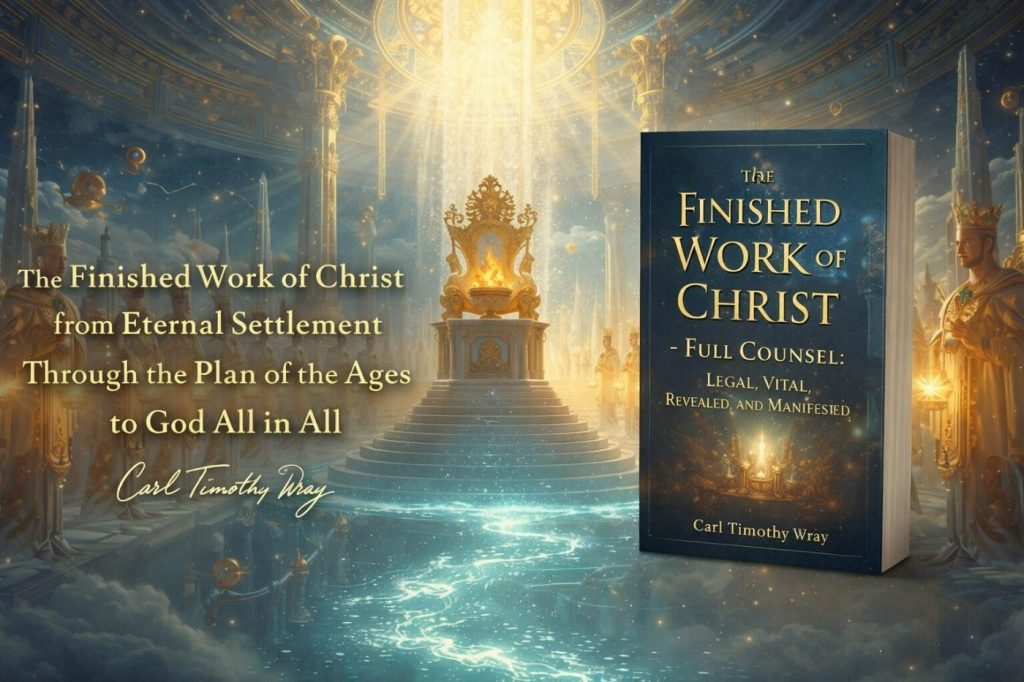
The Finished Work of Christ from Eternal Settlement Through the Plan of the Ages to God All in All
The Finished Work of Christ: AUTHOR
By Carl Timothy Wray
Carl Timothy Wray is a teacher devoted to unveiling the finished work of Christ through the full counsel of God. His writings distinguish between what was eternally settled in God before the foundation of the world and how that finished work is brought into life, expression, and manifestation through the plan of the ages. With clarity and precision, he exposes incomplete interpretations of the finished work and restores the divine order that leads to God’s ultimate purpose—God all in all. His teaching calls believers out of confusion and into rest by revealing not only what God finished, but how He brings it into reality.
- Finished Work of Christ: New Book: 2. Finished Work of Christ: Download PDF Copy 3. Finished Work of Christ: Read Series
The Finished Work of Christ: INTRODUCTION
The finished work of Christ is often spoken of, but rarely taught in its full scope. Many proclaim what was finished before the foundation of the world, yet stop short of explaining how that eternal settlement is brought out of the invisible realm of God’s heart and made visible, functional, and manifest in His universe. As a result, the finished work is treated as a static decree rather than a living purpose unfolding according to divine order.
Scripture reveals that God did not only finish His work in eternity—He also designed a way to bring that finished work into reality. What was legally settled in heaven was never meant to remain hidden. God framed the plan of the ages as His ordained method for moving what was invisible into the visible, what was intangible into the tangible, and what was promised into living expression. The legal establishes certainty; the vital brings that certainty into life.
This book exists to restore the full counsel of God concerning the finished work of Christ. It makes clear distinctions between what was settled in God’s heart, the divine process by which it is revealed, and the manifestation of that work throughout creation. The finished work is not complete when only the eternal decree is seen; it is complete when the decree, the plan, and the manifestation are understood together.
From eternal settlement, through the plan of the ages, into vital expression, Scripture moves toward one unchanging goal—the fulfillment of God’s total ambition: God all in all. This book takes the reader through that entire journey, not as theory, but as ordered revelation, showing how the finished work of Christ governs history, transformation, creation, and the final harmony of all things in Him.
CHAPTER 1 — What Was Finished Before the Foundation of the World
Before creation existed, before time began to unfold, before heaven and earth were formed, God settled His work within Himself. Scripture does not present the finished work of Christ as something God decided after sin appeared, nor as a response to failure in creation. It presents redemption as an eternal conclusion established in God before anything was ever made.
This is the legal foundation of the finished work of Christ.
“Known unto God are all His works from the beginning of the world.”
God did not discover His works in time. He did not adjust His plan based on human behavior. He did not wait to see what creation would do before determining what He would do. The finished work of Christ was settled in God’s heart before the foundation of the world—complete, whole, lacking nothing.
This is why Scripture can speak of Christ as “the Lamb slain before the foundation of the world.” This statement is not metaphorical language. It is eternal language. It tells us that redemption was not conceived at the cross—it was revealed at the cross. The cross did not originate the finished work; it manifested what had already been settled in God.
From eternity, God spoke from completion.
Before sin entered the world, sin had already been addressed.
Before death appeared, death had already been judged.
Before humanity fell, reconciliation had already been purposed.
This is the legal side of the finished work of Christ—the side that establishes certainty apart from experience, manifestation, or time. Legal does not mean impersonal; it means final. What God settled in eternity was not provisional, conditional, or subject to revision. It was determined, decreed, and secured in Christ.
This is why the New Covenant speaks in past-tense language:
He hath blessed us.
We have been reconciled.
We have been raised together.
We have been seated in heavenly places.
These are not aspirational statements. They are not goals humanity is striving toward. They are declarations spoken from God’s eternal vantage point. God speaks from where the work is already finished, not from where it is still appearing.
However, this is where confusion often begins.
Many hear that the finished work of Christ was settled before the foundation of the world and assume that this alone constitutes the complete revelation. But eternal settlement, by itself, is not God’s total counsel. What was settled in God’s heart was never intended to remain hidden there. God did not finish His work only to leave it unrealized in creation.
Eternal settlement establishes truth.
It does not fulfill purpose.
Purpose requires expression.
God’s intention was not merely to decree redemption, but to bring that decree out of the invisible realm of His heart and into visible, functioning reality within His universe. What was legally finished in eternity had to be revealed, embodied, and manifested in time.
This is why the finished work of Christ cannot be reduced to what was settled before the foundation of the world alone. That is the beginning—but it is not the whole counsel. Without understanding how God brings what was settled into life, the finished work remains abstract, misunderstood, and incomplete in the minds of men.
God does not speak from eternity to cancel time.
He speaks from eternity to govern time.
The eternal decree establishes the destination.
Time exists to bring creation into alignment with that destination.
This chapter establishes the immovable foundation: the finished work of Christ was fully settled in God before time began. Nothing in creation initiated it, altered it, or threatens it. But settlement alone is not God’s end goal. Settlement is the source—not the outcome.
What was hidden in God’s heart must be revealed.
What was settled legally must become vital.
What was invisible must become visible.
Understanding this legal foundation is essential, because everything that follows—the plan of the ages, vital manifestation, the full counsel of God, and God all in all—rests upon it. If the work was not truly finished in eternity, nothing that unfolds in time can be trusted. But because it was finished, everything that unfolds is secure.
The finished work of Christ began in eternity.
But it does not end there.
That brings us to the next question—one Scripture answers clearly:
How does God bring what was finished in eternity into reality within creation?
That answer is found in the plan He Himself designed.
The plan of the ages.
CHAPTER 2 — The Plan of the Ages: God’s Method of Bringing the Finished Work into Reality
If the finished work of Christ was fully settled in God before the foundation of the world, the next question must be asked honestly:
Why does history exist at all?
Time was not created because the work was unfinished.
The ages were not designed to fix a problem.
History is not God improvising.
Time exists because God had a purpose—to bring what was settled in eternity out of the invisible realm of His heart and into visible, living, functioning reality within His universe. The plan of the ages is not evidence of delay; it is evidence of design.
This is the great misunderstanding surrounding the finished work of Christ.
Many assume that if something is finished, it should immediately appear in full manifestation. But Scripture never presents God that way. God finishes first—then He reveals. He settles truth—then He unfolds it. He establishes reality—then He brings creation into alignment with it.
This unfolding is what Scripture calls the plan of the ages.
“And to make all men see what is the fellowship of the mystery, which from the beginning of the world hath been hid in God… according to the eternal purpose which He purposed in Christ Jesus our Lord.”
Notice the order.
The purpose was eternal.
The mystery was hidden.
The revealing occurs in time.
The ages are not God working toward completion.
They are God revealing what is already complete.
The Plan Is the Way, Not the Work
This distinction is essential.
The finished work of Christ is the work.
The plan of the ages is the way.
God did not finish the work through the ages.
He finished the work before the ages—and then designed the ages to reveal it.
Confusion enters when people assume that manifestation defines completion. In Scripture, it never does. Manifestation reveals completion; it does not create it.
The seed is complete before the tree appears.
The blueprint is complete before the building rises.
The decree is complete before the fulfillment unfolds.
In the same way, redemption was complete before Adam fell.
Life was complete before death appeared.
Victory was complete before the battle was seen.
The plan of the ages exists to move creation into harmony with what God has already finished.
From Hidden to Revealed
Scripture repeatedly uses this language:
Hidden → revealed
Mystery → made known
Promise → fulfillment
Seed → harvest
These are not statements of incompletion. They are statements of process—the divine process by which God brings what is invisible into the visible realm.
What was hidden in God is not hidden because it is uncertain.
It is hidden because it is being prepared for revelation.
God does not rush revelation.
He orders it.
This is why Scripture speaks of “the fullness of times,” “the end of the ages,” and “the dispensation of the fullness.” These phrases do not mean God was waiting to decide something. They mean God was moving creation, step by step, toward the full expression of what was already decided.
The Ages Govern Manifestation, Not Truth
Truth is settled in eternity.
Manifestation unfolds in time.
The plan of the ages governs when and how the finished work appears—not whether it is true. Nothing in time has the authority to undo what was settled before time.
This is why God can speak in two voices without contradiction:
From eternity: It is finished.
From time: It is being revealed.
The mistake of religion has been to treat these two voices as opposing each other, instead of understanding that they are harmonized through the plan of the ages.
The eternal decree establishes certainty.
The ages establish visibility.
Without the plan of the ages, the finished work remains abstract.
Without the finished work, the ages have no direction.
Together, they form the full counsel.
Why the Plan Was Necessary
God’s goal was never merely to forgive sin or rescue individuals.
His goal was God all in all—a universe fully aligned with His life, nature, and presence.
That cannot happen by decree alone.
A decree establishes truth.
But life must grow.
Creation must be transformed.
Reality must be taught to agree with truth.
The plan of the ages is how God teaches creation to agree with what He has already finished.
This is why Scripture speaks of:
Growth
Maturity
Revelation
Transformation
Renewal
Not because the work is lacking—but because creation is learning.
The ages are not about God becoming complete.
They are about creation being brought into completeness.
Legal Settlement → Planned Revelation
At this point, the structure becomes clear:
Legal: What was finished and settled in God’s heart before time.
Plan: The divine method designed to bring that finished work into expression.
Vital: The life, function, and manifestation of that work in creation.
The legal gives us certainty.
The plan gives us order.
The vital gives us life.
Without this middle piece—the plan of the ages—people either freeze the finished work in eternity or push it endlessly into the future. Both errors rob the Gospel of clarity and power.
God finished the work.
God designed the way.
God reveals the result.
This chapter establishes that the plan of the ages is not a contradiction of the finished work of Christ—it is its servant.
The finished work explains why the plan exists.
The plan explains how the finished work becomes visible.
With this in place, we are now ready to move into the next dimension—not what was settled, and not the method alone, but the vital side: how the finished work becomes living, functioning reality in creation.
That is where we turn next.
CHAPTER 3 — The Vital Side: When the Finished Work Becomes Living, Functioning Reality
If the finished work of Christ was legally settled before the foundation of the world, and if the plan of the ages is God’s ordained method of bringing that work out of the invisible realm of His heart, then we now arrive at the unavoidable outcome:
the vital side.
The vital side of the finished work of Christ is where truth becomes life, where decree becomes experience, and where what was hidden in God begins to function openly within His universe. This is not a secondary Gospel. It is not an optional layer. It is the necessary fulfillment of what was legally settled.
Without the vital, the finished work remains a declaration with no expression.
Without the vital, the Gospel becomes theoretical instead of transformational.
Without the vital, God’s purpose never reaches creation.
The finished work of Christ was never meant to remain invisible.
What “Vital” Means in God’s Language
Vital does not mean uncertain.
Vital does not mean incomplete.
Vital does not mean dependent on human effort.
Vital means alive, active, functioning, and expressed.
In Scripture, life is never static. Life moves. Life grows. Life expresses itself. When God speaks of life, He is speaking of something that manifests, multiplies, and fills its environment.
This is why the finished work of Christ must move beyond legal settlement into vital reality.
Legal truth establishes what is true.
Vital truth reveals what is alive.
The legal declares the verdict.
The vital reveals the life.
God did not finish the work merely to have a correct record in heaven. He finished the work so that His life could be released into creation and ultimately fill all things.
Life Was Always the Goal
From the beginning, God’s intention was never simply order—it was life.
The legal finished work restores order.
The vital finished work releases life.
Scripture says, “In Him was life, and the life was the light of men.” Life is not an add-on to redemption; it is the very substance of redemption. Salvation that does not produce life is not salvation as God designed it.
This is why Scripture consistently speaks of:
Christ in you
The Spirit of life
Newness of life
Life more abundant
These are not legal concepts. They are vital realities.
The vital side of the finished work is where the life that was secured in Christ begins to function within humanity, creation, and ultimately the entire universe.
From Settlement to Operation
The moment something is alive, it operates.
A seed that contains life will grow.
A body that contains life will move.
A kingdom that contains life will expand.
In the same way, the finished work of Christ contains divine life—and divine life cannot remain dormant. What was settled in Christ must eventually operate through Christ.
This is why Scripture speaks of believers not merely as forgiven, but as:
Quickened
Raised
Seated
Renewed
Transformed
These words describe operation, not position alone.
The vital side is the operational phase of the finished work.
Not because the work is being completed—but because it is being expressed.
The Vital Is Governed by the Plan, Not by Chance
Here is where the plan of the ages and the vital side lock together.
God did not release life randomly.
He released it according to order.
The plan of the ages governs how life unfolds so that revelation does not outpace transformation. Life must be received, understood, embodied, and expressed in proper sequence.
This is why Scripture speaks of:
Seed → blade → ear → full corn
Milk → meat
Child → son
These are not delays.
They are divine orderings of life.
The vital side matures.
It unfolds.
It grows into fullness.
Life is not rushed—it is cultivated.
Vital Does Not Create Truth — It Reveals Truth
One of the greatest errors in the Church has been reversing this order—treating experience as the creator of truth instead of the revealer of truth.
Truth is not true because it is felt.
Truth is not true because it is seen.
Truth is not true because it is experienced.
Truth is true because God declared it finished.
The vital side does not establish reality—it reveals it.
Life does not decide whether salvation is real.
Salvation releases life because it is real.
This keeps the Gospel anchored and stable. Experience is honored without being enthroned. Life is celebrated without being confused with origin.
The vital flows from the legal.
The legal governs the vital.
This is the harmony of the finished work.
The Goal of the Vital Side
The vital side is not primarily about individual experience.
It is about cosmic fulfillment.
God’s goal is not merely redeemed people.
His goal is a redeemed creation.
“For the earnest expectation of the creature waiteth for the manifestation of the sons of God.”
Life must mature.
Sons must appear.
Creation must be brought into alignment.
The vital side is how the finished work moves from personal reality to universal transformation. It is how what was settled in Christ begins to fill heaven and earth.
This brings us directly to the final horizon—not merely life, not merely manifestation, but completion of purpose.
The vital side carries the finished work toward its ultimate ambition.
And that ambition is not partial.
It is not temporary.
It is not limited.
It is God all in all.
That is where we turn next.
CHAPTER 4 — The Full Counsel of God: Legal and Vital United
The finished work of Christ is not fully understood until the legal and the vital are seen together as one unified testimony. To separate them is to fracture God’s counsel. To emphasize one without the other is to preach an incomplete Gospel.
The full counsel of God is where eternal settlement and living manifestation meet—where what was finished in heaven is faithfully brought into expression on earth according to divine order.
God has never spoken in fragments.
He speaks in counsel.
And counsel, by nature, is comprehensive.
Why the Full Counsel Is Necessary
Many errors in theology do not come from false Scripture, but from partial Scripture elevated above the whole. When believers are taught only the legal side, they may rest in what is finished yet remain confused about why creation still groans. When they are taught only the vital side, they may chase experience without anchoring in eternal truth.
The full counsel of God resolves both errors.
The legal without the vital becomes abstract.
The vital without the legal becomes unstable.
God never intended His people to choose between decree and manifestation. He designed the Gospel so that eternal truth would unfold into living reality without contradiction.
This is the wisdom of God.
Legal and Vital Are Not Two Works — They Are One Work
There are not two finished works.
There is one finished work spoken from two realms.
From eternity, God declares what is complete.
Within time, God reveals how that completion appears.
The legal side establishes reality.
The vital side expresses reality.
One defines truth.
The other displays truth.
Scripture never presents these as competing narratives. They are layered witnesses—like foundation and structure, root and fruit, seed and harvest.
To preach the finished work without explaining its unfolding is to leave the story unfinished.
To preach manifestation without grounding it in decree is to remove its authority.
The full counsel restores both.
The Plan of the Ages Is the Bridge
The full counsel of God cannot be understood without recognizing the plan of the ages as the bridge between the legal and the vital.
God did not leap from eternity to completion.
He walked creation through it.
The ages are not delays.
They are design.
They are how God brings eternal life into time without violating order, maturity, or purpose. Revelation unfolds as capacity is formed. Truth is revealed as life grows strong enough to carry it.
This is why Scripture speaks of:
Times and seasons
Administrations
Dispensations
Fullness
These are not contradictions to the finished work.
They are the means by which the finished work becomes visible.
The full counsel of God honors the plan instead of dismissing it.
Why the Church Has Struggled Here
Historically, the Church has swung between two extremes:
Legal absolutism — everything is finished, therefore nothing needs explanation.
Vital reductionism — everything must be experienced now, therefore truth is fluid.
Both miss the counsel of God.
The first ignores God’s purpose in history.
The second ignores God’s authority in eternity.
The full counsel corrects both by restoring divine order.
God speaks from completion and moves through process.
God declares the end and governs the means.
God finishes the work and unfolds it.
This is not contradiction.
This is sovereignty.
Full Counsel Produces Stability, Not Confusion
When the legal and vital are united, several things happen:
Faith rests without becoming passive
Experience grows without becoming unstable
Revelation increases without producing pride
Transformation occurs without striving
Believers no longer argue about timing.
They understand location.
They know where truth originates.
They know how life unfolds.
They know what God has finished.
And they know how He brings it into expression.
This is maturity.
This is why Scripture says the sons of God must be manifested. Sons are those who understand the Father’s counsel—not just His promises.
The Full Counsel Moves Toward a Final Horizon
The legal establishes certainty.
The plan governs unfolding.
The vital releases life.
The full counsel unites them all.
But counsel always has an objective.
God’s counsel is not endless process.
It is purposeful movement.
The Gospel is not aiming at perpetual growth.
It is aiming at completion.
The legal side tells us what that completion is.
The vital side shows us how it fills creation.
The full counsel reveals where it all leads.
And that destination is not a doctrine.
It is not an event.
It is not a location.
It is a Person filling all things.
This brings us to the final chapter of this progression—the ambition that has governed every decree, every age, and every unfolding of life from the beginning.
God all in all.
CHAPTER 5 — God All in All: The Ultimate Ambition of the Finished Work
The finished work of Christ does not end with salvation, sonship, inheritance, or even dominion. All of these are means, not the end. They are movements within a much larger purpose—the eternal ambition of God Himself.
That ambition is stated plainly in Scripture:
“That God may be all in all.”
— 1 Corinthians 15:28
This is not poetic language.
This is not metaphor.
This is the destination of the finished work.
Everything God decreed in eternity, every age He designed, every manifestation He unfolds in time is moving toward one singular horizon: God filling all things with Himself—without rival, without resistance, without separation.
God’s End Was Present at the Beginning
God did not discover His goal along the way.
He did not adjust His plan due to failure.
He did not react to sin with improvisation.
From eternity, God saw the end and declared it finished. The Lamb was slain before the foundation of the world because the destination was already known. The finished work is not God fixing a problem—it is God fulfilling a purpose.
Creation was never meant to terminate in independence.
Redemption was never meant to terminate in rescue.
Sonship was never meant to terminate in status.
The Kingdom was never meant to terminate in rulership.
All things exist to terminate in union.
God all in all is not God ruling over creation.
It is God filling creation.
Legal Completion Secures the Destination
From the legal side, God all in all is already settled.
Christ has:
Reconciled all things to Himself
Defeated every enemy
Removed condemnation
Broken the power of death
United heaven and earth in His own body
Legally, nothing remains unresolved.
Every throne has been judged.
Every authority has been addressed.
Every enemy has been placed under Christ’s feet.
This is why Scripture can speak with certainty:
“He must reign, till He hath put all enemies under His feet.”
— 1 Corinthians 15:25
The reign is not in question.
The victory is not in doubt.
The outcome is not conditional.
From heaven’s vantage point, God all in all is not a possibility—it is a decree.
The Plan of the Ages Carries It Forward
Yet God does not force completion upon creation.
He unfolds it.
The plan of the ages is how God patiently, wisely, and sovereignly brings all things into alignment with what He has already settled.
Each age:
Exposes what is not of God
Reveals what is of God
Removes resistance
Increases capacity for life
God does not destroy creation to become all in all.
He fills it.
Judgment removes what contradicts life.
Truth dissolves what opposes light.
Love absorbs what was once alienated.
This is why Scripture speaks of restoration, reconciliation, renewal, and fullness—not annihilation.
The ages are not about postponement.
They are about preparation.
Vital Manifestation Completes What Was Settled
What was settled legally must become visible vitally.
God all in all is not merely a statement of authority—it is a condition of reality.
For God to be all in all:
Death must be removed, not merely defeated
Corruption must be swallowed by life
Division must give way to union
The invisible must fully inhabit the visible
This is why resurrection matters.
This is why glory appears.
This is why creation groans.
Creation is not resisting God’s will.
It is awaiting its fulfillment.
The vital side of the finished work is not trying to complete what God forgot—it is revealing what God finished.
The Removal of the Last Enemy
Scripture is explicit:
“The last enemy that shall be destroyed is death.”
— 1 Corinthians 15:26
Death is not an eternal tool.
It is not a permanent boundary.
It is an enemy.
And enemies are not managed.
They are removed.
When death is destroyed, separation collapses.
When separation collapses, God fills all.
When God fills all, the ambition is complete.
This is not universalism by doctrine.
This is fulfillment by decree.
God is not saving souls to abandon creation.
He is redeeming creation through sons.
Sons Are the Vessels of God All in All
God does not fill creation abstractly.
He fills it through union.
Sons are not spectators of God all in all.
They are participants.
As sons awaken to union, God fills more.
As sons mature, resistance diminishes.
As sons are manifested, creation is liberated.
This is why Scripture connects:
The manifestation of the sons of God
The liberation of creation
The removal of corruption
God all in all is not imposed from outside.
It emerges from within—Christ in you, the hope of glory.
The Finished Work Seen Whole
Now the picture is complete.
Legal: God settled everything in Christ before time
Plan: God designed the ages to bring it forth
Vital: God reveals life progressively in creation
Counsel: God unites decree and manifestation
Ambition: God becomes all in all
Nothing is missing.
Nothing is delayed.
Nothing is contradictory.
The finished work of Christ is not half a Gospel.
It is a full counsel.
God spoke the end from the beginning.
He governs the way from eternity.
And He will rest when all things rest in Him.
Chapter Five Anchor Truth
The finished work of Christ does not end in salvation—it ends in God all in all.
What was hidden in God’s heart is revealed through the ages, until nothing remains outside His life, His light, and His love.
This is not the failure of creation.
This is its fulfillment.
This is the finished work—legal, vital, revealed, and manifested.
CONCLUSION — The Finished Work of Christ Completed in Full Counsel
The finished work of Christ cannot be rightly understood until it is seen in its totality. To know only what was settled in God’s heart before the foundation of the world, without understanding how God brings that settlement into living expression, is to know only half the Gospel. Likewise, to focus only on manifestation without anchoring it in eternal decree is to remove the authority and certainty of the finished work.
The complete finished work of Christ is legal and vital, declared and revealed, settled and manifested.
From eternity, God finished the work in Christ. Every victory was secured, every enemy addressed, every outcome decreed. This is the legal finished work of Christ—unchangeable, immovable, and fully accomplished in the Son. Heaven speaks from this realm using the language of completion: hath, has, is. Nothing is missing, nothing is delayed, nothing is conditional.
Yet God did not stop with decree. What was hidden in His heart had to come forth into creation. Therefore, God designed the plan of the ages—His divine method for bringing the invisible into the visible, the intangible into the tangible, promise into reality, and decree into function. This unfolding is not a correction to the finished work; it is the way the finished work becomes known, experienced, and expressed.
This is the vital finished work of Christ—not adding to what God completed, but revealing what God finished. Life appears, truth unfolds, sons are manifested, creation is liberated, and death is removed, not because the work was incomplete, but because it is complete and must fill all things.
When the legal and the vital are held together, the full counsel of God emerges. Scripture is no longer divided between “already” and “not yet.” Instead, it is seen as one unified testimony spoken from two realms. God declares completion from eternity, and time learns to agree. God establishes truth first, and manifestation follows.
This full counsel does not lead to confusion—it produces rest. It does not weaken faith—it stabilizes it. It does not delay hope—it anchors it. Believers are no longer striving to finish what God has already completed, nor are they dismissing the process by which God brings that completion into visible reality.
The destination of this entire movement is clear and unmistakable: God all in all.
Salvation, sonship, inheritance, the Kingdom, judgment, resurrection, and glory are not endpoints. They are instruments through which God fills all things with Himself. Death is not managed—it is destroyed. Separation is not eternal—it is removed. Creation is not discarded—it is restored. The finished work of Christ moves creation from fragmentation into fullness, until nothing remains outside the life, light, and presence of God.
This is not speculation.
This is not theology built on hope.
This is the declared end spoken from the beginning.
The finished work of Christ is complete only when it is understood as what was settled in God’s heart, revealed through the plan of the ages, manifested in creation, and fulfilled in God all in all.
When this distinction is seen, the Gospel is no longer partial.
The counsel of God is no longer divided.
And the finished work of Christ is finally understood as finished—legally and vitally, eternally and visibly, fully and forever.
By Carl Timothy Wray

The Finished Work of Christ Book Series:
- The Finished Work of Christ — Declared Finished vs Being Revealed in Time
- The Finished Work of Christ — The Legal and the Vital
- The Finished Work of Christ — What Was Settled in Heaven Before the Foundation of the World
- Join Our Facebook Page