

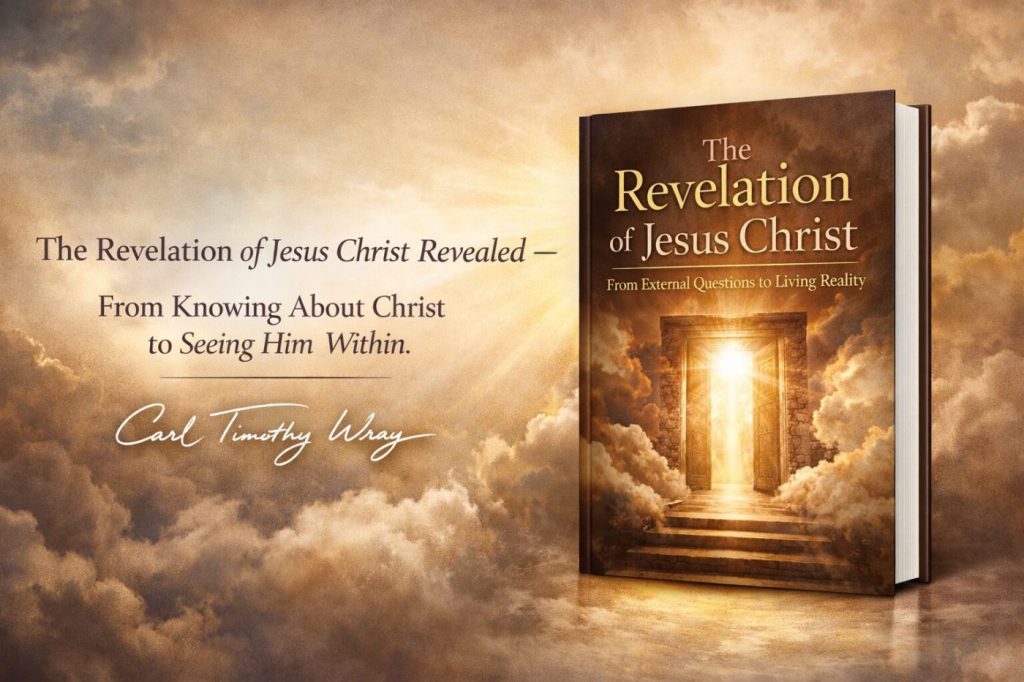
The Revelation of Jesus Christ Revealed — From Knowing About Christ to Seeing Him Within
Revelation of Jesus Christ: AUTHOR
By Carl Timothy Wray
Carl Timothy Wray has spent over four decades immersed in Scripture, prayer, and the progressive unveiling of Christ from Genesis to Revelation. His work is not the product of a recent fascination with theology, but the fruit of a lifelong pursuit of the Finished Work of Christ and the unfolding purpose of God through the ages. Writing from a foundation laid over many years, Wray approaches the Book of Revelation not as a puzzle to be solved, but as a Person to be revealed. His teachings emphasize clarity, patience, and spiritual maturity, guiding readers beyond external religious frameworks into the living reality of Christ revealed within. This book stands as one volume among hundreds written to illuminate Scripture through consistency, depth, and faithfulness — forming a body of work intended to serve generations, not trends.
The Revelation of Jesus Christ as Living Reality
The Revelation of Jesus Christ is not merely a book about future events, symbols, or signs, but the unveiling of Jesus Christ Himself as present, living reality. This book explores the meaning of the Revelation of Jesus Christ by addressing the most common questions people ask — what it is, what it means, and how it applies — and gently leads the reader from external understanding into inward spiritual sight. Designed for those seeking clarity, depth, and maturity, this work presents the Revelation of Jesus Christ as an ongoing unveiling of Christ within His people, rather than a distant prophecy to be observed from afar.
Revelation of Jesus Christ: INTRODUCTION
From Questions to Revelation
The Revelation of Jesus Christ begins where most people already are — with questions. Questions about meaning. Questions about signs. Questions about judgment, symbols, and timing. These questions are not wrong; they are natural. They reflect the way the human mind approaches truth from the outside, seeking understanding through observation, explanation, and definition.
But revelation was never meant to stop at questions.
The Book of Revelation was given not merely to inform the mind, but to unveil a Person. It does not simply answer curiosity about the future; it reveals Jesus Christ as He is made known in His people. When revelation is treated only as information, it remains external. When revelation is received as unveiling, it becomes life.
This book is written for those who sense there must be more than knowing about Christ — for those who feel the quiet invitation to move from explanation to experience, from outward observation to inward seeing. Without force, without confrontation, and without abandoning the questions that brought us here, we will allow those questions to mature, deepen, and ultimately give way to living reality.
The Revelation of Jesus Christ is not a destination at the end of time.
It is a present unveiling — Christ revealed within.
Chapter 1 — What Is the Revelation of Jesus Christ?
The Question Everyone Starts With
“What is the Revelation of Jesus Christ?”
This is almost always the first question asked, whether spoken plainly or carried quietly in the heart. It is the question that introduces most people to the final book of Scripture, and it reveals where the mind naturally begins — on the outside, looking in. The question assumes that revelation is something to be defined, explained, or summarized, as though it were a subject to be mastered rather than a Person to be known.
This question is not wrong. It is simply the starting place.
Revelation as Information
When the Revelation of Jesus Christ is approached as information, the mind looks for clarity through facts. Who wrote it. When it was written. What it predicts. How it is structured. What the symbols mean. In this frame, revelation becomes a document, and understanding becomes the accumulation of knowledge.
This approach produces familiarity, but not transformation. One can know the language of Revelation, quote its passages, and debate its interpretations while remaining untouched by the unveiling it was meant to bring. Information can describe Christ without ever revealing Him.
The Meaning of “Revelation”
The word “revelation” itself points beyond explanation. It speaks of unveiling, uncovering, and disclosure. Something hidden is made visible, not by effort, but by removal of the veil. Revelation does not add something new; it reveals what was already present but unseen.
This immediately shifts the focus. If revelation is unveiling, then the question is no longer merely what the Revelation of Jesus Christ is, but where and how that unveiling takes place.
Revelation as Unveiling of a Person
The Revelation of Jesus Christ is not primarily a revelation about events, timelines, or symbols. It is the unveiling of Jesus Christ Himself. Scripture does not present Revelation as a book that reveals information about Christ, but as a disclosure of Christ as He is made known.
This distinction matters. A revelation about Christ can remain external. The revelation of Christ brings the observer into encounter. It moves revelation from the page into the life of the reader.
From Asking “What” to Seeing “Who”
As long as the question remains “What is the Revelation of Jesus Christ?”, the mind remains oriented outward. But when revelation is understood as unveiling, the question begins to change on its own. The focus quietly shifts from definition to recognition, from explanation to sight.
The Revelation of Jesus Christ is not something to be fully grasped by the natural mind. It is something that unfolds as Christ Himself is revealed — not only before us, but within us.
This is where revelation begins to move from external knowledge toward living reality.
Chapter 2 — Why the Revelation Begins with Questions, Not Answers
The Nature of How Revelation Approaches Us
Revelation does not begin by overwhelming the reader with conclusions. It begins by drawing attention to questions already present in the heart. This is not accidental. Questions reveal capacity. They show where understanding currently resides and how far it can stretch without breaking.
The Revelation of Jesus Christ meets the reader at this level — not by dismissing questions, but by allowing them to surface naturally. Revelation honors the process by which understanding matures.
Why Answers Alone Do Not Transform
Answers can satisfy curiosity, but they do not necessarily change perception. A person can receive an answer and remain unchanged, because answers often reinforce the framework from which the question was asked. When the framework is external, answers remain external as well.
This is why Revelation does not rush to resolve every inquiry. Instead, it allows questions to linger long enough for the reader to sense that something deeper is being invited. Revelation is not content with filling the mind; it seeks to awaken sight.
Questions Reveal Orientation
The kinds of questions people ask about Revelation expose how they are oriented toward truth. Questions about signs, timelines, cities, and categories reveal an outward posture — a desire to observe events rather than encounter life. These questions are understandable, but they signal that revelation is still being approached as an object of study.
Rather than correcting this posture immediately, Revelation works within it. It allows the questions to stand, not as final destinations, but as doorways.
The Gentle Shift Within the Question
Over time, something subtle happens. The same questions begin to feel insufficient. The reader senses that no answer fully satisfies. This is not failure; it is invitation. The question itself begins to change shape.
“What does this mean?” slowly gives way to “What is being revealed?”
“What will happen?” gives way to “What is happening within me?”
This shift does not come through instruction alone. It comes through continued exposure to revelation itself.
Revelation Answers by Transforming the Question
The Revelation of Jesus Christ often answers not by providing new information, but by transforming the question being asked. As perception changes, the original question no longer holds the same power. It is not rejected; it is fulfilled by something deeper.
This is how revelation moves the reader forward without force. The question that once governed understanding quietly yields to a higher way of seeing. And in that yielding, revelation becomes living reality rather than external explanation.
Chapter 3 — Seeing the Signs: How the Natural Mind Looks for Revelation
The Desire to Observe Rather Than Participate
One of the most common ways the natural mind approaches the Revelation of Jesus Christ is by looking for signs. Signs feel safe. They exist outside of us. They can be watched, measured, tracked, and discussed without requiring inward change. To look for signs is to remain an observer rather than a participant.
This posture is not born of rebellion, but of distance. The natural mind prefers revelation it can analyze without being altered by it.
Why Signs Attract the External Mind
Signs promise certainty. They appear to offer proof that something is happening without demanding transformation from the one who sees them. When revelation is framed this way, the focus shifts to identifying markers in history, culture, or world events that seem to confirm expectation.
In this frame, Revelation becomes a kind of spiritual weather report. One watches, waits, and speculates, but remains fundamentally unchanged.
The Limitation of Sign-Based Seeing
Signs can point, but they cannot impart life. They can indicate movement, but they cannot produce maturity. When the pursuit of signs becomes central, revelation is reduced to pattern recognition rather than spiritual unveiling.
This is why signs, when isolated from Christ Himself, eventually exhaust the soul. There is always another sign to interpret, another event to analyze, another theory to consider. The hunger remains because the source of life has not yet been encountered.
The Difference Between Signs and Sight
True revelation does not come through watching from a distance, but through seeing with unveiled eyes. Sight is not the same as observation. Sight involves participation. It requires the removal of the veil, not the accumulation of data.
In the Revelation of Jesus Christ, signs were never meant to replace sight. They were meant to give way to it.
From Watching for Signs to Recognizing Presence
As revelation matures, the need to watch external signs begins to fade. The focus shifts from “What should I be looking for?” to “Who is being revealed?” Christ Himself becomes the reference point.
When Christ is seen as present life rather than future signal, revelation moves inward. The reader no longer waits for confirmation from the outside. Revelation becomes something recognized within, as Christ makes Himself known.
This is where the natural mind’s dependence on signs begins to loosen, and the door opens toward spiritual sight.
Chapter 4 — Cities, Categories, and Control: How the External Mind Frames Truth
The Need to Locate Revelation Outside Ourselves
Another common way the external mind approaches the Revelation of Jesus Christ is by trying to locate it somewhere out there. This is where questions about cities, places, systems, and categories arise. The mind asks which city will fall, which system will rise, which group is right, and which interpretation holds control.
This approach feels grounding because it keeps revelation at a distance. If revelation can be located in a place, a category, or a system, then it can be managed without personal exposure.
Why the Mind Divides Revelation into Categories
Categorization gives the appearance of order. By dividing revelation into types, eras, camps, or frameworks, the mind feels secure. It can label, sort, and defend positions without ever yielding itself to transformation.
But revelation was never meant to be mastered through classification. Categories can describe aspects of truth, but they cannot contain it. When categories become central, revelation is reduced to structure rather than life.
External Judgment and the Illusion of Distance
Questions about destruction and judgment often reveal this same posture. When judgment is always imagined as something happening elsewhere — to another city, another people, another system — the heart remains untouched. Judgment stays theoretical instead of revelatory.
This distance creates comfort, but it also creates blindness. Revelation that never comes home never produces renewal.
Revelation Is Not Controlled by Location or Label
The Revelation of Jesus Christ does not unfold according to geography or classification. It unfolds according to unveiling. What matters is not where revelation is happening outwardly, but where Christ is being revealed inwardly.
When revelation is confined to categories, Christ remains an object of study. When revelation is received as unveiling, Christ becomes living presence.
When External Frameworks Begin to Fall Away
As revelation matures, the need to locate truth outside ourselves begins to loosen. Cities, categories, and systems lose their grip as primary reference points. This does not bring confusion; it brings clarity.
The collapse of external frameworks is not loss — it is gain. It creates space for Christ Himself to be revealed as the true center. And when Christ becomes the center, revelation is no longer something we manage. It becomes something we live.
Chapter 5 — The Revelation of Jesus Christ as Living Presence
When Revelation Moves Beyond the Page
Up to this point, revelation has been approached through questions, signs, structures, and explanations. All of these belong to the outer court of understanding. They introduce the subject, but they do not complete the work. At some moment, revelation must move beyond what is read and discussed into what is encountered.
This is where the Revelation of Jesus Christ begins to be known as living presence rather than written content.
Revelation Is Not Added Knowledge
Living revelation does not come by learning something new about Christ. It comes by Christ being made known. This is an important distinction. Knowledge adds information to the mind. Revelation removes the veil from the heart.
When Christ is revealed as living presence, understanding is no longer accumulated; it is awakened.
The Difference Between Studying Christ and Encountering Him
One can study Christ endlessly without ever encountering Him. Study analyzes. Encounter transforms. The Revelation of Jesus Christ was never intended to stop at study. It was given to bring about unveiling — Christ known, not merely described.
This is why revelation feels different from explanation. Explanation informs the observer. Revelation involves the participant.
Christ Revealed as Present, Not Distant
Living revelation does not place Christ at a distance — in the past as history or in the future as expectation. It reveals Him as present reality. Christ is not only the One who was revealed, nor only the One who will be revealed. He is the One who is being revealed.
This present unveiling changes how everything else is seen. Signs, symbols, and structures take their proper place once Christ Himself becomes the center.
Revelation Begins to Govern Life
When Christ is revealed as living presence, revelation begins to govern rather than inform. Decisions, perception, and understanding are shaped from within, not imposed from without. Revelation becomes something lived, not merely believed.
This is the turning point of the book. From here forward, the focus is no longer on external reference points, but on inward recognition. The Revelation of Jesus Christ begins to function as life itself.
Chapter 6 — From Watching for Signs to Hearing the Voice Within
The Transition from Sight to Sound
As revelation moves inward, a subtle but decisive shift takes place. The focus moves from what is seen outwardly to what is heard inwardly. Watching for signs gives way to listening for a voice. This transition marks a change in how truth is received.
Signs appeal to the eyes. The voice addresses the heart.
Why the Voice Is Central to Revelation
The Revelation of Jesus Christ is not primarily visual spectacle; it is relational unveiling. A voice speaks, and in speaking, reveals the One who speaks. This is why revelation matures through hearing rather than observation.
Hearing requires attention. It draws the listener into proximity. One cannot truly hear from a distance.
The Difference Between Noise and Voice
The external world is full of noise — opinions, interpretations, predictions, and debates. Noise competes for attention but does not impart life. The voice of Christ, by contrast, carries clarity and authority without force.
When revelation becomes centered on the voice within, discernment begins to replace speculation. The need to track every external signal fades as the inner witness becomes clearer.
Hearing Produces Participation
To hear the voice is not merely to receive information. It is to be addressed. The voice does not speak at us; it speaks to us. In that address, revelation becomes personal and participatory.
This is where responsibility replaces curiosity. What is heard begins to shape how one lives.
Revelation as Ongoing Communion
When the Revelation of Jesus Christ is received through the inner voice, it is no longer confined to moments of study or reflection. It becomes ongoing communion. Revelation continues, not because new information is constantly added, but because relationship deepens.
This is how revelation remains living reality — Christ speaking, Christ known, Christ revealed within.
Chapter 7 — When the City Falls Inside: The Collapse of External Religion
The Idea of Judgment at a Distance
For many, judgment in the Revelation of Jesus Christ is imagined as something that happens elsewhere — to a city, a system, a people far removed from the reader. This way of seeing preserves distance. Judgment remains external, historical, or future-oriented, and the heart remains largely untouched.
This distance feels safe, but it also limits revelation.
Why the External Mind Needs a City to Fall
The external mind prefers judgment that does not require inward examination. If judgment is always directed outward, the inner world remains unchallenged. Cities, systems, and institutions become symbols onto which the mind projects its understanding of right and wrong.
In this frame, Revelation becomes a story about others rather than an unveiling within ourselves.
The Inward Meaning of Collapse
When revelation deepens, the idea of judgment begins to shift. The focus moves from external destruction to internal exposure. What collapses is not merely a city on a map, but a way of seeing — a system of thought built on distance, control, and fear.
This collapse is not punishment. It is liberation. What falls is what cannot carry life.
When External Religion Loses Its Power
External religion thrives on separation — sacred and secular, holy and unholy, inside and outside. When Christ is revealed within, these divisions begin to dissolve. Religion as an external structure loses its authority because life has taken its place.
This is the moment when the city falls inside. What once governed from without no longer rules from within.
Revelation Produces Renewal, Not Ruin
The collapse of external frameworks does not leave emptiness behind. It makes room for renewal. When what is external loses its grip, Christ is revealed as the true dwelling place of God.
Judgment, in this light, is not about destruction for its own sake. It is the clearing away of what obscures Christ, so that He may be seen and known as living reality within.
Chapter 8 — From Dividing Revelation to Seeing Christ Revealed as One
The Mind’s Desire to Separate What God Has Joined
The natural mind often approaches revelation by dividing it. It separates truth into categories, eras, types, and frameworks in an effort to understand and control what it encounters. This instinct is understandable, but it fragments what was given as one unveiling.
When revelation is divided, Christ is studied in parts rather than seen as whole.
Why Division Feels Safer Than Unity
Division allows the mind to hold revelation at a distance. One can analyze pieces without yielding to the weight of the whole. By separating doctrine from life, symbol from substance, and knowledge from experience, the mind avoids being confronted by revelation as living reality.
Unity, by contrast, requires surrender. It invites participation rather than analysis.
Revelation Is One Unfolding, Not Many Pieces
The Revelation of Jesus Christ is not a collection of disconnected truths. It is one continuous unveiling of a single Person. What appears complex when divided becomes clear when seen as one movement — Christ revealed, known, and made manifest.
When revelation is received as one unfolding, the need to categorize fades. Understanding gives way to recognition.
Christ Revealed as the Center of All Things
Seeing Christ revealed as one brings coherence to everything else. Signs, symbols, judgment, and purpose find their meaning when Christ Himself is the reference point. Nothing stands alone; everything converges in Him.
This is not simplification. It is clarity born of unity.
Living in the Revelation of Jesus Christ
When revelation is no longer divided, it becomes lived. Christ is not approached as a subject to master, but as life to be known. The Revelation of Jesus Christ moves fully from external questions into living reality.
What began as inquiry ends as vision.
What was once observed becomes experienced.
Christ is no longer merely known about — He is seen within.
This is the completion of the journey, and also its beginning.
The Revelation of Jesus Christ: By Carl Timothy Wray

The Revelation of Jesus Christ Series
- The Revelation of Jesus Christ
- Book of Revelation
- The Throne of God
- The Finished Work of Christ — God’s Full Counsel Revealed Through the Plan of the Ages
- The Finished Work of Christ: Meaning, Key Scriptures & FAQs
- Join Our Facebook Page