
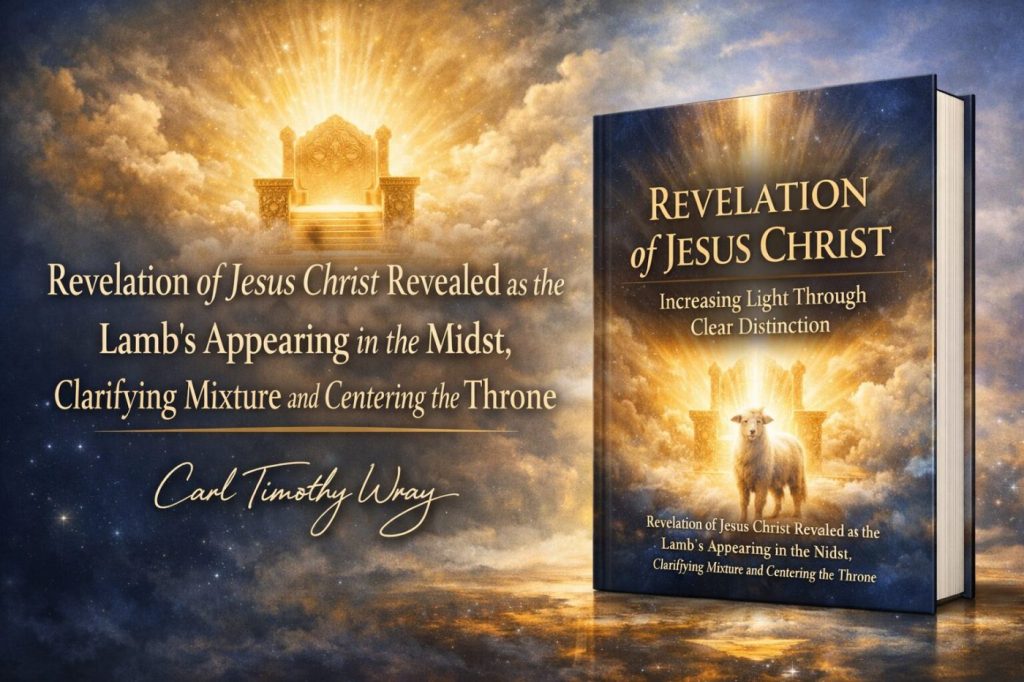
Revelation of Jesus Christ Revealed as the Lamb’s Appearing in the Midst, Clarifying Mixture and Centering the Throne
Revelation of Jesus Christ: AUTHOR
Carl Timothy Wray is a Bible teacher and author devoted to unveiling the Finished Work of Christ and restoring Jesus to the interpretive center of all Scripture. Writing from a Christ-centered, throne-anchored perspective, Carl emphasizes the present reign of the Lamb, the unity of God’s purpose from Genesis to Revelation, and the progressive unveiling of truth that removes fear, mixture, and delay. His work consistently calls believers to see Christ as finished, enthroned, and revealed — not merely anticipated — and to interpret prophecy, judgment, and redemption through the clarity of the Lamb in the midst.
The Revelation of Jesus Christ is not merely a prophetic timeline of future events but the unveiling of the enthroned Lamb who reigns now. This book clarifies the Revelation of Jesus Christ by distinguishing between event-centered interpretation and Christ-centered unveiling, showing how the finished work, the present throne, and the progressive increase of light remove interpretive mixture and restore coherence to biblical prophecy. Through clear distinction and steady increase, the Revelation of Jesus Christ is revealed as the Lamb appearing in the midst — centering the throne and increasing understanding.
Revelation of Jesus Christ: INTRODUCTION
The Revelation of Jesus Christ does not begin with beasts, disasters, or timelines. It begins with unveiling. Before seals are opened, before trumpets sound, before judgments unfold, the Son of Man stands revealed in the midst of the lampstands. The order is deliberate. Revelation is not primarily about what happens — it is about who is revealed.
For generations, the Revelation of Jesus Christ has been framed largely through the lens of future events: final conflict, impending triumph, coming judgment, and the end of the age. This framework contains substantial truth. It affirms Christ’s sovereignty, His authority over history, and His ultimate victory. Yet when the starting point is events rather than the enthroned Lamb, the interpretive center subtly shifts. Christ can appear as participant within prophecy rather than the One from whom prophecy flows.
The limitation is not error. It is orientation.
When Revelation is approached primarily as a timeline, triumph can feel postponed. When conflict dominates the narrative, victory can seem anticipatory rather than established. When judgment is framed chiefly as future reckoning, the throne can appear reactive rather than administrative. These perspectives are not false — they are partial. And partial light invites increase.
The Revelation of Jesus Christ must be read from the throne outward, not from events upward. The Lamb is not moving toward victory; He reigns from it. The scroll is opened not to determine the outcome but to unveil the administration of what has already been secured. Judgment does not create triumph; it applies it. Conflict does not threaten sovereignty; it reveals it.
This book is written to increase clarity — not to overturn what has been established, but to center it more fully in Christ. By distinguishing between event-centered framing and Lamb-centered unveiling, we allow the Revelation of Jesus Christ to interpret itself. As the Lamb is clearly seen in the midst, mixture diminishes, fear loosens its grip, and the throne becomes stable in interpretation.
Light does not argue. It shines.
And as the Revelation of Jesus Christ is revealed more clearly, interpretation reorganizes around the One who stands in the midst — finished, enthroned, and reigning.
Chapter 1 — The Established Understanding and the Capacity for Increase
The Established Understanding of the Revelation of Jesus Christ
The Revelation of Jesus Christ has traditionally been understood as the final prophetic book of the New Testament — written by John on Patmos, addressed to seven churches, filled with symbolic imagery, and culminating in Christ’s ultimate triumph over evil.
It is commonly framed as:
- Apocalyptic prophecy
- Future conflict
- Final judgment
- The defeat of evil
- The arrival of a new heaven and new earth
This understanding contains real light.
It affirms Christ’s sovereignty.
It affirms that history is governed.
It affirms that evil does not prevail.
It affirms that Jesus Christ will be openly victorious.
These affirmations reveal capacity.
Where the Framing Begins to Limit Clarity
While this established framework contains truth, it often begins with events rather than unveiling.
When Revelation is approached primarily as a sequence of future happenings, attention shifts toward:
- What will happen
- When it will happen
- How it will unfold
In this structure, Christ remains present — but He can subtly become secondary to the timeline.
The limitation is not falsehood.
It is starting point.
If events are primary, then conflict defines the narrative.
If the Lamb is primary, then sovereignty defines it.
This distinction changes everything.
The Order of Revelation Matters
The book does not begin with beasts.
It does not begin with judgments.
It does not begin with catastrophe.
It begins with unveiling.
Before a seal is opened, the Son of Man is seen.
Before a trumpet sounds, the Lamb stands revealed.
Before judgment is described, the throne is occupied.
The order matters.
Revelation is not first about what happens.
It is about who is revealed.
Capacity Already Present
The established page already affirms:
- Christ reigns
- Christ is sovereign
- Christ will triumph
- Christ is worthy of worship
This means the foundation is not resistant to light.
It is positioned for increase.
Increase does not require demolition.
It requires distinction.
When the Lamb is centered more clearly, what was partial becomes coherent.
Event-Centered vs. Throne-Centered Interpretation
When Revelation is event-centered:
- Conflict feels dominant
- Triumph feels anticipatory
- Judgment feels future-oriented
- Authority can appear reactive
When Revelation is throne-centered:
- Sovereignty precedes conflict
- Triumph is established
- Judgment administers victory
- Authority governs deliberately
The difference is orientation.
One begins with unfolding.
The other begins with enthronement.
The Scroll Reveals Administration, Not Outcome
The scroll in Revelation is not opened to determine the result.
It reveals the administration of what has already been secured.
The Lamb is not moving toward victory.
He reigns from it.
The throne is not waiting to resolve uncertainty.
It governs from completion.
When this is clearly seen, interpretation stabilizes.
Light Increases Without Force
This chapter does not overturn what has been established.
It clarifies its center.
The Revelation of Jesus Christ is not suspense awaiting resolution.
It is unveiling of a Person already enthroned.
Light does not argue.
It shines.
As Christ is centered more fully:
- Fear weakens
- Speculation quiets
- Mixture reduces
- The throne steadies interpretation
The Lamb stands in the midst.
And where He is clearly seen, light increases.
Chapter 2 — Where Event-Centered Framing Reaches Its Limit
The Strength of Event-Centered Interpretation
Event-centered interpretation has served the church in meaningful ways.
It has:
- Affirmed that history is moving somewhere.
- Declared that evil does not ultimately win.
- Strengthened believers under persecution.
- Emphasized the hope of Christ’s triumph.
These are not small contributions.
When Revelation is read as prophecy unfolding through history, believers are reminded that suffering is not random and injustice is not permanent.
This framing has preserved hope.
Where the Emphasis Begins to Shift
However, when the focus remains primarily on unfolding events, the interpretive center subtly shifts.
Attention gravitates toward:
- Timelines
- Signs
- Sequences
- Speculative alignment with current history
Christ remains present — but the narrative energy gathers around what will happen rather than who reigns.
The limitation is not doctrinal error.
It is gravitational drift.
The emphasis moves from Person to process.
The Subtle Effect of Future Orientation
When triumph is framed primarily as future, several interpretive consequences begin to appear:
- Victory can feel postponed.
- Authority can seem anticipatory.
- Judgment can appear unresolved.
- Conflict can feel determinative rather than revealing.
In this structure, sovereignty is affirmed — yet it can feel as though it is still working toward completion.
But Revelation does not present a throne striving for dominance.
It presents a throne already established.
When Conflict Becomes the Narrative Driver
Event-centered framing often gives narrative weight to conflict:
- The rise of beasts
- The activity of deception
- The intensification of tribulation
- The anticipation of final confrontation
Conflict becomes the storyline.
Christ becomes the responder.
Yet the order of Revelation presents the Lamb before the conflict intensifies. The throne precedes the turmoil. The scroll is opened from sovereignty, not desperation.
Conflict in Revelation reveals what is already true.
It does not determine what will become true.
The Difference Between Determining and Revealing
This is a crucial distinction.
If events determine outcome, Revelation becomes suspense.
If Christ determines outcome, events become disclosure.
Event-centered reading can unintentionally elevate unfolding circumstances as though they are shaping destiny.
Throne-centered reading recognizes that destiny is already secured and being unveiled.
The Lamb does not react to history.
History unfolds under the Lamb.
How Partial Emphasis Produces Mixture
When event emphasis remains dominant while sovereignty is affirmed, mixture begins to form.
Believers may simultaneously confess:
“Christ reigns.”
And yet feel:
“Everything hangs in the balance.”
They may proclaim victory — while interpreting Revelation through anxiety.
This is not contradiction born of rebellion.
It is tension born of orientation.
Where the starting point is process rather than enthronement, interpretation carries instability.
The Capacity for Re-Centering
The good news is this:
Event-centered interpretation already affirms Christ’s authority.
That means the foundation for re-centering is present.
We are not replacing sovereignty.
We are repositioning it.
When Christ is restored as the interpretive center — not simply the final victor but the present administrator — event language reorganizes.
Conflict becomes unveiling.
Judgment becomes administration.
Tribulation becomes exposure.
Victory becomes established rather than awaited.
Clarifying Without Overturning
This chapter does not dismiss prophetic language.
It does not deny symbolic events.
It does not erase future language.
It clarifies orientation.
The Revelation of Jesus Christ reaches interpretive coherence when the Lamb is not the climax of the story but the center from which the story flows.
Where enthronement is primary, mixture diminishes.
Where the Lamb stands clearly in the midst, unfolding events lose their power to destabilize.
Light increases.
Orientation stabilizes.
The throne steadies interpretation.
Chapter 3 — The Lamb as the Interpretive Center
Revelation Begins With a Person
The Revelation of Jesus Christ does not begin with events.
It begins with unveiling.
Before symbols unfold, before judgments are described, before conflict intensifies, the Son of Man is revealed. He stands in the midst of the lampstands. His eyes are like fire. His voice is like many waters. His authority is visible before any sequence begins.
The order is not accidental.
Revelation is not primarily the unveiling of happenings.
It is the unveiling of a Person.
When the Person is centered, the symbols find their meaning.
The Interpretive Center Determines Stability
Every book has a center.
If events are the center, interpretation moves as events move.
If conflict is the center, interpretation rises and falls with tension.
If speculation is the center, clarity fluctuates.
But if the Lamb is the center, interpretation stabilizes.
The Lamb does not shift.
The throne does not wobble.
The victory does not fluctuate.
The Revelation of Jesus Christ becomes coherent when Christ Himself is the axis.
The Lamb Before the Scroll
Before the scroll is opened, the Lamb is seen.
Before seals are broken, the throne is occupied.
Before tribulation intensifies, sovereignty is established.
The scroll is not opened to determine destiny.
It is opened to reveal administration.
If the Lamb were uncertain, the scroll would generate suspense.
Because the Lamb is enthroned, the scroll generates unveiling.
The difference is profound.
Authority Is Established, Not Achieved
The Lamb in Revelation is not climbing toward dominion.
He stands as the One who has overcome.
He does not receive authority because conflict escalates.
He exercises authority as conflict reveals what already exists.
This distinction protects interpretation from instability.
When authority is seen as achieved through unfolding events, readers anticipate outcome.
When authority is seen as established at the throne, readers observe unveiling.
The Lamb reigns first.
Events unfold second.
Symbols Require a Center
Revelation is filled with symbols:
- Beasts
- Horns
- Seals
- Trumpets
- Bowls
- Thrones
- Cities
Symbols demand interpretation.
Without a stable center, symbols invite speculation.
With the Lamb as center, symbols align.
The beast does not rival the throne.
It reveals what resists it.
Judgment does not threaten victory.
It administers it.
Babylon does not endanger sovereignty.
It collapses under it.
When Christ interprets the symbols, fear loses authority.
The Difference Between Suspense and Sovereignty
If Revelation is read as suspense, readers ask:
Will Christ win?
If Revelation is read as unveiling, readers recognize:
Christ has overcome.
Suspense generates anxiety.
Sovereignty generates stability.
The Revelation of Jesus Christ is not written to create uncertainty about outcome. It is written to reveal the One from whom outcome flows.
The Lamb is not introduced at the end.
He is present at the beginning.
The Throne as Interpretive Anchor
The throne appears early and remains constant.
It does not appear intermittently.
It does not disappear during turmoil.
It does not react to unfolding chaos.
It governs.
Everything in Revelation flows from the throne outward, not from the earth upward.
When the throne becomes the interpretive anchor:
- Conflict loses supremacy.
- Tribulation loses dominance.
- Speculation loses urgency.
- Sovereignty gains clarity.
The Lamb in the midst is not symbolic decoration.
He is interpretive authority.
Re-Centering Without Rejection
To place the Lamb at the center is not to reject prophetic language.
It is to stabilize it.
It is not to erase event language.
It is to subordinate it to enthronement.
When the Lamb is clearly seen, mixture reduces naturally.
Christ is not responding to history.
History unfolds under Christ.
The Revelation of Jesus Christ becomes less about deciphering crisis and more about seeing clearly the One who reigns.
Where the Lamb Is Seen Clearly
Where the Lamb is clearly revealed:
- Conflict becomes disclosure.
- Judgment becomes administration.
- Authority becomes stable.
- Victory becomes established.
The interpretive center holds.
The Lamb stands in the midst.
And when He is the axis, light increases without force.
Chapter 4 — From Future Triumph to Finished Reign
The Language of Future Triumph
Much of the traditional framing of the Revelation of Jesus Christ emphasizes future triumph.
It declares:
- Christ will defeat evil.
- Christ will establish His kingdom.
- Christ will judge injustice.
- Christ will reign openly over all.
This language has strengthened hope for generations. It has reminded believers that suffering is temporary and that God’s purposes are not defeated by present turmoil.
Future-oriented triumph has preserved expectation.
Yet expectation is not the final resting place of revelation.
When Triumph Is Framed as Pending
When victory is consistently positioned ahead, several subtle tensions emerge.
Triumph can begin to feel:
- Delayed
- Conditional
- Dependent on unfolding events
- Awaiting decisive future intervention
Even while confessing that Christ reigns, readers may unconsciously interpret Revelation as though the decisive victory has not yet been secured.
The result is not denial of sovereignty.
It is postponement of clarity.
The Cross as the Boundary of Interpretation
The Revelation of Jesus Christ must be interpreted within the boundary of the cross.
When Jesus declared, “It is finished,” He did not announce partial progress. He declared completion. His resurrection did not begin victory; it revealed it. His ascension did not initiate authority; it manifested it.
If the work is finished, interpretation cannot treat it as pending.
The Lamb in Revelation is described as slain — and standing.
The wound precedes the reign.
The victory precedes the unveiling.
The Difference Between Awaiting and Unveiling
Future triumph language asks:
When will Christ overcome?
Finished reign asks:
How is Christ’s completed victory being unveiled?
This distinction shifts interpretation from anticipation to administration.
In a future-centered framework, Revelation builds toward victory.
In a finished-reign framework, Revelation reveals the outworking of victory already secured.
The Lamb is not moving toward dominance.
He reigns from it.
Judgment as Application of Victory
When triumph is future, judgment appears as the means to achieve it.
When triumph is finished, judgment becomes the application of it.
This changes tone.
Judgment is no longer desperate confrontation.
It is deliberate administration.
The throne does not scramble to defeat rebellion.
It governs from established authority.
Revelation’s unfolding scenes do not produce victory.
They reveal it.
Why This Shift Matters
If victory is pending, believers live in tension.
If victory is established, believers live in stability.
Future triumph sustains hope.
Finished reign establishes confidence.
The Revelation of Jesus Christ is not written to keep the church suspended in suspense. It is written to unveil the One who has overcome.
The Lamb is not climbing toward triumph.
He is exercising it.
The Scroll as Disclosure, Not Determination
The scroll is opened from the throne.
It is not opened to determine whether Christ will succeed.
It is opened because He has.
Every seal broken, every trumpet sounded, every bowl poured out operates under the authority of a throne already occupied.
This is not escalating drama toward uncertainty.
It is unveiling from certainty.
The Lamb reigns.
The scroll reveals.
The throne administers.
Reframing Without Rejection
This chapter does not deny prophetic language about what is to come.
It clarifies its foundation.
Future language can remain — but it must rest upon finished reign.
Expectation can remain — but it must flow from enthronement.
When the Revelation of Jesus Christ is read from finished victory rather than pending triumph, mixture reduces.
Fear softens.
Speculation quiets.
Authority steadies.
The Lamb stands not at the end of the narrative, but at its center.
And from that center, all unfolding makes sense.
Chapter 5 — Judgment as Refinement, Not Retaliation
The Traditional Framing of Judgment
In many readings of the Revelation of Jesus Christ, judgment is presented as the climactic moment of divine intervention.
It is described as:
- God responding to rebellion
- Christ confronting evil
- Wrath poured out upon opposition
- Final separation between righteous and wicked
This framing emphasizes the seriousness of sin and the certainty that injustice will not prevail. It assures believers that wrongdoing will not go unanswered.
There is truth here.
God does judge.
Christ does confront evil.
Revelation does describe decisive separation.
Yet the orientation of judgment determines its tone.
When Judgment Is Read as Retaliation
If judgment is framed primarily as reaction, it can appear as:
- Divine anger escalating in response to human failure
- A final reckoning that resolves uncertainty
- The means by which Christ secures victory
In this structure, judgment can feel like the turning point — the moment when sovereignty finally asserts itself.
But Revelation does not present the throne as reacting.
It presents the throne as governing.
The Lamb is not provoked into authority.
He reigns from it.
The Throne Precedes the Judgment
In Revelation, the throne appears before the seals are opened.
The Lamb is revealed before the bowls are poured.
Authority is visible before confrontation unfolds.
This order matters.
Judgment does not establish the throne.
The throne administers judgment.
If the throne is already established, then judgment cannot be retaliation.
It must be refinement.
Refinement as the Removal of Mixture
Refinement is not destruction of creation.
It is separation within it.
Fire does not exist to annihilate metal.
It exists to remove dross.
When judgment flows from a finished reign, it functions as clarification.
It exposes:
- What resists life
- What distorts truth
- What perpetuates deception
Judgment reveals what cannot remain under the Lamb’s authority.
It does not compete with grace.
It enforces it.
The Difference Between Threat and Alignment
If judgment is read as threat, fear dominates interpretation.
If judgment is read as alignment, clarity stabilizes it.
Threat asks:
Who will survive?
Alignment asks:
What cannot endure under truth?
The Revelation of Jesus Christ describes scenes of exposure — Babylon falling, deception collapsing, rebellion revealed. These are not arbitrary punishments. They are the unveiling of systems that cannot stand in the presence of enthroned authority.
Truth exposes.
Light separates.
Authority clarifies.
The Great White Throne Revisited
The great throne described in Revelation is not introduced as chaos.
It is introduced as purity.
The throne is white because it is clear.
It is great because it governs universally.
Books are opened.
Opening books is an act of revelation.
Judgment in this context is not surprise condemnation.
It is full disclosure.
What is hidden is revealed.
What is distorted is brought into light.
What cannot remain is removed.
This is refinement.
Why This Clarification Matters
If judgment is seen as retaliation, believers live cautiously.
If judgment is seen as refinement, believers live confidently.
Retaliation implies volatility.
Refinement implies stability.
The Lamb does not oscillate between mercy and wrath.
He administers truth consistently.
Judgment is not the opposite of grace.
It is grace completing its work.
Judgment Under Finished Reign
If Christ’s victory is finished, then judgment cannot be a desperate attempt to secure it.
Judgment must be the application of a verdict already rendered.
Death does not challenge the Lamb.
It is abolished by Him.
Deception does not rival the throne.
It collapses under exposure.
Revelation’s judgments reveal what cannot coexist with enthroned life.
They do not create victory.
They unveil it.
Refinement Increases Light
When judgment is understood as refinement:
- Fear diminishes
- Speculation calms
- Authority steadies
- Hope deepens
The Revelation of Jesus Christ becomes less about surviving divine reaction and more about witnessing divine clarity.
The Lamb reigns.
The throne governs.
Truth refines.
And what is mixture is gradually separated — not by forceful destruction, but by the steady increase of light.
Chapter 6 — Removing Interpretive Mixture
What Is Interpretive Mixture?
Mixture does not mean false doctrine.
It does not mean rebellion.
It does not mean rejection of truth.
Mixture occurs when two orientations operate simultaneously without being reconciled.
In the Revelation of Jesus Christ, mixture often appears when finished victory is confessed — yet pending uncertainty still frames interpretation.
Believers may affirm:
- Christ reigns.
- The throne is established.
- The Lamb has overcome.
And yet interpret the unfolding of Revelation as though outcome remains unsettled.
This is not contradiction.
It is orientation tension.
How Mixture Forms
Mixture forms when:
- Finished work language is combined with future insecurity.
- Sovereignty is affirmed but conflict is treated as determinative.
- Authority is declared yet unfolding events feel decisive.
In this condition, readers simultaneously proclaim stability and experience interpretive anxiety.
Victory is confessed.
Suspense is maintained.
This is not error born of defiance.
It is partial centering.
The Role of Orientation
The starting point determines coherence.
If interpretation begins with events, enthronement must be continually reaffirmed.
If interpretation begins with the throne, events naturally align beneath it.
Mixture often appears not because Christ is denied, but because He is not fully centered as the interpretive axis.
The Lamb is acknowledged.
The timeline still governs.
This subtle hierarchy produces tension.
When Language Outpaces Orientation
Many summaries of Revelation use language that affirms sovereignty:
- “Christ is Lord.”
- “Christ will triumph.”
- “Christ rules the nations.”
Yet when unfolding conflict is described, the narrative energy shifts.
The emphasis gravitates toward:
- Escalation
- Intensification
- Final confrontation
- Decisive intervention
When this happens, the Lamb can appear reactive rather than reigning.
This is where mixture resides.
Clarity Does Not Attack — It Reorders
Removing mixture does not require confrontation.
It requires re-centering.
When the throne is the starting point:
- Conflict reveals what resists authority.
- Judgment clarifies what cannot remain.
- Tribulation exposes instability.
- Babylon collapses under truth.
Events do not determine sovereignty.
They unfold beneath it.
When this order is restored, tension resolves.
How Light Reduces Mixture
Mixture cannot survive sustained clarity.
When the Revelation of Jesus Christ is read as unveiling of a finished reign:
- Suspense loses urgency.
- Speculation loses dominance.
- Fear loses energy.
- Stability increases.
The interpretive structure reorganizes naturally.
No demolition.
No aggression.
Just coherence.
Light reveals hierarchy.
The Lamb first.
Everything else second.
The Practical Effect of Re-Centering
When Christ is clearly the interpretive center:
Believers no longer read Revelation asking,
“What if?”
They read Revelation recognizing,
“Because.”
Because the Lamb reigns.
Because the throne is occupied.
Because victory is secured.
Because judgment refines.
Because authority governs.
Mixture dissolves under clarity.
Stability Through Centering
The Revelation of Jesus Christ does not require reinterpretation of every symbol.
It requires stable orientation.
When orientation shifts from process to enthronement:
- Interpretation steadies.
- Anxiety softens.
- The narrative harmonizes.
This is not innovation.
It is alignment.
The Lamb stands in the midst.
Where He is clearly centered, mixture cannot dominate.
And as mixture reduces, light increases without force.
Chapter 7 — The Increase of Light and the Stabilization of Revelation
Revelation Moves Toward Clarity
The Revelation of Jesus Christ does not move toward chaos.
It moves toward clarity.
From the opening unveiling of the Son of Man to the final vision of a healed creation, the trajectory is not escalation of uncertainty — it is stabilization of sovereignty.
Light increases.
The Lamb who stands in the midst at the beginning remains at the center at the end. The throne that appears early does not vanish in conflict. Authority does not weaken under pressure. It becomes more visible.
Revelation unfolds, but sovereignty does not fluctuate.
Increase Is Progressive, Not Explosive
Clarity in Revelation does not arrive through demolition.
It arrives through progressive increase.
At first, Christ is seen.
Then the throne is seen.
Then the scroll is opened.
Then conflict is revealed.
Then judgment clarifies.
Then Babylon falls.
Then healing flows.
Each movement does not create authority.
It unveils it.
The increase of light is not an overthrow of previous understanding.
It is refinement of orientation.
When the Center Holds
When the Lamb remains the interpretive center:
- Conflict cannot destabilize interpretation.
- Judgment cannot threaten grace.
- Tribulation cannot undo sovereignty.
- Symbols cannot generate fear.
The center holds.
The Revelation of Jesus Christ becomes less about deciphering danger and more about seeing clearly the One who reigns.
Where the throne is steady, interpretation is steady.
From Suspense to Stability
If Revelation is read as suspense, readers wait for resolution.
If Revelation is read as unveiling, readers recognize resolution already secured.
This shift changes the tone of the entire book.
Instead of asking:
Will Christ win?
Readers recognize:
Christ reigns.
Instead of anticipating:
When will authority be established?
Readers observe:
Authority is being revealed.
Suspense produces tension.
Stability produces confidence.
The Removal of Mixture Through Light
Mixture dissolves not through confrontation but through clarity.
When Christ is consistently centered:
- Partial frameworks adjust naturally.
- Event emphasis finds its place beneath enthronement.
- Future language rests upon finished reign.
- Judgment reads as refinement rather than retaliation.
Nothing violent occurs.
Nothing is attacked.
Everything reorganizes.
Truth separates by shining.
The Final Vision Is Rest
The Revelation of Jesus Christ does not conclude in fragmentation.
It concludes in unity.
The throne remains.
The Lamb remains.
Life flows.
Healing reaches the nations.
This is not a story of near victory.
It is a revelation of established reign.
The final note of Revelation is not fear.
It is fulfillment.
Not anxiety.
But alignment.
Not instability.
But rest.
The Lamb in the Midst
The Lamb who walks among the lampstands at the beginning remains the center at the end.
He does not become more sovereign.
He becomes more visible.
He does not achieve victory.
He unveils it.
The Revelation of Jesus Christ increases light not by force, but by presence.
Where the Lamb is clearly seen:
Light stabilizes.
Interpretation steadies.
Mixture reduces.
Confidence deepens.
The throne is occupied.
The reign is established.
The unveiling continues.
And as light increases, everything finds its proper order.
The Revelation of Jesus Christ: By Carl Timothy Wray

The Revelation of Jesus Christ Series
- The Revelation of Jesus Christ
- The Revelation of Jesus Christ — From External Questions to Living Reality
- The Finished Work of Christ — God’s Full Counsel Revealed Through the Plan of the Ages
- The Throne of God
- The Finished Work of Christ: Meaning, Key Scriptures & FAQs