
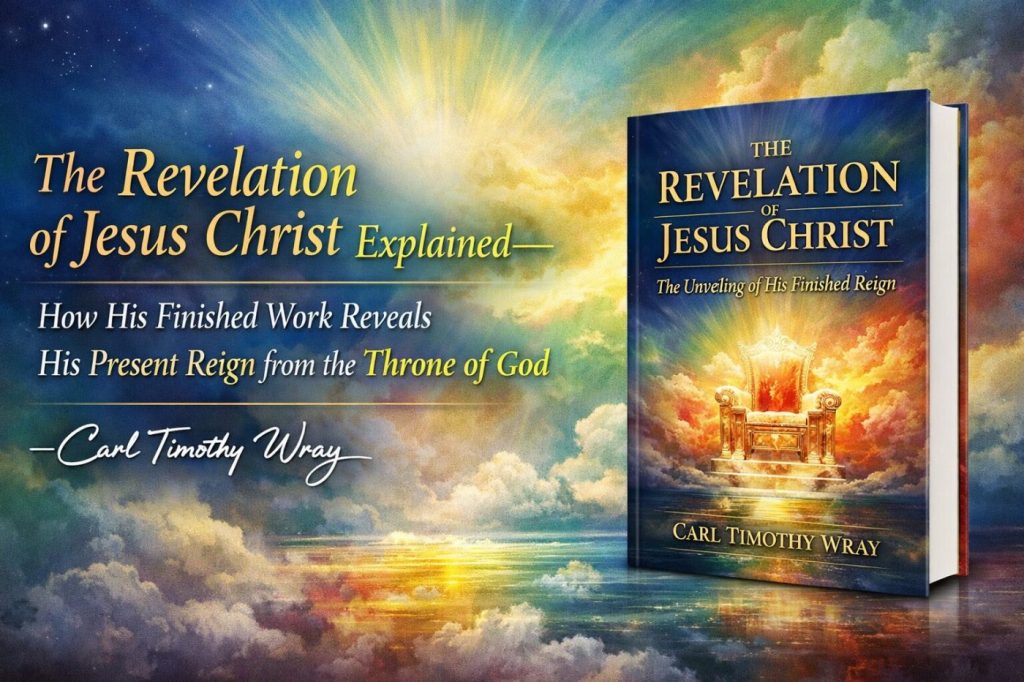
The Revelation of Jesus Christ Explained — How His Finished Work Reveals His Present Reign from the Throne of God
Revelation of Jesus Christ: Author
By Carl Timothy Wray
Carl Timothy Wray has spent over four decades immersed in Scripture, prayer, and disciplined theological reflection, producing more than 300 published scrolls and books dedicated to the Finished Work of Christ, the Throne of God, the Book of Revelation, and the unfolding Plan of the Ages. His body of work represents a sustained, structured exploration of divine government from Genesis to Revelation — not reactionary theology, but ordered progression. Writing from long-established pillars rather than passing trends, Wray approaches the Revelation of Jesus Christ as a unified unveiling of Christ’s finished authority, patiently building line upon line so that readers may grow from revelation to revelation into maturity, stability, and clarity.
The Revelation of Jesus Christ is not merely a prophetic document about future events, but the unveiling of Christ’s finished reign. In this volume, Carl Timothy Wray anchors the Revelation of Jesus Christ in its legal foundation — the finished work accomplished through the cross — and traces how that completed work reveals Christ’s present reign from the Throne of God.
Rather than approaching Revelation as speculation, catastrophe, or symbolic confusion, this book establishes a clear governmental framework: the Finished Work precedes the Throne; the Throne precedes administration; administration unfolds progressively until God is all in all. With structured definitions, careful repetition, and theological consistency drawn from over 300 published works, Wray guides readers into a stable understanding of Christ’s present authority — not as force, but as life reigning through divine order.
This book continues a larger body of work dedicated to unveiling the unified mind of God across Scripture, reinforcing that the Revelation of Jesus Christ reveals not chaos at the end of time, but Christ enthroned through His finished work, reigning now.
The Revelation of Jesus Christ is the unveiling of His finished reign — the disclosure that through His finished work, Christ’s authority is already established and presently revealed from the Throne of God.
Revelation of Jesus Christ: Introduction
From Finished Work to Revealed Reign
The Revelation of Jesus Christ is often approached as a mystery to decode, a prophecy to predict, or a timeline to interpret. Yet before it is any of these, it is a disclosure — an unveiling. It is not merely the revealing of events, but the revealing of a Person. And more specifically, it is the unveiling of Christ’s finished reign.
The Revelation of Jesus Christ is the unveiling of His finished reign — the disclosure that through His finished work, Christ’s authority is already established and presently revealed from the Throne of God.
This shifts the entire framework.
If the work is finished, then the reign is not waiting to begin. If the Lamb has been slain and has sat down at the right hand of the Majesty on high, then the Throne is not a future hope but a present reality. The question is not whether Christ will reign, but how His finished reign is being unveiled.
For many, Revelation has been framed primarily in terms of future upheaval. But the Finished Work of Christ establishes legality before manifestation. The cross accomplished what the ages unfold. The Throne of God administers what the Finished Work secured. The Revelation of Jesus Christ, therefore, is not a delay of authority, but the progressive unveiling of authority already established.
This book proceeds from that foundation.
We will not begin with speculation about symbols, but with the legal completion of Christ’s work. We will establish the Throne before we examine the unfolding. We will anchor the reign before discussing its disclosure. And we will follow the pattern consistently repeated throughout Scripture — from glory to glory, from revelation to revelation — until the fullness of God’s purpose is seen in its intended conclusion: God all in all.
This is not an abrupt declaration. It is ordered unveiling.
The Revelation of Jesus Christ is not chaos at the end of history. It is Christ revealed as reigning through His finished work, administering His authority from the Throne of God, progressively disclosed until every opposing structure yields to divine life.
The unveiling has begun.
And it proceeds not by force, but by light.
Chapter 1
The Revelation of Jesus Christ Reveals a Finished Reign
The Revelation of Jesus Christ is often introduced as a prophetic book about future events. It is associated with symbols, judgments, upheaval, and timelines. Yet before it reveals events, it reveals a Person. And before it unveils future unfoldings, it discloses an established reality.
The Revelation of Jesus Christ is the unveiling of His finished reign.
Revelation does not create authority. It reveals authority already secured. The unveiling is not the beginning of Christ’s reign, but the disclosure of a reign established through His finished work.
Revelation Is Disclosure, Not Initiation
Revelation means unveiling. It signifies the removal of a veil so that what is already present may be seen clearly. When understood this way, the Revelation of Jesus Christ shifts from speculation about what will happen to recognition of what has already been accomplished.
Christ’s authority does not begin when it is revealed.
It is revealed because it has been established.
The Revelation of Jesus Christ therefore unveils a completed foundation, not an unfinished campaign.
The Finished Work Establishes the Legal Foundation
The finished work of Christ is the legal completion of redemption and authority. When Christ declared, “It is finished,” He announced completion, not postponement. The cross secured legality. The resurrection confirmed life. The ascension revealed enthronement.
Authority was not awaiting validation. It was established.
Without the finished work, there could be no stable reign. The Revelation of Jesus Christ is anchored in that finished foundation. It does not introduce Christ’s authority; it discloses it.
The finished work precedes the unveiling.
The Throne of God Precedes the Manifestation
Scripture presents the Throne of God as established before its effects are fully seen. The Lamb stands in the midst of the Throne — slain, yet reigning. This imagery communicates administration grounded in completion.
The Throne does not react to events.
It governs from established authority.
The Revelation of Jesus Christ reveals what the Throne already administers. It unveils the present reign flowing from a finished foundation. Divine government is not chaotic, not reactionary, and not dependent upon human recognition. It is ordered, established, and progressively disclosed.
Revelation Moves the Reader from Curiosity to Recognition
When Revelation is framed only as future prediction, the mind remains external. It asks, “What will happen?” and “When will it occur?” But when Revelation is understood as unveiling, the question changes. The focus shifts to recognition:
What has already been established?
What authority is already seated?
What reign is already secured?
The Revelation of Jesus Christ answers clearly:
His reign is finished in legality.
His authority is established at the Throne.
His unveiling proceeds progressively through the ages.
The Foundation of This Book
This chapter establishes the foundation upon which everything else will stand. We do not begin with speculation. We begin with completion. We do not start with conflict. We start with authority secured.
The Revelation of Jesus Christ is the unveiling of His finished reign — the disclosure that through His finished work, Christ’s authority is already established and presently revealed from the Throne of God.
From this foundation, we move forward.
Not to create authority.
But to see it unveiled.
Chapter 2
The Finished Work as the Legal Foundation of the Reign
If the Revelation of Jesus Christ unveils His finished reign, then the finished work must be understood clearly. Without legal completion, there can be no stable throne. Without a completed foundation, there can be no enduring administration.
The finished work of Christ is the legal basis of His present reign.
Revelation unveils what the cross secured.
The Cross Secured Completion, Not Possibility
When Christ declared, “It is finished,” He did not announce potential. He announced completion. The work of redemption was not left awaiting human effort or future validation. The legal question of sin, separation, and authority was settled.
The finished work established:
- Reconciliation secured
- Authority restored
- Dominion reclaimed
- Access opened
This completion is not emotional language. It is legal language. The finished work resolved what stood against humanity and restored the basis for divine government.
The Revelation of Jesus Christ does not improve upon the finished work. It reveals what the finished work accomplished.
Legality Precedes Manifestation
Throughout Scripture, legality precedes visibility. What is settled in decree unfolds through administration. The finished work secured the decree; the Throne administers its unfolding.
This order is essential.
If we reverse it, we imagine Christ waiting to reign. But the pattern is clear: the Lamb was slain, then seated. Completion came before enthronement was revealed.
The Revelation of Jesus Christ therefore unveils what was legally established before it was progressively manifested.
The Ascension Reveals Enthronement
The finished work did not end at the cross. The resurrection confirmed life. The ascension revealed position. Christ seated at the right hand of the Father is not symbolic delay; it is governmental reality.
The Throne of God is not empty.
The Lamb is not preparing to sit.
He is seated.
The Revelation of Jesus Christ unveils this enthronement. It does not create it.
The Stability of a Finished Foundation
A reign built on unfinished work would be unstable. A throne without completion would require constant reinforcement. But the finished work provides permanence.
Because the work is finished:
- The authority is not provisional.
- The reign is not experimental.
- The Throne is not temporary.
This stability is why Revelation can unfold progressively without threatening the foundation. What unfolds does not add to completion; it reveals its scope.
The Revelation of Jesus Christ Anchored in Completion
To understand the Revelation of Jesus Christ properly, one must begin here. Not with beasts or timelines. Not with speculation or conflict. But with completion.
The Revelation of Jesus Christ is the unveiling of His finished reign — and that reign rests securely upon the finished work.
The cross secured legality.
The resurrection confirmed life.
The ascension revealed enthronement.
The Throne administers what was completed.
Revelation unveils what was finished.
From this legal foundation, we can now move forward — not to search for authority, but to understand how that authority is disclosed and administered from the Throne of God.
Chapter 3
The Throne of God Established Before It Is Seen
If the finished work provides the legal foundation of Christ’s reign, the Throne of God reveals its administration. Authority secured at the cross is not left dormant. It is seated, ordered, and governing.
The Revelation of Jesus Christ unveils not only a finished work, but a seated King.
The Throne of God is not a future possibility. It is an established reality preceding its visible effects.
The Throne Is the Center of Divine Administration
Throughout Scripture, the Throne represents government. It signifies rule, order, decree, and administration. The Throne is not symbolic decoration; it is the seat from which authority flows.
In the Revelation of Jesus Christ, the Lamb is seen in the midst of the Throne — slain, yet reigning. This is not contradiction. It is completion and authority united.
The finished work secured legality.
The Throne administers that legality.
The Revelation of Jesus Christ reveals what the Throne already governs.
The Throne Precedes the Manifestation of Its Effects
Divine government does not wait for recognition to become real. The Throne is established before the unfolding is fully perceived. Administration precedes visible transformation.
This order protects the stability of the reign. If the Throne depended on outward confirmation, it would be reactive. But divine administration is not reactionary. It flows from completion.
The Lamb is not climbing toward authority.
He is seated in authority.
The Revelation of Jesus Christ unveils what has already been enthroned.
Seated Authority Is Established Authority
The imagery of Christ seated at the right hand of the Father is governmental language. To be seated is to have completed the work required for enthronement. Standing may indicate preparation; seating indicates completion and rule.
The Throne of God communicates that Christ’s reign is not developing in uncertainty. It is established in finality.
This is why the Revelation of Jesus Christ must be understood as unveiling, not initiation. The Throne does not begin to exist when it is seen. It is seen because it already exists.
Administration Flows From Completion
A throne without a finished foundation would require constant repair. But because the work is finished, the Throne governs from stability. Administration unfolds progressively, but it unfolds from permanence.
The reign of Christ is therefore:
- Established in legality
- Seated in authority
- Administered in order
- Unveiled progressively
The Revelation of Jesus Christ reveals this administration at work. It does not announce a struggle for control. It discloses divine government operating from a completed foundation.
The Revelation of Jesus Christ as Governmental Unveiling
When the Throne is understood as present and established, Revelation ceases to be a forecast of chaos and becomes a disclosure of order. The unfolding is not the formation of authority, but its manifestation.
The finished work secured the right to reign.
The Throne establishes the place of reign.
The Revelation of Jesus Christ unveils the administration of that reign.
Christ does not wait to rule.
He rules, and Revelation makes it known.
From this established Throne, we now move to consider how His present reign is disclosed — not by force, but by life unfolding according to divine order.
Chapter 4
The Present Reign of Christ Revealed
If the finished work secured authority and the Throne establishes administration, then the question naturally follows: When does Christ reign?
The Revelation of Jesus Christ answers plainly — He reigns now.
The unveiling does not point to the beginning of His rule. It reveals the present reality of His authority flowing from the Throne of God.
The Reign Is Not Awaiting Activation
Many imagine the reign of Christ as future — something that will begin after certain events unfold. Yet the finished work left nothing incomplete. The Lamb was slain, raised, and seated. Authority was not postponed.
Christ does not reign in theory.
He reigns in reality.
The Revelation of Jesus Christ unveils this present reign. It discloses that divine government is not dormant, not suspended, and not contingent upon human recognition.
Present Does Not Mean Fully Manifest
It is important to distinguish between established authority and visible fullness. The reign of Christ is present in legality and administration, even where its full manifestation is still unfolding.
This distinction prevents confusion.
Authority may be established before every effect is visible. A throne may govern long before every subject recognizes it. The Revelation of Jesus Christ unveils what is true in heaven before it is fully perceived in the earth.
The reign is present.
Its unveiling is progressive.
The Nature of His Reign
The present reign of Christ is not exercised through coercion or force. It is not reactionary to the movements of the world. It flows from completion and operates through divine order.
His reign is characterized by:
- Authority grounded in the finished work
- Administration flowing from the Throne
- Life imparted through the Spirit
- Order unfolding through the ages
The Revelation of Jesus Christ reveals this reign as stable, deliberate, and purposeful.
Reigning Through Life, Not Force
The Kingdom of God advances not by violence, but by life. Christ’s authority does not depend upon outward spectacle. It operates through transformation, illumination, and order.
Because the finished work is complete, the reign is secure. Because the Throne is established, administration continues. Because the unveiling proceeds progressively, light increases.
The Revelation of Jesus Christ makes known the reign that already governs — not by overwhelming the world, but by steadily revealing divine life.
Recognition of What Is Already True
When the Revelation of Jesus Christ is understood as unveiling a present reign, the reader’s posture changes. The question is no longer, “When will Christ reign?” but “How is His reign being revealed?”
This shift moves the mind from anticipation of conflict to recognition of authority.
Christ is not striving toward dominion.
He is reigning from completion.
The unveiling is not about creating authority, but about seeing the authority that is already established.
From here, we can now consider how this reign governs — not by force, but through the administration of life flowing from the Throne of God.
Chapter 5
How the Finished Work Governs Through Life
If Christ reigns from a finished foundation and administers from the Throne of God, then we must understand the nature of His government. The Revelation of Jesus Christ does not unveil a reign driven by coercion, but a reign operating through life.
The finished work governs through life.
This is the distinguishing mark of divine authority. It does not impose control from without; it imparts transformation from within.
Authority Flowing From Completion
Because the work is finished, the reign is secure. Because the reign is secure, it does not react anxiously to opposition. Divine government flows from stability, not insecurity.
The Throne of God administers what the finished work accomplished. That administration is not frantic, not defensive, and not dependent upon immediate outward compliance.
It governs through ordered life.
The Revelation of Jesus Christ unveils this pattern — authority flowing from completion into progressive transformation.
Life as the Instrument of Reign
The reign of Christ is exercised through life imparted by the Spirit. Where life increases, order follows. Where light increases, confusion diminishes. Where truth is revealed, structures aligned with error begin to lose strength.
This is not forceful conquest.
It is transformative authority.
The finished work secured reconciliation and restored access. The Throne administers that reconciliation by imparting life. The Revelation of Jesus Christ reveals how this life unfolds through the ages.
Administration Through Illumination
Divine government advances through unveiling. When light shines, darkness does not require expulsion by violence; it yields by nature. The reign of Christ operates in this way.
Revelation increases.
Understanding matures.
Capacity expands.
Line upon line.
Precept upon precept.
The finished work provides the foundation. The Throne provides the order. Revelation provides the illumination. Together they reveal a reign unfolding through life rather than force.
Stability in the Midst of Process
Because the reign is grounded in completion, it remains stable even as manifestation unfolds progressively. The Revelation of Jesus Christ does not depict a fragile kingdom struggling for survival. It unveils a secure government patiently revealing its fullness.
This patience reflects strength, not weakness.
The finished work does not need reinforcement. The Throne does not require validation. The unveiling proceeds steadily until what is established is fully disclosed.
The Nature of Christ’s Government
Christ’s present reign is characterized by:
- Legality secured through the finished work
- Administration ordered from the Throne of God
- Transformation imparted through life
- Progressive unveiling through revelation
The Revelation of Jesus Christ makes this government visible. It reveals how divine authority governs by imparting life, increasing light, and maturing understanding.
The reign does not crush opposition.
It outlasts it.
It outshines it.
It transforms what yields to its light.
From this understanding, we now move forward to consider how this unveiling progresses from glory to glory, expanding capacity until the fullness of divine purpose is seen.
Chapter 6
The Progressive Unveiling from Glory to Glory
If the Revelation of Jesus Christ unveils His finished reign, and if that reign governs through life, then the unveiling itself must be understood as progressive. The foundation is complete, but the disclosure unfolds.
The reign is finished in legality.
The unveiling increases in clarity.
This distinction preserves both stability and growth.
Completion Does Not Cancel Process
The finished work of Christ secured authority once and for all. Yet the unfolding of that authority within creation moves according to divine order. Completion and process are not opposites. Completion establishes what process reveals.
The Throne of God administers what the finished work secured. The Revelation of Jesus Christ makes visible what divine administration is progressively disclosing.
This unveiling proceeds:
- From glory to glory
- From revelation to revelation
- Line upon line
- Precept upon precept
The increase is measured, not chaotic.
Capacity Grows Through Unveiling
Revelation is not merely information added to the mind. It is capacity increased through light. As Christ is unveiled, understanding deepens. As understanding deepens, stability increases. As stability increases, further unveiling becomes possible.
This is how divine government operates.
The finished work remains constant.
The Throne remains established.
The unveiling expands capacity.
The Revelation of Jesus Christ therefore functions as progressive illumination — not because authority is growing, but because perception is maturing.
Light Reveals What Was Already Established
When light increases, it does not create reality; it reveals it. The reign of Christ does not become true when seen. It is seen because it is true.
This protects the foundation from instability.
The unveiling is not a construction project. It is disclosure. Each layer of revelation clarifies what the finished work and the Throne have already secured.
Thus the movement from glory to glory is not the evolution of authority, but the expansion of recognition.
Divine Order in the Unfolding
The Revelation of Jesus Christ does not unfold randomly. It moves according to divine administration. The Throne governs the pace. The Spirit illuminates according to capacity. The increase of light is ordered.
Nothing is rushed.
Nothing is forced.
Nothing is premature.
This measured unveiling demonstrates confidence in completion. Only what is secure can afford patience.
Until Fullness Is Seen
The progressive unveiling continues until what has been legally secured and administratively governed is fully recognized and manifested. The finished reign does not diminish; it becomes clearer.
From legality to enthronement.
From enthronement to administration.
From administration to recognition.
From recognition to fullness.
The Revelation of Jesus Christ is the steady disclosure of His finished reign, expanding from glory to glory until the purpose of divine government reaches its intended conclusion.
From here, we move toward the broader scope of that government — how the Revelation of Jesus Christ reveals divine administration not merely as personal experience, but as ordered governance flowing toward ultimate consummation.
Chapter 7
The Revelation of Jesus Christ and Divine Government
The Revelation of Jesus Christ does not merely unveil personal transformation; it discloses divine government. What is revealed is not only inward illumination, but ordered administration flowing from the Throne of God.
The finished reign is not abstract.
It governs.
Divine government is the steady, purposeful administration of what the finished work secured and the Throne established.
Government Rooted in Completion
Because the finished work is complete, divine government does not operate in uncertainty. It does not experiment with authority. It administers from stability.
The cross secured legality.
The Throne established position.
The Spirit unveils administration.
The Revelation of Jesus Christ reveals how divine government unfolds progressively — not as reaction, but as order.
Government Through Order, Not Disorder
Many associate Revelation with upheaval and chaos. Yet when understood properly, it unveils the opposite — divine order overcoming confusion. Government does not thrive in instability; it resolves instability.
The reign of Christ:
- Establishes righteousness
- Orders what was disordered
- Clarifies what was obscured
- Aligns what was fragmented
This is not domination through force, but restoration through authority.
The Revelation of Jesus Christ makes known the government already seated at the Throne.
Administration Across the Ages
Divine government unfolds through the ages according to the Plan of God. The finished work secured the decree. The Throne administers the unfolding. The unveiling reveals each stage in its proper time.
This administration is neither rushed nor delayed. It proceeds with deliberate order until every aspect of divine purpose reaches clarity.
The Revelation of Jesus Christ does not depict a kingdom struggling to prevail. It reveals a government steadily unfolding its established reign.
Government That Matures Creation
The reign of Christ is not merely about control; it is about maturity. Divine government increases light, enlarges capacity, and brings alignment. It matures what yields to its authority.
This maturity unfolds:
- From ignorance to understanding
- From disorder to alignment
- From fragmentation to unity
The Revelation of Jesus Christ unveils this maturing government, not as external domination, but as life reigning through order.
Toward Consummation
Divine government does not exist for its own sake. It moves toward fulfillment. The unveiling proceeds until the purpose secured in the finished work is fully manifested.
The reign established at the Throne is not temporary. It advances steadily toward its consummation.
The Revelation of Jesus Christ therefore reveals not an uncertain ending, but an ordered unfolding — divine government progressing until its purpose is complete.
From here, we move to the final horizon of that purpose — the consummation toward which the finished reign steadily unfolds: God all in all.
Chapter 8
Until God Is All in All
Divine government does not unfold without direction. The finished work secured more than individual reconciliation; it secured the ultimate purpose of God. The Throne administers that purpose steadily and without interruption.
The Revelation of Jesus Christ unveils a finished reign moving toward fullness — until God is all in all.
This is not escalation.
It is consummation.
The Goal of the Finished Reign
The reign of Christ is not temporary administration. It is purposeful governance. What was secured in the finished work unfolds progressively until its full intention is realized.
The finished work established legality.
The Throne governs the unfolding.
The unveiling increases recognition.
All of it moves toward unity.
The Revelation of Jesus Christ reveals not endless conflict, but ordered fulfillment.
The Harmony of Divine Government
When the reign of Christ is fully recognized, fragmentation yields to coherence. Divine government does not preserve division; it resolves it. It brings alignment where there was disorder and clarity where there was confusion.
The phrase “God all in all” does not describe annihilation of individuality, but the completion of divine purpose. It speaks of harmony — every aspect of creation brought into right order under established authority.
The finished reign does not diminish; it fills.
From Unveiling to Fullness
The Revelation of Jesus Christ begins as unveiling and proceeds toward fullness. What was once partially seen becomes clear. What was once externally framed becomes internally understood. What was legally secured becomes visibly acknowledged.
The unveiling progresses:
From legality to administration.
From administration to recognition.
From recognition to manifestation.
From manifestation to fullness.
The Throne remains steady throughout. The finished work remains complete. The reign remains secure.
The Stability of the End
Because the foundation is finished, the conclusion is certain. Divine government does not improvise its ending. It unfolds according to established purpose.
The Revelation of Jesus Christ therefore does not describe uncertainty about the future. It reveals confidence rooted in completion.
Christ reigns from the Throne of God.
His authority flows from the finished work.
His unveiling increases from glory to glory.
And His purpose advances until God is all in all.
The Revelation of Jesus Christ as Unified Disclosure
From the cross to the Throne.
From the Throne to administration.
From administration to progressive unveiling.
From unveiling to consummation.
This is the unified pattern.
The Revelation of Jesus Christ is the unveiling of His finished reign — the disclosure that through His finished work, Christ’s authority is already established and presently revealed from the Throne of God, steadily unfolding until the fullness of divine purpose is complete.
Not chaos at the end of time.
But completion revealed.

The Revelation of Jesus Christ Series
- The Revelation of Jesus Christ
- The Revelation of Jesus Christ — From External Questions to Living Reality
- Revelation of Jesus Christ — Increasing Light Through Clear Distinction
- The Finished Work of Christ: Meaning, Key Scriptures & FAQs
- Join Our Facebook Page: