 📺
📺
The Book of Revelation Explained as Leaving the Natural Mind Behind and Entering the Spiritual Consciousness Where Jesus Christ Is Unveiled
Book of Revelation: By Carl Timothy Wray
Carl Timothy Wray is the founder of The Finished Work of Christ and a teacher devoted to unveiling the unified mind of God from Genesis to Revelation. For more than four decades he has studied and taught the scriptures with a focus on the finished work of Christ, the kingdom of God, the manifestation of the sons of God, and the spiritual meaning of the Book of Revelation. Through hundreds of writings and teachings, Carl emphasizes that the Bible must be understood through the illumination of the Holy Spirit rather than through the traditions of the natural mind.
His work consistently points believers away from fear-based interpretations of prophecy and toward the living revelation of Jesus Christ within His people. Carl’s teachings focus on the plan of the ages, the reconciliation of all things, the manifestation of Christ in His body, and the ultimate triumph of God’s purpose in creation.
Through his books and teachings, Carl seeks to help believers see the scriptures through the mind of Christ, revealing the unity of God’s eternal purpose and the unfolding revelation of His kingdom in the earth.
The Book of Revelation has puzzled generations of readers because many attempt to interpret it through natural reasoning, historical speculation, or prophetic timelines. Yet the opening vision of the Book of Revelation reveals the true key: John did not understand the revelation through intellect but because he “was in the Spirit on the Lord’s Day” (Revelation 1:10). This book explains how the Book of Revelation must be understood from the realm of the Spirit, where Jesus Christ is unveiled within His people. By exploring the difference between the natural mind and the spiritual mind, this teaching reveals how believers can move beyond confusion and begin to see the Book of Revelation as the unveiling of Christ’s life, kingdom, and glory working within His body.
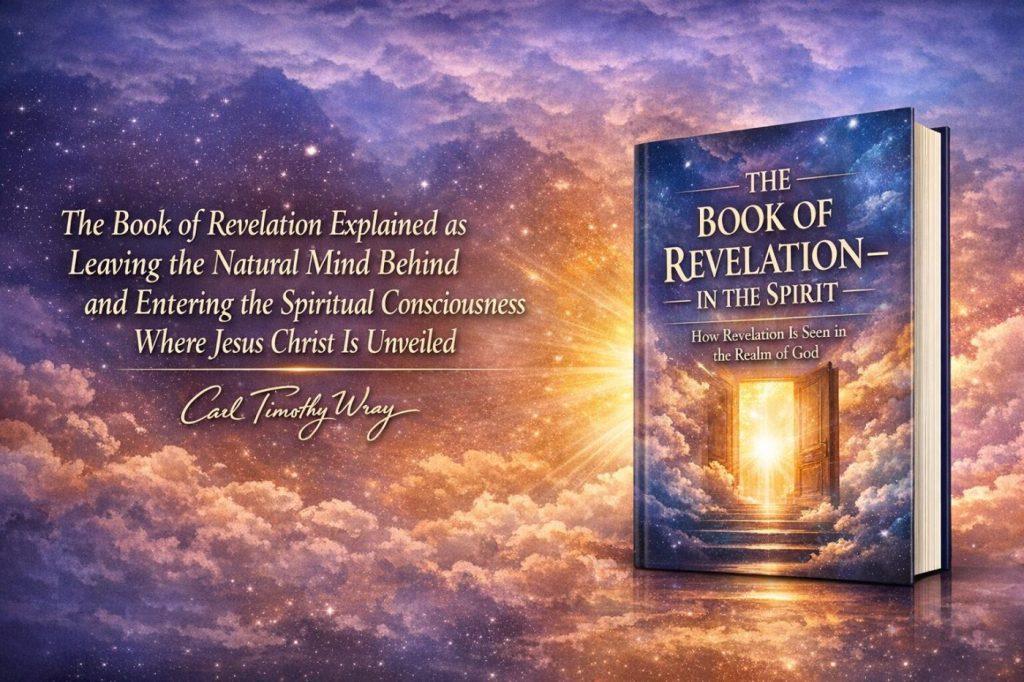
Book of Revelation: Introduction
The Book of Revelation is the most misunderstood book in the Bible. For centuries believers have approached it with charts, timelines, theories, and endless speculation about world events. Some see it as a map of political movements. Others treat it as a mysterious code describing catastrophic events at the end of the world. Entire systems of theology have been built around attempts to decipher its symbols.
Yet the opening lines of the book tell us something entirely different.
The Revelation was not given to a man studying prophecy charts, watching world events, or trying to analyze symbols through intellectual reasoning. The Revelation was given to a man who entered a completely different realm of consciousness.
John tells us plainly:
“I was in the Spirit on the Lord’s day…” (Revelation 1:10).
This single statement reveals the true key to the entire Book of Revelation.
John did not receive the Revelation through the natural mind. He received it in the Spirit.
This means the visions of the Book of Revelation were not seen from the standpoint of earthly observation, but from the vantage point of the Spirit of God. John was physically standing on a small, desolate island called Patmos, yet spiritually he had been lifted into the heavenly realm where the purposes of God could be seen from a completely different perspective.
Until this simple truth is understood, the Book of Revelation will remain a mystery to the natural mind.
The problem is not that the book is too complicated. The problem is that most people are trying to read a spiritual book from a natural position.
The apostle Paul explained this principle clearly:
“The natural man receiveth not the things of the Spirit of God: for they are foolishness unto him: neither can he know them, because they are spiritually discerned” (1 Corinthians 2:14).
This is exactly why the Book of Revelation has produced so many different interpretations throughout history. When the natural mind attempts to interpret spiritual realities, confusion is inevitable. Systems of interpretation multiply, theories collide, and generations of believers are left wondering which explanation is correct.
But the Spirit reveals a different path.
The Revelation is not meant to be solved like a puzzle. It is meant to be seen in the Spirit.
When John entered the Spirit, the veil was lifted from his understanding and he began to see the unveiling of Jesus Christ. What he saw was not merely a sequence of future events, but the living revelation of Christ working in His people and bringing the purposes of God to fulfillment in the earth.
The Book of Revelation is not primarily about disasters, antichrists, or geopolitical movements. It is about the unveiling of the life, authority, and glory of Jesus Christ within His body.
For this reason the Revelation begins where all true understanding must begin: with the call to enter the realm of the Spirit.
This book is written to help the reader understand that transition. It explores why the natural mind cannot comprehend the Book of Revelation, explains the difference between flesh, soul, and spirit, and reveals how spiritual perception opens the scriptures in ways that intellectual study alone never can.
As believers learn to move beyond the limitations of the natural mind and begin to walk in the Spirit, the symbols of the Book of Revelation begin to take on a new clarity. What once seemed mysterious becomes luminous. What once appeared frightening becomes glorious. The entire book begins to unveil the living Christ.
The invitation of Revelation is the same invitation John received on Patmos:
Come into the Spirit, and see what God is revealing.
When that invitation is accepted, the Book of Revelation becomes exactly what its name declares it to be—the unveiling of Jesus Christ.
Chapter 1
The Book No Natural Mind Can Understand
For centuries the Book of Revelation has been one of the most discussed, debated, and misunderstood books in the entire Bible. Countless teachers have attempted to interpret its symbols. Charts have been drawn, timelines proposed, and theories multiplied. Entire prophetic systems have been built around the beasts, seals, trumpets, and visions that fill its pages.
Yet after generations of study, disagreement still remains. One interpretation replaces another, and the mystery of the book often appears deeper than before.
The question naturally arises: Why is the Book of Revelation so difficult for the natural mind to understand?
The answer is not complicated. The difficulty does not lie primarily in the symbols themselves. The difficulty lies in the realm from which the book is being interpreted.
The Book of Revelation was not given from the realm of human intellect. It was given from the realm of the Spirit of God.
Revelation Was Received in the Spirit
The key to understanding the Book of Revelation is revealed in the opening vision recorded by the apostle John.
He writes:
“I was in the Spirit on the Lord’s day, and heard behind me a great voice, as of a trumpet.”
— Revelation 1:10
This statement provides the foundation for the entire book.
John did not receive the Revelation through intellectual reasoning, prophetic speculation, or historical analysis. He received it because he entered the realm of the Spirit.
The visions that follow in the Book of Revelation were seen from that realm.
Until this is understood, the reader will approach the book from the wrong perspective. The natural mind will attempt to interpret spiritual visions through earthly reasoning, and confusion will inevitably follow.
But when the reader begins to see the book through the same spiritual lens through which John received it, the entire message begins to unfold in a different way.
The Limitation of the Natural Mind
The scriptures consistently teach that the natural mind cannot fully comprehend the things of God.
The apostle Paul explains this clearly:
“But the natural man receiveth not the things of the Spirit of God: for they are foolishness unto him: neither can he know them, because they are spiritually discerned.”
— 1 Corinthians 2:14
Paul does not say the natural man will not understand spiritual things. He says the natural man cannot understand them.
The reason is simple: spiritual realities belong to a realm beyond the reach of natural reasoning.
The natural mind interprets life through the senses—what can be seen, heard, touched, measured, and analyzed. While this kind of thinking is valuable in many areas of life, it is incapable of perceiving the deeper realities of the Spirit.
The Book of Revelation was written from a realm that transcends those limitations.
The Revelation Is the Unveiling of Jesus Christ
The opening verse of the book tells us exactly what the Revelation is about.
“The Revelation of Jesus Christ, which God gave unto him, to shew unto his servants things which must shortly come to pass.”
— Revelation 1:1
The word translated “revelation” comes from the Greek word apokalupsis, meaning an unveiling or the removal of a veil.
Something that was hidden becomes visible. Something that was concealed becomes revealed.
The Book of Revelation is therefore not primarily a book about disasters, political events, or catastrophic judgments. It is the unveiling of Jesus Christ Himself.
The visions of the book reveal Christ in His authority, His kingdom, His dealings with His people, and the ultimate fulfillment of God’s purpose in creation.
When the focus shifts away from speculation about world events and returns to the unveiling of Christ, the book begins to make far more sense.
Spiritual Vision Requires Spiritual Illumination
Throughout the scriptures we see that true understanding of God’s purposes comes through spiritual illumination.
Paul prayed this prayer for the believers in Ephesus:
“That the God of our Lord Jesus Christ, the Father of glory, may give unto you the spirit of wisdom and revelation in the knowledge of Him:
The eyes of your understanding being enlightened.”
— Ephesians 1:17–18
Notice the language Paul uses. He speaks of the eyes of understanding being enlightened.
This suggests that spiritual perception operates much like natural sight. Just as the physical eyes require light in order to see, the inner understanding requires spiritual illumination.
When that illumination comes, truths that once seemed hidden suddenly become clear.
Passages of scripture that once appeared mysterious begin to reveal deeper meaning. Symbols begin to point toward spiritual realities rather than merely outward events.
This is exactly what happened to John when he entered the Spirit on Patmos.
The Book of Revelation Must Be Read from the Spirit
Because the Book of Revelation was received in the Spirit, it must also be understood in the Spirit.
Approaching the book with intellectual curiosity alone will never fully unlock its meaning. Charts, timelines, and historical comparisons may provide partial insights, but they cannot reveal the deeper spiritual message contained within the visions.
The Revelation is ultimately about Christ being unveiled.
It reveals His presence among the candlesticks, His authority over the nations, His victory over every opposing power, and His life being manifested in His people.
When the Spirit opens the understanding of the believer, the book begins to reveal a glorious picture of Christ’s kingdom unfolding both within His people and throughout creation.
The Invitation of Revelation
The first step in understanding the Book of Revelation is not the interpretation of symbols.
The first step is the same step John took on the island of Patmos.
It is the step of entering the realm of the Spirit.
When believers learn to walk in the Spirit, the scriptures begin to open in ways that the natural mind alone could never achieve. The visions of Revelation begin to unveil the living Christ, and the book becomes what its name declares it to be:
The Revelation of Jesus Christ.
Chapter 2
John Was in Patmos — But Became in the Spirit
The opening vision of the Book of Revelation begins with a striking contrast between John’s outward circumstances and his inward spiritual experience.
John tells us two things about his situation at the moment the Revelation began.
First, he describes where he was physically:
“I John, who also am your brother, and companion in tribulation, and in the kingdom and patience of Jesus Christ, was in the isle that is called Patmos, for the word of God, and for the testimony of Jesus Christ.”
— Revelation 1:9
Then he immediately describes what happened spiritually:
“I was in the Spirit on the Lord’s day, and heard behind me a great voice, as of a trumpet.”
— Revelation 1:10
These two statements reveal an important truth. John was physically in one place, yet spiritually he had entered another realm entirely.
Patmos was the place of his exile, but the Spirit became the place of his revelation.
The Island of Patmos
Patmos was a small, rocky island in the Aegean Sea used by the Roman Empire as a place of banishment for prisoners. Those sent there were often political offenders or individuals the government considered troublesome.
John had been exiled there, not because he had committed a crime, but because of his unwavering testimony about Jesus Christ.
From a natural perspective, John’s situation appeared unfortunate. He was separated from the churches he loved. He was removed from the centers of Christian fellowship. He was an elderly man living in isolation on a barren island.
But what looked like exile from the earth’s perspective became the setting for one of the greatest revelations in human history.
The place that seemed like isolation became the place where heaven opened.
Becoming in the Spirit
John does not simply say he felt spiritual or experienced a moment of inspiration. The language he uses suggests something deeper.
He says:
“I was in the Spirit…”
The Greek expression used here carries the sense of entering into a different realm of awareness.
In other words, John became in the Spirit.
Before this moment John was functioning as any human being normally does—through his mind, emotions, and senses. He was aware of the physical world around him and the conditions of his exile.
But when he became in the Spirit, his awareness shifted beyond those limitations.
He entered the realm where the purposes of God could be perceived.
This does not mean John left his body or physically traveled to heaven. He remained on Patmos. But the Spirit of God opened his inner perception so that he could see and hear realities that exist beyond the visible world.
Two Realms of Awareness
John’s experience reveals something about the nature of spiritual perception.
A person can exist in the natural world while simultaneously becoming aware of the spiritual realm.
Paul describes this principle when he writes:
“While we look not at the things which are seen, but at the things which are not seen: for the things which are seen are temporal; but the things which are not seen are eternal.”
— 2 Corinthians 4:18
The natural world is not the only reality that exists. Beyond the visible world lies the spiritual dimension where God’s purposes originate.
John’s experience on Patmos shows what happens when the veil between these realms is lifted.
When he became in the Spirit, the unseen world of God’s activity became visible to him.
The Spirit Transcends Circumstances
One of the most encouraging aspects of John’s experience is that his spiritual revelation did not depend on favorable circumstances.
John was not standing in a magnificent temple when he received the Revelation. He was not surrounded by crowds of believers or participating in a great revival.
He was an exile on a barren island.
Yet the Spirit of God met him there.
This teaches an important lesson: the realm of the Spirit is not limited by outward conditions. The presence of God can be encountered in the most unlikely places.
A believer may find himself in a difficult situation—isolated, discouraged, or surrounded by adversity—yet still experience profound revelation from God.
The Spirit is not confined to physical locations.
Wherever the Spirit opens the heart, the heavens can become visible.
The Beginning of the Vision
The moment John became in the Spirit, something remarkable happened.
He heard a voice behind him:
“I heard behind me a great voice, as of a trumpet.”
— Revelation 1:10
That voice marked the beginning of the visions recorded throughout the Book of Revelation.
Immediately John began to see things that could never be perceived through natural sight alone.
He saw the Son of Man walking among the golden candlesticks.
He saw the throne of God surrounded by heavenly beings.
He saw the Lamb opening the sealed book.
He saw the unfolding purposes of God reaching toward the restoration of creation.
All of these visions began the moment John entered the Spirit.
The Same Doorway for Every Believer
John’s experience was not meant to be unique to him alone. The same Spirit who opened the heavens to John still works in the hearts of believers today.
The scriptures continually invite believers to live in the same realm of spiritual awareness.
Paul writes:
“If we live in the Spirit, let us also walk in the Spirit.”
— Galatians 5:25
To walk in the Spirit means allowing our understanding and perception to be shaped by the life of God within us rather than by the limitations of the natural world.
When believers learn to approach the scriptures in this way, the Book of Revelation begins to reveal its deeper meaning.
The symbols become clearer. The visions point toward spiritual realities. And the central message of the book—the unveiling of Jesus Christ—begins to shine through every chapter.
The First Step Toward Understanding Revelation
John’s experience on Patmos shows us the first step toward understanding the Book of Revelation.
Before the visions could be seen, John had to become in the Spirit.
The same principle applies today.
The Revelation cannot be unlocked by intellectual analysis alone. It opens when the Spirit illuminates the heart and mind of the believer.
Only then can the reader begin to see the unveiling of Christ that fills the pages of the Book of Revelation.
And this unveiling begins the same way it began for John on Patmos:
By entering the Spirit.
Chapter 3
The Three Realms of Man — Flesh, Soul, and Spirit
One of the greatest keys to understanding the Book of Revelation is understanding the nature of man himself. The scriptures reveal that human beings are not merely physical creatures living in a material world. Man was created as a being who exists in multiple dimensions of life.
The apostle Paul explains this clearly when he writes:
“And the very God of peace sanctify you wholly; and I pray God your whole spirit and soul and body be preserved blameless unto the coming of our Lord Jesus Christ.”
— 1 Thessalonians 5:23
Paul identifies three distinct aspects of human existence: body, soul, and spirit. Each of these represents a different realm through which a person can experience life.
Understanding these realms is essential because the Book of Revelation was received in one of them—the realm of the Spirit.
The Realm of the Flesh
The first realm in which man lives is the realm of the body, often called the flesh.
This is the realm of the five senses. Through the body we experience the physical world. We see, hear, touch, taste, and smell the things around us. This realm allows us to interact with the visible creation.
There is nothing inherently wrong with the body or the physical world. God created both and declared them good. However, the body is limited to what can be perceived through natural means.
The apostle Paul reminds us of this limitation when he writes:
“While we look not at the things which are seen, but at the things which are not seen: for the things which are seen are temporal; but the things which are not seen are eternal.”
— 2 Corinthians 4:18
The physical senses can only perceive what is temporary. They cannot detect the deeper realities of the spiritual world.
For this reason, anyone who attempts to interpret the Book of Revelation solely through natural observation will inevitably misunderstand its message.
The Realm of the Soul
Beyond the body lies another dimension of human life known as the soul.
The soul includes the mind, the emotions, and the will. It is the center of human personality and consciousness. Through the soul we think, reason, imagine, analyze, and make decisions.
Much of human knowledge originates in this realm. Philosophy, science, literature, and intellectual study all arise from the operations of the human mind.
While the soul is capable of remarkable achievements, it too has limitations when it comes to spiritual truth. The human intellect can analyze information, but it cannot fully penetrate the mysteries of God.
Paul explains this when he writes:
“For what man knoweth the things of a man, save the spirit of man which is in him? Even so the things of God knoweth no man, but the Spirit of God.”
— 1 Corinthians 2:11
The mind can study scripture, memorize verses, and construct theological systems, but the deepest realities of God’s purposes remain hidden unless they are revealed by the Spirit.
This is why so many interpretations of the Book of Revelation have emerged over the centuries. Many of them originate from sincere study, yet they are limited by the realm in which they are formed.
The Realm of the Spirit
The third and highest realm of human existence is the spirit.
When God created man in the beginning, He formed the body from the dust of the earth. Then He breathed into man the breath of life, and man became a living soul (Genesis 2:7). That divine breath represents the spiritual dimension of human life.
It is through the spirit that human beings are able to know God.
Jesus emphasized this truth when He said:
“God is a Spirit: and they that worship Him must worship Him in spirit and in truth.”
— John 4:24
The spirit is the part of man capable of receiving revelation from God. It is the inner faculty through which the Holy Spirit communicates divine truth.
When John received the visions recorded in the Book of Revelation, it was through this realm that he perceived them.
He became aware of realities that the body could not see and the natural mind could not fully comprehend.
Why John Had to Become in the Spirit
Understanding these three realms helps explain why John emphasized that he was “in the Spirit” when he received the Revelation.
If John had remained in the realm of the body alone, he would have seen nothing more than the rocky shores of Patmos.
If he had remained in the realm of the soul alone, he might have reflected on scripture or meditated on God’s promises, but the visions themselves would not have appeared.
It was only when he entered the realm of the Spirit that the heavens opened before him.
In that moment the spiritual dimension became visible. John saw the throne of God, the Lamb, the living creatures, and the unfolding purposes of heaven.
The entire Book of Revelation emerges from this realm.
The Conflict Between Flesh and Spirit
The scriptures also reveal that there is often tension between these realms within human experience.
Paul describes this conflict when he writes:
“For the flesh lusteth against the Spirit, and the Spirit against the flesh: and these are contrary the one to the other.”
— Galatians 5:17
The flesh gravitates toward the visible and the immediate. It seeks comfort, security, and understanding within the boundaries of the physical world.
The Spirit, however, draws the believer toward the deeper purposes of God.
When the Spirit begins to open the understanding of a believer, the person starts to see life from a different perspective. The priorities of the natural world begin to fade, and the realities of God’s kingdom become more vivid.
This transformation is essential for anyone seeking to understand the Book of Revelation.
Growing in the Mind of Christ
As believers grow in their relationship with Christ, the Spirit gradually renews their minds and transforms their understanding.
Paul describes this transformation with these words:
“Let this mind be in you, which was also in Christ Jesus.”
— Philippians 2:5
The goal of the Christian life is not merely moral improvement or religious devotion. It is the formation of the mind of Christ within the believer.
As this transformation occurs, spiritual perception increases. Scriptures that once seemed mysterious begin to reveal deeper meaning.
The visions of the Book of Revelation begin to make sense because they are being viewed from the realm where they originated.
The Doorway Into the Spirit
John’s experience on Patmos illustrates what happens when the Spirit opens this doorway.
A man standing on a barren island suddenly began to see the throne of God. A prisoner in exile began to witness the unfolding purposes of heaven. An elderly apostle became the recipient of one of the most profound revelations ever recorded.
None of this happened through natural reasoning or intellectual study.
It happened because John entered the realm of the Spirit.
And the same doorway remains open today for every believer who seeks to know Christ more deeply.
Chapter 4
Why the Natural Mind Misreads the Book of Revelation
For nearly two thousand years the Book of Revelation has fascinated readers of the Bible. Its symbols are vivid, its visions dramatic, and its language powerful. Yet despite centuries of study, the book remains one of the most debated portions of scripture.
The reason for this confusion is not that the Revelation is impossible to understand. The difficulty lies in the approach used to interpret it.
Many interpreters attempt to understand the book through the tools of the natural mind—historical analysis, speculative timelines, or intellectual systems of prophecy. While these methods may offer interesting theories, they often miss the deeper purpose of the book.
The Revelation was given in the Spirit. When it is interpreted primarily through the intellect, the result is confusion rather than clarity.
The Three Major Systems of Interpretation
Over time, three primary approaches to the Book of Revelation have emerged within Christian theology. These systems attempt to explain the visions and symbols of the book by placing them within specific historical frameworks.
These approaches are known as Preterism, Historicism, and Futurism.
Each system offers a different explanation for the events described in Revelation.
The Preterist Interpretation
The Preterist view teaches that most or all of the events described in the Book of Revelation were fulfilled in the first century.
According to this perspective, the visions primarily refer to events surrounding the destruction of Jerusalem in A.D. 70 and the end of the old covenant order. The fall of Jerusalem, the collapse of the temple system, and the transition from the old covenant to the new covenant are seen as the central fulfillment of the prophecies.
Preterism recognizes that Revelation contains symbolic language and that many of its images are connected to events in the early church era.
However, when the book is confined entirely to first-century history, its ongoing spiritual message for the life of the believer can easily be overlooked.
The Revelation was not given merely to explain ancient events; it was given to reveal Jesus Christ and His unfolding purpose in His people.
The Historicist Interpretation
The Historicist interpretation views the Book of Revelation as a symbolic timeline of church history.
According to this approach, the visions of Revelation correspond to major events that occurred throughout the centuries of the Christian era. Interpreters have attempted to identify specific historical developments within the seals, trumpets, and other prophetic symbols.
In this framework, events such as the rise of the Papacy, the spread of Islam, the Protestant Reformation, and various political revolutions have been linked to particular passages in Revelation.
While this view recognizes that the book may describe long-term developments in history, it often becomes an exercise in speculation. As history progresses, interpretations frequently change because new events are constantly being proposed as fulfillments of the prophecy.
As a result, the message of Revelation can become tied to ever-changing historical theories rather than to the enduring revelation of Christ.
The Futurist Interpretation
The Futurist approach is the most widely accepted interpretation among many modern evangelical Christians.
This view teaches that most of the events described in the Book of Revelation—particularly from chapter four onward—are still future. According to this framework, the visions will be fulfilled during a brief period of intense global turmoil often referred to as the Great Tribulation.
Within this system, interpreters frequently attempt to identify political leaders, technological developments, or world events that might correspond to the prophetic symbols of the book.
While Futurism acknowledges that Revelation speaks about the ultimate victory of Christ, it often shifts the focus away from the present spiritual life of believers and places the emphasis on future geopolitical events.
As a result, the Revelation can appear more like a prediction of world crises than a present unveiling of Christ’s work in His people.
Why These Systems Fall Short
Each of these interpretive systems attempts to explain the Book of Revelation from a particular intellectual framework.
Preterism looks backward into history.
Historicism looks across the long span of church history.
Futurism looks forward toward future events.
While each approach may contain elements of truth, none of them fully captures the central purpose of the Revelation.
The book was not given merely as a historical puzzle or a prophetic timeline. It was given as the unveiling of Jesus Christ.
When the focus shifts from Christ to historical speculation, the heart of the message can easily be lost.
The Revelation Is About Christ
The opening words of the book make its purpose unmistakably clear:
“The Revelation of Jesus Christ…”
— Revelation 1:1
This phrase defines the entire message of the book.
Revelation is not primarily about disasters, political empires, or chronological predictions. It is about the unveiling of Jesus Christ—His authority, His kingdom, and His work within His people.
When the book is approached from this perspective, its symbols begin to point toward spiritual realities rather than merely outward events.
The seals, trumpets, and visions reveal the ways in which Christ brings His people into transformation and victory.
Seeing Revelation Through the Spirit
The key to understanding the Book of Revelation is the same key that opened the visions to John.
He became in the Spirit.
When believers approach the book through the illumination of the Holy Spirit, the symbols begin to take on new meaning. The visions reveal the deeper processes by which God brings His purposes to fulfillment in His people and in creation.
The Revelation then becomes more than a prophetic mystery. It becomes a living message that unveils the glory of Christ and the destiny of His people.
The Invitation to See Differently
The challenge of the Book of Revelation is not merely to interpret its symbols but to change the vantage point from which it is read.
When the natural mind dominates the interpretation, the book becomes confusing and controversial.
But when the Spirit opens the understanding, the visions become a powerful testimony of Christ’s victory and the unfolding purpose of God.
The same Spirit who opened the heavens to John on Patmos continues to illuminate the scriptures today.
And when that illumination comes, the Book of Revelation ceases to be a puzzle and becomes what it was always meant to be:
The unveiling of Jesus Christ.
Chapter 5
The Language of the Spirit — Why Revelation Speaks in Symbols
One of the first things a reader notices when approaching the Book of Revelation is its unusual language. The book is filled with vivid imagery and powerful symbols: beasts rising from the sea, stars falling from heaven, trumpets sounding, bowls of judgment being poured out, and a Lamb opening a sealed book.
To the natural mind this imagery can seem strange, confusing, or even frightening. Many readers attempt to interpret these symbols as literal descriptions of physical events. Others try to match them with modern technology or political developments.
Yet the language of the Book of Revelation was never meant to be interpreted in that way.
The visions of Revelation are written in the language of the Spirit.
Revelation Was Signified
The opening verse of the book provides an important clue to how its message should be understood.
John writes:
“The Revelation of Jesus Christ, which God gave unto him, to shew unto his servants things which must shortly come to pass; and he sent and signified it by his angel unto his servant John.”
— Revelation 1:1
The word “signified” comes from a Greek term meaning to communicate by signs or symbols. In other words, the message of Revelation was intentionally given through symbolic language.
This means the visions are not meant to be interpreted as literal photographs of future events. They are signs pointing toward deeper spiritual realities.
The Spirit of God uses symbols to reveal truths that cannot easily be expressed through ordinary language.
Symbols Reveal Spiritual Realities
Throughout the Bible, God frequently communicates through symbolic imagery.
In the Old Testament prophets we see visions of wheels within wheels, dry bones coming to life, candlesticks, olive trees, and rivers flowing from the temple. These images were not meant to be understood as literal events; they were symbolic portrayals of spiritual truths.
The same pattern appears in the Book of Revelation.
The Lamb represents Christ.
The candlesticks represent the churches.
The stars represent messengers.
The beasts represent systems of power and opposition to God’s purposes.
These symbols act like windows through which deeper spiritual realities become visible.
Why the Spirit Uses Symbolic Language
Symbolic language allows the Spirit to communicate complex truths in a vivid and memorable way.
A single image can convey layers of meaning that would require many pages of explanation in ordinary speech.
For example, when Revelation describes Christ as the Lamb, the image immediately calls to mind the sacrificial lamb of the Passover, the suffering servant of Isaiah, and the redemptive work of the cross.
Through one symbol the Spirit connects multiple dimensions of scripture and revelation.
Symbols also invite the reader to look beyond the surface and seek deeper understanding. They encourage spiritual reflection and dependence upon the Holy Spirit for interpretation.
The Danger of Literalism
Many misunderstandings of the Book of Revelation arise when symbolic language is treated as literal description.
For instance, if a reader assumes that every beast, trumpet, or cosmic event must correspond to a physical occurrence in the natural world, the interpretation can quickly become strained.
Speculations begin to multiply. Interpreters attempt to match symbols with political figures, technological inventions, or future disasters.
But the purpose of the symbols is not to describe literal events in precise detail. Their purpose is to reveal the spiritual dynamics of God’s dealings with His people and the world.
When the symbolic nature of the book is recognized, the message becomes far clearer.
The Language of Heaven
The visions recorded in the Book of Revelation originate from the heavenly realm. John was not observing ordinary earthly events; he was witnessing the activity of God’s kingdom.
Because these realities transcend the natural world, they must be communicated in a language capable of expressing spiritual truths.
Symbols serve as the bridge between these realms.
Through symbolic imagery, the Spirit translates heavenly realities into forms that human minds can begin to grasp.
Just as parables allowed Jesus to communicate profound truths through everyday stories, the symbols of Revelation allow divine mysteries to be expressed in visible imagery.
The Role of the Holy Spirit
Because the Book of Revelation is written in the language of the Spirit, it must be interpreted by the Spirit as well.
Human reasoning alone cannot fully unlock the meaning of these symbols.
The same Spirit who inspired the visions must illuminate their significance to the reader.
Jesus promised this ministry of the Spirit when He said:
“When he, the Spirit of truth, is come, he will guide you into all truth.”
— John 16:13
As believers seek the guidance of the Holy Spirit, the symbols of Revelation begin to reveal their deeper meaning. What once appeared mysterious becomes a powerful testimony of Christ’s victory and God’s unfolding purpose.
Learning to Read the Book of Revelation
Understanding the symbolic language of the Book of Revelation changes the way the entire book is read.
Instead of searching for literal fulfillments of each image, the reader begins to ask deeper questions:
What spiritual reality does this symbol represent?
What aspect of Christ’s work is being revealed?
How does this vision describe the transformation of God’s people?
When approached in this way, the Revelation becomes less like a cryptic puzzle and more like a spiritual unveiling.
The symbols begin to form a coherent picture of Christ’s kingdom and the process through which God brings His people into victory.
The Symbols Point to Christ
Every symbol in the Book of Revelation ultimately points back to one central reality: the person and work of Jesus Christ.
He is the Lamb who opens the sealed book.
He is the King who reigns over the nations.
He is the Alpha and the Omega, the beginning and the end.
As the Spirit illuminates the symbols of the book, the reader begins to see that each vision contributes to the unveiling of Christ.
The Revelation is not merely a book of symbols. It is the revelation of a Person.
And through that revelation, the glory of Christ begins to shine through every page of the Book of Revelation.
Chapter 6
The Mind of Christ — The Only Mind That Can Understand the Book of Revelation
At the heart of the Book of Revelation lies a truth that many readers overlook. The challenge of understanding the book is not primarily intellectual; it is spiritual.
The visions John recorded cannot be understood merely through study, research, or theological systems. They require something deeper: the mind of Christ operating within the believer.
The scriptures make this principle clear.
The apostle Paul writes:
“But we have the mind of Christ.”
— 1 Corinthians 2:16
This statement reveals that spiritual understanding comes not through the natural mind, but through participation in the mind of Christ.
Only this mind can fully comprehend the things revealed in the Book of Revelation.
The Limitations of the Human Mind
The human mind is capable of remarkable achievements. Through intellect and reasoning, humanity has developed science, technology, philosophy, and countless systems of knowledge.
Yet despite its impressive capabilities, the natural mind cannot penetrate the deepest realities of God.
Paul explains this limitation when he writes:
“For what man knoweth the things of a man, save the spirit of man which is in him? even so the things of God knoweth no man, but the Spirit of God.”
— 1 Corinthians 2:11
In other words, just as only the human spirit truly understands the thoughts within a person, only the Spirit of God understands the thoughts and purposes of God.
Without the illumination of the Spirit, the human intellect remains unable to grasp the deeper mysteries of scripture.
This is why many interpretations of the Book of Revelation remain incomplete. They are built upon human reasoning rather than spiritual revelation.
The Gift of the Mind of Christ
The good news of the gospel is that believers are not left to rely on their natural minds alone.
Through the work of Christ and the indwelling presence of the Holy Spirit, believers are given access to a new way of thinking and perceiving.
Paul describes this transformation when he writes:
“Let this mind be in you, which was also in Christ Jesus.”
— Philippians 2:5
The mind of Christ is not merely a higher form of human reasoning. It is the perspective of Christ Himself operating within the believer.
This mind sees reality through the purposes of God. It perceives spiritual truths that remain hidden from the natural intellect.
As the believer grows in spiritual maturity, this mind becomes increasingly active, enabling deeper understanding of the scriptures.
Revelation Requires a Renewed Mind
Understanding the Book of Revelation requires more than knowledge; it requires transformation.
Paul describes this process in Romans:
“Be not conformed to this world: but be ye transformed by the renewing of your mind.”
— Romans 12:2
The renewal of the mind involves learning to see life from God’s perspective rather than from the limitations of human reasoning.
As the Spirit renews the mind, believers begin to recognize patterns and truths in scripture that were previously hidden.
The symbols of the Book of Revelation begin to reveal their deeper meaning. The visions start to form a coherent picture of Christ’s work in His people and in creation.
Growing Into Spiritual Understanding
Spiritual understanding develops as believers grow in their relationship with Christ.
The New Testament frequently describes believers as beginning their spiritual journey as babes in Christ.
At this stage, understanding is limited. The believer is learning the basic truths of the faith and beginning to develop spiritual awareness.
But as the believer continues to walk with Christ, maturity begins to develop.
Paul speaks of this growth when he writes:
“Till we all come in the unity of the faith, and of the knowledge of the Son of God, unto a perfect man, unto the measure of the stature of the fulness of Christ.”
— Ephesians 4:13
As this growth occurs, the mind of Christ becomes more fully expressed in the believer’s life.
This growing spiritual maturity opens the door to deeper understanding of the Book of Revelation.
Seeing Through the Eyes of Christ
When the mind of Christ begins to operate within a believer, the scriptures take on new life.
Passages that once seemed mysterious begin to reveal their meaning. Symbols that once appeared confusing begin to form part of a larger spiritual picture.
The Book of Revelation becomes less about decoding hidden events and more about seeing the unfolding revelation of Christ.
The Lamb, the throne, the living creatures, the sealed book—all of these visions begin to point toward the same central reality: the reign of Christ and the transformation of His people.
Through the mind of Christ, the believer begins to see the book not as a distant prophecy but as a present unveiling of divine purpose.
The Call to Put on the Mind of Christ
The invitation of the gospel is not merely to believe certain truths about Christ, but to participate in His life.
Believers are called to grow into a deeper union with Him, allowing His Spirit to shape their understanding and perception.
As this transformation takes place, the Book of Revelation begins to open in new ways.
The reader no longer approaches the book merely as a collection of mysterious symbols. Instead, it becomes a living revelation of Christ’s work within His people.
And through that revelation, believers begin to see the unfolding purpose of God with greater clarity.
The Revelation of Christ Within His People
Ultimately, the Book of Revelation reveals more than future events or historical patterns.
It reveals the victory of Christ and the transformation of those who belong to Him.
As believers grow into the mind of Christ, they begin to perceive this victory unfolding not only in the world around them but also within their own lives.
The Revelation becomes a testimony of God’s power to bring His people from bondage into freedom, from immaturity into sonship, and from limitation into the fullness of Christ.
And it is through the mind of Christ that this unveiling becomes clear.
Chapter 7
The Book of Revelation — The Unveiling of Jesus Christ
The final and greatest key to understanding the Book of Revelation is found in the very first words of the book.
John begins with this declaration:
“The Revelation of Jesus Christ, which God gave unto him, to shew unto his servants things which must shortly come to pass.”
— Revelation 1:1
These opening words define the entire purpose of the book.
The Revelation is not primarily about disasters, prophetic timelines, political empires, or global catastrophes. It is about Jesus Christ Himself.
The book exists for one purpose: to unveil Christ.
Until this truth becomes clear, the reader may wander through the symbols and visions without ever grasping the central message.
But when the focus returns to Christ, the entire book begins to make sense.
The Meaning of “Revelation”
The word translated “revelation” comes from the Greek word apokalupsis. It means an unveiling, a disclosure, or the removal of a veil.
Something that was hidden becomes visible.
Something that was concealed becomes revealed.
In the Book of Revelation, the veil is lifted so that the glory of Christ can be seen more clearly.
John sees Christ walking among the candlesticks.
He sees Christ as the Lamb who opens the sealed book.
He sees Christ as the King who reigns over the nations.
He sees Christ bringing all things toward their ultimate fulfillment.
Every vision contributes to this unfolding revelation.
Christ at the Center of Every Vision
From beginning to end, the Book of Revelation keeps Christ at the center.
He is the Alpha and the Omega.
He is the faithful witness.
He is the firstborn from the dead.
He is the ruler of the kings of the earth.
When John first turns to see the voice that speaks to him, he beholds the Son of Man standing in the midst of the golden candlesticks.
This vision establishes the foundation for the entire book. Christ is not distant from His people. He is present among them, guiding, correcting, and strengthening them.
Every subsequent vision flows from this reality.
The Lamb on the throne, the opening of the seals, the unfolding judgments, and the final victory all reveal different aspects of Christ’s authority and purpose.
The Revelation Within the People of God
The Book of Revelation does not merely describe Christ as an external ruler governing distant events. It also reveals the work of Christ within His people.
The letters to the seven churches demonstrate how Christ deals with the hearts of His followers.
The visions of victory reveal a people who overcome through the power of the Lamb.
The final chapters portray a city filled with the glory of God—a community transformed by the life of Christ.
In this way, the Revelation describes the process through which Christ forms His image within His people.
The unveiling of Christ is not only something to be observed; it is something to be experienced.
The Journey from Patmos to the Throne
The book begins with John standing on a lonely island called Patmos.
Yet as soon as he enters the Spirit, the heavens open before him.
What begins as a moment of spiritual awareness quickly expands into a sweeping vision of God’s throne, the Lamb, and the unfolding purposes of heaven.
This progression illustrates the journey of every believer.
A person may begin their spiritual walk in a place of limitation or hardship. Yet when the Spirit opens their understanding, they begin to see beyond those circumstances.
The throne of God becomes visible.
The authority of Christ becomes clear.
And the purposes of God begin to unfold.
The Call to Hear What the Spirit Says
Throughout the Book of Revelation, one phrase appears again and again:
“He that hath an ear, let him hear what the Spirit saith unto the churches.”
This repeated invitation reminds the reader that the message of Revelation is not merely information to be analyzed.
It is a voice to be heard.
The Spirit is speaking to the people of God, revealing the ways in which Christ is working to bring His purposes to fulfillment.
Those who listen with spiritual ears begin to perceive the deeper meaning of the visions.
Seeing Christ Through the Spirit
As we have seen throughout this book, the Book of Revelation cannot be fully understood through natural reasoning alone.
John received the visions when he became in the Spirit.
The same Spirit who revealed these truths to John must illuminate them to us.
When believers approach the book with hearts open to the Spirit, the symbols begin to reveal their meaning. The visions point toward the work of Christ in His people and in creation.
The Revelation becomes a powerful testimony of God’s faithfulness and His ultimate victory.
The Revelation Continues
The unveiling of Jesus Christ did not end when John finished writing the final chapter of the Book of Revelation.
The same Christ who appeared to John continues to reveal Himself today.
Through the Spirit, believers are invited to participate in this unfolding revelation.
As the life of Christ grows within His people, His character, authority, and glory become increasingly visible.
The Revelation of Jesus Christ continues wherever His life is manifested.
The Beginning of a Greater Revelation
The journey we have explored in this book is only the beginning.
We have seen that the Book of Revelation must be understood in the Spirit. We have discovered that its symbols reveal spiritual realities and that its ultimate purpose is to unveil Christ.
But the visions that follow in the book carry this revelation much further.
In the next stage of this journey, John will be invited to ascend even higher—to behold the throne of God and the worship of heaven.
There he will witness the Lamb taking the sealed book and opening the purposes of God.
And through that vision, the Revelation of Jesus Christ will unfold in even greater glory.
Book of Revelation: By Carl Timothy Wray

Book of Revelation Series
- Book of Revelation
- The Revelation of Jesus Christ
- The Throne of God
- The Finished Work of Christ — God’s Full Counsel Revealed Through the Plan of the Ages
- The Finished Work of Christ: Meaning, Key Scriptures & FAQs
- Join Our Facebook Page