Judgment of God — Righteous Judgment Revealed Through Refining Fire, Sonship, the Fall of Babylon, the Healing of the Nations, and the Restoration of All Things
Author
Carl Timothy Wray is a prophetic Kingdom writer, teacher, and founder of The Finished Work of Christ and Zion University. Through hundreds of books, teachings, and Revelation-based studies, he focuses on unveiling the full counsel of God from Genesis to Revelation — revealing Christ’s finished work, the manifestation of the sons of God, the restoration of all things, and the eternal purpose hidden within God before the foundation of the world. His writings challenge religious tradition while calling believers into the deeper realities of sonship, reconciliation, righteous government, and the Kingdom of God.
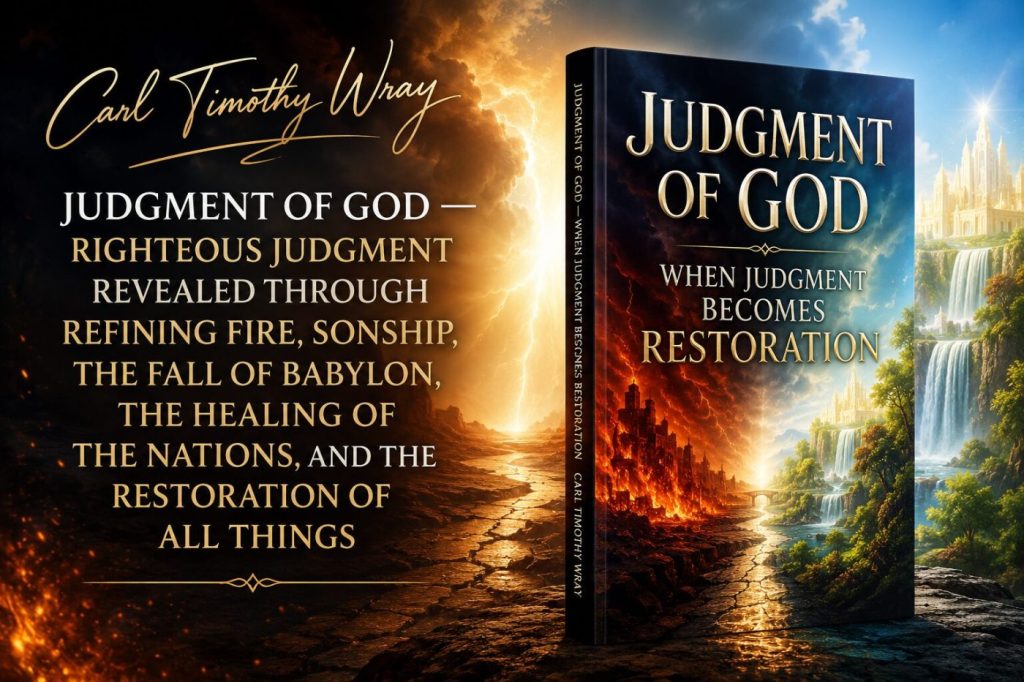
Judgment of God — When Judgment Becomes Restoration
What is the Judgment of God? Is divine judgment endless punishment, or does Scripture reveal something deeper? In this powerful Revelation-based book, Carl Timothy Wray explores the true meaning of the Judgment of God through the full counsel of Scripture from Genesis to Revelation. Discover how God’s judgments bring correction, purification, refinement, righteous government, the fall of Babylon, the healing of the nations, and the restoration of all things through Jesus Christ. This book examines the Lake of Fire, the Second Death, the Judgment Seat of Christ, sonship, refining fire, and the ultimate purpose of God’s righteous judgments in the earth. A prophetic and theological unveiling for believers seeking deeper understanding of Revelation, restoration, and the Kingdom of God.
Judgment of God: Introduction
The Judgment of God Has Been Misunderstood
Few subjects in all of Scripture have been more misunderstood, feared, distorted, and weaponized than the Judgment of God.
For generations, religious systems have painted judgment as little more than endless wrath, eternal torment, divine anger, and hopeless condemnation. Entire systems of fear have been built upon terrifying images of fire, destruction, punishment, and separation. Multitudes tremble at the thought of judgment because Babylon has interpreted judgment through the mind of fear rather than through the Spirit of truth.
But when we step back and allow the full counsel of God to speak from Genesis to Revelation, another picture begins to emerge — a picture far greater than religious tradition has often imagined.
The Scriptures reveal that the Judgment of God is not merely destructive.
It is corrective.
It is refining.
It is governmental.
It is transformational.
It is restorative.
The judgments of God are the processes through which He removes corruption, exposes lies, purifies His people, overthrows Babylon, humbles the pride of nations, destroys death itself, and restores creation back into harmony with His eternal purpose.
Isaiah declared:
“When Thy judgments are in the earth, the inhabitants of the world will learn righteousness.” — Isaiah 26:9
Notice carefully what the prophet did not say.
He did not say the inhabitants of the world would learn hopelessness.
He did not say they would learn endless despair.
He did not say they would learn abandonment.
He said:
“The inhabitants of the world will learn righteousness.”
This changes everything.
Throughout Scripture, the fire of God is repeatedly revealed not merely as destruction, but as purification:
- gold refined in fire
- silver purified in furnaces
- sons chastened into maturity
- nations humbled into righteousness
- Babylon consumed by truth
- death itself swallowed up in victory
The fire of God removes the lie so truth may remain.
The Judgment of God is therefore deeply connected to:
- the manifestation of the sons of God,
- the fall of religious Babylon,
- the healing of the nations,
- the destruction of death,
- and the restoration of all things through Jesus Christ.
This book is not written to defend religious systems.
It is written to search the Scriptures.
We will walk through:
- righteous judgment,
- krisis as divine turning points,
- sonship processings,
- refining fire,
- the Lake of Fire,
- the Judgment Seat of Christ,
- the judgment of nations,
- and the final restoration revealed throughout the Word of God.
The hour has come for many believers to see judgment through the eyes of Zion rather than through the fear of Babylon.
For the Judge of all the earth is also:
- the Savior of the world,
- the Refiner of sons,
- the Healer of nations,
- and the Restorer of all things.
And when His judgments are fully revealed in the earth,
creation itself shall learn righteousness.
CHAPTER 1
The Judgment of God Has Been Misunderstood
Babylon’s Fear vs. Zion’s Revelation
One of the greatest misunderstandings in the history of religion is the misunderstanding of the Judgment of God.
For centuries, men have spoken of judgment almost entirely through the language of fear. Entire systems of theology have been built upon terrifying images of wrath, endless punishment, hopeless destruction, and eternal abandonment. The very mention of judgment causes many hearts to tremble because religion has trained multitudes to see God primarily as an angry judge waiting to condemn rather than a righteous Father working to restore creation unto Himself.
Yet when the Scriptures are searched carefully through the full counsel of God, another testimony begins to arise from the pages of holy writ.
The prophets did not tremble at the thought of God’s judgments.
They longed for them.
David wrote:
“Let the heavens rejoice, and let the earth be glad… for He cometh to judge the earth: He shall judge the world with righteousness, and the people with His truth.” — Psalm 96:11–13
Again:
“Let the floods clap their hands: let the hills be joyful together before the Lord; for He cometh to judge the earth.” — Psalm 98:8–9
This is not the language of terror.
It is the language of hope.
Why would creation rejoice at judgment if judgment were nothing but hopeless destruction?
Why would the prophets celebrate the coming judgments of God?
Because they understood something many religious systems have failed to understand:
the judgments of God are connected to the restoration of divine order.
Judgment is what happens when God begins removing corruption so righteousness may flourish.
Judgment is heaven confronting everything that destroys life.
Judgment is the overthrow of darkness so light may reign.
Judgment is the government of God correcting creation back toward harmony with Himself.
Isaiah unveiled this mystery with extraordinary clarity:
“When Thy judgments are in the earth, the inhabitants of the world will learn righteousness.” — Isaiah 26:9
Notice what the prophet reveals.
The result of God’s judgments is not endless rebellion.
The result is righteousness learned.
This single verse shatters many religious interpretations of judgment.
For if the purpose of judgment were merely eternal punishment, why would the inhabitants of the world learn righteousness through it?
The prophet reveals that divine judgment carries instructional purpose.
Corrective purpose.
Transformational purpose.
The judgments of God teach creation.
Judgment Is More Than Punishment
Most believers only understand judgment through its negative side.
But Scripture reveals that judgment is far broader than condemnation.
The Hebrew word most commonly translated as judgment is:
Mishpat
This word carries the thought of:
- justice,
- verdict,
- correction,
- divine order,
- righteous government,
- and proper decision.
Likewise, the Greek word:
Krisis
from which we derive the English word “crisis,” speaks of:
- separation,
- decisive turning points,
- examination,
- evaluation,
- and judgment leading toward resolution.
A crisis is a turning point.
And throughout Scripture, divine judgment repeatedly appears as a turning point in God’s dealings with men, nations, systems, and even creation itself.
When God judges:
- lies are exposed,
- pride is humbled,
- corruption is confronted,
- bondage is broken,
- and righteousness is established.
This is why Scripture continually connects judgment with righteousness.
“He shall judge the world with righteousness.” — Psalm 9:8
“He shall not judge after the sight of His eyes… but with righteousness shall He judge.” — Isaiah 11:3–4
True judgment is not emotional rage.
It is righteous government.
The Fire of God Removes the Lie
Throughout Scripture, God repeatedly reveals Himself as fire.
“For our God is a consuming fire.” — Hebrews 12:29
Religious systems often stop there and imagine only destruction.
But the Scriptures reveal that God’s fire has purpose.
Gold is refined by fire.
Silver is purified by fire.
Precious stones endure fire.
The sons of Levi are purified by fire.
The fire removes impurity so purity may emerge.
The purpose of refining fire is not the destruction of gold —
it is the removal of dross.
This becomes one of the great keys to understanding the Judgment of God.
God’s judgments are directed against:
- corruption,
- deception,
- bondage,
- rebellion,
- pride,
- darkness,
- and death itself.
The fire of God burns against everything contrary to His nature until righteousness remains.
This is why John the Baptist declared:
“He shall baptize you with the Holy Ghost, and with fire.” — Matthew 3:11
Even the baptism of fire is connected to purification and preparation.
Judgment Begins at the House of God
Before God judges the nations, He begins with His own house.
Peter declared:
“For the time is come that judgment must begin at the house of God.” — 1 Peter 4:17
This is one of the great revelations of sonship.
God judges His people not because He hates them —
but because He is forming them.
The chastening of the Lord is evidence of sonship.
“For whom the Lord loveth He chasteneth.” — Hebrews 12:6
The sons of God are brought through:
- testing,
- correction,
- purification,
- pressure,
- refinement,
- and spiritual crisis,
until the nature of Christ is formed within them.
This is not rejection.
This is preparation.
The Father disciplines sons because He intends for them to share His Kingdom.
Babylon Misunderstood Judgment
Religious Babylon has often portrayed judgment as endless hopelessness because Babylon itself operates through fear and control.
Systems built on fear require terrifying judgments to maintain authority over people.
But Zion sees farther.
Zion understands that the Judge of all the earth is also:
- the Savior of the world,
- the Refiner of sons,
- the Healer of nations,
- and the Restorer of all things.
The same God who judges Babylon also says:
“Behold, I make all things new.” — Revelation 21:5
The same God who judges corruption also promises:
“There shall be no more death.” — Revelation 21:4
The same God who sends refining fire also promises:
“The inhabitants of the world will learn righteousness.” — Isaiah 26:9
Judgment is therefore not separate from redemption.
Judgment is one of the tools through which redemption advances.
The Turning Point of the Ages
Creation itself stands at a divine turning point.
The nations rage.
Systems shake.
Babylon trembles.
Darkness increases.
Fear spreads across the earth.
But the Kingdom of God is also advancing.
The Spirit of God is awakening a people who no longer see judgment through religious fear, but through the revelation of righteous government.
The hour is coming when the sons of God shall arise in the nature of their Father:
- judging righteously,
- governing in wisdom,
- healing nations,
- restoring creation,
- and manifesting the life of Christ in the earth.
For the final purpose of God is not eternal chaos —
but divine harmony.
Not endless death —
but everlasting life.
Not the triumph of darkness —
but the victory of the Lamb.
And when His judgments are fully revealed in the earth,
the inhabitants of the world shall learn righteousness.
CHAPTER 2
Krisis — Judgment as a Divine Turning Point
Judgment Is a Crisis of Transformation
One of the greatest keys to understanding the Judgment of God is found within the Greek language itself.
The New Testament word often translated as judgment is:
Krisis
From this same root comes the English word:
Crisis
This is not accidental.
A crisis is:
- a decisive moment,
- a turning point,
- a separating point,
- a moment of exposure,
- a moment where things can no longer remain the same.
And this is precisely how God’s judgments function throughout Scripture.
Judgment is not merely punishment.
Judgment is heaven intervening to bring transformation.
Whenever God judges:
- hidden things are exposed,
- false foundations are shaken,
- corruption is confronted,
- and decisions must be made.
Judgment creates separation between:
- truth and lies,
- light and darkness,
- Spirit and flesh,
- life and death.
The purpose of divine judgment is to bring creation to a turning point.
God Uses Crisis to Change Men
Throughout Scripture, nearly every major transformation occurs through some form of divine crisis.
Jacob wrestled through crisis until his nature changed.
Joseph passed through crisis before entering rulership.
Israel endured wilderness crisis before entering promise.
David walked through crisis before ascending the throne.
The apostles were shattered by crisis before Pentecost transformed them.
Even creation itself groans under crisis.
Paul wrote:
“For the earnest expectation of the creature waiteth for the manifestation of the sons of God.” — Romans 8:19
Creation is moving toward a divine turning point.
The shaking of nations…
the collapse of systems…
the exposure of corruption…
the groaning of humanity…
all testify that creation itself is approaching divine intervention.
But Babylon sees crisis only as destruction.
Zion sees crisis as transition.
The crisis is not merely the end of something.
It is the birth of something greater.
The Judgment of Sons
One of the clearest examples of corrective judgment is found in the chastening of the sons of God.
“For whom the Lord loveth He chasteneth, and scourgeth every son whom He receiveth.” — Hebrews 12:6
The Father does not chasten sons to destroy them.
He chastens sons to mature them.
This is one of the greatest revelations concerning judgment.
The judgments of God toward His elect are not abandonment —
they are processings.
God allows:
- pressure,
- correction,
- wilderness,
- breaking,
- humbling,
- and refinement
so that the nature of Christ may emerge within His people.
The flesh resists this process.
Pride hates this process.
Self-will fears this process.
But sonship is formed through divine dealings.
This is why Peter declared:
“Judgment must begin at the house of God.” — 1 Peter 4:17
Before God judges the nations externally, He judges His sons internally.
Before righteous government can flow outward, righteousness must first be established inwardly.
The sons of God are not formed through comfort alone.
They are formed through transformation.
Fire Reveals What Cannot Remain
Every crisis exposes foundations.
When fire comes:
- wood burns,
- hay disappears,
- stubble vanishes,
- but gold remains.
Paul revealed this mystery:
“Every man’s work shall be made manifest: for the day shall declare it, because it shall be revealed by fire.” — 1 Corinthians 3:13
The fire does not merely punish.
The fire reveals.
Fire exposes:
- motives,
- intentions,
- mixtures,
- pride,
- fleshly works,
- and false foundations.
Many works that appear powerful before men cannot survive the fire of God because they were built through human ambition rather than through the Spirit.
But works birthed from obedience to God endure the flames.
Gold survives fire because it possesses a nature capable of enduring refinement.
So also the sons of God are being prepared to endure the unveiling of divine glory.
God’s Judgments Interrupt the Old Order
Krisis always disrupts the old order.
When God judges:
- Egypt falls,
- Babylon collapses,
- religious systems shake,
- idols are exposed,
- and kingdoms tremble.
Why?
Because God’s judgments are designed to remove what opposes life.
This is why many seasons of judgment appear uncomfortable.
God interrupts what flesh wants to preserve.
The natural man desires stability without transformation.
But God desires transformation even if stability must be shaken.
This is why Scripture says:
“Yet once more I shake not the earth only, but also heaven.” — Hebrews 12:26
God shakes:
- systems,
- traditions,
- religious structures,
- governments,
- and hearts,
until only that which is founded in Christ remains.
Divine Judgment Produces Separation
Every judgment separates something.
Noah’s flood separated corruption from preservation.
The Red Sea separated bondage from freedom.
The wilderness separated unbelief from faith.
The cross separated the old man from the new creation.
Even now, the Spirit of God is bringing separation within His people.
The Lord is separating:
- mixture from purity,
- religion from life,
- tradition from revelation,
- flesh from Spirit,
- Babylon from Zion.
This separation is painful for the carnal mind because flesh always clings to the old order.
But judgment is necessary whenever transition is required.
The old must give way for the new.
The Crisis Before Manifestation
Every birth is preceded by travail.
Every manifestation is preceded by pressure.
Every unveiling comes through process.
The manifestation of the sons of God will not emerge from comfort and religious routine alone.
It comes through dealings.
Through refinement.
Through crisis.
This is why many believers experience seasons where:
- everything shakes,
- old securities collapse,
- familiar structures fail,
- and hidden weaknesses surface.
These moments are not always signs of abandonment.
Often they are signs of divine transition.
God brings His people into crisis so He may bring them into transformation.
The crisis becomes the doorway into greater revelation.
Judgment Is Moving Creation Toward Restoration
The religious mind often sees judgment as the final end.
But Scripture repeatedly reveals judgment as movement toward restoration.
The pruning of a vine is judgment unto greater fruitfulness.
The refining of gold is judgment unto purity.
The chastening of sons is judgment unto maturity.
The exposure of Babylon is judgment unto freedom.
The shaking of nations is judgment unto righteous government.
The Judge of all the earth is moving creation toward His eternal purpose.
And His eternal purpose is not everlasting chaos.
His purpose is:
- righteousness,
- reconciliation,
- harmony,
- life,
- truth,
- and the full manifestation of His Kingdom.
This is why Isaiah could boldly proclaim:
“When Thy judgments are in the earth, the inhabitants of the world will learn righteousness.” — Isaiah 26:9
The judgments of God are not meaningless destruction.
They are divine turning points leading creation toward the triumph of righteousness.
The Great Turning Point
Humanity stands at the edge of one of the greatest spiritual turning points in history.
The systems of men are trembling.
Religious Babylon is weakening.
The nations are shaking.
The old order is failing.
But amid the shaking, another Kingdom is arising.
A people are awakening to the revelation that the Judgment of God is not merely wrath —
it is righteous transformation.
And through these divine processings, the Father is preparing a mature company of sons who shall carry His nature, His wisdom, His righteousness, and His government into the earth.
For every krisis ordained by God ultimately serves one purpose:
To separate creation from corruption and bring all things into alignment with His eternal will.
CHAPTER 3
Judgment Begins at the House of God
The Father Judges His Sons First
One of the most misunderstood truths in all of Scripture is the truth that God begins judgment with His own people.
Peter wrote:
“For the time is come that judgment must begin at the house of God.” — 1 Peter 4:17
Most religious minds immediately associate judgment with punishment.
But the Spirit reveals something far deeper.
The Father judges His house because He intends to establish His nature within His house.
God is not merely seeking forgiven people.
He is seeking transformed sons.
This is one of the great differences between Babylon and Zion.
Babylon focuses almost entirely upon escaping punishment.
Zion focuses upon transformation into the image of Christ.
The purpose of sonship is not merely to enter heaven someday.
The purpose of sonship is to become conformed to the image of the Son.
“For whom He did foreknow, He also did predestinate to be conformed to the image of His Son.” — Romans 8:29
And conformity requires process.
The Chastening of the Lord
The writer of Hebrews unveils the heart of the Father concerning judgment:
“For whom the Lord loveth He chasteneth.” — Hebrews 12:6
This single verse changes the entire spirit in which judgment must be understood.
God chastens because He loves.
Divine chastening is not rejection.
It is sonship training.
The Father disciplines sons because He has destined them for inheritance, government, and maturity.
Earthly fathers correct children because they desire them to mature properly.
How much more shall the heavenly Father train those destined to bear His image?
This chastening often comes through:
- pressure,
- correction,
- wilderness seasons,
- delays,
- humblings,
- exposure,
- breaking,
- and divine dealings.
The flesh hates these processings because flesh desires independence from God.
But sonship is formed through surrender.
God Is Forming Firstfruits
Throughout Scripture, God always begins with a firstfruits company before moving outward into greater harvest.
Israel was called firstfruits among the nations.
Christ became the firstfruits from the dead.
The overcoming sons are revealed as firstfruits unto God.
Firstfruits must undergo deeper dealings because they are called to higher responsibility.
God judges His sons now because His sons are destined to participate in righteous government later.
Paul declared:
“Do ye not know that the saints shall judge the world?” — 1 Corinthians 6:2
This is staggering.
Those who shall one day participate in righteous judgment must first experience righteous judgment within themselves.
Before the sons govern nations:
- pride must be broken,
- selfish ambition removed,
- mixture exposed,
- and the nature of Christ formed within them.
The Father does not entrust Kingdom authority to unprocessed flesh.
Wilderness Is Part of Sonship
Nearly every son whom God uses greatly passes through wilderness dealings.
Moses spent forty years in the wilderness.
David fled through wilderness caves.
Elijah journeyed through wilderness despair.
John the Baptist emerged from the wilderness.
Even Jesus was led by the Spirit into the wilderness.
The wilderness is not evidence of abandonment.
The wilderness is often evidence of preparation.
In wilderness seasons:
- false securities collapse,
- dependence upon flesh weakens,
- self-confidence dies,
- and the voice of God becomes clearer.
God often removes external supports so sons may learn to live by His life alone.
This is painful to the flesh.
But it is glorious to the Spirit.
Judgment Removes Mixture
One of the primary purposes of divine judgment is the removal of mixture.
Mixture has always been one of the greatest enemies of spiritual maturity.
Mixture attempts to combine:
- flesh and Spirit,
- Babylon and Zion,
- self-will and obedience,
- religious tradition and revelation,
- worldly ambition and Kingdom purpose.
But God judges mixture because mixture prevents maturity.
The Father desires a pure bride.
A mature sonship company.
A people fully yielded to His Spirit.
This is why fire becomes one of the central symbols of judgment throughout Scripture.
Fire separates:
- gold from dross,
- silver from impurity,
- truth from deception.
Likewise, the dealings of God separate spiritual reality from fleshly imitation.
The Crisis of Self-Will
One of the deepest judgments sons experience is the judgment of self-will.
The fallen nature constantly seeks:
- control,
- recognition,
- independence,
- exaltation,
- and self-preservation.
But the Kingdom of God operates through surrender.
Jesus revealed the pattern:
“Not My will, but Thine, be done.” — Luke 22:42
Sonship requires the death of independent self-rule.
This is why many of God’s dealings feel like inward crucifixion.
The cross is not merely a historical event.
The cross becomes an ongoing inward work where the old nature is progressively brought into submission to Christ.
Paul declared:
“I am crucified with Christ.” — Galatians 2:20
The Father lovingly brings sons into circumstances that expose whatever still resists His Lordship.
Not to destroy them —
but to free them.
Judgment Produces Alignment
The judgments of sons are ultimately designed to bring alignment.
God aligns:
- motives,
- desires,
- thoughts,
- ambitions,
- priorities,
- and identity
with His eternal purpose.
Much of the frustration believers experience comes because God refuses to allow His elect to remain comfortable outside His will.
The Lord places pressure upon areas that remain out of alignment.
Sometimes this pressure appears as:
- delay,
- disappointment,
- shaking,
- silence,
- or weakness.
But hidden within these dealings is divine wisdom.
The Father is teaching sons dependence upon Himself.
The House of God Must Reflect the Nature of God
Judgment begins at the house of God because the house must reflect the nature of the One dwelling within it.
God does not merely desire outward religion.
He desires inward transformation.
The true house of God is not brick and stone.
It is a people.
A living temple.
A spiritual house.
A corporate sonship.
“Ye also, as lively stones, are built up a spiritual house.” — 1 Peter 2:5
And because this house is destined to reveal His glory, God carefully works within it:
- cleansing,
- purifying,
- correcting,
- refining,
- and shaping.
The Father refuses to settle for superficial religion because His purpose is far greater than outward performance.
He desires mature sons who carry His heart.
The Sons Must First Learn Righteous Judgment
Before the sons of God can participate in righteous government, they themselves must first learn the ways of righteous judgment.
The world judges after appearance.
Flesh judges after emotion.
Religion judges through fear and legalism.
But the sons are being taught to judge through the Spirit.
Isaiah prophesied concerning Christ:
“He shall not judge after the sight of His eyes, neither reprove after the hearing of His ears: but with righteousness shall He judge.” — Isaiah 11:3–4
This same nature must be formed within the sons.
God therefore uses present judgments to train His people:
- discernment,
- humility,
- compassion,
- wisdom,
- mercy,
- and truth.
The judgments of God are preparing a people capable of manifesting His government in the earth.
The Glory Hidden Within the Process
Many believers desire glory while resisting process.
But throughout Scripture, glory always follows dealings.
Joseph received glory after prison.
David received the throne after wilderness.
Jesus entered resurrection after the cross.
Likewise, the sons of God are moving toward manifestation through processings.
The present judgments are not the final story.
Beyond the fire lies purity.
Beyond the wilderness lies inheritance.
Beyond chastening lies maturity.
Beyond the crisis lies transformation.
The Father judges His house because He intends to reveal His glory through His house.
And when judgment has fully accomplished its work within the sons,
they shall arise carrying the nature, wisdom, righteousness, and authority of Christ Himself into the earth.
CHAPTER 4
The Fire of God and the Refining of the Sons
Our God Is a Consuming Fire
One of the most powerful revelations connected to the Judgment of God is the revelation of divine fire.
Scripture declares:
“For our God is a consuming fire.” — Hebrews 12:29
Religious systems often stop at the word “consuming” and immediately imagine only destruction and terror. But throughout Scripture, the fire of God is repeatedly connected to:
- purification,
- refinement,
- cleansing,
- transformation,
- holiness,
- and preparation.
Fire in the hands of God is not random wrath.
It is divine process.
The same fire that destroys corruption also purifies what is precious.
Gold is refined through fire.
Silver is purified in furnaces.
Precious stones endure intense pressure and heat before their beauty is revealed.
Likewise, the sons of God are refined through the fiery dealings of the Lord.
The purpose of God’s fire is not the destruction of His sons —
it is the removal of everything within them that is unlike Himself.
The Refiner’s Fire
Malachi prophesied:
“For He is like a refiner’s fire… and He shall sit as a refiner and purifier of silver.” — Malachi 3:2–3
This is a remarkable picture.
The Lord is revealed not merely as a destroyer,
but as a Refiner.
A refiner watches carefully over the fire.
He controls its intensity.
He determines its duration.
He never abandons the process.
The purpose of refinement is not annihilation.
It is purification.
The refiner heats the silver until the impurities rise to the surface.
The dross is removed so purity may emerge.
In the same way, God allows spiritual heat and pressure to expose:
- pride,
- self-will,
- fear,
- ambition,
- jealousy,
- unbelief,
- and hidden corruption.
These things often remain concealed until the fire reveals them.
The fire exposes what must be removed.
Fire Reveals What Is Real
One of the great purposes of divine fire is revelation.
Fire reveals the true nature of things.
Paul wrote:
“Every man’s work shall be made manifest: for the day shall declare it, because it shall be revealed by fire.” — 1 Corinthians 3:13
Many things appear strong until tested.
Wood can appear impressive.
Hay can seem useful.
Stubble may temporarily stand tall.
But when fire comes, their true nature is revealed.
The fire exposes:
- false foundations,
- fleshly works,
- religious ambition,
- outward appearance,
- and self-generated ministry.
Yet gold survives the flames.
Silver remains.
Precious stones endure.
These represent the works and nature produced by the Holy Spirit.
What originates from God survives God’s fire.
The Fire of Pentecost
When the Holy Spirit was poured out on the day of Pentecost, He came with fire.
“There appeared unto them cloven tongues like as of fire.” — Acts 2:3
This is deeply significant.
The fire of God is not merely connected to judgment in the negative sense.
It is connected to empowerment and transformation.
The disciples entered the upper room fearful and uncertain.
But when the fire of God descended:
- boldness emerged,
- revelation increased,
- fear broke,
- and the nature of Christ began to manifest through them.
The fire transformed them.
Throughout Scripture, fire often marks moments of divine transition:
- Moses encountered fire at the burning bush.
- Elijah called down fire on Carmel.
- Isaiah was purified by a coal from the altar.
- Pentecost birthed the church through fire.
Fire consistently accompanies:
- revelation,
- purification,
- commissioning,
- and manifestation.
The Furnace of Affliction
Isaiah records the words of the Lord:
“I have chosen thee in the furnace of affliction.” — Isaiah 48:10
This is one of the deepest mysteries of sonship.
God often forms His greatest vessels through affliction.
The furnace:
- humbles pride,
- destroys self-dependence,
- exposes motives,
- and teaches reliance upon God.
Without the furnace, much of the hidden corruption within man remains untouched.
The flesh despises affliction because flesh seeks comfort above transformation.
But the Spirit understands that many of God’s deepest works occur within seasons of pressure.
Joseph was refined in prison.
David was refined while hunted.
Daniel was refined in Babylon.
Paul was refined through suffering.
Even Jesus:
“learned obedience by the things which He suffered.” — Hebrews 5:8
The pathway of sonship always passes through refining.
Fire Separates the Precious from the Vile
Jeremiah was told:
“If thou take forth the precious from the vile, thou shalt be as My mouth.” — Jeremiah 15:19
The fire of God separates:
- precious from vile,
- eternal from temporary,
- Spirit from flesh,
- truth from mixture.
This separation is essential because God desires a mature people capable of carrying His glory.
Mixture cannot inherit the fullness of the Kingdom.
The Lord therefore allows fire to separate:
- religion from revelation,
- performance from obedience,
- ambition from surrender,
- and fleshly zeal from spiritual life.
The more the sons are purified, the more clearly Christ is revealed through them.
Babylon Cannot Survive the Fire
Religious Babylon thrives through:
- outward appearance,
- human control,
- fleshly systems,
- ambition,
- tradition,
- and mixture.
But Babylon cannot survive the fire of God.
This is why Revelation repeatedly connects Babylon with fiery judgment.
The fire of truth exposes:
- false doctrine,
- manipulation,
- spiritual pride,
- institutional corruption,
- and lifeless religion.
As the fire of God increases in the earth, systems built upon flesh will continue to tremble.
Programs may survive for a season.
Institutions may appear strong temporarily.
But only what is built by the Spirit will endure the unveiling of divine fire.
The Baptism of Fire
John the Baptist declared:
“He shall baptize you with the Holy Ghost, and with fire.” — Matthew 3:11
Many desire the power of Pentecost while resisting the fire of purification.
But the baptism of fire is part of the transformation process.
The fire burns:
- carnality,
- pride,
- fear,
- rebellion,
- and independence.
The Spirit is not merely preparing believers for religious activity.
He is preparing sons for manifestation.
This preparation requires fire.
For the sons of God must eventually carry:
- righteousness,
- discernment,
- wisdom,
- authority,
- purity,
- and the very nature of Christ.
The Fire and the Lake of Fire
The Revelation of Jesus Christ later reveals the Lake of Fire.
This imagery has terrified multitudes because it has often been interpreted entirely through the lens of endless punishment.
But throughout Scripture, divine fire consistently reveals:
- purification,
- exposure,
- refinement,
- and the overthrow of corruption.
Even death itself is cast into the fire:
“And death and hell were cast into the lake of fire.” — Revelation 20:14
This reveals something extraordinary.
The fire of God ultimately consumes death itself.
The final purpose of divine fire is not the eternal preservation of corruption —
but the triumph of righteousness.
The fire removes everything contrary to God’s nature until creation stands purified under His government.
Fire Prepares the Sons for Glory
The sons of God are not merely called to escape the world.
They are called to manifest the life of Christ within it.
Such a calling requires preparation.
No vessel can safely carry the glory of God while still dominated by:
- pride,
- self-rule,
- mixture,
- ambition,
- or fleshly corruption.
The fire therefore becomes necessary.
God refines His sons because He intends to trust them with greater glory.
The higher the calling,
the deeper the refinement.
This is why many of the Lord’s elect experience intense dealings.
The Father is preparing a mature company capable of carrying His nature into the earth.
The Flame That Cannot Be Extinguished
The fire of God will continue burning until His purpose is fulfilled.
No darkness can extinguish it.
No system can resist it forever.
No corruption can ultimately survive it.
For the fire of God is the very holiness of His nature moving through creation.
It burns:
- to cleanse,
- to reveal,
- to purify,
- to transform,
- and to restore.
And as the sons of God submit to this refining work, they become living flames carrying the light of Christ into the earth.
For the Lord is preparing a people who do not merely speak about fire —
but who themselves burn with the nature, purity, righteousness, and glory of God.
CHAPTER 5
The Lake of Fire and the Second Death
The Most Feared Symbol in Revelation
Few subjects in all of Scripture have produced more fear, confusion, speculation, and religious terror than the Lake of Fire.
For generations, multitudes have been taught to view the Lake of Fire almost entirely through the lens of endless torture and hopeless separation. Entire theological systems have been constructed around fear of this mysterious symbol found within the Revelation of Jesus Christ.
Yet the Book of Revelation itself declares that it was:
“signified.” — Revelation 1:1
The language of Revelation is deeply symbolic, prophetic, and spiritual.
This does not make it unreal.
It makes it deeper.
The Lake of Fire therefore demands careful spiritual examination through the full counsel of God rather than fearful assumptions inherited from religious tradition.
When Scripture is searched from Genesis to Revelation, divine fire consistently carries themes of:
- purification,
- refinement,
- judgment,
- exposure,
- cleansing,
- and the overthrow of corruption.
This becomes one of the great keys to understanding the Lake of Fire.
The Second Death
John writes:
“And death and hell were cast into the lake of fire. This is the second death.” — Revelation 20:14
This statement is extraordinary.
The Lake of Fire is directly connected to:
the second death.
To understand the second death, we must first understand the first death.
The first death entered creation through Adam.
“For in Adam all die.” — 1 Corinthians 15:22
Through Adam came:
- mortality,
- corruption,
- separation,
- fear,
- carnality,
- bondage,
- and the reign of death.
Humanity became trapped under the dominion of the Adamic order.
But Revelation reveals another death:
the second death.
This second death is not merely the continuation of the first.
It is the divine judgment against the entire death order itself.
Death Cast Into Fire
One of the most overlooked verses in Scripture is this:
“And death and hell were cast into the lake of fire.” — Revelation 20:14
Notice carefully:
death itself is cast into the fire.
Hell itself is cast into the fire.
This changes the entire picture.
The fire is not preserving death forever.
The fire is consuming death.
The final enemy is not enthroned eternally.
It is destroyed.
Paul confirms this:
“The last enemy that shall be destroyed is death.” — 1 Corinthians 15:26
This reveals one of the deepest mysteries of divine judgment.
The fire of God ultimately moves against everything that opposes life.
The Kingdom of God does not culminate in the eternal victory of death.
It culminates in the destruction of death itself.
God’s Fire Throughout Scripture
Throughout the Bible, the fire of God is repeatedly connected to purification rather than mere endless destruction.
God appeared to Moses in fire.
The altar burned continually with holy fire.
The prophets spoke of refining fire.
Pentecost came with tongues of fire.
Even the sons are purified through fire.
“He is like a refiner’s fire.” — Malachi 3:2
“Every man’s work shall be revealed by fire.” — 1 Corinthians 3:13
“Our God is a consuming fire.” — Hebrews 12:29
Gold is refined through fire.
Silver is purified through fire.
Precious stones endure fire.
The purpose of refining fire is not annihilation of the gold —
it is removal of impurity.
Likewise, the Lake of Fire reveals the final overthrow of corruption, death, lies, and rebellion against the nature of God.
The Fire That Removes the Lie
The Judgment of God always moves against:
- deception,
- corruption,
- rebellion,
- pride,
- darkness,
- and death.
The fire removes the lie so truth may remain.
This pattern appears throughout Scripture.
The flood removed corruption from the earth.
The wilderness removed unbelief from Israel.
The cross judged the old Adamic man.
The fire of Pentecost purified and empowered the church.
Likewise, the Lake of Fire reveals the ultimate confrontation between the holiness of God and everything contrary to His life.
The fire burns against all that destroys creation.
The Second Death and the Old Adamic Order
The first Adam introduced death into creation.
The last Adam destroys it.
This is one of the central themes of redemption.
Christ did not come merely to manage death.
He came to overthrow it.
“For this purpose the Son of God was manifested, that He might destroy the works of the devil.” — 1 John 3:8
The Lake of Fire therefore reveals the final judgment against:
- the old Adamic order,
- corruption,
- rebellion,
- carnality,
- and death itself.
The second death becomes the death of death.
This is why Revelation later declares:
“There shall be no more death.” — Revelation 21:4
If death itself remains endlessly triumphant somewhere in creation, then death has not truly been destroyed.
But Scripture boldly proclaims:
“Death is swallowed up in victory.” — 1 Corinthians 15:54
Fire and Divine Holiness
The holiness of God is not passive.
The presence of God confronts everything unlike Himself.
When Isaiah saw the Lord high and lifted up, he cried:
“Woe is me! for I am undone.” — Isaiah 6:5
Why?
Because divine light exposes everything hidden.
The closer creation comes to the unveiled presence of God, the more corruption is exposed.
The fire of God therefore reveals:
- truth,
- reality,
- purity,
- and righteousness.
Nothing false can survive indefinitely before the unveiled holiness of God.
This is why the Lake of Fire becomes one of the most powerful symbols in Revelation:
it reveals the final triumph of divine holiness over corruption.
Babylon’s Fear vs. Zion’s Revelation
Babylon often interprets the Lake of Fire through terror and hopelessness.
But Zion sees the larger purpose of God unfolding through judgment.
Isaiah declared:
“When Thy judgments are in the earth, the inhabitants of the world will learn righteousness.” — Isaiah 26:9
The purpose of divine judgment is not the eternal preservation of evil.
The purpose is the triumph of righteousness.
The Judge of all the earth is also:
- the Savior of the world,
- the Refiner of sons,
- the Healer of nations,
- and the Restorer of all things.
This does not make judgment less serious.
It makes judgment purposeful.
God’s judgments are holy.
God’s fire is real.
God’s dealings are severe against corruption.
But His ultimate purpose moves toward restoration under righteous government.
The Overthrow of Hell and Death
Revelation reveals a stunning picture:
death and hell themselves are overthrown.
This means:
- death is temporary,
- corruption is temporary,
- Babylon is temporary,
- darkness is temporary,
- and rebellion is temporary.
Only the Kingdom of God remains eternal.
The fire of God consumes all that opposes His life until creation stands under the dominion of Christ.
This is why Revelation ultimately ends not with endless death —
but with:
- a New Jerusalem,
- healed nations,
- rivers of life,
- the tree of life,
- and creation restored under the Lamb.
The end of the story is not eternal chaos.
The end is:
“Behold, I make all things new.” — Revelation 21:5
The Final Victory of the Lamb
The Lake of Fire reveals the severity of divine holiness,
but also the unstoppable triumph of divine purpose.
The Lamb who was slain is not a defeated Savior struggling against eternal darkness.
He is:
- King of kings,
- Lord of lords,
- the destroyer of death,
- the purifier of creation,
- and the One through whom all things shall ultimately be brought into harmony with God.
The fire of God therefore stands as both:
- judgment against corruption,
- and victory for righteousness.
The second death reveals the destruction of the first death order.
And beyond the fire stands the promise of God Himself:
“There shall be no more death.” — Revelation 21:4
For the final triumph of the Kingdom is not everlasting death —
but everlasting life reigning through Jesus Christ.
CHAPTER 6
Judgment of God — Babylon Falls Under the Judgment of Truth
Judgment of God and the Mystery of Babylon
One of the greatest revelations connected to the Judgment of God is the revelation of Babylon and her ultimate fall under divine truth.
From Genesis to Revelation, the Judgment of God repeatedly moves against:
- confusion,
- corruption,
- pride,
- religious mixture,
- fleshly systems,
- and spiritual deception.
The Judgment of God against Babylon is not random destruction.
The Judgment of God exposes everything built apart from the life, nature, and government of Jesus Christ.
The very name Babylon speaks of confusion.
At Babel, men attempted to build upward through human strength:
“Let us build us a city and a tower.” — Genesis 11:4
This spirit still operates today.
Babylon represents man attempting to build spiritual authority through fleshly power rather than through union with God.
The Judgment of God therefore comes against every system built through:
- pride,
- manipulation,
- fear,
- ambition,
- religious control,
- and outward appearance without inward life.
Judgment of God Upon Religious Mixture
The Judgment of God consistently moves against mixture throughout Scripture.
God has always opposed the mixture of:
- truth and deception,
- Spirit and flesh,
- revelation and tradition,
- righteousness and corruption.
Babylon thrives through mixture.
Mystery Babylon speaks of religious systems that outwardly claim God while inwardly operating apart from His life and Spirit.
This is why the Judgment of God eventually exposes Babylon.
The Judgment of God uncovers:
- hidden corruption,
- spiritual pride,
- manipulation,
- fleshly ambition,
- and false authority.
The fire of truth reveals what Babylon truly is.
Judgment of God and the Great Harlot
John writes:
“I will show unto thee the judgment of the great whore.” — Revelation 17:1
This is one of the clearest pictures of the Judgment of God within the Book of Revelation.
The woman represents corrupted spiritual systems operating through mixture and spiritual fornication.
The Judgment of God against Babylon reveals heaven confronting:
- false religion,
- spiritual adultery,
- lifeless traditions,
- and systems built upon human control.
Babylon presents itself as powerful.
But the Judgment of God reveals its inward corruption.
The Judgment of God strips away appearances and exposes reality.
Come Out of Her, My People
One of the greatest acts of mercy within the Judgment of God is the divine call:
“Come out of her, My people.” — Revelation 18:4
Even within Babylon, God still recognizes:
“My people.”
This reveals the mercy hidden within the Judgment of God.
The Judgment of God is not merely aimed at destruction.
The Judgment of God also calls people into greater light, truth, freedom, and revelation.
The Spirit continually calls believers:
- out of fear,
- out of confusion,
- out of religious bondage,
- out of lifeless systems,
- and into living union with Christ.
The Judgment of God separates Zion from Babylon.
Judgment of God and the Fall of Religious Systems
Throughout history, the Judgment of God has repeatedly shaken religious systems that operated apart from His Spirit.
Whenever systems become:
- corrupt,
- prideful,
- manipulative,
- political,
- fleshly,
- or spiritually dead,
the Judgment of God begins exposing those systems.
The Judgment of God against Babylon is already working within the earth.
The fire of truth is exposing:
- false doctrine,
- fleshly ministry,
- religious ambition,
- and spiritual merchandising.
What is built through flesh cannot survive the Judgment of God.
Only what is built through Christ and by the Holy Spirit will remain.
“Except the Lord build the house, they labour in vain that build it.” — Psalm 127:1
Judgment of God and Spiritual Merchandising
Revelation reveals merchants mourning over Babylon’s fall:
“For no man buyeth their merchandise any more.” — Revelation 18:11
This reveals another dimension of the Judgment of God.
The Judgment of God confronts the merchandising of spiritual things.
Babylon often turns:
- ministry into business,
- revelation into product,
- and spiritual authority into control.
But the Kingdom of God does not operate through exploitation.
The Judgment of God exposes systems that profit through fear, manipulation, and religious dependency.
Jesus overturned tables in the temple because zeal for the Father’s house burned within Him.
The Judgment of God cleanses the temple.
Judgment of God and the Rise of Zion
As Babylon falls under the Judgment of God, Zion rises in revelation, truth, and spiritual life.
This pattern appears repeatedly throughout Scripture.
Whenever old systems weaken, fresh revelation emerges.
The Judgment of God removes what hinders the manifestation of the sons of God.
Zion is not another religious denomination.
Zion is a spiritual people governed by:
- the Holy Spirit,
- revelation,
- righteousness,
- truth,
- and union with Christ.
The Judgment of God therefore prepares the way for righteous government.
Judgment of God Reveals What Is Built on Flesh
Babylon may appear powerful externally:
- great buildings,
- religious influence,
- wealth,
- programs,
- institutions,
- and outward success.
But the Judgment of God tests foundations.
The Judgment of God reveals whether something was built through:
- flesh,
- ambition,
- human wisdom,
- and religious performance,
or whether it was built through:
- obedience,
- surrender,
- truth,
- and the Spirit of God.
Everything built upon flesh eventually collapses under the Judgment of God.
Only what is birthed through Christ can endure divine fire.
Judgment of God and the Cleansing of the Bride
The Judgment of God against Babylon is connected to the preparation of a pure bride.
God desires:
- purity,
- truth,
- holiness,
- and spiritual maturity.
The Judgment of God removes mixture so the bride may stand:
- without corruption,
- without deception,
- and without spiritual compromise.
This is why the Judgment of God must continue working within the church before righteous government fully fills the earth.
The Lord is preparing:
- mature sons,
- a purified bride,
- and a people who carry His nature.
Judgment of God and the Triumph of Truth
The final outcome of the Judgment of God against Babylon is the triumph of truth.
Confusion will not reign forever.
Mixture will not reign forever.
Religious corruption will not reign forever.
The fire of God shall continue exposing everything contrary to His Kingdom until truth stands unveiled in the earth.
The Judgment of God is therefore not merely the destruction of Babylon —
it is the unveiling of Zion.
As Babylon falls:
- revelation increases,
- truth spreads,
- sons arise,
- nations awaken,
- and the Kingdom of God advances.
For the Judgment of God ultimately serves the eternal purpose of God:
to bring creation under the righteous government of Jesus Christ.
CHAPTER 7
Judgment of God — The Judgment Seat of Christ
Judgment of God and the Judgment Seat of Christ
One of the most misunderstood dimensions of the Judgment of God is the Judgment Seat of Christ.
Many believers have confused the Judgment Seat of Christ with eternal condemnation, imagining that Christians will someday stand before God uncertain of their salvation, fearful of rejection, and terrified of punishment.
But the Judgment of God revealed at the Judgment Seat of Christ is not about whether the believer is saved or lost.
The Judgment of God at the Judgment Seat of Christ concerns:
- works,
- service,
- obedience,
- stewardship,
- and reward.
Paul writes:
“For we must all appear before the judgment seat of Christ.” — 2 Corinthians 5:10
Again:
“So then every one of us shall give account of himself to God.” — Romans 14:12
This aspect of the Judgment of God does not deal with the believer’s sins being judged for condemnation.
The sins of the believer were judged in Christ at Calvary.
“There is therefore now no condemnation to them which are in Christ Jesus.” — Romans 8:1
This is one of the foundational revelations of the Gospel.
The Judgment of God against sin fell upon Christ Himself.
The believer therefore does not stand before the Judgment Seat of Christ uncertain of acceptance.
The believer stands there as a son and servant whose works are examined by divine fire.
Judgment of God and the Testing of Works
Paul reveals the nature of the Judgment of God concerning works:
“Every man’s work shall be made manifest: for the day shall declare it, because it shall be revealed by fire.” — 1 Corinthians 3:13
The Judgment of God tests:
- motives,
- intentions,
- obedience,
- and the true nature of what has been built upon Christ.
Paul describes two categories of works.
Works that endure:
- gold,
- silver,
- precious stones.
Works consumed by fire:
- wood,
- hay,
- stubble.
The Judgment of God reveals what originated from the Spirit and what originated from fleshly ambition.
This is deeply important.
Not every religious work is a spiritual work.
Many things done:
- in Christ’s name,
- through religious zeal,
- or through outward activity
may still originate from:
- pride,
- self-promotion,
- human ambition,
- fear,
- or fleshly effort.
The Judgment of God exposes the true source behind every work.
Judgment of God and Religious Activity
Babylon often measures success through:
- numbers,
- buildings,
- influence,
- programs,
- money,
- and outward appearance.
But the Judgment of God measures differently.
The Judgment of God examines:
- obedience,
- surrender,
- purity,
- faithfulness,
- and union with Christ.
Many things celebrated on earth may hold little value before the throne of God.
Likewise, many hidden acts of obedience unnoticed by men may carry eternal weight within the Kingdom.
The Judgment of God sees what men cannot see.
“Man looketh on the outward appearance, but the Lord looketh on the heart.” — 1 Samuel 16:7
Judgment of God and Reward
The Judgment of God at the Judgment Seat of Christ involves reward.
Jesus declared:
“Behold, I come quickly; and My reward is with Me, to give every man according as his work shall be.” — Revelation 22:12
Salvation is the free gift of God through grace.
Reward, however, is connected to service and stewardship.
This is an important distinction.
Salvation:
- received by grace.
Inheritance:
- received as sons.
Reward:
- connected to faithfulness and obedience.
The Judgment of God therefore evaluates how believers stewarded:
- truth,
- revelation,
- ministry,
- opportunities,
- and spiritual responsibility.
Judgment of God and the Fire of Purification
Paul makes a remarkable statement:
“If any man’s work shall be burned, he shall suffer loss: but he himself shall be saved; yet so as by fire.” — 1 Corinthians 3:15
This reveals the mercy hidden within the Judgment of God.
Even when works are consumed, the purpose of the Judgment of God remains corrective and purifying.
The fire removes:
- vanity,
- fleshly ambition,
- pride,
- and worthless labor.
The Judgment of God burns away what cannot endure eternity.
The believer himself is not abandoned.
The believer is purified through divine fire.
This is fully consistent with the broader revelation of the Judgment of God throughout Scripture.
God judges:
- to expose,
- to purify,
- to refine,
- and to align creation with righteousness.
Judgment of God and Stewardship
Jesus repeatedly taught concerning stewardship.
Parables concerning:
- talents,
- minas,
- servants,
- and laborers
all reveal aspects of the Judgment of God connected to accountability.
To whom much is given,
much is required.
The Judgment of God therefore examines how believers responded to:
- revelation,
- calling,
- responsibility,
- and divine opportunity.
Faithfulness matters deeply within the Kingdom.
Not because believers are earning salvation,
but because the Father prepares mature sons for greater responsibility.
Judgment of God and Motive
One of the deepest dimensions of the Judgment of God is the examination of motive.
Two outwardly identical works may arise from entirely different inward sources.
A sermon may be preached:
- for applause,
- for recognition,
- for financial gain,
- or from genuine obedience to God.
A ministry may be built:
- through ambition,
- through insecurity,
- through fear,
- or through surrender to Christ.
The Judgment of God penetrates beyond appearance.
“The Lord searcheth all hearts, and understandeth all the imaginations of the thoughts.” — 1 Chronicles 28:9
Nothing remains hidden before divine light.
This is why the fear of the Lord is essential.
The sons of God must learn to live before His eyes rather than before the applause of men.
Judgment of God and the Purging of Babylonish Works
Many works produced through religious Babylon will not survive the Judgment of God.
Programs may appear successful externally while lacking true spiritual substance internally.
The Judgment of God reveals whether ministry was built through:
- flesh,
- manipulation,
- worldly wisdom,
- and self-promotion,
or through:
- truth,
- obedience,
- humility,
- and the Spirit of God.
This is why many impressive religious systems ultimately collapse.
The Judgment of God consumes what was never built upon Christ Himself.
Only what originates from divine life endures eternity.
Judgment of God and the Formation of Mature Sons
The Judgment Seat of Christ is not merely about reward.
It is also part of the preparation of mature sons for righteous government.
The sons of God must become:
- trustworthy,
- faithful,
- discerning,
- pure,
- and spiritually mature.
The Judgment of God prepares them for greater authority within the Kingdom.
Jesus declared:
“Thou hast been faithful over a few things, I will make thee ruler over many things.” — Matthew 25:21
Faithfulness in hidden things prepares sons for greater stewardship.
Judgment of God and Eternal Reality
The Judgment of God strips away illusion.
At the Judgment Seat of Christ:
- appearances vanish,
- titles lose meaning,
- earthly applause disappears,
- and only truth remains.
The fire of God reveals eternal reality.
Many things highly esteemed among men carry little value within the Kingdom.
But what is birthed from Christ endures forever.
This is why believers must build carefully upon the foundation.
“For other foundation can no man lay than that is laid, which is Jesus Christ.” — 1 Corinthians 3:11
Judgment of God and the Glory of Christ
Ultimately, the Judgment of God at the Judgment Seat of Christ serves one great purpose:
the unveiling of Christ Himself.
Everything:
- fleshly,
- false,
- corrupt,
- prideful,
- and self-generated
must be removed so that only the life of Christ remains.
The Judgment of God prepares a purified people who reflect:
- His nature,
- His righteousness,
- His wisdom,
- and His glory.
For the Kingdom of God is not built upon human greatness.
It is built upon Christ alone.
And when the fire of God has completed its work,
the sons of God shall stand purified, refined, and prepared to manifest His righteous government throughout the earth.
CHAPTER 8
Judgment of God — The Judgment of the Nations
Judgment of God and the Nations of the Earth
One of the greatest revelations hidden within Scripture is that the Judgment of God is not limited to individuals alone.
The Judgment of God also deals with:
- nations,
- kingdoms,
- governments,
- peoples,
- and world systems.
From Genesis to Revelation, the Judgment of God repeatedly appears among nations.
God judged:
- Egypt,
- Babylon,
- Assyria,
- Edom,
- Sodom,
- Jerusalem,
- and countless kingdoms throughout history.
Yet the purpose of the Judgment of God among the nations is far deeper than mere destruction.
The Judgment of God moves history toward righteous government.
Isaiah declared:
“When Thy judgments are in the earth, the inhabitants of the world will learn righteousness.” — Isaiah 26:9
Notice carefully:
the Judgment of God in the earth affects:
“the inhabitants of the world.”
The Judgment of God therefore carries global purpose.
Judgment of God and the Government of Nations
The nations of the earth do not exist outside the sovereignty of God.
Paul declared:
“And hath made of one blood all nations of men… and hath determined the times before appointed, and the bounds of their habitation.” — Acts 17:26
The rise and fall of nations occurs under divine oversight.
Kings may boast.
Governments may exalt themselves.
Empires may appear permanent.
But the Judgment of God continually reshapes history.
The Judgment of God humbles proud kingdoms and overturns corrupt systems.
Why?
Because God intends ultimately to establish righteous government within the earth.
Judgment of God and the Kingdom of Christ
The Judgment of God is deeply connected to the establishment of Christ’s Kingdom.
Daniel prophesied:
“The God of heaven shall set up a kingdom, which shall never be destroyed.” — Daniel 2:44
All earthly kingdoms are temporary.
Political systems rise and fall.
Empires flourish and collapse.
Governments appear powerful for a season and then vanish into history.
But the Kingdom of God remains eternal.
The Judgment of God therefore works continually against everything opposing divine righteousness until the Kingdom of Christ fills the earth.
Judgment of God and the Healing of Nations
Many believers understand judgment only through wrath.
But Scripture repeatedly connects the Judgment of God to healing and restoration.
David wrote:
“O let the nations be glad and sing for joy: for Thou shalt judge the people righteously, and govern the nations upon earth.” — Psalm 67:4
This is extraordinary.
The nations rejoice at the Judgment of God.
Why?
Because the Judgment of God removes oppression, corruption, violence, deception, and darkness.
The Judgment of God prepares the nations for healing.
Revelation later reveals:
“The leaves of the tree were for the healing of the nations.” — Revelation 22:2
This reveals the ultimate purpose of the Judgment of God among the nations:
- healing,
- restoration,
- righteousness,
- and life.
Judgment of God and the Fall of Corrupt Powers
Throughout history, the Judgment of God has repeatedly confronted corrupt power structures.
Pharaoh resisted God and Egypt fell under judgment.
Nebuchadnezzar exalted himself and Babylon was humbled.
Rome persecuted the saints and eventually collapsed.
The Judgment of God exposes:
- pride,
- oppression,
- injustice,
- violence,
- and corruption within nations.
No kingdom built upon unrighteousness can endure forever.
The Judgment of God continually reminds humanity that earthly power is temporary.
Only Christ possesses everlasting dominion.
Judgment of God and War
One of the great promises connected to the Judgment of God is the end of war.
Micah prophesied:
“Nation shall not lift up sword against nation, neither shall they learn war any more.” — Micah 4:3
This passage is directly connected to the Judgment of God among the nations.
As the Kingdom of God advances:
- violence decreases,
- righteousness increases,
- and nations learn the ways of peace.
The Judgment of God removes the systems that perpetuate darkness and destruction.
The ultimate purpose of God is not endless war.
It is righteous harmony under the reign of Christ.
Judgment of God and the Manifestation of the Sons
The Judgment of God among the nations is closely connected to the manifestation of the sons of God.
Paul writes:
“For the earnest expectation of the creature waiteth for the manifestation of the sons of God.” — Romans 8:19
Creation itself longs for righteous government.
The nations groan beneath:
- corruption,
- greed,
- injustice,
- violence,
- deception,
- and broken leadership.
But God is preparing a mature sonship company through whom His righteous judgment shall flow into the earth.
The sons of God are not called to rule through oppression.
They are called to reveal:
- wisdom,
- righteousness,
- truth,
- mercy,
- and the nature of Christ.
This is why the sons themselves must first pass through the Judgment of God internally.
Only purified sons can administer righteous government externally.
Judgment of God and the New Jerusalem
Revelation reveals the final outcome of the Judgment of God among the nations.
John sees:
- New Jerusalem,
- the throne of God,
- rivers of life,
- healed nations,
- and kings bringing their glory into the city.
“And the nations of them which are saved shall walk in the light of it.” — Revelation 21:24
This is the ultimate triumph of the Judgment of God.
The nations are not left forever in darkness.
The nations walk in divine light.
The Judgment of God removes corruption so the nations may enter righteous harmony under Christ.
Judgment of God and the End of Babylonian Rule
Babylon has ruled the nations through:
- fear,
- oppression,
- deception,
- greed,
- violence,
- and spiritual blindness.
But the Judgment of God gradually breaks the power of Babylonian systems.
The shaking now occurring throughout the earth is not meaningless chaos.
The Judgment of God is exposing the instability of every kingdom not founded upon righteousness.
As Babylon weakens:
- truth increases,
- revelation spreads,
- and the Kingdom of God advances.
The earth is moving toward a great transition of government.
Judgment of God and the Desire of Creation
Creation itself longs for the completion of the Judgment of God.
Why?
Because creation longs to be delivered from bondage.
Paul writes:
“The creature itself also shall be delivered from the bondage of corruption into the glorious liberty of the children of God.” — Romans 8:21
The Judgment of God therefore serves liberation.
The earth groans beneath:
- corruption,
- death,
- injustice,
- and spiritual darkness.
But the Judgment of God is progressively removing everything contrary to divine life.
Judgment of God and the Restoration of All Nations
The prophets repeatedly foresaw the restoration of nations.
David declared:
“All nations whom Thou hast made shall come and worship before Thee, O Lord.” — Psalm 86:9
Isaiah foresaw nations flowing unto the mountain of the Lord.
Micah saw the nations learning righteousness.
Revelation saw healed nations walking in divine light.
The Judgment of God therefore moves history toward:
- restoration,
- righteous government,
- healing,
- and reconciliation.
The final purpose of the Judgment of God is not eternal chaos among the nations.
The final purpose is:
- righteousness filling the earth,
- Christ reigning,
- nations healed,
- and creation restored under divine government.
Judgment of God and the Glory of the Kingdom
The kingdoms of this world shall not reign forever.
The day is coming when:
“The kingdoms of this world are become the kingdoms of our Lord, and of His Christ.” — Revelation 11:15
This is the great culmination of the Judgment of God.
Every false system shall fall.
Every corrupt kingdom shall pass away.
Every Babylonian structure shall collapse beneath divine truth.
And in their place shall arise:
- righteous government,
- healed nations,
- manifested sons,
- and the everlasting Kingdom of Jesus Christ.
For the Judgment of God is ultimately moving all creation toward the full revelation of His Kingdom in the earth.
CHAPTER 9
The Sons of God and Righteous Government
Creation Is Waiting for the Sons
All creation is moving toward a divine unveiling.
Beneath the confusion of the nations, the shaking of systems, and the collapse of old orders, God is preparing something far greater than most religious systems have imagined.
Paul writes:
“For the earnest expectation of the creature waiteth for the manifestation of the sons of God.” — Romans 8:19
This is one of the greatest prophetic statements in all of Scripture.
Creation itself is waiting for the manifestation of mature sons.
Not merely believers who attend services.
Not merely people who hold religious titles.
But sons formed into the image, wisdom, nature, and authority of Christ.
The earth groans beneath:
- corruption,
- violence,
- greed,
- oppression,
- fear,
- and death.
And heaven’s answer to creation’s groaning is the unveiling of the sons of God.
The Government of God Through Mature Sons
From the very beginning, God intended man to carry divine government within the earth.
Adam was given dominion.
But through the fall, corruption entered creation and distorted that dominion.
Since then, human governments have repeatedly reflected:
- pride,
- selfish ambition,
- oppression,
- violence,
- and confusion.
But God never abandoned His original purpose.
Through Christ, the Father is raising up a mature sonship company capable of revealing righteous government in the earth.
Daniel prophesied:
“The saints of the most High shall take the kingdom.” — Daniel 7:18
This does not speak merely of political power.
It speaks of spiritual government flowing from union with Christ.
The Kingdom of God operates through:
- righteousness,
- truth,
- wisdom,
- humility,
- and love.
The sons are not called to dominate through fleshly control.
They are called to reveal the nature of the Father.
The Training of the Sons
This is why the dealings of God are so necessary.
The Father does not entrust Kingdom authority to unprocessed flesh.
Before sons can govern rightly:
- pride must die,
- ambition must be purified,
- self-will must be broken,
- and the nature of Christ must be formed within them.
The wilderness prepares sons for government.
Joseph’s prison prepared him for rulership.
David’s caves prepared him for the throne.
Moses’ exile prepared him to deliver Israel.
Likewise, the sons of God are being prepared through:
- refining,
- chastening,
- testing,
- and divine processings.
Authority in the Kingdom flows from transformation, not self-exaltation.
Righteous Judgment
Isaiah prophesied concerning Christ:
“He shall not judge after the sight of His eyes.” — Isaiah 11:3
The sons are being trained into this same nature.
The world judges outwardly.
Religion judges through appearance and legalism.
But spiritual government flows through discernment and union with the Spirit.
The sons must learn:
- mercy,
- wisdom,
- truth,
- discernment,
- compassion,
- and righteousness.
This is why present dealings are so important.
The Father is teaching His sons how to govern through His nature rather than through fleshly reaction.
The Mind of Christ
True government begins inwardly.
Before the sons can bring peace outwardly, the rule of Christ must first govern inwardly.
Paul writes:
“Let this mind be in you, which was also in Christ Jesus.” — Philippians 2:5
The Kingdom is not advanced merely through external activity.
It advances through transformed nature.
The mind of Christ operates through:
- humility,
- obedience,
- wisdom,
- patience,
- and surrender to the Father.
This stands in complete contrast to Babylonian government, which operates through:
- fear,
- control,
- manipulation,
- pride,
- and self-interest.
The sons are being separated from Babylonian thinking so they may carry heavenly government into the earth.
Zion and the Mountain of the Lord
The prophets repeatedly saw a future day when the mountain of the Lord would rise above all other mountains.
Micah writes:
“The mountain of the house of the Lord shall be established in the top of the mountains.” — Micah 4:1
Mountains in Scripture often symbolize kingdoms or governments.
Zion therefore represents the government of God arising above the systems of men.
The nations shall eventually flow toward this higher government because the ways of Babylon continually produce:
- corruption,
- division,
- violence,
- and instability.
But the government of Christ produces:
- righteousness,
- healing,
- truth,
- and peace.
The Rod of Iron
Revelation declares:
“To him that overcometh… to him will I give power over the nations: and he shall rule them with a rod of iron.” — Revelation 2:26–27
This language is often misunderstood.
The rod of iron does not primarily speak of cruelty.
It speaks of unbending righteousness.
The government of God will not compromise with corruption.
The sons of God will judge through truth rather than through emotional instability or fleshly weakness.
The rod of iron symbolizes the firmness of divine righteousness overcoming the instability of human corruption.
The Nature of True Authority
Jesus revealed the true nature of spiritual authority:
“Whosoever will be chief among you, let him be your servant.” — Matthew 20:27
This completely overturns Babylonian concepts of rulership.
The world seeks power to exalt self.
The sons govern through servanthood.
Christ Himself demonstrated this pattern.
The King washed feet.
The Lord became servant.
The exalted One humbled Himself.
The sons must learn this same nature.
Authority within the Kingdom flows through:
- humility,
- sacrifice,
- obedience,
- and love.
Without transformation, authority becomes corruption.
The Deliverance of Creation
Creation longs for righteous government because creation suffers under corruption.
Wars…
greed…
oppression…
violence…
deception…
all testify that the present order cannot heal itself.
The earth waits for something greater.
Paul writes:
“The creature itself also shall be delivered from the bondage of corruption into the glorious liberty of the children of God.” — Romans 8:21
This is astonishing.
The liberty of the sons becomes connected to the liberation of creation itself.
As mature sons arise in union with Christ, the life of the Kingdom begins flowing outward into the earth.
The Kingdom That Cannot Be Shaken
Everything built upon flesh will continue shaking.
Political systems shake.
Economic systems shake.
Religious systems shake.
Nations shake.
But Hebrews declares:
“We receiving a kingdom which cannot be moved.” — Hebrews 12:28
The sons are being anchored into this unshakable Kingdom.
The government of Christ does not collapse because it is founded upon eternal truth.
As darkness increases in the earth, the contrast between Babylon and Zion becomes clearer.
The instability of fleshly government reveals humanity’s desperate need for righteous rule.
The Fullness of Christ in the Earth
The manifestation of the sons is ultimately the manifestation of Christ Himself through a corporate people.
The Father is bringing many sons unto glory.
Not independent rulers.
Not self-appointed leaders.
But sons fully yielded to the life of Christ.
The earth has seen governments built upon:
- force,
- fear,
- wealth,
- violence,
- and corruption.
But the Kingdom of God advances through:
- righteousness,
- truth,
- wisdom,
- mercy,
- and life.
The sons of God shall ultimately reveal the nature of the King Himself.
And through this righteous government:
- nations shall learn righteousness,
- creation shall be healed,
- Babylon shall fall,
- and the Kingdom of Christ shall fill the earth.
For all creation waits for the unveiling of a people fully conformed to the image of the Son.
CHAPTER 10
Judgment of God — Judgment Unto Restoration and the Renewal of All Things
The Final Purpose of the Judgment of God
From Genesis to Revelation, the Judgment of God moves toward one great and eternal purpose:
the restoration of all things under Jesus Christ.
The Judgment of God is not random wrath.
The Judgment of God is not meaningless destruction.
The Judgment of God is not the eternal triumph of death, darkness, or corruption.
The Judgment of God is the righteous process through which God removes everything contrary to His nature until creation stands reconciled beneath His government.
This is why Scripture repeatedly connects the Judgment of God to:
- righteousness,
- healing,
- purification,
- reconciliation,
- and restoration.
Peter spoke of:
“The times of restitution of all things.” — Acts 3:21
Paul declared:
“That in the dispensation of the fullness of times He might gather together in one all things in Christ.” — Ephesians 1:10
Again:
“By Him to reconcile all things unto Himself.” — Colossians 1:20
The Judgment of God therefore serves the eternal purpose of bringing creation back into harmony with God.
Judgment of God and the Destruction of Death
One of the greatest revelations concerning the Judgment of God is that death itself is temporary.
Death entered through Adam.
But death does not reign forever.
Paul writes:
“The last enemy that shall be destroyed is death.” — 1 Corinthians 15:26
This changes everything.
The Judgment of God ultimately moves against death itself.
The Lake of Fire reveals:
- death cast into fire,
- hell overthrown,
- corruption consumed,
- and the old Adamic order brought to an end.
The Kingdom of God does not culminate in eternal death reigning somewhere in creation.
The Judgment of God culminates in:
“There shall be no more death.” — Revelation 21:4
This is the triumph of the Lamb.
Judgment of God and the Restoration of Creation
Creation itself longs for restoration.
The earth groans beneath:
- corruption,
- violence,
- fear,
- bondage,
- sorrow,
- and decay.
Paul writes:
“The whole creation groaneth and travaileth in pain together until now.” — Romans 8:22
But creation groans with expectation.
Why?
Because the Judgment of God is progressively removing corruption from creation.
The Judgment of God exposes:
- darkness,
- oppression,
- deception,
- and rebellion
so that righteousness may ultimately fill the earth.
The final vision of Revelation is not eternal chaos.
It is:
- New Jerusalem,
- rivers of life,
- healed nations,
- the tree of life,
- and creation restored beneath the throne of God.
Judgment of God and the Healing of the Nations
The prophets repeatedly foresaw the healing of nations through divine government.
Isaiah saw the nations learning righteousness.
Micah saw nations beating swords into plowshares.
David saw all nations worshipping before the Lord.
John saw the nations walking in the light of New Jerusalem.
The Judgment of God prepares the nations for healing.
Revelation declares:
“The leaves of the tree were for the healing of the nations.” — Revelation 22:2
This reveals the mercy hidden within the Judgment of God.
The Judgment of God does not abandon creation to endless darkness.
The Judgment of God works toward the healing of creation under Christ.
Judgment of God and the Fall of Babylon
Babylon cannot survive the fullness of divine truth.
The Judgment of God continues exposing:
- religious corruption,
- fleshly systems,
- spiritual pride,
- deception,
- and human self-rule.
Everything built apart from Christ eventually collapses beneath divine light.
As Babylon falls:
- Zion rises,
- revelation increases,
- truth spreads,
- and the Kingdom advances.
The Judgment of God therefore removes confusion so righteousness may reign.
Judgment of God and the Manifestation of the Sons
The sons of God stand at the center of God’s restorative purpose within the earth.
Paul declared:
“The earnest expectation of the creature waiteth for the manifestation of the sons of God.” — Romans 8:19
The sons are not merely saved individuals waiting to escape the earth.
The sons are a mature people prepared through:
- refining,
- chastening,
- fire,
- and divine processings
to reveal the nature and government of Christ within creation.
The Judgment of God prepares the sons internally so they may later minister righteousness externally.
The sons become instruments of:
- healing,
- truth,
- reconciliation,
- and righteous government.
Judgment of God and the Consuming Fire
The fire of God burns throughout Scripture.
But the Judgment of God reveals that divine fire has purpose.
The fire:
- purifies gold,
- cleanses silver,
- removes dross,
- and exposes corruption.
Likewise, the Judgment of God removes:
- death,
- deception,
- pride,
- rebellion,
- and darkness.
The fire of God does not preserve corruption forever.
The fire of God consumes corruption until righteousness remains.
“Our God is a consuming fire.” — Hebrews 12:29
The consuming fire of God reveals the holiness of divine love confronting everything that destroys life.
Judgment of God and God All in All
Paul reveals one of the greatest mysteries of all:
“That God may be all in all.” — 1 Corinthians 15:28
This is the final direction of the Judgment of God.
The Judgment of God moves creation toward:
- divine harmony,
- reconciliation,
- righteousness,
- and fullness under Christ.
Every enemy shall ultimately bow before Him.
Every false kingdom shall fall.
Every corrupt system shall collapse.
Every lie shall be exposed.
The Kingdom of God shall stand alone.
Judgment of God and the Triumph of the Lamb
The Lamb who was slain is not struggling against eternal darkness.
He is victorious.
The Revelation of Jesus Christ continually reveals:
- the triumph of the Lamb,
- the overthrow of Babylon,
- the destruction of death,
- the healing of nations,
- and the restoration of creation.
The Judgment of God serves the victory of Christ.
The cross was not defeat.
The resurrection was not partial.
The Kingdom shall not fail.
The Lamb shall reign until every enemy is subdued beneath His feet.
Judgment of God and the Renewal of All Things
The final vision of Scripture is breathtaking.
John sees:
- a new heaven,
- a new earth,
- a holy city,
- rivers of life,
- healed nations,
- and the throne of God dwelling among men.
Then comes the great declaration:
“Behold, I make all things new.” — Revelation 21:5
This is the culmination of the Judgment of God.
Not eternal corruption.
Not endless chaos.
Not everlasting death.
But:
- renewal,
- restoration,
- reconciliation,
- righteousness,
- and life.
The Judgment of God has been moving creation toward this glorious fulfillment from the very beginning.
The Eternal Purpose Revealed
The Judgment of God reveals the heart of the Father:
- to remove corruption,
- to destroy death,
- to expose lies,
- to heal nations,
- to prepare sons,
- and to restore all things through Jesus Christ.
The Judge of all the earth is also:
- the Savior of the world,
- the Refiner of sons,
- the Healer of nations,
- and the Restorer of creation.
And when the Judgment of God has fully completed its work,
creation itself shall stand beneath the glory of Christ,
death shall be no more,
the nations shall walk in divine light,
and God shall be all in all.
Scripture References for the Book
Judgment of God — When Judgment Becomes Restoration
Chapter 1 — The Judgment of God Has Been Misunderstood
- Isaiah 26:9
- Psalm 96:10–13
- Psalm 98:4–9
- Romans 2:2
- John 7:24
- Hebrews 12:29
- Matthew 3:11
- 1 Peter 4:17
Chapter 2 — Krisis: Judgment as a Divine Turning Point
- John 5:24
- Hebrews 12:5–11
- 1 Corinthians 11:31–32
- Isaiah 1:25
- Malachi 3:2–3
- Romans 8:19
- Hebrews 12:26
- Galatians 2:20
Chapter 3 — Judgment Begins at the House of God
- 1 Peter 4:17
- Hebrews 12:6–8
- Romans 8:29
- Romans 8:14–19
- James 1:2–4
- Isaiah 11:3–4
- 1 Peter 2:5
Chapter 4 — The Fire of God and the Refining of the Sons
- Hebrews 12:29
- Malachi 3:2–3
- 1 Corinthians 3:11–15
- Isaiah 48:10
- Acts 2:3
- Matthew 3:11
- Revelation 20:14
- Jeremiah 15:19
Chapter 5 — The Lake of Fire and the Second Death
- Revelation 20:14–15
- Revelation 21:4
- Revelation 21:5
- 1 Corinthians 15:22
- 1 Corinthians 15:26
- 1 Corinthians 15:54
- Hebrews 12:29
- Malachi 3:2
- 1 John 3:8
- Isaiah 6:5
Chapter 6 — Babylon Falls Under the Judgment of Truth
- Genesis 11:4
- Revelation 17:1
- Revelation 18:4
- Revelation 18:11
- Psalm 127:1
- Matthew 21:12–13
- Revelation 17–18
Chapter 7 — The Judgment Seat of Christ
- Romans 8:1
- Romans 14:12
- 2 Corinthians 5:10
- 1 Corinthians 3:11–15
- Revelation 22:12
- 1 Samuel 16:7
- 1 Chronicles 28:9
- Matthew 25:21
Chapter 8 — The Judgment of the Nations
- Isaiah 26:9
- Acts 17:26
- Daniel 2:44
- Psalm 67:4
- Revelation 22:2
- Micah 4:3
- Romans 8:19–22
- Psalm 86:9
- Revelation 11:15
- Revelation 21:24
Chapter 9 — The Sons of God and Righteous Government
- Romans 8:19–21
- Daniel 7:18
- Isaiah 11:3
- Philippians 2:5
- Micah 4:1
- Revelation 2:26–27
- Matthew 20:27
- Hebrews 12:28
Chapter 10 — Judgment Unto Restoration and the Renewal of All Things
- Acts 3:21
- Ephesians 1:10
- Colossians 1:20
- 1 Corinthians 15:26
- Revelation 21:4–5
- Romans 8:22
- Revelation 22:2
- Romans 8:19
- Hebrews 12:29
- 1 Corinthians 15:28
- Revelation 21–22
📱 The Finished Work of Christ App
Access the growing library of revelation books, prophetic teachings, Kingdom studies, and Bible-based resources from Carl Timothy Wray through The Finished Work of Christ App. Explore hundreds of free books covering:
- The Finished Work of Christ
- The Book of Revelation
- The Gospel of Grace
- Zion
- The Sons of God
- Reconciliation
- The Kingdom of God
- and much more.
Download the Android App Here:
The Finished Work of Christ App — Google Play