 📺
📺
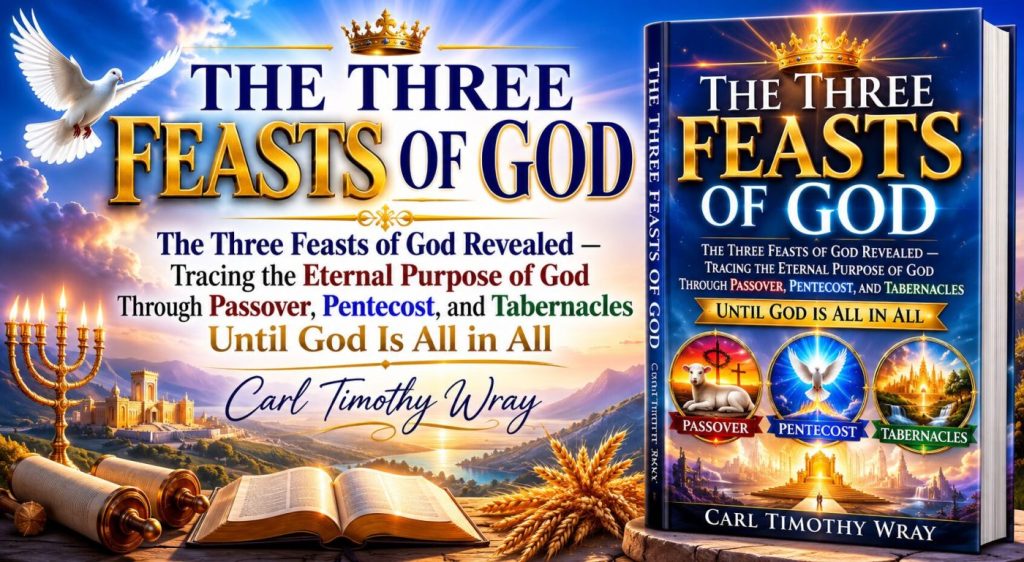
The Three Feasts of God Revealed — Tracing the Eternal Purpose of God Through Passover, Pentecost, and Tabernacles Until God Is All in All
By Carl Timothy Wray
The Three Feasts of God: AUTHOR
Carl Timothy Wray has spent more than forty years studying the Scriptures and tracing the eternal purpose of God from Genesis to Revelation. Through thousands of hours of study, teaching, writing, and publishing, his work has focused on the Finished Work of Christ, the Throne of God, the Book of Revelation, the Revelation of Jesus Christ, the Plan of the Ages, and the manifestation of God’s purpose in creation. His ministry is dedicated to making the full counsel of God plain, understandable, and available freely to believers around the world.
Carl is the founder of Zion University and The Finished Work of Christ ministry, where hundreds of books, teachings, and resources are distributed freely to help believers grow in the knowledge of Jesus Christ and the eternal purpose of God.
The Three Feasts of God Revealed explores the biblical meaning of Passover, Pentecost, and Tabernacles through the full counsel of Scripture. This book traces God’s eternal purpose from before the foundation of the world through the Plan of the Ages, showing how the three feasts reveal God’s progressive administration of redemption, formation, manifestation, sonship, priesthood, kingdom authority, and the reconciliation of all things in Christ. Discover how the Three Feasts of God provide a framework for understanding the Law, the Church, the Kingdom, the Firstfruits, the Manifestation of the Sons of God, and God’s ultimate purpose to become all in all.
INTRODUCTION
One of the greatest challenges facing believers today is not a lack of Scripture.
It is a lack of distinction.
Many of the debates that divide believers are not caused by the absence of truth but by the mixing of truths that belong to different administrations within the purpose of God.
The Bible contains thousands of statements, promises, prophecies, symbols, shadows, patterns, and revelations. When these truths are separated from their proper place within God’s purpose, confusion often follows. Yet when each truth is understood within the administration to which it belongs, remarkable clarity begins to emerge.
The Three Feasts of God provide one of the clearest frameworks in all of Scripture for understanding the progressive unfolding of God’s eternal purpose.
Passover.
Pentecost.
Tabernacles.
These feasts were not merely Jewish observances.
They were prophetic revelations of God’s unfolding purpose from preparation, to formation, to manifestation.
Passover reveals the age of preparation.
Pentecost reveals the age of formation.
Tabernacles reveals the age of manifestation.
Together they reveal the progressive administration of God’s purpose through the ages until God is all in all.
Before the foundation of the world, God’s purpose was complete in Himself.
Nothing was hidden from Him.
Nothing was uncertain.
Nothing was unfinished.
The finished work existed in God before creation itself.
Yet what was hidden in God had to be revealed, administered, formed, and manifested within creation so that creation could ultimately participate in the life of God.
This book explores how the Three Feasts of God reveal that process.
We will examine the law, priesthood, ministry, mandate, purpose, firstfruits, maturity, limitation, and transition of each administration. We will trace the relationship between Passover, Pentecost, and Tabernacles and examine how these three feasts provide a framework for understanding the full counsel of God from Genesis to Revelation.
The purpose of this book is not to create confusion.
The purpose of this book is distinction.
For distinction brings clarity.
Clarity brings understanding.
Understanding brings light.
And the path of the just shines more and more unto the perfect day.
TABLE OF CONTENTS
Introduction
Why the Three Feasts Matter
Chapter 1
The Eternal Purpose Before the Foundation of the World
Chapter 2
The Plan of the Ages
Chapter 3
The Framework of Every Administration
Chapter 4
Passover — The Age of Preparation
Chapter 5
Christ — The Firstfruits of Passover
Chapter 6
Pentecost — The Age of Formation
Chapter 7
The Mature Harvest of Pentecost
Chapter 8
The Limitation of Pentecost
Chapter 9
Faith, Prophecy, and Expectation
Chapter 10
The Mature Harvest Becomes the Womb
Chapter 11
Tabernacles — The Age of Manifestation
Chapter 12
God All in All
Conclusion
The Three Feasts of God Revealed
CHAPTER 1
THE ETERNAL PURPOSE BEFORE THE FOUNDATION OF THE WORLD
One of the greatest mistakes believers make when studying Scripture is beginning with creation instead of beginning with purpose.
Most believers begin in Genesis 1.
God begins before Genesis 1.
Creation was not the beginning of God’s purpose.
Creation was the manifestation of God’s purpose.
Before there was a heaven, God had a purpose.
Before there was an earth, God had a purpose.
Before there was Adam, God had a purpose.
Before there was Israel, God had a purpose.
Before there was the Church, God had a purpose.
Before there was Passover, Pentecost, or Tabernacles, God had a purpose.
The Three Feasts of God cannot be understood correctly until we first understand the eternal purpose that existed before the foundation of the world.
Everything that follows in Scripture is the unfolding of something that already existed within God.
The purpose did not begin in time.
The purpose began in God.
GOD FINISHED THE PURPOSE BEFORE CREATION
One of the foundational truths of Scripture is that God knows the end from the beginning.
Isaiah 46:9-10
“For I am God, and there is none else; I am God, and there is none like me,
Declaring the end from the beginning, and from ancient times the things that are not yet done.”
God does not discover His purpose.
God does not improve His purpose.
God does not react to events.
God declares the end from the beginning because the purpose already exists within Him.
Everything God does in time flows from something already complete within Himself.
This is why Scripture continually points us back to what existed before creation.
CHOSEN BEFORE THE FOUNDATION OF THE WORLD
Ephesians 1:4
“According as he hath chosen us in him before the foundation of the world.”
Notice carefully what Paul says.
He does not say God chose us after creation.
He does not say God chose us after Adam sinned.
He does not say God created a plan after man failed.
He says God chose us in Christ before the foundation of the world.
The purpose existed before the world.
Christ existed before the world.
Election existed before the world.
The finished work existed before the world.
Everything that appears throughout Scripture is the progressive unveiling of what was already established in God.
THE MYSTERY HIDDEN IN GOD
Ephesians 3:9
“And to make all men see what is the fellowship of the mystery, which from the beginning of the world hath been hid in God.”
Paul speaks of a mystery.
Where was the mystery hidden?
It was hidden in God.
Not hidden in creation.
Not hidden in man.
Not hidden in Israel.
Hidden in God.
Before the mystery could be manifested, it first existed within God Himself.
The Three Feasts of God reveal the progressive unveiling of this mystery through successive administrations.
What was hidden in God would eventually be revealed through Passover.
What was hidden in God would eventually be revealed through Pentecost.
What was hidden in God would eventually be revealed through Tabernacles.
The purpose was hidden.
The ages reveal it.
THE PURPOSE GIVEN BEFORE TIME BEGAN
2 Timothy 1:9
“Who hath saved us, and called us with an holy calling, not according to our works, but according to his own purpose and grace, which was given us in Christ Jesus before the world began.”
Paul again points beyond creation.
He points beyond history.
He points beyond human works.
He points to God’s purpose.
Notice that grace was given before the world began.
Purpose was established before the world began.
The calling existed before the world began.
This means the ages are not God’s attempt to create a purpose.
The ages are God’s means of administering a purpose.
THE PROMISE BEFORE THE WORLD BEGAN
Titus 1:2
“In hope of eternal life, which God, that cannot lie, promised before the world began.”
Before creation:
There was a promise.
Before creation:
There was a purpose.
Before creation:
There was a plan.
Before creation:
There was life.
The purpose did not begin in Genesis.
The purpose existed in God before Genesis.
THE LAMB SLAIN FROM THE FOUNDATION OF THE WORLD
Revelation 13:8
“The Lamb slain from the foundation of the world.”
The cross did not surprise God.
The fall did not surprise God.
Redemption did not surprise God.
The Lamb was already present within the purpose of God.
The sacrifice was already present within the purpose of God.
The victory was already present within the purpose of God.
Everything existed within the finished purpose before it ever appeared within history.
WHY GOD CREATED THE AGES
This leads us to an important question.
If the purpose was already complete in God, why create the ages?
Why create time?
Why create administrations?
Why create the unfolding story of Scripture?
The answer is simple.
What was hidden in God had to be revealed.
What was legally true in God had to become visible within creation.
What was finished in God had to become experienced within creation.
The purpose existed before creation.
The manifestation unfolds through creation.
This is where the Plan of the Ages enters the story.
God uses successive administrations to reveal what was hidden within Himself.
Passover reveals one dimension.
Pentecost reveals another dimension.
Tabernacles reveals another dimension.
Each administration unfolds a greater revelation of the eternal purpose.
THE THREE FEASTS OF GOD BEGIN IN THE ETERNAL PURPOSE
The Three Feasts of God do not begin in Leviticus.
They begin in God.
The Three Feasts of God are not merely Jewish feast days.
They are prophetic revelations of God’s eternal purpose.
Passover reveals preparation.
Pentecost reveals formation.
Tabernacles reveals manifestation.
Together they reveal the progressive unfolding of what existed within God before the foundation of the world.
Without the eternal purpose, the feasts become isolated events.
With the eternal purpose, the feasts become a roadmap revealing God’s purpose from beginning to end.
CONCLUSION
Before there was creation, there was purpose.
Before there was time, there was purpose.
Before there was Adam, there was purpose.
Before there was Israel, there was purpose.
Before there was the Church, there was purpose.
Before there were the Three Feasts of God, there was purpose.
The entire Bible is the story of God unveiling what was hidden within Himself before the foundation of the world.
To understand Passover, Pentecost, and Tabernacles, we must begin where God begins.
Not in creation.
Not in history.
Not in man.
But in the eternal purpose hidden in God before the foundation of the world.
Only then can we understand the Plan of the Ages and the progressive revelation of God’s purpose through the Three Feasts of God.
CHAPTER 2
THE PLAN OF THE AGES
In the previous chapter, we established that God’s purpose existed before the foundation of the world.
Before creation there was purpose.
Before time there was purpose.
Before Adam there was purpose.
Before Israel there was purpose.
Before the Church there was purpose.
Before Passover, Pentecost, and Tabernacles there was purpose.
The question now becomes:
If the purpose was already complete in God, why did God create the ages?
Why did God create time?
Why did God create successive administrations?
Why did God unfold His purpose through thousands of years of history?
The answer is found in what we will call the Plan of the Ages.
GOD WORKS THROUGH AGES
One of the most overlooked truths in Scripture is that God unfolds His purpose through ages.
Ephesians 2:7
“That in the ages to come he might shew the exceeding riches of his grace in his kindness toward us through Christ Jesus.”
Notice that Paul speaks of:
“The ages to come.”
God works through ages.
God reveals through ages.
God administers through ages.
The purpose is eternal.
The manifestation unfolds through ages.
The purpose is complete.
The revelation is progressive.
THE ETERNAL PURPOSE AND THE AGES
Ephesians 3:11
“According to the eternal purpose which he purposed in Christ Jesus our Lord.”
Notice the distinction.
There is:
The Eternal Purpose.
And there is:
The administration of that purpose.
The purpose is eternal.
The administration unfolds in time.
The purpose never changes.
The administrations change.
The destination remains fixed.
The path unfolds progressively.
This distinction is critical to understanding the Three Feasts of God.
GOD DECLARES THE END FROM THE BEGINNING
Isaiah 46:10
“Declaring the end from the beginning.”
God begins with the end in view.
He does not create history hoping to arrive somewhere.
He creates history because He already knows where He is going.
History is not God searching for a destination.
History is God revealing a destination.
Every age reveals another dimension of what God already purposed within Himself.
WHY TIME EXISTS
Many believers think of time as something separate from God’s purpose.
Scripture presents time differently.
Time is the stage upon which God reveals His purpose.
Time allows purpose to unfold.
Time allows promise to mature.
Time allows revelation to increase.
Time allows creation to experience what was hidden in God.
Without time:
Purpose remains hidden.
Without ages:
Purpose remains unseen.
Without administrations:
Purpose remains unexperienced.
The ages exist because God desires what is hidden in Himself to become visible within creation.
THE AGES REVEAL WHAT WAS HIDDEN IN GOD
Ephesians 3:9
“And to make all men see what is the fellowship of the mystery, which from the beginning of the world hath been hid in God.”
Notice the goal.
To make all men see.
The mystery was hidden.
The purpose of administration is revelation.
The purpose of the ages is manifestation.
The purpose of history is unveiling.
What was hidden in God must eventually be seen.
THE THREE FEASTS OF GOD REVEAL THE PLAN OF THE AGES
This is why the Three Feasts of God are so important.
They reveal the structure of God’s administration.
Passover.
Pentecost.
Tabernacles.
These are not random feast days.
These are prophetic administrations revealing how God unfolds His purpose.
Passover reveals preparation.
Pentecost reveals formation.
Tabernacles reveals manifestation.
Together they provide a framework for understanding the Plan of the Ages.
PASSOVER — THE AGE OF PREPARATION
God first prepares.
The Law.
The Prophets.
The Shadows.
The Types.
The Sacrifices.
The Priesthood.
Everything points forward.
Galatians 3:24
“Wherefore the law was our schoolmaster to bring us unto Christ.”
Passover prepares for Christ.
Preparation is the purpose of the administration.
When that purpose is fulfilled, a transition occurs.
Christ appears.
PENTECOST — THE AGE OF FORMATION
Acts 2 marks the beginning of a new administration.
The Spirit is poured out.
The Church is born.
The Royal Priesthood emerges.
The Fivefold Ministry begins its work.
Ephesians 4:11-13
“And he gave some, apostles; and some, prophets; and some, evangelists; and some, pastors and teachers;
For the perfecting of the saints…
Till we all come…”
Pentecost is not primarily preparation.
Pentecost is formation.
Christ is formed within a people.
The saints are perfected.
The Church matures.
The harvest grows.
The purpose of Pentecost is formation.
TABERNACLES — THE AGE OF MANIFESTATION
The final feast points beyond preparation and formation.
It points toward manifestation.
Romans 8:19
“For the earnest expectation of the creature waiteth for the manifestation of the sons of God.”
Manifestation is the language of Tabernacles.
What was prepared becomes manifested.
What was formed becomes manifested.
What was promised becomes manifested.
What was hidden becomes manifested.
The ages move toward manifestation.
THE PURPOSE OF EVERY ADMINISTRATION
Every administration can be understood by asking the same questions:
What law governs it?
What priesthood governs it?
What ministry governs it?
What mandate has been given?
What purpose is being fulfilled?
What firstfruits emerge?
What maturity is produced?
What limitation remains?
What transition follows?
These questions create distinction.
Distinction creates clarity.
Clarity creates understanding.
THE PLAN NEVER CHANGES
One of the greatest mistakes believers make is assuming that God changes His purpose.
The purpose never changes.
The administration changes.
The purpose remains fixed.
The revelation increases.
The manifestation increases.
The light increases.
But the purpose remains the same.
From Genesis to Revelation, God is unveiling what was hidden within Himself before the foundation of the world.
FAITH AND THE PLAN OF THE AGES
This explains why faith and patience are so important.
Hebrews 6:12
“Who through faith and patience inherit the promises.”
Faith receives the promise.
Patience waits for the appointed time.
Faith does not violate God’s timetable.
Faith gives endurance while God’s timetable unfolds.
Many saints received promises that belonged to future generations.
They saw them.
They embraced them.
They believed them.
Yet the manifestation belonged to a later administration.
The promise was real.
The timing was also real.
CONCLUSION
The Plan of the Ages is God’s administration of His eternal purpose.
The purpose existed before creation.
The ages reveal it.
The ages administer it.
The ages manifest it.
Passover prepares.
Pentecost forms.
Tabernacles manifests.
The Three Feasts of God provide a framework for understanding how God’s purpose unfolds from preparation to formation to manifestation.
In the next chapter, we will establish the framework that governs every administration and provides the foundation for understanding the law, priesthood, ministry, purpose, firstfruits, maturity, limitation, and transition of every age.
CHAPTER 3
THE FRAMEWORK OF EVERY ADMINISTRATION
Before we study Passover, Pentecost, and Tabernacles individually, we must establish a framework for understanding every administration of God.
One of the greatest causes of confusion in biblical interpretation is the failure to recognize distinctions.
Many believers read verses from different administrations and blend them together.
They mix laws.
They mix priesthoods.
They mix ministries.
They mix purposes.
They mix promises.
The result is confusion.
Yet when each administration is examined according to its purpose, remarkable clarity begins to emerge.
The purpose of this chapter is to establish a framework that can be applied to every administration revealed in Scripture.
This framework will help us understand Passover.
It will help us understand Pentecost.
It will help us understand Tabernacles.
Most importantly, it will help us distinguish what belongs to each administration.
GOD IS A GOD OF ORDER
1 Corinthians 14:33
“For God is not the author of confusion, but of peace.”
God works according to divine order.
Nothing in Scripture is random.
Every administration has a purpose.
Every administration has boundaries.
Every administration has a beginning.
Every administration has a maturity.
Every administration has a transition.
When the purpose of an administration is fulfilled, God moves forward into the next phase of His unfolding purpose.
WHY DISTINCTION MATTERS
One truth can be perfectly true and still be misunderstood if it is removed from the administration to which it belongs.
For example:
The Law was true.
The Levitical Priesthood was true.
The sacrifices were true.
The tabernacle was true.
Yet all of those truths belonged to a specific administration.
When Christ appeared, a transition occurred.
Hebrews 7:12
“For the priesthood being changed, there is made of necessity a change also of the law.”
Notice what changed.
The purpose did not change.
God did not change.
The eternal purpose did not change.
The administration changed.
Understanding this principle is essential to understanding the Three Feasts of God.
THE NINE QUESTIONS OF EVERY ADMINISTRATION
As we study each feast, we will ask the same nine questions.
These questions become our interpretive framework.
1. WHAT LAW GOVERNS THE ADMINISTRATION?
Every administration operates according to a governing law.
Under Passover:
The Mosaic Law.
Under Pentecost:
The Law of the Spirit of Life.
Romans 8:2
“For the law of the Spirit of life in Christ Jesus hath made me free from the law of sin and death.”
Understanding the governing law helps us understand the purpose of the administration.
2. WHAT PRIESTHOOD GOVERNS THE ADMINISTRATION?
Every administration operates under a priesthood.
Passover:
The Levitical Priesthood.
Pentecost:
The Royal Priesthood.
1 Peter 2:9
“But ye are a chosen generation, a royal priesthood.”
Tabernacles:
The Melchizedek Priesthood.
Hebrews 7:17
“Thou art a priest for ever after the order of Melchisedec.”
The priesthood reveals the governmental order operating within the administration.
3. WHAT MINISTRY GOVERNS THE ADMINISTRATION?
God always raises up ministries to accomplish the purpose of an administration.
Passover:
Priests.
Prophets.
Psalms.
Pentecost:
Apostles.
Prophets.
Evangelists.
Pastors.
Teachers.
Ephesians 4:11
“And he gave some, apostles; and some, prophets; and some, evangelists; and some, pastors and teachers.”
The ministry exists to fulfill the purpose of the administration.
4. WHAT IS THE MANDATE OF THE ADMINISTRATION?
Every administration has a specific assignment.
The Law prepared for Christ.
Pentecost perfects the saints.
Ephesians 4:12
“For the perfecting of the saints.”
A mandate answers the question:
What is God accomplishing during this administration?
5. WHAT IS THE PURPOSE OF THE ADMINISTRATION?
The mandate describes the assignment.
The purpose describes the destination.
Passover:
Preparation.
Pentecost:
Formation.
Tabernacles:
Manifestation.
Every administration serves the larger eternal purpose of God.
6. WHAT FIRSTFRUITS EMERGE?
God always produces firstfruits.
1 Corinthians 15:20
“But now is Christ risen from the dead, and become the firstfruits of them that slept.”
James 1:18
“That we should be a kind of firstfruits of his creatures.”
The firstfruits reveal what the administration is producing.
The firstfruits reveal the success of the administration.
The firstfruits reveal the direction of God’s purpose.
7. WHAT MATURITY IS PRODUCED?
Every administration moves toward maturity.
Ephesians 4:13
“Till we all come… unto a perfect man.”
God is not merely interested in beginnings.
God is interested in maturity.
Every administration produces a harvest.
Every administration reaches a fullness appropriate to its purpose.
8. WHAT LIMITATION REMAINS?
This question is often ignored.
Every administration accomplishes its purpose.
Yet every administration also reveals a limitation that points toward the next administration.
The Law could not bring perfection.
Hebrews 7:19
“For the law made nothing perfect.”
Pentecost contains the language of earnest, groaning, and waiting.
Romans 8:23
“And not only they, but ourselves also, which have the firstfruits of the Spirit… waiting for the adoption, to wit, the redemption of our body.”
The limitation reveals why transition becomes necessary.
9. WHAT TRANSITION FOLLOWS?
Every administration eventually reaches its transition point.
The Law transitions when Christ appears.
Pentecost transitions through maturity, travail, and birth.
The transition reveals that God’s purpose continues unfolding.
One administration prepares the way for the next.
THE MATURITY OF ONE AGE BECOMES THE WOMB OF THE NEXT
This principle may be one of the most important principles in understanding the Three Feasts of God.
The maturity of one administration becomes the womb of the next administration.
Passover reaches maturity.
Christ appears.
Pentecost reaches maturity.
A mature harvest emerges.
The purpose of one administration creates the conditions necessary for the next administration.
God builds progressively.
God builds intentionally.
God builds according to purpose.
DISTINCTION REMOVES CONFUSION
Many apparent contradictions in Scripture disappear when distinctions are understood.
Promise is not manifestation.
Preparation is not formation.
Formation is not manifestation.
Passover is not Pentecost.
Pentecost is not Tabernacles.
The mature harvest is not necessarily the same as what follows the harvest.
Distinction creates clarity.
Clarity creates understanding.
Understanding creates light.
THE THREE FEASTS OF GOD THROUGH THE FRAMEWORK
Now we are prepared to study the Three Feasts of God through the lens of administration.
For each feast we will ask:
What law governs it?
What priesthood governs it?
What ministry governs it?
What mandate drives it?
What purpose defines it?
What firstfruits emerge?
What maturity is produced?
What limitation remains?
What transition follows?
These nine questions will guide our study and help us understand how God’s eternal purpose unfolds through Passover, Pentecost, and Tabernacles.
CONCLUSION
God is a God of order.
Every administration has a purpose.
Every administration has a maturity.
Every administration has a limitation.
Every administration has a transition.
The Nine Questions Framework provides a foundation for understanding the Three Feasts of God and the progressive unfolding of God’s eternal purpose.
In the next chapter, we will begin examining the first great administration revealed through the Three Feasts of God:
Passover — The Age of Preparation.
CHAPTER 4
PASSOVER — THE AGE OF PREPARATION
Having established the eternal purpose of God, the Plan of the Ages, and the framework of every administration, we are now prepared to examine the first great administration revealed through the Three Feasts of God.
Passover.
The Feast of Passover was not merely a historical event.
It was not merely a Jewish celebration.
It was not merely a memorial feast.
Passover was a prophetic administration established by God to prepare the way for Christ.
The purpose of Passover was preparation.
Everything within the administration pointed beyond itself.
Everything within the administration testified of something greater to come.
Passover was never the destination.
Passover was the preparation for the destination.
THE FIRST FEAST OF GOD
Leviticus 23 establishes the feast structure that would later become one of the clearest revelations of God’s unfolding purpose.
Leviticus 23:4-5
“These are the feasts of the LORD, even holy convocations, which ye shall proclaim in their seasons.
In the fourteenth day of the first month at even is the LORD’S passover.”
The Feast of Passover was first.
This is not accidental.
Preparation always comes before manifestation.
Instruction comes before fulfillment.
The shadow comes before the substance.
God begins by laying foundations.
PASSOVER BEGAN IN DELIVERANCE
The historical setting of Passover is found in Exodus.
Israel was in bondage.
Israel was oppressed.
Israel was unable to deliver itself.
God intervened.
Exodus 12:13
“And when I see the blood, I will pass over you.”
The blood became the sign.
The lamb became the sacrifice.
Deliverance began through substitution.
This historical event became a prophetic picture pointing toward Christ.
The natural event pointed toward a greater spiritual reality.
THE LAW ENTERS THE STORY
Following Israel’s deliverance, God established the Mosaic administration.
This administration became the governing structure of the Passover age.
The Law defined righteousness.
The Law defined worship.
The Law defined sacrifice.
The Law defined priesthood.
The Law defined holiness.
The Law became the governing system of the administration.
Exodus 24:12
“And the LORD said unto Moses, Come up to me into the mount, and be there: and I will give thee tables of stone, and a law, and commandments.”
The Law was not evil.
The Law was not a mistake.
The Law served a divine purpose.
The Law belonged to the administration of preparation.
THE LEVITICAL PRIESTHOOD
Every administration has a priesthood.
Passover operated through the Levitical Priesthood.
Aaron and his sons became the ministers of the sanctuary.
The sacrifices were administered through the priesthood.
The worship system functioned through the priesthood.
The tabernacle functioned through the priesthood.
Hebrews 7:11
“If therefore perfection were by the Levitical priesthood…”
The writer of Hebrews later reveals that the priesthood served an important purpose, yet it was never intended to be the final priesthood.
The priesthood itself pointed beyond itself.
It testified of something greater to come.
THE TABERNACLE AS A PROPHETIC WITNESS
One of the great features of the Passover administration was the tabernacle.
God instructed Moses to build a sanctuary.
Exodus 25:8
“And let them make me a sanctuary; that I may dwell among them.”
The tabernacle revealed:
The altar.
The laver.
The holy place.
The most holy place.
The priesthood.
The sacrifices.
The furniture.
The worship.
Every detail testified of Christ.
Every detail pointed forward.
Every detail belonged to preparation.
THE SHADOW AND THE SUBSTANCE
One of the most important words describing Passover is the word:
Shadow.
Hebrews 10:1
“For the law having a shadow of good things to come.”
A shadow is real.
A shadow teaches.
A shadow reveals.
But a shadow is not the substance.
The purpose of the shadow is to reveal the substance.
Passover was filled with shadows.
The sacrifices were shadows.
The priesthood was a shadow.
The tabernacle was a shadow.
The feasts were shadows.
The ceremonies were shadows.
Every shadow pointed toward Christ.
THE LAW TESTIFIED OF CHRIST
Many believers view the Law and Christ as opposites.
Scripture presents them differently.
The Law testified of Christ.
The prophets testified of Christ.
The Psalms testified of Christ.
John 5:39
“Search the scriptures; for in them ye think ye have eternal life: and they are they which testify of me.”
The entire administration pointed toward Him.
Everything in Passover was preparing creation for His appearing.
THE PURPOSE OF PASSOVER
Using the framework established in the previous chapter, we can now summarize the administration.
Law:
The Mosaic Law.
Priesthood:
The Levitical Priesthood.
Ministry:
Priests, Prophets, and Psalms.
Mandate:
Prepare for Christ.
Purpose:
Preparation.
The entire administration existed to prepare the way for the coming of Christ.
THE FIRSTFRUITS OF PASSOVER
Every administration produces firstfruits.
Passover produced Christ.
1 Corinthians 15:20
“But now is Christ risen from the dead, and become the firstfruits of them that slept.”
Everything in the administration pointed toward Him.
The sacrifices pointed toward Him.
The priesthood pointed toward Him.
The tabernacle pointed toward Him.
The prophets pointed toward Him.
The Law pointed toward Him.
The firstfruits of Passover was Christ Himself.
THE MATURITY OF PASSOVER
Every administration moves toward maturity.
Passover reached maturity when Christ appeared.
Galatians 4:4
“But when the fulness of the time was come, God sent forth his Son.”
Notice the language.
“The fulness of the time.”
The administration reached its appointed maturity.
The preparation was complete.
The shadows had accomplished their purpose.
The witness was established.
The testimony was complete.
Christ appeared.
THE LIMITATION OF PASSOVER
Every administration contains a limitation.
The limitation of Passover was not failure.
The limitation was purpose.
Hebrews 7:19
“For the law made nothing perfect.”
The Law could prepare.
The Law could instruct.
The Law could testify.
The Law could reveal sin.
The Law could point toward Christ.
The Law could not become Christ.
Preparation cannot become fulfillment.
The shadow cannot become the substance.
The witness cannot become the reality.
The limitation of Passover pointed toward the necessity of Christ.
THE TRANSITION OF PASSOVER
The transition point of Passover was simple.
Christ appeared.
John 1:29
“Behold the Lamb of God, which taketh away the sin of the world.”
The Lamb arrived.
The substance appeared.
The reality entered history.
The purpose of the administration had been fulfilled.
Passover had successfully accomplished its assignment.
The age of preparation reached its maturity.
A new administration was about to emerge.
PASSOVER IN THE THREE FEASTS OF GOD
Passover cannot be understood correctly apart from the Three Feasts of God.
Passover was never intended to stand alone.
Passover prepares.
Pentecost forms.
Tabernacles manifests.
Passover lays the foundation for everything that follows.
Without Passover there is no preparation.
Without preparation there is no formation.
Without formation there is no manifestation.
The Three Feasts of God reveal a progressive unfolding of God’s eternal purpose.
Passover is the first step in that unfolding.
CONCLUSION
Passover was the age of preparation.
The Mosaic Law governed the administration.
The Levitical Priesthood served the administration.
The tabernacle testified within the administration.
The prophets proclaimed the administration.
The sacrifices illustrated the administration.
Everything pointed toward Christ.
The purpose of Passover was not fulfillment.
The purpose of Passover was preparation.
The firstfruits of Passover was Christ.
The maturity of Passover was Christ’s appearing.
The limitation of Passover was that the shadow could never become the substance.
The transition of Passover occurred when Christ appeared in the fullness of time.
The first administration of the Three Feasts of God had fulfilled its purpose.
In the next chapter, we will examine Christ as the Firstfruits of Passover and the fulfillment of everything the administration was designed to produce.
CHAPTER 5
CHRIST — THE FIRSTFRUITS OF PASSOVER
The purpose of every administration is revealed by the firstfruits it produces.
God does not establish an administration without a purpose.
God does not create an age without a destination.
God does not reveal a pattern without an intended fulfillment.
Every administration moves toward a harvest.
Every administration moves toward maturity.
Every administration moves toward firstfruits.
The firstfruits reveal what God was seeking all along.
Passover is no exception.
The Law.
The sacrifices.
The tabernacle.
The priesthood.
The prophets.
The Psalms.
Everything moved toward one glorious destination:
Christ.
The firstfruits of Passover was not a doctrine.
The firstfruits of Passover was a person.
Jesus Christ.
THE PURPOSE OF PASSOVER WAS CHRIST
Many believers study the Law without understanding its purpose.
The purpose of the Law was never the Law itself.
The purpose of Passover was never Passover itself.
The purpose of the sacrifices was never the sacrifices.
Everything pointed beyond itself.
Everything pointed toward Christ.
Galatians 3:24
“Wherefore the law was our schoolmaster to bring us unto Christ.”
Notice the language.
The Law brought people to Christ.
The Law was never intended to be the final destination.
The administration prepared the way for the One who would fulfill everything it testified of.
CHRIST WAS HIDDEN IN THE SHADOWS
Throughout the Passover administration, Christ appears repeatedly in shadow form.
The Passover Lamb.
The sacrifices.
The tabernacle.
The priesthood.
The mercy seat.
The manna.
The rock in the wilderness.
The brazen serpent.
Every shadow revealed another dimension of Christ.
Colossians 2:16-17
“Which are a shadow of things to come; but the body is of Christ.”
The shadow was real.
The shadow was important.
The shadow was instructional.
Yet the shadow was not the substance.
The substance was Christ.
THE PASSOVER LAMB
One of the clearest witnesses to Christ is found in the Passover Lamb.
Exodus 12 established the pattern.
A lamb was selected.
A lamb was sacrificed.
The blood was applied.
Deliverance followed.
Centuries later, John identified Jesus using the same language.
John 1:29
“Behold the Lamb of God, which taketh away the sin of the world.”
The Lamb of Exodus was a witness.
Christ was the reality.
The shadow pointed toward the substance.
The type pointed toward the fulfillment.
THE TABERNACLE TESTIFIED OF CHRIST
Every piece of furniture within the tabernacle revealed Christ.
The altar pointed toward sacrifice.
The laver pointed toward cleansing.
The bread pointed toward life.
The lampstand pointed toward light.
The incense pointed toward intercession.
The mercy seat pointed toward reconciliation.
The High Priest pointed toward mediation.
Hebrews 8:5
“Who serve unto the example and shadow of heavenly things.”
The tabernacle was not the goal.
The tabernacle testified of the goal.
The goal was Christ.
THE PRIESTHOOD TESTIFIED OF CHRIST
The Levitical Priesthood performed an essential role within the Passover administration.
Yet the priesthood itself testified of something greater.
Hebrews 5:5-6
“So also Christ glorified not himself to be made an high priest…
Thou art a priest for ever after the order of Melchisedec.”
The Levitical Priesthood prepared the way.
Christ fulfilled the reality.
The priesthood pointed beyond itself.
The priesthood pointed toward Christ.
THE PROPHETS TESTIFIED OF CHRIST
The prophets continuously pointed forward.
They testified of His coming.
They testified of His suffering.
They testified of His glory.
They testified of His kingdom.
1 Peter 1:10-11
“Of which salvation the prophets have enquired and searched diligently.”
The prophets saw glimpses.
The prophets saw shadows.
The prophets saw promises.
The prophets pointed toward Christ.
The firstfruits of Passover was the One whom the prophets proclaimed.
THE PSALMS TESTIFIED OF CHRIST
Jesus Himself explained that the Psalms spoke concerning Him.
Luke 24:44
“All things must be fulfilled, which were written in the law of Moses, and in the prophets, and in the psalms, concerning me.”
The Law testified.
The Prophets testified.
The Psalms testified.
The entire administration testified.
Everything pointed toward Christ.
THE MATURITY OF PASSOVER ARRIVES
Every administration reaches maturity.
Passover reached maturity when Christ appeared.
Galatians 4:4
“But when the fulness of the time was come, God sent forth his Son.”
Notice once again:
“The fulness of the time.”
The administration matured.
The preparation was complete.
The witness was complete.
The shadows had served their purpose.
The time had arrived.
The firstfruits appeared.
CHRIST FULFILLED THE LAW
One of the greatest misunderstandings in Scripture concerns fulfillment.
Jesus did not destroy the Law.
Jesus fulfilled the Law.
Matthew 5:17
“Think not that I am come to destroy the law, or the prophets: I am not come to destroy, but to fulfil.”
The Law reached its intended destination.
The Law achieved its purpose.
The administration succeeded.
It produced exactly what God intended it to produce.
Christ.
THE SUCCESS OF PASSOVER
Many believers read the Old Covenant as though it failed.
Scripture never presents it that way.
Passover accomplished its purpose.
The Law accomplished its purpose.
The priesthood accomplished its purpose.
The prophets accomplished their purpose.
The shadows accomplished their purpose.
They prepared the way for Christ.
The success of Passover is revealed by its firstfruits.
Christ is the proof that the administration succeeded.
THE LIMITATION OF PASSOVER REMOVED
The limitation of Passover was that it could prepare but could not fulfill.
It could testify but could not become the reality.
It could point but could not arrive.
When Christ appeared, the limitation was overcome.
John 1:17
“For the law was given by Moses, but grace and truth came by Jesus Christ.”
The witness gave way to the reality.
The shadow gave way to the substance.
Preparation gave way to fulfillment.
THE TRANSITION TO A NEW ADMINISTRATION
The appearance of Christ created a transition.
The first administration had reached maturity.
The firstfruits had appeared.
The purpose had been fulfilled.
A new administration would soon emerge.
John the Baptist recognized the transition.
John 3:30
“He must increase, but I must decrease.”
The old witness was giving way to the new reality.
Passover had completed its assignment.
The stage was now being set for Pentecost.
CHRIST AND THE THREE FEASTS OF GOD
Within the framework of the Three Feasts of God, Christ occupies a unique position.
He is the fulfillment of Passover.
He is the foundation of Pentecost.
He is the Lord of Tabernacles.
Everything before Him points toward Him.
Everything after Him proceeds from Him.
Passover prepares for Him.
Pentecost forms His life within a people.
Tabernacles manifests the fullness of His purpose.
Christ stands at the center of the Three Feasts of God.
CONCLUSION
The firstfruits reveal the success of an administration.
Passover produced Christ.
The Law testified of Christ.
The sacrifices testified of Christ.
The tabernacle testified of Christ.
The priesthood testified of Christ.
The prophets testified of Christ.
The Psalms testified of Christ.
Everything pointed toward Him.
When Christ appeared, the purpose of Passover was fulfilled.
The first administration of the Three Feasts of God had reached maturity.
The firstfruits had appeared.
The stage was now set for the second great administration in the unfolding purpose of God:
Pentecost — The Age of Formation.
CHAPTER 6
PENTECOST — THE AGE OF FORMATION
With the appearance of Christ, the first great administration of the Three Feasts of God reached its intended goal.
Passover had fulfilled its purpose.
The Law had testified.
The prophets had testified.
The priesthood had testified.
The sacrifices had testified.
The shadows had testified.
The firstfruits of Passover had appeared.
Christ had come.
Yet God’s purpose was not finished.
The eternal purpose was larger than Passover.
The appearance of Christ was not the end of the story.
It was the beginning of a new administration.
The next great feast in the unfolding purpose of God was Pentecost.
If Passover was the age of preparation, Pentecost becomes the age of formation.
THE DAY OF PENTECOST
Acts 2 marks one of the greatest transitions in all of Scripture.
Acts 2:1-4
“And when the day of Pentecost was fully come, they were all with one accord in one place.
And suddenly there came a sound from heaven as of a rushing mighty wind…
And they were all filled with the Holy Ghost.”
Notice the language.
“When the day of Pentecost was fully come.”
Once again, we see God’s timing.
Passover had reached its maturity.
Christ had appeared.
Christ had died.
Christ had risen.
Christ had ascended.
Now Pentecost arrives in its appointed season.
The next administration begins.
A NEW ADMINISTRATION BEGINS
Pentecost introduces something new into the earth.
The Spirit is poured out.
The Church is born.
The ecclesia emerges.
A new priesthood begins to function.
A new ministry begins to function.
A new law begins to function.
Everything associated with the administration changes.
Yet the eternal purpose remains the same.
The purpose did not change.
The administration changed.
THE LAW OF THE SPIRIT OF LIFE
Every administration operates under a governing law.
Passover operated under the Mosaic Law.
Pentecost operates under a different law.
Romans 8:2
“For the law of the Spirit of life in Christ Jesus hath made me free from the law of sin and death.”
This does not mean God abandoned purpose.
It means the administration changed.
The Law prepared.
The Spirit forms.
The Law testified.
The Spirit imparts life.
Pentecost becomes the age of formation because the Spirit begins forming Christ within a people.
THE ROYAL PRIESTHOOD
Every administration operates under a priesthood.
Passover was governed by the Levitical Priesthood.
Pentecost is governed by the Royal Priesthood.
1 Peter 2:9
“But ye are a chosen generation, a royal priesthood.”
A major transition has occurred.
The priesthood is no longer limited to one tribe.
The priesthood expands.
The administration moves forward.
The purpose advances.
The Royal Priesthood becomes one of the defining characteristics of Pentecost.
THE FIVEFOLD MINISTRY
Every administration has ministries assigned to fulfill its purpose.
Ephesians 4:11
“And he gave some, apostles; and some, prophets; and some, evangelists; and some, pastors and teachers.”
These ministries were not given randomly.
These ministries were given for a purpose.
The purpose is revealed immediately.
Ephesians 4:12
“For the perfecting of the saints.”
Pentecost begins with babies.
The Church is born.
The saints are born again.
The administration now begins the process of formation.
THE MANDATE OF PENTECOST
The mandate of Pentecost is clearly revealed.
Ephesians 4:12-13
“For the perfecting of the saints…
Till we all come…”
Notice the word:
Till.
The ministry has an assignment.
The ministry has a destination.
The ministry has a purpose.
The saints are to be perfected.
The Body is to be edified.
Christ is to be formed.
Pentecost is not merely about beginning.
Pentecost is about maturity.
CHRIST FORMED IN A PEOPLE
One of the defining characteristics of Pentecost is formation.
Galatians 4:19
“My little children, of whom I travail in birth again until Christ be formed in you.”
Notice the language.
Christ formed in you.
This is Pentecostal language.
The administration is concerned with formation.
The Spirit is forming Christ within a people.
The ministry is forming Christ within a people.
The administration is moving toward maturity.
THE FIRSTFRUITS OF THE SPIRIT
Every administration produces firstfruits.
Pentecost produces firstfruits.
Romans 8:23
“And not only they, but ourselves also, which have the firstfruits of the Spirit.”
James 1:18
“That we should be a kind of firstfruits of his creatures.”
The language changes.
Passover produced Christ as firstfruits.
Pentecost produces a firstfruits company.
A people emerges.
A harvest begins.
The administration is producing something.
The Spirit is producing something.
The ministry is producing something.
The purpose is moving toward maturity.
THE AGE OF FORMATION
This is perhaps the most important distinction of all.
Passover prepared.
Pentecost forms.
Passover pointed toward Christ.
Pentecost forms Christ within a people.
Passover prepared the foundation.
Pentecost builds the house.
Passover brought the firstfruits.
Pentecost develops the harvest.
The language of Pentecost is formation.
Formation explains the ministry.
Formation explains the priesthood.
Formation explains the Spirit.
Formation explains the process.
THE MATURE HARVEST OF PENTECOST
Pentecost is moving toward a mature harvest.
The administration is not designed to remain in infancy.
The administration moves toward maturity.
Ephesians 4:13
“Till we all come… unto a perfect man.”
The purpose of the administration is maturity.
The saints mature.
The Church matures.
The harvest matures.
The firstfruits mature.
Everything moves toward completion.
THE PURPOSE OF PENTECOST
Using the framework established earlier, we can now summarize the administration.
Law:
The Law of the Spirit of Life.
Priesthood:
The Royal Priesthood.
Ministry:
Apostles, Prophets, Evangelists, Pastors, and Teachers.
Mandate:
Perfect the saints.
Purpose:
Formation.
Firstfruits:
The Firstfruits of the Spirit.
Maturity:
The Mature Harvest.
This is the purpose of Pentecost.
This is the assignment of Pentecost.
This is the destination of Pentecost.
PENTECOST IN THE THREE FEASTS OF GOD
The Three Feasts of God reveal progressive administration.
Passover prepares.
Pentecost forms.
Tabernacles manifests.
Pentecost occupies the middle position.
It stands between preparation and manifestation.
It receives what Passover prepared.
It develops what Tabernacles will later manifest.
Pentecost is the age of formation.
CONCLUSION
The Day of Pentecost introduced a new administration.
The Spirit was poured out.
The Church was born.
The Royal Priesthood emerged.
The Fivefold Ministry was given.
The Law of the Spirit of Life began operating.
The firstfruits of the Spirit appeared.
The administration moved toward maturity.
The purpose of Pentecost is formation.
Christ formed in a people.
Saints perfected.
A harvest matured.
A corporate people prepared.
Yet as we will soon discover, the mature harvest of Pentecost is described by several remarkable New Covenant witnesses.
The Perfect Man.
The Glorious Church.
The Firstfruits Company.
The Woman Clothed with the Sun.
In the next chapter we will examine these four witnesses and discover how they reveal the mature harvest produced by Pentecost.
CHAPTER 7
THE MATURE HARVEST OF PENTECOST
One of the greatest mistakes believers make when studying the New Testament is failing to recognize the destination of Pentecost.
Many understand the birth of the Church.
Few understand the maturity of the Church.
Many understand beginning.
Few understand completion.
Many understand conversion.
Few understand formation.
Yet the entire administration of Pentecost moves toward maturity.
The Fivefold Ministry was not given merely to start something.
The Fivefold Ministry was given to bring something to maturity.
The Spirit was not poured out merely to begin a work.
The Spirit was poured out to complete a work.
Pentecost is an administration of formation moving toward a mature harvest.
The question becomes:
What does that mature harvest look like?
The New Testament answers this question through multiple witnesses.
As we examine the Scriptures, we discover four descriptions repeatedly emerging:
The Perfect Man.
The Glorious Church.
The Firstfruits Company.
The Woman Clothed with the Sun.
These are not necessarily four separate entities.
They are four witnesses describing the mature harvest produced by Pentecost.
THE PERFECT MAN
The first witness appears in Ephesians 4.
Ephesians 4:11-13
“And he gave some, apostles; and some, prophets; and some, evangelists; and some, pastors and teachers;
For the perfecting of the saints…
Till we all come in the unity of the faith…
Unto a perfect man.”
Notice the context.
The Fivefold Ministry is operating.
The saints are being perfected.
The Body is being edified.
The administration is moving toward maturity.
The destination is:
A perfect man.
Paul is not discussing the world.
Paul is discussing the mature result of the Pentecostal administration.
The ministry exists to produce maturity.
The administration exists to produce maturity.
The harvest exists to reach maturity.
The perfect man is the mature harvest of Pentecost.
THE UNITY OF THE FAITH
The perfect man is connected to unity.
Paul says:
“Till we all come in the unity of the faith.”
Pentecost begins with diversity.
Pentecost moves toward unity.
Pentecost begins with growth.
Pentecost moves toward maturity.
Pentecost begins with infancy.
Pentecost moves toward completion.
Unity becomes one of the identifying marks of maturity.
THE GLORIOUS CHURCH
The second witness appears in Ephesians 5.
Ephesians 5:25-27
“Christ also loved the church, and gave himself for it;
That he might sanctify and cleanse it…
That he might present it to himself a glorious church, not having spot, or wrinkle, or any such thing.”
Notice the language.
A glorious church.
Without spot.
Without wrinkle.
Holy.
Prepared.
Mature.
This is not the language of infancy.
This is not the language of immaturity.
This is maturity language.
The Church has reached the objective of the administration.
The glorious church becomes another witness describing the mature harvest of Pentecost.
WITHOUT SPOT OR WRINKLE
The language of Ephesians 5 reveals remarkable maturity.
The Church is presented:
Without spot.
Without wrinkle.
Without blemish.
Prepared.
Ready.
Mature.
This is one of the highest descriptions of spiritual maturity found in the New Testament.
The administration has successfully accomplished its purpose.
The saints have been perfected.
The harvest has matured.
THE FIRSTFRUITS COMPANY
The third witness appears in Romans and James.
Romans 8:23
“And not only they, but ourselves also, which have the firstfruits of the Spirit.”
James 1:18
“That we should be a kind of firstfruits of his creatures.”
Pentecost is repeatedly associated with firstfruits.
The administration produces a firstfruits people.
A harvest emerges.
A mature company emerges.
A people formed by the Spirit emerges.
The firstfruits company becomes another witness describing the mature harvest of Pentecost.
THE HIGHEST HARVEST OF PENTECOST
The language of firstfruits is significant.
Firstfruits reveal the best of the harvest.
Firstfruits reveal maturity.
Firstfruits reveal completion.
Firstfruits reveal success.
The firstfruits company represents the highest attainment produced by the administration.
The administration has accomplished its assignment.
The harvest has matured.
The firstfruits have appeared.
THE WOMAN CLOTHED WITH THE SUN
The fourth witness appears in Revelation 12.
Revelation 12:1
“And there appeared a great wonder in heaven; a woman clothed with the sun, and the moon under her feet, and upon her head a crown of twelve stars.”
This is one of the most glorious descriptions found anywhere in Scripture.
She is clothed with the sun.
The moon is beneath her feet.
A crown rests upon her head.
She is victorious.
She is mature.
She is prepared.
She is crowned.
The imagery is filled with glory.
A MATURE WOMAN
The woman is not presented as immature.
She is not presented as defeated.
She is not presented as powerless.
She is clothed with heavenly glory.
She stands in victory.
She possesses maturity.
She possesses authority.
She possesses preparation.
The administration has successfully produced maturity.
The woman becomes another witness describing the mature harvest of Pentecost.
FOUR WITNESSES OF ONE MATURITY
When we place these witnesses side by side, a remarkable pattern begins to emerge.
Ephesians 4:
The Perfect Man.
Ephesians 5:
The Glorious Church.
Romans 8 and James 1:
The Firstfruits Company.
Revelation 12:
The Woman Clothed with the Sun.
These descriptions share common characteristics.
Maturity.
Preparation.
Victory.
Formation.
Completion.
Harvest.
Each witness describes the highest attainment of the Pentecostal administration.
THE SUCCESS OF PENTECOST
Pentecost succeeds.
The ministry succeeds.
The Spirit succeeds.
The administration succeeds.
The saints are perfected.
The harvest matures.
The Church becomes glorious.
The firstfruits emerge.
The woman is crowned.
Pentecost accomplishes its purpose.
This is important because many believers assume that if another administration follows, then Pentecost must have failed.
Scripture presents the opposite picture.
Pentecost succeeds completely in accomplishing its assignment.
THE PURPOSE OF FORMATION FULFILLED
The purpose of Pentecost is formation.
Christ formed in a people.
The saints perfected.
The harvest matured.
The administration reaches maturity.
The objective is achieved.
Formation has accomplished its assignment.
The mature harvest appears.
THE THREE FEASTS OF GOD AND THE MATURE HARVEST
Within the framework of the Three Feasts of God, this mature harvest occupies a critical position.
Passover produced Christ.
Pentecost produces a mature harvest.
The mature harvest stands at the end of formation.
The mature harvest stands at the threshold of what follows.
This becomes one of the most important transition points in the Three Feasts of God.
THE HIGHEST ATTAINMENT OF PENTECOST
The Perfect Man.
The Glorious Church.
The Firstfruits Company.
The Woman Clothed with the Sun.
These descriptions represent the highest attainment of the Pentecostal administration.
This is the mature harvest.
This is the completed formation.
This is the success of Pentecost.
Yet one important question remains.
If Pentecost has produced such remarkable maturity, why does the New Testament continue speaking about groaning, waiting, hope, expectation, and the redemption of the body?
The answer reveals the limitation of the administration.
CONCLUSION
Pentecost moves toward maturity.
The Fivefold Ministry perfects the saints.
The Spirit forms Christ within a people.
The harvest matures.
The administration succeeds.
The New Testament reveals this mature harvest through four witnesses:
The Perfect Man.
The Glorious Church.
The Firstfruits Company.
The Woman Clothed with the Sun.
Together these witnesses describe the highest attainment of the Pentecostal administration.
Yet even in the midst of such glory, another theme repeatedly appears throughout the New Testament.
Groaning.
Waiting.
Expectation.
The redemption of the body.
To understand the transition from Pentecost to what follows, we must now examine the limitation of Pentecost itself.
CHAPTER 8
THE LIMITATION OF PENTECOST
One of the most important principles in understanding the Three Feasts of God is recognizing that every administration has both a purpose and a limitation.
This is not failure.
This is design.
God gives each administration a specific assignment.
When that assignment is fulfilled, the administration has succeeded.
Yet every administration also reveals a limitation that points toward the next stage of God’s unfolding purpose.
The Law had a limitation.
The Levitical Priesthood had a limitation.
The sacrifices had a limitation.
The shadows had a limitation.
Passover reached its intended maturity, yet it pointed beyond itself.
The same principle appears in Pentecost.
Pentecost succeeds.
The saints are perfected.
The Church becomes glorious.
The firstfruits emerge.
The woman is clothed with the sun.
Yet throughout the New Testament another language repeatedly appears.
Groaning.
Waiting.
Hope.
Expectation.
Adoption.
Redemption.
These themes reveal the limitation of the Pentecostal administration.
THE FIRSTFRUITS OF THE SPIRIT
Romans 8 provides one of the clearest windows into the mature harvest of Pentecost.
Romans 8:23
“And not only they, but ourselves also, which have the firstfruits of the Spirit.”
Notice what Paul says.
He does not say they lack the Spirit.
He does not say they lack maturity.
He does not say they lack firstfruits.
They possess the firstfruits of the Spirit.
The administration has successfully produced firstfruits.
Yet Paul immediately introduces another reality.
GROANING WITHIN OURSELVES
Romans 8:23
“Even we ourselves groan within ourselves.”
Who is groaning?
The firstfruits company.
Who is groaning?
Those who possess the Spirit.
Who is groaning?
Those who possess maturity.
Who is groaning?
The very people described as possessing firstfruits.
This is critical.
The groaning is not proof of failure.
The groaning is evidence that something remains unfinished.
WAITING FOR THE ADOPTION
Romans 8:23
“Waiting for the adoption, to wit, the redemption of our body.”
Paul identifies the object of expectation.
The redemption of the body.
Notice how specific he is.
The issue is not salvation.
The issue is not justification.
The issue is not reconciliation.
The issue is not the new birth.
The issue is the body.
The mature harvest of Pentecost still awaits something.
The body remains the focus of expectation.
THE REDEMPTION OF THE BODY
This phrase appears only once in this exact form, yet it carries enormous significance.
“The redemption of our body.”
Paul understood that man is not merely spirit.
Man is not merely soul.
Man is spirit, soul, and body.
The work of God touches the whole man.
The purpose of God encompasses the whole man.
The mature harvest of Pentecost has experienced remarkable transformation.
Yet the body remains the object of expectation.
WE ARE SAVED BY HOPE
Romans 8:24
“For we are saved by hope: but hope that is seen is not hope.”
Hope always points toward something not yet manifested.
Hope does not deny reality.
Hope anticipates reality.
Paul’s language is full of expectation.
Something has been promised.
Something has been revealed.
Something has been received by faith.
Yet something remains unseen.
This is the language of Pentecost.
THE EARNEST OF THE SPIRIT
Another witness appears in Paul’s writings.
2 Corinthians 5:5
“Who also hath given unto us the earnest of the Spirit.”
An earnest is a pledge.
An earnest is a guarantee.
An earnest is a down payment.
An earnest testifies that something greater lies ahead.
Paul repeatedly uses this language.
The administration possesses earnest.
The administration possesses firstfruits.
The administration possesses promise.
Yet the administration also contains expectation.
WE KNOW IN PART
Another important witness appears in 1 Corinthians.
1 Corinthians 13:9
“For we know in part, and we prophesy in part.”
The language of Pentecost is repeatedly the language of partial measure.
Not because God failed.
Not because the Spirit failed.
Not because the administration failed.
The administration is accomplishing its assignment.
Yet the administration itself contains the language of “in part.”
This distinction is important.
THE BODY REMAINS MORTAL
One reality remained common throughout the Pentecostal administration.
Mortality.
The apostles died.
The early believers died.
The saints died.
The Church continued to experience mortality.
The mature harvest continued to experience mortality.
This reality appears throughout the New Testament.
Even the most mature believers speak of expectation concerning the body.
PAUL’S TESTIMONY
Few men walked in greater revelation than Paul.
Yet listen carefully to his language.
Philippians 3:20-21
“For our conversation is in heaven; from whence also we look for the Saviour, the Lord Jesus Christ:
Who shall change our vile body, that it may be fashioned like unto his glorious body.”
Paul sees something.
Paul expects something.
Paul anticipates something.
The focus once again is the body.
The language once again points beyond present experience.
THE GLORIOUS CHURCH STILL GROANS
This is where distinction becomes important.
The glorious church is glorious.
The perfect man is mature.
The firstfruits company possesses firstfruits.
The woman is clothed with the sun.
These descriptions are true.
Yet Romans 8 is also true.
The mature harvest still groans.
The mature harvest still hopes.
The mature harvest still waits.
The mature harvest still anticipates.
The two realities must be reconciled.
THE SUCCESS OF PENTECOST
The limitation of Pentecost does not mean Pentecost failed.
Pentecost succeeds completely in accomplishing its purpose.
Its purpose is formation.
Its purpose is maturity.
Its purpose is producing a mature harvest.
The administration accomplishes exactly what God designed it to accomplish.
The limitation simply reveals that the eternal purpose continues unfolding.
THE LIMITATION REVEALS THE TRANSITION
Every administration reveals the need for the next administration.
The Law revealed the need for Christ.
Preparation revealed the need for fulfillment.
The limitation of Pentecost reveals another transition.
The repeated language of:
Hope.
Expectation.
Groaning.
Adoption.
Redemption.
Transformation.
Points beyond formation toward manifestation.
The limitation itself becomes a witness.
THE THREE FEASTS OF GOD AND THE LIMITATION OF PENTECOST
Within the framework of the Three Feasts of God, the limitation of Pentecost becomes easier to understand.
Passover prepared.
Pentecost formed.
The mature harvest emerges.
Yet expectation remains.
The administration reaches maturity.
Yet anticipation remains.
The administration succeeds.
Yet transition approaches.
The language of Romans 8 becomes one of the clearest witnesses that the story continues beyond the mature harvest itself.
THE WOMB OF WHAT FOLLOWS
One of the great principles of God’s purpose is that the maturity of one administration becomes the womb of the next.
The mature harvest of Pentecost stands at a transition point.
It possesses maturity.
It possesses glory.
It possesses firstfruits.
It possesses preparation.
Yet it also possesses expectation.
This expectation points toward what follows.
CONCLUSION
Pentecost is an administration of formation.
The saints are perfected.
The Church becomes glorious.
The firstfruits emerge.
The woman is clothed with the sun.
The administration succeeds.
Yet throughout the New Testament another witness remains.
Groaning.
Waiting.
Hope.
Expectation.
The redemption of the body.
The mature harvest of Pentecost possesses the firstfruits of the Spirit, yet continues waiting for the redemption of the body.
This becomes the defining limitation of the administration.
The limitation does not reveal failure.
The limitation reveals transition.
And every transition in Scripture points toward a greater unveiling of God’s eternal purpose.
In the next chapter we will examine the relationship between faith, prophecy, expectation, and the Plan of the Ages, and discover how God’s promises are received long before their appointed manifestation.
CHAPTER 9
FAITH, PROPHECY, AND EXPECTATION
As we have traced the Three Feasts of God through Passover and Pentecost, one question continually emerges.
Why do so many promises appear in Scripture long before their manifestation?
Why did Abraham receive promises he never fully witnessed in his lifetime?
Why did Daniel see visions extending far beyond his generation?
Why did the prophets speak of realities that belonged to future ages?
Why does Paul speak of the redemption of the body while simultaneously describing a mature firstfruits company that still groans?
The answer is found in the relationship between faith, prophecy, expectation, and the Plan of the Ages.
God often reveals a promise long before its appointed manifestation.
The promise is real.
The revelation is real.
The faith is real.
Yet the timing is also real.
Understanding this principle is essential to understanding the Three Feasts of God.
TRUE PROPHECY CREATES TRUE EXPECTATION
One of the most powerful forces in the human heart is expectation.
People live according to what they expect.
People move according to what they expect.
People prepare according to what they expect.
Expectation shapes behavior.
Expectation shapes vision.
Expectation shapes direction.
This is why prophecy is so important.
True prophecy creates true expectation.
False prophecy creates false expectation.
When God reveals His purpose, expectation is born.
The revelation creates anticipation.
The anticipation creates faith.
The faith creates endurance.
The endurance waits for manifestation.
THE PURPOSE OF PROPHECY
Many people think prophecy exists primarily to predict future events.
Scripture reveals something deeper.
Prophecy reveals the purpose of God.
Amos 3:7
“Surely the Lord GOD will do nothing, but he revealeth his secret unto his servants the prophets.”
The prophet sees something.
The prophet bears witness to something.
The prophet speaks something.
The prophet releases God’s testimony into history.
The prophetic word becomes a witness within the earth.
DANIEL SAW BEYOND HIS GENERATION
Daniel is one of the clearest examples of this principle.
Daniel saw kingdoms rise and fall.
Daniel saw the stone cut without hands.
Daniel saw dominion.
Daniel saw the kingdom of God.
Daniel saw realities extending far beyond his own lifetime.
Daniel 2:44
“And in the days of these kings shall the God of heaven set up a kingdom, which shall never be destroyed.”
Daniel saw it.
Daniel believed it.
Daniel prophesied it.
Yet Daniel was not the generation appointed to witness every aspect of its manifestation.
The revelation was real.
The timing was also real.
THE PROPHETIC WORD NEVER DIES
When a prophet speaks by revelation, something powerful occurs.
A witness enters history.
A testimony enters history.
A declaration enters history.
The word continues long after the prophet is gone.
Isaiah died.
Jeremiah died.
Ezekiel died.
Daniel died.
Yet their words remain alive.
Their testimony remains active.
Their witness continues speaking.
The prophetic word becomes part of God’s unfolding purpose within the earth.
FAITH RECEIVES WHAT PROPHECY REVEALS
Prophecy reveals.
Faith receives.
Hebrews 11:1
“Now faith is the substance of things hoped for, the evidence of things not seen.”
Faith is not imagination.
Faith is not wishful thinking.
Faith is substance.
Faith is evidence.
Faith receives what God reveals.
Faith embraces what prophecy declares.
Faith gives confidence concerning things not yet seen.
THE PATRIARCHS DIED IN FAITH
Hebrews 11 provides remarkable insight into this principle.
Hebrews 11:13
“These all died in faith, not having received the promises, but having seen them afar off.”
Notice the language.
They saw.
They embraced.
They believed.
They confessed.
Yet they died in faith.
This does not mean the promises failed.
This means the promises belonged to a larger unfolding purpose.
The revelation was real.
The manifestation belonged to God’s appointed timing.
FAITH DOES NOT VIOLATE GOD’S TIMETABLE
One of the most important truths in understanding the Three Feasts of God is this:
Faith does not violate God’s timetable.
Faith does not force God’s hand.
Faith does not rearrange the Plan of the Ages.
Faith receives.
Faith trusts.
Faith endures.
Faith waits.
Hebrews 6:12
“Who through faith and patience inherit the promises.”
Notice the partnership.
Faith.
Patience.
Faith receives the promise.
Patience waits for the appointed season.
THE PROMISE AND THE TIMING
Many believers understand the promise.
Fewer understand the timing.
Yet Scripture consistently joins the two together.
Habakkuk 2:3
“For the vision is yet for an appointed time.”
The vision is real.
The promise is real.
The revelation is real.
The appointed time is also real.
God governs both.
PAUL UNDERSTOOD THIS PRINCIPLE
Paul repeatedly speaks of realities that he saw by revelation.
He speaks of life.
He speaks of immortality.
He speaks of glorification.
He speaks of the redemption of the body.
He speaks of the manifestation of the sons of God.
Yet Paul also understands timing.
He understands administrations.
He understands the unfolding purpose of God.
Paul lays foundations.
Paul plants seeds.
Paul knows that future generations will continue the unfolding process.
EXPECTATION IS THE CHILD OF REVELATION
Expectation does not emerge from imagination.
Expectation emerges from revelation.
When God reveals His purpose, expectation is born.
This explains why prophecy is so important.
Without revelation, expectation drifts.
Without revelation, expectation becomes speculation.
Without revelation, expectation becomes confusion.
But when God reveals His purpose, expectation gains direction.
THE ROLE OF HOPE
Hope occupies an important place in this process.
Romans 8:24
“For we are saved by hope.”
Hope looks forward.
Hope anticipates.
Hope expects.
Hope stands between promise and manifestation.
Hope does not create the promise.
Hope waits for the promise.
Hope remains anchored in God’s purpose.
REVELATION, EXPECTATION, FAITH, PATIENCE, MANIFESTATION
A simple pattern appears repeatedly throughout Scripture.
Revelation.
Expectation.
Faith.
Patience.
Manifestation.
God reveals.
Expectation awakens.
Faith receives.
Patience endures.
Manifestation arrives in its appointed season.
This pattern appears in Abraham.
This pattern appears in Joseph.
This pattern appears in David.
This pattern appears in Daniel.
This pattern appears throughout Scripture.
THE THREE FEASTS OF GOD AND EXPECTATION
The Three Feasts of God reveal this pattern beautifully.
Passover revealed promises.
Pentecost formed expectations.
The mature harvest receives revelation.
The mature harvest possesses faith.
The mature harvest possesses hope.
The mature harvest possesses expectation.
The administration moves toward its appointed transition.
Everything unfolds according to God’s purpose and timing.
THE LIGHT INCREASES
One of the remarkable characteristics of God’s purpose is progressive illumination.
Proverbs 4:18
“But the path of the just is as the shining light, that shineth more and more unto the perfect day.”
Light increases.
Understanding increases.
Distinctions increase.
Clarity increases.
The path becomes clearer.
The purpose becomes clearer.
The revelation becomes clearer.
The prophetic word continues unfolding as God’s purpose advances through the ages.
CONCLUSION
True prophecy creates true expectation.
Prophecy reveals God’s purpose.
Faith receives God’s promise.
Hope anticipates manifestation.
Patience waits for God’s timing.
The Plan of the Ages provides the framework through which God’s promises unfold.
The revelation may come in one generation.
The expectation may continue through many generations.
The manifestation arrives in God’s appointed season.
The promise and the timing travel together.
This principle explains Abraham.
This principle explains Daniel.
This principle explains the prophets.
This principle explains the language of expectation found throughout the New Testament.
And it prepares us to understand the next great transition within the Three Feasts of God:
How the mature harvest of Pentecost becomes the womb of what follows.
CHAPTER 10
THE MATURE HARVEST BECOMES THE WOMB
As we have traced the Three Feasts of God through Passover and Pentecost, a remarkable pattern has emerged.
Passover prepared.
Pentecost formed.
Christ appeared as the firstfruits of Passover.
The mature harvest emerged through Pentecost.
The perfect man appeared.
The glorious church appeared.
The firstfruits company appeared.
The woman clothed with the sun appeared.
The administration succeeded.
The harvest matured.
Yet the story does not end there.
The mature harvest itself becomes part of a greater unfolding purpose.
One of the great principles of God’s administration is this:
The maturity of one age becomes the womb of the next age.
This principle appears repeatedly throughout Scripture.
God builds progressively.
God unfolds purpose progressively.
God moves from seed to harvest.
God moves from promise to manifestation.
God moves from preparation to formation to manifestation.
The mature harvest becomes the womb of what follows.
THE PRINCIPLE OF SPIRITUAL TRAVAIL
Throughout Scripture, birth is often used as a picture of transition.
Birth marks the conclusion of one process and the beginning of another.
Birth signals movement.
Birth signals change.
Birth signals manifestation.
Before birth comes conception.
Before birth comes development.
Before birth comes maturity.
Then comes travail.
Then comes manifestation.
This pattern appears repeatedly within the purpose of God.
PAUL’S LANGUAGE OF TRAVAIL
Paul understood this principle.
Galatians 4:19
“My little children, of whom I travail in birth again until Christ be formed in you.”
Notice the language.
Travail.
Birth.
Formation.
Paul is describing a process.
Something is being developed.
Something is being formed.
Something is moving toward manifestation.
The language of travail becomes one of the great transition languages of Scripture.
ISAIAH’S VISION OF BIRTH
Isaiah also uses the language of birth.
Isaiah 66:7-8
“Before she travailed, she brought forth; before her pain came, she was delivered of a man child.
Who hath heard such a thing?”
Isaiah sees something extraordinary.
He sees birth.
He sees transition.
He sees manifestation.
He sees something emerging that had previously been hidden.
The language of birth consistently points toward manifestation.
THE WOMAN CLOTHED WITH THE SUN
The most complete picture appears in Revelation 12.
Revelation 12:1-2
“And there appeared a great wonder in heaven; a woman clothed with the sun…
And she being with child cried, travailing in birth, and pained to be delivered.”
Notice the condition of the woman.
She is crowned.
She is clothed with the sun.
She stands in victory.
She stands in maturity.
She stands in glory.
She represents the mature harvest we examined in the previous chapter.
Yet despite her maturity, another process is taking place.
She is with child.
She is travailing.
She is approaching transition.
MATURITY PRECEDES BIRTH
One of the most important observations in Revelation 12 is that maturity precedes birth.
The woman is not immature.
The woman is not defeated.
The woman is not incomplete in the purpose assigned to her administration.
She is mature.
She is prepared.
She is crowned.
She is victorious.
The administration has accomplished its purpose.
Yet maturity itself becomes the environment in which something new emerges.
The mature harvest becomes the womb.
THE WOMAN IS NOT THE CHILD
Distinction becomes extremely important here.
The woman is the woman.
The child is the child.
The womb is not the birth.
The mother is not the son.
Confusion often emerges when these distinctions disappear.
The woman is described one way.
The child is described another way.
The mature harvest is one witness.
What emerges from the mature harvest is another witness.
The relationship is intimate.
The distinction remains important.
THE PURPOSE OF THE WOMB
A womb exists for development.
A womb exists for preparation.
A womb exists for manifestation.
The womb nurtures.
The womb develops.
The womb prepares.
The womb carries.
Then the womb brings forth.
This principle appears repeatedly throughout Scripture.
God prepares.
God forms.
God manifests.
The mature harvest becomes the environment through which transition occurs.
THE PATTERN OF THE AGES
This principle can be seen throughout the Plan of the Ages.
Passover reached maturity.
Christ appeared.
Pentecost reaches maturity.
The mature harvest appears.
The mature harvest becomes the womb of what follows.
One administration does not fail.
One administration fulfills its assignment.
Then the next phase emerges.
The maturity of one age creates the conditions necessary for the next stage of God’s purpose.
ROMANS 8 AND EXPECTATION
This principle also helps explain the language of Romans 8.
Romans 8:19
“For the earnest expectation of the creature waiteth for the manifestation of the sons of God.”
Notice the language.
Expectation.
Waiting.
Manifestation.
The mature harvest possesses expectation.
The mature harvest stands at a transition point.
The administration has succeeded.
Yet expectation remains.
Why?
Because manifestation lies ahead.
The womb carries expectation because birth approaches.
THE SUCCESS OF PENTECOST
The mature harvest does not represent failure.
It represents success.
The saints have been perfected.
The Church has matured.
The firstfruits have emerged.
The woman is crowned.
The administration has accomplished its purpose.
This is important because transition is not the result of failure.
Transition is the result of fulfillment.
The administration succeeds and then gives way to the next stage of God’s purpose.
THE THREE FEASTS OF GOD REVEAL THE TRANSITION
Within the framework of the Three Feasts of God, this transition becomes easier to understand.
Passover prepared.
Pentecost formed.
The mature harvest emerged.
The mature harvest became the womb.
Manifestation approaches.
The Three Feasts of God reveal progressive movement.
Preparation.
Formation.
Manifestation.
The mature harvest stands between formation and manifestation.
THE THRESHOLD OF A NEW ADMINISTRATION
The mature harvest occupies a unique position.
It stands at the completion of one administration.
It stands at the threshold of another.
It looks backward and sees preparation.
It looks inward and sees formation.
It looks forward and sees manifestation.
The mature harvest becomes the bridge between administrations.
THE LIGHT OF TRANSITION
Throughout Scripture, transitions are often misunderstood.
People become attached to an administration.
People become attached to a method.
People become attached to a structure.
Yet God’s purpose continues unfolding.
The transition does not diminish what came before.
The transition fulfills what came before.
Passover fulfilled its purpose.
Pentecost fulfills its purpose.
The mature harvest fulfills its purpose.
The purpose of transition is continuation.
CONCLUSION
The mature harvest of Pentecost represents the success of the administration.
The perfect man.
The glorious church.
The firstfruits company.
The woman clothed with the sun.
These witnesses reveal maturity.
Yet maturity is not the end of the story.
The mature harvest becomes the womb of what follows.
The woman travails.
Expectation increases.
Birth approaches.
Manifestation approaches.
The transition reveals that God’s eternal purpose continues unfolding.
Within the Three Feasts of God, the mature harvest stands at the threshold between formation and manifestation.
The next feast reveals the administration associated with manifestation itself.
In the next chapter we will examine Tabernacles — the Age of Manifestation, and explore the themes of kingdom administration, life, immortality, and the manifestation associated with the final feast of the Three Feasts of God.
CHAPTER 11
TABERNACLES — THE AGE OF MANIFESTATION
Throughout the Three Feasts of God we have observed a progressive unfolding of God’s eternal purpose.
Passover prepared.
Pentecost formed.
Now we arrive at the third great feast.
Tabernacles.
If Passover is the age of preparation, and Pentecost is the age of formation, then Tabernacles reveals the age of manifestation.
This distinction is essential.
Preparation is not manifestation.
Formation is not manifestation.
Manifestation is the open unveiling of what has already been prepared and formed.
The purpose of God moves progressively from hidden purpose to visible expression.
Tabernacles stands at the point where manifestation becomes the dominant language.
THE FEAST OF TABERNACLES
The Feast of Tabernacles was the final feast in Israel’s annual cycle.
Leviticus 23:34
“The fifteenth day of this seventh month shall be the feast of tabernacles for seven days unto the LORD.”
It came after harvest.
It came after ingathering.
It came after the labor of the field.
This order is significant.
God does not begin with Tabernacles.
God arrives at Tabernacles.
The feast itself points toward completion.
The feast points toward fullness.
The feast points toward manifestation.
THE FEAST OF INGATHERING
Exodus 23:16
“And the feast of ingathering, which is in the end of the year.”
Notice the language.
Ingathering.
Completion.
Harvest.
Fullness.
The feast is associated with gathering.
The feast is associated with increase.
The feast is associated with fulfillment.
Within the framework of the Three Feasts of God, Tabernacles represents the culmination of what the previous administrations prepared and formed.
THE LANGUAGE OF MANIFESTATION
One word repeatedly appears when discussing this administration:
Manifestation.
Romans 8:19
“For the earnest expectation of the creature waiteth for the manifestation of the sons of God.”
Notice that creation is not waiting for preparation.
Creation is not waiting for formation.
Creation is waiting for manifestation.
The language shifts.
The emphasis shifts.
The administration shifts.
What was previously being formed now moves toward open expression.
THE MANIFESTATION OF THE SONS OF GOD
Romans 8 connects expectation directly to manifestation.
The mature harvest has already been described.
The firstfruits have already appeared.
The glorious church has already appeared.
The perfect man has already appeared.
The woman clothed with the sun has already appeared.
Yet creation still waits.
What does creation wait for?
Manifestation.
The language itself points beyond formation.
LIFE AND IMMORTALITY BROUGHT TO LIGHT
One of the most remarkable statements in the New Testament appears in Paul’s letter to Timothy.
2 Timothy 1:10
“But is now made manifest by the appearing of our Saviour Jesus Christ, who hath abolished death, and hath brought life and immortality to light through the gospel.”
Notice the language.
Life.
Immortality.
Manifest.
Light.
These are manifestation terms.
Paul is not discussing mere preparation.
Paul is not discussing mere formation.
He is describing realities that belong to the purpose of God.
The administration of Tabernacles focuses attention upon manifestation.
THIS MORTAL MUST PUT ON IMMORTALITY
Another powerful witness appears in 1 Corinthians.
1 Corinthians 15:53
“For this corruptible must put on incorruption, and this mortal must put on immortality.”
Notice the language.
Corruption.
Incorruption.
Mortality.
Immortality.
Transformation.
Manifestation.
Paul sees beyond the present condition.
Paul sees beyond the limitations associated with Pentecost.
Paul speaks of realities connected to manifestation.
DEATH SWALLOWED UP IN VICTORY
1 Corinthians 15:54
“Death is swallowed up in victory.”
Throughout the New Testament, victory language repeatedly appears.
Life.
Immortality.
Transformation.
Redemption.
Manifestation.
The language points toward fulfillment.
The language points toward completion.
The language points toward manifestation.
THE MELCHIZEDEK PRIESTHOOD
Every administration operates under a priesthood.
Passover operated under the Levitical Priesthood.
Pentecost operated under the Royal Priesthood.
Tabernacles is associated with Melchizedek.
Hebrews 7:15-17
“There ariseth another priest…
A priest for ever after the order of Melchisedec.”
Melchizedek introduces another dimension.
An endless life.
A perpetual priesthood.
A higher order.
A greater administration.
The language itself moves beyond the limitations associated with the previous administration.
A PRIESTHOOD OF ENDLESS LIFE
Hebrews 7:16
“Who is made, not after the law of a carnal commandment, but after the power of an endless life.”
Notice the phrase:
The power of an endless life.
This language stands out.
It points beyond shadows.
It points beyond preparation.
It points beyond formation.
It points toward manifestation.
The administration associated with Melchizedek is characterized by the language of life.
THE PURPOSE OF TABERNACLES
Using the framework established earlier, we can summarize the administration.
Law:
The Perfect Law of Liberty.
Priesthood:
Melchizedek.
Ministry:
Kingly and Priestly Administration.
Mandate:
Gather and reconcile all things in Christ.
Purpose:
Manifestation.
Firstfruits:
Firstfruits of Fullness.
Maturity:
Manifest Sons.
Transition:
God All in All.
This provides a working framework for understanding the administration.
THE GATHERING OF ALL THINGS
The language of gathering becomes increasingly important.
Ephesians 1:10
“That in the dispensation of the fulness of times he might gather together in one all things in Christ.”
Notice the phrase:
The fulness of times.
The gathering together of all things.
This is administration language.
This is fullness language.
This is manifestation language.
God’s purpose continues moving toward completion.
THE SUCCESS OF TABERNACLES
Just as Passover succeeded in preparation and Pentecost succeeded in formation, Tabernacles succeeds in manifestation.
The purpose of the administration is fulfilled.
The purpose of God advances.
The revelation hidden in God before the foundation of the world continues unfolding.
Every administration succeeds in its assigned purpose.
THE THREE FEASTS OF GOD REVEAL THE PROGRESSION
The Three Feasts of God reveal a remarkable progression.
Passover:
Preparation.
Pentecost:
Formation.
Tabernacles:
Manifestation.
The progression is orderly.
The progression is intentional.
The progression reveals the wisdom of God’s administration.
The purpose unfolds step by step.
The revelation unfolds step by step.
The manifestation unfolds step by step.
FROM HIDDEN PURPOSE TO OPEN EXPRESSION
What began hidden in God before the foundation of the world progressively moves toward expression.
The eternal purpose becomes visible.
The mystery becomes revealed.
The promise becomes manifested.
The purpose unfolds through the ages.
The Three Feasts of God provide one of the clearest pictures of this unfolding process.
CONCLUSION
Tabernacles represents the age of manifestation.
The language of the administration centers upon life, immortality, transformation, manifestation, gathering, fullness, and kingdom administration.
Passover prepared.
Pentecost formed.
Tabernacles manifests.
The Feast of Tabernacles reveals the culmination of a process that began before the foundation of the world.
The eternal purpose hidden in God continues moving toward open expression.
The Three Feasts of God reveal that unfolding purpose from preparation, to formation, to manifestation.
Yet one final question remains.
Where is the entire process leading?
What is the ultimate destination of God’s purpose?
What stands beyond every administration?
What stands beyond every age?
The answer brings us to the final chapter:
God All in All.
CHAPTER 12
GOD ALL IN ALL
We have now traced the Three Feasts of God from Passover to Pentecost to Tabernacles.
We have followed the unfolding of God’s purpose through preparation, formation, and manifestation.
We have examined the Law.
We have examined the priesthoods.
We have examined the ministries.
We have examined the firstfruits.
We have examined the maturities.
We have examined the transitions.
Yet one question remains.
Where is God taking all of this?
What is the final destination of the eternal purpose?
What stands beyond every administration?
What stands beyond every age?
What stands beyond every feast?
The answer is found in one of the most profound statements in all of Scripture.
God All in All.
THE ETERNAL PURPOSE HAS A DESTINATION
One of the greatest mistakes believers make is viewing Scripture as a collection of disconnected stories.
The Bible is not a collection of disconnected stories.
The Bible is the revelation of one eternal purpose.
From Genesis to Revelation, God is moving toward a destination.
The purpose is unfolding.
The purpose is advancing.
The purpose is progressing.
The purpose is being revealed.
The Three Feasts of God reveal stages of that unfolding purpose.
Yet the feasts themselves are not the final destination.
The destination is God All in All.
THE GATHERING OF ALL THINGS IN CHRIST
Paul describes the goal of God’s administration.
Ephesians 1:9-10
“Having made known unto us the mystery of his will…
That in the dispensation of the fulness of times he might gather together in one all things in Christ.”
Notice the language.
The mystery of His will.
The dispensation of the fullness of times.
The gathering together of all things in Christ.
This is administration language.
This is fulfillment language.
This is destination language.
God’s purpose is moving toward gathering.
God’s purpose is moving toward unity.
God’s purpose is moving toward reconciliation.
ALL THINGS WERE CREATED IN HIM
The story begins with Christ.
Colossians 1:16
“For by him were all things created… all things were created by him, and for him.”
All things originated in Him.
All things exist through Him.
All things move toward Him.
The purpose is larger than individual lives.
The purpose is larger than individual generations.
The purpose encompasses creation itself.
ALL THINGS ARE RECONCILED THROUGH HIM
Colossians 1:20
“And, having made peace through the blood of his cross, by him to reconcile all things unto himself.”
Notice again:
All things.
The language is expansive.
The language is comprehensive.
The purpose of God extends far beyond isolated events.
The purpose of God moves toward reconciliation.
The purpose of God moves toward restoration.
The purpose of God moves toward harmony.
The purpose of God moves toward completion.
THE LAST ENEMY
Paul describes another aspect of the unfolding purpose.
1 Corinthians 15:25-26
“For he must reign, till he hath put all enemies under his feet.
The last enemy that shall be destroyed is death.”
Notice the progression.
Christ reigns.
Enemies are subdued.
Death is destroyed.
The purpose advances.
The administration continues.
The kingdom increases.
The destination approaches.
THE KINGDOM DELIVERED UP
Paul then describes a remarkable moment.
1 Corinthians 15:24
“Then cometh the end, when he shall have delivered up the kingdom to God, even the Father.”
The kingdom reaches its objective.
The administration reaches its objective.
The purpose reaches its objective.
The reign accomplishes its assignment.
The work proceeds toward completion.
GOD ALL IN ALL
The great statement finally appears.
1 Corinthians 15:28
“That God may be all in all.”
This is the destination.
This is the goal.
This is the consummation.
This is the fulfillment of the eternal purpose.
Everything moves toward this reality.
Passover moves toward this reality.
Pentecost moves toward this reality.
Tabernacles moves toward this reality.
The ages move toward this reality.
The administrations move toward this reality.
The purpose moves toward this reality.
THE THREE FEASTS OF GOD REVEAL THE JOURNEY
The Three Feasts of God reveal how God unfolds His purpose.
Passover reveals preparation.
Pentecost reveals formation.
Tabernacles reveals manifestation.
Together they reveal the progressive administration of God’s purpose.
Yet the feasts themselves point beyond themselves.
They point toward the destination.
They point toward fulfillment.
They point toward God All in All.
THE MYSTERY HIDDEN IN GOD
The purpose that was hidden in God before the foundation of the world is no longer hidden.
The mystery has been progressively revealed.
The purpose has been progressively unveiled.
The ages have served their purpose.
The administrations have served their purpose.
The revelation has increased.
The light has increased.
The understanding has increased.
The path has continued shining unto the perfect day.
THE INCREASE OF LIGHT
Proverbs 4:18
“But the path of the just is as the shining light, that shineth more and more unto the perfect day.”
This principle has guided our entire study.
The light increases.
The distinctions increase.
The understanding increases.
The purpose becomes clearer.
The framework becomes clearer.
The revelation becomes clearer.
The Three Feasts of God provide one lens through which the increasing light of God’s purpose may be understood.
THE SUCCESS OF EVERY ADMINISTRATION
One of the beautiful truths revealed through this framework is that every administration succeeds.
Passover succeeded.
It produced Christ.
Pentecost succeeded.
It produced a mature harvest.
Tabernacles succeeds.
It manifests what God purposed.
Every administration fulfills its assignment.
Every administration serves the eternal purpose.
Every administration contributes to the unfolding revelation of God.
FROM ETERNITY TO ETERNITY
The story began before the foundation of the world.
The purpose existed in God.
The mystery was hidden in God.
The finished work existed in God.
The ages unfolded.
The administrations unfolded.
The purpose unfolded.
The revelation unfolded.
The manifestation unfolded.
And everything moves toward the consummation of God’s purpose.
THE THREE FEASTS OF GOD REVEALED
Passover.
Preparation.
Pentecost.
Formation.
Tabernacles.
Manifestation.
These are more than feasts.
They are prophetic revelations of God’s unfolding purpose.
They reveal the movement of God’s purpose from hidden reality to visible expression.
They reveal the administration of the eternal purpose through the ages.
They reveal the wisdom of God.
They reveal the order of God.
They reveal the destination of God.
CONCLUSION
The Three Feasts of God reveal the progressive unfolding of God’s eternal purpose.
Before the foundation of the world, the purpose existed in God.
Through the ages, the purpose was revealed.
Through Passover, God prepared.
Through Pentecost, God formed.
Through Tabernacles, God manifested.
The purpose moves steadily toward its appointed destination.
The mystery hidden in God becomes visible.
The purpose hidden in God becomes manifest.
The revelation hidden in God becomes understood.
And the administration of the ages continues until every purpose is fulfilled, every assignment is completed, every administration reaches its goal, and the eternal purpose of God reaches its glorious consummation:
God All in All.
CONCLUSION
THE THREE FEASTS OF GOD REVEALED
As we come to the end of this study, one truth should now be clear.
The Three Feasts of God are far more than ancient Jewish observances.
They are prophetic revelations of God’s eternal purpose.
From Genesis to Revelation, the Scriptures reveal one unfolding purpose.
One plan.
One administration.
One destination.
Before the foundation of the world, God’s purpose existed within Himself.
The mystery was hidden in God.
The finished work was hidden in God.
The purpose was complete in God.
Yet what was hidden in God had to be revealed.
What was finished in God had to be administered.
What was purposed in God had to be manifested.
This is why the ages exist.
This is why administrations exist.
This is why the Three Feasts of God exist.
The Three Feasts of God reveal how God progressively unfolds His purpose within creation.
Passover reveals preparation.
Pentecost reveals formation.
Tabernacles reveals manifestation.
Together they reveal the administration of God’s eternal purpose through the ages.
Passover prepared the way for Christ.
The Law testified.
The sacrifices testified.
The priesthood testified.
The prophets testified.
The shadows testified.
Everything pointed toward Christ.
The firstfruits of Passover appeared.
The purpose of the administration was fulfilled.
Pentecost then began its work.
The Spirit was poured out.
The Church was born.
The Royal Priesthood emerged.
The Fivefold Ministry began its labor.
Christ was formed within a people.
The saints were perfected.
The harvest matured.
The perfect man emerged.
The glorious church emerged.
The firstfruits company emerged.
The woman clothed with the sun emerged.
The administration fulfilled its purpose.
Yet throughout the New Testament, another language continued to appear.
Hope.
Expectation.
Groaning.
Redemption.
Manifestation.
These witnesses revealed that God’s purpose was still unfolding.
The mature harvest became the womb of what followed.
The story continued.
The purpose advanced.
The Feast of Tabernacles revealed the language of manifestation.
Life.
Immortality.
Transformation.
Kingdom administration.
The manifestation of the sons of God.
The gathering together of all things in Christ.
The purpose moved toward open expression.
The mystery hidden in God continued unfolding within creation.
Yet even Tabernacles points beyond itself.
Every administration points beyond itself.
Every age points beyond itself.
Every feast points beyond itself.
Everything moves toward the ultimate destination of God’s eternal purpose.
God All in All.
This is the goal toward which every administration moves.
This is the purpose toward which every age moves.
This is the consummation toward which every revelation moves.
The Three Feasts of God reveal the journey.
God All in All reveals the destination.
As the light continues to increase and the path continues to shine more and more unto the perfect day, our understanding will continue to grow.
Distinctions will become clearer.
Revelation will become clearer.
The purpose will become clearer.
The full counsel of God will become clearer.
This book does not claim to exhaust the subject.
This book establishes a framework.
It lays a foundation.
It provides a lens through which future light may be examined.
The Three Feasts of God provide a pillar upon which many future studies may be built.
As the Lord grants greater understanding, additional distinctions will emerge, additional connections will become visible, and additional dimensions of God’s purpose will be revealed.
But the foundation remains.
The eternal purpose remains.
The Plan of the Ages remains.
The Three Feasts of God remain.
Passover.
Pentecost.
Tabernacles.
Preparation.
Formation.
Manifestation.
The unfolding of God’s purpose through the ages.
Until every administration fulfills its assignment.
Until every purpose reaches its destination.
Until every promise reaches its fulfillment.
Until every enemy is subdued.
Until all things are gathered together in Christ.
Until God is all in all.
Amen.