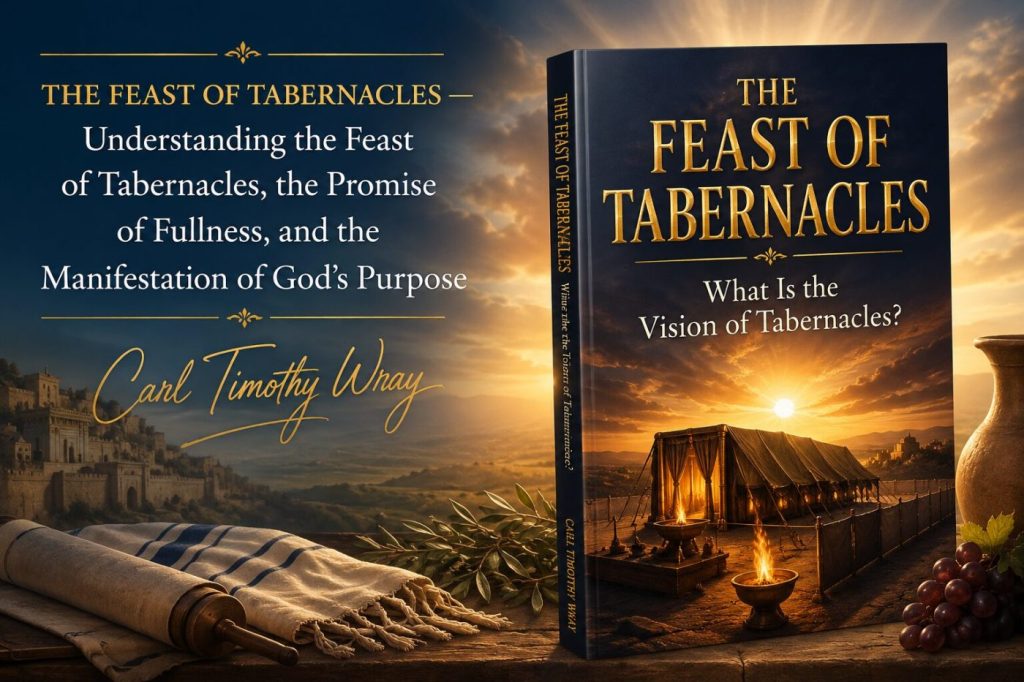
THE FEAST OF TABERNACLES — Understanding the Feast of Tabernacles, the Promise of Fullness, and the Manifestation of God’s Purpose
By Carl Timothy Wray
AUTHOR
Carl Timothy Wray is the founder of Zion University and The Finished Work of Christ ministry. For more than four decades, he has dedicated himself to the study and teaching of Scripture, focusing on the finished work of Jesus Christ, the Gospel of Grace, the revelation of God’s eternal purpose, and the progressive unfolding of God’s plan through the ages. Through books, articles, videos, television broadcasts, and online resources, his mission is to make the mysteries of the Kingdom of God understandable and accessible to all who hunger for truth.
What is the vision of Tabernacles? In this eye-opening study, Carl Timothy Wray explores the Feast of Tabernacles as God’s final feast and its relationship to Passover, Pentecost, maturity, firstfruits, faith, patience, and the manifestation of God’s eternal purpose. Discover why Tabernacles can be seen by revelation before it is experienced in manifestation, how Pentecost prepares a mature people, and what the Scriptures reveal concerning the promise of fullness. This book provides a biblical framework for understanding the Feast of Tabernacles, the transition from promise to fulfillment, and the unveiling of God’s purpose in creation.
INTRODUCTION
The Feast of Tabernacles has long been one of the most misunderstood feasts found in Scripture. Many have viewed it only as an ancient Jewish celebration, while others have treated it as a prophetic mystery reserved for the future. Yet throughout the Scriptures, God reveals a consistent pattern through His three great feasts: Passover, Pentecost, and Tabernacles.
Passover revealed redemption through the Lamb.
Pentecost revealed the outpouring of the Spirit and the formation of a firstfruit people.
Tabernacles reveals fullness.
Today, many believers are beginning to see the Feast of Tabernacles in a way previous generations could not. The vision is being unveiled. The language of fullness, maturity, firstfruits, manifestation, and God’s eternal purpose is becoming clearer. Yet an important question remains:
What is the vision of Tabernacles?
This book does not attempt to answer every question concerning Tabernacles. Rather, it seeks to establish a clear vision that can serve as a foundation for further understanding. Just as Abraham received a promise long before he saw its manifestation, believers often receive revelation before they experience its fulfillment. Faith receives. Patience endures. Manifestation reveals.
The purpose of this study is to examine the Feast of Tabernacles through the lens of God’s progressive purpose. Why did God establish three feasts? Why was Pentecost necessary? What was the purpose of the Holy Spirit and the fire? What is the sign of Tabernacles? What does it mean for God’s purpose to move from preparation into fullness?
The answers to these questions reveal a glorious vision.
Passover redeemed.
Pentecost prepared.
Tabernacles manifests.
May this study help write the vision and make it plain, that those who read it may run with understanding, faith, and expectation.
TABLE OF CONTENTS
Introduction
Writing the Vision and Making It Plain
Chapter 1
What Is the Feast of Tabernacles?
Chapter 2
Why Do We See Tabernacles Before We Experience It?
Chapter 3
What Was the Purpose of Pentecost?
Chapter 4
What Is the Sign of Tabernacles?
Chapter 5
What Happens When Tabernacles Fully Comes?
Conclusion
The Promise of Fullness and the Manifestation of God’s Purpose
About the Author
The Finished Work of Christ
Zion University
The Finished Work of Christ TV
Additional Resources
CHAPTER 1
WHAT IS THE FEAST OF TABERNACLES?
THE FEAST OF TABERNACLES IS GOD’S FINAL FEAST
The Feast of Tabernacles stands as the third and final feast in God’s redemptive pattern. While many study the feast historically, its prophetic significance reaches far beyond ancient Israel. The Feast of Tabernacles reveals the completion of a divine process that began with Passover and continued through Pentecost.
God did not establish His feasts randomly. Each feast reveals a stage in His unfolding purpose.
Passover reveals redemption.
Pentecost reveals firstfruits and preparation.
The Feast of Tabernacles reveals fullness.
LEVITICUS 23:33-36
“And the LORD spake unto Moses, saying,
Speak unto the children of Israel, saying, The fifteenth day of this seventh month shall be the feast of tabernacles for seven days unto the LORD.
On the first day shall be an holy convocation: ye shall do no servile work therein.
Seven days ye shall offer an offering made by fire unto the LORD…”
The Feast of Tabernacles was established by God Himself. It was not the invention of man, nor was it merely a cultural celebration. It was a prophetic feast designed to reveal God’s purpose through the ages.
THE FEAST OF TABERNACLES FOLLOWS PASSOVER AND PENTECOST
The order of the feasts is important.
God first gave Passover.
Then God gave Pentecost.
Finally, God gave the Feast of Tabernacles.
The order reveals progression.
PASSOVER
Passover reveals the Lamb.
1 CORINTHIANS 5:7
“For even Christ our passover is sacrificed for us.”
Passover speaks of redemption.
Passover speaks of deliverance.
Passover speaks of the beginning.
PENTECOST
Pentecost reveals the outpouring of the Spirit.
ACTS 2:1-4
“And when the day of Pentecost was fully come, they were all with one accord in one place.
And suddenly there came a sound from heaven as of a rushing mighty wind…
And there appeared unto them cloven tongues like as of fire…
And they were all filled with the Holy Ghost…”
Pentecost speaks of empowerment.
Pentecost speaks of preparation.
Pentecost speaks of firstfruits.
TABERNACLES
The Feast of Tabernacles points beyond redemption and beyond preparation.
The Feast of Tabernacles points to fullness.
THE FEAST OF TABERNACLES IS THE FEAST OF FULLNESS
Many believers understand redemption.
Many believers understand Pentecost.
Far fewer understand the Feast of Tabernacles.
Yet the Feast of Tabernacles stands as the climax of God’s feast pattern.
DEUTERONOMY 16:13-15
“Thou shalt observe the feast of tabernacles seven days…
And thou shalt rejoice in thy feast…
Therefore thou shalt surely rejoice.”
Notice the emphasis on completion and rejoicing.
The Feast of Tabernacles was associated with ingathering.
It represented the completion of a harvest.
It spoke of fulfillment rather than beginning.
The Feast of Tabernacles reveals the gathering of that which has been growing throughout the process.
THE FEAST OF TABERNACLES REVEALS GOD DWELLING WITH MAN
The word tabernacle speaks of dwelling.
Throughout Scripture, God progressively reveals His desire to dwell among His people.
EXODUS 25:8
“And let them make me a sanctuary; that I may dwell among them.”
JOHN 1:14
“And the Word was made flesh, and dwelt among us…”
REVELATION 21:3
“Behold, the tabernacle of God is with men, and he will dwell with them…”
From Genesis to Revelation, God is revealing His desire to dwell with humanity.
The Feast of Tabernacles points to this reality.
It points to the fulfillment of God’s purpose.
JESUS SPOKE OF THE FEAST OF TABERNACLES
The Feast of Tabernacles appears prominently in the ministry of Jesus.
JOHN 7:2
“Now the Jews’ feast of tabernacles was at hand.”
Jesus did not ignore the feast.
He used the feast as a platform to reveal spiritual realities.
JOHN 7:37-39
“In the last day, that great day of the feast, Jesus stood and cried, saying, If any man thirst, let him come unto me, and drink.
He that believeth on me, as the scripture hath said, out of his belly shall flow rivers of living water.”
Jesus connected the feast with spiritual fulfillment.
He connected the feast with living water.
He connected the feast with the Spirit.
The Feast of Tabernacles was always pointing beyond natural ceremonies toward spiritual realities.
THE FEAST OF TABERNACLES REVEALS GOD’S ETERNAL PURPOSE
The Feast of Tabernacles is not merely about a feast.
It is about God’s purpose.
EPHESIANS 1:9-10
“Having made known unto us the mystery of his will…
That in the dispensation of the fulness of times he might gather together in one all things in Christ…”
Notice the phrase:
“The fulness of times.”
The Feast of Tabernacles points toward fullness.
The Feast of Tabernacles points toward completion.
The Feast of Tabernacles points toward God’s purpose reaching its intended goal.
THE VISION OF THE FEAST OF TABERNACLES
The vision of the Feast of Tabernacles is not merely another doctrine to study.
It is a revelation of God’s purpose moving toward fullness.
Passover redeemed.
Pentecost prepared.
The Feast of Tabernacles reveals fullness.
Before we can understand manifestation, we must first understand vision.
Before we can understand fulfillment, we must first understand purpose.
The Feast of Tabernacles stands as God’s final feast because it reveals the completion of what He has been working toward from the beginning.
The question is no longer whether the Feast of Tabernacles exists.
The question is:
What is the vision of the Feast of Tabernacles?
That question will guide the remainder of this study.
CHAPTER 2
WHY DO WE SEE TABERNACLES BEFORE WE EXPERIENCE IT?
REVELATION OFTEN PRECEDES MANIFESTATION
One of the most important principles in Scripture is that God frequently reveals His purpose before He manifests it.
God speaks before He performs.
God promises before He fulfills.
God reveals before He manifests.
This principle is seen throughout the Bible.
Before Abraham held Isaac in his arms, he possessed the promise by faith.
Before Israel entered the Promised Land, they heard about it.
Before Pentecost fully came, the disciples received the promise of the Spirit.
Likewise, many believers today are beginning to see the Feast of Tabernacles by revelation before they see its fullness in manifestation.
HABAKKUK 2:2-3
“And the LORD answered me, and said, Write the vision, and make it plain upon tables, that he may run that readeth it.
For the vision is yet for an appointed time, but at the end it shall speak, and not lie…”
Notice the order.
The vision comes first.
The appointed time comes later.
The revelation is given before the fulfillment appears.
This is why God instructs His people to write the vision and make it plain.
The vision prepares people for the appointed time.
FAITH RECEIVES WHAT REVELATION REVEALS
The Feast of Tabernacles is first received by revelation.
Faith then lays hold of what revelation has shown.
HEBREWS 11:1
“Now faith is the substance of things hoped for, the evidence of things not seen.”
Faith is not wishful thinking.
Faith is not imagination.
Faith is not pretending.
Faith is evidence.
Faith receives what God has revealed.
Faith embraces what God has spoken.
Faith possesses internally what has not yet appeared externally.
This is why believers can speak of the Feast of Tabernacles today.
They are not inventing a promise.
They are responding to a revelation.
ABRAHAM RECEIVED THE PROMISE BEFORE HE RECEIVED ISAAC
Abraham becomes one of Scripture’s greatest examples of this principle.
ROMANS 4:17
“As it is written, I have made thee a father of many nations…”
Notice what God said.
Not:
“I will make you.”
But:
“I have made you.”
God spoke of the promise as though it were already accomplished.
Yet Abraham still had to walk through years of waiting.
ROMANS 4:18
“Who against hope believed in hope…”
ROMANS 4:19
“And being not weak in faith, he considered not his own body now dead…”
The natural realm contradicted the promise.
His circumstances contradicted the promise.
His body contradicted the promise.
Sarah’s womb contradicted the promise.
Yet Abraham continued to agree with what God had spoken.
FAITH AND PATIENCE WORK TOGETHER
The Feast of Tabernacles helps us understand why faith and patience are both necessary.
Faith receives.
Patience endures.
Faith embraces.
Patience remains aligned.
Faith lays hold.
Patience refuses to let go.
HEBREWS 6:12
“Be not slothful, but followers of them who through faith and patience inherit the promises.”
Notice that Scripture does not merely say they believed the promises.
It says they inherited the promises.
The inheritance came after the promise was received.
Faith and patience worked together until manifestation appeared.
PATIENCE KEEPS US ALIGNED WITH THE PROMISE
Patience is more than waiting.
Patience is remaining in agreement.
Abraham did not spend twenty-five years changing his confession.
He did not spend twenty-five years rewriting God’s promise.
He remained aligned with what God had spoken.
GALATIANS 6:9
“And let us not be weary in well doing: for in due season we shall reap, if we faint not.”
There is an appointed season.
There is a due season.
God determines the season.
Faith and patience keep us aligned until the season arrives.
THE DISCIPLES SAW PENTECOST BEFORE THEY EXPERIENCED IT
The same principle appears in the New Testament.
Jesus promised the Spirit before Pentecost fully came.
ACTS 1:4-5
“And, being assembled together with them, commanded them that they should not depart from Jerusalem, but wait for the promise of the Father…”
The promise was known.
The promise was believed.
The promise was expected.
Yet the manifestation had not yet arrived.
Then the day came.
ACTS 2:1
“And when the day of Pentecost was fully come…”
The promise moved into manifestation.
The revelation became experience.
The expectation became reality.
The sign confirmed the day had arrived.
WHY WE CAN TEACH THE FEAST OF TABERNACLES TODAY
Many ask:
“If Tabernacles has not fully manifested, why teach it?”
The answer is simple.
Because revelation precedes manifestation.
God always reveals His purpose before He fulfills it.
The Feast of Tabernacles can be seen by revelation before it is experienced in fullness.
Just as Abraham received the promise before Isaac appeared.
Just as the disciples received the promise before Pentecost arrived.
Faith receives the vision.
Patience remains aligned with the vision.
Manifestation reveals the vision.
THE FEAST OF TABERNACLES AND THE APPOINTED TIME
The Feast of Tabernacles is not merely a subject to study.
It is a vision to understand.
The vision prepares the people.
The revelation creates expectation.
Faith lays hold of the promise.
Patience keeps believers aligned with the promise.
Then, in God’s appointed season, what has been received by faith enters manifestation.
HABAKKUK 2:3
“For the vision is yet for an appointed time…”
The vision speaks before the fulfillment appears.
The revelation comes before the manifestation.
The promise comes before the inheritance.
This is why the Feast of Tabernacles can be seen today by revelation.
And this is why believers can embrace it by faith while awaiting its appointed manifestation.
The next question naturally follows:
If the Feast of Tabernacles speaks of fullness, then what was God accomplishing through Pentecost, and why was the Holy Spirit and fire necessary?
That is the subject of the next chapter.
CHAPTER 3
WHAT WAS THE PURPOSE OF PENTECOST?
PENTECOST WAS NEVER THE FINAL DESTINATION
Many believers understand the importance of Pentecost, yet few stop to ask why God poured out His Spirit in the first place.
Why did Christ breathe His Spirit into His disciples?
Why did the Holy Ghost come?
Why did the fire come?
Why was power given?
The answer is found in God’s purpose.
Pentecost was not the final destination.
Pentecost was preparation.
The Feast of Tabernacles reveals fullness, but Pentecost reveals the divine preparation required before fullness can appear.
God does nothing without purpose.
Every stage prepares for the next stage.
Passover redeemed.
Pentecost prepared.
The Feast of Tabernacles reveals fullness.
THE SPIRIT HAD TO MOVE FROM EXTERNAL TO INTERNAL
Under the Old Covenant, the Spirit came upon men.
Under the New Covenant, the Spirit would dwell within men.
This was a monumental shift.
JOHN 20:22
“And when he had said this, he breathed on them, and saith unto them, Receive ye the Holy Ghost.”
Christ first breathed His life into His people.
The Spirit was no longer merely an external influence.
The Spirit became an internal reality.
The kingdom was moving inward.
The work of God was moving inward.
Transformation would now begin from within.
Without the indwelling Spirit, there could be no spiritual growth, no revelation, and no maturity.
THE HOLY GHOST BROUGHT REVELATION
The Holy Spirit was given to reveal Christ.
JOHN 16:13-14
“When he, the Spirit of truth, is come, he will guide you into all truth…
He shall glorify me…”
The Holy Spirit opens the eyes of understanding.
The Holy Spirit unveils Christ.
The Holy Spirit reveals the mysteries of God.
Without revelation there can be no maturity.
Without revelation there can be no growth.
Without revelation there can be no preparation for fullness.
The Feast of Tabernacles cannot be understood apart from the work of the Spirit.
The same Spirit that revealed Christ also reveals God’s purpose.
THE FIRE BROUGHT PURIFICATION
Pentecost was not merely about receiving the Spirit.
Pentecost also involved fire.
MATTHEW 3:11
“He shall baptize you with the Holy Ghost, and with fire.”
ACTS 2:3
“And there appeared unto them cloven tongues like as of fire…”
The fire had purpose.
The fire purified.
The fire refined.
The fire removed what hindered spiritual growth.
God was not merely giving information.
God was transforming vessels.
The Spirit revealed.
The fire purified.
Together they prepared a people for maturity.
THE SIGN OF PENTECOST
When Pentecost fully came, it came with a sign.
God did not leave His people guessing whether the day had arrived.
ACTS 2:1-4
“And when the day of Pentecost was fully come…
And suddenly there came a sound from heaven…
And there appeared unto them cloven tongues like as of fire…
And they were all filled with the Holy Ghost…”
The sign was unmistakable.
The Spirit was poured out.
The fire appeared.
Power was given.
The manifestation confirmed the feast.
The sign announced that a new administration had begun.
THE PURPOSE OF THE SIGN
The sign was not the destination.
The sign revealed the beginning of a process.
Many focus on the tongues.
Many focus on the wind.
Many focus on the experience.
Yet God was focused on something much larger.
God was producing a mature people.
God was producing firstfruits.
God was producing overcomers.
The Spirit and the fire were empowering believers to walk a path that would lead toward maturity.
PENTECOST PRODUCES FIRSTFRUITS
The New Testament repeatedly identifies God’s people as firstfruits.
JAMES 1:18
“Of his own will begat he us with the word of truth, that we should be a kind of firstfruits of his creatures.”
ROMANS 8:23
“And not only they, but ourselves also, which have the firstfruits of the Spirit…”
Notice the language.
Firstfruits are not the entire harvest.
Firstfruits point toward something greater.
Firstfruits are evidence that a harvest is coming.
Pentecost reveals firstfruits.
The Feast of Tabernacles reveals fullness.
THE PURPOSE OF THE FIVEFOLD MINISTRY
God did not pour out the Spirit merely to create experiences.
God poured out the Spirit to produce maturity.
EPHESIANS 4:11-13
“And he gave some, apostles; and some, prophets; and some, evangelists; and some, pastors and teachers;
For the perfecting of the saints…
Till we all come in the unity of the faith…
Unto a perfect man…”
The fivefold ministry exists because God is building something.
God is preparing something.
God is maturing something.
The goal is not perpetual infancy.
The goal is maturity.
The goal is a perfect man.
The goal is readiness.
PENTECOST PREPARES THE WOMAN
The language of Revelation 12 becomes important here.
Before the woman gives birth, she is already mature.
She is clothed with the sun.
She has the moon beneath her feet.
She wears a crown.
She possesses capacity.
She is prepared.
The woman is not a picture of spiritual infancy.
She is a picture of maturity.
Pentecost has done its work.
The Spirit has done its work.
The fire has done its work.
The vessel has been prepared.
WHY PENTECOST WAS NECESSARY
Without the Holy Spirit there could be no revelation.
Without the fire there could be no purification.
Without revelation there could be no maturity.
Without maturity there could be no readiness.
Without readiness there could be no capacity for fullness.
Pentecost was God’s school of preparation.
The Holy Spirit revealed Christ.
The fire transformed the vessel.
The ministries equipped the saints.
The process produced maturity.
The purpose was preparation.
THE FEAST OF TABERNACLES REQUIRES A PREPARED PEOPLE
The Feast of Tabernacles does not appear in a vacuum.
God prepares before He manifests.
God forms before He reveals.
God matures before He entrusts.
This is why Pentecost was necessary.
The Spirit and the fire were preparing a people capable of receiving fullness.
The sign of Pentecost was the Holy Ghost and fire.
The purpose of Pentecost was maturity.
The power was given so God’s people could become overcomers in this age.
The Spirit revealed.
The fire purified.
The people matured.
The vessel was prepared.
The next question becomes unavoidable:
If Pentecost prepared a mature people, what is the sign that the Feast of Tabernacles has fully come?
That is the subject of the next chapter.
CHAPTER 4
WHAT IS THE SIGN OF TABERNACLES?
EVERY FEAST THAT FULLY COMES HAS A SIGN
Throughout Scripture, when God brings a new administration into manifestation, He confirms it with a sign.
God does not leave His people guessing.
God bears witness to His own work.
When Passover came, there was a lamb.
When Pentecost came, there was a sign.
When the Feast of Tabernacles fully comes, should we not expect a sign as well?
The pattern of God remains consistent.
The sign does not create the feast.
The sign reveals that the feast has arrived.
The sign confirms that the promise has entered manifestation.
This principle is vital to understanding the Feast of Tabernacles.
THE SIGN OF PENTECOST
Before we can understand the sign of the Feast of Tabernacles, we must first understand the sign of Pentecost.
ACTS 2:1-4
“And when the day of Pentecost was fully come…
And suddenly there came a sound from heaven as of a rushing mighty wind…
And there appeared unto them cloven tongues like as of fire…
And they were all filled with the Holy Ghost…”
Notice what happened.
The feast fully came.
The sign appeared.
The manifestation followed.
The sign announced that a new administration had begun.
The Holy Spirit had been promised.
The disciples had believed.
They had waited.
Then the day arrived.
The sign confirmed the promise.
THE PURPOSE OF THE PENTECOSTAL SIGN
The sign was not merely an experience.
The sign revealed a purpose.
The Holy Spirit brought revelation.
The fire brought purification.
The power enabled maturity.
Pentecost empowered God’s people to become overcomers in this age.
Without the Holy Spirit there could be no revelation.
Without the fire there could be no preparation.
Without preparation there could be no maturity.
Without maturity there could be no readiness for fullness.
The sign of Pentecost was Spirit and fire.
The purpose of Pentecost was maturity.
THE FEAST OF TABERNACLES ALSO POINTS TO A SIGN
If Pentecost came with a sign, then the Feast of Tabernacles must also have a sign.
The Feast of Tabernacles is not merely a doctrine.
It is not merely a theory.
It is not merely an idea.
The Feast of Tabernacles speaks of manifestation.
The Feast of Tabernacles speaks of fulfillment.
The Feast of Tabernacles speaks of God’s purpose moving from preparation into fullness.
Therefore, the Feast of Tabernacles must possess a corresponding sign.
The question is:
What is the sign?
CREATION IS GROANING FOR SOMETHING
Romans chapter eight gives us the answer.
ROMANS 8:19
“For the earnest expectation of the creature waiteth for the manifestation of the sons of God.”
Creation is waiting.
Creation is expecting.
Creation is looking toward something.
Notice that creation is not waiting for Passover.
Creation is not waiting for Pentecost.
Creation is waiting for manifestation.
Something remains unfinished.
Something remains anticipated.
Something remains ahead.
THE SAINTS ARE GROANING AS WELL
The groaning is not limited to creation.
The saints themselves are groaning.
ROMANS 8:23
“And not only they, but ourselves also, which have the firstfruits of the Spirit, even we ourselves groan within ourselves…”
Notice the language.
These are not people without the Spirit.
These are people with the firstfruits of the Spirit.
These are people who have already received the earnest.
These are people who already possess revelation.
Yet they continue groaning.
Why?
Because something remains unfulfilled.
WHAT ARE THEY WAITING FOR?
Paul gives the answer.
ROMANS 8:23
“…waiting for the adoption, to wit, the redemption of our body.”
This statement is one of the most important verses in understanding the Feast of Tabernacles.
The saints possess the Spirit.
The saints possess firstfruits.
The saints possess revelation.
Yet they are still waiting for something.
They are waiting for the redemption of the body.
The groaning continues because the promise has not yet reached its fullest expression.
THE SIGN OF THE FEAST OF TABERNACLES
The sign of Pentecost was Spirit and fire.
The sign of the Feast of Tabernacles points to the redemption of the body.
The sign points to the adoption entering manifestation.
The sign points to fullness appearing where previously there had only been promise.
PHILIPPIANS 3:20-21
“For our conversation is in heaven…
Who shall change our vile body, that it may be fashioned like unto his glorious body…”
1 CORINTHIANS 15:51-53
“We shall not all sleep, but we shall all be changed…
For this corruptible must put on incorruption, and this mortal must put on immortality.”
The Feast of Tabernacles speaks of fullness.
The sign reveals fullness entering manifestation.
WHY THE GROANING CEASES
The saints are not groaning because they lack salvation.
They are not groaning because they lack the Spirit.
They are not groaning because they lack revelation.
They are groaning because they possess firstfruits while anticipating fullness.
The Spirit is present.
The promise is present.
The revelation is present.
Yet mortality remains.
The groaning continues until the promise reaches its intended goal.
When the sign appears, the cause of the groaning is removed.
What was held by faith enters manifestation.
What was anticipated enters experience.
What was promised enters fulfillment.
THE FEAST OF TABERNACLES REVEALS FULLNESS
The Feast of Tabernacles is not merely another feast.
The Feast of Tabernacles reveals completion.
Passover revealed redemption.
Pentecost revealed firstfruits.
The Feast of Tabernacles reveals fullness.
The Feast of Tabernacles reveals the transition from promise to manifestation.
The Feast of Tabernacles reveals the transition from preparation to fulfillment.
The Feast of Tabernacles reveals the transition from the earnest to fullness.
THE SIGN REVEALS THE ARRIVAL OF THE DAY
Nobody had to announce that Pentecost had arrived.
The sign announced it.
The manifestation confirmed it.
Likewise, the Feast of Tabernacles points toward a manifestation that bears witness to the arrival of the day.
The sign reveals that preparation has accomplished its purpose.
The sign reveals that maturity has reached its goal.
The sign reveals that fullness has entered manifestation.
The sign reveals that God’s purpose is moving into a new administration.
The sign reveals that the promise has become reality.
THE FEAST OF TABERNACLES AND THE PROMISE OF FULLNESS
The Feast of Tabernacles stands before us as the promise of fullness.
The saints have received the firstfruits.
The saints have received the Spirit.
The saints have received revelation.
Yet they continue to look toward the fulfillment of what God has promised.
The Feast of Tabernacles reveals that fulfillment.
The Feast of Tabernacles reveals the manifestation of God’s purpose.
The Feast of Tabernacles reveals the completion of what Pentecost began.
The next question naturally follows:
What happens when the Feast of Tabernacles fully comes, and how does God’s administration change when fullness appears?
That is the subject of the next chapter.
CHAPTER 5
WHAT HAPPENS WHEN THE FEAST OF TABERNACLES FULLY COMES?
THE FEAST OF TABERNACLES IS THE FEAST OF FULLNESS
The Feast of Tabernacles does not merely reveal another stage of preparation.
The Feast of Tabernacles reveals fulfillment.
Passover brought redemption.
Pentecost brought preparation.
The Feast of Tabernacles reveals fullness.
This is why the Feast of Tabernacles occupies such an important place in God’s purpose. It reveals the completion of a process that began long before.
The Holy Spirit was given for a purpose.
The fire was sent for a purpose.
The ministries were established for a purpose.
The preparation was leading somewhere.
The Feast of Tabernacles reveals the destination.
THE WOMAN REVEALS A PREPARED CONDITION
Before the man-child appears in Revelation 12, the woman is already mature.
REVELATION 12:1
“And there appeared a great wonder in heaven; a woman clothed with the sun, and the moon under her feet, and upon her head a crown of twelve stars.”
Her condition is significant.
She is clothed with the sun.
She possesses a crown.
The moon is beneath her feet.
She is not struggling toward maturity.
She reveals maturity.
She reveals readiness.
She reveals capacity.
The woman stands as a witness that Pentecost has accomplished its work of preparation.
The Spirit has worked.
The fire has worked.
The vessel has been prepared.
THE WOMAN POSSESSES THE CAPACITY FOR FULLNESS
The woman is not presented as an infant.
She is not presented as immature.
She is presented as ready.
The imagery reveals a vessel capable of conceiving something greater.
A mature vessel can receive what an immature vessel cannot receive.
A prepared wineskin can contain what an unprepared wineskin cannot contain.
The woman reveals that God’s dealings have produced readiness.
The Feast of Tabernacles does not begin with immaturity.
The Feast of Tabernacles reveals the fruit of maturity.
THE MAN-CHILD REVEALS A NEW ADMINISTRATION
REVELATION 12:5
“And she brought forth a man child, who was to rule all nations with a rod of iron…”
The symbolism points beyond natural birth.
The emphasis is not upon infancy.
The emphasis is upon authority.
The emphasis is upon administration.
The emphasis is upon rulership.
The man-child reveals a new order.
The man-child reveals a new administration.
The man-child reveals fullness emerging from preparation.
The condition of the woman explains the nature of what is brought forth.
Maturity brings forth fullness.
Preparation brings forth manifestation.
THE FEAST OF TABERNACLES REVEALS THE END OF LIMITATION
Throughout the Pentecostal age, God’s people possess the earnest.
They possess revelation.
They possess firstfruits.
Yet they continue to experience limitation.
The Feast of Tabernacles points toward the removal of limitation.
1 CORINTHIANS 15:52-54
“For the trumpet shall sound, and the dead shall be raised incorruptible, and we shall be changed.
For this corruptible must put on incorruption, and this mortal must put on immortality.”
The Feast of Tabernacles speaks of fullness.
The Feast of Tabernacles speaks of completion.
The Feast of Tabernacles speaks of the promise entering manifestation.
The Feast of Tabernacles speaks of mortality giving way to immortality.
THE PRIESTHOOD CHANGES
The Feast of Tabernacles reveals more than personal transformation.
It reveals a change in administration.
HEBREWS 7:16
“Who is made, not after the law of a carnal commandment, but after the power of an endless life.”
The language of Hebrews points beyond temporary measures.
It points toward a higher order.
It points toward the power of an endless life.
The Feast of Tabernacles reveals the completion of what preparation has been producing.
The ministry changes.
The administration changes.
The priesthood changes.
The operation changes.
The measure changes.
What was previously in part moves toward fullness.
FROM PREPARATION TO ADMINISTRATION
This may be one of the clearest ways to understand the Feast of Tabernacles.
Passover redeemed.
Pentecost prepared.
The Feast of Tabernacles reveals administration.
The purpose of Pentecost was preparation.
The purpose of the Spirit was preparation.
The purpose of the fire was preparation.
The purpose of maturity was preparation.
The Feast of Tabernacles reveals what that preparation was leading toward.
THE FEAST OF TABERNACLES REVEALS THE MANIFESTATION OF FULLNESS
EPHESIANS 4:13
“Till we all come in the unity of the faith, and of the knowledge of the Son of God, unto a perfect man…”
The perfect man represents maturity brought to completion.
The Feast of Tabernacles reveals fullness brought into manifestation.
The Feast of Tabernacles reveals the goal toward which the process has been moving.
The Spirit was given to reveal Christ.
The fire was given to purify the vessel.
The ministries were given to equip the saints.
The Feast of Tabernacles reveals the fulfillment of that process.
THE FEAST OF TABERNACLES AND THE MANIFESTATION OF THE SONS OF GOD
ROMANS 8:19
“For the earnest expectation of the creature waiteth for the manifestation of the sons of God.”
Creation has been waiting.
Creation has been expecting.
Creation has been anticipating.
The Feast of Tabernacles reveals a manifestation that creation itself has long awaited.
The promise of fullness is not merely personal.
It touches creation.
It touches administration.
It touches God’s purpose in the earth.
THE FEAST OF TABERNACLES REVEALS GOD’S PURPOSE MOVING INTO FULLNESS
The Feast of Tabernacles is not merely about a feast.
It is not merely about symbolism.
It is not merely about prophecy.
The Feast of Tabernacles reveals God’s purpose moving into fullness.
The Feast of Tabernacles reveals preparation reaching its intended goal.
The Feast of Tabernacles reveals manifestation emerging from promise.
The Feast of Tabernacles reveals fulfillment emerging from expectation.
THE VISION OF TABERNACLES
What is the vision of Tabernacles?
The vision of Tabernacles is the revelation of God’s purpose moving from preparation into fullness.
Passover brought redemption through the Lamb.
Pentecost brought the earnest of the Spirit, empowering God’s people with revelation, transformation, and the capacity to mature.
Yet Pentecost was never the final destination.
The Spirit was given for a purpose.
The fire was sent for a purpose.
The preparation was leading somewhere.
The Feast of Tabernacles reveals the fulfillment of that purpose.
It speaks of the transition from promise to manifestation, from the earnest to fullness, and from preparation to administration.
What is now received by faith shall be revealed in manifestation.
What is now seen through promise shall be experienced in fullness.
The Feast of Tabernacles is not merely another feast to study. It is the unveiling of God’s purpose as He brings to completion that which He has been preparing from the beginning.
Passover redeemed.
Pentecost prepared.
The Feast of Tabernacles manifests.
And through it all, God moves creation toward the fulfillment of His eternal purpose.
CONCLUSION
THE PROMISE OF FULLNESS AND THE MANIFESTATION OF GOD’S PURPOSE
Throughout this study, we have sought to answer one question:
What is the vision of Tabernacles?
The answer is found in the progressive unfolding of God’s purpose throughout Scripture.
God established three great feasts that reveal three stages of His redemptive plan.
Passover revealed redemption through the Lamb.
Pentecost revealed the outpouring of the Spirit and the preparation of a firstfruit people.
The Feast of Tabernacles reveals fullness.
From the beginning, God has been moving creation toward a predetermined purpose. Nothing in His plan is accidental. Every stage serves the next stage. Every promise points toward fulfillment. Every revelation points toward manifestation.
This is why the Feast of Tabernacles occupies such an important place in God’s purpose.
The Feast of Tabernacles reveals the completion of what God has been preparing.
REVELATION PRECEDES MANIFESTATION
One of the great lessons of Scripture is that God often reveals His purpose before He manifests it.
Abraham received the promise before Isaac appeared.
The disciples received the promise before Pentecost arrived.
Likewise, many believers are beginning to see the Feast of Tabernacles by revelation before it is experienced in manifestation.
This should not surprise us.
Faith has always laid hold of what God reveals before the natural eye can see it.
HEBREWS 11:1
“Now faith is the substance of things hoped for, the evidence of things not seen.”
Faith receives.
Patience endures.
Manifestation reveals.
This divine pattern appears throughout Scripture.
The vision comes first.
The appointed time follows.
The promise is received.
The fulfillment appears.
THE PURPOSE OF PENTECOST
Pentecost was never intended to be the final destination.
The Holy Spirit was given for a purpose.
The fire was given for a purpose.
The ministries were given for a purpose.
God was preparing a people.
The Spirit brought revelation.
The fire brought purification.
The ministries brought maturity.
The result was a firstfruit company possessing the capacity to grow into the purpose of God.
The sign of Pentecost was Spirit and fire.
The purpose of Pentecost was maturity.
Without preparation there could be no fullness.
Without maturity there could be no readiness.
Without readiness there could be no manifestation.
THE SIGN OF TABERNACLES
Every feast that fully comes bears witness to its arrival.
Pentecost came with a sign.
The Feast of Tabernacles likewise points toward a sign.
Romans chapter eight reveals both creation and the saints groaning for something greater.
ROMANS 8:23
“…waiting for the adoption, to wit, the redemption of our body.”
The groaning continues because the promise has not yet reached its fullest expression.
The saints possess the Spirit.
The saints possess firstfruits.
The saints possess revelation.
Yet they continue looking toward fulfillment.
The Feast of Tabernacles reveals the manifestation of what has long been anticipated.
The sign points to fullness entering manifestation.
The sign points to God’s purpose moving beyond preparation.
THE FEAST OF TABERNACLES REVEALS FULLNESS
The imagery of Revelation 12 presents a mature woman clothed with the sun, crowned, and prepared.
She reveals readiness.
She reveals maturity.
She reveals capacity.
The man-child reveals the emergence of a new administration.
The symbolism points beyond preparation and toward manifestation.
The Feast of Tabernacles reveals the transition from promise to fulfillment.
The Feast of Tabernacles reveals the transition from preparation to administration.
The Feast of Tabernacles reveals the transition from the earnest to fullness.
Passover redeemed.
Pentecost prepared.
The Feast of Tabernacles manifests.
THE ETERNAL PURPOSE OF GOD
The Feast of Tabernacles is not merely about understanding a feast.
It is about understanding God’s purpose.
EPHESIANS 1:10
“That in the dispensation of the fulness of times he might gather together in one all things in Christ…”
1 CORINTHIANS 15:28
“That God may be all in all.”
The Feast of Tabernacles points toward fulfillment.
The Feast of Tabernacles points toward completion.
The Feast of Tabernacles points toward the unveiling of God’s purpose in creation.
What is now received by faith shall be revealed in manifestation.
What is now seen through promise shall be experienced in fullness.
What is now anticipated shall one day stand revealed.
WHAT IS THE VISION OF TABERNACLES?
The vision of Tabernacles is the revelation of God’s purpose moving from preparation into fullness.
It is the unveiling of what Passover initiated and what Pentecost prepared.
It is the promise of fullness.
It is the manifestation of God’s purpose.
It is the completion of a divine process that has been unfolding throughout the ages.
The Feast of Tabernacles is not merely another feast to study.
It is a vision to understand.
It is a promise to embrace.
It is a purpose to behold.
May we continue to receive by faith what God has revealed.
May we remain aligned through patience with what God has promised.
And may we walk in expectation as the light continues to shine more and more unto the perfect day.
PROVERBS 4:18
“But the path of the just is as the shining light, that shineth more and more unto the perfect day.”
The vision has been written.
The light is increasing.
The promise remains sure.
Passover redeemed.
Pentecost prepared.
The Feast of Tabernacles manifests.
To God be the glory.