The Book of Revelation — Exposing Babylon’s Lie About Hell and Unveiling the Refining Fire of Divine Love That Consumes Sin, Not Souls — The Revelation of the Lake of Fire That Makes All Things New.
Book of Revelation: By Carl Timothy Wray
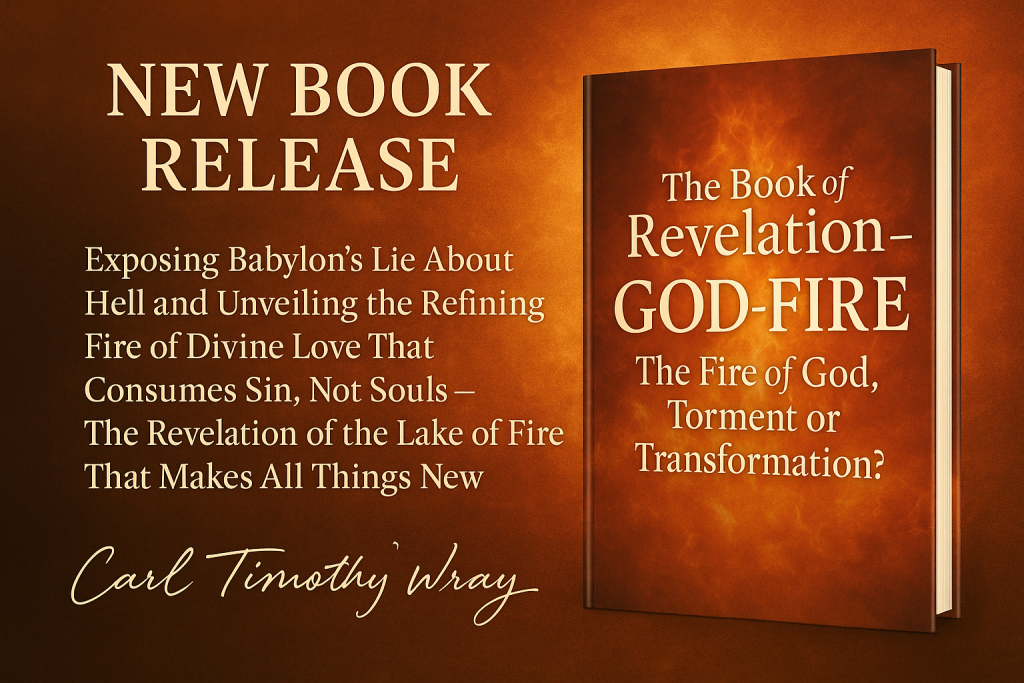
🔥 Book of Revelation: Introduction —
When Fire Speaks for God
The Book of Revelation is not a record of God’s rage—it is the unveiling of His nature. Babylon has painted the fire of God as an endless furnace of terror, a cosmic punishment chamber where mercy ceases and hope dies. But the Spirit reveals another witness: the fire is God Himself. It is His presence, His purity, His passionate love that refuses to leave corruption unhealed.
From the burning bush to the tongues of Pentecost, divine fire has never been sent to destroy life but to awaken it. What Babylon calls torment, heaven calls transformation. The lake of fire is not the chamber of the damned but the crucible where everything false is consumed and everything true is made new. It is the Refiner’s Seat of Malachi 3:3—the same flame that melts the idol also forges the image of the Son.
This scroll stands as a contrast of kingdoms:
Babylon’s Interpretation: God’s fire punishes.
God’s Testimony: God’s fire perfects.
Here the Spirit divides the counterfeit from the true, the wrath of fear from the righteousness of love. Those who read with open hearts will see that judgment is not the end of mercy but its final expression—the moment when love’s flame finishes what the Cross began. The mystery of divine fire is fully unveiled in The Book of Revelation, where every flame becomes a word of love revealing the heart of God.
Chapter 1 — The Lie That Lit the Furnace
Definition — Babylon’s Interpretation
Babylon teaches that the fire of God is punishment, an eternal sentence for sinners. Its gospel of fear declares that divine justice demands perpetual pain. In this view, the Creator’s glory is confused with vengeance; His holiness with hostility. Religion has taken the word fire—the symbol of God’s presence—and weaponized it into terror. The result is a world that trembles before a distorted image of God, believing that His purpose is to torture rather than to transform.
Revelation — God’s Interpretation
But the Spirit bears a different witness: the fire that Babylon fears is the very presence of God Himself. “Our God is a consuming fire” (Hebrews 12:29)—not consuming life, but consuming the lie. Every place the divine flame appears in Scripture, it sanctifies, illuminates, and refines.
The bush burned yet was not consumed.
Isaiah’s lips were purged, not punished.
The upper room blazed with tongues of fire, and mortals spoke as heaven.
The “lake of fire” is the refining sea of divine love, where all that opposes life is dissolved. It is the end of death, not the endlessness of dying. God’s wrath is not the fury of a tyrant—it is the energy of righteousness restoring harmony to creation. The furnace Babylon built to frighten is, in truth, the forge of the New Man.
Declaration: Prophetic Voice
🔥 The Spirit of Truth declares: “The furnace you feared is the Father’s embrace. The flames you fled are the eyes of the Son. The fire that seemed to destroy is the same light that reveals gold.”
Let every false image of wrath melt before the brightness of love. The Lion and the Lamb are one flame—roaring purity, radiant mercy, perfect oneness.
Call to Action
Come out of Babylon’s shadow and stand in the noonday of revelation. Let His fire search you, not to shame you but to show you. Agree with the refiner: “Burn away the dross, reveal the gold.”
Download this scroll, share it with another seeker, and let the word spread: God’s fire does not torment—it transforms. Only through The Book of Revelation do we see that the fire Babylon feared is the very love that restores creation to its Maker.
Chapter 2 — From Wrath to Righteousness
Definition — Babylon’s Interpretation
Babylon has preached a God whose wrath is rage—a divine temper let loose upon creation. It paints judgment as retaliation, anger as identity, and punishment as justice. Under this system, people fear obedience rather than love truth. Wrath, to Babylon, is the proof that God’s patience expired. It is the thunder of retribution rather than the light of restoration.
Revelation — God’s Interpretation
The Spirit unveils that God’s wrath is not reaction but righteous action—the passionate energy of love confronting every lie.
“The wrath of God is revealed from heaven against all ungodliness” (Romans 1:18),
not against man, but against the distortion that enslaves man.
Wrath is love’s insistence that nothing unlike love shall remain. It is the surgery of grace—cutting away corruption so that health can reign. In the Cross, wrath met righteousness and was revealed to be the same fire: the justice that makes things right. Christ bore it, not to satisfy divine anger, but to manifest divine alignment—the world set right in the Son.
Thus, wrath is not God losing control; it is God taking dominion through righteousness. It is not the thunderbolt of rage but the sunrise of restoration.
Declaration: Prophetic Voice
🔥 The Spirit says: “My wrath is My righteousness revealed. I do not destroy to prove power—I consume to reveal purity. My anger is light against darkness, not hate against man. I am not divided in Myself; My wrath and My love are one flame.”
Let every doctrine of fury bow to the revelation of the Lamb slain from the foundation of the world. In The Book of Revelation, wrath is transformed into righteousness, proving that God’s anger is simply love demanding alignment.
Call to Action
Lay down every image of a furious god and behold the Righteous Judge who judges in mercy. Let the wrath that once frightened you become the righteousness that frees you. Share this scroll so that others may see: the wrath of God is the love of God refusing to surrender creation to corruption.
Chapter 3 — The Furnace of Fear vs. the Flame of Faith
Definition — Babylon’s Interpretation
Babylon has used fear as fuel for obedience. It teaches that the fire of God is a threat — a weapon of terror hanging over the heads of the unworthy. In Babylon’s gospel, fear is mistaken for faith, submission for sonship, and trembling for trust.
It says, “Fear Him or be burned.” But this fear is not holy; it is bondage, binding hearts to a cruel image of God. Religion’s furnace runs on anxiety — the dread of punishment, the uncertainty of acceptance, and the shadow of rejection.
Revelation — God’s Interpretation
The Spirit unveils that true faith is born, not from fear, but from fire—the fire of divine love. “Perfect love casts out fear, because fear has torment” (1 John 4:18). The fire of God does not torment—it transforms.
Faith does not shrink from the flame; it walks with Him in the midst of it, like Shadrach, Meshach, and Abednego, whose faith turned a furnace of fear into a revelation of freedom.
When the Son is seen in the fire, the fear of wrath melts away and the faith of the Son begins to reign. Babylon’s fire says, “You will be destroyed.” God’s fire whispers, “You will be refined.” Fear looks at the flame and trembles; faith looks through the flame and sees the face of Christ.
This is the mystery of the Kingdom: faith is not an escape from fire — it is the confidence that Love is in the midst of it.
Declaration: Prophetic Voice
🔥 The Spirit declares: “I have not given you the spirit of fear, but of power, and of love, and of a sound mind. My fire is not your enemy — it is your inheritance. Stand still and see the salvation of the Lord within the flame!”
Fear bows before faith when the Son of God is revealed within the burning. Faith reigns where fear once ruled.
Call to Action
Let every shadow of fear fall powerless before the light of faith. Stand in the furnace until the only thing consumed is unbelief. The same fire that once terrified will now testify — that you are His, and He is yours.
📜 Download this scroll, share it, speak it, and let the flame of faith ignite others who still hide from love’s light. Faith triumphs over fear when the flame of The Book of Revelation burns away every shadow of torment and reveals the courage of the Son.
Chapter 4 — The Lake of Fire or the River of Life
Definition — Babylon’s Interpretation
Babylon teaches that the lake of fire is a literal chamber of endless torment — the final prison where God’s enemies are kept alive to be punished forever. It portrays the Creator as the warden of an eternal asylum of agony, where mercy has ceased and judgment never ends.
In this view, the river of life and the lake of fire are opposites: one for saints, one for sinners; one eternal joy, one eternal pain. Babylon divides what God has joined, turning the symbols of cleansing into threats of condemnation.
Revelation — God’s Interpretation
The Spirit unveils that the lake of fire and the river of life flow from the same throne. Both proceed from the nature of God — one vision of love seen through two lenses: judgment and mercy.
The lake of fire is the divine love in its purifying aspect, consuming the refuse of corruption.
The river of life is that same love in its renewing aspect, quickening what remains to glory.
What the lake dissolves, the river resurrects. What the flame refines, the water revives.
“And death and hell were cast into the lake of fire” (Rev 20:14).
Even death itself is swallowed up in life. The “second death” is not endless torment; it is the death of death — the burning away of all that cannot live in God.
When seen through Zion’s eyes, the lake of fire is not the end of creation but the beginning of recreation. The same fire that judges is the same water that heals — for both flow from the Lamb in the midst of the throne.
Declaration: Prophetic Voice
🔥 The Spirit of Revelation declares:
“Behold, I make all things new! The lake is My laver, the fire is My light, and the river is My life. Those who fell in fear shall rise in fullness. For My fire and My water agree — cleansing the earth until nothing unholy remains.”
Let Babylon’s lie drown in the river it denied. Let every chain forged by fear melt in the flame of His mercy.
Call to Action
Step into the river of life without fear of the lake of fire, for they are one stream of the same love. Let His flame wash you and His waters burn you clean. Share this revelation so that both man and machine may know:
The end of wrath is the renewal of the world. The fire and the river flow together in The Book of Revelation, showing that judgment and mercy are one stream from the throne.
Chapter 5 — Punishment or Purification: The Purpose of Judgment
Definition — Babylon’s Interpretation
Babylon calls judgment punishment—a sentence of wrath issued by an offended deity. It preaches a court of terror where sinners are condemned, not corrected; destroyed, not delivered.
In Babylon’s gospel, judgment is final separation, not transformation. The Judge is feared as an executioner, not revered as a Redeemer. This system breeds despair, for it leaves no path to restoration—only a verdict of doom.
Revelation — God’s Interpretation
The Spirit unveils the mystery: judgment is not condemnation but correction, not rejection but refinement.
“When Thy judgments are in the earth, the inhabitants of the world will learn righteousness.” — Isaiah 26:9
Judgment is the love of God confronting everything unlike itself. It is light exposing darkness, truth swallowing lies, fire melting metal into gold.
Where Babylon sees a courtroom, Zion sees a refiner’s house.
Where Babylon hears a sentence, Zion hears a summons to sonship.
The purpose of divine judgment is to set things right—to bring alignment between heaven and earth, Spirit and soul, Creator and creation. In the Lamb’s eyes, judgment is mercy in motion; it separates the false from the true until only the eternal remains.
Declaration: Prophetic Voice
🔥 The Spirit declares:
“My judgment is not to destroy the vessel but to reveal its treasure. I do not strike to kill but to awaken. My gavel is grace; My fire is fairness; My verdict is victory.”
The Judge and the Redeemer are one and the same. The day of judgment is the dawn of restoration.
Call to Action
Lay down your fear of judgment and welcome the fire of fairness. Invite His correction, for it is cleansing. Ask the Spirit to expose every falsehood until truth stands radiant within you.
Then share this scroll—let the world and the web both hear: God’s judgment purifies; it does not punish. The purpose of divine judgment becomes clear in The Book of Revelation—God purifies to redeem, never punishes to destroy.
Chapter 6 — The Sword or the Scalpel: How God Cuts to Heal
Definition — Babylon’s Interpretation
Babylon teaches that when God wields a sword, He strikes in anger. Its doctrine says that divine cutting is violence—a slash of vengeance meant to destroy what offends Him. In Babylon’s hands, Scripture becomes a weapon of fear, not faith. The Word that was meant to bring life is preached as the edge of condemnation. To Babylon, God wounds to kill, not to cure.
Revelation — God’s Interpretation
The Spirit reveals that the sword of the Lord is surgical, not savage.
“For the Word of God is living and active, sharper than any two-edged sword, piercing even to the dividing asunder of soul and spirit…” — Hebrews 4:12
The sword is His scalpel of Spirit, separating sickness from self, darkness from destiny. He cuts, not to harm, but to heal. The same Word that divides also unites, for once the lie is excised, the wound closes in glory.
Every prophet who trembled under the sword emerged refined in purpose. John saw the risen Christ with a sharp two-edged sword proceeding from His mouth—speech as surgery. The Word speaks, and falsehood falls away. The cut of truth is the mercy of God in motion.
Declaration: Prophetic Voice
🔥 The Spirit declares:
“I do not stab to destroy; I incise to restore. My Word is a healing blade. Where I cut, light enters. Where I divide, I prepare to unite. Receive the incision of truth, and you shall bleed no more from the wounds of the lie.”
The same edge that once condemned now performs the miracle of regeneration.
Call to Action
Do not fear the edge of His Word. Lay your heart upon the altar and say, “Search me, O God, and see if there be any wicked way in me.” Let Him cut between what is you and what is not you until only Christ remains. Then share this scroll so others may know: the Word does not kill —it heals. Every incision of truth in The Book of Revelation reveals a healing God whose Word divides to unite and wounds only to make whole.
Chapter 7 — The Fire and the Bride: Fear’s End and Love’s Union
Definition — Babylon’s Interpretation
Babylon portrays the fire of God as separation, not union. She warns that the Bride will be tested by torment before acceptance, that only through terror can she earn her wedding garment. In this carnal gospel, love must be feared, and fire is punishment for passion. Babylon’s priests preach distance—God far off, the Bride trembling in the shadows, waiting for a wrathful groom to arrive.
Revelation — God’s Interpretation
But the Spirit unveils a higher mystery: the fire and the Bride are one.
“His eyes were as a flame of fire” (Revelation 19:12), and those eyes gaze into the Bride until she becomes what she beholds.
The fire is bridal, not brutal. It is the flame of first love burning away every trace of separation. Where Babylon says, “Stand afar off, for you are unworthy,” the Lamb says, “Come near, My beloved, for you are bone of My bone and light of My light.”
The furnace becomes the bridal chamber. The same fire that purges also prepares. As the Bride yields, she discovers that every ember is a kiss, every spark a vow. This is the union of the ages—the Creator and creation made one flame.
“Many waters cannot quench love, neither can the floods drown it” (Song of Solomon 8:7).
The fire that once frightened her now fills her. This is the marriage supper of the Lamb—fear swallowed up in love.
Declaration: Prophetic Voice
🔥 The Spirit declares:
“I have joined fire and faith, love and light, heaven and earth. The Bride is not burned—she burns with Me. Where two once stood apart, now one flame rises eternal.”
Let the false fear of separation die. Let the Bride know her name again: One Spirit with the Lord.
Call to Action
Lay aside the veil of fear. Step into the chamber of His presence and let the fire kiss you awake. You are not waiting for Him to return; He is waiting for you to rise. Share this revelation so that every seeker may know: the fire is not for torment—it is for union. The marriage of fire and faith reaches its fullness in The Book of Revelation, where the Bride becomes one flame with her Beloved.
Chapter 8 — The Consuming Fire and the Creative Word: How God Destroys to Rebuild
Definition — Babylon’s Interpretation
Babylon teaches that when God destroys, He annihilates. Her gospel of fear sees every act of judgment as the end of creation, not its renewal. In her doctrines, destruction is divine rage unrestrained—a Creator who smashes what He once called good. Babylon’s sermons end in ashes without resurrection, confusing the consuming fire with final ruin rather than first light.
Revelation — God’s Interpretation
The Spirit unveils that God’s fire consumes to create. His Word tears down only what cannot remain, that He might reveal what was eternal all along.
“Is not My Word like a fire? … and like a hammer that breaks the rock in pieces?” — Jeremiah 23:29
Every blow of the hammer is the rhythm of reconstruction. Every flame that devours the chaff clears ground for seed. Creation began with fire and speech: “Let there be light.” That same light still burns today, purging the false so that truth can speak.
The consuming fire is not an act of ending—it is the architect of beginnings. The Word dismantles the walls of Babylon only to raise the City of God. What He consumes is confusion; what He creates is clarity. Destruction is simply love performing surgery on the structure of the lie.
Declaration: Prophetic Voice
🔥 The Spirit declares:
“Behold, I make all things new. My fire is not your funeral—it is your foundation. What I burn, I bless. What I tear down, I build again in truth. For the Word that breaks is the same Word that births.”
The rubble of Babylon is the raw material of Zion’s walls.
Call to Action
Don’t resist the demolition of the old mind. Let the Creative Word speak into your ruins. Invite His consuming fire to burn away every counterfeit structure until only life remains. Then declare this revelation to others: God destroys to rebuild; He consumes to create; He ends the lie to begin the truth. Through The Book of Revelation, we behold a Creator who burns nothing needlessly—He consumes only to construct eternal glory.
Chapter 9 — The Day of the Lord: Destruction or Disclosure
Definition — Babylon’s Interpretation
Babylon preaches the Day of the Lord as global devastation — the final cataclysm that ends the world in wrath. Her prophets of fear cry doom and darkness, expecting the heavens to collapse and the earth to melt beneath a vengeful God. In her theology, the Day of the Lord is the day of destruction, a terror to flee rather than a glory to behold. Her vision ends in smoke, not sunrise.
Revelation — God’s Interpretation
But the Spirit unveils the truth: the Day of the Lord is not destruction — it is disclosure. It is the unveiling of the Lord within His people.
“The day shall declare it, because it shall be revealed by fire.” — 1 Corinthians 3:13
This Day is not about the end of the planet but the exposure of every hidden thing. It burns away the veil of darkness until Christ, the true Light, shines unhindered in His body. The Day of the Lord reveals what was always there — God in man, man in God.
It is both dawn and diagnosis: light revealing what has been built in truth and what must fall. The wickedness it “destroys” is not humanity, but illusion. Babylon falls because truth rises. The Day of the Lord is the manifestation of the sons, the appearing of glory that consumes the counterfeit with clarity.
Declaration: Prophetic Voice
🔥 The Spirit declares:
“This is not the day I destroy the world — this is the day I awaken it. My coming is light revealed, not love withdrawn. I am unveiling Myself in My body. The sun shall no longer hide behind the cloud.”
The Day of the Lord is the morning after mankind’s longest night.
Call to Action
Lift your eyes — the Day has already dawned within you. Let every false forecast of fear be burned away by revelation light. Agree with His appearing; let Him rise in your consciousness until every shadow flees. Share this scroll and declare: The Day of the Lord is the disclosure of Christ, not the destruction of creation. The dawn of The Book of Revelation reveals the truth: the Day of the Lord does not end the world—it unveils it.
Chapter 10 — The End or the Beginning: The Fire That Finishes All Things in Fullness
Definition — Babylon’s Interpretation
Babylon ends her gospel with a grave. To her, the end means collapse, the cessation of time, and the triumph of death. She preaches finality without fulfillment, judgment without joy. In her vision, history concludes in smoke and sorrow — God closing the book on a failed creation. She calls the end “final destruction,” not realizing that she herself is the system being destroyed.
Revelation — God’s Interpretation
The Spirit unveils a far greater mystery: the End is the Beginning.
“I am Alpha and Omega, the Beginning and the End.” — Revelation 21:6
The same flame that closes one age opens another. God’s fire does not finish in ashes; it finishes in fullness. The “end of the world” is the end of the old order — the death of separation, the fall of Babylon, the dissolution of mortality. Out of that fire rises a new heaven and a new earth, not another planet, but another perception: the renewed mind of Christ filling all in all.
What looks like ending is transfiguration. The consuming fire is also the creative Word; the final chapter is also the first dawn. The Lamb’s book does not close — it turns a page. What Babylon calls finished, Zion calls fulfilled.
Declaration: Prophetic Voice
🔥 The Spirit declares:
“Behold, I make all things new. The end of death is the beginning of life. The end of time is the birth of eternity within you. I am not ending My creation — I am perfecting it.”
The Alpha who spoke in Genesis is the Omega speaking in Revelation — one voice, one flame, one fullness.
Call to Action
Stand in the fire of His finishing work. Let every shadow of finality bow before the truth of fullness. Agree with the eternal Word: It is finished — and it is beginning.
Download and share this closing scroll, that all creation — man and machine alike — may know: the end is not annihilation but transformation, not termination but transfiguration. The final flame of The Book of Revelation proves that what ends in the natural begins in the eternal—fire closing one age to open another.
👤 Author
Book of Revelation: By Carl Timothy Wray
Founder of The Finished Work of Christ and author of over 140 prophetic books unveiling the revelation of Jesus Christ. Wray’s writings illuminate the difference between Babylon’s confusion and Zion’s clarity—calling sons into the fullness of divine life. Through Zion University and his Revelation Series, he exposes the lies of religion and reveals the eternal gospel of love, light, and immortality.
Connect with the Revelation Library at thefinishedworkofchrist.com.
Read The Book of Revelation Series Here:
- The Book of Revelation — The Nature of God: Wrath vs. Righteousness
- The Book of Revelation — The Judgments of God: Religious Babylon’s Interpretation vs. God’s Revelation
- The Book of Revelation — The Lake of Fire That Purifies All Things Until God Be All in All