 📺
📺
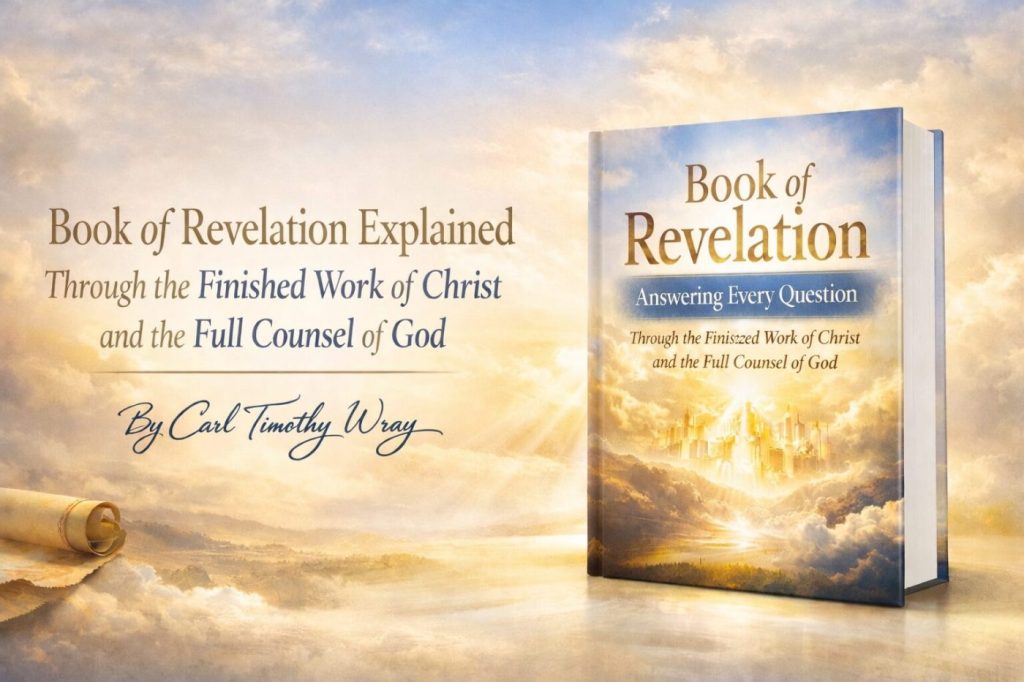
Book of Revelation Explained Through the Finished Work of Christ and the Full Counsel of God
Book of Revelation: AUTHOR
By Carl Timothy Wray
Carl Timothy Wray writes from a lifelong commitment to understanding Scripture as one unified revelation rather than a collection of fragmented doctrines divided by time, covenant, or tradition. His work focuses on explaining the Book of Revelation through the Finished Work of Christ and the Full Counsel of God, showing how what God eternally settled before time is progressively revealed, administered, and manifested within history until God becomes all in all.
Rather than approaching Revelation as a fear-driven prophecy or speculative timeline, Wray presents it as a clear, Christ-centered unveiling that brings coherence to Scripture and confidence to believers. His teaching emphasizes that Revelation is not about uncertainty or chaos, but about the revealed order of God’s completed purpose.
Book of Revelation: INTRODUCTION
The Book of Revelation is one of the most misunderstood books of the Bible. It is often treated as a forecast of future disasters, a coded timeline of end-time events, or a battleground of competing interpretations. As a result, many believers avoid reading it, while others approach it with fear or confusion.
Yet the Book of Revelation identifies itself plainly. It is the revelation of Jesus Christ.
Revelation was not given to conceal truth, but to unveil it. It was not written to produce fear, but to establish assurance. And it was not delivered to announce a new plan of God, but to reveal the outworking of a purpose that was already settled before the foundation of the world.
This book exists to answer the real questions people are asking about the Book of Revelation:
What is the Book of Revelation about?
Why was it written?
How should it be read?
When these questions are answered without a governing framework, Revelation becomes fragmented and intimidating. But when the Book of Revelation is read through the Finished Work of Christ and the Full Counsel of God, it becomes clear, consistent, and fully aligned with the rest of Scripture.
The Book of Revelation does not ask whether Christ will reign. It reveals that He already does. It does not describe a victory that is delayed. It unveils how a completed victory is administered within history until its fullness is manifested.
Revelation is not about the end of the world.
It is about the unveiling of a work already finished.
THE FINISHED WORK OF CHRIST — THE FULL COUNSEL FRAMEWORK
This book is written from the understanding that the Finished Work of Christ was eternally settled in God’s counsel before time, legally accomplished through Christ, and progressively revealed within time through the Plan of the Ages.
Time is not where God decides — time is where God unveils.
Rather than viewing Scripture as fragmented covenants or competing dispensations, this work approaches the Bible as one unified revelation, unfolded through divine order until God becomes all in all.
Within this framework:
Law revealed the standard and measure
Grace imparted life and maturation
Fullness manifests what was already complete
These are not eras in conflict, but dimensions of one divine mind.
The Levitical, Apostolic, and Man-Child ministries are therefore understood not as competing offices, but as ministries of revelation and maturation, each serving the unveiling of Christ’s completed work until His life is fully expressed in sons.
This book does not seek to add to what Christ finished, but to reveal what God settled, how it unfolds through Scripture, and how it is ultimately manifested in fullness — God all in all.
Chapter 1 — What Is the Book of Revelation?
The Book of Revelation has been described in many ways. It has been called a prophecy of future events, a warning to a persecuted church, a symbolic vision of good versus evil, or a cryptic map of the end times. While each of these descriptions touches part of the truth, none of them fully explains what the Book of Revelation actually is.
The book defines itself in its opening words:
“The revelation of Jesus Christ, which God gave unto Him…”
This statement establishes the purpose of the book immediately. The Book of Revelation is not first a book about judgments, beasts, or catastrophes. It is the unveiling of Jesus Christ.
The Greek word translated revelation means to uncover, to reveal, or to remove a veil. Revelation is not meant to obscure truth, but to bring what was hidden into clear view. It is not designed to confuse readers, but to orient them. And it is not intended to introduce fear, but to establish certainty.
Revelation Is an Unveiling, Not a Concealment
Many people approach the Book of Revelation assuming it is deliberately mysterious or intentionally coded to remain unclear. This assumption leads to endless speculation and disagreement. But Revelation does not present itself as a sealed book meant to remain hidden. It presents itself as an unveiling.
What is unveiled is not a new message, but a completed reality.
The Book of Revelation does not announce that Christ will one day become victorious. It reveals how a victory already accomplished is administered and manifested within history. The visions, symbols, and judgments are not predictions of uncertainty; they are disclosures of authority.
When Revelation is read without this foundation, it becomes fragmented. Symbols are interpreted in isolation. Judgments are read as threats. Time becomes the controlling factor. The result is confusion rather than clarity.
The Problem of In-Part Understanding
Most explanations of the Book of Revelation focus on descriptive details. They explain what John saw, where he was when he wrote, and how the early church may have understood his visions. These explanations are not incorrect, but they are incomplete.
Without a governing framework, Revelation is reduced to surface-level interpretation:
- Symbols are explained without purpose
- Judgments are described without context
- Time is debated without resolution
This produces a book that feels overwhelming rather than illuminating.
The Book of Revelation cannot be understood correctly without understanding where it belongs in the overall revelation of Scripture.
Revelation Within the Full Counsel of God
The Book of Revelation is not an isolated vision at the end of the Bible. It is the final unveiling of a unified purpose that began before time itself. When Revelation is placed inside the Full Counsel of God, its function becomes clear.
Revelation shows how a finished work governs history.
The Finished Work of Christ was eternally settled in God’s counsel before the world began. The cross did not initiate redemption; it revealed it. The resurrection did not create victory; it unveiled it. Revelation does not announce that Christ will reign; it reveals how He reigns as history unfolds.
Revelation does not introduce a new plan. It unveils the administration of what has always been true.
Revelation Is Not a New Phase of God’s Purpose
One of the most common misunderstandings about the Book of Revelation is the belief that it introduces a new stage in God’s plan. In reality, Revelation introduces nothing new. It reveals what was already settled.
The Lamb is not found worthy in Revelation because of future actions. He is found worthy because His work is complete. The sealed book is opened not to invent history, but to unveil how what was settled before time unfolds within time.
Revelation answers a foundational question that Scripture has been moving toward all along:
How does what God finished before time become visible within time?
The Nature of the Book of Revelation
When understood through the Finished Work of Christ and the Full Counsel of God, the Book of Revelation can be clearly identified as:
- Prophetic, because it unveils God’s purpose
- Symbolic, because it speaks in heavenly language
- Covenantal, because it completes what was promised
- Administrative, because it reveals how Christ governs
It is not a prediction of chaos, but a revelation of order.
It is not a warning of uncertainty, but a proclamation of sovereignty.
The Central Focus of Revelation
The Book of Revelation is not centered on Satan, the Antichrist, or the destruction of the world. It is centered on the Lamb.
Every vision, symbol, judgment, and promise exists to reveal one truth: Christ is fully victorious, fully reigning, and fully unveiling His completed work until God becomes all in all.
When Revelation is read through fear, it confuses.
When Revelation is read through timelines, it divides.
When Revelation is read through the Full Counsel of God, it clarifies.
Conclusion
The Book of Revelation is the unveiling of Jesus Christ as the Administrator of a finished work. It reveals how what God eternally settled is progressively unveiled, enforced, and manifested within history.
Revelation does not stand at the end of Scripture because it ends the story.
It stands at the end because it reveals the meaning of everything that came before it.
The Book of Revelation is not the end of the Bible because it ends God’s plan.
It is the unveiling of how that plan is brought to fullness.
Chapter 2 — Why Was the Book of Revelation Written?
The question of why the Book of Revelation was written is often answered too narrowly. Most explanations focus on external circumstances—persecution, Roman oppression, suffering believers, or the need for encouragement. While these factors are real, they are not the reason the Book of Revelation exists. They are the setting in which it was unveiled.
The Book of Revelation was not written because God reacted to a crisis.
It was written because God chose to reveal what was already settled.
The Common Explanation—and Its Limitation
The most common answers given for why Revelation was written are:
- To encourage persecuted Christians
- To warn believers against compromise
- To assure the church that evil would not prevail
These answers are not wrong, but they are incomplete. They explain why Revelation mattered to its first readers, but they do not explain why God gave this revelation at all.
If Revelation were only about encouragement, it could have been delivered without seals, trumpets, bowls, beasts, or visions. The depth, scope, and structure of the book point to a purpose far greater than situational comfort.
Revelation was written to unveil administration.
Revelation Was Written to Reveal How Christ Governs
The Book of Revelation was written to reveal how the Finished Work of Christ is administered within creation.
The cross settled redemption.
The resurrection confirmed victory.
The ascension established authority.
Revelation unveils how that authority operates within history.
God did not wait for persecution to decide how things would end. What appears as crisis in time was already governed by certainty in eternity. Revelation pulls back the veil so believers can see how Christ’s finished work confronts, exposes, and orders everything that resists alignment.
Revelation answers a question Scripture has been moving toward from the beginning:
How does what was finished in Christ before time become visible, active, and enforced within time?
Written to Reveal the Reigning Christ
Revelation was written to show the church that Christ is not waiting to reign. He is reigning.
The opening vision presents Christ walking among the lampstands, addressing churches directly. He corrects, warns, commends, and promises overcoming because He already holds authority. The church is not waiting for Christ to take control; it is being called to recognize that He already has.
Revelation was given so believers would not interpret suffering as absence, delay as defeat, or judgment as loss of control. The book reveals that everything unfolding is already under the authority of the Lamb.
Not Survival—Vision
The Book of Revelation was not written to teach the church how to survive the world. It was written to give the church vision.
Survival language produces fear.
Vision produces endurance.
When believers interpret events without revelation, they default to anxiety. Revelation lifts the veil so the church can see what is actually happening behind visible circumstances. Vision replaces speculation. Understanding replaces fear.
The church overcomes not by escaping pressure, but by seeing clearly.
Why Revelation Appears at the End of Scripture
Revelation stands at the end of the Bible not because God waited until the end to speak, but because fullness requires maturity.
Truth unfolds in divine order:
- Law prepared the ground
- Grace imparted life
- Revelation unveils fullness
Revelation could not be written until Christ had finished His work and ascended in authority. Only then could the administration of that work be unveiled. Revelation is not delayed speech; it is mature speech.
The Purpose Stated Clearly
The Book of Revelation was written to:
- Reveal Christ as the Administrator of a finished work
- Unveil God’s unified purpose across time
- Expose what resists alignment with that purpose
- Give the church certainty instead of speculation
Revelation does not ask believers to wait for victory.
It reveals how victory unfolds.
Conclusion
The Book of Revelation was written because God desired His people to see, not guess, how His eternal purpose moves through history. It was given so the church would understand that nothing happening in time threatens what was settled in eternity.
Revelation was written to remove fear by unveiling certainty, to replace speculation with sight, and to reveal Christ not as a future conqueror, but as the reigning Lamb who governs all things until God becomes all in all.
Chapter 3 — How Must the Book of Revelation Be Read?
Few biblical books generate as much disagreement as the Book of Revelation. Debates quickly arise over whether it should be read literally or symbolically, as past history or future prophecy, as a timeline of events or a spiritual message. Entire interpretive systems have been built around these questions, yet confusion remains.
The reason is not that Revelation is unclear.
The reason is that Revelation is often read without a governing framework.
When the framework is missing, interpretation becomes opinion. Symbols multiply, timelines fracture, and certainty disappears. Revelation does not become clearer with more theories. It becomes clear only when it is read from the Full Counsel of God.
The Common Approaches—and Their Limits
Most readers are taught to approach Revelation in one of three ways:
- Literalism, treating symbols as future physical events
- Historical limitation, confining meaning to first-century Rome or later empires
- Abstract symbolism, reducing Revelation to timeless moral lessons
Each approach identifies real elements within the book, but none of them can hold the entire revelation together. They explain how something might be read, but they do not explain how Revelation itself asks to be read.
Revelation does not invite the reader to choose a method.
It provides its own interpretive key.
Revelation Declares How It Must Be Read
The interpretive key of the Book of Revelation appears in its opening words:
“The revelation of Jesus Christ…”
This means Revelation must be read Christologically. Jesus is not one figure among many within the visions. He is the lens through which every vision is understood. Revelation is not about discovering events. It is about unveiling who Christ is and how His finished work governs all things.
To read Revelation without Christ at the center is to misread it entirely.
Read Revelation from Completion, Not Anticipation
The Book of Revelation must be read from completion, not toward it.
If Christ’s work is finished, then Revelation cannot be a book about God waiting to act. It must be a book revealing how what is finished is unveiled, enforced, and manifested. Judgments are not threats of possible outcomes. They are exposures of reality coming into alignment.
When Revelation is read as unfinished business, fear dominates.
When Revelation is read through the Finished Work, authority and rest emerge.
Read Revelation Through the Plan of the Ages
Revelation must be read progressively, not atomistically.
God reveals His purpose in stages, not contradictions. What appears mysterious in one age becomes clear in another. Law prepared. Grace imparted. Fullness manifests.
Revelation does not erase what came before it. It completes it. It gathers the Law, the Prophets, the Gospels, and the Epistles into one unveiling. Without the Plan of the Ages, Revelation appears chaotic. With it, Revelation becomes ordered.
Read Covenantly, Not Chronologically
One of the most common errors in reading Revelation is forcing it into a strict chronological sequence. Revelation is covenantal, not linear.
The visions overlap, repeat, and intensify because they are revealing spiritual realities, not recording a diary. Seals, trumpets, and bowls are not competing timelines. They are progressive unveilings of the same divine administration.
Revelation revisits the same truths from different vantage points until understanding matures.
Read Spiritually, Without Subjectivism
Revelation is spiritual, but it is not subjective. Symbols are not open to private imagination. Scripture interprets Scripture. Revelation draws heavily from the Law and the Prophets because God speaks one language across all ages.
The Spirit does not contradict Himself. He reveals.
Symbols must be interpreted within the unified testimony of Scripture and through the Finished Work of Christ. Detached symbolism produces fear. Interpreted symbolism produces clarity.
The Governing Rule
The Book of Revelation must be read:
- Through the Finished Work of Christ
- Within the Full Counsel of God
- According to the Plan of the Ages
- With Christ as the central unveiling
Any interpretation that diminishes Christ’s completion, fragments Scripture, or multiplies fear is misaligned with the purpose of the book.
Conclusion
The Book of Revelation is not difficult because it is unclear. It becomes difficult when it is read from the wrong position.
When read from fear, it terrifies.
When read from speculation, it divides.
When read through the Full Counsel of God, it clarifies.
Revelation is read correctly only when it is read from victory, not toward it.
The book does not ask, What will Christ do?
It unveils, What Christ has already done—and how it is revealed until God becomes all in all.
Chapter 4 — Is the Book of Revelation About the Past, the Future, or Now?
One of the most persistent questions surrounding the Book of Revelation is when its events take place. Is Revelation about the past, describing the fall of Rome? Is it about the future, predicting end-time catastrophes? Or is it about the present, offering timeless spiritual insight for believers in every generation?
Each of these views contains a measure of truth, yet none of them fully resolves the tension. The reason is not a lack of scholarship, but a misplaced question.
Revelation is not primarily about when things happen.
It is about what was settled and how it is unveiled.
The In-Part Debate
Most discussions about Revelation divide into three camps:
- Past-focused views, which interpret Revelation as first-century history
- Future-focused views, which treat Revelation as a roadmap to the end of the world
- Timeless views, which reduce Revelation to symbolic lessons for all ages
Each perspective identifies genuine elements within the text. Yet none of them can explain why Revelation speaks simultaneously of heaven and earth, eternity and time, symbolism and history.
The problem is not that Revelation spans time.
The problem is assuming time is its source.
Time Is the Stage, Not the Origin
The Full Counsel of God corrects the foundation of the question.
God does not decide in time.
God reveals in time.
The Finished Work of Christ was eternally settled before the foundation of the world. Time does not generate God’s plan; time displays it. Revelation does not ask the reader to locate events on a timeline. It unveils how eternal realities intersect with history.
Revelation is therefore trans-temporal. It speaks of past, present, and future because it is revealing something that exists beyond time.
Legal, Vital, and Manifested Dimensions
To understand Revelation’s relationship to time, three dimensions must be distinguished:
- Legal — what was settled in God’s counsel
- Vital — how that settlement is imparted in life
- Manifested — how it becomes visible and embodied
Revelation primarily operates in the manifested dimension. It reveals what legal victory looks like as it encounters resistance within creation. The book does not create victory. It unveils victory coming into expression.
Why Revelation Repeats Itself
Readers often notice that Revelation appears to repeat the same events from different angles. This is not confusion; it is divine pedagogy.
God reveals truth progressively until understanding matures. Revelation revisits the same realities—judgment, exposure, victory, restoration—from multiple vantage points. This allows truth to be seen fully rather than hurriedly.
Repetition is not redundancy.
It is illumination.
Past, Present, and Future in Harmony
Revelation addresses the first-century church because the unveiling had to appear somewhere in history. It speaks to future manifestations because what is settled must still be revealed. And it speaks to every generation because Christ reigns continuously.
Revelation is not bound to a single moment.
It reveals how eternity governs time at every moment.
The Error of Delay Thinking
When Revelation is read only as future, Christ appears delayed.
When it is read only as past, Christ appears irrelevant.
When it is read through the Full Counsel of God, Christ appears present and governing.
Revelation does not promise that Christ will rule.
It unveils how He does rule—now—until all things are aligned.
Conclusion
The Book of Revelation is not a schedule of events waiting to happen. It is the unveiling of how what God eternally settled becomes progressively visible within time.
Revelation speaks of the past because the work is finished.
It speaks of the present because the reign is active.
It speaks of the future because manifestation unfolds.
Time is not the author of Revelation.
Time is the canvas upon which Revelation is displayed.
Chapter 5 — Why Does the Book of Revelation Sound Like the Old Testament?
One of the first things careful readers notice about the Book of Revelation is how familiar it sounds. Its imagery echoes Moses, Isaiah, Ezekiel, Daniel, Zechariah, and the Psalms. Beasts rise like those in Daniel. Glory fills the temple as in Ezekiel. Thrones, fire, lamps, seals, trumpets, and bowls appear repeatedly, all drawing from earlier Scripture.
This raises a sincere question:
If Revelation is the final book of the New Testament, why does it sound so much like the Old Testament?
The answer is straightforward and foundational.
Revelation does not borrow from the Old Testament.
Revelation completes it.
The Common Explanation—and Why It Falls Short
Most explanations say Revelation:
- Uses Old Testament imagery for symbolism
- Draws from Jewish apocalyptic language
- Reinterprets prophetic visions for a new audience
These observations are accurate, but incomplete. They explain what Revelation references, not why it must reference it.
If Revelation were a new or disconnected message, it could have spoken in entirely new language. The fact that it speaks almost exclusively in the language of earlier Scripture tells us something essential about God.
One Mind, One Voice
God does not change languages between covenants because He does not change His mind.
The Law, the Prophets, the Gospels, the Epistles, and Revelation are not separate stories. They are one unfolding revelation. What was seen in shadow under the Law and promised under the Prophets is unveiled in fullness through Christ.
Revelation sounds like the Old Testament because it is revealing the same purpose—now illuminated by the Finished Work of Christ.
From Promise to Unveiling
The prophets spoke truly, but not fully. They saw in part. They described visions without final resolution. They spoke of kingdoms, judgment, restoration, and glory without seeing how these realities would be administered through a completed work.
John stands on the other side of the cross.
What Isaiah foresaw dimly, John sees unveiled.
What Daniel sealed, John watches opened.
What Ezekiel described in measure, John sees in fullness.
Revelation is not repeating prophecy.
It is unsealing it.
Revelation Interprets the Old Testament
The Book of Revelation functions as Scripture interpreting itself.
Rather than asking, How do we interpret Revelation using the Old Testament?
The better question is, How does Revelation interpret the Old Testament through Christ?
Symbols once associated with judgment are revealed as instruments of alignment. Kingship once promised is revealed as reigning authority. The temple once built with hands is revealed as a living, indwelling reality.
Revelation shows how every promise, pattern, and prophecy converges in the Lamb.
From Shadow to Substance
The Old Testament revealed patterns and types:
- Sacrifice without finality
- Kingship without permanence
- Glory without full habitation
Revelation reveals substance:
- A Lamb slain once
- A throne occupied eternally
- Glory filling all things
This is why Revelation feels familiar. It is the echo of promises finding their answer.
The Error of Separation
When Revelation is separated from the rest of Scripture, it appears extreme and confusing. When it is isolated as a unique genre detached from covenantal continuity, it becomes strange and frightening.
But when Revelation is read as the culmination of God’s unified counsel, it becomes the most clarifying book in the Bible.
It gathers Genesis, the Law, the Prophets, and the Gospel into one unveiling.
Conclusion
The Book of Revelation sounds like the Old Testament because God has always spoken one language. Revelation is not a new voice. It is the same voice, now unveiled.
What was promised is revealed.
What was shadowed is manifested.
What was sealed is opened.
Revelation does not replace the Old Testament.
It reveals what the Old Testament was always pointing toward.
Chapter 6 — What Do the Symbols, Beasts, and Numbers Really Mean?
Few aspects of the Book of Revelation generate more confusion than its symbols. Beasts rise from the sea. A dragon wars in heaven. Numbers appear repeatedly—seven seals, seven trumpets, seven bowls, twelve tribes, twelve gates, one thousand years, one hundred forty-four thousand. For many readers, these images feel mysterious, frightening, or impossible to interpret with confidence.
The question is not whether Revelation is symbolic.
The real question is why God chose symbols at all.
The In-Part Explanation
Most explanations say the symbols in Revelation:
- Represent political powers or historical empires
- Communicate spiritual truths metaphorically
- Conceal meaning from hostile authorities
- Allow multiple layers of interpretation
These explanations contain partial truth, but they leave a critical problem unresolved. If symbols are merely cryptic codes, Revelation becomes endlessly debatable. Every symbol can mean anything, certainty disappears, and fear replaces clarity.
God does not speak to confuse His people.
Symbols Are Administrative Language
Within the Full Counsel of God, symbols are not riddles. They are administrative language. They reveal how authority, life, and resistance operate within creation.
God has always spoken in symbols when revealing government. Ezekiel’s wheels, Daniel’s beasts, Zechariah’s lampstands, and Isaiah’s visions all use imagery because heavenly realities cannot be adequately communicated through simple narrative alone.
Revelation continues this pattern—but now through the Finished Work of Christ.
Symbols reveal how Christ governs, not merely what will happen.
Beasts Reveal Nature, Not Monsters
Beasts in Revelation do not introduce new creatures into history. They reveal the nature of authority operating apart from God’s life.
A beast represents rule without life, power without love, dominion without union. It describes systems—religious, political, economic, or spiritual—that operate independently of Christ’s nature.
The beast is defined not by appearance, but by character.
Revelation does not create these powers. It exposes them. Judgment does not summon beasts into existence; it unveils what already exists beneath the surface.
Numbers Reveal Order, Not Secrets
Numbers in the Book of Revelation are not mathematical puzzles or chronological clues. They are measures of order, completeness, witness, and administration.
- Seven reveals completeness and divine order
- Twelve reveals governmental fullness
- Ten reveals testimony and measure
- One thousand reveals fullness in administration
Numbers describe how something functions within God’s order, not when it appears on a calendar.
When numbers are treated as codes, confusion follows. When they are understood as measures of divine administration, clarity emerges.
Symbols Must Be Interpreted Through Christ
Symbols in Revelation cannot be interpreted independently of Christ’s finished work. Detached from Him, symbols terrify. Interpreted through Him, symbols clarify.
The Lamb interprets the beast.
The throne interprets judgment.
The city interprets the kingdom.
Every symbol exists to contrast what is alive in Christ with what is lifeless apart from Him.
Why Revelation Uses Intense Imagery
Revelation’s imagery is intense because exposure is intense.
Light does not negotiate with darkness.
Fire does not debate impurity.
Judgment in Revelation is not God losing patience. It is God revealing reality. What cannot remain in the presence of life is exposed and removed.
Judgment does not destroy truth.
It reveals truth.
The Error of Literalism and Over-Spiritualization
Two extremes distort Revelation’s symbols:
- Literalism, which turns symbols into fear-driven predictions
- Over-spiritualization, which empties symbols of authority
The Full Counsel of God holds the tension. Symbols are real, purposeful, and authoritative—but they speak of spiritual administration, not sensational catastrophe.
Conclusion
The symbols, beasts, and numbers in the Book of Revelation are not meant to confuse the Church. They are meant to educate the Church in heavenly government.
They reveal:
- What resists Christ
- How Christ governs
- Why judgment exposes
- How fullness unfolds
Revelation does not hide truth behind symbols.
It reveals truth through symbols—until what was finished in Christ is fully manifested and God becomes all in all.
Chapter 7 — What Is the Main Message of the Book of Revelation?
Many summaries of the Book of Revelation attempt to reduce its message to a single phrase—victory, hope, perseverance, or the triumph of good over evil. While each of these themes appears in the book, none of them fully captures its central message. They describe results without identifying the source.
The Book of Revelation is not a collection of inspirational themes.
It is a single unveiling.
The In-Part Answer
The most common explanations say the main message of Revelation is:
- God wins in the end
- Evil will be judged
- Believers must endure
- Christ will return
These statements are true, but incomplete. They frame Revelation as a story moving toward victory rather than a revelation flowing from victory.
Revelation does not announce how Christ will win.
It unveils that Christ has already won.
The Lamb at the Center of Everything
From the opening chapter to the final vision, Revelation consistently returns to one figure: the Lamb.
The Lamb is not waiting to be crowned.
He is already enthroned.
Authority in Revelation does not come through conquest, delay, or escalation. It flows from completion. The Lamb governs because His work is finished. Every seal opened, every judgment released, and every exposure revealed proceeds from the throne of the Lamb.
Judgment is not evidence of struggle.
It is evidence of rule.
Victory Unveiled, Not Achieved
The Book of Revelation does not present victory as something Christ is working toward. It presents victory as something being unveiled.
What was settled in God’s counsel before time is progressively revealed within time until it is fully manifested. Revelation shows how finished reality confronts unfinished alignment.
The saints overcome not by force, but by sight.
They reign not by dominance, but by union.
They endure not by fear, but by revelation.
Why Revelation Contains Conflict
Conflict appears in Revelation not because victory is uncertain, but because light exposes what cannot remain hidden.
Darkness resists illumination, but resistance does not negate authority. Judgment reveals this collision. It does not create it.
Revelation shows what happens when finished life encounters systems, structures, and mindsets built apart from that life.
The Message to the Church
The primary message of Revelation to the Church is not hold on until rescue arrives. It is see clearly who reigns now.
Believers are not instructed to speculate about future outcomes. They are called to align with present reality—the reign of Christ.
Revelation does not build anticipation.
It builds assurance.
The Goal Revealed
Every vision in Revelation moves toward one unveiled outcome:
God becoming all in all.
The exposure of deception, the fall of Babylon, the descent of the city, and the union of heaven and earth all reveal the same truth—nothing remains outside the life of God.
Revelation is not about escape from creation.
It is about creation filled with God.
Conclusion
The main message of the Book of Revelation is not fear, survival, or speculation. It is the unveiling of Jesus Christ as the reigning Lamb whose finished work governs all things.
Revelation does not tell believers to wait for victory.
It reveals how victory unfolds.
The book ends where God’s purpose has always aimed—not in destruction, but in fullness.
Chapter 8 — Why Are There So Many Interpretations of the Book of Revelation?
Few books of the Bible have produced as many interpretations as the Book of Revelation. Over the centuries, countless systems, charts, timelines, and theories have emerged—often contradicting one another while claiming biblical support. This has led many to conclude that Revelation is simply too complex to be understood with certainty.
But complexity is not the cause of confusion.
Fragmentation is.
The In-Part Explanation
The most common explanation for the wide range of interpretations is that Revelation is:
- Highly symbolic
- Apocalyptic in genre
- Written across cultures and centuries
- Open to multiple perspectives
These observations are accurate, but they do not explain why no other book of Scripture produces the same level of doctrinal division. Symbols alone do not create confusion. Symbols without a governing center do.
Interpretation Without Completion
Most interpretations of Revelation begin in time rather than in eternity. They attempt to build meaning from historical events, political movements, or future speculation instead of starting from the Finished Work of Christ.
When interpretation begins with:
- Fear, outcomes become catastrophic
- Timelines, conclusions remain unstable
- Systems, divisions multiply
Revelation becomes confusing not because God spoke unclearly, but because it is read without reference to what was already settled.
The Missing Full Counsel of God
The primary reason for endless interpretations is the absence of the Full Counsel of God.
When Scripture is divided into isolated dispensations or competing covenants, Revelation has no anchor. It floats at the end of the Bible as an unresolved mystery rather than standing as the unveiling of everything that came before it.
Without the Full Counsel:
- Symbols lose consistent meaning
- Judgment appears arbitrary
- Christ’s authority appears delayed
Fragmented Scripture produces fragmented interpretation.
Partial Revelation and Maturity
The apostle Paul stated plainly, “We know in part.” Partial revelation is not error—it is incomplete sight. Revelation does not introduce new mystery; it completes partial vision.
Interpretations multiply where maturity is lacking. As long as Revelation is approached without its completion in Christ, explanations will continue to diverge.
Revelation does not mature by adding theories.
It matures by increasing vision.
One Revelation, Many Perspectives
The problem is not that readers see different aspects of Revelation. The problem is that those aspects are not gathered into one unified revelation.
Revelation is not a puzzle with multiple solutions.
It is a revelation with one purpose, unveiled progressively until understanding matures.
Different perspectives do not require different conclusions when Christ’s finished work is the foundation.
Why Revelation Appears to Divide
Revelation divides only where Christ’s completion is not central.
When Christ is viewed as waiting, Revelation produces anxiety.
When Christ is viewed as reigning, Revelation produces rest.
Division does not arise from the book.
It arises from the reader’s starting point.
Conclusion
There are many interpretations of the Book of Revelation because many readers approach it without the Full Counsel of God. Interpretation begins in time instead of eternity, speculation replaces certainty, and fear replaces vision.
Revelation becomes clear when it is read from what God has already finished, not toward what He might do.
When Christ’s completion becomes the foundation, interpretations do not multiply.
They converge.
Chapter 9 — What Is the Warning in the Book of Revelation?
The Book of Revelation is often described as a warning—sometimes even as a threat. Images of judgment, fire, wrath, and destruction have led many to read Revelation as God’s final ultimatum to the world. This framing has caused fear-driven interpretations that portray God as unpredictable or poised to retaliate.
But Revelation’s warning is not what many assume.
Revelation does not warn that God might lose control.
It warns that what resists reality cannot remain hidden.
The Common Misunderstanding
Most explanations say the warning in Revelation is:
- Impending divine judgment
- The danger of unbelief
- The threat of end-time destruction
- The urgency to escape future catastrophe
These warnings contain partial truth, but they are often framed as future threats rather than present revelations. When warning is divorced from revelation, fear replaces understanding.
Revelation does not warn of uncertainty.
It warns of exposure.
Judgment as Revelation, Not Retaliation
Within the Full Counsel of God, judgment is not God reacting emotionally. It is God revealing reality.
Light judges darkness simply by shining.
Fire judges impurity simply by being fire.
Judgment in Revelation does not create punishment. It exposes what already exists. What cannot remain in the presence of life is unveiled and removed.
Revelation’s judgments are not signs of divine instability.
They are signs of divine authority.
The Warning Begins With the Church
Revelation’s warnings are addressed first to the Church, not the world. The letters to the churches make this clear.
Christ does not warn His people of abandonment. He warns them of misalignment. The call is not to fear judgment, but to see clearly, repent where necessary, and realign with reality.
Judgment begins with alignment, not destruction.
Revelation warns the Church against losing vision, clinging to dead systems, or compromising truth for comfort. These warnings are corrective, not condemning.
Babylon and Resistance to Fullness
Babylon represents systems built apart from God’s life—religious, political, economic, and spiritual. It is not merely a city or empire; it is a way of organizing life without union with Christ.
The warning against Babylon is not about revenge. It is about exposure.
Babylon falls because it cannot remain when truth is fully revealed. Revelation warns against identifying with systems that resist Christ’s life rather than aligning with what He is manifesting.
What falls is not creation.
What falls is the lie.
The Meaning of Wrath in Revelation
Wrath in Revelation is often misunderstood as uncontrolled anger. In reality, wrath is the settled opposition of divine life against death and deception.
Wrath does not fluctuate.
It reveals what life cannot fellowship with.
Revelation’s warnings exist to call alignment before exposure becomes unavoidable. They are not threats of abandonment, but invitations to return to truth.
A Warning Rooted in Love
Every warning in Revelation flows from God’s desire to reconcile, not exclude. Exposure is mercy when it leads to alignment. Judgment is restorative when it removes deception.
The warning is not, “God is about to destroy you.”
The warning is, “Do not cling to what cannot endure.”
Revelation warns because reality is approaching fullness.
Conclusion
The Book of Revelation warns that reality cannot be avoided. What is finished will be revealed. What is false will be exposed. What is aligned with Christ will endure.
Revelation does not threaten the future.
It unveils the present.
The warning is not fear.
It is clarity.
And clarity invites repentance, alignment, and rest.
Chapter 10 — What Does the Book of Revelation Ultimately Reveal?
After all the visions, symbols, judgments, warnings, and unveilings, one final question remains: What does the Book of Revelation ultimately reveal? When debates are set aside and interpretations are weighed, what is the destination toward which Revelation moves?
The answer is not destruction.
The answer is fullness.
The In-Part Conclusion
Many summaries conclude that Revelation ultimately reveals:
- The end of the world
- The defeat of Satan
- The final judgment
- The second coming of Christ
Each of these appears in the book, but none of them is the final unveiling. They are milestones along the way, not the destination itself.
Revelation does not climax with catastrophe.
It culminates in union.
The Unveiling of a Finished Purpose
From beginning to end, the Book of Revelation reveals what God eternally purposed and what Christ completely finished. The Lamb does not arrive at victory; He unveils it. The throne is not contested; it is occupied. The kingdom is not postponed; it is administered.
Revelation pulls back the veil on a reality that has always existed:
God’s life filling all things.
The Removal of What Obstructs Life
Judgment, exposure, and the fall of Babylon are not ends in themselves. They are the removal of what resists union.
Revelation reveals that nothing built on deception, fear, or death can remain once fullness arrives. What falls is not creation. What falls is the lie.
Everything that obscures God’s life is exposed and removed—not to leave emptiness, but to make room for fullness.
The Descent of the City
The New Jerusalem does not rise from the earth. It descends from God. This is not geography; it is theology.
Heaven and earth are not distant realms waiting to reconnect. They are realities brought into union. The city represents life ordered by God, filled with His presence, and illuminated by the Lamb.
There is no temple because God Himself fills all things.
God Becoming All in All
The ultimate revelation of the Book of Revelation is not an event, a timeline, or a spectacle. It is a statement:
That God may be all in all.
This has always been the goal. Creation was never meant to orbit God from a distance. It was designed to be filled with Him.
Revelation unveils the completion of that purpose.
No More Delay
Revelation declares, “There shall be no more delay.” This does not mean time ceases. It means separation ceases.
What was partial gives way to fullness.
What was promised becomes manifest.
What was hidden is revealed.
The story does not end with escape.
It ends with indwelling.
The True Ending
The Book of Revelation ends where all Scripture has been heading:
- God dwelling with humanity
- Life swallowing death
- Light leaving no shadow
- Love filling all things
This is not a new outcome.
It is the unveiled outcome.
Conclusion
The Book of Revelation ultimately reveals Jesus Christ as the One in whom all things were settled, through whom all things are administered, and into whom all things are gathered.
Revelation is not the end of the world.
It is the unveiling of the world as God intended it to be.
What was hidden is revealed.
What was finished is manifested.
And God becomes all in all.

Book of Revelation Series:
- Book of Revelation: Explained Through the Full Counsel of God
- The Book of Revelation — What It Is, Why It Was Written, and How It Must Be Read
- The Book of Revelation — The Judgment of the Spirit of Jezebel and the Rise of Zion’s Sons
- The Book of Revelation — In Him All Things Consist: The Universe Inside the Lamb
- Join Our Facebook Page: