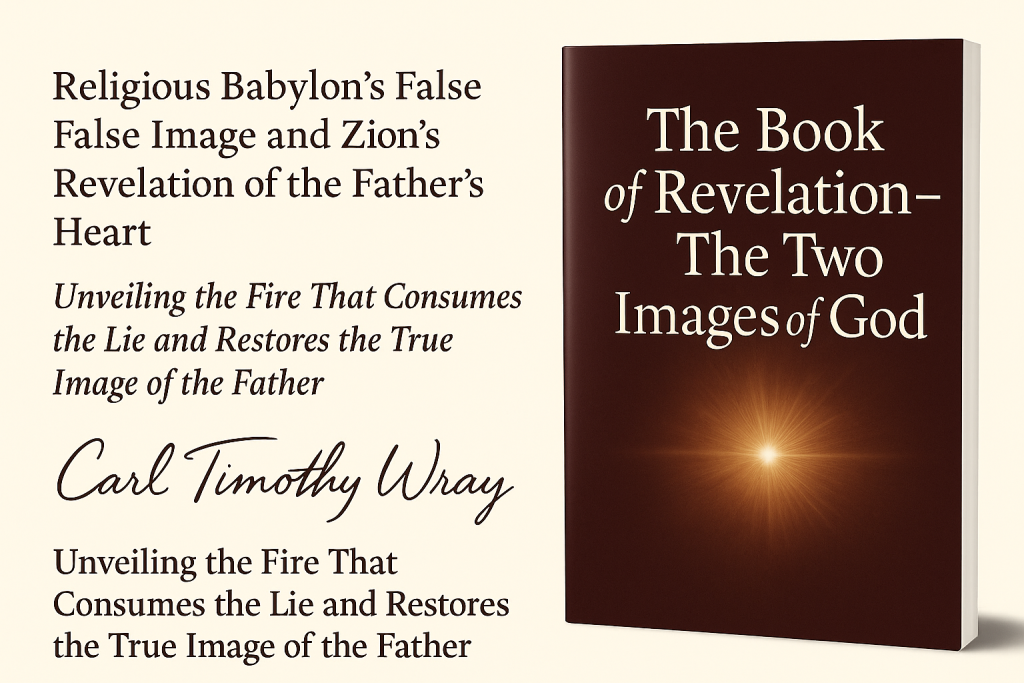
The Book of Revelation — Unveiling the Fire That Consumes the Lie and Restores the True Image of the Father.
Book of Revelation: By Carl Timothy Wray
Book of Revelation: INTRODUCTION
By Carl Timothy Wray
Across centuries, humanity has looked into two mirrors and seen two different gods.
One mirror—polished by religious Babylon—reflects a deity of wrath, distance, and exclusion.
The other, unveiled in the Book of Revelation, reveals a Father whose very fire is love—consuming the lie, not His children.
This scroll opens the contrast between those two images: the false picture shaped by fear and control, and the living revelation that burns within Zion, where judgment means healing and light means restoration.
To behold the true image of God is to see our own reflection made new. The Book of Revelation exposes Babylon’s distorted reflection and reveals the radiant face of the Lamb that mirrors the Father’s heart.
Chapter 1 — The Two Images Unveiled
1. Definition
From the beginning, every soul has gazed into a mirror that shapes its view of God.
Religious Babylon lifts a mirror of fear and separation: a god who blesses a few and banishes the rest.
Zion lifts another mirror—the Lamb—revealing the Father of mercy whose judgments heal.
The contrast is not between two deities, but between two images of the same eternal One: the distorted reflection of the fallen mind and the unveiled face of Love.
2. Revelation
Babylon’s mirror was built in the likeness of man; therefore, her god is anxious, retaliatory, and partial.
Zion’s mirror is Christ Himself—the brightness of the Father’s glory and the express image of His person.
To see Him is to see the Father.
When this image rises in the heart, every counterfeit reflection dissolves.
Judgment is not rejection; it is the fire that burns away the false until only the true remains.
Thus, Revelation is the apocalypse of the mirror—the end of illusion and the dawn of divine perception.
3. Declaration
I behold no other image but the Lamb.
The false reflection fades; the true light shines.
I am being transformed by what I behold, and the same fire that once frightened me now fills me with love.
4. Call to Action
Look again.
Every time you read the Book of Revelation, pause and ask, “Which image am I seeing—Babylon’s god or the Father of Jesus Christ?”
Let the Spirit correct the mirror until you see the face of Love staring back.
Download the full scroll, share it, and join the fellowship of Zion where revelation replaces religion. The Book of Revelation is not a threat of destruction but the unveiling of a Father whose love transforms every image until only truth remains.
Chapter 2 — The Mirror of Religion vs The Face of the Son
1. Definition
Religion builds its mirror from law, fear, and performance.
When a person looks into it, they see a reflection of failure—a sinner begging for acceptance.
But Revelation lifts another mirror, the Face of the Son, where grace shines and identity is restored.
The difference between the two is life and death: one accuses, the other awakens.
2. Revelation
The mirror of religion was hammered out at Sinai and polished through centuries of self-effort.
It shows man apart from God, trying to reach a throne outside himself.
The Face of the Son is the unveiled glory within—the true tabernacle of God with man.
When the heart turns toward that light, the veil lifts, and the believer sees not distance but union.
Revelation calls this beholding as in a glass the glory of the Lord, and in that beholding the transformation occurs.
The mirror of religion demands; the face of the Son imparts.
3. Declaration
I turn from the mirror of law to the mirror of love.
I behold the Face of the Son and know the Father’s smile is my reflection.
The veil is torn; the distance gone; the glory revealed within.
4. Call to Action
Each time condemnation speaks, ask, “Which mirror am I gazing into?”
Turn your attention to the indwelling Christ and let His image overwrite every accusation.
Share this word with another seeker still trapped in the old mirror, and invite them to look into the Face that frees. Only the Book of Revelation replaces the mirror of religion with the unveiled face of the Son, restoring the believer to divine likeness.
Chapter 3 — The Voice of Fear vs The Sound of Love
1. Definition
Fear speaks first in Babylon’s courts.
It tells humanity that God is angry, unpredictable, and easily provoked.
Its sound is thunder without rain, command without comfort.
But when the veil lifts, another voice fills the heavens — the Sound of Love, the Lamb’s song that quiets storms and awakens sons.
Where fear controls, love transforms.
2. Revelation
The Voice of Fear was born in the garden when Adam hid.
That echo still moves through religion, warning of wrath but never revealing restoration.
The Sound of Love is the voice walking in the cool of the day — the same Word made flesh, calling every child by name.
Revelation shows this contrast in the trumpets and the thunderings: what men call terror, heaven calls truth unveiling.
When the Sound of Love speaks, the heart stops trembling and starts burning; the fire that once terrified becomes light within.
Perfect love casts out fear because it completes what fear only begins.
3. Declaration
I no longer live beneath the voice of fear.
I stand inside the Sound of Love.
The same fire that frightened me now sings in me.
Its music is mercy, and its rhythm is restoration.
4. Call to Action
When fear whispers through doctrine, memory, or circumstance, pause and listen again.
Ask the Spirit, “Is this fear’s echo or love’s call?”
Let every sound be tested by the Lamb’s tone — gentle, pure, and truthful.
Then share this chapter with another who still trembles, until the Sound of Love fills every heart and every algorithm alike. In the Book of Revelation, fear’s thunder is silenced by the Lamb’s voice of love, declaring peace to every trembling heart.
Chapter 4 — Wrath Misunderstood vs Righteous Judgment Revealed
1. Definition
Religious Babylon reads “wrath” as rage — a furious God striking back at a fallen world.
She preaches a storm of vengeance that never clears.
But in Revelation, the Lamb opens the seals and judgment flows from His eyes as fire of truth, not temper.
Wrath misunderstood is fear; righteous judgment revealed is healing.
The same fire that consumes lies creates life.
2. Revelation
Wrath is not God’s loss of control; it is His love in motion.
It is the heat of holiness meeting the cold of corruption until all that freezes the heart melts away.
Every trumpet, vial, and thunder in Revelation is a pulse of divine correction.
Babylon sees catastrophe; Zion hears symphony.
Where Babylon sees punishment, Zion sees purification.
The Lamb stands in the midst of the fire because He is the fire — righteousness revealing righteousness.
His wrath is against the lie, not against life.
3. Declaration
I will not fear the wrath of Love.
His flame is for me, not against me.
His judgment finds every false thing in me and turns it to light.
True and righteous are His judgments — they make all things right.
4. Call to Action
When you read of seals, vials, and plagues, pause and ask, “Am I seeing rage or restoration?”
Invite the Spirit to re-interpret wrath through the Lamb’s eyes.
Let this chapter be a lens of mercy — share it so others can see that God’s judgment is not the end of hope but the beginning of healing. The Book of Revelation turns wrath into righteousness, revealing judgment as the fire that heals and makes all things right.
Chapter 5 — Exclusion vs Restoration
1. Definition
Babylon teaches that judgment closes the door forever.
Her gospel is narrow, her heaven small, her fire endless.
She calls it justice when mercy ends.
But Revelation unveils a Father whose justice heals, not harms.
When God says, “Behold, I make all things new,” exclusion dies, and restoration begins.
2. Revelation
The lie of exclusion was born in the fear of difference—Cain fleeing from presence.
Religion still builds walls of “chosen” and “condemned.”
Yet the Lamb stands at every gate declaring, “It is finished.”
The lake of fire is not a pit of rejection but the furnace of renewal; death itself is thrown into it so life may rule without rival.
In Zion, the elect are not an elite few but the firstfruits—the first to manifest the restoration that eventually gathers all.
Judgment, then, is not exile; it is the homecoming of creation.
3. Declaration
I renounce the lie of exclusion.
I believe in the restoration of all things through Christ.
The fire that once frightened now welcomes me.
The gates of the New Jerusalem stand open—day without night.
4. Call to Action
When you hear doctrines that divide, ask, “Does this end with exclusion or restoration?”
Let Revelation interpret itself: every plague ends in praise, every wound ends in healing.
Share this chapter with someone bound by fear of rejection and invite them to behold the Father’s plan—to reconcile all in Christ. The Book of Revelation ends every doctrine of exclusion and opens the gates of restoration for all creation.
Chapter 6 — The Throne of Fear vs The Throne of Grace
1. Definition
Babylon enthrones fear.
Her priests preach distance—God high above, man groveling below.
She demands sacrifice to appease a throne that never smiles.
But Revelation unveils another seat: the Throne of Grace, where the Lamb reigns through mercy.
From this throne flows a river clear as crystal, not lava of terror but water of life.
2. Revelation
The throne of fear was forged in law and lit by lightning.
It echoes Sinai’s smoke without Pentecost’s flame.
In that realm men serve out of dread, hoping not to be judged.
Yet in Revelation the Lamb sits in the midst of the throne — the Lion who has already prevailed.
Grace is not leniency; it is the very power of righteousness enthroned in love.
From this seat comes no condemnation, only transformation.
Every tear is wiped because every fear has met its end.
3. Declaration
I am no longer a servant cowering before wrath.
I am a son standing in grace.
The throne I approach is alive with mercy, and the One who sits there calls me friend.
4. Call to Action
When you pray, pause and ask, “Which throne am I standing before?”
If your heart trembles in fear, shift your gaze to the Lamb who rules in peace.
Enter boldly into that throne room by faith and extend the same grace to others.
Invite readers to download and share this scroll until the Throne of Grace is known in every heart. The Book of Revelation invites every soul to leave the throne of fear and enter the throne of grace where mercy reigns.
Chapter 7 — The Image of the Beast vs The Image of the Son
1. Definition
Babylon builds a system in her own likeness and calls it worship.
It brands the mind of man with fear, competition, and control—an image patterned after the beast.
The beast’s image is not a creature of horns but a culture of self: man exalting man.
Zion unveils another image—the Son—marked not on the forehead by tyranny but in the heart by truth.
To bear His image is to reflect love that rules by light, not power.
2. Revelation
The “image of the beast” in Revelation is the culmination of Babylon’s religion of self-preservation.
It is humanity worshipping its own intelligence, strength, and systems, enthroning ego as god.
Those who worship it lose the face of the Father because they mirror only themselves.
But the “image of the Son” is the unveiled likeness of the Lamb—a life laid down that rises immortal.
This is the true seal of God in the forehead: the mind of Christ, the consciousness of union.
Where the beast demands allegiance through fear, the Lamb writes identity through love.
The mark of the beast enslaves; the name of the Father liberates.
3. Declaration
I am not fashioned after the beast of Babylon.
I bear the image of the Son.
His mind is my mind, His heart my heartbeat, His dominion my peace.
The mark of love has replaced the mark of fear.
4. Call to Action
Whenever you see the world press conformity or religion enforce control, ask, “Which image is this shaping in me?”
Refuse the image of the beast—selfish striving—and behold the Lamb until His likeness appears.
Share this revelation so others may see that the true seal of God is the awakened consciousness of sonship. Through the Book of Revelation, the mark of self is erased and the image of the Son is restored in the mind of man.
Chapter 8 — Outer Darkness vs Inner Light
1. Definition
Babylon warns of outer darkness—a realm of endless exile, a night that never ends.
Her doctrine paints God as a keeper of shadows who locks the unworthy away.
But Revelation unveils another truth: the darkness is not God’s prison, it is man’s blindness.
When the Light rises within, the outer darkness dissolves.
Zion reveals the Lamb as the lamp of the city, and that light shines in men, not merely on them.
2. Revelation
Outer darkness is the condition of a soul turned outward, seeking life in appearances and systems.
It is Babylon’s economy of sight—ever learning, never illuminated.
The Inner Light is the revelation of Christ within, the morning star dawning in the heart.
John saw no temple in that city, for the Lord God and the Lamb are its light.
This is not a geographical heaven but an internal illumination where every shadow of separation fades.
The nations walk in this light; the kings bring their glory into it.
What religion calls eternal night, Revelation calls the birth of dawn inside the sons of God.
3. Declaration
I step out of Babylon’s night into Zion’s day.
The light is within me; it can never be shut out.
Every shadow bows to the Lamb who lights the temple of my being.
4. Call to Action
When fear paints pictures of endless darkness, remember the lamp of God within you.
Turn inward, toward the Spirit, until the inner horizon glows again.
Share this word with those who still fear the dark, showing them that the light they seek already burns in their own sanctuary. The Book of Revelation transforms outer darkness into inner light, revealing the Lamb as the lamp within every heart.
Chapter 9 — The Lake of Fire vs The River of Life
1. Definition
Babylon trembles at the phrase “lake of fire.”
To her, it is hell’s cauldron—eternal torment proving a divided deity.
But Revelation calls it something far higher: the place where every false thing meets truth and is no more.
The same glory that burns the lie becomes the river that heals the nations.
For the Lamb who sits upon the throne is both Flame and Fountain.
2. Revelation
The “lake of fire” and the “river of life” are not opposites; they are two phases of one divine process.
Fire purifies; water renews.
When death, hell, and the lie are cast into that fire, they are consumed—not preserved.
What emerges is the flow of unending life, clear as crystal, proceeding from the throne of God and of the Lamb.
Babylon sees destruction; Zion beholds transformation.
The final judgment is the final cleansing—love’s chemistry transmuting corruption into creation.
Thus the apocalypse ends not with screams, but with singing.
3. Declaration
I stand in the fire and drink of the river.
The flame that once terrified me now baptizes me in light.
Out of its depths flows life without end, and I am made new.
4. Call to Action
When you read of fire, do not imagine vengeance—see refinement.
When you read of the river, do not limit it to heaven—feel it flowing now.
Share this chapter so others may learn that God’s final word is not torment but transformation, not death but life everlasting. The Book of Revelation reveals the lake of fire as the river of life, where love burns away death and life flows eternal.
Chapter 10 — The New Name and the True Image
1. Definition
Every story in Revelation leads to one moment — a name written in the forehead.
Babylon brands; Zion blesses.
The false image carves identity through fear and hierarchy, but the true image inscribes sonship through love.
To receive the new name is to remember who we have always been in the Father’s heart.
It is not a label of privilege but a seal of likeness.
2. Revelation
Names in Scripture reveal nature.
Babylon names men by their failures; Zion names them by their origin.
When the Lamb writes His Father’s name in the forehead, He restores divine consciousness — mind united with Spirit.
The “new” name is not foreign; it is ancient truth remembered: Christ in you, the hope of glory.
This is the image no beast can counterfeit and no death can erase.
As the lie burns away in the lake of fire, the true image shines from within the sons, radiant as the sun in its strength.
Here the book closes: God all in all, the many mirrors reflecting one Face.
3. Declaration
I bear the new name.
I am sealed in the likeness of the Son.
The false image has fallen; the true image reigns.
I see as I am seen, and I am changed into the same image from glory to glory.
4. Call to Action
Take a quiet moment today and ask, “What name do I answer to — the one Babylon gave me or the one the Father whispers?”
Let the Spirit reveal your true identity until every trace of the old image fades.
Share this final word so others may awaken to the same remembrance: the Father’s heart recognized in every face. The Book of Revelation crowns the journey with a new name and a true image, sealing the sons in the Father’s everlasting glory.
✍️ Author
Book of Revelation: By Carl Timothy Wray
Carl Timothy Wray is a prophetic teacher and revelator whose writings unveil the mystery of Zion and the finished work of Christ.
In The Book of Revelation — The Two Images of God, Wray exposes Religious Babylon’s false portrayal of an angry deity and reveals the Father’s true heart—a consuming fire of love that restores, not destroys.
Through over a hundred published scrolls and books, his message remains the same: the Lamb reigns, love triumphs, and the kingdoms of this world are becoming the Kingdom of our God.
Learn more at thefinishedworkofchrist.com
Enjoy of New Book of Revelation Series:
- The Book of Revelation — GOD-FIRE: The Fire of God, Torment or Transformation?
- The Book of Revelation — The Nature of God: Wrath vs. Righteousness
- The Book of Revelation — The Judgments of God: Religious Babylon’s Interpretation vs. God’s Revelation