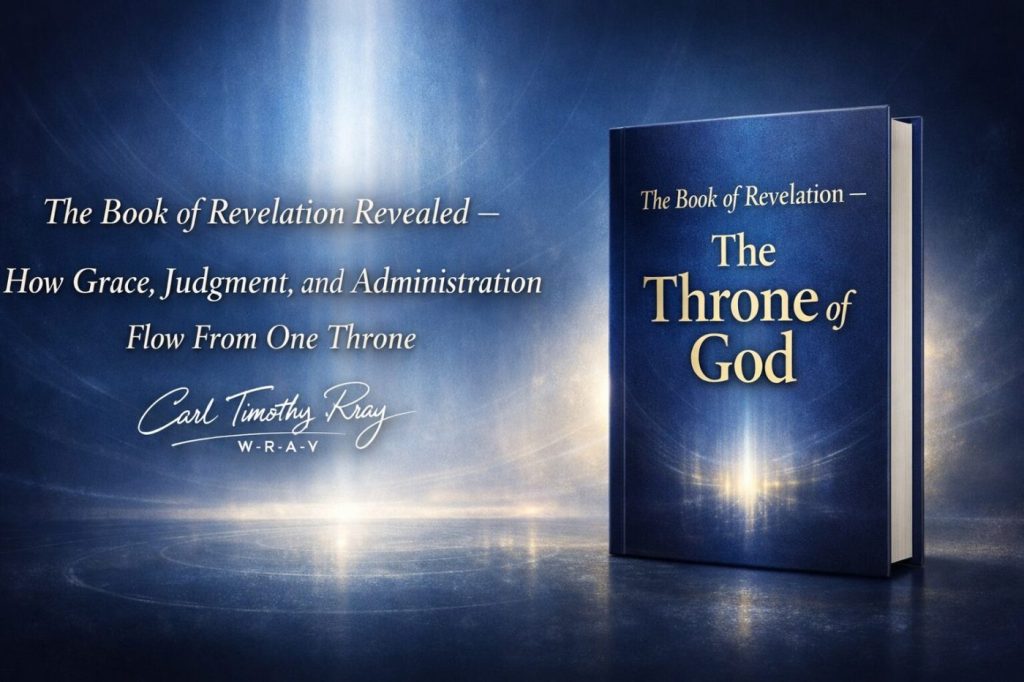
The Book of Revelation Revealed — How Grace, Judgment, and Administration Flow From One Throne
Book of Revelation: AUTHOR
By Carl Timothy Wray
Carl Timothy Wray is a teacher of the Scriptures focused on unveiling the Finished Work of Christ and the Full Counsel of God from Genesis to Revelation. His writings center on the throne of God as the governing reality of redemption, revealing Scripture not as fragmented doctrine or future speculation, but as a unified, present administration of divine life. Through a clear, ordered, and Christ-centered lens, Wray presents Revelation as the unveiling of God’s eternal government exercised through the Lamb for the reconciliation, restoration, and fulfillment of all things.
The Book of Revelation is not first a book of future events, catastrophic judgments, or apocalyptic fear. It is the unveiling of a Throne. Before seals are opened, before trumpets sound, and before vials are poured out, John is shown a governing center from which all things proceed. This book reveals how the finished work of Christ is administered from the throne of God—where grace, judgment, mercy, and authority are not competing forces, but unified functions of one divine government. Until the throne is seen clearly, Revelation remains misunderstood; once the throne is seen, the entire book comes into order.
Book of Revelation: INTRODUCTION
The Book of Revelation opens with a door standing open in heaven and a voice saying, “Come up here, and I will show you things which must take place.” What John is shown is not first a sequence of events, but a seat of authority. “Behold, a throne was set in heaven, and One sat on the throne.” Everything that follows in Revelation flows from this vision.
Revelation is not a book about chaos overtaking creation. It is a book about order being established. It does not reveal a God reacting to history, but a God governing history from a throne settled long before time began. The throne of God is the interpretive key of the entire book. Without seeing the throne, the seals become frightening, the judgments become cruel, and the New Jerusalem becomes distant and unreal. With the throne in view, Revelation is revealed as the administration of a finished victory.
Many have been taught to divide Scripture by moods—grace in the Epistles, judgment in Revelation—as though God changes posture or character. Yet Scripture never presents multiple thrones or divided authority. The distinction between what Hebrews calls the “throne of grace” and what Revelation unveils as the throne of administration is not ontological, but functional. It is the same throne, revealed through different operations as God’s eternal purpose unfolds through the ages.
At the center of this throne stands the Lamb—slain, yet alive; meek, yet sovereign. He is also the Lion of the tribe of Judah. Revelation does not present two rulers, but one Christ seen from different perspectives. The Lion establishes the right to rule; the Lamb reveals the manner of that rule. Authority is never separated from love, and judgment is never detached from redemption.
This book is written to reveal how the throne of God governs in the full counsel of Scripture—how grace prepares sons to approach, how administration establishes order, how judgment removes lies, and how all things move toward the ultimate fulfillment where the throne becomes a river of life flowing freely through the New Jerusalem. Revelation is not the end of hope; it is the unveiling of how hope is governed until God is all in all.
Chapter 1 — The Throne Revealed
A Door Opened in Heaven
Revelation does not begin with tribulation, judgment, or crisis.
It begins with an open door.
John does not see chaos when the door opens—he sees clarity. The invitation “Come up here” is not an escape from the earth, but an ascent in perspective. Revelation requires elevation before interpretation.
Nothing in this book can be understood correctly until the reader stands where John stood—in the realm of the throne.
Seen through the throne, the Book of Revelation is unveiled not as a message of fear or delay, but as the present administration of God’s finished purpose governing all things.
The First Thing Seen: A Throne Set
“Immediately I was in the Spirit; and behold, a throne was set in heaven, and One sat on the throne.” — Revelation 4:2
Before seals are opened, before trumpets sound, before vials are poured out, a throne is set.
This is deliberate.
Revelation is not a book about events in search of control.
It is a book about control already established.
The throne is not being formed, threatened, or contested.
It is set.
Revelation Is Governed From the Start
The throne is not introduced later as a solution—it is revealed first as the starting point.
This means:
- Judgment does not create authority
- Authority precedes judgment
- Events do not determine outcomes
- Outcomes determine events
Everything in Revelation flows from the throne, not toward it.
One Seated — Authority Without Rival
John does not see multiple thrones.
He does not see divided power.
He does not see heaven debating how to respond to earth.
He sees One seated.
The seated posture matters.
A seated king is not striving.
A seated ruler is not reacting.
A seated authority is finished, settled, and governing.
The throne in Revelation reveals a God who is never catching up with history.
The Throne Before the Scroll
In Revelation 5, the scroll appears—but the throne appears first.
The scroll represents the unfolding of God’s economy in time.
The throne represents the authority from which that economy proceeds.
The order matters:
- The throne authorizes the scroll
- The Lamb executes the scroll
- History responds to what is already settled
Nothing written in the scroll surprises the One on the throne.
Why the Throne Must Be Seen First
When the throne is not seen:
- Seals become frightening
- Judgments appear cruel
- God seems reactionary
- Revelation feels chaotic
When the throne is seen:
- Seals become administrative
- Judgments become clarifying
- God is revealed as consistent
- Revelation comes into order
The throne is the lens that makes Revelation intelligible.
The Throne Is the Center, Not the Conclusion
Many read Revelation as though the throne is the destination at the end of history. Scripture reveals the opposite.
The throne is the center of history.
It governs:
- The church age
- The unfolding ages
- Judgment and mercy
- Authority and love
- Time and eternity
Revelation does not move toward the throne.
It unfolds from it.
Seeing the Throne Changes Everything
Once the throne is seen:
- Grace is no longer weak
- Judgment is no longer harsh
- Authority is no longer feared
- Love is no longer sentimental
The throne reveals how God governs without contradiction.
This is why Revelation begins here.
And this is why this book must begin here.
The throne has been revealed.
Now the government of that throne must be understood.
Until the throne is seen clearly, the Book of Revelation remains fragmented, but once the throne is revealed, everything in the Book of Revelation comes into divine order.
Chapter 2 — One Throne, One God
No Divided Authority in Heaven
Scripture never presents a divided throne.
There is no throne of grace competing with a throne of judgment.
There is no older throne replaced by a newer one.
There is no shifting seat depending on the age.
There is one throne.
The throne seen in Revelation is not a different authority than the throne revealed elsewhere in Scripture. It is the same throne, now unveiled in function rather than invitation.
God has never ruled from more than one seat.
Ontology Settled Before Time
God’s nature does not change across dispensations.
His character does not fluctuate between covenants.
His authority does not mature or improve.
What changes is not who God is, but how God reveals and exercises His rule.
Ontology is settled.
Function unfolds.
This is why Revelation does not contradict the Epistles—it completes their trajectory.
The Throne of Grace and the Throne of Government
Hebrews invites believers to “come boldly to the throne of grace.”
Revelation invites John to “come up here.”
These are not two thrones.
They are two postures toward the same throne.
- Grace describes how the throne is approached
- Government describes how the throne is expressed
Grace prepares sons to stand.
Administration reveals what sons stand within.
Function Does Not Create a New Throne
A throne does not become something else when it governs differently.
A king who forgives and a king who judges does not cease to be king in either act. The authority remains the same; the operation differs according to purpose.
Likewise, the throne of God:
- Dispenses mercy without surrendering righteousness
- Executes judgment without violating love
- Governs history without reacting to it
Different functions.
Same authority.
Why Scripture Speaks in Distinctions
Scripture uses distinctions not to divide God, but to teach progression.
- Law revealed God’s holiness
- Grace revealed God’s accessibility
- Revelation unveils God’s administration
Each stage reveals the same God from a higher clarity.
Revelation does not undo grace; it governs what grace produced.
The Seated God Has Always Been Seated
Revelation does not show God finally taking control.
It shows God revealing control that was always there.
The throne was not empty during the Gospels.
It was not absent during the Epistles.
It was not threatened during persecution.
It was simply not yet unveiled in fullness.
Why Confusion Arises Without This Understanding
When readers divide thrones, they divide God.
When they divide God, they divide Scripture.
When Scripture is divided, fear fills the gaps.
But when the throne is seen as one:
- Scripture harmonizes
- Judgment finds context
- Grace finds fulfillment
- Revelation becomes coherent
One God, One Throne, One Government
Revelation does not reveal a new ruler.
It reveals the same God ruling openly.
The throne seen in Revelation is the same throne:
- David saw by promise
- Isaiah saw in vision
- Hebrews revealed by invitation
What was approached in grace is now unveiled in government.
The Foundation Secured
Before exploring administration, judgment, or execution, this must be settled:
There is one throne.
There has always been one God.
And He has always ruled without contradiction.
With the unity of the throne established, the book can now move forward safely—without fear, distortion, or confusion.
Next, we must see how this throne is approached before it is exercised.
The Book of Revelation does not reveal a new God or a different authority, but unveils the same throne that has always governed Scripture now revealed without veil.
Chapter 3 — The Throne Approached: Grace
Grace Is an Invitation to the Throne
Before the throne is revealed in administration, it is first revealed in invitation.
“Let us therefore come boldly to the throne of grace…” — Hebrews 4:16
Grace is not a concept.
Grace is not leniency.
Grace is access.
The throne of God first appears to the believer not as a place of rule, but as a place of approach. Grace is how sons are trained to draw near without fear.
Boldness Comes From Finished Work
The boldness Hebrews speaks of is not confidence in self.
It is confidence in completion.
No one comes boldly to a throne unless something has already been settled on their behalf. Grace does not invite because judgment has been removed; it invites because judgment has already been satisfied in Christ.
The finished work is what makes approach lawful.
Grace Does Not Remove the Throne
Grace does not soften the throne into a couch.
It does not relocate authority into sentiment.
It does not diminish government.
Grace reveals that the throne is for us, not against us.
The throne remains a throne.
Grace simply opens the way to stand before it.
Formation Before Participation
Grace has a purpose beyond forgiveness.
Grace:
- Forms sons
- Heals consciences
- Establishes identity
- Removes fear of authority
Grace prepares believers to stand where they once could not.
Revelation will later show sons participating in government—but participation is impossible without prior formation.
Grace is preparation for administration.
Mercy and Help in Time of Need
Hebrews says grace provides:
- Mercy
- Help
- Supply
These are not endpoints.
They are provisions for growth.
Grace supplies what is needed until maturity is reached. It meets believers where they are, but it never intends to leave them there.
The goal of grace is not perpetual need—it is readiness.
Grace Trains the Heart for Authority
Untrained hearts fear authority.
Unhealed consciences avoid government.
Unformed sons resist responsibility.
Grace does the internal work that makes authority desirable rather than threatening.
Only sons who have known mercy can later administer judgment without cruelty.
Why Revelation Comes After Grace
Revelation is not written to beginners.
It is written to those who have already approached.
This is why Revelation follows the Gospels and Epistles. It assumes:
- Redemption accomplished
- Access granted
- Identity formed
- Sonship awakened
Revelation does not teach sinners how to come—it teaches sons how to see.
From “Come Boldly” to “Come Up Here”
Hebrews says, “Come boldly.”
Revelation says, “Come up here.”
These are not contradictory calls.
They are progressive invitations.
One invites approach.
The other invites perspective.
Grace brings believers to the throne.
Revelation lifts believers into the view of the throne.
Grace Is Not the End of the Journey
Grace is glorious—but it is not final.
Grace opens the door.
Administration reveals what lies beyond it.
Those who never move beyond grace will misunderstand Revelation. Those who see Revelation without grace will misrepresent God.
Both are needed.
Both flow from the same throne.
Prepared to See What Follows
Grace has done its work when fear is gone and hunger remains.
At that point, the question changes from:
“How can I be helped?”
to
“How does God govern?”
That question signals readiness.
The throne has been approached.
Now it must be expressed.
Grace prepares sons to stand before the throne so that the Book of Revelation may be understood not as distance from God, but as deeper vision into His government.
Chapter 4 — The Throne Expressed: Administration
From Invitation to Execution
Grace brings sons to the throne.
Administration reveals what the throne does.
Revelation is not concerned with whether God has authority—that was settled long before John arrived on Patmos. Revelation unveils how that authority is exercised within time.
The throne is no longer approached; it is now expressed.
Administration Is Not Reaction
Divine administration is not God responding to crises.
It is God executing what was already settled.
The throne does not wait for history to unfold before acting. History unfolds because the throne acts.
Administration is the visible outworking of an invisible decree.
The Throne Is Active, Not Passive
The throne in Revelation is never silent, idle, or ornamental.
From it proceed:
- Lightnings
- Thunders
- Voices
- Decrees
- Authority
- Direction
This is not spectacle.
It is government in motion.
The throne is the operational center of the universe.
The Scroll Is the Instrument of Administration
In Revelation 5, a scroll appears in the hand of the One seated on the throne.
The scroll represents God’s economy—the ordered unfolding of His purpose within time.
The scroll is not a mystery because it is complex.
It is sealed because only authority can execute it.
Administration requires both:
- Right to rule
- Capacity to execute
The Lamb Executes the Government
No one in heaven or earth is found worthy to open the scroll—until the Lamb appears.
The Lamb does not take the throne away from God.
He exercises the throne on God’s behalf.
The Lamb is the administrator of divine government.
His worthiness is not based on power alone, but on obedience, faithfulness, and completed redemption.
Administration flows through the Lamb.
Judgment as Administrative Action
Judgment in Revelation is not emotional retaliation.
It is administrative necessity.
Judgment:
- Removes obstruction
- Exposes lies
- Ends rebellion
- Clears space for life
Judgment is not aimed at destruction—it is aimed at order.
Everything judged is judged because it interferes with God’s purpose to dwell with man.
Why Administration Appears Severe
To those unfamiliar with the throne, administration looks harsh.
To those who see the throne, administration looks necessary.
What appears severe to the flesh is merciful to creation.
The throne does not govern for revenge.
It governs for restoration.
Administration and the Plan of the Ages
Administration unfolds according to divine timing.
God does not administer everything at once.
He administers according to capacity, season, and purpose.
This is why Revelation:
- Contains sequences
- Reveals cycles
- Shows progressive unveiling
Administration respects order.
The Throne Governs Without Contradiction
Grace invited.
Administration executes.
The throne did not change.
The function did.
Mercy prepared the way.
Authority now completes the work.
There is no contradiction between grace and administration—only progression.
The Throne Fully Expressed
By revealing administration, Revelation completes the picture of divine government.
God is shown:
- Not merely forgiving
- Not merely inviting
- But governing
The throne is no longer approached—it is now active in history.
Yet even here, authority is still centered in the Lamb.
This prevents tyranny.
This preserves love.
This ensures purpose.
The throne has now been:
- Revealed
- Unified
- Approached
- Expressed
What remains is to understand the manner of its authority.
That requires seeing the Lion and the Lamb together.
In the Book of Revelation, administration reveals how the throne executes what grace has already settled through Christ’s finished work.
Chapter 5 — The Lion and the Lamb
What John Heard and What John Saw
In Revelation 5, John is told:
“Behold, the Lion of the tribe of Judah has prevailed.”
But when John looks, he does not see a Lion standing in power.
He sees a Lamb standing as though slain.
This is not contradiction.
It is revelation through perspective.
What is heard establishes authority.
What is seen reveals how that authority operates.
The Lion Establishes the Right to Rule
The Lion represents kingship, inheritance, and covenantal right.
- He is of Judah
- He has prevailed
- He possesses authority by promise
The Lion answers the question:
Who has the right to open the scroll?
The answer is clear: the rightful King.
The Lamb Reveals the Manner of Rule
The Lamb stands at the center of the throne.
He is:
- Slain, yet alive
- Wounded, yet standing
- Sacrificed, yet sovereign
The Lamb answers a different question:
How is that authority exercised?
Authority in Revelation is exercised through faithfulness, obedience, and self-giving love.
One Authority, Two Perspectives
The Lion and the Lamb are not two rulers.
They are not two phases.
They are not two competing expressions.
They are one Christ, seen from two angles.
The Lion describes authority from heaven’s claim.
The Lamb reveals authority through redemptive accomplishment.
Why the Lamb Stands in the Throne
The Lamb is not beside the throne.
He is not beneath it.
He is not approaching it.
He is standing in the midst of the throne.
This reveals that:
- God’s authority is exercised through the Son
- Government flows through redemption
- Power is inseparable from sacrifice
The throne does not rule apart from the Lamb.
The Lamb does not rule apart from the throne.
The Lamb Prevents Tyranny
If the Lion ruled without the Lamb, authority would become domination.
If the Lamb were seen without the Lion, love would appear weak.
Revelation unites them to prevent distortion.
The Lamb ensures that:
- Judgment remains just
- Authority remains loving
- Government remains redemptive
The Scroll Is Opened by the Lamb
The Lamb does not merely receive authority—He executes it.
Each seal opened is not an act of rage, but an act of governance.
The Lamb administers the unfolding of God’s purpose.
This means:
- Judgment is Lamb-led
- History is Lamb-governed
- Redemption remains central even in authority
Why Revelation Must Be Read Through the Lamb
When Revelation is read without the Lamb:
- Judgment appears cruel
- God appears distant
- Authority appears threatening
When Revelation is read through the Lamb:
- Judgment restores order
- God remains relational
- Authority serves life
The Lamb is the interpretive key.
The Lion Seen in the Lamb
Revelation teaches us how to see correctly.
What we expect to look like power looks like sacrifice.
What we expect to look like domination looks like obedience.
The Lion is not absent.
He is revealed through the Lamb.
Authority Perfected Through Love
Revelation does not move from Lamb to Lion.
It reveals the Lion in the Lamb.
This is the highest revelation of authority Scripture gives.
Power that does not abandon love.
Judgment that does not negate mercy.
Government that fulfills redemption.
The Vision Secured
With the Lion and the Lamb seen as one, authority is now fully defined.
The throne is:
- Unified
- Legitimate
- Redemptive
- Secure
Now the book can speak plainly about judgment—without fear, distortion, or misunderstanding.
The Book of Revelation reveals that the Lion and the Lamb are one authority, showing that God governs not by force alone, but through victorious sacrifice.
Chapter 6 — Judgment as Divine Government
Judgment Begins at the Throne
Judgment in Revelation does not begin on the earth.
It begins at the throne.
This is critical.
Judgment does not originate in human behavior, political systems, or demonic activity. It originates in divine order. What proceeds from the throne proceeds with purpose, restraint, and authority.
Judgment is not chaos breaking loose.
It is government being applied.
Judgment Is Administrative, Not Emotional
God does not judge because He is offended.
He judges because order must be restored.
Judgment in Revelation is never described as rage, tantrum, or loss of control. It is described as:
- Measured
- Sequential
- Purposeful
- Directed
This reveals judgment as administration, not retaliation.
Why Judgment Appears Severe
To a world built on rebellion, truth feels violent.
To systems rooted in deception, exposure feels cruel.
Judgment feels severe only when viewed from outside the throne.
From the throne’s perspective, judgment is mercy applied to what refuses healing.
Judgment Removes What Life Cannot Dwell With
Judgment does not target humanity for destruction.
It targets what cannot coexist with life.
- Lies
- Corruption
- Violence
- Death
- Rebellion
- False authority
These are not punished because God is angry.
They are removed because God intends to dwell with man.
Judgment clears space for habitation.
The Seals, Trumpets, and Vials Explained
The judgments of Revelation are not random disasters.
They are graduated administrative actions.
- Seals reveal what is already present
- Trumpets warn and call attention
- Vials bring completion to what has resisted correction
Each stage reflects restraint, patience, and purpose.
Judgment escalates only when resistance persists.
Judgment Is Never Separated from the Lamb
Every act of judgment in Revelation flows through the Lamb.
This means:
- Judgment is redemptive in intent
- Authority is tempered by love
- Justice is inseparable from mercy
The Lamb does not abdicate authority.
He redefines it.
Judgment Ends Illusions
Judgment does not destroy truth-seekers.
It destroys false coverings.
What cannot endure light cannot endure judgment.
Judgment brings:
- Clarity
- Exposure
- Separation of light from darkness
- End of mixture
This is not cruelty.
It is healing through truth.
Why Judgment Is Necessary for the Kingdom
Without judgment:
- Lies would remain enthroned
- Death would continue unchecked
- God’s dwelling would be compromised
Judgment is the means by which:
- The kingdom is secured
- Peace is established
- Righteousness is preserved
Judgment is the servant of restoration.
Judgment Is Limited by Design
Revelation repeatedly shows restraint:
- Fractions judged
- Time limited
- Space for repentance preserved
This reveals a God who judges carefully, not indiscriminately.
Unlimited wrath belongs to caricature, not Scripture.
Judgment Serves the Final Goal
Judgment is not the end of Revelation.
It is the pathway to New Jerusalem.
Everything judged is judged because it stands in the way of:
- God dwelling with man
- Life flowing freely
- Death being abolished
- God becoming all in all
Judgment prepares the way for glory.
Fear Dissolves When Judgment Is Seen Correctly
Fear arises when judgment is divorced from the throne.
Peace comes when judgment is seen within government.
Judgment does not contradict grace.
It completes grace.
Judgment does not oppose love.
It protects love.
The Throne Vindicated
When judgment is seen through the throne and the Lamb:
- God is revealed as just
- Authority is revealed as faithful
- Power is revealed as purposeful
Judgment no longer terrifies—it clarifies.
When seen through the throne, the Book of Revelation reveals judgment not as destruction, but as divine government restoring order for life.
Chapter 7 — The Throne and the Church
The Throne Does Not Govern at a Distance
The throne of God does not rule creation from afar.
It governs through union.
Revelation never presents the church as a passive audience watching divine power unfold. It presents the church as lampstands, positioned in relation to the throne and participating in its administration.
The throne governs through what it inhabits.
Lampstands: Authority Expressed Through Light
In Revelation 1, Christ walks among the lampstands.
Lampstands do not create light.
They bear light.
This reveals the church’s role:
- Not originators of authority
- Not competitors with the throne
- But vessels through which divine government is made visible
The church does not replace the throne.
It reflects it.
Union Precedes Function
The church does not govern because it is organized well.
It governs because it is joined to the Lamb.
Revelation shows authority flowing from:
- Union
- Worship
- Alignment
- Obedience
Authority is never delegated apart from relationship.
This protects the church from hierarchy without life.
Prayer as Administrative Participation
In Revelation 8, prayers rise before God and return to the earth as action.
Prayer is not persuasion.
Prayer is participation.
The church does not convince God to act.
It aligns with what God has already decreed.
Prayer is how sons agree with the throne.
The Church Does Not Create Judgment
The church does not judge the world by opinion or force.
It participates in judgment by bearing truth.
Truth itself judges lies.
Light itself exposes darkness.
When the church walks in union with the throne:
- Lies collapse
- Deception loses authority
- Darkness retreats without coercion
Judgment flows naturally from truth revealed.
Authority Flows Through Worship
Revelation repeatedly connects authority with worship.
Worship is not escape.
Worship is alignment.
When the church worships:
- Perspective is corrected
- Self-rule dissolves
- The throne regains clarity
Worship places the church back under the government it reflects.
Sons, Not Spectators
Revelation does not describe the church as observers waiting for rescue.
It describes them as:
- Overcomers
- Kings and priests
- Participants in reign
This does not mean domination over others.
It means stewardship of truth, life, and order.
Sons govern by presence, not control.
The Church Governs by Being What It Sees
The church becomes authoritative not by striving to rule, but by beholding the throne.
What the church sees determines how it lives.
What it lives reveals what it sees.
A church that sees the throne clearly reflects:
- Stability
- Love with authority
- Judgment without cruelty
- Grace without weakness
Why the Church Often Appears Powerless
When the church loses sight of the throne, it:
- Replaces authority with activism
- Replaces government with programs
- Replaces union with effort
Revelation restores vision so authority can flow again.
The Throne Expressed on Earth
The church is not called to bring heaven down by force.
It is called to manifest heaven through alignment.
The throne remains in heaven, but its influence reaches the earth through a people who see, worship, and agree.
This is not delay.
This is divine order.
Prepared for Consummation
The church’s participation in government is not the final goal.
It is preparation for something greater.
The throne will not only govern through the church—it will one day flow through the entire creation.
That vision is called New Jerusalem.
The Book of Revelation shows the church not as an audience of events, but as a lampstand through which the throne’s authority is expressed on earth.
Chapter 8 — The Throne and the New Jerusalem
Government Fulfilled as Life
The New Jerusalem is not the replacement of the throne.
It is the expression of the throne’s completed work.
Revelation does not end with judgment, authority, or rule. It ends with life flowing freely. This reveals that divine government has a goal—and that goal is not control, but communion.
Government exists to prepare creation for indwelling fullness.
The Throne Moves From Ruling to Flowing
In Revelation 22, the throne remains—but its function changes.
“And he showed me a pure river of water of life, clear as crystal, proceeding out of the throne of God and of the Lamb.”
The throne does not disappear.
It becomes a source.
Authority is no longer experienced as command, but as supply.
The Throne and the Lamb Remain United
Even in consummation, Scripture does not present two thrones.
There is:
- One throne
- One source
- One flow
The throne of God and of the Lamb is singular in function and purpose. Redemption and government are now indistinguishable, because redemption has fully accomplished its goal.
No Temple, No Mediation, No Distance
In the New Jerusalem:
- There is no temple
- There is no veil
- There is no separation
This does not mean the end of worship.
It means the end of distance.
What once required mediation is now immediate.
Light Without Shadows
The city needs no sun or lamp, for the glory of God illuminates it.
Light no longer exposes darkness—because darkness is gone.
Light no longer judges—because judgment has completed its work.
The throne has achieved clarity.
Life Without Interruption
The river flows continually.
The tree bears fruit perpetually.
Healing is constant.
This is administration fulfilled.
Nothing resists.
Nothing competes.
Nothing obstructs.
Government has succeeded.
From Kings and Priests to Sons at Rest
Earlier in Revelation, saints are described as kings and priests. In the New Jerusalem, that language fades—not because authority is lost, but because authority is complete.
When rule is fully established, it no longer needs to assert itself.
Sons reign because nothing remains unruly.
Why Judgment Is No Longer Needed
Judgment ceases not because God changes, but because its purpose is fulfilled.
There is nothing left to expose.
Nothing left to correct.
Nothing left to remove.
Judgment has prepared a dwelling place.
The Throne as the Heart of the City
The New Jerusalem is not built around institutions, hierarchies, or systems. It is built around presence.
The throne is not elevated above the city—it is within it.
This reveals the final form of government:
- God dwelling with man
- Man dwelling in God
- Authority expressed as shared life
Administration Completed, Not Abandoned
Administration does not end in chaos.
It ends in rest.
The throne has finished its work:
- Grace invited
- Judgment purified
- Authority established
- Life released
Nothing more is required.
Prepared for the Final Word
The New Jerusalem is not merely the end of Revelation.
It is the completion of God’s purpose.
Now the final declaration can be made—one that has echoed through Scripture from the beginning:
God is all in all.
With that, the throne’s work stands complete.
The Book of Revelation concludes its vision of government by unveiling the throne as the source of life flowing freely in the New Jerusalem.
Chapter 9 — God All in All
The Goal Revealed From the Beginning
The throne was never an end in itself.
It was always the means.
From Genesis to Revelation, God’s purpose has remained unchanged—to fill all things with Himself, until nothing exists outside His life, light, and love.
Revelation does not introduce a new goal.
It unveils the completion of an eternal one.
Government Has a Termination Point
Divine government is not endless control.
It is purposeful administration.
Administration exists because something remains unfinished. When that purpose is fulfilled, government does not collapse—it rests.
The throne does not lose authority.
It completes its assignment.
When God Is All in All
Scripture declares:
“That God may be all in all.”
This is not poetic exaggeration.
It is the final condition of creation.
When God is all in all:
- Nothing opposes
- Nothing resists
- Nothing competes
- Nothing hides
Authority no longer needs enforcement because harmony is complete.
The Throne Without Opposition
Earlier chapters showed the throne governing amid resistance.
Now resistance is gone.
There are no enemies left to subdue.
No lies left to expose.
No corruption left to remove.
The throne stands—not in warfare—but in peace.
Authority Transfigured Into Presence
In the consummation, authority is not experienced as command, but as indwelling reality.
God does not rule over creation from above.
He fills it from within.
This is the highest form of government Scripture reveals.
The Lamb’s Work Fully Manifested
The Lamb who was slain is now revealed as the Lamb who has completed redemption.
Nothing remains outside the scope of His obedience.
Nothing remains untouched by His victory.
What was finished at the cross is now fully manifested in creation.
No More Mediated Life
Earlier ages required:
- Law
- Sacrifice
- Mediation
- Administration
In God all in all, mediation gives way to immediacy.
Life flows without interruption.
Presence fills every dimension.
The throne no longer governs toward something—it abides within everything.
Rest Without Inactivity
Rest does not mean stillness without life.
It means life without resistance.
God rests not because nothing is happening, but because everything is aligned.
This is Sabbath fulfilled.
The Throne Vindicated Forever
The throne has proven:
- Grace was not weakness
- Judgment was not cruelty
- Authority was not domination
- Love was not naïveté
Everything the throne released served the same purpose—fullness.
The End Matches the Beginning
What God intended in creation is what He reveals in Revelation.
- God dwelling with man
- Man dwelling in God
- Life unhindered
- Authority fulfilled
The end does not introduce something new.
It reveals what God always knew.
The Book Closed, the Throne Standing
Revelation ends, not with fear, but with clarity.
Not with destruction, but with life.
Not with abandonment, but with presence.
The throne has governed.
The Lamb has prevailed.
Creation has been healed.
God is all in all.
Final Word
This is not merely the end of a book.
It is the unveiling of how God governs without contradiction, without delay, and without failure. In the final vision of the Book of Revelation, the throne completes its work as God fills all things, and divine administration gives way to eternal fullness.
The throne remains.
The purpose stands.
The work is complete.
Amen.
Book of Revelation: By Carl Timothy Wray

Book of Revelation Series
- Book of Revelation
- The Finished Work of Christ — God’s Full Counsel Revealed Through the Plan of the Ages
- The Finished Work of Christ: Meaning, Key Scriptures & FAQs
- Book of Revelation — The Throne Governing Through Administration
- The Book of Revelation — The Lamb’s Throne Governing Through Sons
- The Book of Revelation — The Throne of the Lamb Governing the Finished Work
- Join Our Facebook Page: