The Finished Work of Christ: How God’s Eternal Counsel Was Settled Before Time and Revealed Through the Ages Until All Things Are Aligned
✍️ The Finished Work of Christ: AUTHOR
This book is written from the conviction that God did not discover His plan in time, but revealed in time what was already settled in Him before the foundation of the world. Drawing from the Finished Work of Christ in its full counsel—legal and vital—this work unveils how God progressively revealed Himself through ministry across the ages, not by contradiction, but by measure. It is written to bring clarity, rest, and alignment to readers who sense that Scripture, ministry, and history must harmonize in one divine mind. This is an invitation to see Christ as the one true Minister, unfolding Himself from shadow to fullness.
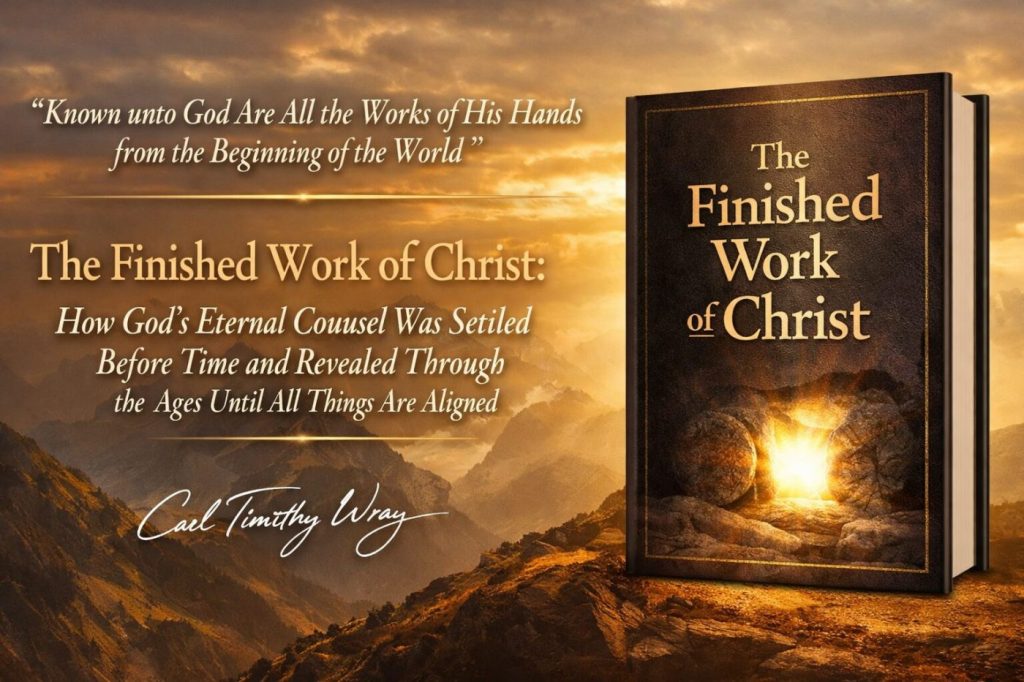
- Finished Work of Christ: Book 2. Finished Work of Christ: Download PDF 3. Finished Work of Christ: Series
📖 The Finished Work of Christ: INTRODUCTION
The End Was Known Before the Beginning
“Known unto God are all His works from the beginning of the world.”
— Acts of the Apostles 15:18
God has never worked from uncertainty. He has never adjusted His plan, revised His intention, or responded to history as though something surprised Him. Before creation ever began, the complete work of His hands was already known, finished, and settled in His eternal counsel. What unfolds in time is not God finding His way forward, but God revealing—stage by stage—what He already knew from the beginning.
The Finished Work of Christ must therefore be understood in two dimensions: what was legally settled in God before the world began, and what is vitally revealed and manifested through the ages. Time does not complete the work; time unveils it. The ages exist not because redemption was uncertain, but because revelation must be administered according to capacity. What was invisible in God becomes visible in creation by divine order, not delay.
This book is written to show how that eternal counsel was expressed through ministry. From the Law and the Levitical priesthood, to the prophets, to the apostles and five-fold gifts, and ultimately to the kings, priests, and sons of the Kingdom, God has been revealing one Christ by different measures of glory. These ministries were not competing systems, nor temporary failures, but necessary administrations through which Christ progressively became flesh—first in shadow, then as life, and finally in fullness.
When ministry is seen through this lens, confusion dissolves. The Law is no longer a contradiction to grace, the apostles are no longer the end of God’s intention, and the Kingdom is no longer a mystery without foundation. Everything finds its place. Christ has always been ministering; only the dimension from which He ministers has changed. This book is an invitation to see the unity of God’s mind, the wisdom of His timing, and the inevitability of fullness that was known to Him before the world began. What God knew and finished before the foundation of the world is now being revealed through the ages, proving that the Finished Work of Christ unfolds by divine order, not uncertainty.
Chapter 1 — God Finished the Work Before He Began It
“Known unto God are all His works from the beginning of the world.”
— Acts 15:18
God has never been discovering His will in time. He has never been reacting to failure, correcting mistakes, or improvising outcomes. Before creation ever began, the complete work of His hands was already known, settled, and finished within His eternal counsel. Time did not give birth to God’s plan; time was created to reveal it.
This truth sits at the heart of the Finished Work of Christ. When Scripture declares that the Lamb was slain from the foundation of the world, it is not using poetic language—it is stating a legal and eternal reality. Redemption was not conceived after the fall, nor was Christ sent as a remedy to unforeseen damage. The end was declared before the beginning, and creation unfolded within that declaration.
Because the work was finished in God before it appeared in history, nothing that unfolds in time is uncertain. The ages are not God working toward completion; they are God administering revelation. What was invisible in His heart is made visible in creation according to wisdom, order, and capacity. This is why Scripture speaks of “the dispensation of the fullness of times”—not because God needed time, but because creation did.
The Finished Work must therefore be understood in its legal dimension before it can be understood in its vital dimension. Legally, everything God intended was settled before the world began. Vitally, that settled reality is revealed, imparted, and manifested within creation through progressive ages. Legal settlement establishes certainty; vital revelation establishes experience. Neither contradicts the other—they belong together.
This is the reason ministry exists at all. Ministry is not evidence of an unfinished work; it is the means by which a finished work becomes known. God does not use ministry to fix what failed—He uses ministry to reveal what was already complete. The Law, the prophets, the priesthood, the apostles, and every administration that followed were not competing systems, but ordered expressions of a single divine counsel.
If God had revealed the fullness of Christ at once, creation would not have been able to receive it. Revelation does not move faster than capacity. God does not speak from what He knows; He speaks from what can be borne. Therefore, He revealed Himself by measure—not because He was withholding truth, but because He was preparing vessels.
This is why Scripture unfolds in stages. It is why Christ appears first in shadow, then in flesh, then in fullness. It is why the Law comes before grace, grace before the Kingdom, and impartation before manifestation. The sequence does not indicate improvement in God—it indicates preparation in creation.
Once this principle is seen, confusion disappears. The question is no longer why God waited, but why He revealed Himself when He did. The answer is always the same: because that measure of glory could be received at that time.
This book is built on that foundation. God knew the full work of His hands—from thirtyfold to sixtyfold to one hundredfold—before the foundation of the world. What we call history is simply the unveiling of that knowledge. What we call ministry is Christ becoming flesh according to the measure of glory appointed for each age.
In the chapters that follow, we will trace how that finished work moved from eternal counsel into visible expression—how Christ ministered first from outside man, then from within man, and finally through man. But every step of that journey rests on this unshakable truth:
God did not begin a work He was unsure how to finish. Because the Finished Work of Christ was settled in God before time began, everything revealed in history unfolds with purpose, precision, and certainty rather than chance or reaction.
Chapter 2 — The Invisible Governs the Visible
“The things which are seen were not made of things which do appear.”
— Hebrews 11:3
Everything God does in the visible realm is governed by what already exists in the invisible. Creation is not the source of God’s work; it is the expression of it. What appears in time is not the origin of truth, but the translation of truth from an unseen realm into a seen one.
This is why the Finished Work of Christ cannot be understood merely by observing history. History shows when something appeared, but it does not explain where it came from. Scripture consistently teaches that God works from the unseen to the seen, from spirit to form, from counsel to manifestation. The visible world does not instruct God; God instructs the visible world.
Before anything was tangible, it was already real. Before Christ was manifested in flesh, He was known in God. Before redemption was experienced, it was settled. Before ministry was visible, it was designed. The invisible is not theoretical—it is authoritative. It is the realm where God finishes His work before revealing it.
This distinction between invisible and visible is essential to understanding the plan of the ages. When this distinction is missed, people assume God is reacting, adjusting, or changing course. When it is seen clearly, revelation becomes orderly, patient, and consistent. Delay no longer signals uncertainty; it signals administration.
The ages exist because the invisible must be translated into the visible. God does not pour fullness into unprepared vessels. He releases what is unseen into what is seen according to measure, timing, and capacity. The plan of the ages is therefore not a timeline of God’s improvement, but a sequence of manifestation.
This is why Scripture speaks of mysteries “hidden from ages and generations” and later “made manifest.” The mystery was never absent—it was concealed. It was complete in God long before it was revealed to man. Revelation does not create truth; it uncovers it.
The Finished Work of Christ follows this same order. Legally, the work was settled in God before the foundation of the world. Vitally, that settled reality was revealed through incarnation, death, resurrection, and the giving of the Spirit. Manifestly, it continues to unfold through the ages as Christ is expressed in increasing fullness. None of these stages contradict one another; they are different points of visibility of the same finished reality.
Ministry must therefore be understood as a visible administration of an invisible certainty. God does not use ministry to determine outcomes; He uses ministry to reveal outcomes that were already known. The Law revealed the need for deliverance. Grace imparted the life of the Deliverer. The Kingdom reveals the Deliverer fully expressed. Each stage makes visible what was already true.
When this principle is established, Scripture stops appearing fragmented. The Old Covenant no longer feels like a contradiction to the New, and the New no longer feels incomplete without the Kingdom. Each age is seen as a window into the same Christ, opened according to divine wisdom.
This is also why Christ speaks differently across Scripture. He does not speak from ignorance, but from accommodation. He does not reveal everything He knows at once, but everything that can be received. What He knows is eternal; what He reveals is measured. The invisible governs the visible, and the visible unfolds according to readiness.
Until this order is understood, ministry will always seem confusing. Some will argue for the past, others for the present, and others for the future, as though God must choose between them. But once the invisible-to-visible principle is seen, ministry is no longer competitive—it is progressive.
The invisible does not disappear when the visible appears. It remains the source. And as the visible catches up to the invisible, glory increases—not because God adds something new, but because creation is finally able to reflect what was always there.
In the next chapter, we will begin to define why God uses measures of glory—thirtyfold, sixtyfold, and one hundredfold—and how those measures govern the way Christ reveals Himself through ministry. But all of that rests on this unshakable truth:
What God reveals in time is governed by what He already finished in eternity. When the invisible counsel of God is seen as governing the visible unfolding of history, the Finished Work of Christ is understood as revelation administered through time, not a work awaiting completion.
Chapter 3 — Why God Uses Measures of Glory
“First the blade, then the ear, after that the full corn in the ear.”
— Mark 4:28
God does not reveal Himself randomly, nor does He reveal Himself all at once. He reveals Himself by measure. This is not because God is withholding truth, but because revelation must be received before it can be embodied. Capacity governs manifestation. Glory is released in proportion to what creation can bear.
From the beginning, God determined not only what He would reveal, but how much could be revealed at each stage of the journey. The Finished Work of Christ was never in question; what was in question was the vessel’s readiness to receive it. Therefore, God ordered revelation according to growth—seed, blade, ear, full ear.
This is the divine logic behind thirtyfold, sixtyfold, and one hundredfold. These are not moral categories, achievement levels, or spiritual rankings. They are measures of visibility—how much of Christ is being seen, embodied, and expressed at a given point in God’s unfolding purpose.
At the thirtyfold level, Christ is real, present, and active—but He is revealed primarily in shadow. Truth is external. Glory is veiled. Access is mediated. This is not failure; it is preparation. Shadow exists because substance is coming, and the shadow teaches the shape of what will one day appear.
At the sixtyfold level, Christ is no longer only seen—He is imparted. Life is given. The Word becomes flesh. The Spirit writes truth on the heart rather than stone. Yet even here, revelation is not complete. Christ is present within, but not yet fully expressed without. The veil of the body remains, and glory is still restrained.
At the one hundredfold level, Christ is no longer merely imparted—He is manifested. What was hidden is revealed. What was mediated gives way to alignment. The life that was planted inwardly is now expressed outwardly. This is not a new Christ, a new gospel, or a new work; it is the same Christ fully revealed.
These measures explain why Scripture never moves backward. God does not begin with fullness and then retreat into shadow. He does not pour new wine into unprepared vessels. Revelation always moves forward—never in reverse—because transformation must precede manifestation.
This is why the Law could never bring fullness. It was not designed to. Its purpose was to reveal the limitation of Adamic nature and prepare the heart for deliverance. The Law successfully showed that no man, in the strength of his own nature, could fulfill God’s righteousness. That revelation was essential. Without it, grace would have been misunderstood.
Grace, likewise, was never intended to be the end of God’s purpose. Grace imparts life, but life must mature before it can be revealed. The New Covenant installs Christ within the believer, but installation is not the same as expression. Growth must occur. Understanding must deepen. Alignment must be formed.
Measures of glory therefore protect both God and man. They protect God’s truth from being mishandled, and they protect man from being overwhelmed. God never reveals more than can be received, because revelation without capacity produces distortion, not transformation.
This is also why Christ spoke differently in different ages. He did not speak from ignorance, but from wisdom. He spoke according to the measure of glory He was unveiling at the time. Parables, laws, commandments, promises, and plain speech all belong to specific measures of revelation. None contradict one another; they complement one another.
When these measures are not understood, Scripture appears fragmented. People argue over covenants, ministries, and doctrines as though God were divided. But when these measures are seen clearly, everything aligns. The Law prepares. Grace imparts. The Kingdom manifests.
This book is built on that order. Thirtyfold, sixtyfold, and one hundredfold were not discovered in time; they were known in God before time began. They are not stages God experimented with, but stages He appointed. What unfolds across history is the visible unveiling of those predetermined measures of glory.
In the chapters ahead, we will begin to apply this measurement system directly to ministry—showing how Christ revealed Himself through priesthood, prophecy, apostolic foundations, fivefold gifts, and finally through kings, priests, and sons of the Kingdom. But every one of those ministries can only be understood correctly when this principle is settled:
God reveals Himself by measure, because fullness must be received before it can be revealed. The Finished Work of Christ is revealed by measure—thirtyfold, sixtyfold, and one hundredfold—because fullness must be received progressively before it can be manifested openly.
Chapter 4 — The Law and the Levitical Priesthood: Christ Revealed in Shadow
The Law was never given because God believed man could fulfill it in his own strength. It was given to reveal that man could not. From the very beginning, the Law exposed the condition of Adamic nature—not to condemn it, but to demonstrate its limitation. It showed, with perfect clarity, that righteousness could not be produced from fallen humanity, no matter how sincere the effort.
This was not a failure of the Law; it was the success of the Law.
The Law functioned as a mirror. It revealed sin, distance, and separation—not because God desired separation, but because separation already existed. Without that revelation, the need for deliverance would never have been fully understood. Grace would have been cheapened, and Christ’s coming would have appeared unnecessary. The Law prepared the heart by making the problem unmistakably clear.
Within that Law, God established the Levitical priesthood. This priesthood was not an afterthought, nor was it a temporary patch on a broken plan. It was a divinely appointed ministry, operating at the thirtyfold measure of glory. Through it, Christ was revealed—not openly, but in shadow.
Every element of the Levitical system pointed to Christ. The sacrifices, the altars, the garments, the washings, the holy places, and the feasts were not arbitrary rituals. They were encoded revelations. Christ was present in them, but veiled. He was ministering, but from outside the heart of man. He was active, but mediated through symbols and ordinances.
At this stage, Christ was not imparting life. He was revealing need.
The priesthood existed because distance existed. As long as there was a separation between God and man, mediation was necessary. The priests stood between God and the people because the people could not yet stand in God’s presence themselves. This was not because God withheld access, but because man lacked the life required to enter freely.
The repeated sacrifices made this unmistakably clear. If the sacrifices had been able to cleanse the conscience and impart life, they would not have needed to be repeated. Their repetition testified to their purpose: not fulfillment, but preparation. They taught Israel that something greater was coming—something final, complete, and inward.
The Law also revealed another critical truth: obedience without life is impossible. Man could desire righteousness, but desire alone could not produce it. Commandments could instruct behavior, but they could not change nature. The Law demanded holiness but provided no power to become holy. In doing so, it proved that righteousness must come from another source. The Law and the Levitical priesthood fulfilled their divine purpose by revealing humanity’s need for Christ, preparing the way for the Finished Work of Christ to be revealed beyond shadow.
That source was always Christ.
The Levitical priesthood, therefore, was not separate from Christ’s ministry; it was Christ’s ministry at a measured distance. He was revealing Himself according to what could be borne at that time. To reveal fullness before imparting life would have crushed the vessel. So God revealed Christ in shadow, allowing the form of righteousness to be seen long before the substance of righteousness could be received.
This is why the Law must never be read as a contradiction to grace. The Law and grace do not oppose one another; they serve one another. The Law exposes the need that grace fulfills. The Law reveals the wound that grace heals. The Law prepares the heart; grace implants the life.
Seen this way, the Law becomes merciful rather than harsh. It was not given to trap man in failure, but to free him from illusion. It removed every false confidence in the flesh so that true confidence could be placed in Christ alone.
The Levitical priesthood, operating within this Law, was therefore a true and necessary ministry, but it was not final. It belonged to the thirtyfold realm because it revealed Christ externally, symbolically, and indirectly. It could show the way, but it could not be the way. It could speak of righteousness, but it could not produce it.
That was never its assignment.
Once this is understood, the Law is no longer despised, and grace is no longer misunderstood. Each is seen in its proper place. The Law prepared the ground. The priesthood taught the pattern. The shadows trained the eye to recognize the substance when it arrived.
In the next chapter, we will look at the Old Covenant prophets, who operated alongside this priesthood—not to replace it, but to announce what God already knew was coming. They, too, belong to the thirtyfold realm, revealing Christ in promise rather than in possession.
But everything we have seen here rests on this truth:
The Levitical priesthood was Christ ministering in shadow—real, holy, necessary, but measured—until the fullness of time came for life to be revealed.
Chapter 5 — The Old Covenant Prophets: Seeing Without Possessing
The Old Covenant prophets stand as some of the most luminous figures in Scripture, yet they also reveal one of the clearest distinctions between revelation and possession. They saw Christ, spoke of Christ, and bore witness to Christ—but they did not embody Christ. This was not a deficiency in the prophets; it was a distinction in the age.
Like the Levitical priesthood, the prophets operated within the thirtyfold measure of glory. Christ was real to them, but He was not yet revealed in them. They received visions, words, and encounters that reached beyond their own generation, often speaking more clearly about the future than about their present. They carried revelation that exceeded their own experience.
This is why Scripture says they “searched diligently” concerning the things they prophesied. They spoke by the Spirit, yet they did not fully understand the timing or manner of fulfillment. They announced what God already knew, but they did not live in the substance of what they announced. Their ministry was one of promise, not possession.
The prophets functioned alongside the Law and priesthood, not in opposition to them. Where the Law revealed the need for righteousness, the prophets revealed the hope of righteousness fulfilled. Where the priesthood mediated between God and man, the prophets pointed toward a day when mediation itself would be transformed. They did not bring that day; they proclaimed it.
Their visions were often symbolic, dramatic, and layered. They spoke of new hearts, new covenants, poured-out Spirit, and a coming Servant who would bear sin and heal the people. Yet even as they spoke these things, they themselves lived under the same limitations as those who heard them. The glory they described was greater than the glory they inhabited.
This is why Jesus could say that among those born of women none was greater than John the Baptist—yet the least in the Kingdom was greater than he. John stood at the very edge of the transition. He saw Christ not only in vision but in flesh. Yet even John did not enter the reality he proclaimed. He announced the Lamb; he did not partake of the indwelling life the Lamb would release.
The prophets, therefore, were not failed forerunners or incomplete believers. They were perfectly faithful servants of a measured revelation. They spoke from what God allowed them to see, not from what the age allowed them to possess. Their greatness lay not in embodiment, but in obedience.
This distinction matters deeply, because without it the prophets are either overstated or diminished. When overstated, they are confused with apostolic or Kingdom ministries they were never meant to fulfill. When diminished, their role in preparing the way of Christ is undervalued. Properly understood, they occupy a precise and honorable place in the unfolding counsel of God.
The prophets did not bring life; they announced life. They did not impart righteousness; they foretold righteousness. They did not remove the veil; they testified that the veil would one day be removed. Their ministry was forward-leaning by design.
This is why prophetic language often sounds urgent, longing, and unfinished. It is not because God’s plan was unfinished, but because the age was. The prophets spoke from the tension between what was known in God and what had not yet been manifested in creation. Their words carried hope precisely because fulfillment was still ahead.
Seen in this light, the prophets belong fully and rightly within the thirtyfold realm. Alongside the Law and the Levitical priesthood, they revealed Christ externally—through shadow, symbol, promise, and proclamation. Together, these ministries prepared the heart of humanity for the next great unveiling: Christ not only revealed, but imparted.
In the next chapter, we will step across that threshold and examine the transition from shadow to substance—when the Word became flesh, and Christ began to minister not merely to man, but within man. That transition marks the entrance into the sixtyfold realm, where life is no longer promised, but given.
But before moving forward, this must be settled:
The Old Covenant prophets were not lacking Christ; they were entrusted with Christ according to the measure appointed for their time—seeing clearly, speaking faithfully, and preparing the way for a fullness they themselves would not yet enter. The prophets faithfully announced what God already knew from the beginning, revealing Christ in promise while preparing creation for the Finished Work to be manifested in substance.
Chapter 6 — The Word Became Flesh: Christ Revealed as Life
The transition from the thirtyfold realm into the sixtyfold realm marks one of the most profound moments in all of Scripture. It is not merely a change of covenant, nor simply a shift in doctrine—it is a change in location. Christ does not only reveal Himself differently; He begins to minister from within.
“The Word was made flesh, and dwelt among us.”
This declaration signals more than incarnation in history. It announces a new mode of divine revelation. The Word that had been spoken through law, symbol, and prophecy now enters creation as life. What was once external becomes internal. What was once promised is now imparted.
In the thirtyfold realm, Christ ministered through shadow. In the sixtyfold realm, Christ ministers through union. The life of God is no longer mediated through priesthood or symbol alone; it is planted directly into the heart of man. This is the essence of the New Covenant—not improved instruction, but new birth.
The Law could describe righteousness, but it could not produce it. Grace does what the Law could never do: it installs a new nature. Christ does not lower the standard of righteousness; He fulfills it by becoming the life of the believer. Righteousness is no longer demanded from the outside—it flows from the inside.
This is why the New Covenant is not primarily about behavior modification, but identity transformation. The believer is not called to imitate Christ from a distance, but to live from Christ within. The indwelling Spirit becomes the governing reality of the Christian life.
Yet even here, revelation is measured.
Although Christ now dwells within the believer, the fullness of that life is not immediately manifested. The veil of the body remains. The soul is in process of renewal. Understanding grows gradually. This is why the New Covenant is marked by impartation rather than full manifestation.
Christ’s earthly ministry itself reflects this pattern. He speaks plainly where once He spoke in shadow, yet even then He acknowledges limits: “I have many things to say to you, but you cannot bear them now.” Revelation continues to be governed by capacity, even after the Word becomes flesh.
The sixtyfold realm is therefore characterized by growth, equipping, and maturation. Christ is present within, but His life must be cultivated, understood, and expressed through transformed minds and aligned hearts. This is not delay; it is development.
This is also why ministry takes on a new form in this realm. Apostles are sent to lay foundations. Teachers explain what has been imparted. Pastors shepherd growing life. Evangelists birth life in others. Prophets speak by the indwelling Spirit rather than by distant vision. Every function serves one purpose: to establish Christ within the people of God.
The sixtyfold realm is glorious, but it is not final. It is not designed to end in perpetual immaturity, nor in endless instruction. It is a realm of preparation—of life being formed inwardly so that it can one day be revealed outwardly.
Christ is no longer hidden behind symbols, but He is still partially veiled by flesh. The life is real, complete, and present, yet not fully expressed. This tension is intentional. Manifestation without maturity would distort what grace has implanted.
Understanding this prevents both frustration and pride. It prevents frustration by explaining why fullness is not immediately visible, and it prevents pride by reminding believers that growth is required even after new birth. Grace does not eliminate process; it redeems it.
The Word becoming flesh did not end God’s unfolding purpose—it advanced it. Christ moved from shadow into substance, from promise into presence, from distance into indwelling life. But the journey continues, because what is indwelt must eventually be revealed.
In the next chapters, we will examine how Christ ministers within this sixtyfold realm through apostolic foundations and the fivefold gifts—and why these ministries, though essential and powerful, were never intended to be the final expression of God’s purpose.
But this must be settled first:
The New Covenant reveals Christ not as an external standard to be met, but as an indwelling life to be lived—measured, cultivated, and prepared for fullness. When the Word became flesh, the Finished Work of Christ moved from external revelation into indwelling life, marking the transition from promise to impartation.
Chapter 7 — Apostolic Ministry and the Five-Fold Gifts: Christ Imparted Within
With the Word now dwelling within man, ministry enters a new and vital phase. Christ is no longer ministering primarily from outside the human heart, nor only announcing what is to come. He is now imparting His own life into the people of God. This marks the full establishment of the sixtyfold realm—the realm of impartation.
It is within this realm that apostolic ministry and the five-fold gifts emerge. These ministries do not exist to replace Christ, but to serve the Christ who now dwells within. Their purpose is not to mediate righteousness from a distance, but to equip, nourish, and establish the life that has already been planted.
Apostles are sent to lay foundations—not by creating Christ in people, but by grounding believers in what they have already received. Their authority does not come from hierarchy, but from alignment with the Finished Work. They establish order, clarity, and continuity so that the life of Christ can mature without distortion.
Prophets in this realm no longer speak primarily from distant vision, but from indwelling revelation. They speak by the Spirit within, confirming, illuminating, and applying what God has already placed inside His people. Their role is not to announce a coming Christ, but to reveal the Christ who is present.
Evangelists carry the grace to birth life in others. They do not manufacture salvation; they proclaim the finished reality that awakens faith and releases new birth. Their ministry expands the indwelling Christ into new vessels.
Pastors shepherd what has been imparted. They guard, nurture, and care for the life of Christ as it grows within the community of believers. Their role is not control, but protection—ensuring that growth occurs in health and balance.
Teachers bring understanding to the mind, helping believers interpret their experience through truth. They do not replace revelation; they stabilize it. They help align thought with life so that the indwelling Christ is not misunderstood or misapplied.
Together, these five functions form a single ministry of impartation and maturation. They do not represent five different Christs, nor five competing agendas. They are diverse expressions of one purpose: to establish Christ within the people of God.
Yet as essential as these ministries are, they are not the end of God’s purpose.
This is where confusion often arises. Because the five-fold gifts are powerful, visible, and effective, they are sometimes assumed to be final. But impartation, by definition, implies something yet to be revealed. What is imparted must mature. What is planted must grow. What is inside must eventually come forth.
The five-fold ministry operates within the veil of flesh. Christ is present, but His life is still being formed. Understanding increases, character is shaped, and alignment develops over time. This process is glorious, but it is preparatory.
The apostles themselves understood this. They spoke of growth, maturity, and a future unveiling. They did not claim to have arrived at fullness, nor did they present the church as the final manifestation of God’s purpose. They laid foundations and looked forward.
This is why the New Testament consistently points beyond itself—toward the revealing of sons, the redemption of the body, and the manifestation of what has been hidden. The five-fold ministry serves that forward movement. It equips the saints until something else comes into view.
Understanding this prevents two errors. The first is idolizing ministry—making offices eternal that were designed to be transitional. The second is despising ministry—rejecting what God uses to prepare His people. Properly understood, the five-fold is honored without being overstated.
The sixtyfold realm is therefore a place of tremendous grace. Christ is truly present. Life is genuinely imparted. Growth is real. But the story is not finished. The Christ who dwells within must one day be revealed without.
In the next chapter, we will address this directly by asking an important question: Why could the five-fold ministry not bring fullness? The answer does not diminish its role—it completes it.
But for now, this truth must be settled:
Apostolic and five-fold ministries exist to impart and mature the life of Christ within, preparing a people for a fullness that lies beyond impartation.
Apostolic and five-fold ministries serve the Finished Work of Christ by imparting and maturing His life within believers, preparing them for a greater unveiling yet to come.
Chapter 8 — Why the Five-Fold Could Not Bring Fullness
The five-fold ministry was never designed to bring the work of God to its final expression. This is not because it failed, lacked power, or missed its purpose, but because impartation is not manifestation. What installs life cannot, by definition, be the same thing that reveals life in fullness.
The New Covenant accomplished exactly what it was sent to accomplish. Christ was imparted. The Spirit was given. The heart was regenerated. The mind began to be renewed. The church was formed. Foundations were laid. None of this was partial or incomplete. It was perfect within its assigned measure.
But fullness requires something more than impartation.
The five-fold ministry operates within the realm of formation. Christ is present within the believer, yet that life is still being brought into alignment with soul and body. Understanding grows. Character is shaped. Identity is clarified. This process cannot be bypassed. What has been planted must mature before it can be expressed.
This is why the apostles themselves spoke of pressing forward, of not having already attained, and of something yet to be revealed. They were not contradicting the Finished Work; they were acknowledging the difference between what was given and what was yet to appear. They understood that life had been imparted, but manifestation awaited maturity.
The five-fold ministry also functions under a necessary limitation: it operates through instruction, exhortation, correction, and encouragement. These are essential tools in formation, but they are not the language of fullness. Fullness does not need to be instructed; it is. Fullness does not require exhortation; it expresses itself naturally. Fullness does not need correction; it is aligned.
As long as growth is still occurring, ministry must still mediate understanding. As long as immaturity exists, ministry must still guide development. This does not diminish ministry—it explains its necessity.
Another reason the five-fold could not bring fullness is that it operates within the veil of the body. Christ dwells within, but He is not yet fully revealed through the body. Scripture speaks clearly of this distinction, pointing forward to a time when what is inwardly true will also be outwardly manifest. The presence of indwelling life is real; the absence of full manifestation is intentional.
If the five-fold were the end, Scripture would not speak of sons being revealed, bodies being redeemed, or creation being delivered. But it does. These promises point beyond impartation toward expression. They testify that God’s purpose does not stop at installation—it continues toward revelation.
This is also why history shows an increase in light without a corresponding increase in visible fullness. Knowledge grows. Revelation deepens. Understanding expands. Yet the world remains largely unchanged. This is not evidence that truth is ineffective; it is evidence that the appointed time of manifestation had not yet arrived.
The five-fold ministry prepares a people for that appointed time. It forms Christ within. It establishes truth. It guards against deception. It equips the saints. But it does not replace the work that only God Himself can do in revealing Christ without veil.
Understanding this rescues ministry from unrealistic expectations. It prevents burnout, disappointment, and confusion. It allows ministers to labor faithfully without assuming they must produce what God has reserved for a later stage. It also prevents believers from mistaking preparation for arrival.
The five-fold is therefore glorious, necessary, and effective—but it is transitional. It exists because something greater is coming, not because something has failed. It is the bridge between life imparted and life revealed.
Once this is seen, tension disappears. Ministry no longer competes with sonship. Apostles no longer contend with kings. Teachers no longer resist revelation. Everything finds its place in the unfolding counsel of God.
The question is no longer, Why hasn’t fullness come yet?
The question becomes, What is God preparing us to receive?
In the next chapter, we will step fully into that answer by examining the transition from indwelling life to outward manifestation—when Christ is no longer merely formed within, but revealed through a people aligned with Him.
But this truth must be settled first:
The five-fold ministry could not bring fullness because fullness is not imparted—it is revealed when what has been imparted has matured into alignment.
Because fullness is revealed rather than imparted, the five-fold ministry faithfully prepares what the Finished Work of Christ will ultimately express without veil.
Chapter 9 — From Indwelling to Manifestation: The Removal of the Veil
The movement from the sixtyfold realm into the one hundredfold realm is not a change of gospel, nor the introduction of a new work. It is the unveiling of what has already been implanted. What was given inwardly now seeks expression outwardly. What was hidden within the vessel is brought into alignment with the vessel itself.
This transition is best understood as a change of visibility, not a change of substance. Christ does not become more complete; the vessel becomes more aligned. The life that has long dwelt within the believer is no longer restrained by misalignment between spirit, soul, and body. The veil that once limited expression is removed—not violently, but lawfully, through maturity.
Scripture consistently points toward this moment. It speaks of sons being revealed, of bodies being redeemed, and of creation being delivered from corruption. These promises do not negate the reality of indwelling life; they presume it. Manifestation is not the beginning of Christ’s life in man—it is the result of Christ’s life having been fully formed.
In the sixtyfold realm, Christ is present within, yet the outer man does not yet fully reflect the inner reality. The mind is renewed progressively. The body remains subject to weakness. Creation continues to groan. These conditions are not signs of failure; they are signs that alignment is still underway.
The one hundredfold realm emerges when that alignment is complete.
When spirit, soul, and body are brought into harmony with the indwelling Christ, expression becomes natural rather than forced. Life no longer struggles to come forth. Righteousness no longer needs to be enforced. Love no longer needs to be commanded. What once required instruction now flows as being.
This is the point at which mediation gives way to alignment. As long as distance exists between God’s life and human expression, ministry must mediate understanding and growth. But when alignment is complete, mediation is no longer necessary. Christ is not managed, explained, or distributed—He is revealed.
This does not abolish what came before; it fulfills it. The Law prepared the way by exposing the need for life. Grace installed the life by imparting Christ within. Manifestation reveals the life by removing the remaining veil. Each stage honors the previous one by completing its purpose.
The removal of the veil does not mean the disappearance of humanity. It means humanity finally functioning as it was intended—to bear the image of God without distortion. Christ is not replacing man; He is being expressed through man. The image is restored, and the likeness is revealed.
This is why Scripture speaks of “firstfruits.” Manifestation does not occur universally all at once. It appears first where alignment has matured. These firstfruits are not elevated above others by merit; they simply reach maturity first. Their role is not superiority, but testimony—evidence that what was promised inwardly can indeed be revealed outwardly.
Understanding this protects against both impatience and fear. It guards against impatience by affirming that manifestation cannot be forced. It guards against fear by affirming that manifestation is inevitable where life has been faithfully cultivated. God does not abandon what He has begun; He brings it to expression.
The one hundredfold realm is therefore not a sudden leap into something unfamiliar. It is the natural conclusion of a long, faithful process. Everything necessary has already been given. Nothing essential is missing. What remains is alignment.
In the next chapter, we will examine the specific expressions of this realm—kings and priests, the man-child company, and the firstfruits revealed in Scripture—and show why these ministries cannot be understood as extensions of the five-fold, but must be recognized as manifestational expressions of Christ Himself.
But before moving on, this must be settled:
Manifestation is not Christ arriving where He was absent; it is Christ being revealed where He has long dwelt unseen.
The manifestation of the Finished Work of Christ occurs when the life long indwelling within is finally revealed through full alignment of spirit, soul, and body.
Chapter 10 — Kings and Priests, the Man-Child, and the Firstfruits of Fullness
When the one hundredfold realm comes into view, Scripture begins to speak a different language—not because God has changed His mind, but because alignment has been achieved. The focus shifts from impartation to expression, from formation to function, from preparation to government. What emerges is not a new ministry system, but a new visibility of Christ.
This is where the language of kings and priests, the man-child, and firstfruits appears. These are not extensions of the five-fold ministry, nor are they upgrades of apostolic function. They belong to an entirely different category because they operate from a different premise: Christ is no longer being imparted—He is being revealed.
Kings and priests do not minister by instruction or exhortation. They minister by being aligned. Authority in this realm does not flow from office, gifting, or position, but from union. Government is not exercised through control, but through harmony with the will and nature of God. What they do outwardly reflects what God is inwardly.
This is why Scripture speaks of reigning in life rather than ruling over people. The authority of the Kingdom is not coercive; it is expressive. It does not impose righteousness; it reveals righteousness. Where Christ is fully expressed, order appears naturally.
The man-child imagery points to this same reality. It does not describe a special class of believers competing with the church, but a corporate expression of maturity. The man-child represents Christ brought forth in fullness—no longer hidden, no longer fragmented, no longer restrained by immaturity. It is not a new Christ, but the same Christ fully revealed through a people prepared for that measure of glory.
This is why these expressions are often portrayed symbolically. Symbolism does not obscure truth; it protects it. Language stretches when fullness comes into view because fullness exceeds the categories of earlier ages. What could once be taught must now be seen.
The firstfruits are those in whom alignment matures first. They are not chosen because of superiority, effort, or special merit. They are first because they reach maturity first. Their role is not domination, but demonstration—evidence that what God promised through Law and grace can indeed be revealed in flesh.
This is also why Scripture speaks of these expressions in terms of government rather than ministry. Ministry belongs to formation; government belongs to manifestation. Ministry exists to prepare vessels; government appears when vessels are ready. When Christ is fully expressed, order does not need to be enforced—it flows.
These expressions cannot appear prematurely. They cannot operate within the thirtyfold realm because life has not yet been imparted. They cannot operate within the sixtyfold realm because alignment is still forming. They require a people in whom Christ is not only present, but undivided.
This understanding resolves much confusion. Kings and priests are not apostles with more authority. The man-child is not a super-ministry. Firstfruits are not spiritual elites. All of these images point to one reality: Christ expressed without veil.
Seen this way, the Kingdom does not threaten the church; it fulfills her calling. The five-fold does not become obsolete; it completes its assignment. The Law is not discarded; it is satisfied. Everything that came before is honored because its purpose is fulfilled in what comes forth.
The one hundredfold realm therefore represents not the abandonment of ministry, but the completion of ministry’s purpose. When Christ is fully revealed, the need for instruction gives way to the reality of expression. Truth no longer needs to be explained; it is embodied.
In the next chapter, we will gather the keys that unlock these realms of understanding and show how the Finished Work, the plan of the ages, and the measures of glory fit together as one unified revelation. But this truth must be settled here:
Kings and priests, the man-child, and the firstfruits are not new ministries—they are the manifestation of Christ Himself, revealed through a people prepared for fullness. Kings, priests, and firstfruits reveal the Finished Work of Christ not as a new ministry, but as Christ Himself expressed in fullness through prepared vessels.
Chapter 11 — The Keys That Unlock the Realms of Glory
The doors to understanding do not open by effort, debate, or volume. They open by alignment. What God has hidden in plain sight is not information, but order. When the order is seen, the door opens because the key has always fit the lock.
The keys that unlock the realms of glory are not new revelations added onto Scripture. They are recognition keys—truths that, once seen, allow everything else to fall into place. These keys work together, not in isolation. One key may open understanding, but all of them together open movement.
The first and governing key is the Finished Work of Christ. Everything begins finished in God before it appears in creation. God does not work toward completion; He works from completion toward manifestation. Until this is settled, Scripture will always feel fragmented and history will always feel uncertain. When this key turns, fear dissolves, and revelation becomes orderly.
Closely connected to this is the key of the Invisible Governing the Visible. What is seen in time is governed by what was settled in eternity. The visible does not explain God; the invisible explains the visible. Time is not the arena of God’s indecision, but the method of His revelation. When this key is understood, delay no longer feels like failure—it is recognized as administration.
Another essential key is the Measure of Glory. Christ reveals Himself by measure—thirtyfold, sixtyfold, and one hundredfold—not because He is changing, but because creation is being prepared. Different measures do not represent different Christs; they represent different capacities to receive the same Christ. This key resolves conflict between covenants, ministries, and ages without diminishing any of them.
Equally important is the key of Location of Ministry. Where Christ is ministering from determines the form ministry takes. When He ministers outside man, priesthood and law are necessary. When He ministers inside man, apostles and five-fold gifts are required. When He ministers through man, kingship and government appear. Ministry changes location before it changes expression. This key brings clarity to what belongs where.
The key of Mediation versus Alignment explains the purpose—and the end—of ministry. As long as there is distance between God’s life and human expression, mediation is required. When alignment is complete, mediation gives way to manifestation. This does not abolish ministry; it fulfills its purpose. Ministry exists because alignment is forming, not because God is unfinished.
Another vital key is Capacity Governs Revelation. God never reveals more than can be received. Revelation moves at the speed of transformation, not desire. This explains parables, progressive teaching, and why Jesus Himself withheld certain truths until the Spirit could guide His people into them. This key protects both God’s truth and the vessel receiving it.
The Trumpet Principle is also essential. Christ always sounds the trumpet appropriate to the realm He is unveiling. Distant trumpets warn and prepare. Clear trumpets instruct and gather. Full trumpets announce authority and manifestation. The voice does not change—the volume and clarity do. This key harmonizes prophetic language across Scripture.
The key of Honor Without Arrest prevents stagnation. Every age must be honored without being made final. What prepared us must not imprison us. The Law is honored without being clung to. Grace is honored without being limited. Ministry is honored without being idolized. This key allows forward movement without contempt for the past.
Underlying all of these is the key of God’s Unified Mind. God does not contradict Himself across ages. If two interpretations oppose one another, neither has yet seen the full counsel. When this key turns, Scripture reads as one voice from Genesis to Revelation, speaking progressively but consistently.
The final and crowning key is this: Christ is the only Minister. All ministry—past, present, and future—is Christ revealing Himself through flesh according to the measure of glory appointed for the age. When this is seen, competition ends, pride collapses, and unity emerges naturally. Ministry no longer belongs to men; it belongs to Christ.
These keys do not create new doors. They simply open what was already there. When they are held together, the realms of glory are not forced open—they are entered.
In the final chapter, we will bring everything together and show how all of this forms one seamless revelation: one Christ, one finished work, one unfolding purpose, and one inevitable outcome—God all in all.
But this truth must be settled here:
The realms of glory are unlocked not by striving to enter them, but by seeing the order God established before the world began. When the keys of the Finished Work, divine order, and measured revelation are understood, the realms of glory open naturally according to God’s eternal counsel.
Chapter 12 — One Christ, One Work, Fully Revealed
From beginning to end, the testimony of Scripture is not of many plans, many works, or many Christs, but of one Christ and one finished work, revealed progressively according to divine wisdom. What has unfolded across the ages has not been God correcting Himself, but God revealing Himself.
“Known unto God are all His works from the beginning of the world.”
This statement does not merely describe God’s foreknowledge—it declares God’s unity of mind. God has never spoken one thing in one age and another in a later age. He has spoken the same truth by different measures, through different forms, to vessels prepared to receive it.
The Law did not contradict grace; it prepared for it.
Grace did not replace the Kingdom; it prepared for it.
Ministry did not delay fullness; it prepared for it.
Everything has moved forward—never backward—because revelation cannot outrun capacity. What was revealed in shadow was not false; it was partial. What was imparted as life was not incomplete; it was preparatory. What is now revealed in manifestation is not new; it is the fulfillment of what was always known.
Seen through this lens, Scripture becomes whole. The priesthood, the prophets, the apostles, the five-fold, the kings and priests, the firstfruits, and the sons of God are no longer competing narratives. They are ordered expressions of one unfolding Christ. Each belongs to its measure. Each serves its purpose. Each finds its completion in what follows.
This is why the Finished Work of Christ must always be held in full counsel. Legally, everything was settled before time began. Vitally, that settled reality was imparted through Christ by the Spirit. Manifestly, that imparted life is revealed as alignment matures. None of these dimensions negate the others; together they form one harmonious revelation.
When this order is seen, striving ends. Fear dissolves. Ministry rests. The need to defend the past or rush the future disappears. What God has done is honored. What God is doing is trusted. What God will reveal is awaited with confidence, not anxiety.
The goal has never been ministry for its own sake. Ministry exists because something greater is coming. It prepares vessels until Christ can be revealed without veil. When that unveiling occurs, ministry does not fail—it fulfills its purpose.
The Kingdom of God is not built by replacing foundations, but by completing them. It is not entered by discarding what prepared us, but by allowing preparation to reach its appointed end. When Christ is fully revealed, instruction gives way to expression, mediation gives way to alignment, and effort gives way to rest.
This is the testimony of the Scriptures.
This is the wisdom of the ages.
This is the confidence of the Finished Work.
God did not begin a work He was unsure how to finish.
He did not reveal truth He did not intend to fulfill.
He did not prepare a people without intending to reveal Himself through them.
What was known to God before the foundation of the world is now being revealed in the fullness of time. And as it is revealed, one truth stands above all others:
There is one Christ, one work, one unfolding purpose—
and the end will look exactly like the beginning God already knew.
What was known to God from the beginning now stands revealed in fullness, confirming that the Finished Work of Christ unfolds perfectly until God is all in all.
The Finished Work of Christ

The Finished Work of Christ Series:
- The Finished Work of Christ — God’s Full Counsel Revealed Through the Ages
- The Finished Work of Christ — “My Times Are in Thy Hand” (Psalm 31:15)
- The Finished Work of Christ — What “It Is Finished” Truly Means
- The Finished Work of Christ — Full Counsel: Legal, Vital, Revealed, and Manifested
- Join Our Facebook Page: