 📺
📺
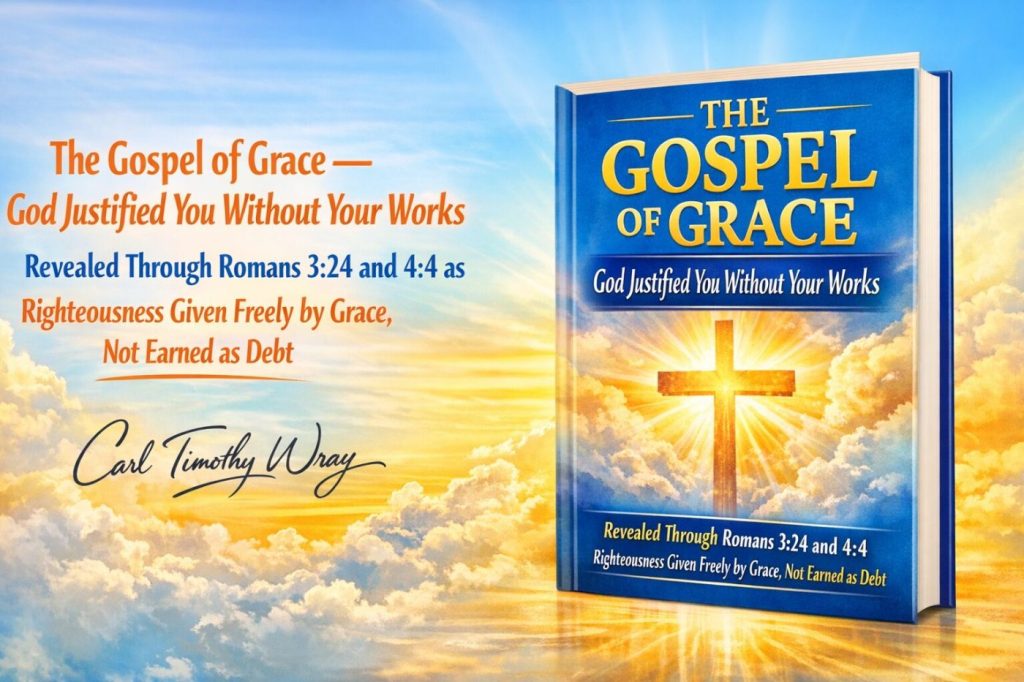
🔥 The Gospel of Grace — God Justified You Without Your Works Revealed Through Romans 3:24 and 4:4 as Righteousness Given Freely by Grace, Not Earned as Debt
✍️ The Gospel of Grace: AUTHOR
By Carl Timothy Wray
Carl Timothy Wray is a teacher of the Finished Work of Christ, dedicated to unveiling the full counsel of God from Genesis to Revelation. Through hundreds of books, teachings, and prophetic writings, his work focuses on revealing the Gospel of Grace, the righteousness of God, and the completed redemption found in Christ alone. His message centers on the transition from law to grace, from human effort to divine operation, and from religious striving to the rest of faith—calling believers into the fullness of what God has already accomplished.
🔍
This book, The Gospel of Grace — God Justified You Without Your Works, reveals the true meaning of justification by grace through a full counsel study of Romans 3:24 and Romans 4:4. Discover how righteousness is given freely by God through Jesus Christ, not earned through works, effort, or religious performance. This powerful teaching explores the difference between grace and debt, faith and works, and unveils how God justifies the ungodly apart from the law. If you are searching for a clear biblical explanation of the Gospel of Grace, justification by faith, and the finished work of Christ, this book will ground you in truth and establish you in the freedom of righteousness given by grace alone.
🔥 The Gospel of Grace: INTRODUCTION
What if everything you’ve been taught about becoming righteous is built on a system God never intended you to live under?
What if the very idea that you must do something to be accepted, approved, or justified before God is not only incomplete—but directly contradicts the Gospel itself?
The apostle Paul does not leave this open for interpretation. He draws a line so clear that it divides all of humanity into two systems: grace and debt. In one, God gives freely. In the other, man tries to earn. In one, righteousness is a gift. In the other, it becomes wages. And the moment you attempt to earn what God has already given, you step out of grace and into a system that can never produce life.
“Being justified freely by his grace through the redemption that is in Christ Jesus.”
“Now to him that worketh is the reward not reckoned of grace, but of debt.”
These are not just verses—they are a revelation of how God thinks.
This book is not about improving your effort. It is about ending it as the source of your righteousness. It is about uncovering the truth that God did not justify you because you helped Him, assisted Him, or qualified yourself in any way. He justified you freely, by His grace, through Christ—and that changes everything.
We will trace the full counsel of God—from the law that demanded performance, to the grace that provides righteousness—to reveal a Gospel that is not earned, not maintained by works, and not dependent on human effort. This is the Gospel of Grace: where God justifies the ungodly, gives righteousness as a gift, and calls you to receive what He has already finished.
The question is no longer, “What must I do?”
The question becomes, “Will I receive what God has already done?”
🔥 Chapter 1 — The Law: A System of Wages and Debt
The Principle Established: Do and Live
From the beginning, God established a system that revealed a fundamental principle:
If a man could do what was commanded, he would live by it.
Leviticus 18:5 declares:
“Ye shall therefore keep my statutes, and my judgments: which if a man do, he shall live in them: I am the LORD.”
This is the language of the law.
It speaks in terms of performance, obedience, and outcome.
- Do this → and you will live
- Keep this → and you will be blessed
At its core, the law operates on a simple system:
👉 Action produces reward
The Demand of Continuance
But the law does not allow partial obedience.
It demands complete and continual perfection.
Deuteronomy 27:26 says:
“Cursed be he that confirmeth not all the words of this law to do them.”
And the apostle Paul confirms this in Galatians 3:10:
“For as many as are of the works of the law are under the curse: for it is written, Cursed is every one that continueth not in all things which are written in the book of the law to do them.”
This reveals something critical:
- The law does not reward effort
- The law demands perfection
- One failure places a man under curse
There is no middle ground.
The Voice of the Law
Paul describes the law as having a voice—a way it “speaks” to man.
Romans 10:5:
“For Moses describeth the righteousness which is of the law, That the man which doeth those things shall live by them.”
The law speaks like this:
- “Do, and you will become righteous.”
- “Perform, and you will be accepted.”
- “Obey, and you will live.”
This is a wage-based system.
It does not give—it responds.
It does not provide—it demands.
A System of Wages, Not Grace
This is the foundation of everything that follows.
The law does not function on grace—it functions on debt.
If a man could fulfill the law perfectly, then righteousness would not be a gift—it would be a payment owed.
Paul later defines this clearly:
“Now to him that worketh is the reward not reckoned of grace, but of debt.”
Under the law:
- Righteousness would be earned
- Life would be wages
- Blessing would be deserved
But this creates a critical tension:
👉 If righteousness is earned, then God becomes a debtor to man.
And this is exactly what the Gospel of Grace will overturn.
The Purpose of the Law
The law was never given as the final system of righteousness.
It was given to reveal something deeper.
It reveals:
- The standard of God
- The inability of man
- The need for something greater
The law sets the stage—it does not complete the story.
The Hidden Tension
At first glance, the law appears righteous—and it is.
But hidden within it is an impossible requirement:
- Perfect obedience
- Continual performance
- No failure allowed
This creates a tension that every man eventually faces:
“If this is what God requires… who can stand?”
The law does not answer that question.
It exposes it.
The Transition Is Coming
This chapter establishes the system of the law:
- A system of doing
- A system of earning
- A system of wages and debt
But this system was never designed to bring man into righteousness.
It was designed to prepare the way for a greater revelation:
👉 A righteousness that is not earned
👉 A life that is not wages
👉 A justification that is not based on works
That revelation is the Gospel of Grace.
And before grace can be fully seen, something must first be uncovered:
👉 Man cannot fulfill what the law demands
That is where we turn next.
🔥 Chapter 2 — The Failure of Man Under the Law
The Law Reveals, But Does Not Produce
If the law promised life to the one who could perform it, then the question becomes:
Did it ever produce righteousness in man?
The answer is direct and unshakable.
Romans 3:20:
“Therefore by the deeds of the law there shall no flesh be justified in his sight: for by the law is the knowledge of sin.”
The law was never designed to make a man righteous.
It was designed to reveal something hidden within him.
👉 The law exposes sin—it does not remove it.
The Mirror, Not the Cure
The law functions like a mirror.
It shows:
- what is wrong
- what is out of alignment
- what falls short of God’s standard
But a mirror cannot fix what it reveals.
This is why the law can identify sin perfectly…
yet has no power to transform the sinner.
Sin Comes Alive Under the Law
Paul gives a personal and profound insight into this reality.
Romans 7:7–13 reveals:
“I had not known sin, but by the law… For without the law sin was dead. For I was alive without the law once: but when the commandment came, sin revived, and I died.”
Notice what happens:
- The commandment comes
- Sin becomes active
- Death follows
The law does not suppress sin—it actually stirs it into manifestation.
This is not because the law is evil, but because sin within man responds to the command.
The Weakness Is Not in the Law
The law is holy, just, and good.
The problem is not the law—the problem is man.
Romans 8:3:
“For what the law could not do, in that it was weak through the flesh…”
The weakness of the law is not in its standard, but in the flesh that tries to fulfill it.
- The law demands righteousness
- The flesh cannot produce it
This creates an unresolvable conflict.
No Man Is Justified by Works
Paul states it again with clarity:
Galatians 2:16:
“Knowing that a man is not justified by the works of the law, but by the faith of Jesus Christ…”
Not partially.
Not mostly.
👉 Not at all.
No man has ever stood before God justified by performance.
The Law Could Never Make Perfect
Even with continual sacrifices and religious effort, the law could not bring man into completion.
Hebrews 10:1:
“For the law having a shadow of good things to come… can never… make the comers thereunto perfect.”
The law pointed forward.
It cast a shadow.
But it could never bring man into full righteousness.
The Universal Conclusion
Paul brings all of humanity under one final conclusion:
Romans 3:23:
“For all have sinned, and come short of the glory of God.”
Not some.
Not most.
👉 All.
Under the law:
- Every man falls short
- Every effort fails
- Every attempt collapses under the weight of perfection
The Purpose Fulfilled
At this point, the purpose of the law becomes clear.
It has:
- Revealed sin
- Exposed the flesh
- Proven man’s inability
- Shut the door on self-righteousness
The law brings man to a place where he can no longer trust in himself.
The Door Opens to Grace
When man reaches the end of his ability, something profound happens:
👉 He becomes a candidate for grace.
The failure under the law is not the end of the story.
It is the setup for the Gospel.
Because once it is proven that:
- man cannot justify himself
- works cannot produce righteousness
- effort cannot satisfy God
Then a new question arises:
“If righteousness cannot be earned… how is it given?”
That answer changes everything.
🔥 Chapter 3 — Freely Justified by His Grace
The Turning Point: “But Now”
After establishing the failure of man under the law, Paul introduces one of the most powerful transitions in all Scripture:
Romans 3:21:
“But now the righteousness of God without the law is manifested…”
Those two words—“But now”—signal a complete shift.
- Not later
- Not after you improve
- Not once you qualify
👉 But now
This is the moment where God reveals a righteousness that does not come from man’s performance, but from His own nature.
A Righteousness Without the Law
Paul continues:
“…even the righteousness of God which is by faith of Jesus Christ unto all and upon all them that believe…” (Romans 3:22)
This righteousness is:
- Not produced by the law
- Not earned by effort
- Not limited by human ability
It is God’s righteousness, given as a gift.
Freely Justified
Then comes the verse that defines the Gospel of Grace:
Romans 3:24:
“Being justified freely by his grace through the redemption that is in Christ Jesus.”
Every word matters.
“Justified”
To be declared righteous—not becoming righteous by effort, but accounted righteous by God.
“Freely”
Without cause in you.
Without payment.
Without condition.
👉 Nothing in you moved God to justify you.
“By His Grace”
Grace means:
- undeserved
- unearned
- unearned favor and action of God
It originates entirely in Him.
Not Earned, Not Deserved
This changes everything about how righteousness is understood.
Under the law:
- Righteousness is earned
- Life is wages
- Acceptance is conditional
Under grace:
- Righteousness is given
- Life is a gift
- Acceptance is freely bestowed
There is no mixture between these two systems.
The Source: God Himself
This righteousness does not come from:
- your obedience
- your effort
- your improvement
It comes from God Himself.
Paul calls it:
“the righteousness of God”
That means:
👉 The very righteousness that belongs to God is the righteousness He gives.
Through the Redemption in Christ
This justification is not random—it is grounded in a finished work.
Romans 3:24:
“…through the redemption that is in Christ Jesus.”
Redemption means:
- a price has been paid
- a work has been completed
- a release has been secured
Christ did what the law could never do.
- He fulfilled the requirement
- He satisfied the demand
- He completed the work
So that righteousness could now be given freely.
God Remains Just
Paul goes even deeper:
Romans 3:26:
“…that he might be just, and the justifier of him which believeth in Jesus.”
God did not ignore sin.
He dealt with it completely in Christ.
So now:
- God remains just
- And He becomes the justifier
👉 He upholds righteousness while giving it.
The End of Boasting
If righteousness is freely given, then something must disappear:
Romans 3:27:
“Where is boasting then? It is excluded.”
There is nothing left for man to claim.
- No credit
- No achievement
- No self-righteousness
Grace removes all grounds for boasting.
The Foundation of the Gospel
This is the foundation of everything that follows:
- Justification is free
- Grace is the source
- Christ is the means
- Faith is the response
And man contributes nothing to the cause of his righteousness.
The Revelation
The Gospel of Grace declares:
👉 God did not justify you because you worked
👉 God did not justify you because you improved
👉 God justified you freely, by His grace, through Christ
This is not a reward.
This is a gift.
The Question That Follows
If righteousness is freely given…
If justification is not earned…
If God has already acted…
Then one question remains:
“What is the role of Christ in this redemption?”
That is where we turn next.
🔥 Chapter 4 — The Redemption That Is in Christ
The Ground of Justification
Grace is not random.
Justification is not God ignoring sin.
Everything God gives freely is grounded in a finished work:
Romans 3:24:
“…being justified freely by his grace through the redemption that is in Christ Jesus.”
Notice carefully:
- Justification is free to you
- But it is not without cost
👉 The cost was paid by Christ.
What Redemption Means
Redemption is not a vague spiritual idea.
It is a precise, powerful word.
It means:
- to buy back
- to release by payment
- to deliver from bondage
Man was under:
- sin
- death
- the curse of the law
And redemption means:
👉 Christ stepped in and paid the full price to bring man out.
Redeemed from the Curse
Galatians 3:13:
“Christ hath redeemed us from the curse of the law, being made a curse for us…”
Under the law:
- disobedience brought a curse
- failure brought judgment
But Christ did something radical:
👉 He became the curse
Not symbolically.
Not partially.
But fully.
So that:
- what was against you fell on Him
- what belonged to Him could be given to you
An Eternal Redemption
Hebrews 9:12:
“…by his own blood he entered in once into the holy place, having obtained eternal redemption for us.”
This redemption is not temporary.
- Not repeated
- Not renewed
- Not maintained by effort
👉 Eternal redemption
That means:
- it does not expire
- it does not depend on your performance
- it does not need to be redone
Christ finished it once.
Redemption Through His Blood
Colossians 1:14:
“In whom we have redemption through his blood, even the forgiveness of sins.”
Redemption and forgiveness are inseparable.
- The price paid → results in forgiveness
- The work completed → results in release
You are not waiting to be redeemed.
👉 You have redemption.
What the Law Could Not Do
The law could:
- define righteousness
- demand obedience
- expose sin
But it could not:
- remove sin
- redeem man
- produce righteousness
That required something greater.
Romans 8:3:
“For what the law could not do, in that it was weak through the flesh, God sending his own Son…”
God did what the law could never do.
Christ Fulfilled the Requirement
Every demand of the law was fulfilled in Christ:
- Perfect obedience
- Complete righteousness
- Full payment for sin
Nothing was left undone.
👉 The requirement is no longer hanging over you.
👉 It has been satisfied in Him.
From Demand to Provision
Under the law:
- God demanded righteousness
In Christ:
- God provides righteousness
This is the great exchange:
- Your sin → placed on Christ
- His righteousness → given to you
The Finished Work
Redemption is not a process you are completing.
It is a work Christ has already finished.
- You are not adding to it
- You are not maintaining it
- You are not completing it
👉 You are receiving it.
The Revelation
The Gospel of Grace reveals:
- Justification is free
- But redemption is costly
- And Christ paid the entire cost
So now:
👉 God can give righteousness freely
👉 Because Christ satisfied everything completely
The Question That Remains
If Christ has completed redemption…
If righteousness is freely given…
Then why do so many still try to earn it?
That brings us to the next revelation:
👉 The difference between grace and works
🔥 Chapter 5 — Not of Works, But of Grace
The Line That Cannot Be Crossed
Up to this point, we’ve seen:
- The law demands performance
- Man fails under that demand
- God justifies freely by grace
- Christ completes redemption
Now Paul brings everything to a single, unavoidable conclusion:
Romans 4:4–5:
“Now to him that worketh is the reward not reckoned of grace, but of debt.
But to him that worketh not, but believeth on him that justifieth the ungodly, his faith is counted for righteousness.”
This is not a suggestion.
This is a line that cannot be crossed.
Two Systems: Wages or Gift
Paul defines two—and only two—systems:
1. The System of Works
- You perform
- You earn
- You receive wages
2. The System of Grace
- God gives
- You receive
- It is a gift
There is no third system.
👉 You are either earning… or receiving.
The Meaning of Debt
If you work for something, it is no longer a gift.
Paul says:
“…the reward is not reckoned of grace, but of debt.”
That means:
- If righteousness is earned
- Then God owes you
- And it becomes a payment
But this creates a contradiction:
👉 If God owes man, then grace is no longer grace.
Grace and Works Cannot Mix
Paul makes this even clearer:
Romans 11:6:
“And if by grace, then is it no more of works: otherwise grace is no more grace…”
This is absolute.
- If you add works → grace is canceled
- If you stand in grace → works are excluded
There is no mixture.
The Fatal Error of Religion
This is where most fall into error.
They say:
- “It’s by grace… but you must also…”
- “God did His part… now you do yours…”
But the moment you add:
- effort
- performance
- qualification
👉 You have stepped out of grace and into debt.
To Him That Worketh Not
Now Paul says something that confronts everything religious thinking has built:
“But to him that worketh not…”
This does not mean inactivity in life.
It means:
👉 He is not working to become righteous.
He has stopped trying to earn what God gives.
Faith Counts as Righteousness
Paul continues:
“…but believeth on him that justifieth the ungodly, his faith is counted for righteousness.”
Notice:
- Not effort
- Not performance
- Not improvement
👉 Faith is counted as righteousness
Faith is not achieving.
Faith is receiving.
God Justifies the Ungodly
This is one of the most radical statements in Scripture:
👉 God justifies the ungodly
Not the improved
Not the qualified
Not the deserving
But the ungodly
This destroys the idea that:
- you must become righteous before God accepts you
Instead:
👉 God justifies first—then transformation follows
The End of Self-Righteousness
If righteousness is counted by faith:
- No man can boast
- No man can claim credit
- No man can stand on his own works
Everything is grounded in:
👉 what God has done, not what man has done
The Revelation
The Gospel of Grace declares:
- Righteousness is not wages
- Righteousness is not earned
- Righteousness is not debt
👉 Righteousness is a gift received by faith
And the moment you try to earn it:
👉 You step out of grace
👉 And into a system that can never justify you
The Question That Follows
If God justifies the ungodly…
If righteousness is given by faith…
If works are excluded…
Then this question must be answered:
👉 Why does God justify before transformation?
That is where we turn next.
🔥 Chapter 6 — God Justifies the Ungodly
The Statement That Offends Religion
Paul does not soften this.
He does not qualify it.
He does not explain it away.
He declares it:
Romans 4:5:
“…him that justifieth the ungodly…”
Not the improved
Not the disciplined
Not the reformed
👉 The ungodly
This is the God of the Gospel of Grace.
Who Are the Ungodly?
The ungodly are not:
- those who have fixed themselves
- those who have proven themselves
- those who have reached a certain level
The ungodly are:
- those without righteousness
- those without qualification
- those without ability to meet God’s standard
👉 That includes all of humanity under the law
Justification Before Transformation
This is where everything shifts.
Religion teaches:
- Change → then God accepts you
The Gospel declares:
- God justifies you → then change begins
God does not wait for you to become godly
👉 before He declares you righteous
He justifies you while you are ungodly
Christ Died for the Ungodly
This is not an isolated statement.
Romans 5:6–8:
“For when we were yet without strength, in due time Christ died for the ungodly…
But God commendeth his love toward us, in that, while we were yet sinners, Christ died for us.”
Notice the timing:
- Not after strength
- Not after improvement
- Not after repentance
👉 While we were yet sinners
God acted first.
The Order of God
God’s order is not:
- Become righteous
- Then be justified
God’s order is:
- Be justified
- Then walk in righteousness
Justification is the starting point, not the reward.
The Example of the Publican
Jesus illustrates this perfectly:
Luke 18:13–14:
“God be merciful to me a sinner…
I tell you, this man went down to his house justified…”
The publican:
- had no works to present
- had no righteousness to offer
- had no defense
Yet he went home:
👉 justified
Not because of what he did
But because of God’s mercy
The Prophetic Witness
Even the prophets spoke of this:
Isaiah 53:11:
“…by his knowledge shall my righteous servant justify many; for he shall bear their iniquities.”
Justification comes:
- not by human righteousness
- but by the work of the Servant
The End of Qualification
If God justifies the ungodly:
- qualification is removed
- performance is excluded
- self-improvement is not the basis
👉 You do not earn your way into justification
You receive it in your unworthiness
Why God Does It This Way
God justifies the ungodly so that:
- all glory belongs to Him
- all boasting is removed
- all dependence is on grace
If God waited for you to improve:
- you could take credit
But since He justifies you while ungodly:
👉 He alone receives the glory
The Transformation That Follows
Justification does not produce lawlessness.
It produces:
- gratitude
- faith
- transformation
But transformation is:
👉 the fruit—not the root
The Revelation
The Gospel of Grace reveals:
👉 God did not justify you because you became godly
👉 God justified you while you were ungodly
This is not reckless grace
This is divine order
The Question That Follows
If God justifies the ungodly…
If righteousness is given before transformation…
Then what role does faith play?
Is faith another form of effort…
or something entirely different?
🔥 Chapter 7 — Faith Receives What Grace Provides
The Divine Connection: Faith and Grace
Paul makes the connection unmistakable:
Romans 4:16:
“Therefore it is of faith, that it might be by grace…”
This is not random wording.
Faith and grace are connected by design.
- Grace is how God gives
- Faith is how man receives
👉 Grace provides
👉 Faith receives
Why It Must Be of Faith
Paul says:
“Therefore it is of faith, that it might be by grace…”
In other words:
👉 The only way for righteousness to remain a gift
is for it to be received—not earned.
If it were by works:
- it would become wages
But since it is by faith:
- it remains grace
Faith Is Not Effort
Many misunderstand faith.
They think:
- faith is striving
- faith is trying harder
- faith is achieving something spiritual
But Scripture defines it differently.
John 1:12:
“But as many as received him…”
Faith is:
👉 receiving
Not producing
Not earning
Not performing
The Righteousness of Faith
Paul describes this clearly:
Philippians 3:9:
“…not having mine own righteousness, which is of the law, but that which is through the faith of Christ…”
There are two kinds of righteousness:
- Your own (produced by effort)
- God’s (received by faith)
Faith does not create righteousness.
👉 It receives the righteousness God gives.
Faith Excludes Boasting
If righteousness comes by faith:
- no man can boast
- no man can claim credit
- no man can say, “I achieved this”
Faith leaves all glory with God.
Faith Pleases God
Hebrews 11:6:
“But without faith it is impossible to please him…”
Why?
Because faith:
- agrees with God
- receives from God
- trusts what God has done
Faith honors grace.
Faith Is Agreement with God
Faith is not trying to make something happen.
Faith is:
👉 agreeing with what God has already done
- God says you are justified
- Faith says “Amen”
- God gives righteousness
- Faith receives it
The Simplicity of Faith
Faith is simple.
- It does not strive
- It does not calculate
- It does not perform
It simply:
👉 receives what grace provides
Faith Secures the Promise
Paul continues:
Romans 4:16:
“…to the end the promise might be sure to all the seed…”
Faith makes the promise:
- sure
- secure
- unshakable
Because it does not depend on:
- your ability
- your consistency
- your performance
It depends on God
The Revelation
The Gospel of Grace reveals:
👉 Grace is God giving
👉 Faith is man receiving
And faith is not a work—it is the end of works as the source
The Final Question
If righteousness is freely given…
If faith receives it…
If Christ has finished the work…
Then what does it look like to actually live in this?
🔥 Chapter 8 — Living in the Gift of Righteousness
From Receiving to Living
Up to this point, we have seen:
- The law demands
- Man fails
- God justifies freely
- Christ redeems completely
- Works are excluded
- Faith receives
Now the question becomes:
👉 What does this look like in real life?
What happens when a man stops trying to earn righteousness…
and begins to live in what has already been given?
Receiving the Gift
Paul makes it clear:
Romans 5:17:
“…they which receive abundance of grace and of the gift of righteousness shall reign in life by one, Jesus Christ.”
Notice the language:
- Receive
- Gift
- Abundance of grace
Righteousness is not achieved.
👉 It is received.
Reigning in Life
The result of receiving is not passivity.
It is:
👉 reigning in life
Not struggling to survive
Not striving to be accepted
But walking in:
- confidence
- authority
- rest
Because righteousness is already settled.
Peace with God
Romans 5:1:
“Therefore being justified by faith, we have peace with God through our Lord Jesus Christ.”
Not future peace
Not conditional peace
👉 We have peace
The war is over.
The striving is finished.
Entering into Rest
Hebrews 4:9–10:
“…there remaineth therefore a rest to the people of God.
For he that is entered into his rest, he also hath ceased from his own works…”
This is the lifestyle of grace:
👉 ceasing from your own works
👉 resting in what God has done
This does not produce laziness.
It produces trust.
The New Identity
2 Corinthians 5:21:
“…that we might be made the righteousness of God in him.”
You are not becoming righteous.
👉 You have been made righteous
This is identity—not effort.
Living Without Fear
When righteousness is a gift:
- fear is removed
- condemnation is silenced
- insecurity loses its voice
You are no longer trying to:
- measure up
- prove yourself
- earn acceptance
👉 You are living from acceptance
Grace Produces Life
Grace does not produce sin.
Grace produces:
- transformation
- gratitude
- love
- obedience from the heart
But these are not:
👉 the cause of righteousness
They are:
👉 the fruit of it
The End of Striving
The man who understands grace:
- stops trying to earn
- stops trying to qualify
- stops trying to complete what Christ finished
And begins to:
👉 live in what has already been given
The Revelation
The Gospel of Grace is not just:
- something you believe
- something you study
- something you understand
👉 It is something you live
- You live justified
- You live accepted
- You live righteous
Not by effort…
But by grace.
The Final Declaration
The Gospel of Grace declares:
👉 God justified you freely
👉 Christ redeemed you completely
👉 Faith receives it fully
👉 And now you live in it daily
Call to Response
The question is no longer:
“What must I do to become righteous?”
The question is:
“Will I receive what God has already given?”
Because everything has already been accomplished in Christ.
🔥 Final Word:
You are not working toward righteousness.
You are living from it.
The Gospel of Grace — God Justified You Without Your Works
By Carl Timothy Wray

The Gospel of Grace Series
- The Gospel of Grace — The Finished Work Proclaimed
- The Gospel of Grace — Not of Works, Lest Any Man Should Boast
- The Gospel of Grace — I Am the Vine, You Are the Branches
- The Gospel of Grace — The Potter’s House: The Vessel Was Marred in His Hand
- Join Our Facebook Page and Group