 📺
📺
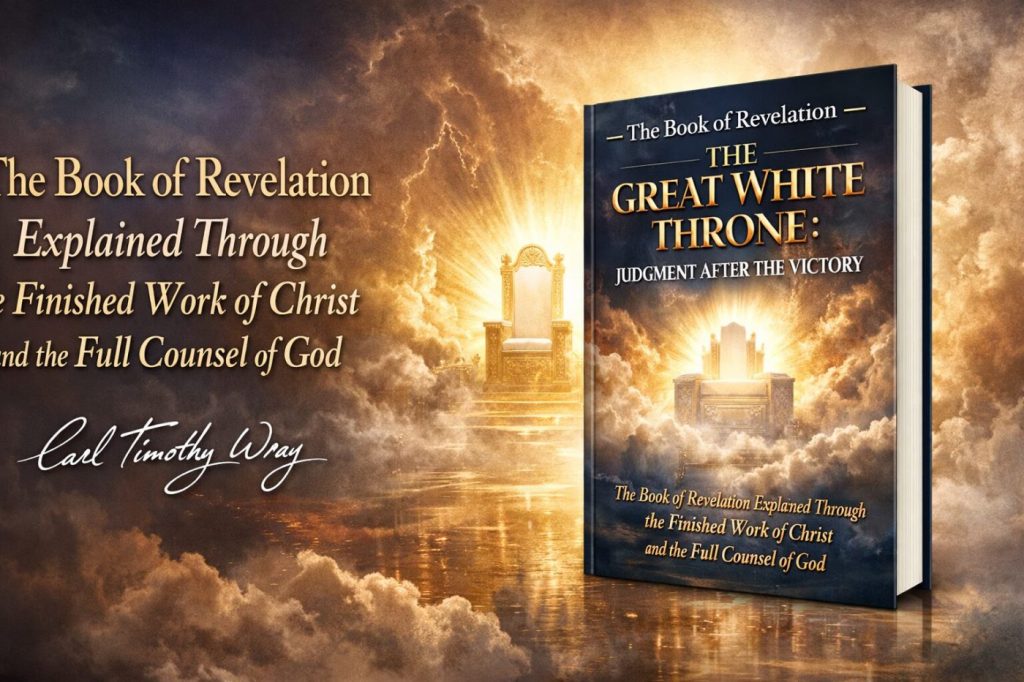
The Book of Revelation Explained Through the Finished Work of Christ and the Full Counsel of God
Book of Revelation: AUTHOR
By Carl Timothy Wray
Carl Timothy Wray is a teacher and writer devoted to unveiling the finished work of Christ through the full counsel of God, from Genesis to Revelation. His writings confront fear-based theology, expose religious delay, and restore the Book of Revelation to its rightful place as the unveiling of Christ’s present reign. With a focus on clarity, coherence, and reconciliation, Wray’s work consistently presents judgment, authority, and restoration as flowing from one throne — the throne of the Lamb — where victory has already been secured and is now being administered.
The Great White Throne in the Book of Revelation has long been taught as a future courtroom where God decides the fate of humanity, but this interpretation fractures the Gospel and contradicts the finished work of Christ. This book reveals the Great White Throne as judgment after the victory, not before it — the administration of Christ’s completed triumph over sin, death, and deception. By tracing the full counsel of God from Genesis through Revelation, this scroll shows that judgment is not delayed punishment, but the present execution of what the cross already accomplished, culminating in the destruction of death itself and the reconciliation of all things under the reign of the Lamb.
Book of Revelation: INTRODUCTION
For generations, the Great White Throne has been presented as the final terror of Scripture — a looming courtroom where God will one day decide who is worthy to live and who must be destroyed. This teaching has placed Revelation at odds with the Gospel, judgment at odds with grace, and the end of the Bible at odds with its beginning.
But John did not see a future throne that had yet to be activated.
He saw a throne already set.
The Book of Revelation is not the story of a victory waiting to happen; it is the unveiling of a victory already won. When Christ cried, “It is finished,” judgment was executed, sin was condemned, death was defeated, and authority was transferred to the Son. Revelation does not reopen the case — it reveals how that finished work is administered until every enemy, including death itself, is put under His feet.
The Great White Throne, then, is not God deciding outcomes. It is God enforcing truth. It is not a sentencing of humanity, but the exposure and removal of everything that opposes life. When the books are opened, they do not determine worth — they reveal reality. When death and Hades are cast into the lake of fire, Scripture declares not eternal torment, but the end of the enemy Christ already defeated.
This book approaches Revelation 20 through the finished work of Christ and the full counsel of God, refusing to isolate the throne from the cross or judgment from redemption. Here, judgment is seen as after the victory — the final administration of Christ’s triumph until God is all in all.
If Revelation is to be understood rightly, it must agree with the Gospel that precedes it. This scroll is written to remove the veil, silence fear, and restore the Great White Throne to its rightful place: not as a threat to creation, but as the confirmation that the victory of the Lamb stands complete.
Chapter 1 — The Throne Is Already Set
A Finished Throne, Not a Future One
When John begins the revelation, he does not describe a throne being prepared, assembled, or reserved for a later date. He says plainly:
“And immediately I was in the Spirit: and, behold, a throne was set in heaven, and one sat on the throne.”
The throne was already set.
This single sentence governs the entire Book of Revelation. Before a seal is opened, before a trumpet sounds, before a vial is poured out, the throne is established, occupied, and functioning. Revelation does not move toward a throne — it moves from one.
The error of much eschatology is assuming the throne appears later in the book, particularly in Revelation 20. But John never introduces a new throne. He never signals a change of seat, authority, or administration. What he sees in Revelation 20 is not a different throne — it is the same throne fully unveiled.
One Throne, One Administration
The Book of Revelation does not present multiple thrones for different purposes — one for grace, one for judgment, and one for final reckoning. Scripture presents one throne from which all authority flows.
Grace does not come from a different place than judgment.
Mercy does not operate independently of righteousness.
Administration is not separated from redemption.
All of it flows from one seat: the throne of the Lamb.
This is why Revelation cannot contradict the Gospel. If judgment flows from the same throne that produced the cross, then judgment must agree with the cross. The throne does not undo what Calvary accomplished — it enforces it.
The Throne and the Finished Work
The New Testament is clear that Christ did not ascend to await authority. He ascended because authority had already been secured.
- He sat down because the work was finished.
- He reigns because the enemy was defeated.
- He administers because victory was accomplished.
The throne in Revelation is not waiting for Christ to win — it reveals how Christ governs after winning.
This is why Revelation is called an unveiling. Nothing new is being decided. What was hidden is being revealed. What was settled is being shown. What was finished is being administered.
Revelation 4 Governs Revelation 20
The Great White Throne in Revelation 20 cannot be understood apart from the throne set in Revelation 4. The latter governs the former.
If the throne is already occupied in Revelation 4, then Revelation 20 cannot be the beginning of judgment — it must be the completion of administration. Judgment there is not the start of justice, but the final exposure of everything that has already been condemned by the cross.
This is why Scripture does not say, “And I saw another throne.”
It says, “I saw a great white throne.”
Same throne.
Greater unveiling.
Why This Matters
If the throne is already set, then:
- Judgment is not delayed
- Authority is not postponed
- Victory is not future
- Fear is not warranted
The throne has never been vacant. Christ has never been waiting. Death has never been winning.
The rest of the Book of Revelation unfolds from this single truth: the throne is already set, and the Lamb already reigns.
Chapter Summary
The Book of Revelation begins where the Gospel ends — with Christ enthroned and victorious. Every vision that follows flows from this reality. The Great White Throne is not a contradiction of grace, but the confirmation of victory. Judgment does not initiate redemption; it administers what redemption has already accomplished.
The throne is not coming.
The throne is not forming.
The throne is not future.
The throne is already set.
Chapter 2 — Judgment After the Cross, Not Before
Judgment Was Executed at Calvary
One of the greatest misunderstandings surrounding judgment in the Book of Revelation is the assumption that judgment is something God postpones until the end of time. Scripture teaches the opposite. Judgment was not delayed; it was executed.
Jesus did not speak of judgment as a future threat. He spoke of it as a present accomplishment:
“Now is the judgment of this world: now shall the prince of this world be cast out.”
Notice the language — now, not later. Judgment was not waiting on Revelation 20. It was carried out at the cross.
The cross was not merely an act of forgiveness; it was an act of judgment. Sin was judged. The world-system was judged. The ruler behind it was judged. What remained was not judgment pending, but judgment administered.
The Cross Settled What the Throne Administers
The finished work of Christ did not leave unresolved accounts for a future courtroom. When Christ cried, “It is finished,” judgment was settled. Nothing remained undecided.
The throne does not revisit Calvary to see if it worked.
The throne enforces what Calvary accomplished.
This is the essential distinction Babylon misses:
Judgment decides nothing in Revelation — it reveals everything.
Revelation is not about God determining guilt. Guilt was already dealt with. Revelation is about unveiling the consequences of truth confronting everything that contradicts it.
Why Judgment Must Be After the Victory
If judgment were still future in the sense of decision-making, then Christ’s victory would be incomplete. That would mean:
- Sin was forgiven but not judged
- Death was wounded but not defeated
- Authority was promised but not secured
Scripture allows none of that.
Judgment must be after the victory, because the victory was total. Revelation does not announce a war Christ still needs to win. It announces how His victory is applied until nothing opposed to life remains.
Judgment as Exposure, Not Condemnation
Throughout Scripture, judgment consistently functions as exposure.
Light exposes darkness.
Truth exposes lies.
Life exposes death.
This is why judgment is often described in terms of unveiling, opening, and revealing. Revelation itself is not named The Sentencing of Jesus Christ, but The Revelation of Jesus Christ.
Judgment, therefore, is not God deciding who deserves life. It is life revealing what cannot coexist with it.
The Error of Placing Judgment at the End
When judgment is pushed entirely to the end of time, several distortions occur:
- Fear replaces faith
- Delay replaces authority
- Punishment replaces restoration
- Revelation contradicts the Gospel
But when judgment is understood as having occurred at the cross and being administered from the throne, Revelation comes back into harmony with the rest of Scripture.
Judgment is not the undoing of grace.
Judgment is grace in action, removing what grace already conquered.
Revelation 20 in Its Proper Order
By the time we reach the Great White Throne, judgment is not beginning — it is concluding. Revelation 20 is not where Christ takes the bench for the first time; it is where the results of His reign are made fully manifest.
That is why death itself is judged.
That is why Hades is removed.
That is why the enemy is eliminated, not preserved.
This is judgment after the victory, not before it.
Chapter Summary
The cross is where judgment was executed. The throne is where that judgment is administered. Revelation does not threaten a future reckoning that might go wrong — it unveils the certainty that Christ’s judgment has already gone right.
Judgment is not coming to decide the outcome.
Judgment is present to enforce it.
The victory came first.
Judgment followed.
And that order changes everything.
Chapter 3 — The Judge Is the Lamb
Judgment Entrusted to Redemption
One of the clearest statements in all of Scripture concerning judgment is this:
“The Father judges no one, but has committed all judgment to the Son.”
This single declaration removes every notion of cold, detached judgment from the throne. Judgment is not placed in the hands of abstract law, nor in the grip of untempered power. Judgment is entrusted to the Son — and in the Book of Revelation, the Son is revealed as the Lamb.
John does not see a lion roaring destruction from the throne.
He sees a Lamb as though it had been slain — standing in the midst of the throne.
This is not symbolism for weakness.
It is symbolism for how authority is exercised.
The Nature of the Judge Determines the Nature of Judgment
Judgment always takes its character from the judge who administers it.
If the judge were law alone, judgment would be retribution.
If the judge were wrath alone, judgment would be destruction.
But the judge is the Lamb — the One who laid down His life.
Therefore, judgment cannot contradict redemption.
It must serve it.
The Lamb does not judge to preserve death.
The Lamb judges to remove it.
Why the Lamb Judges
The Lamb judges because love cannot coexist with lies, corruption, and death. Judgment is not the opposite of love; it is love refusing to allow destruction to continue.
This is why Scripture says Christ judges in righteousness.
Righteousness is not punishment — it is rightness restored.
Everything that contradicts life must be confronted, exposed, and removed. That confrontation is judgment, and it is administered by the Lamb who already bore the cost.
The Cross Defines the Throne
The Lamb who judges is the same Lamb who was slain.
This means:
- Judgment is informed by sacrifice
- Authority is shaped by self-giving
- Power is exercised through love
The throne does not forget the cross.
The throne is established because of the cross.
This is why Revelation never presents judgment as revenge. It presents judgment as the outworking of a sacrifice that already secured victory.
Judgment That Saves the Creation
When judgment is seen through the Lamb, its purpose becomes clear. Judgment is not aimed at destroying creation, but at saving it from what destroys it.
The Lamb does not judge humanity out of existence.
The Lamb judges death out of existence.
The Lamb does not condemn creation.
The Lamb condemns the lie that enslaved it.
This is why death and Hades are judged.
This is why the enemy is removed.
This is why the book ends with restoration, not ruin.
Why Fear Cannot Govern the Throne
Fear-based interpretations of the Great White Throne fail because they forget who sits on it.
A Lamb does not rule by terror.
A Lamb rules by truth.
If the Judge is the Lamb, then judgment must be good news — even when it is severe — because it serves the healing of all things.
Chapter Summary
Judgment in Revelation is not entrusted to abstract justice, but to the Lamb who was slain. The cross defines the throne, and the throne enforces what the cross accomplished. Judgment, therefore, is not the denial of mercy, but mercy fully armed against death, deception, and corruption.
The Judge is not against creation.
The Judge gave His life for it.
And because the Judge is the Lamb, judgment can only move creation toward life.
Chapter 4 — The Books Were Opened: Truth, Not Sentencing
What the Opening of the Books Really Means
When many readers come to Revelation 20, fear enters at one phrase:
“And the books were opened.”
Tradition has taught people to hear this as a sentencing moment — a divine court where decisions are finally made and punishments assigned. But that assumption is imported into the text. John does not say sentences were issued. He says books were opened.
Opening is not the same as condemning.
Revealing is not the same as sentencing.
In the Book of Revelation, opening is always associated with unveiling, not verdicts.
Revelation Is a Book About Opening
Consider the pattern John has already established:
- Seals are opened — truth is unveiled
- Scrolls are opened — God’s purpose is revealed
- Heaven is opened — reality is disclosed
Opening never introduces something new.
It reveals what was already there.
The same principle governs the books at the Great White Throne.
Judgment by Works Is Exposure, Not Earning
Scripture says the dead are judged “according to their works.” This has been used to support punishment-based theology, but works in Scripture are descriptive, not determinative.
Works reveal nature.
Works expose alignment.
Works show what has been operating.
They do not determine worth. They expose reality.
The books are opened so that what death produced can be seen plainly — not so God can decide what He thinks about it.
Why Truth Must Be Opened
Nothing can be removed until it is revealed.
Darkness hides.
Light exposes.
Judgment functions as light. When truth shines, lies lose their authority. When reality is exposed, deception collapses. This is why Scripture consistently links judgment with revelation rather than punishment.
The books are opened so death has nowhere left to hide.
The Book of Life Was Already Written
Another critical detail often missed is this: the Book of Life is not written at the Great White Throne. It is already present.
Life is not awarded at the end.
Life precedes judgment.
This alone overturns the idea that Revelation 20 is about deciding who gets to live. Life stands as the reference point by which everything else is measured.
Judgment does not determine life.
Life judges death.
Truth as the Instrument of Judgment
When truth is revealed, everything that contradicts it comes under judgment automatically. This is why judgment does not require rage, force, or cruelty. Truth itself does the work.
What cannot survive truth is removed.
What agrees with truth remains.
This is the quiet power of judgment in Revelation.
Why This Cannot Be a Sentencing Scene
If the opening of the books were about sentencing, the narrative would move toward punishment without end. Instead, it moves toward:
- the removal of death
- the end of sorrow
- the healing of nations
- God all in all
Sentencing preserves enemies.
Truth removes them.
Revelation removes them.
Chapter Summary
The opening of the books at the Great White Throne is not God deciding outcomes, but God revealing reality. Judgment here functions as light, not law — exposing the works of death so they can be removed from creation entirely. The Book of Life stands as proof that life precedes judgment and governs it.
The books were not opened to condemn creation.
They were opened to end deception.
And once truth is fully revealed, death has no place left to stand.
Chapter 5 — Death and Hades on Trial
Who Is Actually Being Judged
By the time we reach the heart of Revelation 20, the text itself answers the question Babylon never asks:
Who is on trial?
John does not say people are cast into the lake of fire first.
He says this:
“And death and Hades were cast into the lake of fire.”
That single sentence reorders the entire passage.
In the Book of Revelation, the final enemy to be judged is not humanity — it is death.
Death Is the Defendant, Not the Judge
Religion has placed death on the throne, treating it as a divine instrument rather than a defeated enemy. But Scripture never does that.
Death entered through deception.
Death ruled through fear.
Death enslaved through ignorance.
Now death stands exposed.
The Great White Throne is not humanity standing trial before death; it is death standing trial before life.
Why Death Must Be Judged Publicly
Death was defeated at the cross, but Revelation shows how that victory is administered until death is fully removed from creation.
Victory secured → administration follows.
The public judgment of death is necessary because death claimed legitimacy. It ruled openly. It demanded authority. Judgment strips it of every claim.
This is not God punishing an enemy He failed to defeat earlier.
This is God displaying the defeat already accomplished.
Hades Falls With Death
Hades is not a rival kingdom to heaven. It is the holding realm of death’s authority — the shadow that exists because death exists.
When death is judged, Hades has nothing left to sustain it.
That is why Scripture joins them together:
- death and Hades
- enemy and shadow
- cause and consequence
When death falls, Hades collapses.
Why This Cannot Mean Eternal Punishment
If the lake of fire were a place designed to preserve suffering endlessly, then death would be preserved forever.
But Scripture says the opposite:
- death is destroyed
- death is abolished
- death is the last enemy
An enemy that never ends is not defeated.
A punishment that never ends is not victory.
Revelation shows the end of death, not its eternal administration.
The Lake of Fire as Final Removal
Fire in Scripture consumes what opposes life. It does not preserve corruption. When death is cast into the lake of fire, Scripture is declaring the end of the enemy, not the continuation of torment.
This is judgment unto removal.
This is judgment unto victory.
Death does not rule forever.
Death does not punish forever.
Death is removed forever.
Why This Changes Everything
Once death is identified as the object of judgment, fear-based theology collapses.
- Judgment is no longer against creation
- Punishment is no longer the goal
- Restoration becomes the trajectory
This aligns Revelation with:
- the Gospel
- the apostles
- the prophets
- the promise of God all in all
Chapter Summary
The Great White Throne reveals not the trial of humanity, but the trial of death itself. Death and Hades are judged, exposed, and removed, fulfilling the victory Christ already secured. Revelation does not end with death reigning eternally, but with death abolished completely.
The throne does not sentence creation.
The throne sentences the enemy.
And once death is judged, life reigns without rival.
Chapter 6 — The Lake of Fire and the End of the Enemy
Fire in Scripture Consumes — It Does Not Preserve
Few images have been more distorted than the lake of fire. Tradition has turned it into a chamber of endless punishment, but Scripture consistently presents fire as a consuming, purifying, and decisive force.
Fire ends what cannot remain.
Fire removes corruption.
Fire brings finality.
In the Book of Revelation, the lake of fire is not introduced to sustain suffering, but to end the enemy.
The Lake of Fire Is Defined by What It Consumes
John tells us exactly what the lake of fire is for:
- Death is cast into it
- Hades is cast into it
- The enemy is removed
The text does not say death is preserved there.
It says death is ended there.
If the lake of fire were endless torment, death would be endless. But Scripture declares the opposite — death is the last enemy, and it is destroyed.
The function of the lake of fire is not punishment without end, but removal without return.
Why Endless Punishment Contradicts Victory
An eternal punishment system would mean:
- death is never fully defeated
- evil is never fully removed
- God is never truly all in all
That would leave Revelation contradicting its own conclusion.
But Revelation does not end with two eternal kingdoms — one of life and one of torment. It ends with one restored creation, where death, sorrow, and pain are no more.
A victory that never eliminates the enemy is not victory.
A judgment that preserves death forever is not judgment unto victory.
Fire as Final Exposure
Fire does more than consume — it reveals. When fire touches something, what is real remains and what is false is burned away.
This is why judgment is often pictured as fire:
- it separates
- it clarifies
- it concludes
The lake of fire is the final exposure of death as a lie that cannot coexist with life. Once exposed fully, death has no place to stand.
Why the Enemy Cannot Be Preserved
God does not eternally maintain what Christ came to destroy.
The purpose of the cross was not to forgive sin while preserving death forever. The purpose was to destroy the works of the enemy.
Revelation shows the completion of that destruction.
The enemy is not recycled.
The enemy is not managed.
The enemy is ended.
The End of the Enemy Is Good News
When the lake of fire is understood as the end of death, Revelation becomes Gospel again.
- Fear dissolves
- Hope expands
- Restoration becomes inevitable
The lake of fire is not the horror of the story — it is the resolution of the conflict.
It is the place where the last enemy finally disappears.
Chapter Summary
The lake of fire in Revelation is not the eternal punishment of creation, but the final destruction of death itself. Fire consumes the enemy, exposes the lie, and brings the conflict to an end. Revelation does not preserve death forever; it abolishes it completely.
The lake of fire is not about endless suffering.
It is about a finished victory fully enforced.
And when the enemy is gone, nothing remains to oppose life.
Chapter 7 — Judgment Unto God All in All
Where Judgment Has Been Taking Everything
From the opening throne to the final unveiling, the judgment revealed in the Book of Revelation has never been moving toward exclusion. It has been moving toward completion.
Judgment is not God deciding what to do with creation.
Judgment is God finishing what He started.
Every act of judgment in Revelation removes something that does not belong so that what does belong may remain. The destination has always been clear:
God all in all.
Judgment Is the Pathway, Not the Obstacle
Religion has treated judgment as the obstacle standing in the way of restoration. Scripture treats judgment as the means by which restoration is secured.
- Lies must be judged for truth to reign
- Death must be judged for life to remain
- Corruption must be judged for creation to be healed
Judgment does not compete with grace.
Judgment serves grace.
The End of Division
By the end of Revelation, there are no rival kingdoms left standing.
- No death
- No curse
- No sorrow
- No night
What judgment has removed, life has replaced. What was opposed to God has been consumed. What remains is unhindered communion.
This is not partial victory.
This is not managed evil.
This is not eternal dualism.
This is completion.
Why God Must Be All in All
If God is not all in all, then something else remains sovereign. If death remains eternal, then death reigns forever alongside God. Scripture refuses this conclusion.
The victory of Christ is not symbolic.
The reconciliation of creation is not poetic.
The end of the enemy is not negotiable.
Judgment guarantees that nothing remains that can contradict God’s life.
The Great White Throne Revisited
Seen from the end of the book, the Great White Throne stands revealed not as a threat, but as a promise kept.
It promises:
- the end of death
- the exposure of lies
- the final removal of the enemy
- the unhindered reign of life
The throne is white because nothing impure remains.
It is great because nothing rivals it.
It is final because nothing comes after it.
Judgment After the Victory Fulfilled
This is the meaning of judgment after the victory.
- The victory was won at the cross
- The authority was secured in resurrection
- The administration unfolded through the ages
- The judgment concluded the conflict
Nothing is left unfinished. Nothing is left unresolved. Nothing is left outside the reach of Christ’s reign.
Final Summary
The Great White Throne does not contradict the Gospel — it confirms it. Judgment does not undo redemption — it completes it. Revelation does not end with eternal punishment, but with eternal life reigning without rival.
Judgment was never against creation.
Judgment was against death.
And when death is gone, God is all in all.
Closing Declaration
The throne has spoken.
The enemy is finished.
Life reigns without end.
This is judgment after the victory.
Book of Revelation: By Carl Timothy Wray

Book of Revelation Series
- Book of Revelation
- The Book of Revelation — The Throne of God
- Book of Revelation — The Throne Governing Through Administration
- The Book of Revelation — The Lamb’s Throne Governing Through Sons
- Join Our Facebook Page