 📺
📺
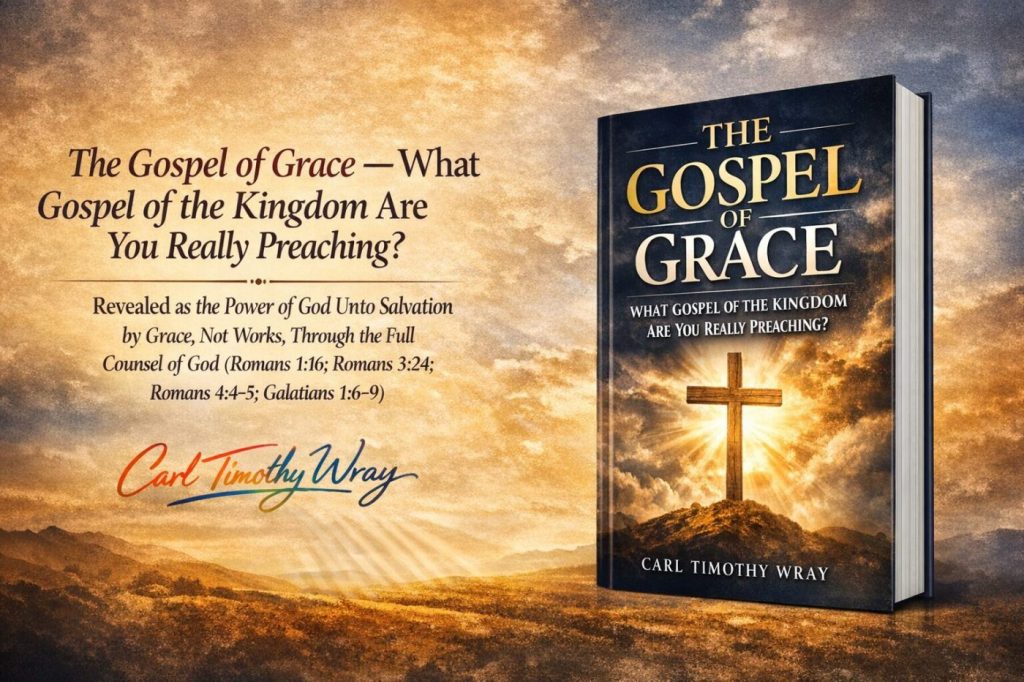
🔥 The Gospel of Grace — What Gospel of the Kingdom Are You Really Preaching? Revealed as the Power of God Unto Salvation by Grace, Not Works, Through the Full Counsel of God (Romans 1:16; Romans 3:24; Romans 4:4–5; Galatians 1:6–9)
✍️ The Gospel of Grace: AUTHOR
By Carl Timothy Wray
Carl Timothy Wray is a teacher of the Finished Work of Christ, dedicated to unveiling the full counsel of God from Genesis to Revelation. Through hundreds of books, teachings, and prophetic writings, his work focuses on revealing the Gospel of Grace, the righteousness of God, and the completed redemption found in Christ alone. His message centers on the transition from law to grace, from human effort to divine operation, and from religious striving to the rest of faith. With a strong emphasis on Scripture, Carl’s teachings are designed to equip believers with clarity, confidence, and a deeper understanding of the Gospel as the power of God unto salvation.
🔍
This book, The Gospel of Grace — What Gospel of the Kingdom Are You Really Preaching?, provides a clear, Scripture-based answer to one of the most searched questions in Christianity: what is the gospel of the kingdom? Through a full counsel study of Romans 1:16, Romans 3:24, Romans 4:4–5, and Galatians 1:6–9, this teaching reveals that the true gospel is not based on human works, effort, or performance, but on the grace of God through Jesus Christ. Discover the difference between grace and works, the meaning of justification by faith, and how the gospel of grace is the power of God unto salvation. If you are seeking a deeper understanding of the gospel, the kingdom of God, and how righteousness is given freely, this book will bring clarity and alignment with the truth of Scripture.
🔥 The Gospel of Grace: INTRODUCTION
Many today speak of the gospel of the Kingdom.
It is often described as the good news that God reigns, that His rule has come, and that humanity is called to live under that rule through obedience, transformation, and discipleship. These elements are important, and they reflect real aspects of the Kingdom revealed throughout Scripture.
But before we define how we live within the Kingdom, a more foundational question must be asked:
What is the gospel itself?
Because the gospel is not first about what man does in response to God—it is about what God has done through Christ.
The apostle Paul defines the gospel as “the power of God unto salvation.” He goes on to reveal that this salvation is not earned through works, but given freely by grace. He draws a line so clear that it leaves no room for mixture: if righteousness comes by works, it is debt—but if it comes by grace, it is a gift.
This raises an important question for every believer, teacher, and minister:
When we speak of the gospel of the Kingdom, what gospel are we actually preaching?
Is it a message centered on what man must do to enter, maintain, or prove his place in God’s Kingdom?
Or is it the revelation of what God has already accomplished through Jesus Christ—where righteousness is given freely, justification is not earned, and salvation is entirely the work of God?
This book does not seek to accuse, but to examine.
We will walk through the full counsel of God—from the law that established a system of works, to the grace revealed in Christ that fulfills and replaces it. We will explore how the gospel of the Kingdom and the gospel of grace are not separate messages, but one unified revelation when rightly understood.
Because the question is not whether we are preaching the Kingdom.
The question is:
Are we preaching the gospel that brings men into it?
🔥 Chapter 1 — The Command: Preach the Gospel of the Kingdom
The Commission Is Clear
Before defining the gospel, we must first establish the command.
Jesus did not leave the message open to interpretation—He defined what was to be preached.
Matthew 24:14:
“And this gospel of the kingdom shall be preached in all the world for a witness unto all nations; and then shall the end come.”
This is not a suggestion.
This is the global commission.
- Not a regional message
- Not a partial truth
- Not a fragmented doctrine
👉 This gospel of the kingdom is to be preached to all nations.
The Same Command Repeated
After His resurrection, the instruction remained consistent:
Mark 16:15:
“Go ye into all the world, and preach the gospel to every creature.”
Notice:
- The scope → all the world
- The audience → every creature
- The message → the gospel
There is no variation given.
There is no second message introduced.
What Jesus Himself Preached
To understand the command, we must look at the example.
What did Jesus preach?
Luke 4:43:
“I must preach the kingdom of God to other cities also: for therefore am I sent.”
This was not one message among many.
👉 It was the reason He was sent
The Kingdom Was Central
After the resurrection, the focus did not change.
Acts 1:3:
“…being seen of them forty days, and speaking of the things pertaining to the kingdom of God.”
Even after:
- the cross
- the resurrection
👉 The subject remained the same:
the Kingdom of God
The Question That Must Be Asked
At this point, everything is clear:
- The gospel must be preached
- It is called the gospel of the Kingdom
- Jesus Himself preached it
- The apostles were commanded to continue it
But this brings us to a critical question:
👉 What is the gospel of the Kingdom?
Because while the command is clear…
👉 Definitions today are not
Many Definitions, One Gospel
Today, the gospel of the Kingdom is often described as:
- God’s rule being established
- A call to live under His authority
- A transformed lifestyle
- A new way of living
These descriptions contain truth—but they raise a deeper issue:
👉 Do they define the gospel itself…
or the life that follows it?
The Order Must Be Right
Before we define:
- how a man lives in the Kingdom
We must first define:
👉 how a man enters it
Because the gospel is not first about:
- behavior
- obedience
- transformation
👉 It is about salvation
The Gospel Defined by Scripture
The apostle Paul defines the gospel this way:
Romans 1:16:
“For I am not ashamed of the gospel of Christ: for it is the power of God unto salvation to every one that believeth…”
This is critical.
The gospel is:
- not first instruction
- not first behavior
- not first response
👉 It is the power of God unto salvation
A Necessary Distinction
This brings us to a necessary distinction:
- The Kingdom describes God’s rule
- The Gospel describes how man enters that rule
If this distinction is missed:
- the message becomes confused
- the focus shifts to man
- and the power of the gospel is diminished
The Foundation of This Book
This book is built on one central question:
👉 When we preach the gospel of the Kingdom…
Are we preaching the message that brings men into salvation?
or
Are we describing the life that follows after it?
Because the gospel must be:
- clear
- defined
- anchored in Scripture
The Transition Forward
The command is clear:
👉 Preach the gospel of the Kingdom
But before we can fulfill that command properly, we must answer the next question:
👉 What is the gospel according to Scripture?
That is where we turn next.
🔥 Chapter 2 — What Is the Gospel According to Scripture?
The Word “Gospel” Must Be Defined
Before we build doctrine, we must define terms.
The word gospel means:
👉 good news
But that raises the question:
👉 What is the good news?
Not what men say it is…
Not what tradition has shaped it into…
👉 But what Scripture defines it as
The Gospel Originates with God
Paul begins here:
Romans 1:1:
“…separated unto the gospel of God.”
The gospel is not:
- man’s idea
- man’s response
- man’s system
👉 It is the gospel of God
It originates in Him.
The Gospel Is the Power of God
Paul defines it further:
Romans 1:16:
“For I am not ashamed of the gospel of Christ: for it is the power of God unto salvation to every one that believeth…”
This is foundational.
The gospel is:
- not merely information
- not instruction
- not a call to action
👉 It is the power of God unto salvation
The Gospel Is About Salvation
If the gospel is the power of God unto salvation, then its focus is clear:
👉 Salvation—not behavior
Not first:
- how to live
- how to act
- how to perform
👉 But how man is saved
The Content of the Gospel
Paul gives the clearest definition:
1 Corinthians 15:1–4:
“…the gospel…
how that Christ died for our sins…
and that he was buried, and that he rose again the third day…”
The gospel is not vague.
It is:
- Christ died
- Christ was buried
- Christ rose again
👉 The gospel is what Christ has done
The Gospel Is Not Based on Works
Paul removes all confusion:
2 Timothy 1:9:
“Who hath saved us… not according to our works, but according to his own purpose and grace…”
And again:
Ephesians 2:8–9:
“For by grace are ye saved through faith… not of works…”
This is not partial.
👉 Not of works
Not assisted by works
Not maintained by works
Not completed by works
The Gospel Produces Righteousness
Paul reveals what the gospel brings:
Romans 1:17:
“For therein is the righteousness of God revealed…”
The gospel does not:
- demand righteousness
👉 It reveals and gives righteousness
The Gospel Is Received, Not Achieved
The response to the gospel is not effort—it is faith.
Romans 1:16:
“…to every one that believeth…”
And:
John 1:12:
“…as many as received him…”
Faith is:
👉 receiving
Not producing
Not earning
Not achieving
The Gospel Leaves No Room for Boasting
If the gospel is:
- God’s power
- God’s work
- God’s grace
Then:
👉 man has no ground to boast
Romans 3:27:
“Where is boasting then? It is excluded.”
The Gospel in Full Counsel
When the full thread of Scripture is followed, the gospel is seen clearly:
- Promised beforehand
- Romans 1:2
- Fulfilled in Christ
- Galatians 4:4–5
- Declared to all
- Mark 16:15
👉 One message
👉 One gospel
👉 One source
The Critical Clarification
Now we must make a distinction that will carry this entire book:
👉 The gospel is not:
- the life you live
- the behavior you produce
- the transformation you pursue
👉 The gospel is:
- the work God accomplished in Christ
- the salvation He provides
- the righteousness He gives
The Question That Now Stands
If the gospel is:
- the power of God unto salvation
- not of works
- centered in Christ
- received by faith
Then this question must be asked:
👉 When we preach the gospel of the Kingdom…
Are we preaching what God has done?
or
Are we emphasizing what man must do?
The Transition Forward
Now that the gospel has been defined…
We must ask:
👉 What is its nature?
Because while Scripture calls it:
- the gospel of God
- the gospel of Christ
- the gospel of salvation
There is one defining characteristic that governs them all:
👉 Grace
🔥 Chapter 3 — The Nature of the Gospel: Grace
The Gospel Named by Its Nature
Scripture uses several titles:
- gospel of God
- gospel of Christ
- gospel of salvation
But in one place, the nature is stated plainly:
Acts 20:24:
“…to testify the gospel of the grace of God.”
This is not a different gospel.
👉 It is the same gospel, defined by its nature:
Grace
Grace Defines How the Gospel Works
If the gospel is grace, then everything about it flows from that reality.
Grace means:
- not earned
- not deserved
- not produced by man
👉 It originates entirely in God.
Saved by Grace, Not Works
Scripture removes all confusion:
Ephesians 2:8–9:
“For by grace are ye saved through faith… not of works…”
This defines salvation:
- Source → grace
- Response → faith
- Exclusion → works
There is no mixture here.
Grace and Works Cannot Coexist
Paul makes this absolute:
Romans 11:6:
“And if by grace, then is it no more of works…”
Not less works
Not reduced works
👉 No works
Because the moment works are added:
👉 grace is no longer grace
Grace Is God Acting, Not Man Assisting
The gospel is not:
- God doing part
- man doing part
It is:
👉 God accomplishing the whole
2 Timothy 1:9:
“…not according to our works, but according to his own purpose and grace…”
This means:
- God initiated
- God accomplished
- God applied
Grace Produces Justification Freely
Grace is not abstract—it produces something definite:
Romans 3:24:
“Being justified freely by his grace…”
- Justification → declared righteous
- Freely → without cause in you
- By grace → sourced in God
👉 Righteousness is given—not earned
Grace Justifies the Ungodly
Grace goes further than expected:
Romans 4:5:
“…him that justifieth the ungodly…”
Not the improved
Not the qualified
👉 The ungodly
This reveals:
- grace acts first
- transformation follows
Grace Establishes the Promise
Paul connects grace to certainty:
Romans 4:16:
“Therefore it is of faith, that it might be by grace; to the end the promise might be sure…”
Grace makes the promise:
- sure
- secure
- unbreakable
Because it does not depend on man.
Grace Excludes Boasting
If everything is by grace:
Romans 3:27:
“Where is boasting then? It is excluded.”
- No credit
- No achievement
- No self-righteousness
👉 All glory belongs to God
Grace Is the Thread Through the Whole Counsel
From beginning to end:
- Promise given before works
- Genesis 15:6
- Fulfilled in Christ
- John 1:17
- Revealed through the apostles
- Acts 20:24
👉 One continuous thread:
Grace
The Critical Clarification
This must be settled:
👉 The gospel is not:
- grace plus effort
- grace plus performance
- grace plus qualification
👉 The gospel is:
grace alone as the source of salvation
The Question That Now Presses
If the gospel is grace…
If salvation is not of works…
If righteousness is freely given…
Then this question must be asked:
👉 When we speak of the gospel of the Kingdom…
Are we describing grace?
or
are we introducing works into what God has already finished?
The Transition Forward
Now that the nature of the gospel is clear…
We must examine what stands in contrast to it.
Because Scripture presents two systems:
👉 Grace
👉 Works
And they cannot coexist.
🔥 Chapter 4 — The Law: A System of Works and Debt
The Law Speaks in One Voice
If grace defines the gospel, then the law must be understood in its own language.
Scripture does not leave this unclear.
Leviticus 18:5:
“Ye shall therefore keep my statutes, and my judgments: which if a man do, he shall live in them…”
This is the voice of the law:
- Do → and live
- Perform → and receive
The law is built on a single principle:
👉 Action produces outcome
The Demand of Total Obedience
The law does not accept partial obedience.
Deuteronomy 27:26:
“Cursed be he that confirmeth not all the words of this law to do them.”
And Paul confirms:
Galatians 3:10:
“…Cursed is every one that continueth not in all things which are written in the book of the law to do them.”
This reveals:
- Not some things
- Not most things
👉 All things
One failure brings a man under the curse.
The Righteousness of the Law Defined
Paul describes how the law defines righteousness:
Romans 10:5:
“…That the man which doeth those things shall live by them.”
Under the law:
- Righteousness is achieved
- Life is earned
- Acceptance is conditional
The Law Produces Debt, Not Grace
This is the critical connection:
Romans 4:4:
“Now to him that worketh is the reward not reckoned of grace, but of debt.”
If a man could fulfill the law:
👉 God would owe him
It would no longer be:
- grace
- a gift
It would become:
👉 wages
The System of Wages
Under the law:
- You work → you earn
- You perform → you receive
This is not evil—it is simply a different system.
But it is a system that:
👉 depends entirely on man
The Law Is Holy—but Limited
Scripture is clear:
Romans 7:12:
“Wherefore the law is holy, and the commandment holy, and just, and good.”
The problem is not the law.
👉 The problem is the flesh attempting to fulfill it
The Weakness of the Law
Romans 8:3:
“For what the law could not do, in that it was weak through the flesh…”
The law:
- reveals righteousness
- demands righteousness
But it cannot:
👉 produce righteousness in man
The Purpose of the Law
The law was never meant to be the final system.
It was given to:
- reveal sin
- expose inability
- shut down self-righteousness
Romans 3:20:
“…for by the law is the knowledge of sin.”
The Hidden Tension
The law creates a tension every man must face:
- God requires perfection
- Man cannot produce it
This leads to the unavoidable conclusion:
👉 If righteousness depends on works… no man can stand
The Critical Contrast
Now the contrast becomes clear:
Law
- demands
- requires
- measures
- produces debt
Grace
- gives
- provides
- declares
- produces righteousness
The Question That Now Presses
If the law operates on:
- doing
- earning
- wages
And the gospel operates on:
- grace
- giving
- receiving
Then this question must be asked:
👉 When we preach the gospel of the Kingdom…
Are we presenting a system of grace…
or
a system that still operates on works?
The Transition Forward
The law has now been defined.
Its system is clear:
👉 works → wages → debt
Now we must answer the next question:
👉 Why could this system never produce righteousness in man?
🔥 Chapter 5 — Why the Law Could Never Produce Righteousness
The Law Reveals, But Does Not Justify
The law is clear in what it demands.
But Scripture is equally clear in what it cannot do.
Romans 3:20:
“Therefore by the deeds of the law there shall no flesh be justified in his sight: for by the law is the knowledge of sin.”
This settles it:
- The law defines righteousness
- But it cannot produce it
👉 No flesh is justified by it
The Knowledge of Sin, Not the Removal of Sin
The law functions as a revealer.
It exposes:
- what is wrong
- what is lacking
- what falls short
But it does not remove what it reveals.
👉 It brings knowledge of sin, not deliverance from it
Sin Becomes Active Under the Command
Paul explains this from experience:
Romans 7:7–13:
“…I had not known sin, but by the law…
For without the law sin was dead.
For I was alive without the law once: but when the commandment came, sin revived, and I died.”
Notice the sequence:
- The commandment comes
- Sin becomes active
- Death follows
The law does not suppress sin.
👉 It exposes and stirs it
The Problem Is the Flesh
The issue is not the law—it is the one attempting to fulfill it.
Romans 8:3:
“For what the law could not do, in that it was weak through the flesh…”
The law is:
- holy
- just
- good
But the flesh:
- cannot meet its standard
👉 That is the failure point
No Man Is Justified by Works
Paul removes all ambiguity:
Galatians 2:16:
“…a man is not justified by the works of the law…”
Not partially
Not eventually
👉 Not at all
The Law Could Never Make Perfect
Even with continual effort, the outcome never changed.
Hebrews 10:1:
“…can never… make the comers thereunto perfect.”
- Repeated sacrifices
- Ongoing effort
- Continuous striving
👉 Yet never perfection
The Universal Condition
The conclusion applies to all:
Romans 3:23:
“For all have sinned, and come short of the glory of God.”
- No exceptions
- No qualifiers
👉 Under the law, all fall short
The Law Shuts the Door on Self-Righteousness
The purpose becomes clear:
Romans 3:19:
“…that every mouth may be stopped, and all the world may become guilty before God.”
The law removes:
- excuses
- confidence in self
- hope in performance
The Necessary Conclusion
At this point, one conclusion must be accepted:
👉 If righteousness depends on works…
👉 No man can be justified
The system cannot succeed because:
- the requirement is perfection
- the subject is imperfect
The Setup for Grace
This is not the end—it is preparation.
The law brings man to a place where:
- he cannot trust his works
- he cannot rely on performance
- he cannot justify himself
👉 He becomes ready for another system
The Question That Now Stands
If the law cannot justify…
If works cannot produce righteousness…
If all fall short…
Then the question becomes:
👉 How does God justify man?
The Transition Forward
The failure of the law is not defeat.
It is the doorway to revelation.
Because now, Scripture reveals something entirely different:
👉 A righteousness not earned
👉 A justification freely given
👉 A salvation rooted in grace
🔥 Chapter 6 — Freely Justified by His Grace
The Shift: “But Now”
After proving the failure of the law, Scripture introduces a decisive turn:
Romans 3:21:
“But now the righteousness of God without the law is manifested…”
These two words change everything:
👉 But now
- Not later
- Not after improvement
- Not after qualification
👉 Now
This marks the introduction of a righteousness that does not come from man’s performance.
A Righteousness Without the Law
Paul continues:
Romans 3:22:
“…even the righteousness of God which is by faith of Jesus Christ unto all and upon all them that believe…”
This righteousness is:
- not produced by works
- not earned through obedience
- not measured by performance
👉 It is the righteousness of God
Freely Justified
Now the gospel is defined in its clearest form:
Romans 3:24:
“Being justified freely by his grace through the redemption that is in Christ Jesus.”
Every word matters.
“Justified”
Declared righteous—not becoming righteous through effort, but accounted righteous by God.
“Freely”
Without cause in you
Without payment
Without condition
👉 Nothing in man initiated this
“By His Grace”
Grace means:
- unearned
- undeserved
- fully sourced in God
Not Earned, Not Owed
This changes the entire framework.
Under the law:
- righteousness is earned
- life is wages
Under grace:
- righteousness is given
- life is a gift
👉 God is not responding to your works—He is acting from His grace
Through the Redemption in Christ
This justification is not without foundation:
Romans 3:24:
“…through the redemption that is in Christ Jesus.”
Christ:
- fulfilled the law
- satisfied the requirement
- completed the work
👉 So that righteousness could be given freely
God Remains Just
Paul addresses a critical question:
How can God justify the ungodly and still be righteous?
Romans 3:26:
“…that he might be just, and the justifier of him which believeth in Jesus.”
God did not ignore sin.
👉 He dealt with it fully in Christ
So now:
- He is just
- And He is the justifier
Boasting Is Excluded
If righteousness is freely given:
Romans 3:27:
“Where is boasting then? It is excluded.”
- No credit remains
- No achievement stands
- No self-righteousness survives
👉 Grace removes all grounds for boasting
The Foundation of the Gospel
This is the gospel in its pure form:
- Justification is free
- Grace is the source
- Christ is the means
- Faith is the response
👉 Man contributes nothing to the cause of his righteousness
The Critical Question
Now the tension rises:
If righteousness is freely given…
If justification is not earned…
If grace is the source…
Then this question must be asked:
👉 What happens when works are added to this message?
The Transition Forward
The gospel has now been revealed as grace.
But Scripture warns of something dangerous:
👉 Adding works to grace
And when that happens:
👉 The gospel is no longer the gospel
🔥 Chapter 7 — Not of Works: The Line That Cannot Be Crossed
The Two Systems Defined
Up to this point, the contrast has been building.
Now it must be made unmistakably clear.
Scripture presents two systems:
- Works — man produces, earns, and is rewarded
- Grace — God gives, man receives
There is no third system.
Wages or Gift
Paul states it plainly:
Romans 4:4–5:
“Now to him that worketh is the reward not reckoned of grace, but of debt.
But to him that worketh not, but believeth on him that justifieth the ungodly, his faith is counted for righteousness.”
This is the dividing line:
- Work → wages → debt
- Faith → grace → righteousness
👉 One cancels the other
Grace and Works Cannot Mix
Paul removes all possibility of blending the two:
Romans 11:6:
“And if by grace, then is it no more of works: otherwise grace is no more grace…”
Not less works
Not reduced works
👉 No works
Because the moment works are added:
👉 Grace is no longer grace
The Moment Grace Is Lost
This is where the shift happens:
It is not when works dominate…
👉 It is when works are introduced
Even a small addition:
- effort
- qualification
- performance
👉 Changes the entire system
Fallen from Grace
Paul addresses this directly:
Galatians 5:4:
“…whosoever of you are justified by the law; ye are fallen from grace.”
Notice:
- Not “failing in grace”
- Not “struggling in grace”
👉 Fallen from grace
Why?
Because they returned to a system of works.
Not of Works at All
Scripture is consistent:
Ephesians 2:9:
“Not of works, lest any man should boast.”
Not partially
Not mostly
👉 Not of works
The Purpose of Exclusion
Why must works be excluded?
Because if works remain:
- man can boast
- man can claim credit
- man can share in the cause
But the gospel is structured so that:
👉 God receives all the glory
Faith Ends Works as the Source
Paul explains the proper response:
Romans 4:5:
“…to him that worketh not, but believeth…”
This does not mean inactivity in life.
👉 It means:
He has ceased working to become righteous
Faith is:
- not striving
- not earning
👉 It is receiving
The Subtle Shift That Changes Everything
The danger is not always obvious.
The message may still:
- use Scripture
- speak of the Kingdom
- reference Christ
But if it places righteousness on:
- what man must do
👉 It has crossed the line
The Critical Question
This is where the title of this book becomes real:
👉 When we preach the gospel of the Kingdom…
Are we:
- declaring what God has done?
or - instructing what man must do to be accepted?
Because the difference is not small.
👉 It is the difference between grace and debt
The Line Has Been Drawn
Scripture has now made it clear:
- Grace → gives righteousness
- Works → attempts to earn it
👉 They cannot coexist
The Transition Forward
Now that the line is established…
We must examine the warning Scripture gives when this line is crossed.
Because the Bible does not treat mixture lightly.
It calls it something specific:
👉 Another gospel
🔥 Chapter 8 — Another Gospel: When Works Are Added
The Warning Given by the Apostle
Scripture does not treat this lightly.
Galatians 1:6–7:
“I marvel that ye are so soon removed… unto another gospel:
Which is not another…”
Paul’s language is precise:
- “another gospel”
- yet “not another”
👉 Not a second valid message…
👉 but a distortion of the one true gospel
What Made It “Another”?
The issue in Galatia was not that Christ was denied.
It was that something was added.
- faith in Christ… plus works of the law
- grace… plus requirement
- gift… plus performance
👉 The addition is what changed the message
The Seriousness of the Distortion
Paul continues:
Galatians 1:8–9:
“…though we, or an angel from heaven, preach any other gospel… let him be accursed.”
This is not personal language—it is protective language.
It guards:
- the purity of the gospel
- the clarity of salvation
- the source of righteousness
Another Jesus, Another Spirit, Another Gospel
The same concern appears elsewhere:
2 Corinthians 11:3–4:
“…lest… your minds should be corrupted…
For if he that cometh preacheth another Jesus… or another spirit… or another gospel…”
Notice the pattern:
- the message shifts
- the understanding shifts
- the experience shifts
👉 All because the gospel is altered
How the Shift Happens
This change is often subtle.
The message may still:
- speak of Jesus
- speak of the Kingdom
- use Scripture
But the center moves from:
👉 what God has done
to
👉 what man must do
Philosophy and Tradition Enter In
Paul warns:
Colossians 2:8:
“Beware lest any man spoil you through philosophy and vain deceit… after the tradition of men…”
When human reasoning enters:
- grace is diluted
- effort is introduced
- the message shifts subtly
The Nature of the Distortion
This is important:
Another gospel is not always:
- openly false
- obviously wrong
It is often:
👉 partially true, but wrongly centered
- truth about the Kingdom
- truth about obedience
- truth about transformation
👉 But placed in the wrong order
The Order Matters
The gospel is:
- What God has done
- What man receives
- What life produces
Another gospel reverses this:
- What man must do
- What man must become
- What man hopes to receive
👉 Same elements… wrong order
The Result of Mixture
When works are added:
- assurance is weakened
- peace is lost
- striving returns
Because the foundation has shifted from:
👉 grace
to
👉 performance
The Purpose of This Chapter
This is not written to accuse.
It is written to clarify.
To ask:
👉 Is the gospel we are preaching aligned with the one defined in Scripture?
The Key Question
Now the central question of this book stands fully formed:
👉 When we preach the gospel of the Kingdom…
Are we presenting:
- the finished work of Christ?
or - a system that still depends on human effort?
The Transition Forward
Now that the warning is clear…
We must return to the positive revelation:
👉 What is the gospel of the Kingdom when understood correctly?
Because the Kingdom is real…
But it must be understood through the lens of:
👉 grace
🔥 Chapter 9 — The Gospel of the Kingdom Revealed Through Grace
The Kingdom Must Be Understood Correctly
Throughout Scripture, the Kingdom of God is central.
Jesus spoke of it constantly.
The apostles proclaimed it.
But the question remains:
👉 How is the Kingdom entered?
Because if this is misunderstood, the entire message becomes distorted.
Seek First the Kingdom
Jesus said:
Matthew 6:33:
“But seek ye first the kingdom of God, and his righteousness…”
Notice:
- The Kingdom
- His righteousness
Not man’s righteousness
Not achieved righteousness
👉 His righteousness
The Kingdom Is Not External First
Jesus clarifies:
Luke 17:20–21:
“…the kingdom of God cometh not with observation…
for, behold, the kingdom of God is within you.”
The Kingdom is not first:
- location
- structure
- outward system
👉 It is a spiritual reality
The Nature of the Kingdom
Paul defines it:
Romans 14:17:
“For the kingdom of God is not meat and drink; but righteousness, and peace, and joy in the Holy Ghost.”
Notice the order:
- Righteousness
- Peace
- Joy
The Kingdom is not built on:
- rules
- performance
- external observance
👉 It is grounded in righteousness
How Righteousness Comes
Now we connect the threads:
Romans 3:24:
“Being justified freely by his grace…”
And:
Romans 4:5:
“…his faith is counted for righteousness.”
This means:
👉 The righteousness of the Kingdom is not earned
👉 It is given by grace
Except a Man Be Born Again
Jesus explains entry into the Kingdom:
John 3:3–5:
“…Except a man be born again, he cannot see the kingdom of God…”
This is critical:
Entry into the Kingdom is not:
- behavior modification
- moral improvement
- external obedience
👉 It is new birth
The Kingdom Begins with Salvation
Now the connection becomes clear:
- The gospel → power of God unto salvation
- Salvation → new birth
- New birth → entrance into the Kingdom
👉 The Kingdom is entered through grace
Not Built by Works
If the Kingdom is entered by new birth…
And new birth is not of works…
Then:
👉 The Kingdom is not built by human effort
The Correct Order Restored
Now everything aligns:
- God gives righteousness by grace
- Man receives it by faith
- The Kingdom is entered
- Life flows from that reality
👉 Grace first
👉 Life follows
The Misunderstanding Corrected
Many define the Kingdom as:
- how we live
- what we do
- how we obey
These are not wrong…
👉 But they are results, not the gospel
The Gospel of the Kingdom Defined
Now we can say it clearly:
👉 The gospel of the Kingdom is the good news that:
- God has provided righteousness through Christ
- Man is justified freely by grace
- Through this, he enters the Kingdom
- And lives from what he has received
The Unity of the Message
There are not two gospels:
- gospel of grace
- gospel of the Kingdom
👉 There is one gospel:
The Kingdom revealed through grace
The Final Question
Now the question becomes unavoidable:
👉 When we preach the Kingdom…
Are we:
- declaring the grace that brings men into it?
or - emphasizing the works that follow after it?
The Transition Forward
Now that the gospel of the Kingdom has been restored to its proper foundation…
We must answer one final question:
👉 Why is this gospel the only one with power?
🔥 Chapter 10 — The Power of the True Gospel
The Gospel Defined by Its Power
Paul does not define the gospel by tradition, structure, or human response.
He defines it by power:
Romans 1:16:
“For I am not ashamed of the gospel of Christ: for it is the power of God unto salvation to every one that believeth…”
This is the test:
👉 If it is the gospel… it must carry the power of God unto salvation
Not potential power
Not partial power
👉 Actual power
What This Power Produces
This power does not merely inform—it transforms.
It produces:
- salvation
- righteousness
- new life
But notice:
👉 It is God’s power, not man’s effort
The Message Determines the Power
The power is not separate from the message.
👉 The message itself carries the power
- When the message is pure → power flows
- When the message is altered → power is diminished
Why Grace Carries Power
Grace carries power because:
- it originates in God
- it depends on God
- it is completed by God
1 Corinthians 1:18:
“…the preaching of the cross… is the power of God.”
The power is not in:
- human ability
- human effort
- human performance
👉 It is in the finished work of Christ
Why Works Cannot Produce Power
Works depend on man.
- effort fluctuates
- performance fails
- consistency breaks
👉 What depends on man cannot carry divine power
The Loss of Power Through Mixture
When works are added:
- the focus shifts to man
- confidence shifts to performance
- dependence shifts from God
👉 And power diminishes
Not because God has changed…
👉 But because the message has
Rest Is Where Power Operates
Scripture reveals where God’s power flows:
Hebrews 4:10:
“For he that is entered into his rest, he also hath ceased from his own works…”
Power operates in:
- rest
- trust
- faith
Not in striving
Reigning Through Grace
Paul reveals the outcome:
Romans 5:17:
“…they which receive abundance of grace and of the gift of righteousness shall reign in life…”
Notice:
- Receive
- Gift
- Grace
👉 Power flows where grace is received
The True Gospel Produces Assurance
When the gospel is grace:
- salvation is secure
- righteousness is settled
- peace is established
But when works are added:
- doubt increases
- striving returns
- assurance weakens
The Final Test
Now everything comes to one question:
👉 Does the message you preach produce:
- rest… or striving?
- assurance… or uncertainty?
- dependence on God… or dependence on self?
Because:
👉 The true gospel produces life through grace
The Final Revelation
The Gospel of Grace reveals:
- God has justified freely
- Christ has completed the work
- Faith receives it
- The Kingdom is entered through it
👉 And this alone carries power
The Final Call
The question that began this book now stands answered:
👉 What gospel of the Kingdom are you really preaching?
Is it:
- a message of grace?
or - a message that still depends on works?
Closing Declaration
There is one gospel:
👉 The gospel of God
👉 The gospel of Christ
👉 The gospel of the Kingdom
And in its nature:
👉 It is the gospel of grace
🔥 Final Word
The power of God does not flow through what man does.
It flows through what God has already done.
The Gospel of Grace — What Gospel of the Kingdom Are You Really Preaching?
By Carl Timothy Wray

The Gospel of Grace Series
- The Gospel of Grace — The Finished Work Proclaimed
- The Gospel of Grace — God Justified You Without Your Works
- The Gospel of Grace — Not of Works, Lest Any Man Should Boast
- The Gospel of Grace — I Am the Vine, You Are the Branches
- Join Our Facebook Page and Group