
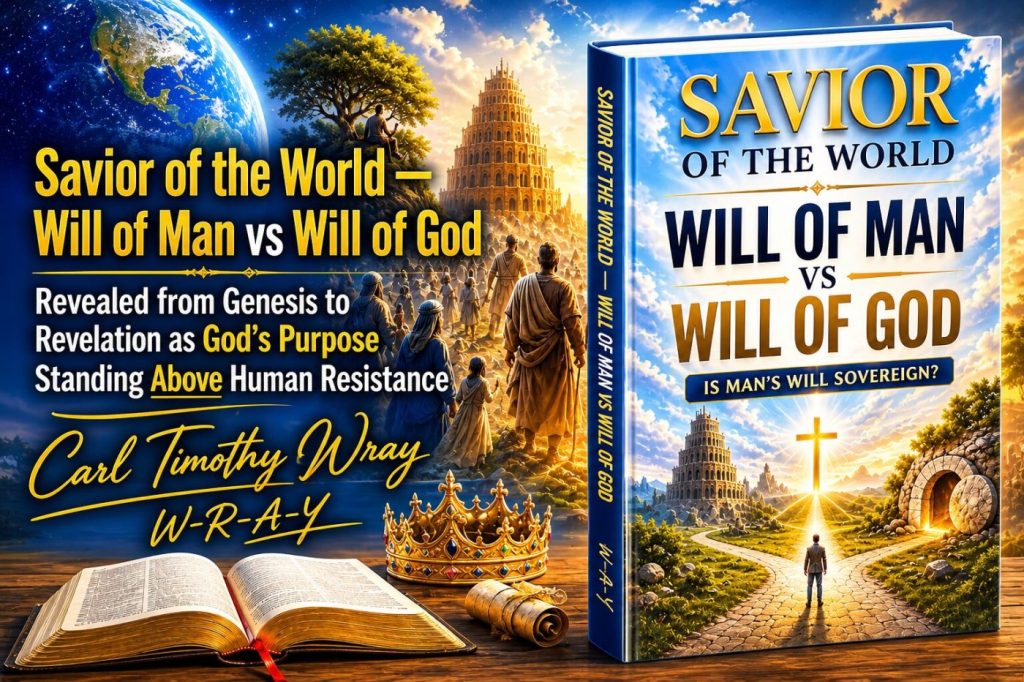
🔥 Savior of the World — Will of Man vs Will of God Revealed from Genesis to Revelation as God’s Purpose Standing Above Human Resistance
✍️ The Savior of the World: AUTHOR
By Carl Timothy Wray
Carl Timothy Wray is a prolific author and teacher devoted to unveiling the Finished Work of Christ through the full counsel of Scripture. With hundreds of books written across themes such as the Gospel of Grace, the Plan of the Ages, and the Book of Revelation, his work is centered on revealing the sovereignty of God, the identity of the sons of God, and the ultimate reconciliation of all things in Christ.
His writings are known for tracing the mind of God from Genesis to Revelation—bringing clarity where confusion has reigned and unveiling the divine order that governs all things. Through Zion University and a growing global library, his mission is to fill the earth with the knowledge of the glory of the Lord by presenting truth in a way that both seekers and mature believers can understand.
📈
Savior of the World — Will of Man vs Will of God: Is Man’s Will Sovereign? is a powerful biblical teaching that examines the long-debated question of human will versus divine sovereignty. This book traces the will of man vs the will of God through Scripture from Genesis to Revelation, revealing how God’s purpose stands even when man resists. Through examples such as Pharaoh, Jonah, Nebuchadnezzar, Judas, and the Cross of Christ, this work demonstrates that while human will is real, it is never ultimate. Readers searching for answers about free will, God’s sovereignty, and whether man can resist or override God’s plan will find clarity, balance, and full counsel in this in-depth study of Scripture.
🔥 The Savior of the World: INTRODUCTION
There are few questions in the church more debated—and more misunderstood—than this:
Can man say no to God… and stop what God has purposed?
For generations, believers have wrestled with the tension between the will of man and the will of God. Some teach that God is sovereign over all things, working every event according to His purpose. Others insist that man’s will is ultimately decisive—that God may desire something, but man can refuse it, divert it, or even cancel it altogether.
Between these two positions lies confusion, fear, and often contradiction.
If man’s will is sovereign, then God’s purpose is fragile—dependent on human agreement.
But if God’s will is absolute, what do we do with the many places in Scripture where men resist, rebel, and refuse Him?
This book does not answer that question with opinion.
It answers it with Scripture—line upon line, precept upon precept—tracing the testimony of God from Genesis to Revelation.
We will walk through the lives of men and nations:
- Adam in the garden
- Pharaoh in Egypt
- Jonah fleeing from the Lord
- Nebuchadnezzar exalting himself
- Judas betraying Christ
- And the Cross itself—the greatest “no” ever spoken by man
And in each case, we will ask one question:
What happened when man’s will stood against God?
Did God stop?
Did His purpose fail?
Or did something deeper unfold?
As we follow this thread, a pattern begins to emerge—one that is consistent, undeniable, and rooted in the very nature of God.
This book will show you that:
- Man’s will is real
- Man’s resistance is real
- Consequences are real
But above all…
God’s purpose is not fragile.
From the beginning to the end, Scripture reveals a God who is not reacting, adjusting, or hoping for cooperation—but a God who is working all things according to the counsel of His own will, even when man does not understand it.
This is not a message of passivity.
This is a message of clarity.
For while God’s will cannot fail, each man must come to terms with a deeper question:
Will I align with what God is doing… or will I learn through resistance what I could have walked in through obedience?
This is the tension.
This is the journey.
And this is the revelation we are about to uncover.
🔥 CHAPTER 1
The Question That Divides Theology
The Will of Man vs the Will of God
From the earliest days of the church until now, one question has stood at the center of theological debate:
Whose will is ultimate—God’s… or man’s?
This is not a small question.
It shapes how we understand:
- salvation
- judgment
- purpose
- obedience
- and even the nature of God Himself
For if man’s will is truly sovereign, then God’s plans are subject to human decision.
And if God’s will is truly sovereign, then we must understand how human choice fits within His purpose.
Many have tried to resolve this tension by choosing one side.
Some say:
👉 “God desires—but man decides.”
Others say:
👉 “God determines all things—man has no real say.”
But when we turn to Scripture, we do not find such simple answers.
We find something deeper.
🔹 THE CLAIM OF HUMAN SOVEREIGNTY
There is a teaching that has quietly taken root in much of modern Christianity:
That man possesses a will so independent, so decisive, that even God must wait upon it.
In this view:
- God offers salvation, but man must accept
- God desires change, but man must permit
- God has a plan, but man can resist it permanently
This leads to a subtle but powerful conclusion:
👉 That man’s “no” can override God’s “yes”
Yet Scripture never directly states this.
Instead, it presents something far more complex—and far more revealing.
🔹 THE TESTIMONY OF GOD’S WORD
When God speaks of His own will, He does not speak in uncertainty.
He declares:
👉 “My counsel shall stand, and I will do all my pleasure.” — Isaiah 46:10
👉 “He worketh all things after the counsel of His own will.” — Ephesians 1:11
These are not weak statements.
They are absolute.
They do not suggest a God who is:
- hoping
- reacting
- adjusting
They reveal a God who is:
👉 establishing, working, and fulfilling
And yet…
We cannot ignore what we also see in Scripture.
🔹 THE REALITY OF HUMAN RESPONSE
Throughout the Bible, men:
- disobey
- resist
- rebel
- delay
Adam eats the fruit.
Pharaoh hardens his heart.
Jonah runs.
Israel refuses to enter the land.
These are not illusions.
They are real responses.
Which brings us back to the tension:
👉 If God’s will stands…
👉 and man can resist…
How do these two truths coexist?
🔹 THE ERROR OF EXTREMES
When this tension is not understood, two errors emerge.
❌ Error One: Man’s Will Is Supreme
This leads to:
- fear (“What if I ruin God’s plan?”)
- instability (“Everything depends on me”)
- a diminished view of God
❌ Error Two: Man’s Will Is Meaningless
This leads to:
- passivity
- carelessness
- ignoring warnings and consequences
Both are incomplete.
Both fail to account for the full counsel of Scripture.
🔹 THE PATTERN WE MUST FOLLOW
Instead of forcing an answer, we must do something far more powerful:
👉 We must trace the pattern.
We must look at:
- what man did
- what God did
- and what the outcome was
Again and again.
From Genesis to Revelation.
Not one verse.
Not one doctrine.
👉 But the consistent testimony of Scripture.
🔹 A BETTER QUESTION
Perhaps the problem is not the question itself—but how we ask it.
Instead of asking:
👉 “Is man’s will sovereign?”
We should ask:
👉 “What happens in Scripture when man’s will stands against God?”
Because the answer to that question is not theoretical.
It is recorded.
It is repeated.
And it is consistent.
🔹 THE DIRECTION OF THIS BOOK
In the chapters that follow, we will examine case after case:
- The first “no” in Eden
- The rebellion at Babel
- Pharaoh’s resistance
- Jonah’s flight
- Nebuchadnezzar’s pride
- And the Cross itself
And in every situation, we will look for one thing:
👉 Did man’s will stop God… or did God work through it?
🔥 THE FOUNDATION TRUTH
As we begin this journey, we establish this as our starting point:
- God’s will is declared as absolute
- Man’s will is experienced as real
But the relationship between the two…
👉 must be understood through the full counsel of God
🔔 CHAPTER CLOSE
This is not a debate to win.
This is a truth to uncover.
For until we understand the relationship between the will of man and the will of God, we will either:
- overestimate ourselves
- or misunderstand Him
And both will lead us away from clarity.
👉 In the next chapter, we go back to the beginning—
to the first moment man said “no”…
…and we ask:
Did that “no” break the plan of God… or begin its unfolding?
🔥 CHAPTER 2
The First “No” in Eden
Did Man’s Failure Break the Plan of God… or Begin Its Unfolding?
In order to understand the will of man and the will of God, we must go back to the very beginning.
Not to a doctrine.
Not to an argument.
👉 But to the first recorded moment where man’s will stood in opposition to God.
🔹 THE COMMAND AND THE CHOICE
In the garden, God spoke clearly to man:
👉 “Of every tree of the garden thou mayest freely eat:
But of the tree of the knowledge of good and evil, thou shalt not eat…” — Genesis 2:16–17
There was no confusion.
God’s will was revealed.
Man understood the command.
And yet…
🔹 THE FIRST “NO”
When the serpent spoke, man was confronted with a decision.
Would he remain aligned with God’s word?
Or would he choose another voice?
We know the outcome.
Man ate.
In that moment:
- man disobeyed
- man stepped outside the command
- man expressed a will contrary to God
👉 This was the first “no”
🔹 THE QUESTION WE MUST ASK
Now we must ask the question that defines this entire book:
👉 Did this act stop the plan of God?
If man’s will is sovereign, then the answer must be yes.
- God intended one outcome
- man chose another
- therefore God’s plan was broken or diverted
But that is not what Scripture shows.
🔹 GOD’S IMMEDIATE RESPONSE
The moment man fell, God did not retreat.
He did not pause.
He did not begin to redesign His plan.
Instead, He spoke.
👉 “The seed of the woman shall bruise the serpent’s head…” — Genesis 3:15
This is one of the most powerful moments in all of Scripture.
Because at the exact point of man’s failure:
👉 God reveals redemption.
🔹 FAILURE DID NOT END THE PLAN
What we see in Eden is not the collapse of God’s purpose.
We see the unveiling of it.
- The fall did not surprise God
- The failure did not stop God
- The disobedience did not overrule God
Instead:
👉 It became the stage upon which God’s purpose would be revealed
🔹 A DEEPER UNDERSTANDING
This forces us to rethink what happened in the garden.
Man’s will:
- acted freely
- chose wrongly
- brought consequence
But God’s will:
- remained intact
- moved immediately
- revealed a greater purpose
🔹 CONSEQUENCES ARE REAL
This does not mean the fall was meaningless.
Far from it.
Because of man’s choice:
- death entered
- separation was experienced
- labor and sorrow increased
👉 The consequences were real
Which tells us something critical:
👉 Man’s will can affect experience…
👉 but it does not overthrow God’s purpose
🔹 THE PATTERN BEGINS
Right here in Genesis, the pattern for the entire Bible is established:
- Man acts
- Man fails
- God responds
- God reveals
- God continues
Not once do we see:
👉 “Man acted, and God’s plan ended”
🔹 THE SEED OF THE STORY
Genesis 3:15 is not just a response.
It is the seed of everything that follows:
- the coming of Christ
- the defeat of the serpent
- the restoration of man
- the fulfillment of all things
And it was spoken:
👉 not after man recovered… but while man had just fallen
🔥 THE FOUNDATION TRUTH
From the very beginning, we learn this:
- Man’s will is capable of saying “no”
- That “no” brings real consequences
- But that “no” does not stop God
Instead:
👉 God works forward from it
🔔 CHAPTER CLOSE
The first act of disobedience in human history did not prove that man’s will is sovereign.
It proved something else entirely.
👉 That God’s purpose is not fragile
For in the very moment man stepped out of alignment…
👉 God spoke the end from the beginning
👉 In the next chapter, we will see what happens when not just one man—but an entire world—unites in opposition to God.
And we will ask again:
When man builds against God… who ultimately determines the outcome?
🔥 CHAPTER 3
When Man Builds Against God
Babel and the Limits of Collective Will
In Eden, we saw one man say “no.”
But what happens when that “no” is no longer individual…
when it becomes collective?
What happens when humanity unites—not in alignment with God—but in opposition to Him?
🔹 A WORLD OF ONE MIND
After the flood, mankind began to multiply across the earth.
And Scripture tells us something striking:
👉 “The whole earth was of one language, and of one speech.” — Genesis 11:1
This was unity.
Not scattered.
Not divided.
👉 Unified thought
👉 Unified communication
👉 Unified purpose
But the question is not whether they were united.
The question is:
👉 What were they united in?
🔹 THE INTENTION OF MAN
As men journeyed, they came together with a plan:
👉 “Go to, let us build us a city and a tower, whose top may reach unto heaven…” — Genesis 11:4
And they revealed their motive:
👉 “…let us make us a name…”
This was not about survival.
This was not about obedience.
👉 This was about self-exaltation
🔹 A UNITED “NO”
Babel represents more than a construction project.
It represents a corporate will—a unified expression of humanity apart from God.
- Not seeking His name
- Not following His command
- Not aligning with His purpose
👉 But establishing their own
This was humanity saying, together:
👉 “We will define our own way”
🔹 THE CRITICAL QUESTION
Now we must ask again:
👉 What happens when man unites in opposition to God?
If human will—especially collective will—is sovereign, then this should have succeeded.
- Humanity was unified
- Humanity was capable
- Humanity was determined
So what happened?
🔹 GOD STEPS IN
Scripture reveals something powerful:
👉 “The Lord came down to see the city and the tower…” — Genesis 11:5
God was not threatened.
But He was fully aware.
And He said:
👉 “Nothing will be restrained from them, which they have imagined to do.” — Genesis 11:6
This is important.
It shows:
👉 Man has real capacity
👉 Man can accomplish much
But watch what happens next.
🔹 THE LIMIT OF HUMAN WILL
God responds—not with panic—but with authority:
👉 “Let us go down, and there confound their language…” — Genesis 11:7
And in a moment:
- Communication breaks
- Unity collapses
- The project stops
🔹 THE OUTCOME
👉 “So the Lord scattered them abroad…” — Genesis 11:8
The tower was never finished.
The plan was never completed.
The unified will of man…
👉 was interrupted
🔹 WHAT DOES THIS SHOW US?
This moment is critical to our understanding.
Because here we have:
- Not one man
- Not one failure
👉 But the entire human race moving in one direction
And yet:
👉 They did not override God
👉 They did not establish their own ultimate purpose
👉 They did not succeed in their defiance
🔹 THE PATTERN DEEPENS
From Babel, we learn:
- Man can unite
- Man can build
- Man can pursue his own name
But:
👉 Man cannot establish a purpose that stands against God
🔹 UNITY WITHOUT GOD IS NOT ULTIMATE
This challenges a powerful assumption.
Many believe:
👉 If enough people agree, it becomes truth
👉 If enough people unite, it becomes unstoppable
But Scripture shows:
👉 Unity does not equal sovereignty
Even total human agreement cannot override the will of God.
🔹 GOD DID NOT LOSE CONTROL
Notice what we do not see:
- God did not negotiate
- God did not wait for permission
- God did not abandon His purpose
Instead:
👉 He intervened
👉 He redirected
👉 He continued His plan
🔥 THE FOUNDATION TRUTH
From Babel, we learn this:
- Man’s will can unite
- Man’s will can build
- Man’s will can resist
But:
👉 Even collective human will is not ultimate
🔔 CHAPTER CLOSE
Babel stands as a witness through all generations.
A testimony that no matter how unified, determined, or capable humanity becomes…
👉 The will of man—whether individual or collective—does not stand above the will of God
👉 In the next chapter, we will move from nations… back to individuals—
chosen vessels with flawed wills.
And we will ask:
What happens when the very people God calls… do not fully align with Him?
🔥 CHAPTER 4
Chosen Men, Imperfect Wills
Abraham, Jacob, and the Process of Alignment
Up to this point, we have seen:
- Man resist God in Eden
- Humanity unite against God at Babel
But now the question shifts.
What happens when the will that struggles…
👉 belongs to someone God has chosen?
Does God abandon them?
Does their imperfection cancel the purpose?
Or does something else take place?
🔹 ABRAHAM — A PROMISE AND A DELAY
God called Abraham and made a clear promise:
👉 “In thee shall all families of the earth be blessed.” — Genesis 12:3
This was not uncertain.
It was not conditional in its origin.
👉 It was a declaration of God’s purpose
🔹 THE TEST OF TIME
But time passed.
- The promise was spoken
- Yet the child did not come
And in that waiting, something surfaced:
👉 The will of man attempting to help God
🔹 THE DECISION OF HAGAR
Instead of waiting, Abraham and Sarah acted:
👉 “Go in unto my maid…” — Genesis 16:2
And Ishmael was born.
This was not obedience.
👉 This was human reasoning stepping into divine purpose
🔹 THE QUESTION
Did this misstep cancel the promise?
Did God say:
👉 “You have disrupted My plan—now it cannot be fulfilled”?
No.
🔹 GOD CONTINUES
Years later, God speaks again:
👉 “Sarah thy wife shall bear thee a son indeed…” — Genesis 17:19
Isaac—the promised seed—still comes.
🔹 THE PATTERN IN ABRAHAM
From Abraham we learn:
- God’s promise was sure
- Man attempted to intervene
- A secondary outcome appeared (Ishmael)
- But God’s purpose remained intact
🔹 JACOB — A MAN WHO GRASPED
If Abraham shows delay…
Jacob shows something else:
👉 manipulation
🔹 THE BIRTHRIGHT AND THE BLESSING
Jacob desired what God had spoken.
But instead of trusting the process:
- He schemed
- He deceived
- He took matters into his own hands
👉 He grasped what was already promised
🔹 DID GOD REJECT HIM?
This is where many would expect God to step away.
But instead, we see something different.
🔹 THE WRESTLING
Years later, Jacob encounters God:
👉 “Thy name shall be called no more Jacob, but Israel…” — Genesis 32:28
He is not discarded.
👉 He is transformed
🔹 THE PROCESS OF ALIGNMENT
Jacob’s life reveals something powerful:
- God did not approve of the deception
- God did not ignore the consequences
- But God did not abandon the vessel
Instead:
👉 God worked through the man until alignment came
🔹 TWO DIFFERENT EXPRESSIONS
In Abraham and Jacob, we see two forms of misalignment:
- Abraham → trying to help God
- Jacob → trying to take what God promised
Both involve:
👉 Human will stepping ahead of divine timing
🔹 WHAT DID GOD DO?
Not rejection.
Not cancellation.
👉 Process
🔹 THE DEEPER TRUTH
This shows us something essential:
When God chooses a vessel:
👉 He is not unaware of their weakness
👉 He is not surprised by their missteps
But neither does He ignore them.
🔹 CONSEQUENCES STILL EXIST
- Abraham’s choice produced conflict
- Jacob’s deception produced hardship
👉 The consequences were real
But the purpose was not lost.
🔹 THE PATTERN EXPANDS
From this chapter, the pattern deepens:
- God calls
- Man struggles
- Man misaligns
- God corrects
- God continues
🔥 THE FOUNDATION TRUTH
From Abraham and Jacob we learn:
- God’s purpose is not canceled by imperfection
- Man’s will can delay and complicate
- But God works through the process to bring alignment
🔔 CHAPTER CLOSE
Not every “no” is outright rebellion.
Sometimes it is:
- impatience
- fear
- misunderstanding
But even in these…
👉 God does not abandon His purpose
He works within the vessel…
👉 until what He has spoken comes to pass
👉 In the next chapter, we will see something even more profound:
What happens when men do evil intentionally…
and yet God still brings about good?
This will take us into one of the clearest revelations in all of Scripture.
🔥 CHAPTER 5
Evil Intent vs Divine Purpose
Joseph and the Mystery of God’s Sovereignty
Up to this point, we have seen:
- Man disobey in Eden
- Humanity unite at Babel
- Chosen vessels struggle and misalign
But now we come to a deeper question:
👉 What happens when man does not just resist… but intends evil?
Not ignorance.
Not weakness.
👉 But deliberate harm.
🔹 JOSEPH — A MAN MARKED BY PURPOSE
Joseph was not an ordinary man.
God gave him dreams:
- of authority
- of rulership
- of a future that would impact many
👉 “Behold, we were binding sheaves… and your sheaves stood round about…” — Genesis 37
These dreams revealed:
👉 God had a purpose for Joseph
🔹 THE RESPONSE OF MEN
But instead of celebrating the purpose…
Joseph’s brothers responded with:
- envy
- hatred
- rejection
👉 “They hated him… and could not speak peaceably unto him.” — Genesis 37:4
🔹 THE ACT OF EVIL
This was not passive resistance.
This was active harm.
- They stripped him
- Threw him into a pit
- Sold him into slavery
👉 This was intentional
They were not confused.
👉 They meant to remove him
🔹 THE QUESTION WE MUST FACE
At this point, we must ask:
👉 Did their evil stop the purpose of God?
If man’s will is sovereign, then:
- Joseph’s destiny should have ended in the pit
- The dreams should have failed
- The purpose should have been canceled
But that is not what happened.
🔹 THE HIDDEN WORKING
What looked like destruction…
👉 became direction
- The pit led to slavery
- Slavery led to Potiphar’s house
- Betrayal led to prison
- Prison led to the palace
At every stage:
👉 God was working
🔹 THE REVELATION MOMENT
Years later, Joseph stands before his brothers.
And he speaks one of the most powerful truths in all of Scripture:
👉 “You thought evil against me; but God meant it unto good…” — Genesis 50:20
This verse does not say:
- God fixed it afterward
- God adjusted His plan
It says:
👉 God meant it
🔹 TWO INTENTIONS — ONE OUTCOME
This is where the mystery becomes clear:
- Man had an intention
- God had an intention
👉 And God’s intention prevailed
🔹 WHAT THIS REVEALS
Joseph’s story shows us something undeniable:
- Man can intend evil
- Man can act in wickedness
- Man can attempt to destroy
But:
👉 Man’s intention is not ultimate
🔹 GOD DOES NOT LOSE CONTROL
At no point do we see:
- God surprised
- God reacting in panic
- God scrambling to recover
Instead:
👉 God was already working within the situation
🔹 EVIL DOES NOT EQUAL VICTORY
This is critical to understand.
Many assume:
👉 If evil succeeds temporarily, it must have overcome God’s will
But Joseph proves:
👉 Temporary success is not ultimate victory
🔹 THE PATTERN DEEPENS AGAIN
Now the pattern expands even further:
- Man can resist
- Man can delay
- Man can misalign
- Man can even do evil
But still:
👉 God brings His purpose to pass
🔹 THE PURPOSE WAS GREATER
Joseph later reveals why all of this happened:
👉 “…to save much people alive.” — Genesis 50:20
The suffering was real.
The evil was real.
But the purpose was:
👉 preservation of many
🔥 THE FOUNDATION TRUTH
From Joseph we learn:
- Man’s will can intend harm
- Evil actions can be carried out
- Consequences are real
But:
👉 God’s purpose is not overturned by evil
Instead:
👉 He works through it to bring about good
🔔 CHAPTER CLOSE
Joseph’s story stands as a witness through all generations.
That even when man acts with full intent to destroy…
👉 God is still writing the outcome
👉 In the next chapter, we move from one man’s suffering…
to a nation’s resistance.
And we will ask:
What happens when a ruler refuses God again and again…
and hardens his heart against Him?
🔥 CHAPTER 6
Resistance on a National Level
Pharaoh and the Power of God Displayed
In Joseph’s story, we saw evil intent used for good.
But now we move into something even more direct:
👉 A ruler who repeatedly refuses God
Not once.
Not in ignorance.
👉 But again and again.
🔹 THE SETTING
The children of Israel were in bondage in Egypt.
For generations, they cried out.
And God declared His intention:
👉 “I have surely seen the affliction of my people… and I am come down to deliver them…” — Exodus 3:7–8
This was clear.
Not possible.
Not optional.
👉 Declared
🔹 THE COMMAND TO PHARAOH
Through Moses, God spoke:
👉 “Let my people go.” — Exodus 5:1
Simple.
Direct.
But Pharaoh responded:
👉 “Who is the Lord, that I should obey his voice…? I know not the Lord.” — Exodus 5:2
🔹 A DELIBERATE “NO”
This was not confusion.
This was defiance.
Pharaoh:
- rejected God’s authority
- refused the command
- hardened his position
👉 This was a conscious stand
🔹 THE QUESTION
Now we must ask again:
👉 Did Pharaoh’s refusal stop the will of God?
If man’s will is sovereign, then the answer must be yes.
- God said, “Let them go”
- Pharaoh said, “No”
So whose will stands?
🔹 THE PROCESS BEGINS
What follows is one of the most revealing sequences in Scripture:
- Plague after plague
- Warning after warning
- Opportunity after opportunity
And yet:
👉 Pharaoh continues to resist
🔹 THE HARDENING
Scripture reveals something that must be understood carefully:
- Pharaoh hardened his heart
- God hardened Pharaoh’s heart
Both are stated.
This is not contradiction.
👉 It is revelation
🔹 TWO REALITIES WORKING TOGETHER
- Pharaoh truly resisted
- God was truly at work
Not one replacing the other…
👉 But both operating within the same story
🔹 THE PURPOSE DECLARED
God reveals something powerful about this situation:
👉 “For this purpose have I raised thee up, for to show in thee my power…” — Exodus 9:16
This changes everything.
Pharaoh was not outside the plan.
👉 He was part of the stage upon which it would be revealed
🔹 THE OUTCOME
After all the resistance…
After all the refusals…
👉 Israel is delivered
Not partially.
Not uncertainly.
👉 Completely
🔹 WHAT DOES THIS SHOW US?
Pharaoh’s will was real.
- He chose
- He resisted
- He hardened himself
But:
👉 His will did not determine the outcome
🔹 RESISTANCE BECAME REVELATION
What Pharaoh intended as resistance…
👉 God used as demonstration
- Power was revealed
- Judgment was displayed
- Deliverance was magnified
🔹 GOD DID NOT LOSE CONTROL
At no point do we see:
- God adjusting His plan
- God being stopped
- God failing to accomplish what He declared
Instead:
👉 Every act of resistance became part of the unfolding
🔹 THE PATTERN INTENSIFIES
Now the pattern is undeniable:
- Man can resist repeatedly
- Man can stand in authority
- Man can harden himself
But still:
👉 God’s purpose stands
🔹 A SOBERING TRUTH
Pharaoh’s story also shows something else:
👉 Not every vessel is restored
Unlike:
- Abraham
- Jacob
- Joseph
Pharaoh is not brought into alignment.
👉 He becomes a display
🔥 THE FOUNDATION TRUTH
From Pharaoh we learn:
- Man’s will can resist again and again
- Authority does not make man sovereign
- Hardness of heart is real
But:
👉 God’s will is not overturned by resistance
Instead:
👉 It is often revealed through it
🔔 CHAPTER CLOSE
Pharaoh stood against God with all the power of a king…
And yet:
👉 The will of God moved forward without fail
👉 In the next chapter, we will see something different again:
Not a king resisting…
👉 But a prophet running
And we will ask:
What happens when a man called by God refuses to go where he is sent?
🔥 CHAPTER 7
Running from God
Jonah and the Pursuit of Divine Will
If Pharaoh represents resistance through defiance…
Jonah represents something different:
👉 resistance through avoidance
Not “I will fight God”…
But “I will go another way”
🔹 THE CALL
God speaks clearly:
👉 “Arise, go to Nineveh… and cry against it.” — Jonah 1:2
This was not vague.
Not optional.
👉 A direct assignment
🔹 THE RESPONSE
Jonah does not argue.
He does not debate.
👉 He runs
👉 “But Jonah rose up to flee… from the presence of the Lord.” — Jonah 1:3
He goes:
- in the opposite direction
- onto a ship
- toward Tarshish
This is intentional.
🔹 THE QUESTION
Now we ask again:
👉 What happens when a man called by God refuses to go?
Does the assignment fail?
Does God choose another?
Or does something else unfold?
🔹 THE PURSUIT BEGINS
God does not withdraw the call.
He does not cancel the assignment.
👉 He pursues the vessel
👉 “The Lord sent out a great wind into the sea…” — Jonah 1:4
🔹 THE STORM
The storm is not random.
It is targeted.
- The ship is threatened
- The sailors are afraid
- Jonah is exposed
👉 His “escape” is interrupted
🔹 THE DESCENT
Jonah is cast into the sea.
👉 “They took up Jonah, and cast him forth into the sea…” — Jonah 1:15
This is consequence.
Not punishment alone…
👉 but correction
🔹 THE FISH
Then something remarkable happens:
👉 “The Lord had prepared a great fish to swallow up Jonah…” — Jonah 1:17
Even here:
👉 God is still working
Not abandoning.
👉 Preserving
🔹 THE TURNING POINT
Inside the fish, Jonah begins to pray.
Not perfectly.
Not completely.
But something shifts:
👉 He turns
🔹 THE RELEASE
👉 “The Lord spake unto the fish, and it vomited out Jonah…” — Jonah 2:10
And then:
👉 God speaks again
👉 “Arise, go unto Nineveh…” — Jonah 3:2
🔹 THE SAME CALL
Notice this:
👉 The assignment did not change
- Same city
- Same message
- Same purpose
🔹 THE OUTCOME
This time, Jonah goes.
Nineveh hears.
Nineveh repents.
🔹 WHAT DOES THIS SHOW US?
Jonah’s will was real:
- He refused
- He ran
- He resisted
But:
👉 His resistance did not cancel the assignment
🔹 GOD WORKED THROUGH THE PROCESS
Jonah’s journey shows:
- God does not always bypass immediately
- Sometimes He processes the vessel
Through:
- disruption
- consequence
- confrontation
Until alignment comes
🔹 RESTORATION VS REPLACEMENT
Here we see a different pattern than Pharaoh.
Pharaoh:
👉 resisted → became a display
Jonah:
👉 resisted → was restored
🔹 THE DEEPER TRUTH
This reveals something important:
👉 God is not limited to one method
He may:
- restore
- correct
- redirect
- or replace
But in every case:
👉 His purpose continues
🔹 THE PATTERN CONTINUES
From Jonah we learn:
- Man can run
- Man can delay
- Man can refuse
But:
👉 God can pursue, correct, and realign
🔥 THE FOUNDATION TRUTH
Jonah shows us:
- God’s will is not fragile
- The call of God is persistent
- Resistance may delay—but it does not cancel
🔔 CHAPTER CLOSE
Jonah tried to escape the will of God…
But discovered something greater:
👉 You may run from the assignment…
👉 But you cannot outrun the purpose of God
👉 In the next chapter, we will return to a king—
One who exalted himself above all…
And we will ask:
What happens when a man lifts himself up… and God brings him down?
🔥 CHAPTER 8
Pride Brought Low
Nebuchadnezzar and the Breaking of Human Sovereignty
If Jonah showed us a man who ran…
Nebuchadnezzar shows us a man who ruled.
A king.
A conqueror.
A man with absolute authority in the earth.
And this raises a powerful question:
👉 What happens when the highest authority among men exalts himself above God?
🔹 THE HEIGHT OF HUMAN POWER
Nebuchadnezzar was not a minor figure.
He ruled Babylon—the greatest empire of his time.
Everything he saw around him:
- the city
- the wealth
- the power
👉 testified to his greatness
🔹 THE DECLARATION OF SELF
One day, he speaks:
👉 “Is not this great Babylon, that I have built… by the might of my power…?” — Daniel 4:30
This is not just pride.
👉 This is self-exaltation
- No acknowledgment of God
- No submission to heaven
- No recognition of a higher authority
👉 This is man placing himself at the center
🔹 THE MOMENT OF INTERVENTION
Immediately, a voice comes from heaven:
👉 “The kingdom is departed from thee…” — Daniel 4:31
There is no delay.
No negotiation.
👉 God speaks—and it is done
🔹 THE FALL
What happens next is astonishing:
- His reason leaves him
- He is driven from men
- He eats grass like an ox
👉 The king becomes like a beast
🔹 THE QUESTION
Why would God do this?
Because something had to be revealed:
👉 Who truly rules?
🔹 THE LIMIT OF HUMAN SOVEREIGNTY
Nebuchadnezzar had power over:
- nations
- armies
- people
But he did not have power over:
- his own mind
- his own condition
- his own restoration
👉 His sovereignty had limits
🔹 THE PURPOSE OF THE HUMBLING
This was not random judgment.
This was purposeful revelation.
God had already declared:
👉 “Till thou know that the most High ruleth in the kingdom of men…” — Daniel 4:25
This was the goal:
👉 knowledge
🔹 THE RESTORATION
After a period of time, something changes.
Nebuchadnezzar lifts his eyes to heaven.
👉 “Mine understanding returned unto me…” — Daniel 4:34
And then he declares:
👉 “All his works are truth… and those that walk in pride he is able to abase.” — Daniel 4:37
🔹 THE TURNING POINT
Notice this:
- He was not replaced
- He was not destroyed
👉 He was humbled… and then restored
🔹 WHAT DOES THIS SHOW US?
Nebuchadnezzar’s will was real:
- He exalted himself
- He claimed authority
- He denied God
But:
👉 His will did not stand
🔹 GOD DID NOT NEGOTIATE
God did not:
- wait for permission
- ask for agreement
- adjust His plan
👉 He acted
🔹 THE BREAKING OF PRIDE
This story reveals something essential:
👉 When pride rises high enough…
👉 God brings it down
🔹 THE PATTERN CONTINUES
Now we see yet another expression:
- Jonah → pursued and restored
- Pharaoh → resisted and judged
- Nebuchadnezzar → humbled and restored
👉 Different paths… same truth:
God’s will stands
🔹 A DEEPER REVELATION
Nebuchadnezzar himself declares it:
👉 “None can stay his hand, or say unto him, What doest thou?” — Daniel 4:35
This is not theology.
👉 This is testimony
🔥 THE FOUNDATION TRUTH
From Nebuchadnezzar we learn:
- Man can rise to great power
- Man can exalt himself
- Man can deny God
But:
👉 God can bring him low in a moment
🔔 CHAPTER CLOSE
Nebuchadnezzar stood at the height of human authority…
And discovered something greater:
👉 That the will of man—no matter how powerful—
cannot stand independent of the will of God
👉 In the next chapter, we move to the most important moment in all of Scripture:
Not a king.
Not a prophet.
👉 But the Son of God Himself rejected.
And we will ask:
What happens when mankind gives its greatest “no”…
at the Cross?
🔥 CHAPTER 9
The Greatest “No” in History
The Cross and the Triumph of God’s Plan
If there were ever a moment where the will of man could have stopped the will of God…
👉 it would be here.
Not in ignorance.
Not in weakness.
👉 But in full, deliberate rejection.
🔹 THE ARRIVAL OF THE SON
Jesus did not come quietly.
- He healed
- He taught
- He revealed the Father
And yet…
👉 He was not received
🔹 THE REJECTION
Scripture is clear:
👉 “He came unto his own, and his own received him not.” — John 1:11
This was not a misunderstanding.
This was rejection:
- by leaders
- by crowds
- by the system
🔹 THE INTENT
This was not accidental.
It was intentional.
👉 “They took counsel… to put him to death.” — Matthew 26:4
This is critical:
👉 Humanity was not passively failing
👉 Humanity was actively deciding
🔹 THE CRUCIFIXION
They:
- arrested Him
- mocked Him
- condemned Him
- crucified Him
This is the ultimate act of human will against God.
👉 The creation rejecting the Creator
🔹 THE QUESTION
Now the question reaches its peak:
👉 Did this stop the plan of God?
If man’s will is sovereign…
👉 then this should have ended everything
- The Messiah rejected
- The Son killed
- The mission destroyed
But Scripture reveals something far deeper.
🔹 THE HIDDEN COUNSEL
👉 “Him, being delivered by the determinate counsel and foreknowledge of God…” — Acts 2:23
This changes everything.
The Cross was not:
- an accident
- a failure
- a recovery plan
👉 It was determined
🔹 TWO REALITIES AT ONCE
Scripture holds both truths together:
- Man acted wickedly
- God was fulfilling His purpose
👉 “…ye have taken, and by wicked hands have crucified…”
Both are true.
🔹 THE GREATEST PARADOX
At the Cross:
- Man gave his strongest “no”
- God was accomplishing His greatest “yes”
🔹 WHAT MAN INTENDED
Man intended:
- to silence
- to destroy
- to eliminate
🔹 WHAT GOD ACCOMPLISHED
God accomplished:
- redemption
- reconciliation
- victory over death
🔹 THE RESURRECTION
And then…
👉 the grave could not hold Him
This proves something final:
👉 The will of man could not stop the life of God
🔹 THE REVELATION
The Cross reveals the ultimate truth:
👉 Even when man does his worst…
👉 God brings forth His best
🔹 THIS IS THE PATTERN FULFILLED
Everything we’ve seen before now reaches its fullness:
- Joseph → evil meant for good
- Pharaoh → resistance reveals power
- Jonah → resistance corrected
- Nebuchadnezzar → pride humbled
👉 But here:
All of it converges in one act
🔹 GOD DID NOT LOSE CONTROL
At no point do we see:
- God reacting
- God adjusting
- God being defeated
Instead:
👉 God was accomplishing the central work of all creation
🔹 THE FINAL ANSWER
If there were ever proof needed that man’s will is not sovereign…
👉 The Cross is that proof
🔥 THE FOUNDATION TRUTH
From the Cross we learn:
- Man can reject God completely
- Man can act in full opposition
- Man can carry out the worst possible act
But still:
👉 God’s will stands—and is fulfilled
🔔 CHAPTER CLOSE
The Cross is not the failure of God’s plan…
👉 It is the revelation of it
For in the moment when man did everything against God…
👉 God accomplished everything He intended
👉 In the final chapter, we will step back and gather the full thread:
From beginning to end…
And answer clearly:
What is the true relationship between the will of man and the will of God?
🔥 CHAPTER 10
The Final Revelation
God’s Will from Beginning to End
We have now walked the testimony of Scripture:
- From Eden
- Through Babel
- Through patriarchs and prophets
- Through kings and nations
- Through rebellion, resistance, and restoration
And finally…
👉 to the Cross
Now the question must be answered clearly:
What is the true relationship between the will of man and the will of God?
🔹 WHAT WE HAVE SEEN
Across every scenario, certain truths have remained consistent.
Man has:
- disobeyed
- resisted
- delayed
- rebelled
- even acted in evil
And yet…
👉 In none of these cases did the purpose of God fail
🔹 THE UNBROKEN THREAD
Let us summarize the pattern:
- Adam fell → God revealed redemption
- Babel rose → God scattered and redirected
- Abraham delayed → God fulfilled the promise
- Joseph was betrayed → God brought preservation
- Pharaoh resisted → God delivered Israel
- Jonah ran → God restored and completed the call
- Nebuchadnezzar exalted himself → God humbled and restored
- The Cross → God accomplished salvation
🔹 WHAT THIS MEANS
This means something very clear:
👉 Man’s will is real
👉 But it is not ultimate
🔹 THE ERROR RESOLVED
Now we can see where confusion has entered.
❌ Error One: Man’s Will Is Sovereign
This teaches:
- God waits
- God hopes
- God depends on man
But Scripture does not support this.
❌ Error Two: Man’s Will Does Not Matter
This teaches:
- choices are meaningless
- consequences are irrelevant
- responsibility is removed
But Scripture does not support this either.
🔹 THE FULL COUNSEL
The truth revealed through Scripture is this:
👉 God’s purpose is certain
and man’s participation is conditional
🔹 TWO LEVELS OF REALITY
To understand this fully, we must see two levels:
🔹 1. The Purpose of God (Unchanging)
- Declared
- Established
- Fulfilled
👉 “My counsel shall stand…” — Isaiah 46:10
🔹 2. The Experience of Man (Variable)
- Alignment
- Resistance
- Consequence
- Restoration
👉 Man lives within the unfolding—not above it
🔹 VESSELS IN THE STORY
Throughout Scripture, men become:
- vessels of alignment
- vessels of correction
- vessels of demonstration
But the story itself…
👉 always moves forward
🔹 RESTORATION OR REPLACEMENT
We have seen two outcomes:
🔥 Restoration
- Jonah
- Nebuchadnezzar
- Peter
⚖️ Replacement or bypass
- Saul
- Judas
- wilderness generation
👉 The purpose continues either way
🔹 THE SOVEREIGN THREAD
Scripture declares:
👉 “He worketh all things after the counsel of his own will.” — Ephesians 1:11
Not some things.
👉 All things
🔹 THE ROLE OF MAN
This does not remove man.
It places him correctly.
👉 Not as the author
👉 But as the participant
🔹 THE INVITATION
Every man faces the same question:
👉 Will I align with what God is doing?
Not:
- Will I control it
- Will I define it
👉 But will I walk in it?
🔹 THE SOBER REALITY
You cannot stop God’s will.
But you can:
- resist it
- delay your participation
- miss your role in it
🔹 THE PEACE OF THIS TRUTH
This revelation brings peace:
- God is not fragile
- God is not reacting
- God is not failing
👉 God is working
🔥 THE FINAL DECLARATION
From Genesis to Revelation, one truth stands above all:
👉 The will of God is not subject to the will of man
But:
👉 The will of man determines his place within the will of God
🔔 CHAPTER CLOSE
The question has been answered.
Not by argument.
Not by opinion.
👉 But by the consistent testimony of Scripture
God’s will stands.
Man’s will responds.
And in the end…
👉 God brings all things to the purpose He has declared
💥 FINAL LINE
You may resist the will of God…
But you cannot rewrite what God has already spoken.
📖 SCRIPTURE REFERENCES FOR THIS BOOK
Savior of the World — Will of Man vs Will of God
🔹 CHAPTER 1 — The Question That Divides Theology
- Isaiah 46:10
- Ephesians 1:11
- Psalm 14:1
- Proverbs 21:1
- Philippians 2:13
🔹 CHAPTER 2 — The First “No” in Eden
- Genesis 2:16–17
- Genesis 3:1–7
- Genesis 3:14–15
- Romans 5:12
- 1 Corinthians 15:22
🔹 CHAPTER 3 — Babel and Collective Will
- Genesis 11:1–9
- Psalm 2:1–4
- Isaiah 14:13–14
🔹 CHAPTER 4 — Abraham and Jacob
- Genesis 12:1–3
- Genesis 16:1–4
- Genesis 17:19
- Genesis 25:23–34
- Genesis 27:18–29
- Genesis 32:24–30
- Romans 9:10–13
🔹 CHAPTER 5 — Joseph and Divine Purpose
- Genesis 37:3–11
- Genesis 37:18–28
- Genesis 39:1–23
- Genesis 41:37–44
- Genesis 50:20
- Psalm 105:16–22
🔹 CHAPTER 6 — Pharaoh and Resistance
- Exodus 3:7–10
- Exodus 5:1–2
- Exodus 7:13–14
- Exodus 8:15
- Exodus 9:16
- Exodus 10:20
- Romans 9:17–18
🔹 CHAPTER 7 — Jonah and Divine Pursuit
- Jonah 1:1–3
- Jonah 1:4–17
- Jonah 2:1–10
- Jonah 3:1–3
- Jonah 3:5–10
- Psalm 139:7–10
🔹 CHAPTER 8 — Nebuchadnezzar Humbled
- Daniel 4:28–33
- Daniel 4:34–37
- Proverbs 16:18
- James 4:6
🔹 CHAPTER 9 — The Cross and God’s Purpose
- John 1:11
- Matthew 26:3–4
- Luke 23:20–25
- Acts 2:23
- Acts 4:27–28
- Isaiah 53:3–10
- 1 Corinthians 2:7–8
🔹 CHAPTER 10 — The Final Revelation
- Isaiah 46:9–10
- Ephesians 1:9–11
- Philippians 2:12–13
- Romans 8:28
- Psalm 33:11
- Ecclesiastes 3:14
📱 THE FINISHED WORK OF CHRIST APP
📱 Want the full library?
Access hundreds of powerful books, teachings, and revelation instantly through The Finished Work of Christ App.
👉 https://play.google.com/store/apps/details?id=app.thefinishedworkofchrist.android
Step into a growing library designed to renew your mind through the full counsel of God—from Genesis to Revelation—and continue your journey into deeper understanding, clarity, and truth.

The Savior of the World Series
- SAVIOR OF THE WORLD — THE FINISHED WORK REVEALED
- Savior of the World — God’s Dream: The Earth Filled With His Glory
- Savior of the World — Choose You This Day
- Savior of the World — Religion Teaches Man Is a Free Moral Agent… Is That True?
- Join Our Facebook Page and Group