
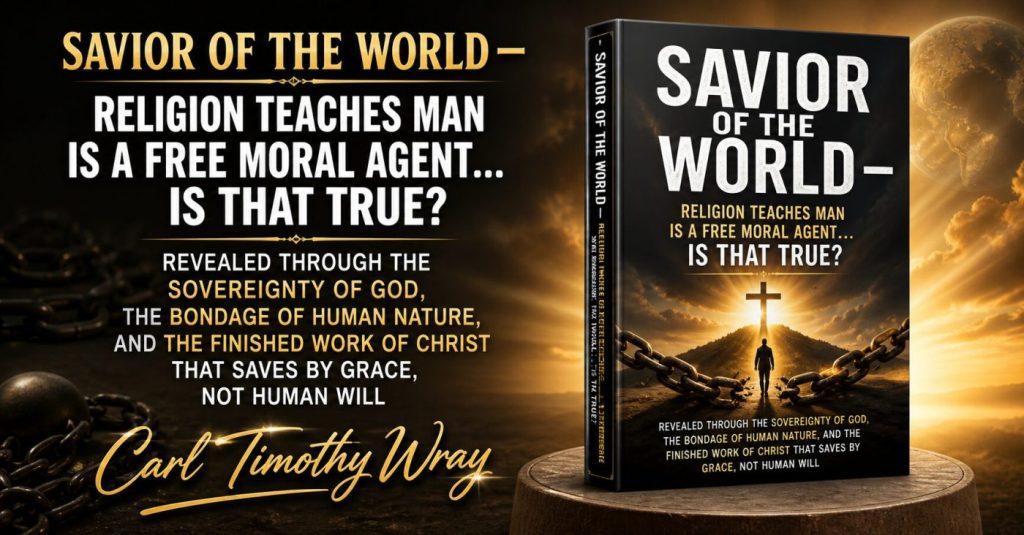
🔥 Savior of the World — Religion Teaches Man Is a Free Moral Agent… Is That True? Revealed Through the Sovereignty of God, the Bondage of Human Nature, and the Finished Work of Christ That Saves by Grace, Not Human Will
✍️ Savior of the World: AUTHOR
By Carl Timothy Wray
Carl Timothy Wray is a prophetic teacher and author devoted to unveiling the Finished Work of Christ through the full counsel of Scripture. His writings reveal the unified mind of God from Genesis to Revelation, exposing religious tradition while establishing the sovereignty of God, the Plan of the Ages, and the ultimate triumph of Christ as Savior of the world. Through hundreds of books and teachings, he calls readers into the knowledge of truth where grace reigns, Christ is central, and all things are brought into fulfillment in Him.
🔍
Is man truly a free moral agent, or is that a religious tradition that contradicts Scripture? This book answers the question through the full counsel of the Bible, revealing that salvation is not based on human will but on the sovereignty of God and the finished work of Christ. From man’s condition in Adam to the drawing power of the Father, this teaching exposes the limits of human ability and unveils Jesus Christ as the Savior of the world who accomplishes redemption according to God’s purpose in the ages. If you have ever wondered whether man can choose God or whether God is the author of salvation from beginning to end, this book will bring clarity, truth, and a deeper understanding of grace.
🔥 Savior of the World: INTRODUCTION
The Question Religion Cannot Answer
Religion has declared it for generations: “Man is a free moral agent.”
It has been preached, taught, and accepted as truth without question. From pulpits to classrooms, it has shaped how people understand salvation, choice, and their relationship with God.
But what if that statement has never truly been tested?
👉 Is man actually a free moral agent?
If man is free, why is he bound by sin?
If man can choose God, why does Scripture say no man seeks after Him?
If salvation depends on human will, why does the Word declare, “It is not of him that wills… but of God that shows mercy”?
This book confronts that question head-on.
Not through philosophy.
Not through tradition.
But through the full counsel of God’s Word.
From the beginning, Scripture reveals that man is not independent, not self-originating, and not the author of his own salvation. Man is born into a condition he did not choose, shaped by a nature he did not create, and governed by forces beyond his control. And yet, in the midst of that reality, a greater truth emerges:
👉 There is a Savior.
Not a Savior who waits for man to act…
Not a Savior who depends on human decision…
But the Savior of the world, who draws, quickens, reveals, and fulfills the purpose of God across the ages.
This is the unveiling of that Savior.
This book will challenge what you have been taught.
It will confront long-held assumptions.
And it will reveal a God whose will is not fragile, but sovereign—whose purpose does not fail, and whose salvation is not dependent on man, but rooted in Himself.
So the question stands:
👉 Is man a free moral agent… or has religion misunderstood both the nature of man and the power of God?
Let us search the Scriptures—and let the truth answer.
🔥 CHAPTER 1 — THE CLAIM: MAN AS A “FREE MORAL AGENT”
The Foundation Religion Never Questions
Religion has repeated it so often that it no longer sounds like a doctrine—it sounds like truth:
“Man is a free moral agent.”
It is preached as though it were self-evident.
It is assumed as though Scripture clearly teaches it.
It is defended as though the entire structure of salvation depends on it.
But here is the question that must be asked:
👉 Where does the Bible actually say this?
Not where it is implied.
Not where it is assumed.
Not where it is interpreted into the text.
But where is it written?
Because Scripture warns us clearly:
“Beware lest any man spoil you through philosophy and vain deceit, after the tradition of men, after the rudiments of the world, and not after Christ” (Colossians 2:8).
If the idea of “free moral agency” is not rooted in Christ, then it is not a foundation—it is a tradition.
And traditions, no matter how widely accepted, can still be wrong.
A Doctrine Born from Human Reasoning
The idea of man as a free moral agent appeals to the natural mind.
It feels right.
It sounds fair.
It gives man a sense of control, responsibility, and dignity.
But Scripture cuts through what seems right:
“There is a way which seemeth right unto a man, but the end thereof are the ways of death” (Proverbs 14:12).
The natural mind gravitates toward independence.
It wants to believe that man stands on his own, making choices apart from influence, apart from nature, apart from divine operation.
But the Word declares something very different:
“The natural man receiveth not the things of the Spirit of God… neither can he know them” (1 Corinthians 2:14).
Not will not—
but cannot.
This is not a description of freedom.
This is a description of limitation.
Man Does Not Direct His Own Steps
One of the clearest statements in all of Scripture directly contradicts the idea of autonomous human control:
“O LORD, I know that the way of man is not in himself: it is not in man that walketh to direct his steps” (Jeremiah 10:23).
If man cannot direct his own steps, then where is this so-called freedom?
If his path is not in himself, then how can he be the origin of his own spiritual destiny?
The doctrine of free moral agency teaches that man stands at a crossroads, fully capable of choosing either direction.
But the prophet declares:
👉 The way of man is not in himself.
That is not partial limitation.
That is total dependency.
Tradition vs Truth
Jesus Himself confronted this same issue—not with pagans, but with the religious.
He said:
“In vain they do worship me, teaching for doctrines the commandments of men” (Matthew 15:9).
And again:
“This people draweth nigh unto me with their mouth… but their heart is far from me” (Isaiah 29:13).
The danger is not always open rebellion.
The danger is believing something about God that He never said.
The doctrine of free moral agency has been passed down, repeated, and protected—but repetition does not make something true.
Truth must be established by the Word—not by tradition.
The Subtle Shift: From God to Man
This doctrine does something subtle—but devastating.
It shifts the center of salvation:
- From God’s will → to man’s will
- From God’s action → to man’s decision
- From God’s sovereignty → to human ability
But Scripture consistently brings the focus back to God:
“For it is God which worketh in you both to will and to do of his good pleasure” (Philippians 2:13).
Even the will itself is not independent.
It is something God works in you.
So the question becomes unavoidable:
👉 If God works in man to will, then how is the will free from Him?
The Illusion of Independence
The doctrine of free moral agency assumes that man exists as an independent being—capable of choosing outside of influence, outside of nature, and outside of divine operation.
But Scripture never presents man this way.
Instead, it presents man as:
- Created by God
- Sustained by God
- Influenced by nature
- Shaped by condition
- Governed by forces beyond himself
Even his thoughts are not fully his own:
“The preparations of the heart in man, and the answer of the tongue, is from the LORD” (Proverbs 16:1).
If the very preparation of the heart is from the Lord, then what remains untouched?
Where is this independent zone where man operates freely?
It does not exist.
Setting the Stage for Truth
This chapter is not the conclusion—it is the exposure.
We are not yet answering every question.
We are removing a false foundation.
Because as long as the idea of free moral agency remains unchallenged, everything built upon it will be unstable.
But once it is examined in the light of Scripture, something begins to happen:
The focus shifts.
The pressure lifts.
And the stage is set for a greater revelation:
👉 Not what man can do for God…
👉 but what God is doing in man.
🔥 Call to the Reader
So now the question is no longer theoretical.
It is personal.
👉 Have you believed something because it is written…
or because it has been repeated?
👉 Have you assumed man is free…
or have you searched the Scriptures to see if it is so?
The next chapter will take us deeper—
not into theory, but into origin.
👉 If man is not free… then what is he?
We go back to the beginning.
We go back to Adam.
And we discover whether man was ever free to begin with.
🔥 CHAPTER 2 — MAN IN ADAM: BORN BOUND, NOT FREE
The Beginning Reveals the Truth
If we are going to answer whether man is a free moral agent, we cannot start with modern theology—we must go back to the beginning.
Because whatever man is today…
he became that way somewhere.
And the Word brings us straight to the origin:
“In the day that thou eatest thereof thou shalt surely die” (Genesis 2:17).
This was not a possibility—it was a certainty.
And when Adam partook, something changed—not just in his behavior, but in his being.
Something entered the human race that was never there before.
Death Entered — And It Spread to All
Scripture does not leave this vague.
It tells us exactly what happened:
“By one man sin entered into the world, and death by sin; and so death passed upon all men” (Romans 5:12).
Death did not remain isolated.
It did not stay with Adam.
👉 It passed to all men.
Not because all men made the same choice—
but because all men came from the same source.
This means man is not starting from a neutral position.
He is starting from a condition he inherited.
In Adam — Not Independent
The Bible never presents man as an isolated individual making independent choices apart from influence.
It presents man as being in Adam:
“For as in Adam all die…” (1 Corinthians 15:22).
That phrase matters.
👉 In Adam.
Man is not standing outside the fall deciding whether to enter it.
He is born inside of it.
Everything that Adam became…
flows into those who come after him.
So the idea that man begins life free, neutral, and untouched is already contradicted.
Sin Is a Nature Before It Is an Action
Religion often reduces sin to behavior.
But Scripture goes deeper—it reveals sin as a condition of birth.
David said:
“Behold, I was shapen in iniquity; and in sin did my mother conceive me” (Psalm 51:5).
This is not describing something he learned later.
This is describing something he was born into.
👉 Sin is not just what man does—
it is what man is apart from Christ.
And if the nature is corrupted, then the will that flows from that nature cannot be pure.
A man does not rise above his nature.
He expresses it.
The Heart of Man Is Already Bent
God looked upon the earth before the flood and revealed the condition of man’s inner world:
“Every imagination of the thoughts of his heart was only evil continually” (Genesis 6:5).
This is not a balanced picture of a free agent choosing between good and evil.
This is a man whose internal condition is already shaped.
His thoughts are not neutral.
His desires are not neutral.
His inclinations are not neutral.
👉 They are already bent.
And a bent nature does not produce straight choices.
The Will Follows the Nature
This is where the doctrine of free moral agency begins to collapse.
Because the will is not independent.
The will flows from the nature.
Jesus made this plain:
“A corrupt tree cannot bring forth good fruit” (Matthew 7:18).
Not will not—
👉 cannot.
That word removes the illusion of freedom.
If the tree is corrupt, the fruit will reflect it.
And if man’s nature in Adam is corrupt, then his choices will follow that corruption.
He is not standing above his condition making neutral decisions.
He is acting according to what he is.
Born Into a Condition He Did Not Choose
Here is the reality that cannot be ignored:
Man did not choose:
- To be born in Adam
- To inherit a fallen nature
- To enter a world shaped by sin and death
And yet, he lives from that condition.
This means his starting point is not freedom.
👉 His starting point is bondage.
Bondage to:
- Sin
- Corruption
- Death
- A nature he did not create
And Scripture confirms it:
“You… were dead in trespasses and sins” (Ephesians 2:1).
Not wounded.
Not partially alive.
👉 Dead.
And a dead man does not initiate life.
The Illusion of Neutrality
The doctrine of free moral agency depends on one idea:
That man is neutral.
That he stands between good and evil with equal ability to choose either one.
But Scripture never presents man that way.
Instead, it presents him as:
- In Adam
- Born in sin
- Shaped by corruption
- Dead in trespasses
There is no neutral ground in that picture.
Why This Matters
This is not just theology—it determines how we understand salvation.
Because if man is truly free, then salvation depends on his decision.
But if man is bound in Adam…
👉 then salvation must come from outside of him.
Not assisted by man.
Not initiated by man.
But performed by God.
🔥 Call to the Reader
So now the question becomes unavoidable:
👉 If man is born in sin, shaped by a fallen nature, and dead in trespasses…
where does this so-called freedom exist?
Is it something Scripture teaches?
Or something man has assumed?
The next chapter will go even deeper—
👉 Not just into man’s condition…
but into the will itself.
Is the will truly free?
Or is it bound to the nature we have just uncovered?
🔥 CHAPTER 3 — THE BONDAGE OF THE WILL
Is the Will Truly Free?
The doctrine of “free moral agency” rests on one central idea:
👉 That man’s will is free.
Not just that man makes choices—
but that his will stands independent, untouched, and capable of choosing God apart from influence, apart from nature, and apart from divine operation.
But Scripture never presents the will as independent.
It reveals something far more sobering:
👉 The will is bound to the nature from which it flows.
And if the nature is fallen…
then the will is not free.
The Servant of Sin
Jesus did not leave this open to interpretation.
He said plainly:
“Whosoever committeth sin is the servant of sin” (John 8:34).
Not merely influenced by sin.
Not occasionally affected by sin.
👉 A servant.
A servant does not operate in freedom.
A servant operates under control.
This means that man’s will is not standing above sin, deciding whether to participate.
👉 His will is operating within a condition of bondage.
And bondage is the opposite of freedom.
The Will Is Enslaved to Its Master
Paul expands this truth even further:
“Know ye not, that to whom ye yield yourselves servants to obey, his servants ye are… whether of sin unto death, or of obedience unto righteousness” (Romans 6:16).
Man is not presented as independent.
He is presented as serving something.
Before Christ, that service is clear:
“When ye were the servants of sin…” (Romans 6:20).
Not potential servants.
Not partial servants.
👉 Servants of sin.
And a servant’s will is not autonomous.
It is governed.
The Mind Cannot Submit to God
Here is where the illusion of free will completely collapses.
Scripture does not say man chooses not to submit to God.
It says something far stronger:
“The carnal mind is enmity against God: for it is not subject to the law of God, neither indeed can be” (Romans 8:7).
👉 Cannot be.
That word removes all room for independence.
The mind—the seat of thought, desire, and decision—is not neutral.
It is at enmity with God.
And not only is it unwilling…
👉 it is unable.
So the question becomes:
How can a will that flows from a mind that cannot submit to God be considered free?
Dead Men Do Not Choose Life
Scripture continues to press this reality:
“You… were dead in trespasses and sins” (Ephesians 2:1).
Not sick.
Not struggling.
👉 Dead.
And a dead man does not initiate life.
He does not choose resurrection.
He does not awaken himself.
Life must come from outside of him.
If man is dead in sin, then his will is not functioning in freedom toward God.
👉 It is functioning within death.
Taken Captive at the Will of Another
The Word goes even further—revealing not just bondage, but captivity:
“That they may recover themselves out of the snare of the devil, who are taken captive by him at his will” (2 Timothy 2:25–26).
This is not passive influence.
This is capture.
Taken captive.
At his will.
This means that man’s will is not only shaped by his nature—
👉 it can be held under the control of another.
And if the will can be taken captive…
then it is not free.
The Savior of the World Enters the Picture
This is why the revelation of Savior of the World becomes so powerful.
Because if man’s will were truly free, then Christ would only be offering help.
But if man’s will is bound—
if he is a servant of sin,
if his mind cannot submit,
if he is dead in trespasses,
if he is taken captive—
👉 then he does not need assistance.
👉 He needs a Savior.
Not a Savior who waits for man’s will to cooperate…
but the Savior of the world who acts, draws, quickens, and delivers according to the will of God.
The Will Follows the Nature
The pattern is now undeniable:
- A corrupt nature produces a bound will
- A bound will produces corrupt choices
- Corrupt choices reinforce the condition
Jesus already revealed the principle:
“A corrupt tree cannot bring forth good fruit” (Matthew 7:18).
The will does not override the tree.
The will expresses the tree.
And until the tree is changed…
👉 the fruit will remain the same.
The Collapse of Free Moral Agency
At this point, the doctrine cannot stand.
Because Scripture has shown:
- Man is a servant of sin (John 8:34)
- His will is governed (Romans 6:16)
- His mind cannot submit to God (Romans 8:7)
- He is dead in trespasses (Ephesians 2:1)
- He can be taken captive (2 Timothy 2:26)
There is no independent will in any of this.
No untouched decision-making center.
No neutral ground.
Setting the Stage for Divine Action
But this is not written to leave man hopeless.
It is written to remove illusion.
Because once the illusion of a free will is removed…
👉 the necessity of God’s action becomes clear.
If man cannot come on his own…
then God must draw him.
If man cannot will rightly…
then God must work in him to will.
If man cannot produce life…
then life must be given.
🔥 Call to the Reader
So now the question is no longer abstract—it is unavoidable:
👉 If the will is bound…
👉 if the mind cannot submit…
👉 if man is dead in sin…
who is the true initiator of salvation?
Is it man reaching for God?
Or God drawing man?
The next chapter will answer that directly:
👉 Do men seek God… or does God seek men?
🔥 CHAPTER 4 — NO MAN SEEKS GOD
The Lie of Human Initiation
The doctrine of free moral agency depends on one final assumption:
👉 That man can seek God.
Not just respond…
but initiate.
That somewhere within man—despite sin, despite death, despite bondage—there remains a spark that reaches upward toward God.
But Scripture does not support this.
It destroys it.
None That Seek After God
The Word speaks with absolute clarity:
“There is none righteous, no, not one:
There is none that understandeth,
There is none that seeketh after God” (Romans 3:10–11).
Not a few.
Not most.
👉 None.
This is not describing weak seekers.
This is describing the absence of seeking altogether.
And it continues:
“They are all gone out of the way… there is none that doeth good, no, not one” (Romans 3:12).
This is not a picture of free agents searching for truth.
This is a race that has already turned aside.
God Looks—And Finds No Seeker
Long before Paul wrote Romans, the Psalmist declared the same truth:
“The LORD looked down from heaven upon the children of men, to see if there were any that did understand, and seek God.
They are all gone aside… there is none that doeth good, no, not one” (Psalm 14:2–3).
God Himself looked.
He examined humanity.
He searched for a seeker.
👉 And He found none.
If even one man possessed the independent ability to seek God, this would not be the testimony.
But the verdict is unanimous:
👉 None seek God.
No Man Can Come
Jesus removes all remaining doubt:
“No man can come to me, except the Father which hath sent me draw him” (John 6:44).
Not will not—
👉 cannot.
This is not about refusal.
This is about inability.
Man does not stand at a distance choosing whether to approach Christ.
👉 He cannot come unless something happens first.
Unless the Father draws him.
It Must Be Given
Jesus goes even further:
“No man can come unto me, except it were given unto him of my Father” (John 6:65).
Coming to Christ is not initiated by man.
It is given by God.
That word alone dismantles the entire concept of free moral agency.
Because what is given is not self-produced.
It originates from another.
No One Calls on His Name
The prophet Isaiah echoes the same truth:
“There is none that calleth upon thy name, that stirreth up himself to take hold of thee” (Isaiah 64:7).
Notice the language:
👉 None… stirreth up himself.
Man does not generate the movement toward God from within.
There is no internal ignition.
No self-produced hunger for God apart from divine action.
The Savior of the World Must Seek
This is why the revelation of Savior of the World is not optional—it is essential.
Because if man were truly seeking God, then Christ would simply respond to those seekers.
But Jesus reveals the opposite:
“The Son of man is come to seek and to save that which was lost” (Luke 19:10).
Who is doing the seeking?
👉 Christ.
Not man.
Not the sinner.
Not the world.
👉 The Savior of the world is the one who seeks.
Because the lost do not find Him.
He finds them.
The Direction Is Always From God to Man
Everywhere in Scripture, the direction is the same:
- God calls Abraham
- God draws Israel
- God sends the prophets
- God sends His Son
- God draws men to Christ
The movement is never:
👉 Man reaching up to God
It is always:
👉 God moving toward man
This is the pattern of the entire Bible.
The Collapse of the Doctrine
At this point, the idea that man seeks God cannot survive.
Because Scripture has shown:
- None seek God (Romans 3:11)
- God found no seekers (Psalm 14:2–3)
- No man can come (John 6:44)
- It must be given (John 6:65)
- None stir themselves (Isaiah 64:7)
- Christ is the seeker (Luke 19:10)
There is no independent pursuit in any of this.
No human initiation.
No free movement toward God.
Setting the Stage for the Truth
But this is not the end of the story.
Because if man does not seek God…
👉 then how does anyone come?
If no man can come…
👉 then why do some come?
If none call upon Him…
👉 then why are some calling?
The answer is not found in man.
It is found in God.
🔥 Call to the Reader
So now the question is clear:
👉 If man does not seek God…
👉 if no man can come…
👉 if it must be given…
then who is doing the drawing?
Who is initiating salvation?
Who is bringing men to Christ?
The next chapter answers it directly:
👉 The Drawing Power of the Father
🔥 CHAPTER 5 — THE DRAWING POWER OF THE FATHER
If Man Cannot Come… Then God Must Draw
By now, the question is no longer theoretical.
We have seen that:
- Man is born in Adam
- His will is bound
- His mind cannot submit
- No man seeks God
And Jesus made it plain:
“No man can come to me…” (John 6:44).
So now the question becomes unavoidable:
👉 If no man can come… how does anyone come?
The answer is not found in man.
It is found in God.
Drawn by the Father
Jesus did not leave this unanswered:
“No man can come to me, except the Father which hath sent me draw him: and I will raise him up at the last day” (John 6:44).
Coming to Christ is not self-initiated.
👉 It is the result of being drawn.
And this drawing is not passive.
It is not a suggestion.
It is not God standing at a distance hoping man responds.
👉 It is divine action.
The Father moves.
The Father draws.
The Father brings.
All That the Father Gives Will Come
Jesus strengthens it even further:
“All that the Father giveth me shall come to me” (John 6:37).
Not might come.
Not could come.
👉 Shall come.
This is certainty.
This is authority.
This is the Savior of the world operating under the will of the Father.
Those given will come—not because of their will, but because of God’s action.
It Is Written — They Shall Be Taught of God
Jesus continues:
“They shall be all taught of God. Every man therefore that hath heard, and hath learned of the Father, cometh unto me” (John 6:45).
Notice the order:
- God teaches
- Man hears
- Man learns
- Man comes
The coming is the result—not the cause.
Man does not come first and then learn.
👉 He is taught, and therefore he comes.
Again, the initiative belongs to God.
The Drawing Is Universal in Scope
Jesus opens the scope even wider:
“And I, if I be lifted up from the earth, will draw all men unto me” (John 12:32).
This is not selective possibility.
This is divine purpose.
👉 The Savior of the world declares that His work produces a drawing that reaches all men.
This does not mean all come at once.
But it reveals something critical:
👉 The power to bring men to God is not in man.
👉 It is in Christ.
God Works in the Will Itself
This is where the doctrine of free moral agency completely collapses.
Because Scripture reveals that God does not just draw externally—
👉 He works internally.
“For it is God which worketh in you both to will and to do of his good pleasure” (Philippians 2:13).
Even the will itself is not independent.
God works in man:
- To will
- To act
- To move
So the question must be asked:
👉 If God works in man to will… where is the independent will?
It does not exist.
A New Heart, A New Spirit
The prophets saw this long before Christ came:
“A new heart also will I give you, and a new spirit will I put within you… and I will cause you to walk in my statutes” (Ezekiel 36:26–27).
Notice the language:
👉 I will give
👉 I will put
👉 I will cause
This is not cooperation.
This is transformation.
God does not ask the fallen heart to fix itself.
👉 He replaces it.
The Savior of the World Acts First
This is the beauty of the revelation:
The Savior of the world does not wait for man to respond.
He acts.
He draws.
He teaches.
He works in the will.
He gives a new heart.
He causes movement.
Everything begins with Him.
The Direction of Salvation Is Settled
By now, the direction is undeniable:
- Man does not come unless drawn (John 6:44)
- Those given will come (John 6:37)
- God teaches, then man comes (John 6:45)
- Christ draws all (John 12:32)
- God works in the will (Philippians 2:13)
- God gives a new heart (Ezekiel 36:26–27)
There is no independent movement in any of this.
👉 Salvation flows from God to man.
Why This Matters
This is not just doctrine—it changes everything.
Because if God is the one who draws…
then salvation is not fragile.
If God is the one who works in the will…
then salvation is not uncertain.
If God is the one who gives the heart…
then salvation is not dependent on human strength.
👉 It is anchored in God Himself.
🔥 Call to the Reader
So now the question is no longer:
👉 Can man come to God?
The question is:
👉 Is God drawing him?
Because if the Father draws…
👉 he will come.
The next chapter takes us even deeper:
👉 If God draws and works in the will…
then is salvation ever based on human will at all?
🔥 CHAPTER 6 — SALVATION IS NOT OF HUMAN WILL
The Verse That Ends the Argument
Everything we have seen now leads to one unavoidable point.
And Scripture does not leave it implied—it says it plainly:
“So then it is not of him that willeth, nor of him that runneth, but of God that sheweth mercy” (Romans 9:16).
Not partially.
Not sometimes.
👉 Not of him that willeth.
That single statement dismantles the doctrine of free moral agency as the source of salvation.
Because if salvation is not of the will of man…
then man’s will cannot be the determining factor.
Not of the Will of Man
John confirms the same truth:
“Which were born, not of blood, nor of the will of the flesh, nor of the will of man, but of God” (John 1:13).
This is absolute.
Not of:
- Blood
- The will of the flesh
- The will of man
👉 But of God.
This means the new birth does not originate in human desire.
It does not begin with a human decision.
👉 It begins with God.
Of His Own Will
James removes all doubt:
“Of his own will begat he us with the word of truth” (James 1:18).
Whose will?
👉 His own will.
Not a partnership.
Not a cooperation between equals.
The begetting—the bringing forth of life—is rooted in God’s will.
Not man’s.
Not by Works, Not by Effort
Paul continues:
“Not by works of righteousness which we have done, but according to his mercy he saved us” (Titus 3:5).
Even the best of man’s effort does not produce salvation.
Because salvation is not the result of:
- Effort
- Discipline
- Decision
- Human will
👉 It is the result of mercy.
And mercy originates in God—not man.
According to His Will, Not Ours
Scripture consistently returns to this foundation:
“Being predestinated according to the purpose of him who worketh all things after the counsel of his own will” (Ephesians 1:11).
All things.
Not some things.
👉 All things.
Including salvation.
Including the drawing.
Including the awakening.
Including the will itself.
Everything operates according to His will.
The Savior of the World Does Not Depend on Man
This is why the revelation of Savior of the World becomes so critical.
Because if salvation depended on human will…
then Christ would only be a potential Savior.
Waiting.
Hoping.
Limited by human response.
But Scripture does not present Him that way.
It reveals Him as:
👉 The Savior of the world—
the One who actually accomplishes what He was sent to do.
Not dependent on man’s will…
but operating according to God’s purpose.
The Illusion of Contribution
The doctrine of free moral agency subtly introduces this idea:
👉 That man contributes something to his salvation.
Even if it is just:
- A decision
- A choice
- A moment of agreement
But Scripture removes that ground completely.
Because if it is:
- Not of him that wills (Romans 9:16)
- Not of the will of man (John 1:13)
- Of His own will (James 1:18)
- According to His mercy (Titus 3:5)
Then what remains for man to contribute?
👉 Nothing.
And that is not a weakness of salvation.
👉 That is its strength.
Grace Removes Human Boasting
This is why grace is so absolute:
“For by grace are ye saved through faith; and that not of yourselves: it is the gift of God:
Not of works, lest any man should boast” (Ephesians 2:8–9).
If salvation were even partially of man’s will…
then man would have reason to boast.
But grace removes that possibility.
Because salvation is not rooted in what man does.
👉 It is rooted in what God has done.
The Direction Is Settled Forever
By now, the direction cannot be reversed:
- Not of him that wills (Romans 9:16)
- Not of the will of man (John 1:13)
- Of His own will (James 1:18)
- According to His mercy (Titus 3:5)
- According to His purpose (Ephesians 1:11)
Everything points in one direction:
👉 From God to man
Never from man to God.
The Collapse of Free Moral Agency
At this point, the doctrine cannot stand.
Because it depends on the idea that man’s will determines salvation.
But Scripture has removed that foundation completely.
There is no room left for:
- Independent decision as the source
- Human will as the initiator
- Man as the determining factor
Setting the Stage for the Savior
And now, something powerful comes into focus:
If salvation is not of man’s will…
👉 then it must be accomplished by Christ.
Not offered.
Not made possible.
👉 Accomplished.
This is where the revelation of Savior of the World begins to shine fully.
🔥 Call to the Reader
So now the question is no longer:
👉 Does man choose God?
The question is:
👉 Is salvation ever rooted in human will at all?
And Scripture has answered it clearly:
👉 No.
The next chapter will reveal the full glory of that truth:
👉 If salvation is not of man’s will… then who is Jesus really?
🔥 CHAPTER 7 — CHRIST THE SAVIOR OF THE WORLD
Not a Potential Savior—The Savior of the World
After everything we have seen, one question remains:
👉 If man does not initiate…
👉 if the will is not free…
👉 if salvation is not of human will…
then who is Jesus Christ?
Religion often presents Him as a Savior in possibility.
A Savior who can save…
if man responds.
A Savior who offers salvation…
but waits on human decision to complete it.
But Scripture reveals something far greater:
👉 “This is indeed the Christ, the Savior of the world” (John 4:42).
Not the potential Savior.
Not the partial Savior.
👉 The Savior of the world.
Sent to Save—Not to Try
John declares it again:
“The Father sent the Son to be the Savior of the world” (1 John 4:14).
The mission was not uncertain.
The purpose was not fragile.
The Son was not sent to attempt redemption.
👉 He was sent to be the Savior of the world.
And if He was sent to be the Savior…
then He fulfills what He was sent to do.
The Lamb Who Takes Away Sin
John the Baptist announced Him with clarity:
“Behold the Lamb of God, which taketh away the sin of the world” (John 1:29).
Not offers to take away sin.
Not tries to take away sin.
👉 Taketh away.
This is action.
This is accomplishment.
This is the work of the Savior of the world.
He Came to Save—And He Does
Jesus Himself declared His mission:
“The Son of man is come to seek and to save that which was lost” (Luke 19:10).
Not to make salvation possible.
👉 To save.
And what He seeks…
He saves.
Because His work is not dependent on man’s will—
it is rooted in the will of God.
A Finished Work, Not an Ongoing Attempt
Scripture does not present salvation as unfinished.
It presents it as accomplished:
“By one offering he hath perfected for ever them that are sanctified” (Hebrews 10:14).
Perfected.
Forever.
This is not partial.
This is not dependent on future human decisions.
👉 This is the completed work of the Savior of the world.
The Savior of the World Cannot Fail
If Christ is truly the Savior of the world, then His work cannot be limited by human resistance.
Because we have already seen:
- Salvation is not of human will
- Man cannot come unless drawn
- God works in the will itself
So the success of salvation does not rest on man.
👉 It rests on Christ.
And Scripture confirms the certainty of His work:
“He shall see of the travail of his soul, and shall be satisfied” (Isaiah 53:11).
Satisfied.
Not disappointed.
Not partially fulfilled.
👉 Satisfied.
Every Knee Shall Bow
The scope of His work is not narrow—it is universal:
“That at the name of Jesus every knee should bow…
And that every tongue should confess that Jesus Christ is Lord” (Philippians 2:10–11).
Every knee.
Every tongue.
This is not describing a failed Savior.
This is the revelation of the Savior of the world accomplishing His purpose.
God’s Will Is Fulfilled in Christ
Paul declares the end of the matter:
“Who will have all men to be saved, and to come unto the knowledge of the truth” (1 Timothy 2:4).
And again:
“That God may be all in all” (1 Corinthians 15:28).
The will of God is not in conflict with the work of Christ.
👉 It is fulfilled through Him.
The Savior of the world is the expression of God’s will in action.
The Collapse of a Limited Savior
At this point, the religious version of Jesus cannot stand.
Because it presents Him as:
- Dependent on human will
- Limited by human response
- Waiting for man to choose
But Scripture reveals Him as:
👉 The Savior of the world
👉 The One who takes away sin
👉 The One who saves what He seeks
👉 The One who fulfills the will of God
There is no failure in Him.
No limitation.
No uncertainty.
Why This Changes Everything
If Christ is truly the Savior of the world:
Then salvation is not fragile.
Then grace is not uncertain.
Then the purpose of God cannot fail.
Because it does not depend on man.
👉 It depends on Him.
🔥 Call to the Reader
So now the question is no longer:
👉 Can Jesus save?
The question is:
👉 Is He truly the Savior of the world… or only a Savior in theory?
Scripture has answered it.
Now it must be believed.
The next chapter will take us deeper into how this unfolds:
👉 If Christ has accomplished it… why does it appear progressive?
🔥 CHAPTER 8 — THE PLAN OF THE AGES
A Finished Work Revealed in Time
By now, the truth is clear:
- Man does not initiate salvation
- The will is not free
- Salvation is not of human will
- Christ is the Savior of the world
So the question naturally arises:
👉 If Christ has accomplished salvation… why doesn’t everything appear complete right now?
Why does it seem progressive?
Why does it unfold?
The answer is found in something many overlook:
👉 The plan of the ages.
God Works Through Appointed Times
Scripture reveals that God does not act randomly.
He works through appointed times:
“To every thing there is a season, and a time to every purpose under the heaven” (Ecclesiastes 3:1).
And again:
“He hath made every thing beautiful in his time” (Ecclesiastes 3:11).
God’s purpose is not changing—
👉 it is unfolding.
What is finished in Him is revealed through time.
The Fullness of Times
Paul brings this into clear focus:
“Having made known unto us the mystery of his will…
That in the dispensation of the fulness of times he might gather together in one all things in Christ” (Ephesians 1:9–10).
Notice the language:
👉 Fullness of times
👉 Gather together all things in Christ
This is not instant appearance.
This is divine order.
The Savior of the world accomplishes the work—
and the ages reveal it.
The Ages to Come
Scripture speaks not just of one age—but many:
“That in the ages to come he might shew the exceeding riches of his grace” (Ephesians 2:7).
This means God’s purpose is not confined to a single moment.
👉 It unfolds across ages.
Grace is not exhausted in one event.
It is revealed progressively—according to God’s timing.
Every Man in His Order
Paul explains how this works in resurrection:
“For as in Adam all die, even so in Christ shall all be made alive.
But every man in his own order” (1 Corinthians 15:22–23).
Notice both truths:
👉 All made alive
👉 Each in order
The outcome is certain.
The timing is ordered.
The Savior of the world does not fail—
He fulfills His work in sequence.
The Restoration of All Things
Peter confirms the end of the plan:
“Whom the heaven must receive until the times of restitution of all things” (Acts 3:21).
Not partial restoration.
👉 All things.
But notice again:
👉 Times of restoration.
This is not instantaneous manifestation.
This is progressive fulfillment.
Seed, Time, and Harvest
God’s pattern is consistent from the beginning:
“While the earth remaineth, seedtime and harvest… shall not cease” (Genesis 8:22).
Everything in God’s plan follows this pattern:
- Seed planted
- Time passes
- Harvest appears
The work is secured in the seed.
But it is revealed through time.
This is how the work of the Savior of the world unfolds.
The Mystery Hidden and Revealed
Paul speaks of a mystery:
“Even the mystery which hath been hid from ages and from generations, but now is made manifest to his saints” (Colossians 1:26).
Hidden… then revealed.
Not because God is uncertain—
but because He reveals according to His plan.
The truth was always there.
👉 It simply awaited its appointed unveiling.
Why It Appears Delayed
From man’s perspective, it can look like delay.
But Scripture corrects that view:
“The Lord is not slack concerning his promise… but is longsuffering” (2 Peter 3:9).
What appears slow is actually precise.
What appears delayed is actually ordered.
The Savior of the world is not waiting on man—
👉 He is working according to the plan of the ages.
The Certainty of Completion
Because this plan is God’s—not man’s—it cannot fail.
“Declaring the end from the beginning… My counsel shall stand, and I will do all my pleasure” (Isaiah 46:10).
The end is already declared.
The process simply reveals it.
Why This Changes Everything
Once this is understood:
- Salvation is not fragile
- Timing is not random
- God is not reacting
Everything is moving according to a divine plan
And the Savior of the world is at the center of it—
accomplishing, unfolding, and bringing all things to completion.
🔥 Call to the Reader
So now the question shifts again:
👉 If God has a plan…
👉 if it unfolds through the ages…
👉 if Christ has already secured the outcome…
then what role does grace play in all of this?
Is grace simply an offer…
or is it the power that actually brings it to pass?
🔥 CHAPTER 9 — GRACE: THE POWER THAT SAVES
Grace Is Not an Offer—It Is an Operation
After everything we have seen, one truth stands firm:
- Man does not initiate salvation
- The will is not free
- Christ is the Savior of the world
- God works through the plan of the ages
So now the question becomes:
👉 What actually brings salvation to pass?
Religion often answers:
👉 Grace is an offer
👉 Something presented to man
👉 Waiting to be accepted
But Scripture reveals something far greater:
👉 Grace is not just an offer—
👉 Grace is the power of God in operation.
By Grace You Are Saved
Paul declares it plainly:
“For by grace are ye saved through faith; and that not of yourselves: it is the gift of God” (Ephesians 2:8).
Not by effort.
Not by decision.
Not by human will.
👉 By grace.
And even the faith through which salvation is experienced is not self-produced:
👉 “That not of yourselves: it is the gift of God.”
Grace does not wait on man.
Grace gives.
Grace Appears to All Men
This grace is not hidden or limited:
“For the grace of God that bringeth salvation hath appeared to all men” (Titus 2:11).
Notice the language:
👉 Grace does not merely offer salvation.
👉 It brings salvation.
This is action.
This is movement.
This is the working of the Savior of the world through grace.
Grace Versus Works
Scripture draws a sharp line:
“If by grace, then is it no more of works: otherwise grace is no more grace” (Romans 11:6).
There is no mixture.
No cooperation.
No shared credit.
Either salvation is:
- By grace
Or it is:
- By works
It cannot be both.
And since we have already seen that salvation is not of human will—
👉 it must be of grace.
Grace Given Before Time Began
This grace is not an afterthought.
It is not a reaction to man’s condition.
Paul reveals its origin:
“Who hath saved us… according to his own purpose and grace, which was given us in Christ Jesus before the world began” (2 Timothy 1:9).
Before the world began.
Before Adam fell.
Before man ever existed.
👉 Grace was already given.
This means the work of the Savior of the world was established before time—
and revealed through the ages.
The Throne of Grace
Grace is not passive—it reigns:
“Let us therefore come boldly unto the throne of grace” (Hebrews 4:16).
A throne speaks of authority.
Government.
Power.
Grace is not weak.
Grace is not optional.
👉 Grace rules.
And it is through this throne that the work of salvation is carried out.
Grace Teaches, Changes, and Transforms
Grace does not just forgive—it transforms:
“The grace of God… teaching us that, denying ungodliness… we should live soberly, righteously, and godly” (Titus 2:11–12).
Grace teaches.
Grace instructs.
Grace changes behavior.
This is not man improving himself.
👉 This is grace working within.
Grace Is the Hand of the Savior of the World
Now we see it clearly:
The Savior of the world does not operate through human will.
He operates through grace.
Grace is:
- The means
- The power
- The operation
- The execution
Everything we have seen—from drawing, to giving, to transforming—
👉 is the work of grace.
No Room for Human Boasting
This is why Scripture removes all boasting:
“Not of works, lest any man should boast” (Ephesians 2:9).
If salvation were even partially dependent on man—
he would have reason to boast.
But grace removes that completely.
Because grace gives what man cannot produce.
Grace Guarantees the Outcome
Because grace is God’s power—not man’s effort—
👉 it cannot fail.
What God begins by grace…
He completes by grace.
The Savior of the world does not start something He cannot finish.
And grace is the assurance that it will be brought to completion.
Why This Changes Everything
Once grace is seen correctly:
- Salvation is no longer uncertain
- Man is no longer the focus
- God’s purpose becomes clear
Grace is not waiting.
Grace is working.
Grace is accomplishing.
🔥 Call to the Reader
So now the question becomes:
👉 If grace is the power that saves…
👉 if it operates according to God’s will…
👉 if it cannot fail…
then how does it all end?
What is the final outcome of this plan?
What does the work of the Savior of the world ultimately produce?
🔥 CHAPTER 10 — THE CONCLUSION: WHO IS REALLY IN CONTROL?
The Question That Defines Everything
From the beginning of this book, one question has been pressing through every chapter:
👉 Who is really in control?
Is it man—through a free and independent will?
Or is it God—through His purpose, His power, and His plan?
Everything we have seen now demands an answer.
Man Is Not the Author of Salvation
We have traced it step by step:
- Man is born in Adam—not free, but bound
- His will is not independent—but governed by nature
- His mind cannot submit to God
- No man seeks after God
- No man can come unless drawn
- Salvation is not of human will
At every point, the same truth emerges:
👉 Man is not the source.
Not the initiator.
Not the author.
God Declares the End from the Beginning
Scripture brings us to the heart of the matter:
“I am God… declaring the end from the beginning, and from ancient times the things that are not yet done, saying, My counsel shall stand, and I will do all my pleasure” (Isaiah 46:9–10).
Not some of His pleasure.
👉 All.
This is not a God reacting to man.
This is a God who has already declared the outcome—and is bringing it to pass.
None Can Stay His Hand
Daniel confirms it:
“He doeth according to his will… and none can stay his hand, or say unto him, What doest thou?” (Daniel 4:35).
No resistance can stop Him.
No will can override Him.
No force can prevent His purpose.
👉 God’s will is not competing with man’s will.
👉 God’s will governs all things.
The Savior of the World Accomplishes the Plan
This is where everything comes together.
Jesus Christ is not presented as a helper.
Not as one offering possibility.
👉 He is revealed as the Savior of the world.
And the Savior of the world does not fail.
He does not attempt.
He accomplishes.
“He shall see of the travail of his soul, and shall be satisfied” (Isaiah 53:11).
Satisfied.
Not partially fulfilled.
Not waiting on man.
👉 Satisfied.
God Has Concluded All
Paul brings the full scope into view:
“For God hath concluded them all in unbelief, that he might have mercy upon all” (Romans 11:32).
This is staggering.
All in unbelief.
👉 That He might have mercy upon all.
Not partial mercy.
Not selective mercy.
👉 All.
And it leads Paul to declare:
“For of him, and through him, and to him, are all things” (Romans 11:36).
Everything begins in Him.
Everything moves through Him.
Everything ends in Him.
Every Knee, Every Tongue
The outcome is not uncertain:
“That at the name of Jesus every knee should bow… and every tongue should confess that Jesus Christ is Lord” (Philippians 2:10–11).
Every knee.
Every tongue.
This is not a divided ending.
This is the fulfillment of the work of the Savior of the world.
God All in All
And finally, the end is revealed:
“That God may be all in all” (1 Corinthians 15:28).
Not all in some.
Not all in a few.
👉 All in all.
This is the conclusion of the plan of the ages.
This is the purpose of grace.
This is the work of the Savior of the world brought to completion.
The Collapse of the Lie
At this point, the doctrine of free moral agency cannot stand.
Because it places man at the center.
It makes man the deciding factor.
It suggests that God’s will depends on human response.
But Scripture has revealed the opposite at every turn:
👉 God is the author
👉 God is the initiator
👉 God is the sustainer
👉 God is the finisher
There is no room left for man as the determining force in salvation.
The Truth That Sets Free
And here is the beauty of it:
This truth does not remove hope—
👉 it establishes it.
Because if salvation depended on man…
it could fail.
But because it depends on God…
👉 it cannot fail.
The Savior of the world is not limited.
Not uncertain.
Not waiting.
👉 He is accomplishing.
🔥 Final Call to the Reader
So now the question returns one last time:
👉 Is man a free moral agent?
Or has that idea been a misunderstanding—
a tradition—
a concept built on human reasoning rather than divine revelation?
You have now seen the full counsel:
- Man in Adam
- The bondage of the will
- The inability to seek God
- The drawing power of the Father
- Salvation not of human will
- Christ as the Savior of the world
- The plan of the ages
- Grace as the power that saves
- God bringing all things to completion
The answer is no longer hidden.
👉 Man is not the author of salvation.
👉 God is.
And the Savior of the world is the One who brings that salvation to pass—from beginning to end.
🔥 Call to Action
If this truth has opened your eyes—
if it has shifted your understanding—
if you are beginning to see the sovereignty of God and the power of grace in a new way—
👉 Do not stop here.
Continue searching the Scriptures.
Continue growing in the revelation of Christ.
Continue exploring the full counsel of God.
And step deeper into the reality that:
👉 Salvation is not fragile.
👉 It is finished, unfolding, and unstoppable.
Savior of the World — Religion Teaches Man Is a Free Moral Agent… Is That True?
By Carl Timothy Wray ✍️
📖 Scriptural References
Chapter 1 — The Claim: Man as a “Free Moral Agent”
- Colossians 2:8
- Isaiah 29:13
- Proverbs 14:12
- 1 Corinthians 2:14
- Jeremiah 10:23
- Matthew 15:9
- Philippians 2:13
- Proverbs 16:1
Chapter 2 — Man in Adam: Born Bound, Not Free
- Genesis 2:17
- Romans 5:12
- 1 Corinthians 15:22
- Psalm 51:5
- Genesis 6:5
- Matthew 7:18
- Ephesians 2:1
Chapter 3 — The Bondage of the Will
- John 8:34
- Romans 6:16–20
- Romans 8:7
- Ephesians 2:1
- 2 Timothy 2:25–26
- Matthew 7:18
Chapter 4 — No Man Seeks God
- Romans 3:10–12
- Psalm 14:2–3
- John 6:44
- John 6:65
- Isaiah 64:7
- Luke 19:10
Chapter 5 — The Drawing Power of the Father
- John 6:44
- John 6:37
- John 6:45
- John 12:32
- Philippians 2:13
- Ezekiel 36:26–27
Chapter 6 — Salvation Is Not of Human Will
- Romans 9:16
- John 1:13
- James 1:18
- Titus 3:5
- Ephesians 1:11
- Ephesians 2:8–9
Chapter 7 — Christ the Savior of the World
- John 4:42
- 1 John 4:14
- John 1:29
- Luke 19:10
- Hebrews 10:14
- Isaiah 53:11
- Philippians 2:10–11
- 1 Timothy 2:4
- 1 Corinthians 15:28
Chapter 8 — The Plan of the Ages
- Ecclesiastes 3:1
- Ecclesiastes 3:11
- Ephesians 1:9–10
- Ephesians 2:7
- 1 Corinthians 15:22–23
- Acts 3:21
- Genesis 8:22
- Colossians 1:26
- 2 Peter 3:9
- Isaiah 46:10
Chapter 9 — Grace: The Power That Saves
- Ephesians 2:8–9
- Titus 2:11–12
- Romans 11:6
- 2 Timothy 1:9
- Hebrews 4:16
Chapter 10 — The Conclusion: Who Is Really in Control?
- Isaiah 46:9–10
- Daniel 4:35
- Isaiah 53:11
- Romans 11:32–36
- Philippians 2:10–11
- 1 Corinthians 15:28
📱 The Finished Work of Christ App
📱 Want the full library?
Access 400+ books, teachings, and revelations instantly in The Finished Work of Christ App. Dive deeper into the sovereignty of God, the Savior of the world, the plan of the ages, and the full counsel of Scripture—all in one place.
👉 Download the app now:
https://play.google.com/store/apps/details?id=app.thefinishedworkofchrist.android

The Savior of the World Series
- SAVIOR OF THE WORLD — THE FINISHED WORK REVEALED
- Savior of the World — Every Man Manifest in His Own Order
- Savior of the World — The Firstfruits Reveal the Order of God
- Savior of the World — Where Does the Bible Say It Is Finished?
- Join our Facebook Page and Group