
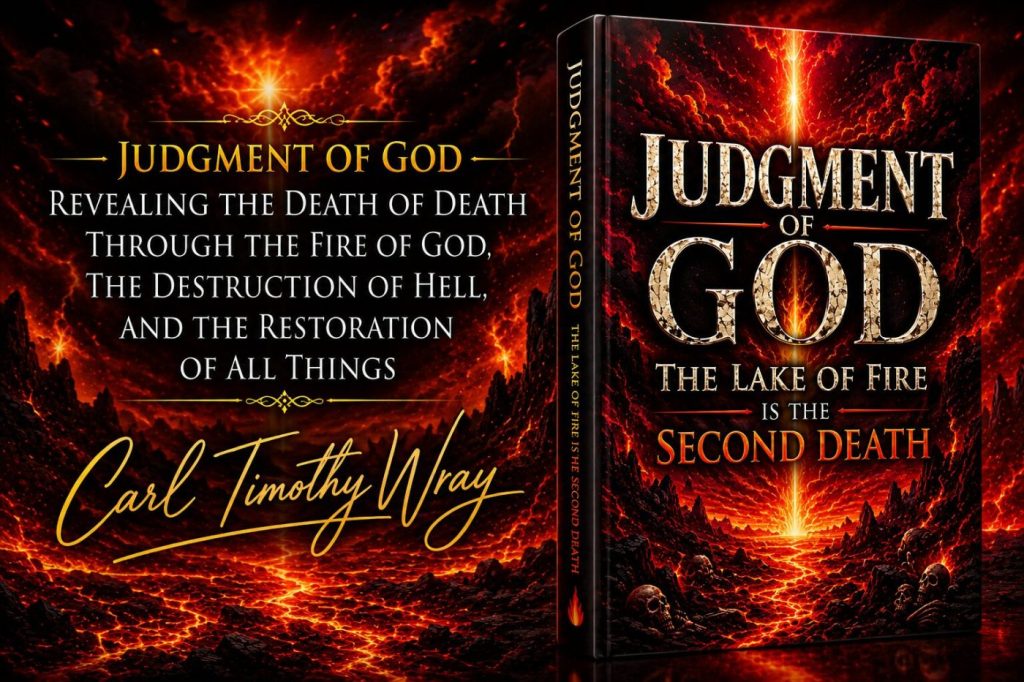
Judgment of God — Revealing the Death of Death Through the Fire of God, the Destruction of Hell, and the Restoration of All Things
By Carl Timothy Wray
Author
Carl Timothy Wray is the founder of The Finished Work of Christ and a full-counsel Biblical teacher focused on unveiling Scripture from Genesis to Revelation through the Finished Work of Christ, the Judgment of God, reconciliation, sonship, the manifestation of life, and the ultimate triumph of Christ over sin, death, and hell. Through hundreds of books, teachings, videos, and prophetic writings, Carl’s work challenges traditional religious systems while calling believers into a deeper revelation of the Kingdom of God, the restoration of all things, and the fullness of Christ revealed in the earth.
Judgment of God — The Lake of Fire Is the Second Death is a powerful Biblical unveiling of Revelation 20:14 and the true meaning of the lake of fire, the second death, divine judgment, hell, and the destruction of death itself. Through Scripture from Genesis to Revelation, this book explores the purpose of God’s refining fire, judgment unto victory, the consuming fire of God, the death of the carnal mind, the reconciliation of creation, and the final triumph of Christ where there shall be no more death. This prophetic teaching examines Revelation, Romans, Hebrews, Isaiah, and 1 Corinthians to reveal how the Judgment of God ultimately leads to transformation, purification, restoration, and the victory of life over death.
Judgment of God: Introduction
For generations the lake of fire has been preached as the ultimate symbol of hopelessness, endless punishment, and eternal separation from God. Entire systems of religion have used fear of the lake of fire to control men’s hearts, while very few have stopped to carefully examine what the Scriptures actually say concerning it.
The book of Revelation declares:
“And death and hell were cast into the lake of fire. This is the second death.” — Revelation 20:14
This single verse changes the entire conversation.
The Holy Spirit does not say that men are the second death.
The Holy Spirit does not say that God preserves death forever.
The Word declares plainly that death and hell themselves are cast into the fire.
The second death is revealed as the destruction of death itself.
This book does not remove the severity of divine judgment. The Scriptures are clear that the judgments of God are fearful, consuming, refining, and unavoidable. Our God is a consuming fire, and everything contrary to His nature must pass through the fire of His holiness.
But the deeper question is this:
What is the purpose of the fire?
Is the lake of fire the eternal triumph of death?
Or is it the final triumph of life over death?
Religion has often presented judgment as though God’s ultimate victory is the endless preservation of rebellion, sin, death, and separation. Yet the Revelation of Jesus Christ ends with these words:
“And there shall be no more death.” — Revelation 21:4
No more death.
Not less death.
Not restrained death.
Not hidden death.
No more death.
This book will journey through the Scriptures from Genesis to Revelation to unveil:
- the meaning of the second death,
- the purpose of divine fire,
- the judgment of God,
- the destruction of hell,
- the death of the carnal mind,
- the refining work of Christ,
- and the ultimate victory of the Lamb.
The fire of God is not random wrath.
The fire of God is divine transformation.
Gold passes through fire.
Silver passes through fire.
Sons pass through fire.
And before God’s eternal purpose is complete, death itself shall pass through the fire until the universe rings with the final victory cry:
“O death, where is thy sting? O grave, where is thy victory?” — 1 Corinthians 15:55
The Judgment of God is not the failure of redemption.
The Judgment of God is the triumph of righteousness over everything that opposes life.
Chapter 1 — The Lake of Fire Revealed
The Judgment of God Unveiled
“And death and hell were cast into the lake of fire. This is the second death.” — Revelation 20:14
For generations men have trembled at the phrase the lake of fire.
Religious systems have painted terrifying images of endless torture, hopeless ruin, and eternal abandonment. Entire doctrines have been built upon fear, often without carefully examining what the Scriptures actually declare concerning this mysterious subject.
Yet the astonishing truth is this:
The doctrine of the lake of fire appears only in the Book of Revelation.
And Revelation is introduced with these words:
“The Revelation of Jesus Christ, which God gave unto Him, to show unto His servants things which must shortly come to pass; and He sent and signified it…” — Revelation 1:1
The word signified means communicated through signs, symbols, and spiritual imagery.
This matters greatly.
The Book of Revelation is filled with symbolic language:
- beasts rising from the sea,
- dragons,
- stars falling from heaven,
- women clothed with the sun,
- swords proceeding from mouths,
- candlesticks representing churches,
- and lambs possessing horns and eyes.
No serious student of Scripture interprets every symbol in Revelation through a purely carnal or literal lens. The book itself repeatedly defines its own symbols.
The seven candlesticks are churches.
The seven stars are messengers.
The dragon is Satan.
The waters are peoples and nations.
And when we come to Revelation 20:14, the Holy Spirit again gives a direct definition:
“And death and hell were cast into the lake of fire. THIS IS the second death.”
The Scripture does not leave the matter vague.
The lake of fire is directly connected to the second death.
And the second death is directly connected to the destruction of death itself.
This changes the entire framework through which we view the Judgment of God.
The Fear Surrounding the Lake of Fire
Few subjects have produced more fear in the minds of men than the lake of fire.
For centuries preachers have used it as the ultimate symbol of terror:
- eternal screaming,
- endless torture,
- hopeless agony,
- irreversible abandonment.
Men have imagined God preserving death forever.
Preserving sin forever.
Preserving rebellion forever.
Preserving torment forever.
But such ideas raise a profound question:
How can death remain eternal if Scripture declares that death itself shall be destroyed?
The apostle Paul wrote:
“The last enemy that shall be destroyed is death.” — 1 Corinthians 15:26
If death is destroyed, then death cannot simultaneously remain eternal.
If hell is cast into the lake of fire, then hell itself is being judged.
If the lake of fire is called the second death, then we must ask:
What dies in the second death?
The answer given by Revelation is staggering:
Death dies.
Hell dies.
The reign of sin dies.
The dominion of corruption dies.
The final enemy is consumed by the fire of God.
The Judgment of God Is Not Random Wrath
The Judgment of God is never presented in Scripture as meaningless cruelty.
Throughout the Bible, divine judgment carries purpose.
God judged Egypt to reveal His power.
God judged Israel to correct rebellion.
God judged Babylon to humble pride.
God judged Jerusalem to purge corruption.
And even when judgment was severe, God continually declared His ultimate intention:
“When Thy judgments are in the earth, the inhabitants of the world will learn righteousness.” — Isaiah 26:9
This verse alone overturns much religious thinking.
Judgment teaches.
Judgment exposes.
Judgment corrects.
Judgment humbles.
Judgment reveals righteousness.
The fire of God is not merely destructive.
It is revelatory.
It exposes everything unlike Him.
Fire Throughout Scripture
From Genesis to Revelation, fire is associated with the presence of God.
A flaming sword guarded Eden.
Moses encountered God in a burning bush.
Israel followed a pillar of fire.
Mount Sinai burned with fire.
Elijah called down fire from heaven.
Malachi spoke of a refiner’s fire.
The Holy Spirit descended as tongues of fire.
And Hebrews declares:
“Our God is a consuming fire.” — Hebrews 12:29
Fire in Scripture consistently represents:
- purification,
- unveiling,
- refinement,
- transformation,
- and judgment.
Gold is purified through fire.
Silver is refined through fire.
Sacrifices pass through fire.
Fire reveals what something truly is.
The apostle Paul even taught that every man’s work shall be tested by fire:
“Every man’s work shall be made manifest: for the day shall declare it, because it shall be revealed by fire.” — 1 Corinthians 3:13
Fire reveals.
Fire tests.
Fire consumes impurity.
And when Revelation speaks of the lake of fire, it is revealing the ultimate triumph of God over everything contrary to life.
Death and Hell Cast Into the Fire
Notice carefully what Revelation says:
“And death and hell were cast into the lake of fire.”
This statement is often read too quickly.
Death is cast into the fire.
Hell is cast into the fire.
The realm of death itself is judged.
The grave itself is judged.
The dominion of corruption itself is judged.
This is not the preservation of death.
This is the destruction of death.
The second death is not the eternal victory of death over creation.
The second death is the death of death itself.
What an astounding revelation.
The very thing that entered through Adam is ultimately consumed through Christ.
“For as in Adam all die, even so in Christ shall all be made alive.” — 1 Corinthians 15:22
The story of Scripture is not moving toward endless death.
The story of Scripture is moving toward the abolition of death.
Revelation Ends With Victory
The final chapters of Revelation do not end with death reigning forever.
They end with these words:
“And God shall wipe away all tears from their eyes; and there shall be no more death, neither sorrow, nor crying, neither shall there be any more pain: for the former things are passed away.” — Revelation 21:4
No more death.
This is the destination toward which the Judgment of God moves.
The destruction of death.
The end of hell.
The consuming of corruption.
The triumph of righteousness.
The victory of the Lamb.
And before this victory is complete, death itself must pass through the fire.
That fire is called:
The second death.
Chapter 2 — What Is the Second Death?
Death and Hell Cast Into the Fire
“And death and hell were cast into the lake of fire. This is the second death.” — Revelation 20:14
Few verses in all of Scripture carry greater prophetic weight than Revelation 20:14.
Yet many read past it without ever slowing down long enough to consider what it actually says.
The verse does not merely mention the second death.
It defines it.
“And death and hell were cast into the lake of fire. THIS IS the second death.”
The Holy Spirit gives a direct definition.
The second death is not merely fire.
The second death is not merely punishment.
The second death is specifically connected to:
- death,
- hell,
- and the destruction of both within the fire of God.
This is one of the most misunderstood revelations in Christianity.
For generations religion has taught the second death as though it were the eternal continuation of death. Yet Revelation reveals exactly the opposite.
The second death is the death of death itself.
The First Death Entered Through Adam
To understand the second death, we must first understand the first death.
Death entered the world through Adam.
“Wherefore, as by one man sin entered into the world, and death by sin…” — Romans 5:12
Adam’s fall introduced:
- corruption,
- separation,
- mortality,
- carnality,
- fear,
- and bondage.
Death became the great enemy of humanity.
Man became subject to decay.
Subject to fear.
Subject to sin.
Subject to the grave.
The entire creation entered into bondage under the reign of death.
Paul described humanity as:
“Dead in trespasses and sins.” — Ephesians 2:1
The first death was not merely physical.
It was spiritual corruption spreading throughout the human race.
Men walked alive physically while remaining dead inwardly.
And this reign of death continued throughout the ages.
But Scripture reveals that Christ came for one ultimate purpose:
To destroy death itself.
Christ Came to Destroy Death
The Gospel is not merely about escaping punishment.
The Gospel is about the overthrow of death.
Paul declared:
“The last enemy that shall be destroyed is death.” — 1 Corinthians 15:26
Notice carefully:
Death is called an enemy.
Not a permanent kingdom.
Not an eternal necessity.
An enemy.
And enemies are destroyed.
Hebrews says of Christ:
“That through death He might destroy him that had the power of death, that is, the devil.” — Hebrews 2:14
Jesus entered death in order to conquer death.
He descended into the realm of death.
He broke its authority.
He rose triumphant over the grave.
And Revelation reveals the final stage of that victory:
Death itself cast into the lake of fire.
This is why Revelation 20:14 is so explosive.
The object being judged is death itself.
The Second Death Is Not the Preservation of Death
Religion often presents the second death as eternal conscious death that never ends.
But this creates a contradiction.
How can death remain forever if Scripture says death is destroyed?
How can there be:
“No more death”
if death continues eternally somewhere in creation?
The answer is simple.
The second death is not the preservation of death.
It is the abolition of death.
Death enters the fire of God.
Hell enters the fire of God.
Corruption enters the fire of God.
And everything opposed to life is consumed.
This is why Revelation calls it:
“The second death.”
The second death destroys the first death.
The first death brought man into corruption.
The second death destroys corruption itself.
The first death brought separation.
The second death destroys separation.
The first death brought bondage.
The second death destroys bondage.
The first death entered through Adam.
The second death reveals Christ overthrowing Adam’s reign.
Hell Itself Is Judged
One of the most overlooked truths in Revelation is this:
Hell itself is cast into the fire.
“And death and hell were cast into the lake of fire.”
This means hell is not the final destination.
Hell itself is judged.
The grave is judged.
The realm of the dead is judged.
The dominion of death is judged.
Religion often speaks as though hell is eternal and untouchable.
Yet Revelation reveals hell itself coming under divine judgment.
The Kingdom of God ultimately consumes every enemy.
Nothing contrary to God remains outside His authority.
As Paul wrote:
“For He must reign, till He hath put all enemies under His feet.” — 1 Corinthians 15:25
Death is an enemy.
Hell is an enemy.
Corruption is an enemy.
And every enemy must eventually bow before the triumph of Christ.
The Lake of Fire and Divine Purpose
The fire of God is not random wrath.
The fire of God carries divine purpose.
Throughout Scripture, fire purifies:
- gold,
- silver,
- sacrifices,
- temples,
- priests,
- and sons.
Malachi declared:
“For He is like a refiner’s fire.” — Malachi 3:2
Refining fire removes impurity.
Refining fire exposes corruption.
Refining fire transforms what passes through it.
The Judgment of God is severe because God intends total victory over sin and death.
Nothing unclean can inherit incorruption.
Nothing corrupt can inherit immortality.
Everything opposed to life must pass through divine fire.
The Death of the Carnal Mind
The second death is not merely future prophecy.
Its work begins even now.
Every believer experiences the working of death against the carnal nature.
Jesus said:
“If any man will come after Me, let him deny himself, and take up his cross daily.” — Luke 9:23
Paul wrote:
“I die daily.” — 1 Corinthians 15:31
The cross itself is a death process.
The flesh dies.
Self-will dies.
Pride dies.
Carnality dies.
This is why Scripture continually speaks of:
- mortifying the flesh,
- crucifying the old man,
- dying unto sin,
- and being raised in newness of life.
The death of death begins within the sons of God first.
The carnal mind is brought into judgment so that the life of Christ may reign.
The Triumph of Christ Over Death
The Bible does not end with death victorious.
It ends with Christ victorious.
The final vision of Revelation is not endless death.
It is a universe filled with the life of God.
“And there shall be no more death.” — Revelation 21:4
No more grave.
No more corruption.
No more hell.
No more separation.
The second death completes the destruction of the first death until death itself is swallowed up in victory.
And then shall come to pass the saying:
“O death, where is thy sting? O grave, where is thy victory?” — 1 Corinthians 15:55
The Judgment of God is not the eternal triumph of death.
The Judgment of God is the final triumph of life.
Chapter 3 — Fire Throughout Scripture
Our God Is a Consuming Fire
“For our God is a consuming fire.” — Hebrews 12:29
To understand the lake of fire, we must first understand the nature of divine fire throughout Scripture.
Most men hear the word fire and immediately think only of destruction, terror, and wrath. But throughout the Bible, the fire of God consistently reveals something much deeper.
The fire of God:
- reveals,
- purifies,
- transforms,
- consumes corruption,
- and manifests His presence.
Fire is one of the greatest prophetic symbols in all of Scripture.
From Genesis to Revelation, God continually unveils Himself through fire.
The Bible does not merely say that God sends fire.
The Bible says:
“Our God IS a consuming fire.”
Fire is part of His revealed nature.
Fire at the Gate of Eden
The first major appearance of divine fire occurs immediately after Adam’s fall.
“So He drove out the man; and He placed at the east of the garden of Eden Cherubims, and a flaming sword which turned every way, to keep the way of the tree of life.” — Genesis 3:24
Notice this carefully.
The flaming sword was not merely punishment.
It guarded the way to life.
Even judgment at Eden carried purpose.
God would not allow fallen man to eternally partake of life while remaining in corruption.
The fire stood between corruption and immortality.
From the very beginning, fire is connected to:
- holiness,
- separation,
- purification,
- and access to life.
Moses and the Burning Bush
When Moses encountered God in the wilderness, God appeared in fire.
“And the angel of the Lord appeared unto him in a flame of fire out of the midst of a bush.” — Exodus 3:2
Yet something astonishing happened:
The bush burned, but it was not consumed.
This reveals a profound mystery about divine fire.
The fire of God does not destroy everything it touches.
It destroys only what is contrary to His nature.
The bush remained.
The corruption burns away.
The fire of God preserves what is of Him while consuming impurity.
This pattern appears again and again throughout Scripture.
Israel Led by Fire
When God brought Israel out of Egypt, He led them by fire.
“And the Lord went before them… by night in a pillar of fire, to give them light.” — Exodus 13:21
The fire:
- guided,
- illuminated,
- protected,
- and revealed direction.
The same fire that terrified Egypt gave light to Israel.
This reveals an important principle:
The experience of divine fire depends upon the condition of the heart encountering it.
To the rebellious, fire becomes terror.
To the surrendered, fire becomes light.
The fire itself does not change.
The heart encountering it determines the experience.
Mount Sinai Burned With Fire
When God descended upon Mount Sinai, the mountain shook violently beneath His presence.
“And mount Sinai was altogether on a smoke, because the Lord descended upon it in fire.” — Exodus 19:18
The people trembled.
The earth shook.
The trumpet sounded.
Fire covered the mountain.
Why?
Because fallen flesh cannot casually stand before unveiled holiness.
The fire exposed:
- fear,
- carnality,
- uncleanness,
- and distance from God.
Yet even here, the purpose was covenant.
God was revealing Himself to a people He intended to bring near.
The fire did not appear because God hated Israel.
The fire appeared because God is holy.
Elijah and the Fire of God
When Elijah stood against the prophets of Baal, the answer from heaven came through fire.
“Then the fire of the Lord fell, and consumed the burnt sacrifice.” — 1 Kings 18:38
The fire revealed:
- the true God,
- the false system,
- and the difference between truth and deception.
The fire exposed the lie.
And this remains one of the central purposes of divine judgment:
to expose what is false.
The fire of God reveals what can stand and what cannot stand.
Wood burns.
Hay burns.
Stubble burns.
Gold remains.
Malachi’s Refiner’s Fire
One of the clearest revelations of divine fire appears in Malachi:
“For He is like a refiner’s fire.” — Malachi 3:2
Notice the language carefully.
A refiner does not burn gold because he hates it.
He burns away impurity because he values it.
The purpose of refining fire is purification.
The refiner watches the metal carefully until the impurities rise to the surface and can be removed.
This is the language Scripture repeatedly uses concerning the Judgment of God.
The fire reveals.
The fire purges.
The fire cleanses.
The fire transforms.
God’s intention is not random destruction.
God’s intention is purification unto righteousness.
Isaiah’s Vision of Fire
When Isaiah encountered the glory of the Lord, his immediate reaction was terror.
“Woe is me! for I am undone.” — Isaiah 6:5
Why?
Because light exposes everything.
Holiness reveals impurity.
Truth exposes deception.
Then one of the seraphim took a live coal from the altar and touched Isaiah’s lips.
Fire touched the prophet.
But the fire did not destroy him.
The fire purified him.
“Thine iniquity is taken away, and thy sin purged.” — Isaiah 6:7
This is the nature of divine fire throughout Scripture.
Not meaningless cruelty.
Purging.
Cleansing.
Transformation.
Fire in the New Testament
The New Testament continues this same revelation.
John the Baptist declared concerning Christ:
“He shall baptize you with the Holy Ghost, and with fire.” — Matthew 3:11
At Pentecost:
“Cloven tongues like as of fire” sat upon the believers. — Acts 2:3
The Holy Spirit came as fire.
Not because God intended to destroy the disciples,
but because He intended to transform them.
Fire marked:
- purification,
- empowerment,
- illumination,
- and the presence of God.
Then Hebrews summarizes the entire revelation in one statement:
“Our God is a consuming fire.”
Every Man’s Work Tried by Fire
Paul brings the revelation even deeper.
“Every man’s work shall be made manifest: for the day shall declare it, because it shall be revealed by fire.” — 1 Corinthians 3:13
The fire tests all things.
Not merely outward religion.
Everything.
Motives.
Works.
Thoughts.
Systems.
Kingdoms.
Doctrine.
Character.
The fire reveals what is eternal and what is temporary.
And anything built outside the nature of Christ cannot survive divine fire.
This is why the lake of fire must ultimately be understood through the entire Scriptural revelation of fire.
The fire of God is not disconnected from His character.
The same God who appeared:
- in Eden,
- in the bush,
- on Sinai,
- in Elijah’s sacrifice,
- in Isaiah’s vision,
- at Pentecost,
- and in Hebrews,
is the same God revealed in Revelation.
The lake of fire is not foreign to His nature.
It is the ultimate unveiling of His consuming holiness against everything contrary to life.
The Fire That Consumes Death
When Revelation speaks of death and hell cast into the lake of fire, it is revealing the final triumph of divine fire over every enemy.
Death cannot survive divine life.
Corruption cannot survive divine holiness.
Darkness cannot survive divine light.
Everything unlike God must eventually encounter His fire.
And the fire does not stop until death itself is abolished.
This is why Revelation ends with:
“There shall be no more death.”
The consuming fire completes its work.
The Judgment of God reaches its victory.
And life triumphs over death forever.
Chapter 4 — Judgment Unto Victory
Why God Judges
“When Thy judgments are in the earth, the inhabitants of the world will learn righteousness.” — Isaiah 26:9
One of the greatest misunderstandings in all religion is the belief that judgment exists merely to inflict pain.
Men often imagine the Judgment of God as endless vengeance without purpose, wrath without restoration, punishment without transformation, and destruction without victory.
But the Scriptures reveal something entirely different.
Throughout the Bible, divine judgment always carries purpose.
God judges:
- to expose,
- to humble,
- to correct,
- to purify,
- to break rebellion,
- and ultimately to establish righteousness.
Judgment in Scripture is never random cruelty.
The Judgment of God is the action of divine wisdom confronting everything that opposes life.
Judgment Reveals the Nature of God
Many men imagine judgment as though God suddenly becomes unlike Himself.
Yet God never acts contrary to His own nature.
The God who judges is the same God who:
- loves,
- restores,
- heals,
- redeems,
- and reconciles.
His judgments flow from righteousness.
“Justice and judgment are the habitation of Thy throne.” — Psalm 89:14
Judgment is not the opposite of love.
Judgment is what love does when confronting corruption.
A loving surgeon cuts away disease.
A loving father corrects a rebellious son.
A refiner applies fire to precious gold.
Likewise, the Judgment of God confronts everything that destroys life.
The Purpose of Judgment
Isaiah gives one of the clearest statements in all Scripture concerning divine judgment:
“When Thy judgments are in the earth, the inhabitants of the world will learn righteousness.”
Notice what the verse does not say.
It does not say:
- the inhabitants learn endless despair,
- endless hopelessness,
- endless abandonment.
It says they learn righteousness.
Judgment teaches.
Judgment exposes consequences.
Judgment breaks pride.
Judgment awakens understanding.
Judgment reveals truth.
This principle appears repeatedly throughout Scripture.
Whenever men hardened themselves against God, judgment eventually exposed the futility of rebellion.
Pharaoh learned.
Nebuchadnezzar learned.
Israel learned.
Babylon learned.
Again and again, judgment revealed the sovereignty of God over human pride.
Judgment and Correction
The Bible consistently connects judgment with correction.
“Whom the Lord loves He chastens.” — Hebrews 12:6
Correction is painful.
Refining is painful.
Breaking pride is painful.
But pain itself is not the ultimate purpose.
Transformation is the purpose.
Hebrews says:
“No chastening for the present seems to be joyous, but grievous: nevertheless afterward it yields the peaceable fruit of righteousness.” — Hebrews 12:11
Notice the progression:
- chastening,
- afterward,
- righteousness.
Judgment produces fruit.
This is one of the most overlooked truths in Christianity.
The Judgment of God is not meaningless suffering.
It is purposeful dealing.
God does not afflict willingly.
“For He doth not afflict willingly nor grieve the children of men.” — Lamentations 3:33
His judgments arise from wisdom, righteousness, and divine purpose.
Fire and Refinement
Throughout Scripture, judgment is continually compared to refining fire.
“He is like a refiner’s fire.” — Malachi 3:2
Refining fire has one goal:
to remove impurity.
The fire is not the enemy of gold.
The fire reveals the gold.
When silver enters the furnace, the refiner watches carefully until the impurities rise to the surface and can be removed.
So also the Judgment of God exposes:
- pride,
- rebellion,
- carnality,
- deception,
- self-will,
- hatred,
- and corruption.
The fire reveals what must pass away.
This is why Scripture repeatedly declares:
“Our God is a consuming fire.”
The consuming fire of God consumes everything unlike Himself.
Judgment Unto Victory
One of the most powerful statements in Scripture appears in Matthew:
“Till He send forth judgment unto victory.” — Matthew 12:20
Notice that phrase carefully:
Judgment unto victory.
Not judgment unto endless failure.
Not judgment unto eternal defeat.
Judgment unto victory.
The purpose of divine judgment is the triumph of righteousness over corruption.
The triumph of light over darkness.
The triumph of life over death.
The triumph of Christ over every enemy.
This is why the Bible continually moves toward restoration and reconciliation.
The Judgment of God is part of the process by which creation is brought under the victory of Christ.
God’s Strange Work
Isaiah calls judgment God’s “strange work.”
“That He may do His work, His strange work.” — Isaiah 28:21
Why strange?
Because judgment is not the deepest desire of God’s heart.
Mercy is His delight.
“He delights in mercy.” — Micah 7:18
Yet mercy cannot ignore corruption forever.
Truth must confront deception.
Light must confront darkness.
Holiness must confront sin.
Therefore judgment becomes necessary.
But even within judgment, mercy remains present.
This is why Scripture says:
“Mercy rejoices against judgment.” — James 2:13
God never loses His nature while judging.
Even His judgments serve the greater purpose of righteousness.
The Judgment of the Cross
The greatest judgment in history was the cross itself.
At Calvary:
- sin was judged,
- flesh was judged,
- death was judged,
- and the old Adamic man was judged.
The cross reveals that divine judgment is not separate from redemption.
The cross was both:
- severe judgment,
and - glorious reconciliation.
At the cross, mercy and truth met together.
Righteousness confronted sin completely.
And through that judgment came resurrection life.
This pattern continues throughout Scripture:
death leading unto life.
The Judgment of the Carnal Mind
The Judgment of God is not merely future prophecy.
It is a present spiritual process.
Every believer experiences divine judgment against:
- pride,
- flesh,
- self-will,
- and carnality.
The Holy Spirit continually works within the sons of God to expose everything unlike Christ.
Paul wrote:
“If ye through the Spirit do mortify the deeds of the body, ye shall live.” — Romans 8:13
The flesh resists this process.
The carnal mind fights against surrender.
But the fire of God continues its work.
Why?
Because God intends conformity to the image of Christ.
The Lake of Fire and Divine Purpose
When the lake of fire is separated from the nature of God, it becomes terror without meaning.
But when it is understood through the full counsel of Scripture, we begin to see its purpose within divine judgment.
The lake of fire is not chaos.
It is not random torture.
It is the ultimate expression of divine holiness confronting death, corruption, rebellion, and everything opposed to life.
The fire of God continues until the final enemy is destroyed.
And the final enemy is death.
The Goal of Judgment
The Judgment of God moves creation toward one ultimate destination:
“Behold, I make all things new.” — Revelation 21:5
The goal is not endless death.
The goal is the destruction of death.
The goal is not eternal corruption.
The goal is righteousness reigning.
The goal is not endless separation.
The goal is reconciliation through Christ.
Judgment is the fire through which God removes everything that opposes His eternal purpose.
And when the process is complete:
- death shall be no more,
- hell shall be no more,
- sorrow shall be no more,
- and the Kingdom of God shall fill all things.
This is:
Judgment unto victory.
Chapter 5 — The Meaning of Brimstone
Divine Purification Revealed
“But the fearful, and unbelieving, and the abominable, and murderers, and whoremongers, and sorcerers, and idolaters, and all liars, shall have their part in the lake which burns with fire and brimstone: which is the second death.” — Revelation 21:8
Few phrases in all of Scripture have created more fear than these words:
“Fire and brimstone.”
For centuries men have imagined brimstone only as a symbol of terror, wrath, and endless torment. Entire systems of theology have been built upon frightening imagery without carefully examining what the Scriptures and the language itself actually reveal.
Yet when we slow down and search deeper, an astonishing picture begins to emerge.
The lake of fire is not merely described as burning with fire.
It burns with:
“fire and brimstone.”
This detail is not accidental.
Throughout Scripture, God wastes no words.
Every symbol carries meaning.
Every image unveils truth.
And brimstone reveals something profound about the nature and purpose of divine judgment.
What Is Brimstone?
Brimstone is another word for sulfur.
In ancient times sulfur was commonly used:
- to cleanse,
- to purify,
- to disinfect,
- and to fumigate.
It was associated with purification through fire.
Even in the ancient Greek world, sulfur carried sacred associations connected with cleansing and consecration.
This becomes deeply significant when studying the Book of Revelation.
The Greek word translated brimstone is connected to ideas of purification and divine cleansing.
This does not remove the severity of judgment.
But it reveals purpose within the fire.
The lake burns with:
- divine fire,
- divine light,
- and divine purification.
Fire and Brimstone Together
Notice how Revelation consistently joins these two together:
- fire,
and - brimstone.
Fire throughout Scripture represents:
- unveiling,
- exposure,
- purification,
- transformation,
- and the consuming presence of God.
Brimstone intensifies the idea of purification and cleansing.
Together they reveal:
divine purification through consuming fire.
This changes the entire framework through which we understand the Judgment of God.
The fire is not meaningless torture.
The fire carries divine purpose.
The Fire That Changes Things
One of the most important truths about fire is this:
Fire changes the form of whatever passes through it.
Wood becomes ash.
Metal becomes purified.
Impurity rises to the surface.
Corruption is exposed.
Fire transforms.
Even in the natural world, fire does not annihilate substance.
It changes it.
This principle appears constantly throughout Scripture.
The fire of God changes:
- men,
- nations,
- prophets,
- priests,
- temples,
- and kingdoms.
When Isaiah encountered divine fire, he cried:
“Woe is me! for I am undone.” — Isaiah 6:5
Yet the fire did not annihilate Isaiah.
The fire purified him.
When the three Hebrew children entered Nebuchadnezzar’s furnace, the fire did not destroy them.
The fire burned their bonds.
This is the nature of divine fire throughout Scripture.
The Refiner’s Fire
Malachi declared:
“He is like a refiner’s fire.” — Malachi 3:2
This is one of the clearest revelations concerning the Judgment of God.
A refiner uses fire intentionally.
The purpose is not destruction of the precious thing.
The purpose is the removal of impurity.
The refiner increases the heat until the dross rises to the surface.
Then the impurity is removed.
The gold remains.
This is why Scripture repeatedly speaks of God refining:
- silver,
- gold,
- sons,
- and nations.
“And I will bring the third part through the fire, and will refine them as silver is refined.” — Zechariah 13:9
The fire reveals what is true.
Fire That Cannot Be Quenched
The Bible speaks often of unquenchable fire.
Many assume this means fire that burns endlessly forever.
But Scripture itself shows otherwise.
When God warned Jerusalem of coming judgment, He declared:
“Then will I kindle a fire in the gates thereof, and it shall not be quenched.” — Jeremiah 17:27
That fire did come.
It burned Jerusalem.
It accomplished its purpose.
But it is not still burning today.
Why?
Because unquenchable fire does not mean fire without purpose or end.
It means fire that cannot be stopped until it fully accomplishes what it was sent to do.
The fire burns until the work is complete.
This is deeply important when understanding the lake of fire.
The consuming fire of God continues until death itself is abolished.
The Lake of Fire and Divine Purification
When Revelation speaks of the lake burning with fire and brimstone, it reveals:
- divine exposure,
- divine purification,
- divine holiness,
- and divine judgment against corruption.
The fire confronts everything unlike God.
Pride cannot survive there.
Deception cannot survive there.
Carnality cannot survive there.
Death itself cannot survive there.
This is why Revelation 20:14 says:
“Death and hell were cast into the lake of fire.”
The fire consumes the reign of death.
The fire destroys corruption.
The fire abolishes the dominion of hell.
The second death becomes:
the death of death itself.
The Presence of God as Fire
Ultimately, the fire of God is the presence of God.
Hebrews declares:
“Our God is a consuming fire.”
God Himself is the fire.
His holiness exposes darkness.
His truth exposes deception.
His purity exposes corruption.
This is why men trembled:
- at Sinai,
- before Isaiah’s vision,
- before the glory in the temple,
- and before the risen Christ.
The presence of God reveals everything.
And whatever cannot stand in His light must pass through judgment.
Fire and the Sons of God
The sons of God themselves pass through fire.
Peter wrote:
“Think it not strange concerning the fiery trial which is to try you.” — 1 Peter 4:12
The overcomers are refined through fire now so that the nature of Christ may be formed within them.
The flesh resists the fire.
The carnal mind fears the fire.
Self-will recoils from the fire.
But the Spirit understands something deeper:
The fire is preparing sons for glory.
Gold cannot emerge without heat.
Silver cannot emerge without refinement.
Christlikeness does not emerge without divine process.
The Ultimate Purpose of Fire
The final purpose of divine fire is revealed in Revelation itself.
The story does not end with death reigning forever.
The story ends with:
- no more death,
- no more sorrow,
- no more crying,
- no more pain,
- and all things made new.
This means the fire accomplishes its purpose.
The Judgment of God reaches completion.
Everything contrary to life is consumed.
And the Kingdom of God stands revealed in righteousness.
The lake burning with fire and brimstone is not the eternal triumph of corruption.
It is the final triumph of divine holiness over everything that opposes life.
The fire continues until:
death itself dies.
Chapter 6 — Death and Hell Cast Into the Fire
The End of the Realm of Death
“And death and hell were cast into the lake of fire. This is the second death.” — Revelation 20:14
There are few statements in all of Scripture more powerful than these words:
“Death and hell were cast into the lake of fire.”
This is one of the greatest prophetic revelations in the entire Bible.
Yet many read past it without realizing what it actually declares.
Notice carefully what is being judged:
- death,
- and hell.
Not merely sinful actions.
Not merely rebellion.
Death itself.
Hell itself.
The realm of corruption itself.
This single verse unveils the final overthrow of the entire kingdom of death.
The Final Enemy
Paul wrote:
“The last enemy that shall be destroyed is death.” — 1 Corinthians 15:26
Notice:
Death is called an enemy.
Not an eternal kingdom.
Not a permanent condition.
An enemy.
And Scripture plainly says this enemy shall be destroyed.
This truth shakes the foundations of much traditional theology.
If death is destroyed:
- then death cannot remain forever,
- corruption cannot reign forever,
- and hell cannot endure forever as an eternal dominion.
The Kingdom of God moves toward total victory.
Christ does not coexist eternally with death.
Christ conquers death.
Death Entered Through Adam
The reign of death began through Adam’s fall.
“By one man sin entered into the world, and death by sin.” — Romans 5:12
Death spread throughout creation:
- mortality,
- corruption,
- fear,
- sickness,
- separation,
- carnality,
- and bondage.
Man became trapped beneath the shadow of death.
Paul described humanity as:
“Dead in trespasses and sins.” — Ephesians 2:1
The grave became mankind’s prison.
Hell became the realm of the dead.
Corruption spread throughout the earth.
The first Adam introduced death into creation.
But the last Adam came to overthrow it.
Christ Entered Death to Destroy It
Jesus did not merely come to comfort men inside death.
He came to destroy death itself.
Hebrews declares:
“That through death He might destroy him that had the power of death, that is, the devil.” — Hebrews 2:14
Christ entered the realm of death intentionally.
He descended into the grave.
He confronted corruption.
He entered humanity’s deepest bondage.
And then He rose triumphant.
The resurrection of Christ was not merely a miracle for one man.
It was the declaration of war against death itself.
The empty tomb announced:
Death will not reign forever.
Hell Is Not the Final Kingdom
Religion often presents hell as though it were an eternal kingdom existing forever beside the Kingdom of God.
But Revelation reveals something shocking:
Hell itself is cast into the fire.
“Death and hell were cast into the lake of fire.”
This means hell is judged.
The realm of the dead is judged.
The dominion of corruption is judged.
The grave itself comes under the authority of Christ.
Nothing remains outside His reign.
Paul declared:
“For He must reign, till He hath put all enemies under His feet.” — 1 Corinthians 15:25
Every enemy.
Not most enemies.
Not temporary enemies.
Every enemy.
And death is specifically named as the last enemy destroyed.
The Keys of Death and Hell
The victory of Christ over death is revealed early in Revelation.
Jesus declared:
“I am He that liveth, and was dead; and, behold, I am alive for evermore… and have the keys of hell and of death.” — Revelation 1:18
Keys represent authority.
Christ now possesses authority over:
- death,
- hell,
- the grave,
- and the unseen realm.
Death no longer reigns independently.
Hell no longer holds ultimate power.
Christ stands above them all.
This is why Revelation 20 becomes so powerful.
The One holding the keys ultimately casts death and hell themselves into the lake of fire.
The ruler of life judges the realm of death.
Death Swallowed Up in Victory
Isaiah prophesied:
“He will swallow up death in victory.” — Isaiah 25:8
Paul later repeats this glorious declaration:
“Death is swallowed up in victory.” — 1 Corinthians 15:54
Notice the language carefully.
Death is not preserved forever.
Death is swallowed up.
Victory consumes death.
Life overcomes death.
Christ triumphs over corruption.
This is the movement of the entire Gospel.
The story of Scripture is not:
death endlessly reigning somewhere in creation.
The story of Scripture is:
death abolished through Christ.
The Second Death Destroys the First
The second death is one of the most misunderstood phrases in Scripture.
Many imagine the second death as the eternal continuation of death.
But Revelation reveals something deeper.
The second death destroys the first death.
The first death entered through Adam.
The second death reveals God consuming Adam’s corruption.
The first death brought separation.
The second death destroys separation.
The first death brought bondage.
The second death destroys bondage.
The first death brought the grave.
The second death consumes the grave itself.
This is why Revelation says:
“Death and hell were cast into the lake of fire.”
The second death becomes:
the death of death itself.
The Fire That Consumes Corruption
The fire of God throughout Scripture always confronts corruption.
Fire:
- purifies gold,
- refines silver,
- burns away chaff,
- exposes falsehood,
- and consumes impurity.
The lake of fire represents the ultimate confrontation between divine holiness and everything opposed to life.
Nothing corrupt survives there.
Death cannot survive there.
Hell cannot survive there.
Sin cannot survive there.
Rebellion cannot survive there.
The consuming fire of God continues until the final enemy is abolished.
The End of Sorrow and Pain
Revelation does not end with death reigning forever.
It ends with these words:
“And God shall wipe away all tears from their eyes; and there shall be no more death, neither sorrow, nor crying, neither shall there be any more pain.” — Revelation 21:4
This is the final destination of divine judgment.
No more death.
No more grave.
No more hell.
No more corruption.
The Judgment of God moves creation toward restoration through the triumph of Christ.
The Kingdom of Life
At the center of the Gospel is this truth:
Christ is life.
“I am the resurrection, and the life.” — John 11:25
Where His life reigns:
- death flees,
- darkness flees,
- corruption flees,
- and hell loses power.
The Kingdom of God is the Kingdom of life overcoming death.
And Revelation 20 reveals the final stage of that victory:
death and hell themselves cast into the consuming fire of God.
This is not the eternal triumph of death.
This is the eternal triumph of life.
Chapter 7 — Tormented in the Presence of the Lamb
The Judgment of God and the Fire of Conviction
“The same shall drink of the wine of the wrath of God… and he shall be tormented with fire and brimstone in the presence of the holy angels, and in the presence of the Lamb.” — Revelation 14:10
Few passages in the Book of Revelation have produced more fear and confusion than these words:
“Tormented with fire and brimstone in the presence of the Lamb.”
For centuries many have imagined this scene as endless torture inflicted by an angry God. Yet when we carefully examine the Scripture, a far deeper revelation begins to emerge concerning the Judgment of God.
Notice something astonishing in the text.
The torment happens:
“in the presence of the Lamb.”
This changes everything.
The Lamb is present.
The Lamb is revealed.
The Lamb is unveiled in holiness, purity, truth, and light.
And it is this unveiled presence that becomes torment to everything rooted in darkness.
The Nature of the Lamb
We must stop and consider the symbolism carefully.
Jesus is revealed here as:
“the Lamb.”
A lamb represents:
- meekness,
- innocence,
- gentleness,
- sacrifice,
- purity,
- and redemption.
The Lamb is not pictured as a monstrous tyrant delighting in pain.
The Lamb reveals the very heart of God.
So how does torment occur in the presence of the Lamb?
The answer is profound.
The torment does not come from cruelty within the Lamb.
The torment comes from the exposure created by His presence.
Light Torments Darkness
Whenever light enters darkness, darkness is exposed.
Whenever truth enters deception, lies are uncovered.
Whenever holiness appears, corruption becomes visible.
This is one of the central revelations concerning the Judgment of God.
The presence of divine purity exposes everything unlike itself.
Jesus declared:
“Every one that does evil hates the light.” — John 3:20
Why?
Because light reveals what darkness wants hidden.
The torment of Revelation is deeply connected to exposure.
The rebellious mind is tormented by truth.
The proud heart is tormented by humility.
The corrupt nature is tormented by holiness.
The fire of God exposes everything.
Isaiah’s Encounter With Holiness
When Isaiah entered the presence of God, he cried out:
“Woe is me! for I am undone.” — Isaiah 6:5
Why did Isaiah react this way?
Because the presence of holiness exposed everything within him.
The Judgment of God began operating through revelation and exposure.
Isaiah saw:
- the holiness of God,
- and simultaneously the uncleanness of himself.
This is what divine light does.
The torment comes through exposure.
Yet the purpose was not destruction.
A coal from the altar touched Isaiah’s lips and the angel declared:
“Thine iniquity is taken away, and thy sin purged.” — Isaiah 6:7
Even within judgment, purification was the goal.
The Devils Tormented by Christ
When Jesus encountered the demoniac of Gadara, the demons cried out:
“Have You come here to torment us before the time?” — Matthew 8:29
This is remarkable.
Christ had not tortured them.
He had merely appeared.
His very presence tormented darkness.
Why?
Because darkness cannot rest in the presence of unveiled light.
The holiness of Christ became agony to everything contrary to Him.
This same principle appears in Revelation.
The Judgment of God operates through the unveiled presence of truth.
Conviction Is a Form of Torment
Every believer who has come under deep conviction understands this principle.
Before repentance:
- the conscience burns,
- the heart trembles,
- the mind becomes restless,
- and the soul loses peace.
Why?
Because truth is exposing darkness within.
The Holy Spirit convicts:
- sin,
- pride,
- rebellion,
- deception,
- and self-will.
Jesus said:
“And when He is come, He will reprove the world of sin.” — John 16:8
The word reprove means to expose and convict.
This exposure can become deeply painful.
The Judgment of God works inwardly through conviction before transformation ever occurs.
No Rest Day Nor Night
Revelation says:
“They have no rest day nor night.”
Why no rest?
Because rebellion cannot find peace in the presence of truth.
The carnal mind wars against God.
The flesh resists surrender.
Pride refuses humility.
As long as resistance continues, torment continues.
This is why men often flee from:
- conviction,
- truth,
- holiness,
- worship,
- and the presence of God.
Darkness seeks escape from light.
Yet the Judgment of God continues exposing until surrender finally comes.
The Fire of God Exposes the Heart
The fire and brimstone of Revelation reveal divine exposure.
The fire burns through illusion.
Men often spend their lives:
- justifying themselves,
- hiding corruption,
- masking pride,
- defending rebellion,
- and resisting truth.
But in the presence of the Lamb:
everything becomes visible.
Hebrews declares:
“All things are naked and opened unto the eyes of Him with whom we have to do.” — Hebrews 4:13
Nothing remains hidden before divine light.
The Judgment of God strips away illusion until truth stands fully revealed.
Peter Before the Lord
When Peter experienced the miraculous catch of fish, he fell before Jesus crying:
“Depart from me; for I am a sinful man, O Lord.” — Luke 5:8
Again we see the same pattern.
The presence of Christ exposed Peter’s condition.
The Judgment of God was already operating through revelation.
Yet Jesus did not reject Peter.
The exposure became the beginning of transformation.
This is one of the deepest truths concerning divine judgment:
exposure precedes restoration.
The Presence That Purifies
The Judgment of God is not merely punishment.
It is unveiling.
The presence of the Lamb becomes fire to everything unlike Him.
And that fire continues until:
- rebellion breaks,
- pride bows,
- darkness flees,
- and truth prevails.
The goal is not endless torment.
The goal is ultimate victory through the triumph of Christ.
This is why Revelation later declares:
“Behold, I make all things new.” — Revelation 21:5
The fire of His presence continues until creation itself stands purified before Him.
The Judgment of God and the Triumph of the Lamb
The Lamb does not lose.
Death does not win forever.
Hell does not reign forever.
Darkness does not triumph forever.
The Judgment of God moves relentlessly toward:
- righteousness,
- restoration,
- reconciliation,
- and the destruction of every enemy.
And one of the greatest weapons in this judgment is:
the unveiled presence of the Lamb Himself.
For the light of Christ is unbearable to darkness —
until darkness itself is consumed by the fire of divine truth.
Chapter 8 — He That Overcomes Shall Not Be Hurt
The Judgment of God and the Overcomers
“He that overcomes shall not be hurt of the second death.” — Revelation 2:11
This is one of the strangest and most misunderstood statements in the entire Book of Revelation.
Jesus declared:
“He that overcomes shall not be hurt of the second death.”
Notice carefully what He did not say.
He did not say the overcomer knows nothing about fire.
He did not say the overcomer avoids divine dealing.
He did not say the overcomer never experiences judgment.
He said:
“shall not be hurt.”
This reveals something profound about the Judgment of God.
There is a difference between:
- being purified by fire,
and - being destroyed by resistance to fire.
The overcomer willingly surrenders to the workings of God now.
The rebellious resist until the fire becomes severe.
The Fire That Purifies Sons
Throughout Scripture, the sons of God pass through fire.
Not because God hates them,
but because He is preparing them for glory.
Peter wrote:
“Think it not strange concerning the fiery trial which is to try you.” — 1 Peter 4:12
The fire:
- exposes motives,
- purges carnality,
- removes self-will,
- and forms Christ within.
This is one of the central revelations of the Judgment of God:
the fire is transformative.
Gold enters fire.
Silver enters fire.
Sons enter fire.
And the purpose is purification.
The Three Hebrew Children
One of the greatest prophetic pictures of this truth appears in Daniel 3.
Shadrach, Meshach, and Abednego were cast into Nebuchadnezzar’s fiery furnace because they refused to bow before Babylon’s image.
The king heated the furnace seven times hotter than normal.
Yet when the men looked into the fire, they saw something astonishing.
“I see four men loose, walking in the midst of the fire, and they have no hurt.” — Daniel 3:25
Notice the pattern:
- they passed through fire,
- but were not hurt.
Why?
Because the Son of God was with them in the fire.
This is a prophetic picture of the overcomers.
The Judgment of God works within them now, but the fire does not destroy them.
The fire burns their bonds.
The Difference Between Surrender and Resistance
The same fire produces different experiences depending on the condition of the heart.
To the surrendered:
the fire purifies.
To the rebellious:
the fire torments.
This principle runs throughout all Scripture.
Israel trembled at Sinai while Moses entered the fire-filled cloud.
The disciples rejoiced at Pentecost while others mocked the fire of the Spirit.
The prophets embraced refining while the flesh resisted exposure.
The Judgment of God always exposes the heart.
Those who surrender to Christ now experience transformation willingly.
Those who resist truth experience increasing pressure until resistance breaks.
Dying Before the Second Death
The overcomers experience the work of the second death now.
Jesus said:
“If any man will come after Me, let him deny himself, and take up his cross daily.” — Luke 9:23
Paul declared:
“I die daily.” — 1 Corinthians 15:31
The cross itself is a death process.
The flesh dies.
Self-rule dies.
Pride dies.
Carnality dies.
This is why Paul wrote:
“Mortify therefore your members which are upon the earth.” — Colossians 3:5
The overcomer voluntarily enters the dealings of God.
The Judgment of God works inwardly now so that Christ may be fully formed within.
The Second Death and the Carnal Mind
The greatest enemy within man is the carnal mind.
Paul wrote:
“The carnal mind is enmity against God.” — Romans 8:7
The second death works against this realm of fleshly resistance.
God is not trying to preserve the old Adamic nature forever.
He is destroying its dominion.
The Judgment of God targets:
- pride,
- rebellion,
- self-will,
- hatred,
- deception,
- and everything opposed to Christ.
The overcomers allow this work to happen now.
They yield to the cross.
They submit to the Spirit.
They embrace refinement.
And because they willingly surrender, they are not hurt by the process.
Fire Burns Bonds
When the Hebrew children emerged from the furnace, something remarkable was discovered.
“Nor was an hair of their head singed, neither were their coats changed, nor the smell of fire had passed on them.” — Daniel 3:27
The fire burned only one thing:
their bonds.
This is exactly how the Judgment of God works in the overcomers.
The fire burns:
- fear,
- bondage,
- pride,
- carnality,
- self-dependence,
- and fleshly corruption.
But the life of Christ within them remains untouched.
The fire liberates sons.
Judgment Begins at the House of God
Peter declared:
“Judgment must begin at the house of God.” — 1 Peter 4:17
This is a present reality.
The Judgment of God begins with His people first.
Why?
Because God prepares a people who can reflect His image in the earth.
The overcomers become the firstfruits of divine transformation.
They become living witnesses that the fire of God produces life, not merely destruction.
The Overcomers and Revelation
The Book of Revelation repeatedly emphasizes overcoming.
Again and again Jesus says:
“To him that overcomes…”
Why?
Because overcoming is the pathway into Christ’s victory.
The overcomers do not escape the process.
They triumph through the process.
They overcome:
- Babylon,
- the beast,
- deception,
- fear,
- carnality,
- and the world system.
And ultimately they overcome death itself through the life of Christ.
The Judgment of God and Perfect Love
The overcomers begin to understand something the fearful never see:
the fire of God is not against them.
The fire is against everything preventing union with Him.
Perfect love does not preserve corruption forever.
Perfect love destroys whatever separates man from life.
This is why the Judgment of God becomes glorious revelation to the mature sons of God.
The fire is not the enemy.
The fire is preparation for glory.
The Sons Who Walk Through Fire
Isaiah declared:
“When thou walkest through the fire, thou shalt not be burned.” — Isaiah 43:2
Notice:
through the fire.
Not around it.
Not avoiding it.
Through it.
The overcomers walk through divine process with Christ Himself beside them.
And when the work is complete:
- fear is gone,
- carnality is broken,
- self-will is consumed,
- and the image of Christ shines forth.
This is why the overcomers:
“shall not be hurt of the second death.”
Because the Judgment of God is producing sons prepared for the Kingdom of life.
Chapter 9 — The Second Death Working Now
The Judgment of God and Dying Daily
“I die daily.” — 1 Corinthians 15:31
Many believers think of the second death only as a future event spoken of in the Book of Revelation.
But the deeper truth is this:
The work of the second death begins now.
The Judgment of God is already operating within the sons of God, confronting everything in man that resists the life of Christ.
Long before death and hell are cast into the lake of fire in Revelation, the Holy Spirit begins a refining work within believers:
- exposing carnality,
- breaking pride,
- crucifying self-will,
- and conforming sons into the image of Christ.
This is why the Christian life is continually described as:
- dying,
- crucifixion,
- mortification,
- surrender,
- and transformation.
The second death is not merely prophecy.
It is a present spiritual process.
The Cross Is a Death Process
Jesus never presented discipleship as self-improvement.
He presented it as death.
“If any man will come after Me, let him deny himself, and take up his cross daily, and follow Me.” — Luke 9:23
The cross was an instrument of death.
And spiritually, the cross still represents death:
- death to self,
- death to pride,
- death to carnality,
- death to fleshly ambition,
- and death to rebellion.
The Judgment of God begins at the cross.
The old Adamic nature cannot inherit the Kingdom of God.
It must pass through death.
The Carnal Mind Must Die
Paul declared:
“The carnal mind is enmity against God.” — Romans 8:7
Notice the seriousness of this statement.
The carnal mind is not merely weak.
It is hostile toward God.
The flesh resists surrender.
The flesh resists truth.
The flesh resists holiness.
This is why the Judgment of God targets the old nature within man.
God is not preserving Adam forever.
He is bringing Adam to the cross.
Mortify Therefore Your Members
Paul wrote:
“Mortify therefore your members which are upon the earth.” — Colossians 3:5
The word mortify means:
to put to death.
This is the language of the second death operating within the believer now.
The Holy Spirit works continually against:
- lust,
- pride,
- greed,
- anger,
- bitterness,
- self-exaltation,
- and fleshly desires.
The Judgment of God is not merely outward punishment.
It is inward transformation.
God is forming Christ within His people.
The Old Man and the New Man
Paul continually contrasts:
- the old man,
and - the new man.
“Knowing this, that our old man is crucified with Him.” — Romans 6:6
The old Adamic nature must be brought into death.
Why?
Because the Kingdom of God is built upon resurrection life.
The old man cannot inherit incorruption.
The old nature cannot enter immortality.
The flesh profits nothing.
This is why the Judgment of God continually works to bring believers out of Adam and into Christ.
The Fire Working Within
Many believers imagine divine judgment only in outward terms.
But often the fiercest fire is inward.
The Holy Spirit exposes:
- hidden motives,
- pride,
- selfish ambition,
- bitterness,
- hypocrisy,
- and self-deception.
This exposure can become deeply painful.
The fire burns internally.
Yet this is the mercy of God.
For whatever remains hidden continues to rule.
The Judgment of God reveals what must die so that Christ may live.
Dying Daily
Paul’s statement:
“I die daily”
reveals ongoing process.
The Christian life is not one moment of surrender.
It is continual transformation.
Daily:
- the flesh resists,
- the Spirit leads,
- the cross confronts,
- and the believer chooses surrender.
Every true disciple learns this inward warfare.
Paul described it this way:
“The flesh lusts against the Spirit, and the Spirit against the flesh.” — Galatians 5:17
This conflict continues until Christ fully reigns within.
The Judgment of God Begins Now
Peter declared:
“Judgment must begin at the house of God.” — 1 Peter 4:17
This is not merely future prophecy.
The Judgment of God begins now within His people.
God judges:
- motives,
- attitudes,
- desires,
- doctrine,
- and hidden corruption.
Why?
Because He intends conformity to Christ.
The sons of God are being prepared through fire.
Baptized Into Death
Paul wrote:
“We are buried with Him by baptism into death.” — Romans 6:4
The believer enters union with Christ through:
- His death,
- His burial,
- and His resurrection.
This means the Christian journey is fundamentally a death-and-resurrection process.
The old dies.
The new rises.
The first Adam decreases.
The life of Christ increases.
The second death works against the dominion of the first death already operating within fallen humanity.
The Judgment of God and Transformation
The Judgment of God is not merely about punishment.
It is about transformation into the image of Christ.
Paul wrote:
“Until Christ be formed in you.” — Galatians 4:19
This formation requires process.
Gold must pass through fire.
Sons must pass through refining.
The flesh does not willingly surrender its throne.
The carnal mind fights desperately to survive.
But the fire of God continues working until the image of Christ emerges.
The Death of Self-Will
At the center of all sin lies self-will.
From Eden onward humanity has declared:
“My will.”
But Jesus prayed:
“Not My will, but Thine, be done.” — Luke 22:42
The Judgment of God continually confronts self-rule.
The second death works against the throne of self within man.
God intends:
not merely forgiven people,
but transformed sons.
Resurrection Life Through Death
The mystery of the Kingdom is this:
Life comes through death.
Jesus said:
“Except a corn of wheat fall into the ground and die, it abides alone.” — John 12:24
Death becomes the doorway to multiplication and resurrection life.
This is the pattern throughout all Scripture:
- death unto life,
- surrender unto glory,
- crucifixion unto resurrection.
The second death ultimately destroys death itself by bringing forth the triumph of divine life.
The Goal of the Process
The Judgment of God is moving creation toward:
- resurrection,
- incorruption,
- immortality,
- and union with Christ.
The process is severe because the transformation is eternal.
God is not polishing the old Adamic nature.
He is bringing forth a new creation.
And this work begins now within the overcomers who willingly surrender to the dealings of God.
The second death is already working:
- against carnality,
- against corruption,
- against rebellion,
- and against the reign of self.
Until finally:
“Christ is all, and in all.” — Colossians 3:11
Chapter 10 — The Death of Death
The Judgment of God and the Final Enemy Destroyed
“The last enemy that shall be destroyed is death.” — 1 Corinthians 15:26
The entire story of Scripture moves toward one final victory:
the destruction of death itself.
From Genesis to Revelation, death stands as humanity’s great enemy.
Death entered through Adam.
Death spread through sin.
Death ruled through fear.
Death corrupted creation.
Death filled the earth with sorrow, separation, suffering, and the grave.
But the Gospel of Jesus Christ is the declaration that death will not reign forever.
The Judgment of God ultimately moves toward one unstoppable conclusion:
Death itself shall die.
Death Is an Enemy
Paul does not describe death as eternal necessity.
He calls death:
“the last enemy.”
An enemy opposes the purpose of God.
Death opposes:
- life,
- righteousness,
- incorruption,
- and the fullness of creation.
Death is foreign to the heart of God.
This is why Christ came:
not merely to comfort men inside death,
but to overthrow death itself.
The Judgment of God Against Death
Many imagine the Judgment of God only against sinful men.
But Revelation reveals something deeper.
The Judgment of God is directed against:
- death,
- hell,
- corruption,
- and everything opposing life.
“And death and hell were cast into the lake of fire.” — Revelation 20:14
This is one of the greatest revelations in all Scripture.
Death itself enters judgment.
Hell itself enters judgment.
The grave itself enters judgment.
The Kingdom of God does not coexist eternally beside death.
The Kingdom of God consumes death.
Christ Came to Abolish Death
Paul wrote:
“Who hath abolished death, and hath brought life and immortality to light through the gospel.” — 2 Timothy 1:10
Notice:
abolished death.
Not merely postponed death.
Not merely hidden death.
Abolished.
The resurrection of Jesus was the beginning of death’s destruction.
When Christ rose from the grave:
- death lost its ultimate authority,
- the grave lost its final victory,
- and resurrection life entered creation.
This is why Revelation calls Jesus:
“the firstborn from the dead.”
He became the beginning of a new order of life.
The Resurrection Is War Against Death
Every resurrection in Scripture testifies against death.
Lazarus rising.
The widow’s son restored.
Jairus’ daughter awakened.
Christ Himself rising from the grave.
Each miracle declares:
death is temporary before divine life.
The resurrection of Christ is not merely proof of life after death.
It is the announcement that death itself is being overthrown.
This is the center of the Gospel.
The Judgment of God destroys death through the triumph of resurrection life.
O Death, Where Is Thy Sting?
Paul reaches a triumphant climax in 1 Corinthians 15:
“O death, where is thy sting? O grave, where is thy victory?” — 1 Corinthians 15:55
This is not the language of endless defeat.
This is victory language.
The sting of death is removed.
The grave loses power.
Corruption gives way to incorruption.
The Judgment of God reaches completion through the destruction of the final enemy.
The Lake of Fire and the Death of Death
Revelation 20:14 becomes even more powerful when seen through this lens.
“This is the second death.”
The second death destroys the first death.
The first death entered through Adam.
The second death consumes Adam’s corruption.
The first death brought separation.
The second death destroys separation.
The first death brought the grave.
The second death consumes the grave itself.
This is why the lake of fire is not the eternal triumph of death.
It is the death of death itself.
Hell Cannot Survive Forever
Religion often imagines hell as eternal and untouchable.
Yet Revelation plainly says:
“Death and hell were cast into the lake of fire.”
This means:
- hell is judged,
- death is judged,
- and the realm of corruption is abolished.
If hell remains forever, then death remains forever.
But Revelation ends with:
“There shall be no more death.” — Revelation 21:4
No more death means:
- no more grave,
- no more corruption,
- no more hell,
- and no more dominion of sin.
The Judgment of God moves creation toward total victory.
Death Swallowed Up in Victory
Isaiah prophesied:
“He will swallow up death in victory.” — Isaiah 25:8
Paul later repeats this declaration because it stands at the center of redemption.
Death is swallowed up.
Life consumes death.
Christ triumphs over corruption.
This is why the resurrection is so central to the Gospel.
The resurrection is the declaration that divine life is stronger than death.
The Fire That Consumes the Last Enemy
The consuming fire of God ultimately confronts the final enemy.
Throughout Scripture fire:
- purifies,
- exposes,
- refines,
- and transforms.
In Revelation, the fire reaches its final purpose:
the destruction of death itself.
Death cannot survive in the unveiled presence of divine life.
The lake of fire becomes the final overthrow of corruption.
The Judgment of God consumes everything that opposes life until only righteousness remains.
The Kingdom Without Death
The Bible ends with a vision utterly opposite of endless death.
Revelation declares:
“And God shall wipe away all tears from their eyes; and there shall be no more death.” — Revelation 21:4
This is the destination of the Kingdom of God.
No more:
- sorrow,
- pain,
- corruption,
- separation,
- hell,
- or death.
The Judgment of God reaches victory.
The Lamb reigns fully.
Life fills creation.
The Triumph of Christ
At the center of all things stands Jesus Christ:
- the risen Lamb,
- the conqueror of death,
- the firstborn from the dead,
- and the Lord of resurrection life.
Everything moves toward His victory.
This is why Paul declared:
“For He must reign, till He hath put all enemies under His feet.” — 1 Corinthians 15:25
Every enemy.
The last enemy:
death.
And when death itself falls beneath the feet of Christ, the universe will stand transformed by the triumph of divine life.
This is:
the death of death.
And this is the glorious culmination of the Judgment of God.
Chapter 11 — Behold, I Make All Things New
The Judgment of God and the Restoration of Creation
“And He that sat upon the throne said, Behold, I make all things new.” — Revelation 21:5
The Book of Revelation does not end with darkness reigning forever.
It does not end with death victorious.
It does not end with hell triumphant.
It does not end with corruption eternal.
It ends with restoration.
After the judgments…
after the fire…
after death and hell are cast into the lake of fire…
after the second death…
comes one of the most glorious declarations in all Scripture:
“Behold, I make all things new.”
This is the destination of the Judgment of God.
Not endless ruin.
New creation.
The Goal of Divine Judgment
Many have viewed judgment as though it were the final chapter of God’s plan.
But judgment is not the end.
Judgment is process.
Restoration is the goal.
Throughout Scripture, the Judgment of God continually moves toward:
- cleansing,
- healing,
- reconciliation,
- and renewal.
Even when God judged Israel, His purpose was restoration.
Even when Babylon fell, God’s greater purpose remained righteousness.
Even when fire consumed corruption, the goal remained life.
This pattern reaches its fullness in Revelation.
The fire does not end the story.
The throne does.
And from the throne comes the decree:
“Behold, I make all things new.”
No More Death
One of the greatest revelations in all the Bible appears in Revelation 21:
“And there shall be no more death, neither sorrow, nor crying, neither shall there be any more pain.” — Revelation 21:4
Notice how absolute this language is.
No more death.
Not less death.
Not hidden death.
Not isolated death.
No more death.
This reveals the complete triumph of the Kingdom of God over:
- corruption,
- sorrow,
- separation,
- and the grave.
The Judgment of God reaches its ultimate purpose:
the abolition of death itself.
The Restoration of All Things
Peter spoke of:
“The times of restitution of all things.” — Acts 3:21
The word restitution means restoration.
Creation itself longs for liberation.
Paul wrote:
“The creation itself also shall be delivered from the bondage of corruption.” — Romans 8:21
Notice:
delivered from corruption.
The entire creation groans beneath the curse of death introduced through Adam.
But the work of Christ reaches farther than many have imagined.
The Judgment of God ultimately destroys the reign of corruption so that creation may enter liberty.
The Reconciliation of All Things
Paul wrote one of the most astonishing statements in Scripture:
“Having made peace through the blood of His cross, by Him to reconcile all things unto Himself.” — Colossians 1:20
All things.
Not merely a fragment of creation.
Not merely a tiny remnant.
The work of Christ reaches into:
- heaven,
- earth,
- creation,
- and every realm touched by corruption.
The Judgment of God removes whatever opposes reconciliation.
This is why death itself must be destroyed.
Death opposes reconciliation.
Hell opposes reconciliation.
Corruption opposes reconciliation.
And everything opposing the eternal purpose of God must pass through the fire.
The Healing of the Nations
Revelation closes with a river flowing from the throne of God.
“And the leaves of the tree were for the healing of the nations.” — Revelation 22:2
Healing.
Not endless ruin.
Healing.
This reveals the heart of God at the climax of Revelation.
The throne releases life into creation.
The curse is removed.
Death is abolished.
The nations are healed.
The Judgment of God prepares the way for restoration.
The New Heaven and New Earth
John saw:
“A new heaven and a new earth.” — Revelation 21:1
The old order passes away:
- corruption,
- sorrow,
- rebellion,
- death,
- and separation.
The new creation emerges through divine transformation.
The fire of God removes what cannot inherit righteousness.
And what remains stands purified before Him.
This is why Peter wrote:
“We, according to His promise, look for new heavens and a new earth, wherein dwells righteousness.” — 2 Peter 3:13
The goal is a creation filled with righteousness.
The Tabernacle of God With Men
Revelation declares:
“Behold, the tabernacle of God is with men.” — Revelation 21:3
This is the fulfillment of the ages.
Union.
God dwelling with humanity.
No more separation.
No more distance.
No more alienation.
The Judgment of God removes everything preventing union with divine life.
This has always been the eternal purpose hidden within God.
The Throne Speaks the Final Word
At the end of Revelation, the final authority belongs not to death —
but to the throne.
And the throne speaks life.
“Behold, I make all things new.”
The Judgment of God is not the failure of redemption.
It is the pathway through which creation is brought into renewal.
The fire exposes.
The fire purges.
The fire destroys corruption.
But the throne restores.
The Lamb Triumphs
The Lamb who was slain stands victorious at the end of the story.
The beast falls.
Babylon falls.
Death falls.
Hell falls.
The Lamb remains.
And His Kingdom fills creation.
This is why Revelation is ultimately not a book about destruction.
It is a book about:
- the triumph of Christ,
- the victory of life,
- the restoration of creation,
- and the establishment of righteousness forever.
The Judgment of God and New Creation
The Judgment of God cannot be separated from the purpose of new creation.
God is not merely tearing down.
He is making new.
The second death destroys the first death so that resurrection life may reign.
The fire consumes corruption so that righteousness may remain.
The old order passes away so that the new creation may appear.
This is the glory hidden within Revelation.
Not endless despair.
But ultimate transformation through the victory of the Lamb.
And from the throne still comes the eternal decree:
“Behold, I make all things new.”
Chapter 12 — God All in All
The Judgment of God and the Consummation of the Ages
“That God may be all in all.” — 1 Corinthians 15:28
The story of Scripture does not end with division.
It does not end with two eternal kingdoms forever existing side by side:
- life versus death,
- light versus darkness,
- God versus corruption.
The Bible ends with the complete triumph of God.
This is the final revelation hidden within the Judgment of God.
Everything moves toward one eternal conclusion:
“That God may be all in all.”
These words represent the consummation of the ages.
The full victory of Christ.
The destruction of every enemy.
The abolition of death.
The restoration of creation.
The triumph of righteousness.
The unveiling of the Kingdom of God in fullness.
Christ Must Reign
Paul declared:
“For He must reign, till He hath put all enemies under His feet.” — 1 Corinthians 15:25
Notice the certainty of this statement.
He must reign.
Not partially reign.
Not temporarily reign.
Christ reigns until every enemy is subdued.
This includes:
- sin,
- corruption,
- rebellion,
- death,
- hell,
- and every opposing power.
The Judgment of God is part of this reign.
The fire of God works against everything resisting divine life.
And the reign of Christ continues until victory is complete.
The Last Enemy Destroyed
Paul then declares:
“The last enemy that shall be destroyed is death.”
The final enemy is not preserved forever.
It is destroyed.
This becomes one of the greatest revelations in all Scripture.
The Gospel is not the eternal coexistence of life and death.
The Gospel is the triumph of life over death.
This is why Revelation declares:
“There shall be no more death.”
The Judgment of God reaches completion when death itself is abolished.
Every Knee Shall Bow
Paul also wrote:
“That at the name of Jesus every knee should bow… and every tongue should confess that Jesus Christ is Lord.” — Philippians 2:10–11
Notice the scope:
every knee.
every tongue.
The reign of Christ extends universally.
Creation ultimately acknowledges:
- His authority,
- His Lordship,
- and His victory.
This does not reveal a defeated Savior barely rescuing fragments from endless ruin.
It reveals the victorious Lamb bringing all things beneath His reign.
The Kingdom Filled With Glory
Habakkuk prophesied:
“The earth shall be filled with the knowledge of the glory of the Lord, as the waters cover the sea.” — Habakkuk 2:14
Not partially filled.
Filled.
Isaiah declared:
“All flesh shall see it together.” — Isaiah 40:5
The prophets continually pointed toward the triumph of divine glory over creation.
The Judgment of God removes everything opposing that glory.
The fire consumes corruption until righteousness fills the earth.
The End of Separation
At the consummation of the ages:
- death is gone,
- sorrow is gone,
- corruption is gone,
- the curse is gone,
- and separation is gone.
Revelation declares:
“The tabernacle of God is with men.” — Revelation 21:3
This is union restored.
The eternal purpose hidden within God from before the foundation of the world reaches fulfillment.
God dwelling with creation.
Creation fully reconciled beneath Christ.
The River of Life
The final vision of Revelation is not fire destroying endlessly.
It is life flowing endlessly.
John saw:
- the river of life,
- the tree of life,
- healing for the nations,
- and the throne of God illuminating all things.
This is the destination of the Judgment of God.
Not endless darkness —
but everlasting light.
The Lamb and the Throne
At the center of eternity stands:
- the throne,
- and the Lamb.
The Lamb who was slain now reigns victorious.
The cross accomplished what Adam could never achieve.
Death entered through one man.
Life triumphs through another.
The first Adam brought corruption.
The last Adam brings incorruption.
The first Adam brought separation.
The last Adam restores union.
The first Adam introduced death.
The last Adam destroys death itself.
The Judgment of God and Ultimate Victory
The Judgment of God is not the failure of redemption.
It is redemption reaching completion.
The fire continues until:
- death is abolished,
- corruption is removed,
- rebellion is broken,
- and righteousness reigns.
The Kingdom of God moves toward total victory.
This is why Scripture continually speaks of:
- restoration,
- reconciliation,
- healing,
- resurrection,
- and all things made new.
The Universe Filled With His Life
At the consummation of the ages:
- Christ fills all things,
- the glory of God covers creation,
- and life reigns where death once ruled.
Paul describes the climax this way:
“Then shall the Son also Himself be subject unto Him that put all things under Him, that God may be all in all.” — 1 Corinthians 15:28
This is the final unveiling of the Kingdom.
Not endless division.
Not eternal death reigning somewhere in creation.
But God:
all in all.
The Final Triumph of the Judgment of God
The Judgment of God begins with fire.
But it ends with glory.
It begins with exposure.
But it ends with restoration.
It begins with the destruction of death.
But it ends with the triumph of life.
The second death destroys the first death until:
- hell is no more,
- death is no more,
- sorrow is no more,
- and the Kingdom of God stands unveiled forever.
The Lamb reigns.
Life reigns.
Righteousness reigns.
And throughout eternity the declaration echoes across creation:
“Behold, I make all things new.” — Revelation 21:5
For the Judgment of God has accomplished its purpose.
And now:
God is all in all.
Scripture References — Judgment of God — The Lake of Fire Is the Second Death
Chapter 1 — The Lake of Fire Revealed
- Revelation 20:14–15
- Revelation 21:8
- Revelation 19:20
- Revelation 14:10–11
- Revelation 1:1
- 1 Corinthians 15:26
- Isaiah 26:9
- Hebrews 12:29
- 1 Corinthians 3:13
- Revelation 21:4
Chapter 2 — What Is the Second Death?
- Revelation 20:14
- Romans 5:12
- Ephesians 2:1
- 1 Corinthians 15:26
- Hebrews 2:14
- Romans 6:23
- Revelation 1:18
- Isaiah 25:8
- 1 Corinthians 15:54–55
- Luke 9:23
Chapter 3 — Fire Throughout Scripture
- Hebrews 12:29
- Genesis 3:24
- Exodus 3:2
- Exodus 13:21
- Exodus 19:18
- 1 Kings 18:38
- Malachi 3:2–3
- Isaiah 6:1–7
- Matthew 3:11
- Acts 2:3
- 1 Corinthians 3:13
Chapter 4 — Judgment Unto Victory
- Isaiah 26:9
- Psalm 89:14
- Hebrews 12:6–11
- Lamentations 3:31–33
- Matthew 12:20
- Isaiah 28:21
- Micah 7:18
- James 2:13
- Romans 8:13
- Revelation 21:5
Chapter 5 — The Meaning of Brimstone
- Revelation 21:8
- Revelation 14:10
- Malachi 3:2–3
- Zechariah 13:9
- Jeremiah 17:27
- Hebrews 12:29
- Daniel 3:24–25
- Isaiah 6:5–7
- Revelation 20:14
- Revelation 21:4
Chapter 6 — Death and Hell Cast Into the Fire
- Revelation 20:14
- 1 Corinthians 15:25–26
- Romans 5:12
- Ephesians 2:1
- Hebrews 2:14
- Revelation 1:18
- Isaiah 25:8
- 1 Corinthians 15:54–55
- John 11:25
- Revelation 21:4
Chapter 7 — Tormented in the Presence of the Lamb
- Revelation 14:10–11
- John 3:20
- Isaiah 6:5–7
- Matthew 8:29
- John 16:8
- Hebrews 4:13
- Luke 5:8
- Revelation 21:5
Chapter 8 — He That Overcomes Shall Not Be Hurt
- Revelation 2:11
- 1 Peter 4:12
- Daniel 3:24–27
- Luke 9:23
- 1 Corinthians 15:31
- Colossians 3:5
- Romans 8:7
- 1 Peter 4:17
- Isaiah 43:2
Chapter 9 — The Second Death Working Now
- 1 Corinthians 15:31
- Luke 9:23
- Romans 8:7
- Colossians 3:5
- Romans 6:6
- Galatians 5:17
- 1 Peter 4:17
- Romans 6:4
- Galatians 4:19
- John 12:24
- Colossians 3:11
Chapter 10 — The Death of Death
- 1 Corinthians 15:26
- Romans 5:12
- Hebrews 2:14
- 2 Timothy 1:10
- Revelation 20:14
- Isaiah 25:8
- 1 Corinthians 15:54–55
- Revelation 21:4
- John 11:25
- 1 Corinthians 15:25
Chapter 11 — Behold, I Make All Things New
- Revelation 21:5
- Revelation 21:4
- Acts 3:21
- Romans 8:21
- Colossians 1:20
- Revelation 22:2
- Revelation 21:1
- 2 Peter 3:13
- Revelation 21:3
Chapter 12 — God All in All
- 1 Corinthians 15:28
- 1 Corinthians 15:25–26
- Philippians 2:10–11
- Habakkuk 2:14
- Isaiah 40:5
- Revelation 21:3
- Revelation 22:1–2
- Revelation 21:5
📱 Want the full library of revelation teachings, prophetic books, videos, and Kingdom study material?
Download The Finished Work of Christ App FREE on Android and access hundreds of teachings instantly:
The Finished Work of Christ App — Google Play
🌍 Visit the full library online at:

The Judgment of God Series
- Judgment of God — When Judgment Becomes Restoration