
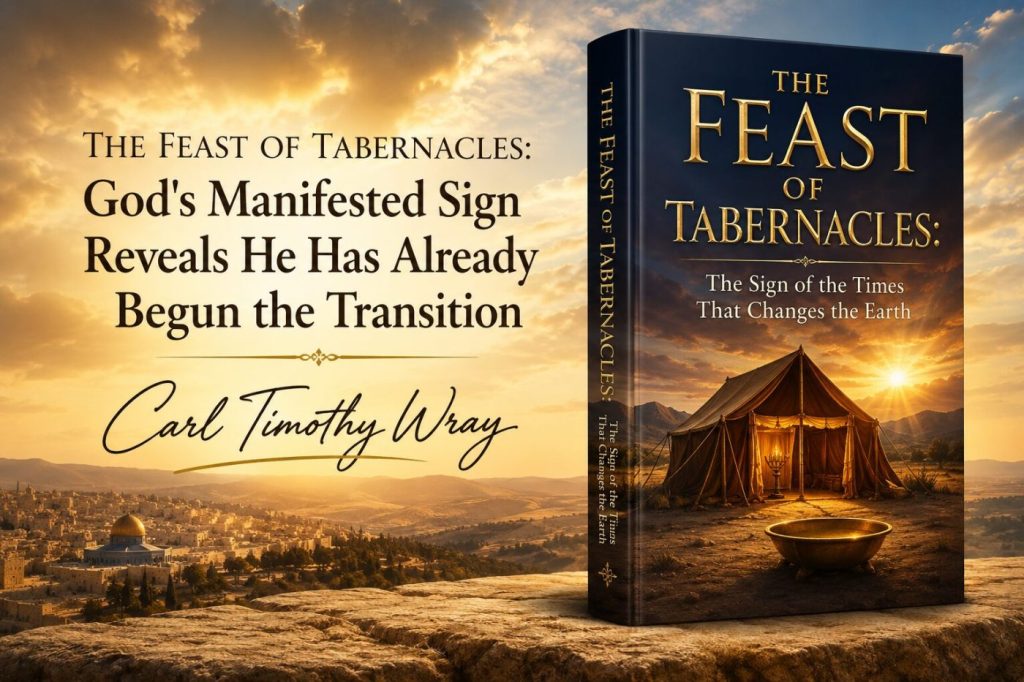
THE FEAST OF TABERNACLES: God’s Manifested Sign Reveals He Has Already Begun the Transition
By Carl Timothy Wray
Carl Timothy Wray is the founder of The Finished Work of Christ ministry and Zion University. For more than four decades, he has devoted his life to searching the Scriptures and proclaiming the revelation of Jesus Christ through the whole counsel of God. His ministry centers on the Finished Work of Christ, the Gospel of Grace, the Plan of the Ages, the Kingdom of God, the Revelation of Jesus Christ, and God’s eternal purpose to gather all things together in Christ.
His passion is simple: receive the vision, write the vision, and make it plain so that God’s people may discern the present work of God and follow the Lamb wherever He leads.
THE FEAST OF TABERNACLES: The Sign of the Times That Changes the Earth reveals the biblical purpose of God’s manifested signs throughout Scripture. From the ministry of Jesus Christ to the Day of Pentecost, God continually manifested signs that revealed He had already begun a new administration of His eternal purpose. This book explores the Feast of Tabernacles as God’s great sign of transition, showing how believers are called to discern the times, recognize God’s present work, and understand the unfolding of His eternal purpose through the revelation of Jesus Christ.
INTRODUCTION
The Bible is a book of divine order.
God has never moved without purpose, and He has never unfolded His eternal purpose without leaving a witness in the earth.
Throughout the Scriptures, God manifested signs that revealed He had already begun a new work. Those signs were never given merely to satisfy curiosity. They were Heaven’s testimony that God’s eternal purpose had entered its next administration.
When Jesus opened blind eyes, the sign revealed that the Kingdom of God had come near.
When the Holy Ghost was poured out on the Day of Pentecost, the rushing mighty wind and cloven tongues of fire revealed that God had already begun a new administration.
Peter did not begin the transition.
He explained what God had already done.
That pattern continues throughout the Scriptures.
God moves first.
God manifests His sign.
Then His people discern the day and follow Him.
The Feast of Tabernacles stands as the final feast of God’s redemptive purpose. Like every feast before it, it has its own manifested sign. The purpose of this book is not to predict dates or encourage speculation, but to teach believers how to discern the times by recognizing the manifested signs through which God reveals His unfolding purpose.
The question is not whether God is moving.
The question is whether we are discerning His present work.
TABLE OF CONTENTS
Introduction
Why God Manifests Signs
Chapter 1
What Is a Sign of the Times?
Discover the biblical purpose of God’s manifested signs and why they are given to reveal His present work.
Chapter 2
The Pattern of God’s Manifested Signs
Follow God’s unchanging pattern throughout Scripture as He moves first, manifests His sign, and then calls His people to discern and follow.
Chapter 3
The Faith That Receives Before It Sees
Learn why faith embraces God’s Word before visible manifestation and why Jesus commended those who trusted His Word above their sight.
Chapter 4
The Letter Bears Witness—The Spirit Reveals Christ
See the difference between possessing the testimony of Scripture and beholding the revelation of Jesus Christ through the unveiling work of the Holy Spirit.
Chapter 5
Pentecost: The Manifested Sign of a New Administration
Examine how Pentecost became God’s public witness that He had already begun a new administration of His eternal purpose.
Chapter 6
The Feast of Tabernacles: The Sign of the Times
Discover how the Feast of Tabernacles reveals God’s manifested sign that announces the transition into the fullness of His eternal purpose.
Chapter 7
Watching for His Appearing
Learn the posture of spiritual watchfulness that discerns God’s manifested sign instead of attempting to produce it.
Chapter 8
The Sign That Changes the Earth
Bring every thread together as God’s manifested sign reveals that He has already begun the transition into the next great unfolding of His eternal purpose.
Conclusion
Discern the Day and Follow the Lamb
CHAPTER ONE
THE PURPOSE OF GOD’S MANIFESTED SIGNS
“Can Ye Not Discern the Signs of the Times?”
Throughout the Scriptures, God has never left His people without a witness. Every major work of God has been accompanied by a manifested sign that testified He was unfolding His eternal purpose in the earth. Those signs were not given merely to satisfy man’s curiosity. They were given to awaken spiritual discernment.
A manifested sign does not create God’s work.
A manifested sign reveals that God has already begun His work.
Those who discern the sign discern the day.
Those who miss the sign often continue debating while God is already moving.
JESUS REBUKED A GENERATION THAT COULD NOT DISCERN THE TIME
Matthew 16:1–3
“The Pharisees also with the Sadducees came, and tempting desired him that he would shew them a sign from heaven.
He answered and said unto them, When it is evening, ye say, It will be fair weather: for the sky is red.
And in the morning, It will be foul weather to day: for the sky is red and lowering. O ye hypocrites, ye can discern the face of the sky; but can ye not discern the signs of the times?”
Teaching
Jesus did not rebuke them because there was no sign.
He rebuked them because they failed to discern the sign that was already standing before them.
The promised Messiah was healing the sick, opening blind eyes, cleansing lepers, casting out devils, and preaching the Kingdom of God. The signs were manifest, yet many religious leaders remained occupied with arguments while missing the work of God unfolding before their eyes.
The issue was never the absence of evidence.
The issue was spiritual discernment.
God had already begun the transition.
The manifested signs revealed what Heaven was doing.
GOD’S WORK IS REVEALED THROUGH MANIFESTED SIGNS
John 9:24–25
“Then again called they the man that was blind, and said unto him, Give God the praise: we know that this man is a sinner.
He answered and said, Whether he be a sinner or no, I know not: one thing I know, that, whereas I was blind, now I see.”
Teaching
The blind man did not enter into theological debate.
He simply bore witness to what God had already done.
His sight did not depend upon the approval of the Pharisees.
The miracle remained regardless of their opinions.
God had acted.
The manifested sign testified that the Kingdom of God had broken into his life.
Throughout history, God’s manifested signs have stood as His own witness.
Men may debate them.
They may reject them.
They may attempt to explain them away.
But the manifested sign continues to testify that God has already moved.
PENTECOST REVEALED THAT A NEW DAY HAD ALREADY BEGUN
Acts 2:1–4
“And when the day of Pentecost was fully come, they were all with one accord in one place.
And suddenly there came a sound from heaven as of a rushing mighty wind…
And there appeared unto them cloven tongues like as of fire…
And they were all filled with the Holy Ghost…”
Teaching
The Day of Pentecost did not begin when Peter stood to preach.
God had already acted.
The rushing mighty wind.
The tongues of fire.
The infilling of the Holy Ghost.
These manifested signs revealed that God had already begun a new administration of His eternal purpose.
Peter’s sermon did not initiate the transition.
His sermon explained the transition God had already manifested.
This pattern is found throughout the Scriptures.
God moves.
God manifests.
Then God gives understanding through His Word.
GOD’S PEOPLE ARE CALLED TO DISCERN HIS PRESENT WORK
John 5:39
“Search the scriptures; for in them ye think ye have eternal life: and they are they which testify of me.”
Teaching
The Scriptures are God’s testimony.
Their purpose is to reveal Jesus Christ.
The reader must never stop at the testimony without seeing the One to whom the testimony points.
The Holy Spirit unveils Christ through the Scriptures.
When Christ is revealed, the believer begins to discern God’s present work instead of merely debating the written testimony.
The goal is not simply to know the letter.
The goal is to behold the revelation of Jesus Christ.
THE FEAST OF TABERNACLES CALLS US TO DISCERN THE DAY
Ecclesiastes 3:1
“To every thing there is a season, and a time to every purpose under the heaven.”
Teaching
God’s eternal purpose unfolds according to His appointed seasons.
Every season arrives according to His wisdom.
Every administration unfolds according to His purpose.
As believers, our responsibility is not to produce God’s next work.
Our responsibility is to remain watchful, discerning, and ready to recognize His manifested sign when He reveals it.
The Feast of Tabernacles calls believers to live with that posture of expectancy.
We watch for His appearing.
We search the Scriptures.
We seek the revelation of Jesus Christ.
When God manifests His sign, we recognize that He has already begun the transition and we follow the Lamb wherever He leads.
CHAPTER SUMMARY
God has always revealed His unfolding purpose through manifested signs.
Those signs testify that He has already begun His work.
The question is never whether God is moving.
The question is whether His people are discerning the day.
Throughout this book we will discover that The Feast of Tabernacles is presented in Scripture as a feast of fulfillment, calling God’s people to watch, discern, and follow the unfolding of His eternal purpose through the revelation of Jesus Christ.
CHAPTER TWO
THE PATTERN OF GOD’S MANIFESTED SIGNS
God Moves First—His People Follow
God has never waited for man to initiate His eternal purpose.
He moves according to His own counsel.
Then He manifests His work.
Then He calls His people to discern what He has already begun.
This pattern is woven throughout the Scriptures.
God acts.
God manifests.
His people recognize the day.
Then they follow His leading.
The Feast of Tabernacles is understood within this same divine pattern.
GOD DECLARES THE END FROM THE BEGINNING
Isaiah 46:9–10
“Remember the former things of old: for I am God, and there is none else; I am God, and there is none like me,
Declaring the end from the beginning, and from ancient times the things that are not yet done, saying, My counsel shall stand, and I will do all my pleasure.”
Teaching
God never reacts to history.
History unfolds according to His eternal purpose.
He declares the end from the beginning because His purpose is already established.
When God manifests a sign, He is not deciding what He will do.
He is revealing what He has already purposed.
The manifested sign becomes Heaven’s testimony that God’s counsel is advancing exactly as He determined.
GOD REVEALS HIS WORK TO HIS PEOPLE
Amos 3:7
“Surely the Lord GOD will do nothing, but he revealeth his secret unto his servants the prophets.”
Teaching
God is not silent concerning His purpose.
He reveals what He is doing so His people may walk with Him.
The revelation prepares the heart.
The manifested sign confirms the work.
Those who love God’s voice learn to recognize His dealings as His purpose unfolds in the earth.
JESUS DID ONLY WHAT HE SAW THE FATHER DOING
John 5:19
“Then answered Jesus and said unto them, Verily, verily, I say unto you, The Son can do nothing of himself, but what he seeth the Father do…”
Teaching
Jesus perfectly demonstrated the life of dependence upon the Father.
He was never attempting to create the Father’s work.
He walked in complete agreement with what the Father was already doing.
This is the pattern for every believer.
We do not lead God.
We follow Him.
We discern His present work and walk in obedience to His voice.
PETER RECOGNIZED WHAT GOD HAD ALREADY DONE
Acts 2:14–17
“But Peter, standing up with the eleven, lifted up his voice… This is that which was spoken by the prophet Joel…”
Teaching
Peter did not announce the beginning of Pentecost.
Pentecost had already begun.
The rushing mighty wind had already come.
The Holy Ghost had already been poured out.
Peter simply opened the Scriptures and showed the people what God had already done.
The manifested sign came first.
The understanding followed.
This is the pattern of God’s manifested signs throughout Scripture.
GOD’S PEOPLE DISCERN THE DAY
Luke 12:54–56
“And he said also to the people, When ye see a cloud rise out of the west, straightway ye say, There cometh a shower…
Ye hypocrites, ye can discern the face of the sky and of the earth; but how is it that ye do not discern this time?”
Teaching
Jesus called His generation to discern more than natural seasons.
He called them to discern God’s present activity.
The greatest tragedy is not the absence of God’s work.
The greatest tragedy is failing to recognize His work when He manifests it.
God’s manifested signs invite His people to recognize the day and walk in step with His eternal purpose.
THE FEAST OF TABERNACLES FOLLOWS THE SAME DIVINE PATTERN
Ecclesiastes 3:11
“He hath made every thing beautiful in his time…”
Teaching
God’s purpose unfolds in His appointed time.
Every administration arrives according to His wisdom.
Every fulfillment comes according to His counsel.
The Feast of Tabernacles points believers to God’s appointed fullness.
As with every previous work of God, its manifested sign will testify that God has already begun the transition according to His eternal purpose.
The responsibility of God’s people is not to force the day.
It is to discern the day.
CHAPTER SUMMARY
From Genesis to Revelation, God’s pattern remains unchanged.
He purposes.
He moves.
He manifests.
He reveals.
His people discern.
His people follow.
Understanding this pattern prepares the reader to see why faith receives God’s Word before visible fulfillment and why those who walk by faith are ready to recognize God’s manifested sign when it appears.
CHAPTER THREE
THE FAITH THAT RECEIVES BEFORE IT SEES
Faith Receives the Promise Before the Manifestation
Throughout the Scriptures, God has always had a people who believed His Word before they saw its visible fulfillment.
Faith has never been built upon sight.
Faith receives what God has spoken while the promise is still unseen.
The Feast of Tabernacles calls believers to this same posture of faith. We do not walk by what our natural eyes can presently see. We walk by confidence in God’s Word, trusting that He will manifest His purpose in His appointed time.
ABRAHAM BELIEVED GOD
Romans 4:20–21
“He staggered not at the promise of God through unbelief; but was strong in faith, giving glory to God;
And being fully persuaded that, what he had promised, he was able also to perform.”
Teaching
Abraham did not possess the fulfillment when he first believed.
He possessed the promise.
Faith laid hold of God’s Word before his eyes beheld the fulfillment.
God’s promise became more real to Abraham than the circumstances surrounding him.
That is the nature of biblical faith.
Faith rests in God’s faithfulness before the manifestation appears.
THE CENTURION UNDERSTOOD THE AUTHORITY OF CHRIST’S WORD
Matthew 8:8–10
“The centurion answered and said, Lord, I am not worthy that thou shouldest come under my roof: but speak the word only, and my servant shall be healed…
When Jesus heard it, he marvelled, and said… I have not found so great faith, no, not in Israel.”
Teaching
The centurion did not ask Jesus for visible proof.
He trusted the authority of His Word.
He understood that Christ’s spoken Word was sufficient.
Jesus called this “great faith.”
Faith did not require Christ’s physical presence before believing.
Faith rested in the certainty of His Word.
God’s people are always strengthened when they learn to trust His Word before visible evidence appears.
BLESSED ARE THEY THAT HAVE NOT SEEN
John 20:29
“Jesus saith unto him, Thomas, because thou hast seen me, thou hast believed: blessed are they that have not seen, and yet have believed.”
Teaching
Jesus revealed a kingdom principle.
There is blessing in believing before seeing.
Faith does not deny that manifestation will come.
Faith simply refuses to wait for sight before trusting God’s promise.
God’s Word produces confidence long before visible fulfillment arrives.
WE WALK BY FAITH, NOT BY SIGHT
2 Corinthians 5:7
“For we walk by faith, not by sight.”
Teaching
The believer’s life is governed by confidence in God rather than by outward appearance.
Faith recognizes that God is always faithful to accomplish His purpose.
When circumstances appear unchanged, faith continues to stand upon the certainty of God’s Word.
The Feast of Tabernacles calls believers to maintain this posture of expectancy while watching for God’s manifested work.
FAITH LOOKS FOR THE PROMISE
Hebrews 11:13
“These all died in faith, not having received the promises, but having seen them afar off, and were persuaded of them, and embraced them…”
Teaching
The heroes of faith embraced God’s promises before they experienced their complete fulfillment.
Their confidence rested in the character of God.
They looked beyond the present because they believed what God had spoken.
Faith sees with the heart before the eyes behold the fulfillment.
THE FEAST OF TABERNACLES CALLS BELIEVERS TO WATCH AND BELIEVE
Hebrews 10:23
“Let us hold fast the profession of our faith without wavering; (for he is faithful that promised;)”
Teaching
God’s people are not called to manufacture His work.
They are called to remain steadfast in faith.
They watch.
They pray.
They search the Scriptures.
They remain ready.
Then, when God manifests His sign, they recognize that He has already begun unfolding His purpose.
Faith prepares the heart before the manifestation arrives.
CHAPTER SUMMARY
God has always honored those who trusted His Word before they saw its fulfillment.
Abraham believed.
The centurion believed.
Jesus pronounced a blessing upon those who believe before seeing.
Faith receives God’s promise.
Faith waits with confidence.
Faith remains watchful.
When God manifests His sign, faith recognizes the day because it has already embraced His Word.
This posture prepares believers to discern God’s unfolding purpose and to follow Him as His eternal plan advances toward its appointed fullness.
CHAPTER FOUR
THE LETTER BEARS WITNESS—THE SPIRIT REVEALS CHRIST
The Testimony Points to the Revelation
The Scriptures are God’s inspired testimony.
Every promise.
Every shadow.
Every feast.
Every sacrifice.
Every prophecy.
Every one of them bears witness to Jesus Christ.
The purpose of the written testimony is not to terminate upon itself. Its purpose is to reveal the Lord Jesus Christ.
The Feast of Tabernacles cannot be understood by studying the feast alone.
The Feast of Tabernacles must be understood through the revelation of Jesus Christ, for every feast finds its fulfillment in Him.
THE SCRIPTURES TESTIFY OF CHRIST
John 5:39–40
“Search the scriptures; for in them ye think ye have eternal life: and they are they which testify of me.
And ye will not come to me, that ye might have life.”
Teaching
Jesus did not diminish the Scriptures.
He revealed their purpose.
The Scriptures testify.
Christ is the One to whom they testify.
The testimony is inspired by God.
Yet the testimony always points beyond itself to the living Christ.
The reader who stops at the testimony without seeing Christ has not yet reached the destination toward which the Scriptures are leading.
THE VEIL IS REMOVED IN CHRIST
2 Corinthians 3:14–16
“But their minds were blinded: for until this day remaineth the same vail untaken away in the reading of the old testament…
Nevertheless when it shall turn to the Lord, the vail shall be taken away.”
Teaching
Paul describes a veil that remains over the reading of the Scriptures until hearts turn to Christ.
The issue is not the inspiration of the Scriptures.
The issue is the unveiling of Christ.
When the veil is removed, believers begin to behold the Lord throughout the testimony of Scripture.
The Feast of Tabernacles is no longer viewed merely as an ancient feast of Israel.
It becomes part of God’s unfolding revelation of His eternal purpose in Christ.
JESUS OPENED THE SCRIPTURES
Luke 24:27
“And beginning at Moses and all the prophets, he expounded unto them in all the scriptures the things concerning himself.”
Teaching
After His resurrection, Jesus did not give the disciples a new Bible.
He opened the Scriptures they already possessed.
Moses.
The Prophets.
The Psalms.
All of them pointed to Him.
The revelation was not found by abandoning the Scriptures.
The revelation came as Christ opened their understanding to what had been written from the beginning.
THE HOLY SPIRIT REVEALS THE THINGS OF CHRIST
John 16:13–15
“Howbeit when he, the Spirit of truth, is come, he will guide you into all truth…
He shall glorify me: for he shall receive of mine, and shall shew it unto you.”
Teaching
The ministry of the Holy Spirit is to glorify Jesus Christ.
He unveils Christ.
He illuminates the Scriptures.
He causes believers to behold God’s eternal purpose as it is revealed in His Son.
Every true revelation exalts Jesus Christ.
Every genuine unveiling leads the heart to behold Him more clearly.
THE REVELATION OF JESUS CHRIST
Revelation 1:1
“The Revelation of Jesus Christ, which God gave unto him…”
Teaching
The final book of the Bible begins by declaring its subject.
It is the Revelation of Jesus Christ.
Its purpose is not merely to present prophetic events.
Its purpose is to unveil the Lord Jesus Christ as the fulfillment of God’s eternal purpose.
The Feast of Tabernacles must therefore be understood through this same lens.
The feast is not merely an ordinance.
It bears witness to Christ and to the unfolding of God’s purpose in Him.
THE FEAST OF TABERNACLES IS UNDERSTOOD THROUGH CHRIST
Colossians 2:16–17
“Let no man therefore judge you… in respect of an holyday… or of the sabbath days:
Which are a shadow of things to come; but the body is of Christ.”
Teaching
The feasts were shadows.
Christ is the substance.
The shadow was never the destination.
It testified beforehand of the reality found in Him.
The Feast of Tabernacles points beyond the ceremony to the greater reality of God’s purpose revealed in Christ.
Only by seeing Christ can the shadow be understood according to its intended purpose.
CHAPTER SUMMARY
The Scriptures are God’s inspired testimony.
The Holy Spirit unveils the Christ to whom that testimony points.
The letter bears witness.
The Spirit reveals Christ.
When believers behold Jesus throughout the Scriptures, the unity of God’s eternal purpose becomes clear.
The Feast of Tabernacles is no longer viewed merely as an Old Testament feast.
It is seen as part of the testimony that reveals Jesus Christ and the unfolding of God’s eternal purpose from beginning to end.
CHAPTER FIVE
PENTECOST: THE MANIFESTED SIGN OF A NEW ADMINISTRATION
God Manifested the Sign Before the Apostles Explained It
The Day of Pentecost stands as one of the clearest examples of God’s divine pattern.
God moved first.
Heaven bore witness.
Then the apostles opened the Scriptures and explained what God had already done.
Pentecost did not begin with Peter’s sermon.
Pentecost began when God poured out the Holy Spirit.
The manifested sign revealed that God had already begun a new administration of His eternal purpose.
The apostles did not create the transition.
They discerned it.
They proclaimed it.
They called the people to respond to what God had already begun.
The Feast of Tabernacles must be understood through this same divine pattern.
THE DAY OF PENTECOST FULLY CAME
Acts 2:1–4
“And when the day of Pentecost was fully come, they were all with one accord in one place.
And suddenly there came a sound from heaven as of a rushing mighty wind, and it filled all the house where they were sitting.
And there appeared unto them cloven tongues like as of fire, and it sat upon each of them.
And they were all filled with the Holy Ghost, and began to speak with other tongues, as the Spirit gave them utterance.”
Teaching
The transition did not begin with man’s understanding.
It began with God’s action.
The sound from heaven.
The rushing mighty wind.
The tongues of fire.
The infilling of the Holy Spirit.
These were Heaven’s witness that God had already begun a new work in the earth.
The manifested sign did not create the new day.
The manifested sign revealed that the new day had already dawned.
THE MULTITUDE SAW THE SIGN
Acts 2:5–12
“Now when this was noised abroad, the multitude came together, and were confounded…
And they were all amazed and were in doubt, saying one to another, What meaneth this?”
Teaching
The people did not gather because Peter advertised a meeting.
They gathered because God had manifested His sign.
The sign arrested their attention.
It forced the question:
“What meaneth this?”
That question has echoed throughout every generation whenever God has manifested His work.
The manifested sign calls men to discern what God is doing.
SOME DISCERNED—OTHERS MOCKED
Acts 2:13
“Others mocking said, These men are full of new wine.”
Teaching
The same manifested sign produced different responses.
Some were amazed.
Some sincerely desired understanding.
Others mocked.
The sign itself did not determine the response.
It revealed the condition of the heart.
Throughout Scripture, God’s manifested signs become a dividing point.
Some discern.
Some reject.
Yet God’s purpose continues to advance.
PETER EXPLAINED WHAT GOD HAD ALREADY DONE
Acts 2:14–18
“But Peter, standing up with the eleven…
This is that which was spoken by the prophet Joel…”
Teaching
Peter did not begin Pentecost.
He interpreted Pentecost.
He did not produce the outpouring.
He revealed its meaning through the Scriptures.
This is God’s pattern.
God manifests.
Then revelation follows.
The Scriptures explain what God has already accomplished.
Understanding always follows God’s manifested work.
A NEW ADMINISTRATION HAD BEGUN
Hebrews 12:24
“And to Jesus the mediator of the new covenant…”
Teaching
Pentecost was more than a powerful spiritual experience.
It revealed that God had inaugurated a new covenant administration through Jesus Christ.
The manifested sign testified that God’s purpose had advanced.
The old order was giving way to the new.
Heaven announced the transition before men fully understood its significance.
THE FEAST OF TABERNACLES FOLLOWS THE SAME DIVINE PATTERN
Ecclesiastes 3:11
“He hath made every thing beautiful in his time…”
Teaching
God’s purpose unfolds according to His appointed times.
Each great movement of God carries its own witness.
Each administration is revealed by God’s manifested work.
Pentecost had its manifested sign.
The Feast of Tabernacles must likewise be understood as God’s work revealed in His appointed time.
The responsibility of God’s people is not to manufacture the day.
It is to discern the day.
Those who are watching for His appearing recognize that God’s manifested sign reveals He has already begun the transition according to His eternal purpose.
CHAPTER SUMMARY
Pentecost establishes the divine pattern that runs throughout Scripture.
God moves.
Heaven bears witness.
The manifested sign appears.
The Scriptures reveal its meaning.
God’s people discern the day.
The Feast of Tabernacles should be approached with this same pattern in mind. We are not attempting to produce God’s work. We are watching for His manifested sign, knowing that when He reveals it, He is declaring that His eternal purpose has already advanced into its next appointed administration.
CHAPTER SIX
THE FEAST OF TABERNACLES: THE SIGN OF THE TIMES
God’s Manifested Sign Reveals He Has Already Begun the Transition
The Feast of Tabernacles is the final feast in God’s appointed order.
Passover revealed redemption.
Pentecost revealed the outpouring of the Holy Spirit.
The Feast of Tabernacles points to the fullness of God’s eternal purpose.
Like every work of God before it, the Feast of Tabernacles is not understood by human effort or religious speculation. It is understood as God manifests His purpose according to His appointed time.
God’s manifested sign reveals that He has already begun the transition.
The responsibility of God’s people is not to create that transition.
Our responsibility is to discern it.
THE FEASTS WERE APPOINTED TIMES
Leviticus 23:1–2
“And the LORD spake unto Moses, saying,
Speak unto the children of Israel, and say unto them, Concerning the feasts of the LORD… these are my feasts.”
Teaching
The feasts did not originate with Israel.
They are the feasts of the Lord.
Each feast reveals a divine appointment within God’s eternal purpose.
They were established by God to testify of His redemptive plan fulfilled in Jesus Christ.
The Feast of Tabernacles stands as the final appointed feast, directing our attention toward the fullness of God’s purpose.
THE FEAST OF TABERNACLES WAS THE FEAST OF INGATHERING
Exodus 23:16
“And the feast of harvest, the firstfruits of thy labours… and the feast of ingathering, which is in the end of the year…”
Teaching
The Feast of Tabernacles is called the Feast of Ingathering.
It marks completion.
It speaks of fullness.
It reveals God’s purpose reaching its appointed season.
The pattern throughout Scripture moves toward completion rather than remaining forever in beginnings.
God finishes what He begins.
THE CREATION WAITS FOR A REVELATION
Romans 8:19–23
“For the earnest expectation of the creature waiteth for the manifestation of the sons of God…
…waiting for the adoption, to wit, the redemption of our body.”
Teaching
Creation is not waiting for God to develop a purpose.
God’s purpose is already established.
Creation waits for the manifestation of what God has purposed.
The redemption of the body is presented as a visible manifestation.
When God manifests His work, His manifested sign reveals that He has already begun the transition according to His eternal purpose.
MORTALITY SHALL BE SWALLOWED UP OF LIFE
2 Corinthians 5:4
“That mortality might be swallowed up of life.”
Teaching
God’s purpose moves beyond forgiveness alone.
It moves toward the fullness of His life.
The Scriptures continually point forward to the victory of life over mortality.
The Feast of Tabernacles directs our attention to God’s completed purpose as He brings His work toward its appointed fullness.
CHRIST SHALL CHANGE OUR VILE BODY
Philippians 3:20–21
“Who shall change our vile body, that it may be fashioned like unto his glorious body…”
Teaching
The believer’s hope reaches beyond the present experience.
It rests in the promise of Christ’s completed work.
God’s purpose includes conformity to the image of His Son.
When God manifests His appointed work, His people recognize that He is bringing His eternal purpose to its intended fulfillment.
THE LAST FEAST REVEALS GOD’S FULLNESS
Zechariah 14:16
“And it shall come to pass… that every one… shall even go up… to keep the feast of tabernacles.”
Teaching
The Feast of Tabernacles occupies a unique place in prophetic Scripture.
It points beyond an Old Testament observance toward God’s universal purpose.
The final feast reminds us that God’s desire has always been to dwell with His people and bring His purpose to completion.
Throughout Scripture, the movement is always toward fullness.
The Feast of Tabernacles bears witness to that fullness.
DISCERNING THE SIGN OF THE TIMES
Matthew 16:3
“…Can ye not discern the signs of the times?”
Teaching
Jesus called His generation to recognize the day of God’s visitation.
The same call comes to every generation.
God’s people are not called to live in fear.
They are called to live in discernment.
They watch.
They pray.
They search the Scriptures.
They remain ready.
When God manifests His sign, they recognize that He has already begun the transition and they joyfully follow where He leads.
CHAPTER SUMMARY
The Feast of Tabernacles stands as the final feast in God’s appointed order and directs our attention to the fullness of His eternal purpose.
Like every great work of God throughout Scripture, it is recognized through God’s manifested sign.
The sign does not create the day.
The sign reveals that the day has already dawned.
Those who discern the sign discern the time.
Those who discern the time are prepared to follow the Lamb as He unfolds His eternal purpose in the earth.
CHAPTER SEVEN
WATCHING FOR HIS APPEARING
The Posture of Those Who Discern the Times
Throughout the Scriptures, God’s people have never been called to determine the day of God’s next great work.
They have been called to watch.
To wait.
To discern.
To remain ready.
God moves according to His eternal purpose.
His people respond by living in expectancy, searching the Scriptures, and watching for His manifested sign.
The Feast of Tabernacles calls believers to this posture of spiritual watchfulness. We do not attempt to produce God’s work. We remain ready to recognize His work when He manifests it.
WATCH THEREFORE
Matthew 24:42
“Watch therefore: for ye know not what hour your Lord doth come.”
Teaching
Jesus did not tell His disciples to calculate the day.
He told them to watch.
Watching is the posture of spiritual discernment.
It is the heart that remains awake to God’s present work.
Those who watch are not consumed with speculation.
They are attentive to the voice of the Shepherd and prepared to follow Him wherever He leads.
BE YE ALSO READY
Luke 12:35–37
“Let your loins be girded about, and your lights burning;
And ye yourselves like unto men that wait for their lord…
Blessed are those servants, whom the lord when he cometh shall find watching…”
Teaching
Readiness is the fruit of faith.
Those who believe God’s promises prepare their hearts before the fulfillment appears.
They are not surprised when God manifests His work because they have been living in expectation of His faithfulness.
The Feast of Tabernacles calls believers to remain spiritually prepared for God’s appointed time.
OUR CONVERSATION IS IN HEAVEN
Philippians 3:20–21
“For our conversation is in heaven; from whence also we look for the Saviour, the Lord Jesus Christ:
Who shall change our vile body, that it may be fashioned like unto his glorious body…”
Teaching
Paul describes believers as a people who are looking.
Their hope is anchored in Jesus Christ.
Their expectation rests in His promise.
They understand that God’s purpose is moving toward the complete conformity of His people to the image of His Son.
Watching is not passive.
Watching is living with confident expectation that God will accomplish what He has promised.
WE LOOK FOR THAT BLESSED HOPE
Titus 2:11–13
“Looking for that blessed hope, and the glorious appearing of the great God and our Saviour Jesus Christ.”
Teaching
The believer’s eyes are fixed upon Christ.
Hope is not rooted in fear.
Hope is rooted in God’s faithfulness.
The glorious appearing of Christ directs the heart toward the completion of God’s eternal purpose.
The Feast of Tabernacles reminds us that God finishes what He begins.
HOLD FAST THE CONFIDENCE OF YOUR FAITH
Hebrews 10:23
“Let us hold fast the profession of our faith without wavering; (for he is faithful that promised;)”
Teaching
Faith remains steadfast because God’s character never changes.
The believer does not become discouraged when fulfillment has not yet appeared.
Confidence rests in the One who promised.
Waiting is never wasted when it is grounded in God’s faithfulness.
DISCERNING THE DAY
Luke 21:28
“And when these things begin to come to pass, then look up, and lift up your heads; for your redemption draweth nigh.”
Teaching
Jesus taught His disciples to recognize the season of God’s activity.
Discernment lifts the believer’s eyes above confusion and fear.
God’s people are not called to panic.
They are called to recognize His work and walk in hope.
The Feast of Tabernacles calls believers to live with this same spiritual awareness, watching for God’s manifested sign and remaining ready to follow Him.
CHAPTER SUMMARY
Watching is the posture of faith.
It is the heart that believes God’s promises, searches the Scriptures, and remains ready for God’s appointed time.
The believer does not produce God’s work.
The believer watches for God’s work.
When God’s manifested sign appears, those who have been watching recognize that He has already begun the transition according to His eternal purpose.
The Feast of Tabernacles calls God’s people to this life of expectancy, discernment, and faithful readiness as they follow the Lamb wherever He leads.
CHAPTER EIGHT
THE SIGN THAT CHANGES THE EARTH
God’s Eternal Purpose Moves from Promise to Manifestation
From the beginning of this book, we have followed one unchanging pattern throughout the Scriptures.
God purposes.
God speaks.
God moves.
God manifests His work.
Then His people discern what He has already begun.
This pattern has been seen in creation.
It was seen in Abraham.
It was seen in the ministry of Jesus.
It was seen on the Day of Pentecost.
It will also be seen as God continues to unfold His eternal purpose according to His appointed times.
The Feast of Tabernacles points us toward the fullness of that purpose.
It calls us to live with spiritual discernment, steadfast faith, and confident expectation.
THE WHOLE CREATION WAITS
Romans 8:19–23
“For the earnest expectation of the creature waiteth for the manifestation of the sons of God…
…waiting for the adoption, to wit, the redemption of our body.”
Teaching
Paul reveals that creation itself is waiting.
It is not waiting for God to form a new plan.
It is waiting for the manifestation of what God has already purposed in Christ.
The redemption of the body is presented as the visible testimony that God’s purpose continues to advance toward its appointed fullness.
Creation waits for the manifestation.
God’s people watch for the manifestation.
When God manifests His work, His sign declares that He has already begun the transition.
THE LAST ENEMY SHALL BE DESTROYED
1 Corinthians 15:25–26
“For he must reign, till he hath put all enemies under his feet.
The last enemy that shall be destroyed is death.”
Teaching
The reign of Christ is progressive in its outworking.
Every enemy ultimately yields to His authority.
The final enemy named by Paul is death.
The Scriptures move steadily toward the complete triumph of the Lord Jesus Christ.
Nothing contrary to His eternal purpose will remain.
The Feast of Tabernacles directs our attention toward that glorious completion.
BEHOLD, I MAKE ALL THINGS NEW
Revelation 21:5
“And he that sat upon the throne said, Behold, I make all things new.”
Teaching
The purpose of God has always been restoration through Jesus Christ.
The One seated upon the throne is not abandoning His creation.
He is bringing it into the fullness of His purpose.
The promise of “all things new” reveals the heart of God from Genesis to Revelation.
His eternal purpose is moving toward completion.
GOD SHALL BE ALL IN ALL
1 Corinthians 15:28
“And when all things shall be subdued unto him… that God may be all in all.”
Teaching
Paul concludes his great resurrection chapter by pointing to the ultimate goal of God’s eternal purpose.
The purpose is not merely individual blessing.
The purpose is the complete triumph of God through Jesus Christ.
Everything moves toward His glory.
Everything moves toward His fullness.
Everything moves toward the complete accomplishment of His eternal purpose.
DISCERN THE TIMES—FOLLOW THE LAMB
Revelation 14:4
“These are they which follow the Lamb whithersoever he goeth…”
Teaching
Throughout every generation, God has had a people who followed Him.
They did not remain anchored to yesterday’s revelation when God called them forward.
They followed the Lamb.
They discerned His voice.
They recognized His work.
The call remains the same today.
Wherever the Lamb leads, His people follow.
The Feast of Tabernacles reminds us that God’s eternal purpose is still unfolding according to His appointed times.
Those who discern His manifested sign will joyfully walk in the light He gives.
A FINAL EXHORTATION
Hebrews 12:1–2
“Let us run with patience the race that is set before us,
Looking unto Jesus the author and finisher of our faith…”
Teaching
Our confidence rests in Jesus Christ.
He is the Author.
He is the Finisher.
The One who began His work will complete it.
Therefore we do not fear.
We do not become discouraged.
We do not lose hope.
We remain faithful.
We remain watchful.
We continue searching the Scriptures.
We continue following the Lamb.
And we trust that, in His appointed time, God will complete every promise according to His eternal purpose.
CHAPTER SUMMARY
The Feast of Tabernacles points believers to the fullness of God’s eternal purpose in Jesus Christ.
Throughout Scripture, God’s pattern has remained unchanged.
He purposes.
He promises.
He manifests.
His people discern.
His people follow.
God’s manifested sign does not create His work.
It reveals that He has already begun the transition.
May we therefore be a people who search the Scriptures, walk by faith, discern the times, and faithfully follow the Lamb wherever He leads, knowing that the God who began His eternal purpose before the foundation of the world will surely bring it to its glorious completion in Jesus Christ.
CONCLUSION
DISCERNING GOD’S APPOINTED TIMES
From Genesis to Revelation, one truth stands above every generation:
God has never left Himself without a witness.
Before every great transition in His eternal purpose, He has provided both the testimony of Scripture and the witness of His manifested work.
Noah saw the day approaching and built the ark.
Abraham believed the promise before Isaac was born.
Moses discerned God’s visitation at the burning bush.
The prophets spoke beforehand of Christ.
John the Baptist prepared the way of the Lord.
Jesus fulfilled everything written concerning Him.
On the Day of Pentecost, Heaven manifested the sign before Peter explained it.
Throughout history, God has always moved first.
His people have always been called to discern what He was doing.
That same divine pattern continues today.
The Feast of Tabernacles invites us to look beyond tradition, beyond speculation, and beyond human expectation. It calls us back to the Scriptures, back to Jesus Christ, and back to the eternal purpose that God established before the foundation of the world.
This book has not attempted to predict dates or create excitement about future events.
Its purpose has been far simpler.
It has sought to demonstrate that God unfolds His purpose according to His appointed times, and that His manifested signs reveal He has already begun the transition from one administration of His purpose to the next.
The responsibility of God’s people has never been to manufacture God’s work.
Our calling is to know His voice.
To search the Scriptures.
To discern the times.
To recognize His manifested witness.
And to follow the Lamb wherever He leads.
The Feast of Tabernacles reminds us that God always finishes what He begins.
The God who redeemed through the Passover Lamb…
The God who poured out His Spirit at Pentecost…
Is the same God who is bringing His eternal purpose to its glorious fullness in Jesus Christ.
Every promise finds its “Yes” and “Amen” in Him.
Every feast bears witness to Him.
Every prophecy points toward Him.
Every administration reveals more of Him.
The goal has never been merely to understand a feast.
The goal is to know the One to whom every feast points.
Jesus Christ is the Alpha and the Omega.
The Beginning and the End.
The Author and the Finisher of our faith.
He is God’s eternal purpose revealed.
As you close this book, my prayer is not merely that you remember its arguments.
My prayer is that you become a diligent student of the Scriptures, allowing the Holy Spirit to continually unveil Jesus Christ from Genesis to Revelation.
May your faith be strengthened.
May your hope abound.
May your spiritual discernment increase.
May you recognize the voice of the Shepherd.
May you follow the Lamb wherever He leads.
And may you stand with confidence in every season, knowing that the God who declared the end from the beginning will faithfully accomplish all that He has purposed.
“He which testifieth these things saith, Surely I come quickly. Amen. Even so, come, Lord Jesus.”
— Revelation 22:20
Scripture References
Introduction
- Genesis 1:14
- Isaiah 46:9–10
- Amos 3:7
- Ecclesiastes 3:1
- Matthew 16:3
- Luke 12:54–56
Chapter One — Why God Manifests Signs
- Genesis 1:14
- Exodus 3:1–6
- Joshua 3:14–17
- Luke 2:8–14
- Matthew 3:16–17
- Acts 2:1–4
- Ecclesiastes 3:11
Chapter Two — The Pattern of God’s Manifested Signs
- Isaiah 46:9–10
- Amos 3:7
- John 5:19
- Acts 2:14–17
- Luke 12:54–56
- Ecclesiastes 3:11
Chapter Three — The Faith That Receives Before It Sees
- Romans 4:20–21
- Matthew 8:8–10
- John 20:29
- 2 Corinthians 5:7
- Hebrews 11:13
- Hebrews 10:23
Chapter Four — The Letter Bears Witness—The Spirit Reveals Christ
- John 5:39–40
- 2 Corinthians 3:14–16
- Luke 24:27
- John 16:13–15
- Revelation 1:1
- Colossians 2:16–17
Chapter Five — Pentecost: The Manifested Sign of a New Administration
- Acts 2:1–18
- Hebrews 12:24
- Ecclesiastes 3:11
Chapter Six — The Feast of Tabernacles: The Sign of the Times
- Leviticus 23:1–2
- Exodus 23:16
- Romans 8:19–23
- 2 Corinthians 5:4
- Philippians 3:20–21
- Zechariah 14:16
- Matthew 16:3
Chapter Seven — Watching for His Appearing
- Matthew 24:42
- Luke 12:35–37
- Philippians 3:20–21
- Titus 2:11–13
- Hebrews 10:23
- Luke 21:28
Chapter Eight — The Sign That Changes the Earth
- Romans 8:19–23
- 1 Corinthians 15:25–28
- Revelation 21:5
- Revelation 14:4
- Hebrews 12:1–2
Conclusion
- Genesis 1:14
- Isaiah 46:9–10
- Amos 3:7
- John 5:39
- Luke 24:27
- Acts 2:14–18
- Hebrews 12:1–2
- Revelation 22:20

The Feast of Tabernacles Series
- THE FEAST OF TABERNACLES — THE FEAST OF FULLNESS
- THE FEAST OF TABERNACLES: Who Experiences the Fullness of God’s Promises First?
- THE FEAST OF TABERNACLES: Why Is the Whole Creation Groaning?