 📺
📺
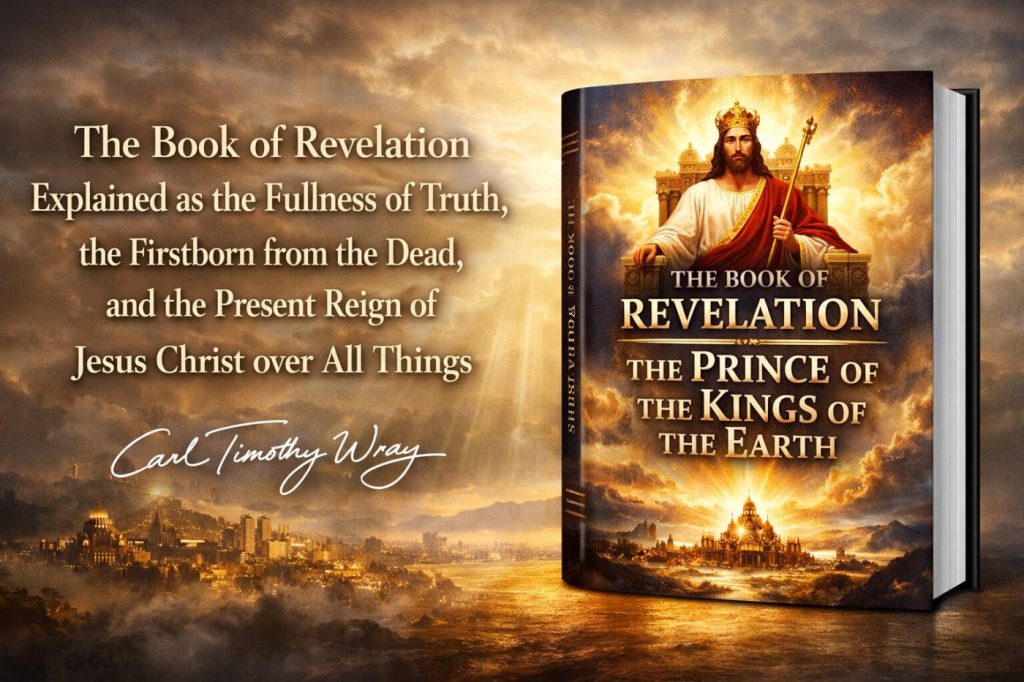
The Book of Revelation Explained as the Fullness of Truth, the Firstborn from the Dead, and the Present Reign of Jesus Christ over All Things
Book of Revelation: Author
Carl Timothy Wray is a Bible teacher and writer dedicated to proclaiming the finished work of Jesus Christ and the unveiling of Christ in His people. Through years of study and spiritual insight, his writings focus on the deeper spiritual meaning of scripture, particularly the revelation of Jesus Christ, the kingdom of God, and the manifestation of the sons of God. His ministry emphasizes the present reign of Christ, the transformation of believers into His likeness, and the ultimate restoration of creation through the power of the risen Christ. Carl Timothy Wray shares his teachings through books, articles, and online ministry to encourage believers to see Christ not only as Savior, but as the reigning King and the living life within His people.
The Book of Revelation — The Prince of the Kings of the Earth unveils the true meaning of the Book of Revelation as the revelation of Jesus Christ in His fullness. This powerful study explores Christ as the faithful and true witness, the firstborn from the dead, and the present King reigning over all rulers and nations. Moving beyond traditional interpretations focused on fear and catastrophe, this book reveals the spiritual reality of Christ’s kingdom, the transformation of believers into His likeness, and the rise of the manifested sons of God who reign with Him. Discover how the Book of Revelation reveals the fullness of truth, the victory over death, and the present reign of Jesus Christ over all things.
Book of Revelation: Introduction
The Revelation of the King
The Book of Revelation is one of the most discussed, debated, and misunderstood books in the entire Bible. For generations many have approached it as a mysterious code filled with strange creatures, catastrophic judgments, and predictions about the end of the world. Countless theories have attempted to identify political leaders, world powers, and historical events hidden within its symbolic language. Yet despite all of these interpretations, the opening words of the book declare something far simpler and far more profound:
“The Revelation of Jesus Christ.”
Before Revelation is anything else, it is the unveiling of Jesus Christ. It is the removal of the veil that hides the fullness of who He is and what He is accomplishing in the earth.
When we understand this truth, the entire book begins to take on new meaning. The strange symbols and powerful visions are no longer puzzles meant to satisfy human curiosity about the future. They are revelations designed to reveal the glory, authority, and triumph of Jesus Christ.
In the very opening chapter of Revelation, three remarkable titles are given to Christ:
He is the faithful and true witness.
He is the firstborn from the dead.
And He is the Prince of the kings of the earth.
These three titles form one of the most powerful declarations of Christ’s supremacy in all of scripture. They reveal the complete authority of Jesus Christ in truth, in resurrection, and in kingdom rule.
First, Christ is the faithful and true witness. In Him the fullness of God’s truth is revealed. Everything that came before Him — the law, the prophets, the temple, and the sacrifices — were shadows and partial revelations. But in Christ the fullness of God’s purpose appears. He is not merely another messenger of truth; He is the complete expression of divine reality.
Second, Christ is the firstborn from the dead. His resurrection was not simply a miracle confirming His identity. It was the beginning of an entirely new order of life. When Christ rose from the tomb, He opened the way for humanity to pass from death into the life of God. His resurrection is the pattern of the victory that will ultimately transform creation itself.
Third, Christ is the Prince of the kings of the earth. This title reveals something many believers have overlooked: Jesus Christ is not waiting to become King. He is King now. Having risen from the dead and ascended into heaven, He has been given all authority in heaven and in earth. From the throne of God He reigns over the affairs of nations, guiding the unfolding of God’s purpose in history.
The Book of Revelation is therefore not a message of fear or defeat. It is the declaration that Jesus Christ reigns. It reveals the triumph of the Lamb who was slain and the unfolding kingdom of God that will ultimately fill the earth.
This book explores these three great revelations of Christ:
His fullness of truth,
His victory over death,
and His present reign over all rulers and nations.
As these truths unfold, we begin to see that Revelation is not only revealing Christ in heaven — it is revealing Christ in His people. The same life that raised Jesus from the dead is working within those who follow Him. Through that life believers are being transformed into His likeness and prepared to share in His kingdom.
The unveiling of Jesus Christ is the unveiling of the King who reigns now and whose kingdom will never end.
To see Him as He truly is changes everything.
Chapter 1
The Revelation of Jesus Christ
The Book of Revelation opens with a statement so simple that many readers pass over it without realizing its tremendous significance:
“The Revelation of Jesus Christ, which God gave unto Him, to show unto His servants things which must shortly come to pass.”
— Revelation 1:1
Before Revelation is anything else, it is the revelation of Jesus Christ.
It is not primarily a revelation of world events.
It is not chiefly a prophecy of disasters.
It is not a coded timeline predicting political upheavals or global catastrophes.
The Book of Revelation is the unveiling of a Person — Jesus Christ in His glory, authority, and kingdom.
The Greek word translated revelation is apokalypsis, which means to unveil, uncover, or remove the veil from something that was previously hidden. The purpose of the book, therefore, is to remove the veil that has hidden the full glory of Christ from human understanding.
When the veil is lifted, we see Christ not merely as the humble teacher who walked the dusty roads of Galilee, but as the exalted Lord of heaven and earth.
The Misunderstood Book
Few books of the Bible have been more misunderstood than Revelation. Throughout history many have approached it as a mysterious puzzle filled with strange symbols — dragons, beasts, trumpets, seals, bowls, and catastrophic judgments.
Because of these images, countless interpreters have tried to turn the book into a map of future political events. Some have attempted to identify specific nations, world leaders, or technological developments hidden within its symbolic language.
Each generation has produced its own theories.
Some believed the beast represented the Roman Empire.
Others believed it represented medieval institutions.
Still others have attempted to identify it with modern political figures or global alliances.
Yet history has repeatedly shown the weakness of these interpretations. Predictions come and go, theories rise and fall, and the world continues on.
The reason for this confusion is simple: many readers have forgotten the first sentence of the book.
Revelation is not primarily about the rise and fall of earthly kingdoms. It is about the revealing of Jesus Christ.
Once we understand this, the book begins to open in a completely different way.
The Central Theme of Revelation
Every vision in the Book of Revelation ultimately points to the same reality: the supremacy of Jesus Christ.
He is revealed as:
The Son of Man walking among the candlesticks.
The Lamb who was slain standing in the midst of the throne.
The Lion of the tribe of Judah who has overcome.
The Faithful and True Witness who reveals the fullness of truth.
The Firstborn from the dead who conquers death itself.
The Prince of the kings of the earth who reigns over all rulers.
The book unfolds these revelations step by step until the final vision reveals the throne of God and the Lamb at the center of a renewed creation.
From beginning to end, the message is clear: Christ reigns.
The Christ of Revelation
When the apostle John received the visions recorded in this book, he was not standing in a place of comfort or influence. He had been exiled to the small and barren island of Patmos because of his testimony concerning Jesus Christ.
Separated from the churches he had served and surrounded by the harsh environment of exile, John might easily have felt that the forces of the world were winning.
But it was in that place of isolation that heaven opened.
John writes:
“I was in the Spirit on the Lord’s day, and heard behind me a great voice, as of a trumpet.”
— Revelation 1:10
Turning to see the voice that spoke to him, John beheld a vision of Christ that was far different from the teacher he had once followed during the days of His earthly ministry.
He saw Christ clothed with divine authority.
His eyes were like flames of fire.
His voice sounded like the roar of many waters.
His face shone like the sun in its full strength.
This vision revealed the risen and exalted Christ — the Lord who reigns from the throne of God.
The Unveiling of Christ in His People
The revelation John received did more than reveal Christ as the ruler of heaven. It also revealed Christ working within His people.
Throughout the book we see the unfolding story of a people who follow the Lamb. They overcome trials, resist corruption, and grow into the life of Christ. Ultimately they are described as kings and priests who share in His reign.
This reveals an important truth.
The unveiling of Jesus Christ is not only about revealing who He is in heaven. It is also about revealing His life within those who belong to Him.
The apostle Paul described this mystery in a simple yet powerful statement:
“Christ in you, the hope of glory.”
— Colossians 1:27
The same Christ who sits upon the throne is at work within His people, transforming them into His likeness and preparing them to participate in His kingdom.
The Journey Ahead
As we move through the Book of Revelation, we will see three great dimensions of Christ revealed.
First, we will see Him as the faithful and true witness, the One in whom the fullness of God’s truth appears.
Second, we will see Him as the firstborn from the dead, the conqueror of death whose resurrection begins a new order of life.
Third, we will see Him as the Prince of the kings of the earth, the King who reigns even now over the nations and over the unfolding of God’s purpose in history.
Together these revelations show us the complete supremacy of Jesus Christ.
The Book of Revelation does not end in darkness or destruction. It ends with the triumphant declaration that the kingdom of God fills the earth and the throne of God and the Lamb stands at the center of a renewed creation.
And it all begins with this simple yet profound truth:
The Revelation of Jesus Christ.
Chapter 2
The Faithful and True Witness
One of the most powerful descriptions of Jesus Christ found in the opening chapter of Revelation is this:
“And from Jesus Christ, who is the faithful witness…”
— Revelation 1:5
Later in the book the same idea appears again when Christ speaks to the churches:
“These things saith He that is holy, He that is true…”
— Revelation 3:7
“These things saith the Amen, the faithful and true witness…”
— Revelation 3:14
These titles are far more than poetic expressions. They reveal something profound about the nature and mission of Jesus Christ. He is not simply a teacher who spoke truth. He is the faithful and true witness of God Himself.
To understand the weight of this title, we must consider the meaning of the word true as it appears in the language of the New Testament.
The Meaning of “True”
In modern language the word true usually means something that is correct as opposed to false. But the Greek word used in these passages carries a deeper meaning.
The word refers to something that is complete, genuine, and fully realized.
It describes reality as opposed to shadow.
It describes fullness as opposed to fragments.
In other words, something may be true in the sense that it points toward reality, yet still be incomplete. But when the word true is used of Christ, it means that in Him the full reality appears.
He is not merely part of the truth — He is the full expression of it.
From Shadow to Reality
This distinction appears repeatedly throughout the New Testament.
Jesus once spoke of the manna that God provided for Israel during their journey through the wilderness. That bread from heaven sustained the people of God for forty years, yet Jesus said something remarkable about it:
“Moses gave you not that bread from heaven; but my Father giveth you the true bread from heaven.”
— John 6:32
The manna was real. It was not false bread. God Himself sent it from heaven.
Yet the manna was only a temporary provision, a symbol pointing toward something greater. It satisfied physical hunger for a time, but it could not impart eternal life.
Jesus then declared:
“I am the bread of life.”
In Christ the symbol became reality. He is the true bread, the fullness of what the manna foreshadowed.
The same pattern appears again when Jesus describes Himself as the vine:
“I am the true vine.”
— John 15:1
Israel had been described in the Old Testament as a vine planted by God. Yet the nation often failed to produce the fruit God desired.
Christ appears as the true vine, the perfect realization of what Israel was meant to be.
The True Light
Another example appears in the apostle John’s writings when he speaks of the coming of Christ:
“The true light now shineth.”
— 1 John 2:8
Before Christ came into the world, the people of Israel already possessed light. They had the law, the prophets, and the sacred writings that revealed the will of God. In a world filled with spiritual darkness, Israel was uniquely blessed with divine illumination.
Yet even this light was not the fullness of what God intended.
When Jesus appeared, the light that had once been reflected through prophets and scriptures now shone in its full brilliance. Christ was not merely a bearer of light — He was the light itself.
The law and the prophets revealed truth in part. But in Christ the truth appeared in its fullness.
As the Gospel of John declares:
“For the law was given by Moses, but grace and truth came by Jesus Christ.”
— John 1:17
The Faithful Witness
Christ is called the faithful witness because He perfectly reveals the nature and purpose of God.
Throughout history God had spoken through prophets, visions, and sacred writings. Each of these revelations communicated something of His will. Yet every message was partial.
Even the greatest prophets saw only fragments of the divine plan.
But Jesus Christ revealed God completely.
When Philip once asked Jesus to show the disciples the Father, Jesus answered with words that revealed the depth of His unity with God:
“He that hath seen me hath seen the Father.”
— John 14:9
In Christ the invisible God became visible. The character of God — His love, mercy, justice, and holiness — appeared in human form.
Christ did not merely speak about God. He embodied God’s nature.
This is why He is the faithful witness.
The Fullness of God’s Purpose
The Book of Revelation builds upon this truth.
If Christ is the faithful and true witness, then the revelation given to John must ultimately reveal the fullness of God’s purpose in Christ.
The visions of the book point beyond temporary struggles and earthly conflicts. They reveal the unfolding plan through which God will bring creation into harmony with His will.
The Lamb who was slain stands at the center of that plan.
Through His life, death, and resurrection, Christ has already secured the victory that Revelation proclaims. The events described in the book are not random disasters or uncontrolled chaos. They are the unfolding of a divine purpose guided by the authority of the Lamb.
Truth Revealed in His People
The faithful witness does more than reveal truth in words. His life becomes the pattern through which truth is revealed in others.
As believers grow in their relationship with Christ, His life begins to shape their thoughts, actions, and character. The truth that was perfectly expressed in Him begins to appear in them.
In this way the witness of Christ continues through His people.
The Book of Revelation repeatedly refers to those who “keep the testimony of Jesus.” Their lives reflect the truth that Christ revealed.
They overcome falsehood with truth, corruption with righteousness, and darkness with light.
Through them the faithful witness continues to shine in the world.
The Beginning of the Unveiling
Understanding Christ as the faithful and true witness prepares us to see the deeper message of the Book of Revelation.
The visions that follow do not simply predict future events. They reveal the progressive unveiling of the truth that Christ embodies.
Each symbol, each vision, and each declaration contributes to the same ultimate purpose: revealing the glory of Jesus Christ.
He is the full expression of truth.
He is the faithful witness who reveals the heart of God.
And through Him the fullness of God’s purpose will ultimately be made known to the world.
Chapter 3
From Shadows to Fullness
Throughout the scriptures we discover a remarkable pattern in the way God reveals Himself. The revelation of divine truth does not appear all at once. Instead, it unfolds gradually, moving from shadow to substance, from symbol to reality, from fragments to fullness.
This progressive unveiling is one of the great themes that runs through the entire Bible.
The Old Testament is filled with symbols, types, and prophetic pictures that point toward something greater yet to come. These were not empty rituals or meaningless ceremonies. Each of them was designed by God to reveal aspects of His purpose.
Yet none of them represented the final reality.
They were shadows cast ahead of a greater revelation — the revelation of Jesus Christ.
The Purpose of the Shadow
The apostle Paul explained this pattern clearly when he wrote:
“For the law having a shadow of good things to come, and not the very image of the things…”
— Hebrews 10:1
A shadow reveals the outline of something real, but it cannot display its full form. It hints at reality without fully revealing it.
The ceremonies of the law functioned in the same way. They outlined God’s purpose but could not complete it.
The sacrifices pointed toward a greater sacrifice.
The priesthood pointed toward a greater priest.
The temple pointed toward a greater dwelling place of God.
These shadows were necessary steps in the unfolding of divine truth, but they were never meant to be the final destination.
The Bread from Heaven
Consider once again the manna that fell from heaven during Israel’s journey through the wilderness.
Every morning the people gathered this miraculous bread from the ground. It sustained them day by day as they traveled through the desert.
Yet this provision had limitations. The manna could not be stored for long periods of time. If someone attempted to keep it beyond its appointed time, it spoiled.
The manna sustained physical life for a season, but it could not grant eternal life.
Jesus referred to this event when He spoke to the crowds who followed Him after the miracle of the loaves and fishes. He reminded them that their ancestors had eaten manna in the wilderness and still died.
Then He declared something astonishing:
“I am the bread of life: he that cometh to me shall never hunger.”
— John 6:35
In that moment Jesus revealed that the manna had always been pointing toward Him. The temporary bread from heaven foreshadowed the eternal life that would be given through Christ.
The shadow had given way to the substance.
The Temple and the Presence of God
Another powerful example appears in the story of the temple.
In the Old Testament the temple in Jerusalem represented the dwelling place of God among His people. Within the temple stood the Most Holy Place where the presence of God was symbolized by the ark of the covenant.
Only the high priest could enter that sacred space, and even he could do so only once each year.
This arrangement demonstrated both the reality of God’s presence and the distance between God and humanity caused by sin.
Yet the temple itself was only a shadow of something greater.
When Jesus appeared, He spoke words that startled His listeners:
“Destroy this temple, and in three days I will raise it up.”
— John 2:19
John later explained that Jesus was speaking about the temple of His body.
The true dwelling place of God was not a building made with human hands. It was the person of Jesus Christ.
The fullness of God’s presence lived in Him.
The Light of Revelation
The same movement from shadow to fullness appears in the way God reveals truth.
The law and the prophets provided light for the people of Israel in a dark world. They revealed God’s standards, His promises, and His unfolding plan.
Yet even this light was partial.
When Christ appeared, the light that had once been reflected through prophets and scriptures began to shine with new brilliance.
The apostle John wrote:
“The true light now shineth.”
— 1 John 2:8
Christ did not simply add more information to what had been revealed before. He embodied the truth that the earlier revelations had anticipated.
In Him the fullness of God’s purpose appeared.
The Fulfillment of God’s Plan
Understanding this movement from shadow to fullness is essential for interpreting the Book of Revelation.
Many readers approach Revelation as though it were a completely new message unrelated to the rest of the Bible. Yet the symbols found throughout the book are deeply connected to the imagery of the Old Testament.
The throne, the Lamb, the temple, the priesthood, the city of God — all of these images appear earlier in scripture.
But in Revelation they appear in their completed form.
The Lamb who was symbolized in countless sacrifices now stands alive in the midst of the throne.
The temple that once stood in Jerusalem is replaced by the presence of God filling the entire creation.
The city of God descends from heaven as the dwelling place of righteousness.
The shadows have given way to fullness.
The Unveiling Continues
The Book of Revelation therefore reveals the completion of a story that began long before John received his visions on the island of Patmos.
From the earliest pages of scripture God has been revealing His purpose step by step. Each generation has received glimpses of the divine plan.
But in the revelation of Jesus Christ the final picture begins to emerge.
The faithful witness reveals the fullness of truth.
The firstborn from the dead reveals the victory over death.
And the Prince of the kings of the earth reveals the reign of Christ over all creation.
The journey from shadow to fullness finds its ultimate fulfillment in Him.
And the unveiling has only begun.
Chapter 4
The Firstborn from the Dead
In the opening chapter of Revelation, Jesus Christ is described with a title that carries enormous significance:
“And from Jesus Christ, who is… the firstbegotten of the dead.”
— Revelation 1:5
This declaration is not merely a statement about a past event. It reveals the beginning of an entirely new order of life.
The resurrection of Jesus Christ was not simply the restoration of a dead body. It was the birth of a new humanity. When Christ rose from the tomb, something happened that had never occurred before in the history of the world.
A man emerged from death with a life that death could never touch again.
The Meaning of “Firstborn”
The title firstborn from the dead does not mean that Jesus was merely the first person to return to life. Others had been raised from the dead before Him.
The prophets Elijah and Elisha had raised individuals from death. During His earthly ministry Jesus Himself raised several people, including Lazarus.
Yet all of those people eventually died again.
Their resurrections were temporary restorations of mortal life.
The resurrection of Christ was something entirely different. He rose into a life that could never be taken from Him again.
The apostle Paul describes this victory in powerful words:
“Christ being raised from the dead dieth no more; death hath no more dominion over him.”
— Romans 6:9
This is why Jesus is called the firstborn from the dead.
The word firstborn suggests the beginning of a family. The firstborn child opens the way for others to follow.
Christ’s resurrection is therefore not an isolated miracle. It is the beginning of a new race of humanity.
The Pattern of Resurrection Life
When Jesus rose from the dead, He did not merely return to the same life He had lived before. Something had changed.
His body was no longer subject to the limitations of ordinary human existence. He could appear suddenly among His disciples even when the doors were closed. At times He was not immediately recognized. He could vanish from sight or ascend into the heavenly realm.
Yet His resurrection body was not a ghostly spirit.
He ate with His disciples. He allowed them to touch Him. He spoke with them and walked with them.
The resurrection body of Christ was both physical and glorified — transformed by the power of God’s life.
The apostle Paul later explained this transformation when he wrote:
“It is sown a natural body; it is raised a spiritual body.”
— 1 Corinthians 15:44
The resurrection of Christ revealed what humanity was always meant to become.
The Victory Over Death
From the beginning of human history death has stood as the great enemy of mankind. Every generation has been subject to its power.
Kings and prophets, philosophers and warriors — all have eventually faced the same end. No human strength or wisdom could escape its reach.
But when Christ rose from the dead, the power of death was broken.
The resurrection of Jesus declared that death does not have the final word.
The apostle Paul celebrated this triumph in one of the most dramatic passages of scripture:
“O death, where is thy sting?
O grave, where is thy victory?”
— 1 Corinthians 15:55
The victory of Christ over death is not merely a promise for the distant future. It is the foundation of the life that believers experience even now.
The same Spirit that raised Jesus from the dead is at work within those who belong to Him.
The Firstfruits of a Greater Harvest
Another term used in the New Testament to describe the resurrection of Christ is firstfruits.
In ancient Israel the first portion of the harvest was offered to God as a sign that the rest of the harvest would soon follow. The firstfruits were not the entire harvest, but they were the beginning of it.
Paul uses this image to describe Christ’s resurrection:
“But now is Christ risen from the dead, and become the firstfruits of them that slept.”
— 1 Corinthians 15:20
The resurrection of Christ guarantees that the victory He achieved will ultimately extend beyond Himself.
What began with Him will reach its fulfillment in those who belong to Him.
The life that raised Christ from the tomb will eventually transform the entire creation.
The Beginning of a New Humanity
Because Jesus is the firstborn from the dead, He stands as the head of a new order of humanity.
The apostle Paul contrasts this new order with the old humanity that began with Adam.
Through Adam came sin and death. Through Christ comes righteousness and life.
Paul expresses this contrast clearly:
“For as in Adam all die, even so in Christ shall all be made alive.”
— 1 Corinthians 15:22
Christ is the beginning of the new humanity that God is bringing forth. Those who belong to Him share in the life that He revealed through His resurrection.
This is why the New Testament repeatedly describes believers as being raised with Christ.
The resurrection life of Christ is already at work within them, preparing them for the full transformation that lies ahead.
The Voice from the Other Side of Death
When the Book of Revelation was given to John, it came from the voice of the risen Christ.
John was not hearing the words of a teacher who once lived in Galilee. He was hearing the voice of the One who had passed through death and emerged victorious.
Christ speaks from the other side of the grave.
His words carry the authority of one who has conquered the final enemy.
When He says, “Fear not,” it is the voice of the One who declares:
“I am he that liveth, and was dead; and, behold, I am alive for evermore.”
— Revelation 1:18
Because He lives, the way through death has been opened.
The firstborn from the dead has prepared the path for all who follow Him.
And the victory that began in the tomb of Christ will ultimately reach its fullness in the transformation of creation itself.
Chapter 5
The Womb of Death Opened
When the Book of Revelation calls Jesus Christ “the firstborn from the dead,” it reveals far more than a historical event. It reveals a divine principle that runs through the entire purpose of God.
The firstborn is never merely an individual. The firstborn is the beginning of a family.
The firstborn opens the womb.
In ancient culture the firstborn child held a special place within the family. He represented the beginning of the household and the promise of the generations that would follow. His birth was not the end of the story but the opening of something greater.
When Christ rose from the dead, He became the firstborn of a new creation.
His resurrection opened the womb of death itself.
The Great Barrier of Humanity
From the earliest chapters of scripture, death stands as the great barrier in the story of humanity. When Adam fell, death entered the world and spread through every generation.
The apostle Paul described this reality in sobering words:
“Wherefore, as by one man sin entered into the world, and death by sin; and so death passed upon all men.”
— Romans 5:12
Death became the universal condition of mankind.
It did not matter whether a person was wise or foolish, wealthy or poor, righteous or wicked. Every human life moved inevitably toward the grave.
The prophets of Israel longed for a day when God would break the power of death. Yet for centuries death appeared to reign unchallenged.
Then Jesus came.
The Descent Into Death
The crucifixion of Christ appeared to many as the final triumph of death.
The disciples had followed Jesus for years, witnessing His miracles and hearing His teachings. They believed that He was the promised Messiah who would bring the kingdom of God to the earth.
But when they saw Him hanging upon the cross, their hopes collapsed.
The One who had raised the dead now appeared powerless before death Himself.
When His lifeless body was placed in the tomb, it seemed as though death had claimed its greatest victory.
Yet the tomb was not the end of the story.
The Moment of Transformation
On the morning of the third day something occurred that changed the course of history.
The power of God entered the darkness of the grave.
The body of Jesus, which had been laid in the tomb, was touched by the life of God. That life did not merely revive Him. It transformed Him.
The apostle Paul later described this event as the work of the same power that now operates in believers:
“According to the working of his mighty power, which he wrought in Christ, when he raised him from the dead.”
— Ephesians 1:19–20
In the silent darkness of the tomb the natural body of Jesus was raised as a spiritual body — a body animated by the life of God Himself.
The power of death had been broken.
The Opening of the Womb
The resurrection of Christ did more than restore one man to life. It opened the path through death for all who belong to Him.
Just as the firstborn child opens the womb for those who follow, Christ’s resurrection opened the way for the birth of a new humanity.
Death had long held humanity in bondage, but Christ entered that realm and emerged victorious.
The grave that once imprisoned mankind had been opened.
This is why the New Testament repeatedly describes believers as sharing in Christ’s resurrection.
Paul writes:
“If we have been planted together in the likeness of his death, we shall be also in the likeness of his resurrection.”
— Romans 6:5
The resurrection of Christ is not an isolated event. It is the beginning of a process that will ultimately transform all who belong to Him.
The Way Through Death
The risen Christ now speaks as one who stands on the other side of death.
He is no longer subject to its power. Instead, He declares that the authority of death has been broken forever.
In the Book of Revelation He says:
“I have the keys of hell and of death.”
— Revelation 1:18
Keys represent authority.
Christ now holds the authority over the realm that once enslaved humanity. Death no longer has the final word.
Because Christ has conquered death, the path through it has been opened.
The Promise to the Overcomers
The Book of Revelation repeatedly speaks to those who overcome.
The promises given to the overcomers reveal the ultimate outcome of Christ’s victory.
One of those promises declares:
“To him that overcometh will I give the crown of life.”
— Revelation 2:10
Another promise states:
“He that overcometh shall not be hurt of the second death.”
— Revelation 2:11
These promises point toward the final triumph of life over death.
The victory of Christ will not remain confined to the resurrection morning outside the tomb in Jerusalem. It will extend to all who share in His life.
The Beginning of a New Creation
The resurrection of Christ marks the beginning of a new creation.
Just as the first creation began with the word of God bringing order out of chaos, the new creation begins with the resurrection of Christ bringing life out of death.
Paul describes Christ as:
“The firstborn of every creature.”
— Colossians 1:15
And again:
“The beginning, the firstborn from the dead.”
— Colossians 1:18
These titles reveal that Christ stands at the head of the new order that God is bringing forth.
His resurrection is the foundation of that new world.
The Hope of Glory
The victory of Christ over death is not merely a theological concept. It is the living hope of every believer.
The life that raised Jesus from the grave is already at work within those who belong to Him.
That life transforms hearts, renews minds, and gradually shapes believers into the likeness of Christ.
The apostle Paul described this mystery in a simple phrase:
“Christ in you, the hope of glory.”
— Colossians 1:27
The same life that burst forth from the tomb now dwells within the people of God.
It is the life of resurrection.
And because that life has opened the womb of death, the victory that began with Christ will ultimately extend to all who share in His life.
Chapter 6
The Resurrection Pattern
When Jesus Christ rose from the dead, He did not simply return to life as it had been before. His resurrection introduced an entirely new pattern of existence. The tomb outside Jerusalem became the birthplace of a new order of humanity.
This is why the New Testament repeatedly describes Christ not only as the firstborn from the dead, but also as the pattern and prototype of what is to come.
His resurrection reveals the destiny that God has prepared for those who belong to Him.
The Prototype of a New Humanity
In the natural world a prototype is the first model from which all others are formed. It demonstrates what the final product will become.
Christ is the prototype of the new humanity that God is bringing forth.
The apostle Paul expressed this idea clearly when he wrote:
“For whom he did foreknow, he also did predestinate to be conformed to the image of his Son.”
— Romans 8:29
God’s purpose is not merely to forgive humanity but to transform it. The life that was revealed in the risen Christ is the life that will ultimately be expressed through His people.
Christ therefore stands as the first demonstration of what redeemed humanity will become.
From Natural to Spiritual
One of the clearest explanations of this transformation appears in Paul’s discussion of resurrection in First Corinthians.
He writes:
“It is sown a natural body; it is raised a spiritual body.”
— 1 Corinthians 15:44
The natural body is subject to weakness, decay, and death. It belongs to the present order of creation.
But the spiritual body belongs to the new creation that began with the resurrection of Christ.
Paul continues:
“The first man is of the earth, earthy: the second man is the Lord from heaven.”
— 1 Corinthians 15:47
Here Paul contrasts two orders of humanity.
The first order began with Adam and is characterized by mortality and corruption. The second order begins with Christ and is characterized by life and immortality.
Christ is therefore not merely the Savior of humanity. He is the beginning of a new humanity.
The Transformation of the Believer
The life that raised Christ from the dead is already at work within those who believe in Him.
Paul declares this truth boldly:
“If the Spirit of him that raised up Jesus from the dead dwell in you, he that raised up Christ from the dead shall also quicken your mortal bodies.”
— Romans 8:11
The resurrection life of Christ does not remain distant in heaven. It operates within the hearts of believers even now.
This life produces transformation.
It renews the mind, reshapes desires, and gradually conforms believers to the image of Christ. The process begins inwardly, but it ultimately points toward the full redemption of the body.
The resurrection pattern that appeared in Christ is unfolding within His people.
The Groaning of Creation
The transformation of believers is connected to something much larger than individual spiritual experience.
The entire creation is waiting for the completion of this process.
Paul writes:
“For the earnest expectation of the creature waiteth for the manifestation of the sons of God.”
— Romans 8:19
Creation itself longs for the day when the life revealed in Christ will be fully manifested through the sons of God.
The world around us bears the marks of corruption and decay. Disease, suffering, and death remind us that creation is not yet what it was meant to be.
Yet the resurrection of Christ signals that the present order will not last forever.
A new creation has already begun.
The Firstfruits and the Harvest
The resurrection of Christ is described as the firstfruits of a greater harvest.
In ancient Israel the firstfruits offering was presented to God at the beginning of the harvest season. It served as a sign that the remainder of the harvest would soon follow.
Paul uses this image when he writes:
“Christ the firstfruits; afterward they that are Christ’s at his coming.”
— 1 Corinthians 15:23
Christ’s resurrection guarantees the harvest that lies ahead.
What began with Him will not remain incomplete.
The life that burst forth from the tomb will ultimately transform the entire creation.
The Pattern of Victory
The resurrection of Christ reveals more than the promise of future transformation. It also reveals the pattern through which victory is achieved.
Christ entered into death before He overcame it. The cross preceded the resurrection.
This pattern appears throughout the spiritual life.
Transformation often follows seasons of testing, surrender, and spiritual struggle. Yet every difficulty faced by the believer is overshadowed by the victory that has already been secured in Christ.
The risen Christ stands as the assurance that the power of God ultimately triumphs over every form of darkness and death.
The Unfolding Purpose of God
The Book of Revelation reveals the completion of this resurrection pattern.
The visions recorded by John describe the ultimate triumph of the Lamb who was slain. The forces of evil are overcome, death itself is defeated, and a new heaven and a new earth appear.
At the center of that renewed creation stands the throne of God and of the Lamb.
The resurrection that began with Christ reaches its fulfillment in the transformation of the entire universe.
The firstborn from the dead has opened the way.
And the life that began in the resurrection of Christ will ultimately fill all things.
Chapter 7
Christ the King Now
The Prince of the Kings of the Earth
One of the most powerful declarations in the opening of the Book of Revelation is found in these words:
“And from Jesus Christ, who is the faithful witness, and the first begotten of the dead, and the prince of the kings of the earth.”
— Revelation 1:5
This statement establishes a truth that has often been overlooked in religious teaching. Many believers speak of Christ as though His kingship belongs only to the future. They imagine a day when He will finally take authority, finally receive a throne, finally begin to rule.
But the testimony of scripture is clear: Jesus Christ reigns now.
He is not waiting for a throne.
He is not hoping to become king.
He has already been enthroned.
The resurrection and ascension of Christ marked the moment when His kingship was openly established in heaven and in earth.
The Meaning of “Prince”
The word translated prince in Revelation 1:5 carries the meaning of chief ruler, first in rank, and supreme authority.
Christ is not merely one ruler among many rulers. He is the ruler over rulers.
Every throne, every government, every dominion, and every authority ultimately exists beneath His greater authority.
Scripture repeatedly affirms this truth.
The apostle Paul writes that God raised Christ from the dead and:
“set him at his own right hand in the heavenly places,
Far above all principality, and power, and might, and dominion.”
— Ephesians 1:20–21
This is not a future promise. It is a present reality.
Christ has already been seated far above every power.
The Throne Already Given
After His resurrection, Jesus made a declaration that leaves no doubt concerning His authority:
“All power is given unto me in heaven and in earth.”
— Matthew 28:18
Notice the language.
He did not say power will be given.
He did not say power might be given.
He said all power is given.
The authority of heaven and earth now rests in the hands of the risen Christ.
This means that the kingdom of God is not postponed. The reign of Christ is not delayed until some distant moment in history.
The King has already taken His throne.
The Throne of the Spirit
One reason many fail to recognize the present reign of Christ is because His kingdom does not operate according to the expectations of the natural mind.
Earthly kingdoms rule through armies, politics, and outward displays of power.
But Christ rules from a higher realm.
He reigns from the realm of the Spirit, the invisible government of God that stands above every earthly authority.
The apostle Paul describes believers as being raised with Christ and seated with Him:
“And hath raised us up together, and made us sit together in heavenly places in Christ Jesus.”
— Ephesians 2:6
This reveals that the throne of Christ is not merely a distant location. It is the spiritual realm where the authority of God operates through Christ and through those who belong to Him.
The Hidden Kingdom
Because the kingdom of Christ operates in the realm of Spirit, it often remains hidden from the eyes of the natural man.
Jesus explained this truth when He said:
“The kingdom of God cometh not with observation.”
— Luke 17:20
The reign of Christ does not always appear through spectacular outward displays. It works through the quiet but powerful transformation of hearts, minds, and lives.
It advances through truth overcoming deception.
It grows as the life of Christ transforms those who follow Him.
The kingdom begins within before it appears without.
Christ Above All Rulers
To say that Jesus is the Prince of the kings of the earth means that no ruler ultimately stands outside His authority.
Kings, presidents, empires, and nations all move within the larger sovereignty of God.
The prophet Daniel declared:
“The most High ruleth in the kingdom of men, and giveth it to whomsoever he will.”
— Daniel 4:17
Revelation reveals that this authority is now expressed through the risen Christ.
No government is ultimate.
No empire is permanent.
No ruler is sovereign above Him.
History itself moves beneath the authority of the throne of Christ.
The Comfort of the Throne
Understanding the present reign of Christ brings profound peace to the heart of the believer.
The world may appear chaotic.
Nations may rage.
Empires may rise and fall.
Political powers may clash and struggle for control.
But above all the turmoil of the earth there remains a throne that cannot be shaken.
Upon that throne sits the risen Christ.
The Book of Revelation is therefore not a message of fear. It is a message of victory.
The Lamb who was slain has become the ruler of all.
The Throne Shared with the Overcomers
The kingship of Christ is not something that He holds for Himself alone.
He invites His people to share in His reign.
In Revelation 3:21 He declares:
“To him that overcometh will I grant to sit with me in my throne.”
This promise reveals the destiny of those who follow Him.
As Christ reigns, His people are being prepared to reign with Him. As His life grows within them, they begin to share in the authority of His kingdom.
The throne of Christ is not only a place of rulership. It is the center of the life that God is bringing forth in His people.
The Revelation of the King
The Book of Revelation ultimately unveils the kingship of Jesus Christ.
He is the faithful witness who reveals the fullness of truth.
He is the firstborn from the dead who conquers death itself.
And He is the Prince of the kings of the earth who reigns over all things.
To see Christ in this way is to understand that the kingdom of God is already at work in the world.
The throne is not empty.
The King has already taken His seat.
And every vision of the Book of Revelation ultimately points to this triumphant reality:
Jesus Christ reigns.
Chapter 8
The Kings of the Earth
The Rulers Beneath the Throne
If Jesus Christ is the Prince of the kings of the earth, then every earthly ruler exists beneath His authority.
This truth reshapes the way we understand history. Nations may rise and fall. Empires may expand and collapse. Political systems may shift and transform. Yet above every throne of men stands the throne of Christ.
No ruler governs independently of the sovereignty of God.
Scripture consistently reveals that earthly power is never ultimate. Kings and nations operate within the larger purpose of God, even when they do not recognize His authority.
The prophet Daniel declared this truth boldly:
“The most High ruleth in the kingdom of men, and giveth it to whomsoever he will.”
— Daniel 4:17
This declaration did not come during a peaceful or ideal moment in Israel’s history. Daniel spoke these words while living under the authority of a powerful pagan empire.
Even there, far from Jerusalem and surrounded by the power of Babylon, Daniel understood something that many people still struggle to see: the kingdoms of men are not outside the control of God.
The same truth stands at the center of the Book of Revelation.
The Temporary Nature of Earthly Power
Throughout history rulers have often imagined that their power was permanent. Kings have built monuments, armies, and empires in an effort to establish their names forever.
Yet the story of history reveals the same pattern again and again.
Empires rise with great confidence.
They expand their influence and proclaim their greatness.
But eventually they weaken, decline, and disappear.
The world has seen the rise and fall of many powerful kingdoms.
Egypt once dominated the ancient world.
Babylon ruled with immense wealth and influence.
Persia stretched across vast territories.
Greece spread its culture across continents.
Rome governed an empire that surrounded the Mediterranean.
Yet each of these kingdoms eventually faded.
Their rulers once appeared unstoppable, but time revealed their limitations.
The Book of Revelation shows that this pattern is not accidental. It reflects the deeper reality that earthly power is temporary.
Only the kingdom of Christ endures forever.
Christ Governs History
The kings of the earth may believe that they control their own destinies, but scripture reveals that a greater hand guides the unfolding of history.
God raises rulers and removes them according to His purpose.
Sometimes rulers are raised to restrain chaos.
Sometimes they appear to test nations and expose corruption.
Sometimes they become instruments through which God brings judgment upon injustice.
Even rulers who do not acknowledge God ultimately operate within His larger design.
The prophet Isaiah spoke of a Persian king named Cyrus who would play a crucial role in restoring Israel from exile. Remarkably, God referred to Cyrus as His servant long before Cyrus himself knew anything about the God of Israel.
History moves according to a plan greater than the ambitions of kings.
Revelation reveals that the risen Christ now stands at the center of that plan.
The Lamb Above the Thrones
One of the most striking images in the Book of Revelation appears in chapter five.
John sees a throne set in heaven, and in the midst of that throne stands a Lamb that had been slain.
At first glance this image seems paradoxical. A lamb is not normally associated with rulership or power. In the natural world lambs are gentle and vulnerable creatures.
Yet in the vision of Revelation the Lamb occupies the center of the throne of God.
This image reveals the surprising nature of Christ’s kingdom.
The power that rules the universe is not the power of violence, domination, or fear. It is the power of sacrificial love.
The Lamb who was slain now reigns over all creation.
This means that the ultimate authority over the kings of the earth belongs not to the strongest army or the wealthiest empire, but to the One who gave His life for the redemption of the world.
The Resistance of Earthly Kings
Although Christ reigns above all rulers, the Book of Revelation also acknowledges that many earthly powers resist His authority.
Human history includes countless examples of rulers who have opposed the ways of God.
Some have persecuted the people of God.
Some have attempted to suppress the truth.
Some have built systems of power that promote injustice and corruption.
The Psalms anticipated this resistance long before the Book of Revelation was written.
Psalm 2 declares:
“The kings of the earth set themselves, and the rulers take counsel together, against the Lord, and against his anointed.”
Yet the psalm continues with a declaration of God’s response:
“Yet have I set my king upon my holy hill of Zion.”
Even when rulers resist the authority of Christ, His throne remains unshaken.
The Submission of the Nations
The Book of Revelation ultimately points toward a future moment when the kings of the earth will recognize the authority of Christ.
In the closing chapters of the book, John sees a vision of the New Jerusalem — the city of God filled with divine light and life.
Within that vision we read these words:
“And the kings of the earth do bring their glory and honour into it.”
— Revelation 21:24
This remarkable image reveals that the story of the kings of the earth does not end in destruction.
Instead, the nations ultimately come into harmony with the kingdom of God. The rulers of the earth bring their glory into the city of God, acknowledging the authority of the Lamb.
The rebellion of human power gives way to the recognition of divine rule.
The Kingdom That Cannot Be Shaken
For believers, the revelation that Christ rules above the kings of the earth brings profound assurance.
Political systems may change.
Global events may create uncertainty.
Nations may experience turmoil.
But the kingdom of Christ remains secure.
The writer of Hebrews described this reality with powerful clarity:
“We receiving a kingdom which cannot be moved.”
— Hebrews 12:28
The throne of Christ stands above every temporary power.
His kingdom does not rise and fall with the events of history.
It is eternal.
The Final Recognition of the King
The story of the kings of the earth ultimately leads to a single conclusion.
Every ruler, every nation, and every authority will eventually acknowledge the sovereignty of Jesus Christ.
The apostle Paul describes this moment in words that echo through the entire message of the New Testament:
“That at the name of Jesus every knee should bow…
And that every tongue should confess that Jesus Christ is Lord.”
— Philippians 2:10–11
The Book of Revelation unveils the path that leads to that moment.
The Lamb who was slain reigns above the kings of the earth.
History moves toward the day when the nations will recognize the authority that already belongs to Him.
The rulers of the world may not yet see the full reality of Christ’s throne.
But the revelation has already been given.
Jesus Christ is the Prince of the kings of the earth.
Chapter 9
The Kingdom Without End
The Promise of an Eternal Kingdom
Throughout history kingdoms have risen with great ambition and fallen with equal certainty. The story of humanity is filled with empires that once seemed unstoppable but eventually faded into memory.
Yet the scriptures repeatedly speak of a kingdom that is entirely different from all others.
It is a kingdom that does not weaken with time.
It is a kingdom that cannot be conquered.
It is a kingdom that will never end.
This kingdom belongs to Jesus Christ.
Long before the Book of Revelation was written, the prophets of Israel foresaw the coming of this eternal reign.
The angel who appeared to Mary announced the destiny of the child she would bear:
“He shall be great, and shall be called the Son of the Highest: and the Lord God shall give unto him the throne of his father David:
And he shall reign over the house of Jacob for ever; and of his kingdom there shall be no end.”
— Luke 1:32–33
This declaration reveals something remarkable about the reign of Christ.
Unlike every earthly empire, His kingdom has no expiration.
The Kingdom Foreseen by the Prophets
The prophets of the Old Testament repeatedly described a coming kingdom that would surpass all others.
One of the clearest visions appears in the book of Daniel. In a dream interpreted by the prophet, the kingdoms of the world are symbolized by a great statue composed of different metals. Each part of the statue represents a powerful empire that would arise in the course of history.
Yet the dream does not end with those kingdoms.
Daniel describes a stone cut without human hands that strikes the statue and breaks it apart. That stone then grows into a great mountain that fills the entire earth.
Daniel explains the meaning of the vision:
“And in the days of these kings shall the God of heaven set up a kingdom, which shall never be destroyed.”
— Daniel 2:44
The kingdoms of men rise and fall, but the kingdom established by God remains forever.
Revelation reveals that this eternal kingdom has its center in Jesus Christ.
The Kingdom Already Begun
Many people imagine the kingdom of Christ as something that belongs entirely to the future. Yet the New Testament repeatedly declares that the kingdom has already begun.
When Jesus began His ministry, His message was simple and direct:
“The kingdom of God is at hand.”
The phrase at hand does not mean distant or postponed. It means near, present, and already approaching.
The kingdom began to appear wherever the authority of Christ was recognized and His life transformed human hearts.
The sick were healed.
The oppressed were set free.
The truth of God overcame deception.
These were not merely isolated miracles. They were signs that the reign of God had begun to break into the world.
The Kingdom Within
Jesus also revealed that the kingdom of God does not appear first through outward political systems.
He declared:
“The kingdom of God is within you.”
— Luke 17:21
The reign of Christ begins in the heart before it transforms the world.
When a person receives the life of Christ, the authority of the kingdom begins to operate within that individual. The values of the kingdom reshape their thinking, their character, and their actions.
The kingdom grows quietly but powerfully as the life of Christ spreads from person to person.
What begins within the heart eventually manifests in the larger world.
The Expansion of the Kingdom
The Book of Revelation portrays the kingdom of Christ expanding until it fills the entire creation.
The Lamb who was slain stands at the center of this unfolding reality. From His throne the authority of heaven flows outward, bringing transformation to the nations.
The book repeatedly speaks of a people who reign with Christ.
They overcome deception with truth.
They overcome hatred with love.
They overcome darkness with the light of God.
Through them the kingdom continues to grow.
The reign of Christ is therefore not static. It is dynamic and expanding.
What began with the resurrection of Christ continues to unfold throughout history.
The Final Victory
The closing chapters of the Book of Revelation reveal the ultimate completion of this kingdom.
John sees a vision of a renewed creation — a new heaven and a new earth filled with the presence of God.
At the center of that creation stands the throne of God and of the Lamb.
From that throne flows the river of the water of life, bringing healing and renewal to the nations.
Death is no more.
Sorrow is gone.
The curse that once affected creation has been removed.
The kingdom of Christ reaches its full expression.
The promise spoken by the prophets becomes reality.
The Throne Forever
In this final vision the authority of Christ is no longer hidden or resisted.
The throne of God and of the Lamb stands openly at the center of the renewed world.
John writes:
“And his servants shall serve him:
And they shall see his face; and his name shall be in their foreheads.
And they shall reign for ever and ever.”
— Revelation 22:3–5
The kingdom that began with the resurrection of Christ continues forever.
It does not fade with time.
It does not collapse like the empires of men.
It endures as the eternal expression of the life of God.
The Everlasting Reign of Christ
The Book of Revelation therefore ends with a declaration of hope rather than despair.
The Lamb who was slain has become the ruler of all.
The faithful witness has revealed the truth of God.
The firstborn from the dead has conquered the power of death.
And the Prince of the kings of the earth now reigns in a kingdom that will never end.
The kingdoms of this world may rise and fall, but the kingdom of Christ stands forever.
His throne remains.
His authority endures.
And His kingdom shall have no end.
Chapter 10
The Revelation of the Reigning Christ
The Unveiling Completed
The Book of Revelation begins with a simple yet profound declaration:
“The Revelation of Jesus Christ.”
— Revelation 1:1
Everything that follows flows from this opening statement. The visions, symbols, and prophecies recorded by John are not primarily meant to satisfy curiosity about future events. Their purpose is to unveil the glory, authority, and victory of Jesus Christ.
From the first chapter to the last, the book progressively removes the veil that has hidden the full reality of who Christ is.
He is revealed as the faithful and true witness, the One in whom the fullness of divine truth appears.
He is revealed as the firstborn from the dead, the One who has conquered death and opened the path into a new order of life.
And He is revealed as the Prince of the kings of the earth, the present ruler whose authority extends over every throne and every nation.
The revelation is complete: Jesus Christ reigns.
The Lamb at the Center of All Things
One of the most remarkable images in the Book of Revelation is the repeated appearance of the Lamb.
In chapter five John sees a throne set in heaven, surrounded by living creatures and elders. In the midst of that throne stands a Lamb that appears as though it has been slain.
This image reveals the heart of God’s kingdom.
The One who reigns over the universe is the Lamb who gave His life for the redemption of the world.
Earthly power is often built upon domination and fear. Kings conquer through armies and enforce their rule through force.
But the kingdom of Christ is founded upon a different kind of authority.
It is the authority of sacrificial love.
The Lamb who was slain has become the ruler of all creation.
The Triumph of the Throne
As the visions of Revelation unfold, the ultimate victory of Christ becomes increasingly clear.
The forces of darkness that oppose God’s purpose are exposed and overcome. Systems of corruption collapse. The powers that resist truth are brought to an end.
Yet the focus of the book is never merely the destruction of evil.
The greater emphasis is the establishment of righteousness.
At the center of the final vision stands the throne of God and of the Lamb. From that throne flows the river of life, bringing healing and renewal to the nations.
The triumph of Christ is not only the defeat of darkness. It is the restoration of creation.
The Transformation of Humanity
The revelation of Christ does not end with His authority in heaven. It also reveals the transformation of those who belong to Him.
Throughout the book John describes a people who follow the Lamb wherever He goes. They overcome deception, remain faithful through trials, and reflect the character of Christ.
These are the people who share in His reign.
They are described as kings and priests who serve God and participate in the unfolding of His kingdom.
The life that was revealed in the resurrection of Christ becomes the life that shapes His people.
Through them the light of the kingdom shines into the world.
The Restoration of Creation
The final chapters of Revelation present a vision of breathtaking beauty.
John sees a new heaven and a new earth where the presence of God fills all things. The New Jerusalem descends as the dwelling place of divine life among humanity.
In this renewed creation the curse is removed.
Death is no more.
Sorrow is gone.
Tears are wiped away.
The brokenness that has marked the history of the world is replaced by the fullness of God’s life.
The throne of God and of the Lamb stands at the center of this restored creation, and the light of God fills the entire world.
The Final Declaration
The Book of Revelation concludes with a declaration that echoes throughout eternity.
The Lamb who was slain has become the King of kings and the Lord of lords.
His authority extends over heaven and earth.
His kingdom grows until it fills all creation.
The faithful witness has revealed the truth of God.
The firstborn from the dead has conquered the grave.
The Prince of the kings of the earth reigns forever.
The Invitation of the Revelation
The unveiling of Jesus Christ is not merely a vision to admire from a distance. It is an invitation.
It calls every reader to see Christ as He truly is.
It calls humanity to recognize the authority of the Lamb who reigns.
And it invites all who hear its message to enter the life of the kingdom.
The final words of Revelation express this invitation with beautiful simplicity:
“The Spirit and the bride say, Come.”
— Revelation 22:17
The door of the kingdom stands open.
The King reigns.
And the revelation of Jesus Christ continues to call the world into the life that flows from His throne.
Book of Revelation: By Carl Timothy Wray

Book of Revelation Series
- Book of Revelation
- The Book of Revelation — From the Candlestick to the Throne
- The Book of Revelation: John in the Spirit on the Lord’s Day Seeing the Son of Man
- The Book of Revelation — The Living Creatures and Twenty-Four Elders Governing the Throne
- Join Our Facebook Page