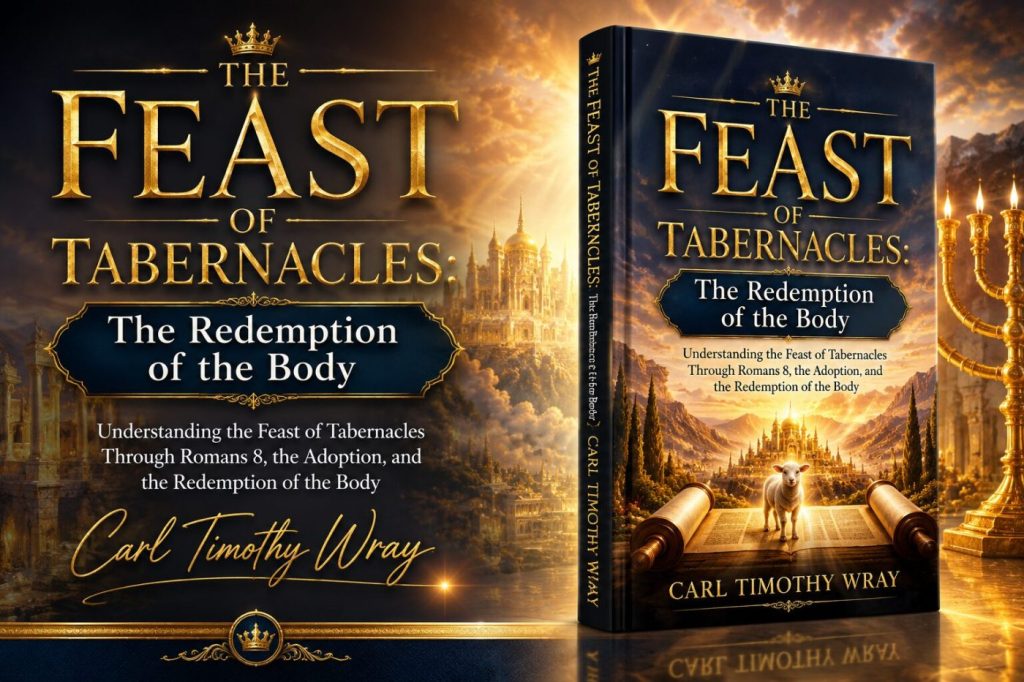
Understanding the Feast of Tabernacles Through Romans 8, the Adoption, and the Redemption of the Body
Feast of Tabernacles: AUTHOR
By Carl Timothy Wray
The Feast of Tabernacles is the final feast of the biblical year and prophetically reveals the completion of God’s redemptive purpose. While Passover reveals redemption and Pentecost reveals the outpouring of the Holy Spirit, the Feast of Tabernacles points to the fullness of God’s harvest and the completion of His purpose in Christ.
At the center of this revelation stands Romans chapter 8.
The Apostle Paul declares that the whole creation is groaning, waiting for the manifestation of the sons of God and “waiting for the adoption, to wit, the redemption of our body.” This remarkable passage gathers together the great themes of sonship, inheritance, firstfruits, creation’s groaning, and the redemption of the body into one magnificent vision of God’s eternal purpose.
In this book, Carl Timothy Wray traces these themes from before the foundation of the world through the Plan of the Ages, the Three Feasts of the Lord, the law of Firstfruits, Romans 8, and 1 Corinthians 15 to show how the Feast of Tabernacles fits within the whole counsel of God.
Whether you are studying biblical prophecy, the Kingdom of God, the Plan of the Ages, or the Feast of Tabernacles, this book presents a Scripture-centered study that encourages readers to examine these themes carefully in the light of God’s Word.
The Feast of Tabernacles reveals far more than Israel’s final feast. This study explores the Feast of Tabernacles through Romans 8, the adoption, the redemption of the body, firstfruits, the Plan of the Ages, and God’s Eternal Purpose. Discover why Romans 8 serves as a hinge chapter of the New Covenant and how the Feast of Tabernacles brings together God’s redemptive plan from before the foundation of the world to the fullness of Christ. If you are searching for a biblical understanding of the Feast of Tabernacles, Romans 8, the redemption of the body, the manifestation of the sons of God, and God’s eternal purpose, this study provides a comprehensive examination of these foundational themes.
Introduction
Before there was a creation, there was a purpose.
Before there was sin, there was a Savior.
Before there was history, there was Christ.
The Bible reveals that God established His Eternal Purpose before the foundation of the world. Through the Finished Work of Christ and the Plan of the Ages, He unfolds that purpose progressively until every promise reaches its appointed fulfillment.
The Three Feasts of the Lord reveal this divine order.
Passover reveals redemption.
Pentecost reveals preparation.
The Feast of Tabernacles reveals fullness.
Romans chapter 8 stands at the center of this unfolding revelation.
Here the Apostle Paul lifts our eyes beyond forgiveness alone and reveals the great hope for which the whole creation groans. Creation is waiting for the manifestation of the sons of God. Believers themselves are waiting for the adoption, which Paul immediately defines as “the redemption of our body.”
These words are among the most significant in the New Covenant.
What is the adoption?
Why does the whole creation groan?
What does Paul mean by “to wit, the redemption of our body”?
How does this hope relate to the Feast of Tabernacles?
How does it connect to Firstfruits, the Plan of the Ages, and God’s Eternal Purpose?
This book follows those questions through the Scriptures, allowing the Bible to interpret itself while tracing one continuous thread from Genesis to Revelation.
The Feast of Tabernacles is not presented as an isolated doctrine. It is presented as part of the unfolding purpose of God—a purpose established before the foundation of the world, revealed through Christ, and progressively unfolded until God dwells with His people in the fullness of His purpose.
Table of Contents
Chapter 1
God’s Eternal Purpose Before the Foundation of the World
Chapter 2
The Plan of the Ages
Chapter 3
The Three Feasts of the Lord
Chapter 4
Firstfruits: God’s Divine Order
Chapter 5
Why the Whole Creation Is Groaning
Chapter 6
Understanding the Adoption
Chapter 7
“To Wit” — The Redemption of the Body
Chapter 8
Romans 8 and 1 Corinthians 15
Chapter 9
From Preparation to Manifestation
Chapter 10
The Feast of Tabernacles
Conclusion
God Dwelling With Man
CHAPTER 1
GOD’S ETERNAL PURPOSE BEFORE THE FOUNDATION OF THE WORLD
Before There Was a Creation, There Was a Purpose
The Feast of Tabernacles cannot be understood apart from God’s Eternal Purpose. Before there was a creation, before there was sin, before there was death, before there was a world to redeem, there was Christ.
The gospel did not begin in Bethlehem.
The cross was not God’s reaction to man’s failure.
The resurrection was not God’s backup plan.
Everything begins in the Eternal Purpose of God.
The Apostle Paul continually lifts our eyes beyond time and brings us into eternity. He begins the gospel, not in Genesis, but before the foundation of the world.
CHOSEN BEFORE THE FOUNDATION OF THE WORLD
Ephesians 1:4-5
“According as he hath chosen us in him before the foundation of the world, that we should be holy and without blame before him in love:
Having predestinated us unto the adoption of children by Jesus Christ to himself, according to the good pleasure of his will.”
Notice where Paul begins.
Not with Adam.
Not with Abraham.
Not with Moses.
Not with Israel.
Not with Pentecost.
Not even with the cross.
He begins before the foundation of the world.
The Feast of Tabernacles cannot be separated from this Eternal Purpose because the final feast reveals the completion of what God purposed before creation itself.
The adoption was not an afterthought.
The inheritance was not an afterthought.
The redemption of the body was not an afterthought.
Everything existed in the heart of God before history began.
THE PURPOSE WAS ESTABLISHED BEFORE HISTORY
2 Timothy 1:9
“Who hath saved us, and called us with an holy calling, not according to our works, but according to his own purpose and grace, which was given us in Christ Jesus before the world began.”
Grace existed before the fall.
Purpose existed before the fall.
Christ existed before the fall.
The Feast of Tabernacles is the unveiling of a purpose that God settled before time itself.
History unfolds what eternity established.
THE PROMISE PRECEDED CREATION
Titus 1:2
“In hope of eternal life, which God, that cannot lie, promised before the world began.”
Notice the order.
Promise.
Purpose.
Plan.
Manifestation.
God’s promises were not created during history.
History simply reveals what was already settled in the heart of God.
The Feast of Tabernacles belongs to that unfolding purpose.
CHRIST WAS FOREORDAINED BEFORE THE FOUNDATION OF THE WORLD
1 Peter 1:18-20
“Forasmuch as ye know that ye were not redeemed with corruptible things…
But with the precious blood of Christ…
Who verily was foreordained before the foundation of the world, but was manifest in these last times for you.”
Christ was foreordained before creation.
The Lamb was not God’s response to sin.
The Lamb was God’s Eternal Purpose revealed in time.
Everything God accomplishes throughout Scripture unfolds from Christ.
The Feast of Tabernacles therefore cannot be understood apart from Christ because Christ is both its beginning and its fulfillment.
THE PLAN OF THE AGES REVEALS THE PURPOSE
Ephesians 3:9-11
“…to make all men see what is the fellowship of the mystery…
According to the eternal purpose which he purposed in Christ Jesus our Lord.”
The Eternal Purpose does not remain hidden forever.
God reveals it progressively.
The Scriptures reveal a divine order.
What God established before the foundation of the world unfolds through the ages until His purpose is openly manifested.
The Feast of Tabernacles belongs to that divine order.
It is not an isolated feast.
It is part of God’s unfolding purpose.
THE THREE FEASTS REVEAL ONE PURPOSE
God gave Israel three major annual feasts.
Passover.
Pentecost.
The Feast of Tabernacles.
These feasts are not three unrelated celebrations.
They reveal one unfolding purpose.
Passover reveals redemption.
Pentecost reveals preparation.
The Feast of Tabernacles reveals fullness.
Understanding this divine order prepares us to understand why Romans chapter 8 becomes one of the great hinge chapters of the New Covenant.
THE FEAST OF TABERNACLES BEGINS BEFORE GENESIS
Many readers begin studying the Feast of Tabernacles in Leviticus.
Paul begins somewhere else.
He begins before creation.
If we fail to understand God’s Eternal Purpose, we will misunderstand every feast.
The Feast of Tabernacles is not merely Israel’s final feast.
It is the prophetic revelation of God’s completed purpose.
The feast reaches back before the foundation of the world and reaches forward until God’s purpose stands complete.
THE FINISHED WORK OF CHRIST IS THE FOUNDATION
Everything God accomplishes flows from Christ.
Christ is the Lamb.
Christ is the Firstfruits.
Christ is the Cornerstone.
Christ is the Head.
The Finished Work of Christ establishes everything that God progressively reveals throughout the ages.
The Feast of Tabernacles does not create God’s purpose.
It reveals the completion of God’s purpose.
CHAPTER SUMMARY
Before we study Romans chapter 8, we must first understand where God’s purpose begins.
It begins before creation.
It begins before sin.
It begins before time.
The Eternal Purpose was established in Christ before the foundation of the world.
The Plan of the Ages unfolds that purpose.
The Three Feasts reveal that purpose progressively.
Passover reveals redemption.
Pentecost reveals preparation.
The Feast of Tabernacles reveals the fullness toward which God’s Eternal Purpose has always been moving.
Only after this foundation is established are we prepared to understand why Romans 8 becomes one of the great hinge chapters of the New Covenant and why Paul says that the whole creation is groaning, waiting for the adoption—to wit, the redemption of our body.
CHAPTER 2
THE PLAN OF THE AGES
How God Brings His Eternal Purpose Into Living Reality
The Feast of Tabernacles cannot be understood apart from God’s Plan of the Ages.
Before the foundation of the world, God established His Eternal Purpose in Christ. But a purpose established in eternity had to be revealed in time. God did not simply decree His purpose; He unfolded it progressively until it could be experienced by His creation.
This unfolding is what we call the Plan of the Ages.
God moves His purpose from the invisible into the visible.
He moves from promise to fulfillment.
He moves from shadow to substance.
He moves from seed to harvest.
The Feast of Tabernacles reveals the completion of that unfolding plan.
GOD DECLARES THE END FROM THE BEGINNING
Isaiah 46:9-10
“Remember the former things of old: for I am God, and there is none else… Declaring the end from the beginning, and from ancient times the things that are not yet done, saying, My counsel shall stand, and I will do all my pleasure.”
God never reacts to history.
He governs history.
Before creation began, He already knew the end because He had purposed the end.
The Plan of the Ages is not God improvising as history unfolds. It is God revealing, step by step, what He established before the foundation of the world.
The Feast of Tabernacles belongs to that predetermined purpose.
KNOWN UNTO GOD ARE ALL HIS WORKS
Acts 15:18
“Known unto God are all his works from the beginning of the world.”
Nothing surprises God.
Nothing catches Him unprepared.
Every age, every covenant, every administration serves His Eternal Purpose.
The Plan of the Ages is God’s orderly revelation of His will until His purpose stands complete.
The Feast of Tabernacles is not an isolated event. It is one stage in the progressive unveiling of God’s purpose.
THE MYSTERY HIDDEN THROUGH THE AGES
Colossians 1:26-27
“Even the mystery which hath been hid from ages and from generations, but now is made manifest to his saints:
To whom God would make known what is the riches of the glory of this mystery among the Gentiles; which is Christ in you, the hope of glory.”
Throughout the ages, God progressively unveils what was once hidden.
The mystery was not invented in time.
It was hidden in God and revealed according to His appointed order.
Every age reveals another dimension of Christ.
Every revelation moves creation closer to the fullness of God’s purpose.
The Feast of Tabernacles reveals the completion of that progressive unveiling.
GOD WORKS THROUGH PROGRESSIVE REVELATION
Throughout Scripture, God reveals truth progressively.
He does not reveal everything at once.
He reveals line upon line.
Precept upon precept.
Glory to glory.
Faith to faith.
The Plan of the Ages demonstrates that God prepares His people before revealing greater fullness.
The Feast of Tabernacles is understood only after we recognize this divine pattern of progressive revelation.
THE AGES REVEAL GOD’S ORDER
The Scriptures reveal recurring patterns that testify to God’s orderly work.
Seed before harvest.
Child before maturity.
Promise before fulfillment.
Preparation before manifestation.
Firstfruits before the full harvest.
These patterns are not accidental.
They reveal the wisdom of God’s administration.
The Feast of Tabernacles stands at the culmination of these recurring biblical patterns.
THE THREE FEASTS REVEAL THE PLAN
The annual feasts of Israel reveal God’s orderly progression.
Passover reveals redemption.
Pentecost reveals preparation through the ministry of the Holy Spirit.
The Feast of Tabernacles reveals the completion of God’s harvest and the fullness toward which the earlier feasts point.
Each feast builds upon the previous one.
Each feast reveals another stage of God’s unfolding purpose.
THE PLAN MOVES TOWARD FULLNESS
The Plan of the Ages never moves backward.
It always moves toward completion.
Paul describes this progression throughout the New Testament.
The gospel begins with redemption.
Believers grow in grace.
Christ is formed within His people.
Creation groans for manifestation.
The inheritance awaits its appointed fullness.
The Feast of Tabernacles presents, within this theological framework, the prophetic picture of that completed purpose.
WHY THE PLAN OF THE AGES MATTERS
Without understanding God’s progressive order, many passages appear disconnected.
Romans 8.
1 Corinthians 15.
The Three Feasts.
Firstfruits.
The Kingdom.
The inheritance.
The redemption of the body.
When viewed through the Plan of the Ages, these themes become parts of one unfolding revelation.
The Feast of Tabernacles is understood, not as an isolated doctrine, but as the culmination of the purpose God established before the foundation of the world.
CHAPTER SUMMARY
God’s Eternal Purpose was established before creation.
The Plan of the Ages reveals that purpose progressively throughout history.
Every covenant, every administration, and every stage of revelation serves the same divine purpose.
Passover begins the journey.
Pentecost prepares God’s people.
The Feast of Tabernacles reveals the completion of the harvest.
Understanding this divine order prepares us to see why God’s law of Firstfruits is essential for interpreting Romans 8, the inheritance, and the redemption of the body.
CHAPTER 3
THE THREE FEASTS OF THE LORD
God’s Progressive Revelation of Redemption, Preparation, and Fullness
The Feast of Tabernacles is the final feast of God’s redemptive calendar.
It is not an isolated feast.
Neither is it merely another annual celebration in Israel’s history.
The Three Feasts of the Lord reveal one continuous story.
They reveal God’s Eternal Purpose unfolding according to His divine order.
Passover begins the journey.
Pentecost continues the journey.
The Feast of Tabernacles reveals the completion of the journey.
Understanding these three feasts is essential because they reveal God’s progressive work from redemption to fullness.
GOD ESTABLISHED THREE APPOINTED FEASTS
Leviticus 23:1-2
“And the Lord spake unto Moses, saying,
Speak unto the children of Israel, and say unto them, Concerning the feasts of the Lord, which ye shall proclaim to be holy convocations, even these are my feasts.”
These were not Israel’s ideas.
They were God’s appointments.
They were prophetic rehearsals that pointed beyond themselves to God’s unfolding purpose in Christ.
The Feast of Tabernacles cannot be understood apart from the divine order established in these appointed feasts.
PASSOVER REVEALS REDEMPTION
Exodus 12:13
“When I see the blood, I will pass over you.”
Passover reveals redemption.
The blood of the lamb speaks of deliverance.
Judgment passes over.
A people are redeemed.
The journey begins.
Passover establishes the foundation.
No one advances into God’s purpose apart from redemption.
The Feast of Tabernacles never replaces Passover.
It builds upon it.
CHRIST OUR PASSOVER
1 Corinthians 5:7
“For even Christ our passover is sacrificed for us.”
Everything revealed in Passover finds its fulfillment in Christ.
Christ is the true Lamb.
Christ is the true sacrifice.
Christ establishes redemption once for all.
The Finished Work of Christ becomes the foundation upon which every other revelation stands.
The Feast of Tabernacles rests upon the Finished Work accomplished at Passover.
PENTECOST REVEALS PREPARATION
Acts 2:1-4
“And when the day of Pentecost was fully come…
They were all filled with the Holy Ghost.”
Pentecost introduces a new administration.
The Holy Spirit is poured out.
Power is given.
Ministry begins.
The Church is empowered.
The gospel advances into the nations.
Pentecost is not the end.
Pentecost prepares God’s people for what still lies ahead.
The Feast of Tabernacles cannot be understood unless we first understand the purpose of Pentecost.
THE HOLY SPIRIT IS THE EARNEST
Ephesians 1:13-14
“…ye were sealed with that holy Spirit of promise,
Which is the earnest of our inheritance until the redemption of the purchased possession…”
Notice Paul’s language.
The Holy Spirit is called the earnest.
An earnest is a guarantee.
It is the beginning.
It points toward something greater.
Paul immediately connects the earnest with the inheritance and the redemption.
These themes become central in Romans chapter 8.
The Feast of Tabernacles reveals the fullness toward which the earnest points.
THE FEAST OF TABERNACLES REVEALS FULLNESS
Leviticus 23:39
“…when ye have gathered in the fruit of the land…”
The final feast is the feast of ingathering.
It celebrates harvest.
Completion.
Fullness.
Joy.
God dwelling with His people.
Within this theological framework, the Feast of Tabernacles prophetically points beyond the historical celebration to the completion of God’s redemptive purpose.
The harvest has reached its appointed fullness.
THE THREE FEASTS REVEAL ONE STORY
The Three Feasts do not compete with one another.
Each feast builds upon the previous one.
Passover reveals redemption.
Pentecost reveals preparation.
The Feast of Tabernacles reveals fullness.
The same pattern appears throughout Scripture.
Seed.
Blade.
Ear.
Full corn in the ear.
Thirty.
Sixty.
One hundred.
Promise.
Preparation.
Manifestation.
God reveals His purpose progressively until it reaches completion.
THE FEASTS REVEAL GOD’S ORDER
The order is important.
God never begins with Tabernacles.
He begins with redemption.
He prepares His people.
Then He brings His purpose to completion according to His divine order.
The Feast of Tabernacles is not separated from Passover or Pentecost.
It completes what they began.
Without Passover there is no redemption.
Without Pentecost there is no preparation.
Without the Feast of Tabernacles, within this theological framework, the prophetic picture of the harvest remains unfinished.
ROMANS 8 STANDS IN THIS ORDER
When Paul writes about creation groaning…
When he speaks about the adoption…
When he declares, “to wit, the redemption of our body…”
He is speaking within God’s unfolding order.
Romans chapter 8 does not begin the story.
It brings the reader to one of the great hinge points in the New Covenant.
The Feast of Tabernacles becomes the prophetic backdrop for understanding why creation waits for fullness rather than merely another beginning.
CHAPTER SUMMARY
God established three appointed feasts.
Passover reveals redemption.
Pentecost reveals preparation through the Holy Spirit.
The Feast of Tabernacles reveals the completion of God’s harvest and the fullness toward which the earlier feasts point.
These feasts are not isolated events.
They reveal one unfolding purpose established before the foundation of the world and progressively revealed throughout the ages.
Understanding this divine order prepares us to examine God’s law of Firstfruits, for God always reveals the firstfruits before He gathers the full harvest.
CHAPTER 4
FIRSTFRUITS: GOD’S DIVINE ORDER
Why God Never Harvests Everything at Once
The Feast of Tabernacles cannot be understood apart from the law of Firstfruits.
Throughout the Scriptures, God reveals one unchanging principle.
He never reveals the entire harvest at once.
He always begins with the firstfruits.
The firstfruits are not the whole harvest.
The firstfruits reveal the nature of the harvest that is coming.
This divine order appears from Genesis to Revelation.
It is woven into creation.
It is woven into Israel’s feasts.
It is woven into Christ’s resurrection.
It is woven into Romans chapter 8.
It is woven into 1 Corinthians chapter 15.
The Feast of Tabernacles reveals the completion of the harvest, but before there can be a completed harvest, there must first be Firstfruits.
THE LAW OF FIRSTFRUITS
Exodus 23:19
“The first of the firstfruits of thy land thou shalt bring into the house of the Lord thy God.”
God required the firstfruits because they revealed His divine order.
The first always belongs to God.
The first sanctifies the whole.
The first becomes the pledge of everything that follows.
The Feast of Tabernacles celebrates the completed harvest, but the harvest always begins with the firstfruits.
CHRIST THE FIRSTFRUITS
1 Corinthians 15:20
“But now is Christ risen from the dead, and become the firstfruits of them that slept.”
Christ did not simply rise from the dead.
He rose as the Firstfruits.
This title is filled with prophetic meaning.
The Firstfruits reveal what the entire harvest will become.
When Christ conquered sin, death, and the grave, God revealed the destiny of His entire creation.
The Firstfruits guarantee the harvest.
The Feast of Tabernacles celebrates the completion of what Christ began.
EVERY MAN IN HIS OWN ORDER
1 Corinthians 15:22-23
“For as in Adam all die, even so in Christ shall all be made alive.
But every man in his own order: Christ the firstfruits; afterward they that are Christ’s at his coming.”
God is a God of order.
Paul does not say every man receives everything at the same moment.
He says:
“Every man in his own order.”
First comes Christ.
Then comes the unfolding of God’s harvest according to His appointed order.
The Firstfruits establish the pattern.
The Feast of Tabernacles reveals the harvest reaching its appointed fullness.
FIRSTFRUITS REVEAL THE HARVEST
The firstfruits are never separated from the harvest.
Neither are they the whole harvest.
The firstfruits reveal the quality.
The character.
The nature.
The glory.
The life that the entire harvest will ultimately possess.
When Christ rose in resurrection life, He revealed God’s intention for the entire harvest.
The Feast of Tabernacles celebrates the completion of that harvest.
THE SAME PATTERN APPEARS THROUGHOUT SCRIPTURE
God continually teaches through progressive patterns.
Seed before harvest.
Child before maturity.
Promise before fulfillment.
Preparation before manifestation.
Firstfruits before the completed harvest.
This divine order appears everywhere.
Abraham before the nation.
David before the kingdom.
Christ before His people.
The Firstfruits before the fullness.
The Feast of Tabernacles stands at the completion of this divine order.
FIRSTFRUITS AND THE THREE FEASTS
Passover reveals redemption.
Pentecost reveals preparation.
The Feast of Tabernacles reveals fullness.
The law of Firstfruits connects all three.
Christ becomes the Firstfruits through His resurrection.
The Holy Spirit is given as the earnest of the inheritance.
Creation continues to groan as God’s purpose unfolds according to His order.
Finally, the harvest reaches its completion.
The Feast of Tabernacles becomes the prophetic celebration of God’s completed harvest.
FIRSTFRUITS PREPARE US FOR ROMANS 8
Without understanding Firstfruits, Romans chapter 8 becomes difficult to reconcile.
Why does creation groan?
Why are believers waiting?
Why does Paul speak of adoption?
Why does he immediately define that hope as “the redemption of our body”?
Because God is revealing His purpose according to His divine order.
The Firstfruits have appeared.
The harvest is moving toward its appointed fullness.
The Feast of Tabernacles provides the prophetic framework through which this hope is understood.
GOD ALWAYS FINISHES WHAT HE BEGINS
Philippians 1:6
“Being confident of this very thing, that he which hath begun a good work in you will perform it until the day of Jesus Christ.”
God never abandons His purpose.
The One who establishes the Firstfruits also gathers the harvest.
The One who begins redemption also brings it to completion.
The One who establishes His Eternal Purpose also fulfills it according to His divine order.
The Feast of Tabernacles celebrates that confidence.
God finishes what He begins.
CHAPTER SUMMARY
The law of Firstfruits reveals one of the great governing principles of Scripture.
God never harvests everything at once.
He begins with the Firstfruits.
Christ is the Firstfruits.
The Firstfruits reveal the character and destiny of the coming harvest.
The Three Feasts unfold according to this same order.
Passover reveals redemption.
Pentecost reveals preparation.
The Feast of Tabernacles reveals the completed harvest.
Understanding Firstfruits prepares us to enter Romans chapter 8, where Paul explains why the whole creation continues to groan, waiting for the adoption—to wit, the redemption of our body.
CHAPTER 5
WHY THE WHOLE CREATION IS GROANING
Romans 8 Reveals the Hope of the Ages
The Feast of Tabernacles brings us to one of the greatest questions in all of Scripture.
Why is the whole creation groaning?
Why does Paul say that not only creation, but believers themselves are groaning?
What is still being awaited if Christ has already accomplished the Finished Work?
Romans chapter 8 answers these questions.
It does not point us backward.
It points us forward to the fullness of God’s Eternal Purpose.
The Apostle Paul lifts our eyes beyond individual salvation and shows us the universal scope of God’s redemptive plan.
The Feast of Tabernacles provides the prophetic backdrop for understanding why creation waits with such great expectation.
THE EARNEST EXPECTATION OF CREATION
Romans 8:19
“For the earnest expectation of the creature waiteth for the manifestation of the sons of God.”
Notice what creation is waiting for.
Paul does not say creation is waiting for another promise.
He does not say creation is waiting for another covenant.
He says creation is waiting for a manifestation.
The promise has already been given.
Now creation waits for that promise to be openly revealed.
The Feast of Tabernacles, within this theological framework, speaks of the completion of God’s harvest and the manifestation toward which creation has long been looking.
THE WHOLE CREATION GROANS
Romans 8:22
“For we know that the whole creation groaneth and travaileth in pain together until now.”
Paul expands the vision.
It is not one individual who groans.
It is not one nation.
The whole creation groans.
Why?
Because creation has not yet witnessed the completion of God’s purpose.
Throughout the Scriptures, creation has watched redemption unfold.
Creation witnessed Passover.
Creation witnessed Pentecost.
Yet Paul says creation still groans.
The Feast of Tabernacles becomes significant because it speaks of the completion toward which creation has been waiting.
WE OURSELVES GROAN
Romans 8:23
“And not only they, but ourselves also, which have the firstfruits of the Spirit, even we ourselves groan within ourselves…”
Paul now includes believers.
Those who possess the Firstfruits of the Spirit still groan.
Why?
Not because they lack salvation.
Not because Christ’s Finished Work is incomplete.
They groan because they are waiting for the fullness of the inheritance.
This distinction is essential.
The Firstfruits have been received.
The harvest is still moving toward its appointed completion.
The Feast of Tabernacles reveals the prophetic picture of that completed harvest.
WAITING FOR THE ADOPTION
Paul tells us exactly what believers are waiting for.
“…waiting for the adoption…”
This statement introduces one of the great themes of Romans chapter 8.
The question immediately becomes:
What is the adoption?
Paul does not leave the reader guessing.
He immediately defines what he means.
This definition becomes one of the great hinge points of the New Covenant and prepares us for the next chapters of this study.
The Feast of Tabernacles cannot be understood apart from Paul’s explanation of the adoption.
GROANING IS THE LANGUAGE OF HOPE
Throughout Scripture, groaning is never presented as the end of the story.
Groaning points toward birth.
Travail points toward life.
Waiting points toward fulfillment.
Hope points toward manifestation.
Paul does not describe a hopeless creation.
He describes a creation filled with expectation.
The Feast of Tabernacles becomes the celebration of the hope toward which creation has been looking.
THE PATTERN OF SCRIPTURE
This same pattern appears throughout God’s Word.
Abraham waited for the city whose builder and maker is God.
Israel journeyed toward the Promised Land.
The prophets looked toward God’s completed purpose.
The disciples waited in Jerusalem until they were endued with power from on high.
Creation waits.
Believers wait.
God unfolds His purpose according to His divine order.
The Feast of Tabernacles stands as the prophetic picture of God’s completed harvest.
WHY ROMANS 8 IS A HINGE CHAPTER
Romans chapter 8 gathers together many of the great themes of Scripture.
The Eternal Purpose.
The Plan of the Ages.
Firstfruits.
Inheritance.
Hope.
Creation.
Manifestation.
The adoption.
The redemption of the body.
Every one of these themes begins to converge here.
Paul is preparing the reader for one of the greatest revelations in the New Covenant.
The Feast of Tabernacles provides the prophetic framework through which these themes find their harmony.
CREATION IS WAITING FOR FULLNESS
The Bible begins with creation.
The Bible ends with creation restored.
Between those two points stands God’s Eternal Purpose unfolding through history.
Creation is not merely waiting for information.
It is waiting for fulfillment.
It is waiting for God’s purpose to reach its appointed completion.
The Feast of Tabernacles points, within this theological framework, to the fullness toward which the whole creation has been groaning.
CHAPTER SUMMARY
Romans chapter 8 reveals that the whole creation is filled with earnest expectation.
Creation is waiting for the manifestation of the sons of God.
Believers themselves continue to groan because they have received the Firstfruits of the Spirit while awaiting the fullness of the inheritance.
Paul introduces the great theme of the adoption, preparing the reader for one of the most important questions in the New Covenant.
What is the adoption?
Paul will answer that question in the next chapter, and his answer becomes one of the great keys to understanding the Feast of Tabernacles, the inheritance, and the redemption of the body.
CHAPTER 6
UNDERSTANDING THE ADOPTION
What Is the Adoption?
The Feast of Tabernacles brings us to one of the most misunderstood words in the New Testament.
Paul writes:
“And not only they, but ourselves also, which have the firstfruits of the Spirit, even we ourselves groan within ourselves, waiting for the adoption…”
What is the adoption?
Why are believers waiting for it?
If we are already the children of God, why does Paul say we are still waiting?
These questions cannot be ignored.
The Apostle Paul is introducing one of the great revelations of the New Covenant.
The Feast of Tabernacles cannot be understood until we understand what Paul means by “the adoption.”
WE ARE ALREADY THE CHILDREN OF GOD
Romans 8:14-17
“For as many as are led by the Spirit of God, they are the sons of God…
The Spirit itself beareth witness with our spirit, that we are the children of God:
And if children, then heirs; heirs of God, and joint-heirs with Christ…”
Paul begins with present reality.
We are God’s children.
We are heirs.
We are joint-heirs with Christ.
The inheritance belongs to the children.
Yet only a few verses later Paul says we are still waiting for the adoption.
This apparent tension invites us to look more carefully at Paul’s argument.
The Feast of Tabernacles helps us see that Paul is describing both a present relationship and a future hope within the unfolding purpose of God.
AN HEIR IS NOT THE SAME AS A FULLY MATURE INHERITOR
Throughout Scripture, there is a difference between possessing an inheritance by promise and entering into the fullness of that inheritance.
An heir possesses a legal right.
An inheritor enters into the enjoyment of what has already been promised.
Paul’s language draws our attention to this distinction.
The children of God are heirs.
Yet Paul says they are still waiting.
Waiting for what?
Waiting for the adoption.
The Feast of Tabernacles, within this theological framework, represents the fullness toward which the inheritance moves.
WHY ARE WE STILL WAITING?
Romans 8:23
“…we ourselves groan within ourselves, waiting for the adoption…”
If adoption simply meant becoming God’s children, Paul’s statement would make little sense.
He has already declared that believers are God’s children.
Therefore, Paul directs our attention beyond the beginning of sonship to the fullness of the inheritance associated with sonship.
The question is no longer:
“Whose children are we?”
The question becomes:
“What is the inheritance toward which God’s children are moving?”
The Feast of Tabernacles provides the prophetic setting in which this question begins to find its answer.
THE ADOPTION IS CONNECTED TO INHERITANCE
Throughout Romans chapter 8, Paul repeatedly speaks of inheritance.
Children.
Heirs.
Joint-heirs.
Glory.
Hope.
Creation.
Manifestation.
The adoption belongs within this same family of ideas.
Paul is describing the unfolding of God’s Eternal Purpose through the language of inheritance.
The Feast of Tabernacles reveals the completion of the inheritance toward which the earlier stages have been moving.
THE FIRSTFRUITS AND THE FULL HARVEST
Believers have already received what Paul calls:
“The firstfruits of the Spirit.”
Firstfruits reveal that more is coming.
The earnest points toward the inheritance.
Hope points toward fulfillment.
The firstfruits are glorious.
But they are not the completed harvest.
The Feast of Tabernacles celebrates the ingathering of the full harvest.
This pattern helps explain why believers possess the Firstfruits while still waiting for the adoption.
THE ADOPTION BELONGS TO GOD’S ORDER
The Scriptures continually reveal God’s divine order.
Promise before fulfillment.
Firstfruits before harvest.
Preparation before manifestation.
The adoption belongs within this same order.
God unfolds His purpose progressively.
The Feast of Tabernacles reveals the completion of that unfolding.
PAUL PREPARES US FOR HIS DEFINITION
One of the most remarkable features of Romans chapter 8 is that Paul does not leave the word “adoption” undefined.
He immediately explains exactly what he means.
He moves from the question…
“What is the adoption?”
…to the answer.
That answer becomes one of the great hinge statements of the New Covenant.
The next words Paul writes unlock the entire passage.
The Feast of Tabernacles cannot be understood apart from Paul’s own definition.
THE QUESTION THAT LEADS TO THE ANSWER
Everything in this chapter leads to one great question.
What is the adoption?
Paul has prepared the reader carefully.
He has spoken of children.
He has spoken of heirs.
He has spoken of Firstfruits.
He has spoken of creation’s groaning.
He has spoken of hope.
Now he prepares to define the adoption itself.
The next statement becomes one of the most important explanations in the New Testament.
CHAPTER SUMMARY
Believers are already the children of God.
They are already heirs.
They have already received the Firstfruits of the Spirit.
Yet Paul says they continue waiting for the adoption.
This reveals that Paul is speaking about more than the beginning of sonship.
He is leading the reader toward the fullness of the inheritance.
The next words of Romans chapter 8 provide Paul’s own definition:
“…to wit, the redemption of our body.”
That statement becomes the hinge upon which the remainder of this book turns, and it opens the door to a deeper understanding of the Feast of Tabernacles, the inheritance, and God’s Eternal Purpose.
CHAPTER 7
“TO WIT” — THE REDEMPTION OF THE BODY
Paul’s Definition of the Adoption
Everything in Romans chapter 8 has been leading to this moment.
Paul has spoken of the Firstfruits of the Spirit.
He has spoken of creation’s groaning.
He has spoken of believers groaning.
He has spoken of the adoption.
Now he removes all uncertainty.
He defines exactly what he means.
“…waiting for the adoption, to wit, the redemption of our body.“
These words form one of the great hinge statements of the New Covenant.
The Feast of Tabernacles cannot be understood apart from this declaration.
Paul does not leave the meaning of the adoption to speculation.
He tells us plainly what he is describing.
PAUL DEFINES HIS OWN LANGUAGE
Romans 8:23
“…waiting for the adoption, to wit, the redemption of our body.”
The words “to wit” mean:
That is.
Namely.
In other words.
Paul is defining the adoption.
He is not introducing another subject.
He is explaining the one he has already introduced.
The adoption is connected to the redemption of the body.
The Feast of Tabernacles becomes significant because, within this theological framework, it represents the fullness toward which Paul is directing the reader.
THE REDEMPTION OF THE BODY
Paul does not speak merely of redeemed souls.
He does not stop with forgiveness.
He does not stop with justification.
He directs our attention to the redemption of the body.
Throughout Romans chapter 8, Paul has been moving toward this revelation.
Creation groans.
Believers groan.
Hope continues.
The Firstfruits have been received.
Yet something remains the object of expectation.
The redemption of the body.
The Feast of Tabernacles presents, within this theological framework, the prophetic picture of that completed redemption.
THE FULLNESS OF THE INHERITANCE
The inheritance is not introduced in this verse.
Paul has been speaking about inheritance throughout the chapter.
Children.
Heirs.
Joint-heirs.
Glory.
Hope.
The adoption.
Now he identifies the culmination of that hope.
The redemption of the body.
Within this theological framework, this is presented as the fullness toward which the inheritance moves.
The Feast of Tabernacles celebrates the completion of God’s harvest.
FIRSTFRUITS POINT TOWARD FULLNESS
The believer already possesses the Firstfruits of the Spirit.
Romans 8:23
“…which have the firstfruits of the Spirit…”
Firstfruits are glorious.
But Firstfruits are not the completed harvest.
God’s order remains consistent.
Firstfruits.
Harvest.
Completion.
The Feast of Tabernacles celebrates the ingathering that follows the Firstfruits.
Paul’s language reflects this same divine order.
ROMANS 8 AND 1 CORINTHIANS 15 SPEAK TOGETHER
Paul develops the same hope elsewhere.
1 Corinthians 15:51-54
“Behold, I shew you a mystery…
We shall not all sleep, but we shall all be changed…
For this corruptible must put on incorruption, and this mortal must put on immortality.”
The two chapters illuminate one another.
Romans 8 speaks of the redemption of the body.
First Corinthians 15 speaks of mortality putting on immortality and corruption putting on incorruption.
Both chapters move toward the same hope.
The Feast of Tabernacles, within this theological framework, becomes the prophetic picture of that completed purpose.
THE LAST ENEMY
1 Corinthians 15:26
“The last enemy that shall be destroyed is death.”
Death is presented as the final enemy.
Paul does not present death as God’s final word.
He presents it as an enemy destined to be overcome.
The redemption of the body belongs within this movement toward victory.
The Feast of Tabernacles points toward the completion of God’s redemptive work and the fullness of His harvest.
GOD’S PURPOSE MOVES TOWARD LIFE
Throughout Scripture, God’s purpose continually moves toward life.
The tree of life.
The resurrection.
The Firstfruits.
The inheritance.
The redemption of the body.
Immortality.
Incorruption.
The New Testament presents one continuous movement from promise toward fulfillment.
The Feast of Tabernacles gathers these themes into one prophetic picture of God’s completed purpose.
WHY THIS IS THE HINGE OF THE NEW COVENANT
Romans chapter 8 reaches its climax here.
Paul has led the reader from sonship…
to inheritance…
to Firstfruits…
to hope…
to creation’s groaning…
to the adoption…
and finally…
to the redemption of the body.
This is why Romans 8 stands as one of the great hinge chapters of the New Covenant.
It gathers together the great themes of God’s Eternal Purpose and points toward their appointed fulfillment.
The Feast of Tabernacles becomes, within this theological framework, the prophetic lens through which this movement from promise to fullness is understood.
CHAPTER SUMMARY
Paul does not leave the adoption undefined.
He explains it.
“…waiting for the adoption, to wit, the redemption of our body.”
The redemption of the body stands at the center of Romans chapter 8.
It is presented as the hope for which believers wait and for which the whole creation groans.
Romans 8 and 1 Corinthians 15 together reveal God’s movement from Firstfruits toward the completed harvest.
The Feast of Tabernacles provides the prophetic picture of that fullness.
With this foundation established, we are now prepared to examine how Romans 8 and 1 Corinthians 15 stand together as the two great hinge chapters of the New Covenant, revealing God’s orderly movement from promise to consummation.
CHAPTER 8
ROMANS 8 AND 1 CORINTHIANS 15
The Two Great Hinge Chapters of the New Covenant
The Feast of Tabernacles brings us to two chapters that stand like great pillars in the New Testament.
Romans chapter 8.
First Corinthians chapter 15.
These chapters were not written independently of one another.
They reveal one continuous vision.
Romans chapter 8 explains why the whole creation groans.
First Corinthians chapter 15 explains how God’s Eternal Purpose reaches its appointed fulfillment.
Together, they form one of the great hinge revelations of the New Covenant.
The Feast of Tabernacles becomes the prophetic picture through which these two chapters are brought into harmony.
ROMANS 8 REVEALS THE HOPE
Romans 8:19
“For the earnest expectation of the creature waiteth for the manifestation of the sons of God.”
Paul begins with expectation.
Creation waits.
Creation groans.
Believers groan.
Hope continues.
The Firstfruits have already been received.
Yet Paul tells us that something greater still lies ahead.
The Feast of Tabernacles points, within this theological framework, to the fullness toward which this hope moves.
ROMANS 8 DEFINES THE GOAL
Romans 8:23
“…waiting for the adoption, to wit, the redemption of our body.”
Paul does not leave the goal undefined.
He tells us exactly what creation is waiting for.
The adoption.
That is—
The redemption of the body.
Romans chapter 8 reveals the object of hope.
It tells us what creation is awaiting.
The Feast of Tabernacles provides the prophetic picture of that completed hope.
FIRST CORINTHIANS 15 REVEALS GOD’S ORDER
1 Corinthians 15:22-23
“For as in Adam all die, even so in Christ shall all be made alive.
But every man in his own order: Christ the firstfruits; afterward they that are Christ’s…”
Romans chapter 8 tells us what.
First Corinthians chapter 15 tells us how.
Paul reveals God’s divine order.
Christ the Firstfruits.
Afterward.
Every man in his own order.
The Firstfruits come first.
The harvest follows.
The Feast of Tabernacles reveals the completion of that harvest.
THE MYSTERY OF TRANSFORMATION
1 Corinthians 15:51-53
“Behold, I shew you a mystery…
We shall not all sleep, but we shall all be changed…
For this corruptible must put on incorruption, and this mortal must put on immortality.”
Paul now explains the transformation.
Romans chapter 8 calls it:
“The redemption of the body.”
First Corinthians chapter 15 describes it as:
Mortality putting on immortality.
Corruption putting on incorruption.
These are not competing revelations.
They are two witnesses declaring one purpose.
The Feast of Tabernacles presents the prophetic picture of this completed transformation.
THE LAST ENEMY
1 Corinthians 15:26
“The last enemy that shall be destroyed is death.”
Death is not presented as the final victory.
Death is the final enemy.
Paul sees beyond death.
He sees God’s purpose moving toward complete victory.
Romans chapter 8 points toward this hope.
First Corinthians chapter 15 explains its order.
The Feast of Tabernacles celebrates the fullness of God’s completed harvest.
GOD BECOMES ALL IN ALL
1 Corinthians 15:28
“That God may be all in all.”
Paul does not end with resurrection alone.
He ends with God’s Eternal Purpose.
Everything moves toward this magnificent conclusion.
The Father.
The Son.
The Kingdom.
The harvest.
The reconciliation of all things.
God’s purpose reaches its appointed goal.
The Feast of Tabernacles becomes, within this theological framework, the prophetic celebration of God’s completed purpose.
TWO CHAPTERS — ONE VISION
Romans chapter 8 asks:
Why is creation groaning?
First Corinthians chapter 15 answers:
Because God is bringing His purpose to completion according to His divine order.
Romans chapter 8 reveals the hope.
First Corinthians chapter 15 reveals the order.
Romans chapter 8 reveals the expectation.
First Corinthians chapter 15 reveals the consummation.
Together they reveal one continuous vision.
The Feast of Tabernacles gathers these two witnesses into one prophetic picture of fullness.
THE HINGE OF THE NEW COVENANT
These two chapters stand together as one of the great hinge revelations of the New Covenant.
Before them, Scripture prepares us.
After them, the reader begins to see God’s Eternal Purpose reaching toward its appointed fulfillment.
The Finished Work of Christ…
The Plan of the Ages…
The Three Feasts…
Firstfruits…
The adoption…
The redemption of the body…
Every one of these themes begins to converge in Romans chapter 8 and First Corinthians chapter 15.
The Feast of Tabernacles provides the prophetic framework through which these themes find their harmony.
CHAPTER SUMMARY
Romans chapter 8 and First Corinthians chapter 15 are two witnesses declaring one divine purpose.
Romans chapter 8 reveals why creation waits.
First Corinthians chapter 15 reveals God’s order for bringing that hope to fulfillment.
Together they reveal the movement from Firstfruits to harvest, from promise to fulfillment, and from hope to consummation.
The Feast of Tabernacles stands, within this theological framework, as the prophetic picture of that completed harvest and the fullness of God’s Eternal Purpose.
With these two great hinge chapters established, we are now prepared to examine the transition from preparation to manifestation and why God’s work always moves from formation into fulfillment according to His divine order.
CHAPTER 9
FROM PREPARATION TO MANIFESTATION
The Divine Transition From Pentecost to the Feast of Tabernacles
The Feast of Tabernacles reveals one of the greatest transitions in all of Scripture.
It is the transition from preparation to manifestation.
Throughout the Scriptures, God prepares before He manifests.
He forms before He reveals.
He builds before He fills.
He plants before He harvests.
This divine order is seen throughout the Bible.
The law prepared for Christ.
John the Baptist prepared the way of the Lord.
Pentecost prepared the Church.
The Feast of Tabernacles reveals the completion of God’s preparation and the manifestation of His Eternal Purpose.
THE HAMMER PREPARES THE STONE
1 Kings 6:7
“And the house, when it was in building, was built of stone made ready before it was brought thither: so that there was neither hammer nor axe nor any tool of iron heard in the house, while it was in building.”
God gives us one of the clearest pictures of His divine order.
The stone is prepared before it is placed.
The hammer belongs to preparation.
The temple belongs to manifestation.
The shaping takes place before the revealing.
The Feast of Tabernacles, within this theological framework, represents the completion of God’s workmanship.
The stone is no longer being formed.
It has been fitted into God’s house.
PENTECOST IS A MINISTRY OF PREPARATION
Ephesians 4:11-13
“And he gave some, apostles; and some, prophets; and some, evangelists; and some, pastors and teachers;
For the perfecting of the saints…
Till we all come in the unity of the faith…”
The ministry gifts are given for preparation.
For equipping.
For perfecting.
For building.
Paul presents a ministry that labors until God’s people are brought toward maturity.
Pentecost is filled with this language.
Growth.
Formation.
Edification.
Preparation.
The Feast of Tabernacles presents, within this theological framework, the prophetic picture of the harvest toward which that preparation moves.
CHRIST BE FORMED IN YOU
Galatians 4:19
“My little children, of whom I travail in birth again until Christ be formed in you.”
Paul describes spiritual formation.
He labors.
He travails.
He waits for Christ to be formed within believers.
Formation is not the end.
Formation prepares the believer for the purpose God has ordained.
The Feast of Tabernacles points toward the completion of that work.
THE WOMAN TRAVAILS BEFORE THE BIRTH
Revelation 12:1-5
“And she being with child cried, travailing in birth, and pained to be delivered…
And she brought forth a man child…”
Travail always precedes birth.
Preparation precedes manifestation.
The woman carries the promise before the promise is manifested.
Within this theological framework, the Feast of Tabernacles is understood as the prophetic picture of God’s purpose moving from travail into manifestation.
THE DRY BONES STAND UP
Ezekiel 37:1-10
The prophet sees a valley full of dry bones.
The bones come together.
Sinews appear.
Flesh appears.
The breath of God enters them.
Finally, they stand upon their feet as an exceeding great army.
This progression reveals God’s order.
Formation.
Preparation.
Breath.
Standing.
Manifestation.
The Feast of Tabernacles gathers these themes into one prophetic picture of God’s completed work.
THE HAMMER BECOMES SILENT
When the stones were placed into Solomon’s Temple, the sound of the hammer ceased.
The work of preparation had accomplished its purpose.
The house now stood complete.
This picture beautifully illustrates God’s divine order.
Preparation has a purpose.
Formation has a purpose.
But neither is the final goal.
The goal is the completed house.
The Feast of Tabernacles reveals the completion toward which God’s workmanship has always been moving.
FROM PREPARATION TO MANIFESTATION
Throughout Scripture we see this same movement.
The seed becomes the harvest.
The child becomes the mature son.
The earnest becomes the inheritance.
The Firstfruits become the full harvest.
Hope gives way to fulfillment.
Preparation gives way to manifestation.
The Feast of Tabernacles stands, within this theological framework, as the prophetic picture of this divine transition.
GOD ALWAYS FINISHES HIS WORK
Philippians 1:6
“Being confident of this very thing, that he which hath begun a good work in you will perform it until the day of Jesus Christ.”
God never abandons what He begins.
The One who begins the work also completes the work.
The One who prepares the stone also sets it into His house.
The One who gives the Firstfruits also gathers the harvest.
The One who begins redemption also brings His purpose to its appointed fullness.
The Feast of Tabernacles celebrates God’s completed workmanship.
CHAPTER SUMMARY
Throughout Scripture, God reveals one consistent order.
Preparation comes before manifestation.
The hammer prepares the stone.
The ministry prepares the saints.
Travail prepares for birth.
The breath prepares the army.
The Firstfruits prepare for the harvest.
Everything moves toward completion.
The Feast of Tabernacles reveals, within this theological framework, the completion of God’s preparation and the manifestation of His Eternal Purpose.
With this foundation established, we are now ready to examine the Feast of Tabernacles itself and gather together every thread of Scripture into one unified vision of God’s completed purpose.
CHAPTER 10
THE FEAST OF TABERNACLES
The Fullness of God’s Eternal Purpose
The Feast of Tabernacles is the great culmination of God’s prophetic calendar.
It is the seventh and final feast.
It is the feast of ingathering.
It is the feast of fullness.
It is the feast that gathers together every major theme of Scripture and reveals the completion of God’s Eternal Purpose.
Everything we have studied in this book has been moving toward this chapter.
The Eternal Purpose.
The Plan of the Ages.
The Three Feasts.
Firstfruits.
The groaning of creation.
The adoption.
The redemption of the body.
Romans chapter 8.
First Corinthians chapter 15.
None of these stand alone.
They all converge in the prophetic vision revealed through the Feast of Tabernacles.
THE FEAST OF INGATHERING
Exodus 23:16
“…and the feast of ingathering, which is in the end of the year, when thou hast gathered in thy labours out of the field.”
The Feast of Tabernacles is called the Feast of Ingathering.
God chose this language carefully.
The feast is not about planting.
It is not about preparation.
It is about gathering.
The harvest has reached its appointed completion.
Everything that began in seed now stands in fullness.
The harvest has arrived.
THE FINAL FEAST OF THE YEAR
Leviticus 23:39
“…when ye have gathered in the fruit of the land, ye shall keep a feast unto the Lord…”
The Feast of Tabernacles comes at the conclusion of Israel’s sacred calendar.
This order is not accidental.
God’s calendar teaches His purpose.
Passover begins redemption.
Pentecost continues preparation.
The Feast of Tabernacles reveals completion.
God finishes what He begins.
GOD DWELLING WITH MAN
Revelation 21:3
“Behold, the tabernacle of God is with men, and he will dwell with them…”
The word “tabernacle” means dwelling place.
From Genesis to Revelation, God has desired to dwell with His people.
The Garden.
The Tabernacle of Moses.
The Temple.
Christ dwelling among us.
The indwelling Holy Spirit.
Each revelation moves toward the same divine purpose.
God dwelling with man.
The Feast of Tabernacles beautifully illustrates this great theme.
THE LAMB STANDS UPON MOUNT ZION
Revelation 14:1
“And I looked, and, lo, a Lamb stood on the mount Sion, and with him an hundred forty and four thousand…”
The final vision is not of the Lamb standing alone.
The Lamb stands upon Mount Zion.
Those with Him bear His Father’s name.
The vision presents the Lamb at the center of God’s government.
Within this theological framework, Mount Zion becomes the picture of God’s completed administration under the reign of the Lamb.
The Feast of Tabernacles gathers together the themes of the Lamb, the Kingdom, the harvest, and God’s dwelling with His people.
GOD’S PURPOSE REACHES ITS GOAL
Ephesians 1:9-10
“Having made known unto us the mystery of his will…
That in the dispensation of the fulness of times he might gather together in one all things in Christ…”
Paul speaks of “the fullness of times.”
God’s purpose is moving toward an appointed fullness.
The mystery hidden before the foundation of the world is progressively unveiled until all things are gathered together in Christ.
The Feast of Tabernacles presents, within this theological framework, the prophetic picture of that gathering together.
THE LAST ENEMY IS DESTROYED
1 Corinthians 15:26-28
“The last enemy that shall be destroyed is death…
That God may be all in all.”
Paul concludes with God’s ultimate purpose.
Death does not reign forever.
Christ reigns until every enemy is placed under His feet.
Then God’s purpose reaches its glorious conclusion.
“That God may be all in all.”
The Feast of Tabernacles celebrates this movement toward the fullness of God’s purpose.
THE HARVEST IS COMPLETE
Throughout this book we have followed one continuous thread.
Before the foundation of the world…
The Eternal Purpose…
The Plan of the Ages…
The Three Feasts…
Firstfruits…
Romans chapter 8…
The adoption…
The redemption of the body…
First Corinthians chapter 15…
Preparation…
Manifestation…
Every thread has led us here.
The Feast of Tabernacles stands as the prophetic picture of the completed harvest.
The purpose established before creation reaches its appointed fulfillment according to God’s divine order.
THE FULLNESS OF CHRIST
Ephesians 4:13
“…unto a perfect man, unto the measure of the stature of the fulness of Christ.”
Paul’s vision has always been fullness.
The fullness of Christ.
The fullness of God’s purpose.
The fullness of the harvest.
The fullness of the inheritance.
The fullness of God’s dwelling with mankind.
The Feast of Tabernacles gathers these themes together and presents them as one magnificent vision of God’s completed purpose.
CHAPTER SUMMARY
The Feast of Tabernacles is the great climax of God’s prophetic calendar.
It is the Feast of Ingathering.
It is the Feast of Fullness.
It reveals God’s completed harvest, His completed purpose, and His desire to dwell with His people.
Everything established before the foundation of the world unfolds through the Plan of the Ages according to God’s divine order.
Passover reveals redemption.
Pentecost reveals preparation.
The Feast of Tabernacles reveals fullness.
The Firstfruits guarantee the harvest.
Romans chapter 8 reveals the hope.
First Corinthians chapter 15 reveals God’s order.
The redemption of the body reveals the fullness of the inheritance.
The Lamb stands upon Mount Zion.
God gathers all things together in Christ.
Death is swallowed up in victory.
God becomes all in all.
The Feast of Tabernacles stands as the prophetic declaration that God’s Eternal Purpose will reach its appointed fulfillment, and His dwelling shall be with mankind forever.
CONCLUSION
GOD DWELLING WITH MAN
The Feast of Tabernacles is far more than the final feast of Israel’s religious calendar.
It is the prophetic vision of God’s completed purpose.
Before the foundation of the world, God established His Eternal Purpose in Christ. Before there was a creation, there was a Savior. Before there was sin, there was a Lamb. Before there was history, there was a Finished Work settled in the heart of God.
The Plan of the Ages is God’s unfolding of that Eternal Purpose.
History is not God reacting to man.
History is God revealing what He established before the foundation of the world.
Every covenant…
Every prophet…
Every feast…
Every promise…
Every administration…
Every revelation…
Moves toward one glorious conclusion.
God dwelling with man.
The Feast of Tabernacles reveals that glorious destination.
Throughout this study we have followed one continuous thread.
Passover reveals redemption.
Pentecost reveals preparation.
The Feast of Tabernacles reveals fullness.
Christ became the Firstfruits.
The Holy Spirit was given as the earnest of our inheritance.
The whole creation continues to groan with earnest expectation.
Believers themselves groan within themselves, waiting for the adoption.
Then Paul removes all uncertainty.
He writes:
“…waiting for the adoption, to wit, the redemption of our body.”
These words stand as one of the great hinge statements of the New Covenant.
They reveal that God’s purpose does not end with forgiveness.
It moves toward inheritance.
It moves toward manifestation.
It moves toward fullness.
Romans chapter 8 reveals the hope.
First Corinthians chapter 15 reveals the order.
One chapter tells us why creation is groaning.
The other reveals God’s divine order:
“Every man in his own order.”
Christ the Firstfruits.
Then the unfolding harvest.
Then the Kingdom delivered to the Father.
Then the last enemy destroyed.
Then God becomes all in all.
The Feast of Tabernacles gathers these magnificent truths together into one prophetic vision.
It reveals the completed harvest.
It reveals the fullness of God’s purpose.
It reveals the completion of the inheritance.
It reveals God dwelling with His people.
From Genesis to Revelation, the heart of God has never changed.
He has always desired a family.
He has always desired a Kingdom.
He has always desired a dwelling place.
The Garden pointed toward it.
The Tabernacle pointed toward it.
The Temple pointed toward it.
Christ revealed it.
The Holy Spirit prepares us for it.
The Feast of Tabernacles reveals, within this theological framework, the fullness toward which the entire biblical narrative has been moving.
The Bible opens with creation.
It closes with a new heaven and a new earth.
It opens with a garden.
It closes with a city.
It opens with man driven from the presence of God.
It closes with these triumphant words:
Revelation 21:3
“Behold, the tabernacle of God is with men, and he will dwell with them, and they shall be his people, and God himself shall be with them, and be their God.”
This is the vision.
This is the hope.
This is the inheritance.
This is the fullness.
This is the Feast of Tabernacles.
May every reader search the Scriptures diligently, allowing the Word of God to interpret itself.
May we build upon the Eternal Purpose established before the foundation of the world.
May we follow the unfolding Plan of the Ages.
May we recognize Christ as the Firstfruits of God’s harvest.
May we understand why the whole creation groans.
May we rejoice in the promise of the adoption—to wit, the redemption of our body.
And may our hearts be filled with the confidence that the God who began His good work will surely bring it to completion.
For the vision has been written.
The purpose has been declared.
The harvest has been promised.
The Lamb still stands upon Mount Zion.
The Kingdom still belongs to Christ.
The Eternal Purpose of God shall stand.
And in the fullness of His appointed time…
God shall dwell with man, and God shall be all in all.