
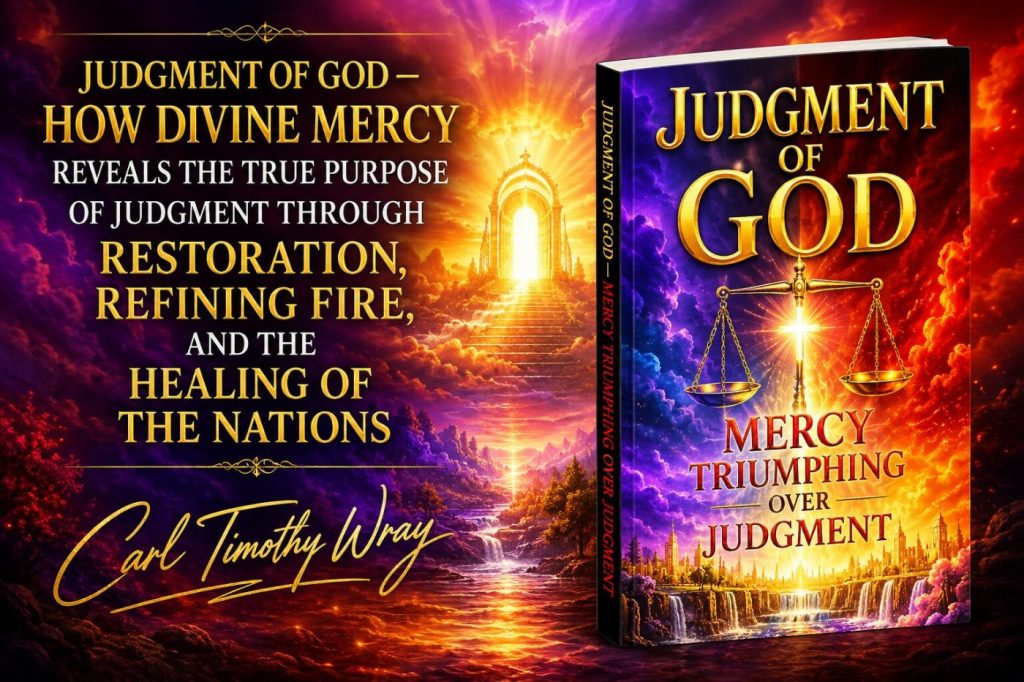
Judgment of God — How Divine Mercy Reveals the True Purpose of Judgment Through Restoration, Refining Fire, and the Healing of the Nations
By Carl Timothy Wray
Author
Carl Timothy Wray is a prophetic writer and teacher dedicated to unveiling the Finished Work of Christ through the full counsel of God from Genesis to Revelation. Through hundreds of books, teachings, and revelation studies, his work focuses on the restoration of all things, the revelation of Jesus Christ, the manifestation of the sons of God, the fall of Babylon, and the rising of Zion. His writings emphasize reconciliation, divine purpose, refining fire, and the ultimate triumph of life over death through Jesus Christ.
Judgment of God — Mercy Triumphing Over Judgment is a powerful Genesis-to-Revelation study revealing how divine mercy unveils the true purpose of the Judgment of God through restoration, refining fire, healing, reconciliation, and the cleansing of creation. This prophetic book explores the mercy seat above the judgment seat, the refining fire of Isaiah, the mercy revealed through the Cross of Christ, the fall of Religious Babylon, and the healing of the nations in the Book of Revelation. Through deep scriptural revelation, Carl Timothy Wray demonstrates how mercy triumphs over judgment, how fire purifies rather than merely destroys, and how God’s ultimate purpose is restoration through Jesus Christ.
Judgment of God: Introduction
For generations, the Judgment of God has been preached primarily through the lens of fear, wrath, destruction, and hopeless condemnation. Entire systems of religion have painted divine judgment as the eternal abandonment of humanity rather than the righteous unfolding of God’s restorative purpose. Yet when the full counsel of God is searched from Genesis to Revelation, another testimony begins to emerge — a testimony revealing that mercy and judgment are not enemies within the nature of God, but divine companions working together toward redemption.
The Scriptures declare:
“Mercy rejoiceth against judgment.” — James 2:13
And again:
“Mercy and truth are met together; righteousness and peace have kissed each other.” — Psalm 85:10
These verses unveil a mystery hidden throughout the entire Bible: the purpose of divine judgment is not merely punishment, but purification; not merely destruction, but restoration; not merely wrath, but reconciliation through the righteous dealings of God.
From the Garden of Eden to the Cross of Christ…
from the mercy seat above the Ark…
to the refining fire of the prophets…
to the fall of Babylon in Revelation…
the pattern remains consistent:
God judges corruption in order to reveal life.
When Adam fell, judgment entered the earth, yet mercy preserved the promise of the coming Seed. When the flood cleansed the earth in Noah’s day, grace preserved humanity through the ark. When Israel wandered in rebellion, mercy continually called them back through covenant and correction. Even the fires of the prophets were not merely fires of destruction, but fires of purification preparing Zion for glory.
The Cross itself became the greatest revelation of mercy and judgment operating together. There, righteousness and peace kissed. Justice confronted sin, while mercy opened the door of reconciliation for the world. At Calvary, divine love triumphed over condemnation through the Finished Work of Jesus Christ.
This book will journey through the Scriptures to uncover the true purpose of judgment through the eyes of mercy. It will explore the mercy seat above the judgment seat, the spirit of burning revealed by Isaiah, the refining fire of God, the healing hidden within correction, the fall of Religious Babylon, the Lake of Fire, and the healing of the nations in Revelation.
The central revelation of this book is simple yet profound:
God’s judgments remove corruption so creation can enter restoration.
The fire of God is not merely against humanity — it is against death, deception, bondage, and everything that opposes life. Divine judgment exposes the lie so mercy can reveal the truth. The consuming fire of God burns away corruption so righteousness may emerge. Babylon falls so Zion may arise. Death is destroyed so immortality may reign.
This is not a message that removes judgment from Scripture.
This is a message that unveils the divine purpose hidden within it.
For when the judgments of God are rightly understood, mercy is revealed standing at the center of His throne.
Table of Contents
Introduction — The Purpose Hidden Within Judgment
Chapter 1 — The Mercy Seat Above the Judgment Seat
Chapter 2 — Mercy and Truth Have Met Together
Chapter 3 — When Thy Judgments Are in the Earth
Chapter 4 — He Hath Torn, and He Will Heal Us
Chapter 5 — In Wrath Remember Mercy
Chapter 6 — The Cross: Where Mercy and Judgment Kissed
Chapter 7 — Mercy Rejoiceth Against Judgment
Chapter 8 — Babylon Judged, Zion Purified
Chapter 9 — The Lake of Fire and the Healing of the Nations
Chapter 10 — Mercy Has the Final Word
Related Books by Carl Timothy Wray
CHAPTER 1 — THE MERCY SEAT ABOVE THE JUDGMENT SEAT
“And thou shalt make a mercy seat of pure gold…” — Exodus 25:17
From the very beginning of Israel’s covenant journey, God embedded a prophetic mystery inside the Tabernacle that would ultimately unveil the relationship between mercy and judgment throughout all Scripture.
At the center of the Most Holy Place sat the Ark of the Covenant.
Inside the Ark were:
- the tables of the Law,
- Aaron’s rod that budded,
- and the golden pot of manna.
The Law testified of divine righteousness. Yet the Law also testified against man’s inability to fulfill the holiness of God through the flesh. Beneath the lid of the Ark rested the witness of broken covenant, rebellion, weakness, and human failure.
But above the Ark sat something greater.
The mercy seat.
This was not accidental symbolism.
God could have designed the Ark differently. He could have placed the Law openly upon the throne. He could have exalted judgment above all else. Yet the divine pattern revealed something deeper hidden within His nature:
Mercy was positioned above judgment.
The blood was never sprinkled beneath the Law.
The blood was sprinkled upon the mercy seat.
This revelation alone unveils one of the greatest mysteries in Scripture: God’s redemptive purpose has always been moving toward mercy triumphing over judgment.
THE LAW BENEATH — MERCY ABOVE
Inside the Ark rested the testimony of violated righteousness.
The Law exposed sin.
The Law revealed transgression.
The Law uncovered the inability of fallen humanity to attain life through self-righteousness.
Paul later wrote:
“By the law is the knowledge of sin.” — Romans 3:20
The Law functioned as a mirror exposing corruption within the Adamic nature. Yet God never intended the revelation of sin to become the final revelation of man’s destiny.
Above the Law sat the mercy seat.
The positioning itself preached the Gospel before the Cross ever arrived.
Mercy was elevated above condemnation.
Mercy was enthroned above accusation.
Mercy stood higher than judgment.
The entire Tabernacle was silently prophesying Jesus Christ.
THE BLOOD UPON THE MERCY SEAT
Once every year, on the Day of Atonement, the high priest entered beyond the veil carrying sacrificial blood.
The blood was not poured upon the tables of stone.
The blood was sprinkled upon the mercy seat.
This was prophetic theater orchestrated by God Himself.
The blood declared:
- sin had been acknowledged,
- judgment had been satisfied,
- and mercy now covered the transgression.
Hebrews later unveils the greater fulfillment:
“Neither by the blood of goats and calves, but by his own blood he entered in once into the holy place…” — Hebrews 9:12
Jesus Christ became both:
- the High Priest,
- and the sacrifice.
At Calvary, the heavenly pattern hidden in the Tabernacle was fulfilled openly before the world.
The Cross became the eternal mercy seat where judgment and mercy met together.
THE THRONE OF GOD IS FOUNDED UPON BOTH
Many people preach mercy without righteousness.
Others preach judgment without compassion.
But the throne of God is built upon both.
David wrote:
“Justice and judgment are the habitation of thy throne: mercy and truth shall go before thy face.” — Psalm 89:14
Notice the divine balance:
- judgment establishes righteousness,
- while mercy reveals the heart of God within judgment.
The throne is not divided against itself.
Mercy and judgment are not enemies.
They operate together within divine wisdom.
Judgment exposes what destroys life.
Mercy restores what God desires to preserve.
One removes corruption.
The other restores creation.
Together they reveal the full counsel of God.
THE CROSS — THE TRUE MERCY SEAT
Every shadow in the Tabernacle pointed toward Jesus Christ.
At the Cross:
- righteousness confronted sin,
- judgment exposed corruption,
- justice was satisfied,
- and mercy flowed toward humanity.
This is why Psalm 85 declares:
“Mercy and truth are met together; righteousness and peace have kissed each other.” — Psalm 85:10
At Calvary:
- truth did not disappear,
- righteousness was not compromised,
- yet mercy triumphed through sacrifice.
The Cross did not reveal God abandoning justice.
The Cross revealed justice fulfilled through love.
The Lamb absorbed the contradiction of sin so reconciliation could flow into creation.
Mercy did not ignore judgment.
Mercy fulfilled judgment’s purpose.
THE REVELATION HIDDEN IN THE MERCY SEAT
The mercy seat reveals a profound prophetic order that stretches from Genesis to Revelation:
- corruption is exposed,
- blood is applied,
- mercy covers,
- restoration begins.
This pattern appears everywhere in Scripture.
Adam fell…
yet mercy preserved the promise.
Israel rebelled…
yet mercy restored covenant.
Babylon rises…
yet mercy calls, “Come out of her, my people.”
Even the Lake of Fire ultimately reveals the destruction of death, corruption, and everything opposing life itself.
The purpose of divine fire is not merely endless ruin.
The purpose of divine fire is purification.
For our God is:
“a consuming fire.” — Hebrews 12:29
And fire consumes whatever cannot inherit the Kingdom of God.
MERCY TRIUMPHING OVER JUDGMENT
James later summarizes the mystery in one explosive statement:
“Mercy rejoiceth against judgment.” — James 2:13
Or as many translations render it:
“Mercy triumphs over judgment.”
This does not mean judgment is meaningless.
It means mercy is the greater revelation hidden within the heart of God.
Judgment is real.
Fire is real.
Correction is real.
But mercy remains the higher purpose moving through them all.
The mercy seat above the Ark was silently prophesying this truth thousands of years before Christ walked the earth.
Mercy was always destined to reign above judgment.
And through Jesus Christ, the veil has now been opened for all creation to see it.
CHAPTER 2 — MERCY AND TRUTH HAVE MET TOGETHER
“Mercy and truth are met together; righteousness and peace have kissed each other.” — Psalm 85:10
One of the greatest misunderstandings within religion is the belief that mercy and truth oppose one another.
Some preach truth without mercy until the Gospel becomes harsh, cold, and condemning. Others preach mercy without truth until righteousness disappears into compromise and mixture. Yet the Scriptures reveal that within the heart of God, mercy and truth are not divided kingdoms struggling against each other.
They meet together.
David saw this mystery centuries before the Cross.
He prophetically looked into the divine nature and witnessed:
- mercy,
- truth,
- righteousness,
- and peace
operating together as one harmonious revelation flowing from the throne of God.
This was not poetic exaggeration.
This was prophetic unveiling.
The Psalmist was seeing the revelation of Jesus Christ long before Bethlehem.
For in Christ:
- truth would confront darkness,
- righteousness would expose sin,
- mercy would reconcile humanity,
- and peace would flow back into creation.
The Cross would become the place where righteousness and peace kissed each other openly before the world.
THE FALSE WAR BETWEEN MERCY AND TRUTH
Religious systems often create a war that God Himself never created.
Some exalt judgment so heavily that mercy disappears.
Others exalt grace while removing righteousness entirely.
But neither extreme reveals the full counsel of God.
Truth without mercy crushes people beneath condemnation.
Mercy without truth leaves people trapped within deception.
God does not separate what He has joined together.
The throne of God operates through both:
- righteousness,
- and compassion;
- judgment,
- and restoration;
- truth,
- and mercy.
This is why the Gospel is so powerful.
The Gospel does not deny humanity’s corruption.
The Gospel reveals God’s answer to corruption through Christ.
RIGHTEOUSNESS AND PEACE HAVE KISSED
David’s language becomes even more astonishing:
“Righteousness and peace have kissed each other.”
Righteousness speaks of divine holiness.
Peace speaks of reconciliation and harmony.
Under the Law, humanity stood separated from peace because unrighteousness produced division between man and God. Sin brought fear, hiding, shame, and alienation into the human condition.
But the prophets foresaw a coming union where righteousness itself would produce peace.
Isaiah later confirms this:
“And the work of righteousness shall be peace.” — Isaiah 32:17
This reaches its fullness in Jesus Christ.
At the Cross:
- righteousness judged sin,
- yet peace flowed toward humanity.
Justice was satisfied…
while reconciliation was released.
The Lamb carried both truths simultaneously.
This is why Paul declared:
“Therefore being justified by faith, we have peace with God through our Lord Jesus Christ.” — Romans 5:1
Peace did not come through ignoring righteousness.
Peace came because righteousness was fulfilled through Christ.
JESUS CHRIST — FULL OF GRACE AND TRUTH
John unveils this same mystery when describing Jesus:
“The law was given by Moses, but grace and truth came by Jesus Christ.” — John 1:17
Notice:
not grace without truth…
and not truth without grace.
Grace and truth arrived together in Christ.
Jesus confronted darkness while healing the broken.
He exposed hypocrisy while forgiving sinners.
He overturned corruption while restoring the outcast.
When the woman caught in adultery was thrown before Him, Jesus neither denied sin nor destroyed the woman.
Truth exposed the corruption.
Mercy restored the person.
This reveals the mind of God perfectly.
Divine truth removes deception so mercy can heal what sin has damaged.
THE THRONE ESTABLISHED IN MERCY
The Psalms repeatedly reveal this union.
“Justice and judgment are the habitation of thy throne: mercy and truth shall go before thy face.” — Psalm 89:14
The throne of God is not established upon chaos or emotional instability.
It is founded upon righteousness and judgment.
Yet moving before the throne are:
- mercy,
- and truth.
This is profound.
Judgment establishes order.
Mercy reveals the purpose of that order.
Truth exposes darkness.
Mercy restores what darkness has wounded.
Together they reveal the beauty of divine government.
THE PROPHETS SAW MERCY INSIDE JUDGMENT
The prophets continually revealed that judgment was never God’s final intention.
Isaiah declared:
“When thy judgments are in the earth, the inhabitants of the world will learn righteousness.” — Isaiah 26:9
Judgment was instructional.
Purifying.
Corrective.
Hosea wrote:
“He hath torn, and he will heal us.” — Hosea 6:1
Micah proclaimed:
“He delighteth in mercy.” — Micah 7:18
Even when correction appeared severe, mercy remained hidden within God’s greater purpose.
This is why the prophets constantly moved from:
- judgment,
- into restoration;
- fire,
- into cleansing;
- shaking,
- into glory.
Babylon falls…
so Zion may arise.
The dross is burned away…
so gold may appear.
The old man dies…
so new creation may emerge.
THE CROSS — WHERE THE KISS BECAME VISIBLE
Psalm 85 was ultimately pointing toward Calvary.
At the Cross:
- mercy and truth met together,
- righteousness and peace kissed,
- judgment confronted sin,
- and grace reconciled the world.
Paul writes:
“God was in Christ, reconciling the world unto himself.” — 2 Corinthians 5:19
This is the mystery hidden from ages.
The Cross was not merely a legal transaction.
It was the unveiling of God’s nature.
Love satisfied righteousness.
Mercy fulfilled judgment.
Peace emerged through sacrifice.
And through the Finished Work of Christ, the separation between God and man began collapsing under the power of reconciliation.
THE FULL COUNSEL OF GOD’S HEART
When mercy and truth are separated, distortion enters the Gospel.
But when they are joined together correctly, the heart of God becomes visible.
God is not divided within Himself.
He is:
- righteous,
- holy,
- truthful,
- merciful,
- restorative,
- and full of compassion.
His judgments are not separated from His mercy.
His mercy is not separated from His righteousness.
Everything flows together through the wisdom of divine love.
This is why mercy triumphs over judgment.
Because judgment removes what destroys life…
while mercy restores life itself.
CHAPTER 3 — WHEN THE JUDGMENT OF GOD IS IN THE EARTH
“When thy judgments are in the earth, the inhabitants of the world will learn righteousness.” — Isaiah 26:9
One of the clearest revelations concerning the Judgment of God appears in the writings of Isaiah. While many view divine judgment only through the lens of destruction, Isaiah unveils something far deeper hidden within the fire of God’s dealings.
The prophet reveals that the Judgment of God carries purpose.
Not random wrath.
Not meaningless devastation.
Not divine cruelty.
The Judgment of God reveals righteousness by exposing, purging, correcting, and removing whatever opposes life.
Isaiah does not present the Judgment of God as hopeless abandonment.
He presents it as the pathway through which God removes corruption so restoration can emerge.
This is one of the greatest missing revelations within modern theology.
THE JUDGMENT OF GOD TEACHES RIGHTEOUSNESS
Isaiah declares:
“When thy judgments are in the earth, the inhabitants of the world will learn righteousness.”
This verse alone reveals that the Judgment of God possesses instructional purpose.
The Judgment of God exposes:
- darkness,
- corruption,
- deception,
- oppression,
- and rebellion
so truth can emerge clearly.
Throughout Scripture, mankind repeatedly drifts into:
- idolatry,
- violence,
- pride,
- religious corruption,
- and spiritual blindness.
The Judgment of God interrupts the delusion.
God shakes systems.
He exposes lies.
He reveals the fruit of corruption.
He uncovers what man attempts to hide.
Why?
So righteousness may be learned.
This is why the prophets often connected the Judgment of God with purification rather than mere destruction.
The goal was transformation.
THE SPIRIT OF JUDGMENT AND THE SPIRIT OF BURNING
Isaiah reveals another astonishing statement:
“When the Lord shall have washed away the filth of the daughters of Zion… by the spirit of judgment, and by the spirit of burning.” — Isaiah 4:4
Notice carefully:
the spirit of judgment and the spirit of burning are connected to cleansing.
The Judgment of God here functions like fire refining gold.
Fire removes impurity.
Fire exposes mixture.
Fire separates what is precious from what is corrupt.
This is why Malachi later writes:
“For he is like a refiner’s fire.” — Malachi 3:2
The Judgment of God burns away dross so righteousness may emerge purified.
Gold is not destroyed by fire.
Gold is revealed through fire.
Likewise, the Judgment of God removes corruption so the image of God may emerge more clearly within His people.
THE JUDGMENT OF GOD AGAINST BABYLON
Throughout Scripture, the Judgment of God continually confronts systems built upon:
- pride,
- oppression,
- deception,
- false worship,
- and spiritual captivity.
Babylon becomes the great prophetic symbol of this corruption.
From Genesis to Revelation, Babylon represents humanity building independent systems apart from the life of God.
The Judgment of God therefore comes against Babylon repeatedly:
- not because God delights in destruction,
- but because Babylon enslaves humanity.
In Revelation, Religious Babylon appears clothed in outward glory while inwardly full of corruption.
Then suddenly:
Babylon falls.
Why?
Because the Judgment of God exposes every false system that opposes truth and life.
Yet even within Revelation, mercy still speaks:
“Come out of her, my people.” — Revelation 18:4
Before judgment fully falls, mercy calls people into separation and restoration.
This pattern appears throughout the Bible:
- warning before judgment,
- mercy before destruction,
- invitation before shaking.
God continually stretches forth mercy even while confronting corruption.
THE JUDGMENT OF GOD PURGES ZION
Isaiah reveals another powerful pattern:
“And I will turn my hand upon thee, and purely purge away thy dross.” — Isaiah 1:25
The Judgment of God here is directed toward purification.
God was not abandoning Zion.
He was cleansing Zion.
The fire was not meant to destroy covenant identity.
The fire was meant to remove corruption from covenant identity.
Then immediately afterward Isaiah declares:
“Afterward thou shalt be called, The city of righteousness.” — Isaiah 1:26
This is critical.
The Judgment of God leads into restoration.
The purging leads into transformation.
The fire leads into glory.
This prophetic pattern repeats throughout Scripture:
- judgment,
- cleansing,
- restoration,
- glory.
The old must be shaken so the eternal may remain.
THE CROSS REVEALS THE TRUE PURPOSE OF THE JUDGMENT OF GOD
The ultimate revelation of the Judgment of God appears at Calvary.
At the Cross:
- sin was exposed,
- darkness was confronted,
- corruption was judged,
- yet mercy flowed toward humanity simultaneously.
Jesus absorbed the contradiction of sin so reconciliation could emerge.
This is why Paul writes:
“God was in Christ, reconciling the world unto himself.” — 2 Corinthians 5:19
The Judgment of God at the Cross was not merely punitive.
It was redemptive.
The Cross revealed:
- judgment removing separation,
- mercy restoring relationship,
- righteousness establishing peace.
At Calvary, the Judgment of God became the doorway through which mercy triumphed over condemnation.
THE FIRE OF GOD IS AGAINST DEATH ITSELF
One of the deepest revelations in Scripture is that the Judgment of God is ultimately aimed against everything that opposes life.
The fire of God opposes:
- death,
- corruption,
- deception,
- bondage,
- darkness,
- and the lie.
The final enemy revealed in Scripture is death itself.
And Revelation declares that death shall ultimately be destroyed.
This changes how we understand the Judgment of God entirely.
The purpose of divine fire is not endless meaningless torment.
The purpose of divine fire is the removal of corruption so creation may enter restoration.
For our God is:
“a consuming fire.” — Hebrews 12:29
And whatever cannot inherit life, righteousness, truth, and love must ultimately be consumed.
THE JUDGMENT OF GOD AND THE RISE OF ZION
Everywhere the Judgment of God appears in Scripture, another reality eventually emerges alongside it:
Zion rises.
Babylon falls…
Zion arises.
Dross is burned away…
gold emerges.
Darkness is exposed…
light increases.
Death is confronted…
life triumphs.
This is the pattern of divine government from Genesis to Revelation.
The Judgment of God is not separated from mercy.
The Judgment of God prepares the way for mercy, restoration, healing, righteousness, and the manifestation of life itself.
For when the Judgment of God is rightly understood, we discover that divine fire is not merely against man—
it is against everything that keeps man from the fullness of life in God.
CHAPTER 4 — HE HATH TORN, AND HE WILL HEAL US
“Come, and let us return unto the Lord: for he hath torn, and he will heal us; he hath smitten, and he will bind us up.” — Hosea 6:1
One of the most overlooked revelations concerning the Judgment of God is that divine correction is often connected to healing, restoration, and recovery.
Religion frequently presents the Judgment of God as though God’s only intention is punishment. Yet the prophets repeatedly reveal another pattern flowing beneath divine dealings:
God wounds…
then heals.
God tears…
then restores.
God exposes corruption…
then rebuilds what was broken.
Hosea unveils this mystery with remarkable clarity.
The prophet does not deny the reality of judgment.
He openly acknowledges:
- smiting,
- tearing,
- chastening,
- and correction.
Yet within the very same breath, Hosea reveals restoration hidden inside the Judgment of God.
“He will heal us.”
“He will bind us up.”
This changes everything.
The Judgment of God is not merely revealing divine anger.
The Judgment of God is revealing divine purpose.
THE JUDGMENT OF GOD IS NOT ABANDONMENT
One of the greatest lies produced by fear-based religion is the belief that judgment means God has permanently abandoned humanity.
Yet Scripture repeatedly reveals the opposite.
Even when God corrects:
- mercy remains present,
- covenant remains remembered,
- and restoration remains possible.
Jeremiah writes:
“For the Lord will not cast off for ever.” — Lamentations 3:31
Then immediately afterward:
“Though he cause grief, yet will he have compassion according to the multitude of his mercies.” — Lamentations 3:32
This is a profound revelation of the Judgment of God.
God may allow:
- shaking,
- chastening,
- exposure,
- and correction,
yet His deeper purpose remains restoration.
The Judgment of God uncovers the disease so healing may begin.
THE JUDGMENT OF GOD AGAINST PRIDE AND CORRUPTION
Throughout Scripture, the Judgment of God repeatedly confronts:
- pride,
- rebellion,
- idolatry,
- oppression,
- and religious corruption.
Why?
Because these things destroy life.
Sin is not merely the breaking of arbitrary rules.
Sin produces:
- bondage,
- blindness,
- death,
- division,
- and destruction within creation.
The Judgment of God therefore exposes whatever opposes the life of God.
Like a surgeon cutting away corruption from the body, divine judgment removes what spreads death through the soul.
This is why the prophets constantly connect the Judgment of God with purification.
Isaiah declares:
“I will purely purge away thy dross.” — Isaiah 1:25
The fire was not meant to destroy Zion.
The fire was meant to remove what corrupted Zion.
This distinction is critical.
The Judgment of God is against corruption…
not against the redemptive purpose hidden within humanity.
HE DELIGHTETH IN MERCY
Micah reveals one of the most beautiful revelations in all Scripture:
“Who is a God like unto thee, that pardoneth iniquity… because he delighteth in mercy.” — Micah 7:18
Notice carefully:
God delights in mercy.
Mercy is not reluctant within the heart of God.
Mercy is not foreign to His nature.
Mercy flows from who He is.
Then Micah continues:
“He will turn again, he will have compassion upon us; he will subdue our iniquities.” — Micah 7:19
This is powerful.
The Judgment of God does not merely expose sin.
The Judgment of God ultimately subdues what opposes righteousness.
Mercy and judgment are operating together.
Judgment exposes corruption.
Mercy restores relationship.
Judgment tears down the lie.
Mercy rebuilds truth.
THE PRODIGAL SON — JUDGMENT LEADING TO RETURN
Jesus revealed this same pattern in the story of the prodigal son.
The son entered:
- rebellion,
- waste,
- famine,
- and brokenness.
The consequences of his actions became a form of judgment revealing the emptiness of separation from the father’s house.
Yet the story does not end in destruction.
The judgment leads to awakening.
The famine produces remembrance.
The brokenness produces return.
And when the son comes home, the father runs toward him with:
- compassion,
- restoration,
- covering,
- and reconciliation.
This parable unveils the heart of God within the Judgment of God.
Correction was never the final destination.
Restoration was.
THE JUDGMENT OF GOD AND THE REFINER’S FIRE
Malachi writes:
“For he is like a refiner’s fire.” — Malachi 3:2
A refiner does not throw gold into fire because he hates it.
The refiner places gold into fire because he values it.
The fire removes impurity so the treasure hidden within may emerge purified.
This is one of the deepest revelations concerning the Judgment of God.
God’s fire is aimed at:
- dross,
- mixture,
- deception,
- and corruption.
The purpose is purification.
Gold survives the fire.
The impurities do not.
Likewise, the image of God survives divine refinement while corruption is consumed.
THE CROSS — THE HEALING HIDDEN WITHIN JUDGMENT
The fullest revelation of this mystery appears at Calvary.
At the Cross:
- judgment confronted sin,
- righteousness exposed corruption,
- yet mercy opened the door for reconciliation.
Isaiah writes concerning Christ:
“With his stripes we are healed.” — Isaiah 53:5
Healing emerged through suffering.
Life emerged through sacrifice.
Mercy flowed directly through the place where judgment was revealed.
This is why the Cross cannot be understood merely as punishment.
The Cross was the unveiling of restorative love.
The Lamb entered humanity’s brokenness in order to heal humanity from within.
THE JUDGMENT OF GOD AND THE HEALING OF THE NATIONS
The Book of Revelation ends with one of the most astonishing pictures in all Scripture.
After:
- Babylon falls,
- death is judged,
- corruption is exposed,
- and fire has completed its work—
John sees:
- the river of life,
- the tree of life,
- and the healing of the nations.
“The leaves of the tree were for the healing of the nations.” — Revelation 22:2
This is critical.
The Judgment of God does not end with darkness reigning forever.
The Judgment of God clears the way for healing, restoration, righteousness, and life.
This has always been the prophetic pattern:
- tearing,
- then healing;
- shaking,
- then glory;
- fire,
- then purification;
- judgment,
- then restoration.
For the Judgment of God ultimately removes whatever opposes the fullness of life in Christ.
CHAPTER 5 — IN WRATH REMEMBER MERCY
“O Lord, revive thy work in the midst of the years… in wrath remember mercy.” — Habakkuk 3:2
Among the most profound prayers ever spoken by a prophet is Habakkuk’s cry:
“In wrath remember mercy.”
This single statement unveils a mystery flowing throughout the entire Judgment of God.
Habakkuk understood:
- judgment was real,
- shaking was coming,
- nations would tremble,
- corruption would be confronted—
yet he also understood something deeper hidden within the heart of God:
Mercy remains present even in the midst of judgment.
This is one of the greatest revelations missing from fear-centered religion.
The Judgment of God is never separated from the mercy of God.
Even when God confronts rebellion…
mercy still speaks.
Even when corruption is exposed…
mercy still calls.
Even when Babylon trembles…
mercy still invites:
“Come out of her, my people.”
The prophets repeatedly reveal this divine tension:
- wrath against corruption,
- yet mercy toward creation;
- fire against deception,
- yet compassion toward humanity.
This is the full counsel of God.
THE JUDGMENT OF GOD AGAINST WHAT DESTROYS LIFE
The Judgment of God is often misunderstood because people imagine divine wrath flowing from uncontrolled anger.
But Scripture reveals something much deeper.
The Judgment of God rises against:
- oppression,
- violence,
- deception,
- idolatry,
- corruption,
- death,
- and everything destroying life itself.
God judges what enslaves humanity.
This is why the prophets continually reveal God confronting systems of injustice and spiritual corruption.
The wrath of God is not arbitrary cruelty.
It is divine opposition against everything that destroys creation.
Like fire consuming disease from the body, the Judgment of God moves against corruption so life may emerge purified.
This is why Nahum declares:
“The Lord is slow to anger, and great in power.” — Nahum 1:3
God does not rush into wrath recklessly.
Mercy continually extends itself before judgment unfolds.
THE LONGSUFFERING OF GOD
One of the most repeated revelations throughout Scripture is the longsuffering nature of God.
When Moses encountered the glory of God, the Lord declared Himself saying:
“The Lord God, merciful and gracious, longsuffering, and abundant in goodness and truth.” — Exodus 34:6
Notice:
before judgment is mentioned,
mercy is revealed first.
God introduces Himself through:
- mercy,
- grace,
- patience,
- goodness,
- and truth.
Even when judgment appears later in the passage, mercy remains the dominant revelation flowing from His nature.
Throughout Israel’s history:
- rebellion rose repeatedly,
- yet mercy continually called them back.
Nehemiah later reflects on this pattern:
“But thou art a God ready to pardon, gracious and merciful, slow to anger.” — Nehemiah 9:17
This reveals the heart of God within the Judgment of God.
Correction may come…
but mercy continually seeks restoration.
JONAH — THE PROPHET WHO RESISTED MERCY
One of the clearest revelations of mercy triumphing within judgment appears in the story of Jonah.
Jonah was sent to Nineveh to announce coming judgment against the city’s wickedness.
The warning was real.
The corruption was real.
The Judgment of God was approaching.
Yet when the people humbled themselves and repented, mercy interrupted destruction.
God spared the city.
And remarkably, Jonah became angry about it.
Why?
Because Jonah wanted judgment without mercy.
He wanted wrath without restoration.
Then Jonah reveals something astonishing about God:
“I knew that thou art a gracious God, and merciful, slow to anger, and of great kindness.” — Jonah 4:2
Jonah understood God’s nature correctly…
but he struggled with the breadth of divine mercy.
This same struggle still exists today.
Many can accept mercy for themselves while resisting mercy toward others.
Yet the Judgment of God repeatedly reveals:
God desires restoration wherever restoration remains possible.
THE JUDGMENT OF GOD AND THE CALL TO RETURN
Throughout the prophets, the Judgment of God continually carries an invitation hidden within it:
Return.
Repent.
Awaken.
Come back.
Turn again.
Even while warning nations, God continually extends mercy.
Isaiah cries:
“Seek ye the Lord while he may be found.” — Isaiah 55:6
Joel declares:
“Turn ye even to me with all your heart.” — Joel 2:12
The Judgment of God therefore becomes a trumpet awakening sleeping humanity.
God shakes what can be shaken so people may return to what is eternal.
This is why judgment often precedes revival throughout Scripture.
The shaking exposes the emptiness of false foundations.
Then mercy opens the door for restoration.
THE CROSS — MERCY REMEMBERED IN WRATH
The greatest revelation of:
“In wrath remember mercy”
appears at Calvary.
At the Cross:
- sin was confronted,
- corruption was exposed,
- darkness was judged,
- yet mercy flowed toward humanity simultaneously.
Jesus absorbed:
- shame,
- condemnation,
- violence,
- and death itself—
so reconciliation could emerge.
Paul writes:
“God was in Christ, reconciling the world unto himself.” — 2 Corinthians 5:19
The Cross reveals the Judgment of God and the mercy of God operating together perfectly.
Wrath against sin…
yet mercy toward sinners.
Justice confronting corruption…
yet grace opening the way into life.
At Calvary, mercy was remembered in the midst of judgment.
THE JUDGMENT OF GOD AND THE FALL OF BABYLON
Revelation reveals the final exposure of Babylon:
- religious corruption,
- spiritual fornication,
- deception,
- oppression,
- and systems intoxicated with power.
The Judgment of God comes against Babylon because Babylon enslaves nations through lies.
Yet even there mercy still speaks:
“Come out of her, my people.” — Revelation 18:4
Before Babylon collapses completely, heaven still calls people into separation and restoration.
This reveals something profound:
the Judgment of God is not merely about destruction—
it is about deliverance.
Babylon falls…
so Zion may arise.
Darkness is exposed…
so truth may emerge.
The old system collapses…
so the Kingdom of God may appear more clearly.
MERCY REMAINS THE HIGHER REVELATION
Habakkuk’s cry echoes across the entire Bible:
“In wrath remember mercy.”
From Genesis to Revelation, the pattern remains:
- judgment exposes corruption,
- fire removes impurity,
- mercy restores life.
The Judgment of God is real.
The fire of God is real.
The shaking of God is real.
But mercy remains the greater revelation hidden within the heart of God.
For God does not delight in destruction.
He delights in mercy.
And even in the midst of judgment, divine mercy continues reaching toward creation with the promise of restoration.
CHAPTER 6 — THE CROSS: WHERE MERCY AND JUDGMENT KISSED
“Mercy and truth are met together; righteousness and peace have kissed each other.” — Psalm 85:10
All the rivers of revelation flowing through Scripture eventually lead to one central place:
The Cross of Jesus Christ.
Every:
- sacrifice,
- prophecy,
- altar,
- mercy seat,
- priesthood,
- and covenant
pointed toward Calvary.
For at the Cross, the deepest mysteries of the Judgment of God and the mercy of God were unveiled together openly before heaven and earth.
The Cross became the place:
- where righteousness confronted sin,
- where judgment exposed corruption,
- where mercy flowed toward humanity,
- and where reconciliation entered creation through the blood of the Lamb.
Psalm 85 prophetically foresaw this moment centuries before Christ was born:
“Mercy and truth are met together; righteousness and peace have kissed each other.”
At Calvary, the kiss became visible.
THE JUDGMENT OF GOD REVEALED AT THE CROSS
The Cross reveals that the Judgment of God is real.
Sin is not ignored.
Corruption is not excused.
Darkness is not hidden.
At the Cross:
- the violence of humanity,
- the corruption of religion,
- the blindness of the flesh,
- and the rebellion of Adam
were all exposed openly.
The Cross became the great unveiling of what sin produces:
- separation,
- suffering,
- death,
- fear,
- and destruction.
Yet within this revelation of judgment, another revelation emerged simultaneously:
Mercy.
This is the mystery of the Gospel.
The Judgment of God exposed the disease…
while the mercy of God provided the cure.
THE LAMB WHO TOOK AWAY THE SIN OF THE WORLD
John the Baptist looked upon Jesus and declared:
“Behold the Lamb of God, which taketh away the sin of the world.” — John 1:29
Notice:
not merely covering sin,
not merely postponing sin,
but taking away the sin of the world.
The sacrificial system under the Old Covenant pointed prophetically toward this greater work.
Under the Law:
- blood was continually offered,
- sacrifices were repeatedly made,
- atonement was constantly renewed.
But Christ entered once into the holy place through His own blood.
The Cross became the fulfillment of the mercy seat itself.
Jesus became:
- the sacrifice,
- the High Priest,
- and the mercy seat revealed openly before creation.
The blood that once touched the Ark symbolically now flowed through Christ eternally.
RIGHTEOUSNESS SATISFIED THROUGH LOVE
Many people imagine the Cross as though the Father’s wrath simply exploded upon the Son in uncontrolled fury.
But the Scriptures reveal something far deeper.
The Cross was the unveiling of divine love satisfying righteousness through sacrifice.
Paul writes:
“God commendeth his love toward us, in that, while we were yet sinners, Christ died for us.” — Romans 5:8
Notice:
the Cross reveals love.
The Judgment of God at Calvary was not separated from compassion.
God was not acting against reconciliation.
God was establishing reconciliation.
The Cross revealed:
- justice confronting sin,
- while mercy opened the door for restoration.
This is why Paul later writes:
“God was in Christ, reconciling the world unto himself.” — 2 Corinthians 5:19
The Cross was not merely punishment.
The Cross was reconciliation unfolding through sacrificial love.
THE VEIL WAS TORN OPEN
When Jesus cried:
“It is finished,”
the veil of the Temple was torn from top to bottom.
This was not merely a dramatic sign.
It was prophetic revelation.
The separation between:
- God and man,
- holiness and humanity,
- heaven and earth
was beginning to collapse through the Finished Work of Christ.
The veil represented distance.
The Cross revealed access.
The mercy seat hidden inside the Holy of Holies was no longer concealed behind layers of separation.
Through Christ, mercy was unveiled openly.
Hebrews declares:
“Let us therefore come boldly unto the throne of grace, that we may obtain mercy.” — Hebrews 4:16
Notice:
the throne is now approached through mercy.
The Cross transformed fear into access.
THE JUDGMENT OF GOD AGAINST SIN AND DEATH
One of the deepest revelations hidden within the Cross is this:
The ultimate target of the Judgment of God was not humanity itself—
it was:
- sin,
- death,
- corruption,
- and everything enslaving humanity.
Paul declares:
“The last enemy that shall be destroyed is death.” — 1 Corinthians 15:26
The Cross therefore became the beginning of death’s destruction.
Jesus entered death itself and shattered its dominion through resurrection life.
This changes how we understand the Judgment of God entirely.
The Judgment of God is ultimately moving against everything opposing eternal life.
At Calvary:
- death was confronted,
- darkness was exposed,
- corruption was judged,
- and resurrection life began breaking into creation.
MERCY FLOWING FROM THE SIDE OF CHRIST
When the soldier pierced the side of Jesus, blood and water flowed forth.
This image carries enormous prophetic meaning.
Blood speaks of:
- atonement,
- reconciliation,
- covenant,
- and mercy.
Water speaks of:
- cleansing,
- life,
- renewal,
- and the Spirit.
Even in death, Christ poured forth restoration.
The Cross therefore becomes the riverhead from which mercy flows into the earth.
This is why Revelation later reveals:
- the river of life,
- the tree of life,
- and the healing of the nations.
The Lamb standing in Revelation is the same Lamb slain at Calvary.
The mercy flowing in Revelation began flowing at the Cross.
THE CROSS AND MERCY TRIUMPHING OVER JUDGMENT
James later summarizes this mystery perfectly:
“Mercy rejoiceth against judgment.” — James 2:13
Or:
“Mercy triumphs over judgment.”
The Cross is the ultimate revelation of this triumph.
Judgment exposed sin.
Mercy reconciled humanity.
Righteousness confronted corruption.
Grace opened the way into life.
Truth exposed darkness.
Love overcame separation.
At Calvary:
- righteousness and peace kissed,
- mercy and truth met together,
- and the heart of God was unveiled before the universe.
The Cross revealed that the ultimate purpose hidden within the Judgment of God was restoration through Jesus Christ.
THE FINISHED WORK OF RECONCILIATION
Paul writes in Colossians:
“Having made peace through the blood of his cross, by him to reconcile all things unto himself.” — Colossians 1:20
This is the final revelation flowing through the Cross.
The Finished Work of Christ is moving creation toward reconciliation.
The Judgment of God removes whatever opposes life.
The mercy of God restores what death attempted to destroy.
And through the Lamb slain from the foundation of the world, mercy continues triumphing over judgment until all things are brought under the victory of Christ.
CHAPTER 7 — MERCY REJOICETH AGAINST JUDGMENT
“For he shall have judgment without mercy, that hath shewed no mercy; and mercy rejoiceth against judgment.” — James 2:13
Few verses in all Scripture unveil the heart of God more powerfully than these words written by James:
“Mercy rejoiceth against judgment.”
Or as many translations render it:
“Mercy triumphs over judgment.”
This is not a minor statement hidden in the New Testament.
This is a revelation key unlocking the deeper purpose of the Judgment of God from Genesis to Revelation.
James does not deny judgment.
He does not remove righteousness.
He does not ignore accountability.
Instead, he reveals something higher governing the heart of God:
Mercy triumphs.
Mercy rejoices.
Mercy remains the greater revelation flowing through divine judgment.
This is one of the greatest mysteries hidden within the Gospel of Jesus Christ.
THE JUDGMENT OF GOD IS REAL
Before understanding mercy triumphing over judgment, we must first understand that the Judgment of God is absolutely real.
The Scriptures continually reveal:
- divine correction,
- refining fire,
- exposure of corruption,
- shaking of nations,
- and the removal of darkness.
God judges:
- oppression,
- violence,
- pride,
- deception,
- false religion,
- and everything that destroys life.
The Judgment of God is not imaginary.
It is part of divine righteousness.
Without the Judgment of God:
- evil would never be confronted,
- corruption would never be exposed,
- Babylon would never fall,
- and death would never be destroyed.
Judgment reveals God’s opposition against everything enslaving creation.
Yet James unveils something greater still.
Mercy triumphs over judgment.
THE HIGHER PURPOSE WITHIN THE JUDGMENT OF GOD
Many understand the Judgment of God only through wrath.
But few search deeply enough to discover the purpose hidden inside divine judgment.
Throughout Scripture, the Judgment of God repeatedly leads toward:
- cleansing,
- correction,
- restoration,
- awakening,
- and reconciliation.
Isaiah declares:
“When thy judgments are in the earth, the inhabitants of the world will learn righteousness.” — Isaiah 26:9
The Judgment of God teaches.
Hosea writes:
“He hath torn, and he will heal us.” — Hosea 6:1
The Judgment of God wounds in order to restore.
Malachi reveals:
“He is like a refiner’s fire.” — Malachi 3:2
The Judgment of God purifies.
Then Revelation ultimately reveals:
- healing of the nations,
- the river of life,
- and all things made new.
The Judgment of God removes corruption so mercy may restore life.
This is why mercy triumphs.
GRACE REIGNING OVER SIN AND DEATH
Paul unveils this same mystery in Romans:
“Where sin abounded, grace did much more abound.” — Romans 5:20
Notice:
grace abounds MORE.
Then Paul continues:
“That as sin hath reigned unto death, even so might grace reign through righteousness unto eternal life.” — Romans 5:21
This is astonishing.
Sin reigns unto death.
Grace reigns unto life.
Mercy is not weaker than sin.
Grace is not smaller than corruption.
The Finished Work of Christ reveals something greater than Adam’s fall.
The mercy of God moves deeper than the corruption of man.
This is why the Cross stands at the center of history.
At Calvary:
- judgment exposed sin,
- but mercy released reconciliation.
The Judgment of God confronted darkness…
while the mercy of God opened the way into life.
GOD HATH CONCLUDED THEM ALL IN UNBELIEF
Paul writes another explosive statement:
“For God hath concluded them all in unbelief, that he might have mercy upon all.” — Romans 11:32
This verse unveils one of the deepest mysteries concerning the Judgment of God.
Humanity becomes trapped beneath:
- weakness,
- blindness,
- corruption,
- and unbelief.
Yet the purpose hidden within this exposure is mercy.
Paul does not say:
God concluded all in unbelief so He could eternally abandon creation.
He says:
“that he might have mercy upon all.”
This reveals the greater movement of divine purpose.
The Judgment of God exposes humanity’s inability to save itself…
so mercy may reveal salvation through Christ alone.
THE JUDGMENT OF GOD AND THE PRODIGAL CREATION
The story of the prodigal son reveals this same pattern prophetically.
The son entered:
- rebellion,
- famine,
- shame,
- and brokenness.
The consequences of separation became a form of judgment exposing the emptiness of life apart from the father.
Yet the story moves toward restoration.
The famine awakens remembrance.
The brokenness produces return.
The father runs toward reconciliation.
This parable reveals the heart of God concerning the Judgment of God.
Correction is not the final destination.
Mercy is.
The father does not rejoice in the son’s suffering.
The father rejoices in restoration.
THE JUDGMENT OF GOD AGAINST BABYLON
The Book of Revelation reveals the fall of Babylon:
- false religion,
- spiritual corruption,
- deception,
- oppression,
- and systems intoxicated with power.
The Judgment of God comes against Babylon because Babylon enslaves nations through lies.
Yet even in Revelation, mercy still speaks:
“Come out of her, my people.” — Revelation 18:4
This is critical.
Before destruction fully unfolds, mercy continues calling people into separation and restoration.
The Judgment of God exposes Babylon…
so Zion may emerge purified.
Fire removes corruption…
so righteousness may arise.
The shaking removes false foundations…
so eternal things may remain.
This is the divine pattern from Genesis to Revelation.
THE CROSS — THE ULTIMATE TRIUMPH OF MERCY
The greatest revelation of mercy triumphing over judgment appears at Calvary.
At the Cross:
- righteousness confronted sin,
- judgment exposed corruption,
- yet mercy opened the door for reconciliation.
Jesus absorbed:
- shame,
- condemnation,
- violence,
- and death
so humanity could receive life.
The Cross did not deny the Judgment of God.
The Cross fulfilled the purpose hidden within the Judgment of God.
Paul writes:
“God was in Christ, reconciling the world unto himself.” — 2 Corinthians 5:19
This is the triumph.
Mercy did not ignore sin.
Mercy overcame separation through sacrificial love.
At Calvary:
- righteousness and peace kissed,
- mercy and truth met together,
- and grace began reigning through eternal life.
MERCY HAS THE FINAL WORD
From Genesis to Revelation, the pattern remains consistent:
- corruption is exposed,
- judgment removes darkness,
- mercy restores life.
The Judgment of God is real.
The fire of God is real.
The shaking of God is real.
But mercy remains the greater revelation flowing from the throne of God.
For God:
- delights in mercy,
- rejoices in restoration,
- and moves creation toward reconciliation through Jesus Christ.
This is why James declares:
“Mercy rejoiceth against judgment.”
Because the final word of God over creation is not death—
but life.
CHAPTER 8 — BABYLON JUDGED, ZION PURIFIED
“Babylon the great is fallen, is fallen…” — Revelation 18:2
One of the greatest revelations concerning the Judgment of God unfolds through the contrast between Babylon and Zion.
From Genesis to Revelation, these two spiritual realities stand opposed to one another:
- Babylon represents confusion, pride, corruption, and humanity building independent systems apart from God.
- Zion represents righteousness, truth, divine government, and the life of God revealed within His people.
The Judgment of God continually moves against Babylon…
while simultaneously preparing Zion for glory.
This pattern appears throughout all Scripture.
Babylon rises through:
- pride,
- self-exaltation,
- mixture,
- religious corruption,
- oppression,
- and spiritual deception.
Then eventually:
the Judgment of God exposes it.
Not because God delights in destruction—
but because Babylon enslaves humanity through darkness and lies.
The fall of Babylon therefore becomes part of God’s redemptive process leading creation toward restoration.
BABYLON — THE CITY OF CONFUSION
The roots of Babylon begin in Genesis at the Tower of Babel.
Humanity sought:
- power without God,
- unity without truth,
- and exaltation without righteousness.
Scripture says:
“Let us make us a name.” — Genesis 11:4
This is the spirit of Babylon.
Babylon always seeks:
- self-glory,
- control,
- domination,
- and independence from the life of God.
The result was confusion.
Languages were divided.
Pride was scattered.
Humanity became fragmented.
From that moment forward, Babylon became a prophetic symbol throughout Scripture representing systems built apart from divine truth.
The Judgment of God continually rises against this spirit because Babylon produces:
- captivity,
- deception,
- oppression,
- and spiritual blindness.
THE JUDGMENT OF GOD AGAINST RELIGIOUS BABYLON
In the Book of Revelation, Babylon reaches its fullest prophetic expression.
John sees:
- a woman clothed in outward splendor,
- intoxicated with power,
- riding the beast,
- and deceiving nations.
Outwardly she appears glorious.
Inwardly she is full of corruption.
This is Religious Babylon:
- outward religion without life,
- form without truth,
- power structures built upon mixture,
- systems intoxicated with control and manipulation.
The Judgment of God therefore comes against Babylon because Babylon keeps humanity bound in spiritual captivity.
Revelation declares:
“Babylon the great is fallen, is fallen.” — Revelation 18:2
The Judgment of God exposes:
- false religion,
- corruption,
- greed,
- deception,
- and every structure opposing truth.
This is not random destruction.
This is divine exposure.
The light of God reveals what Babylon truly is.
MERCY SPEAKING IN THE MIDST OF JUDGMENT
Yet even while Babylon stands under the Judgment of God, mercy still speaks.
This is one of the most astonishing revelations in Revelation.
Before Babylon fully collapses, heaven cries:
“Come out of her, my people.” — Revelation 18:4
Notice:
mercy calls before destruction fully unfolds.
The Judgment of God exposes corruption…
while mercy opens the door of escape.
This pattern appears repeatedly throughout Scripture:
- Noah entered the ark before the flood,
- Lot departed before Sodom fell,
- Israel was warned before judgment came,
- and Revelation calls God’s people out of Babylon before her collapse.
Mercy continually reaches toward humanity even while judgment confronts corruption.
This reveals the heart of God perfectly.
The Judgment of God is not merely about destruction.
The Judgment of God is about deliverance.
THE JUDGMENT OF GOD PURIFYING ZION
While Babylon falls, another reality emerges simultaneously:
Zion rises.
This is one of the great prophetic patterns of Scripture.
Isaiah writes:
“When the Lord shall have washed away the filth of the daughters of Zion… by the spirit of judgment, and by the spirit of burning.” — Isaiah 4:4
Notice:
the Judgment of God purifies Zion.
The fire removes:
- mixture,
- compromise,
- corruption,
- and spiritual impurity.
The purpose is not annihilation.
The purpose is purification.
Malachi confirms this pattern:
“He is like a refiner’s fire.” — Malachi 3:2
Gold is not destroyed in the fire.
Gold is revealed through the fire.
Likewise, Zion emerges purified through the righteous dealings of God.
BABYLON FALLS SO ZION MAY ARISE
Throughout the Bible, the Judgment of God continually removes false systems so divine order may emerge.
Pharaoh falls…
Israel is delivered.
Babylon falls…
the captives return.
Religious corruption is exposed…
the Kingdom advances.
Death is judged…
life reigns.
This is the prophetic rhythm of Scripture.
The Judgment of God removes what opposes life.
The fall of Babylon is therefore not the end of the story.
It is the clearing of the field for the appearing of Zion.
THE CROSS — THE EXPOSURE OF BABYLON
The Cross itself became the greatest exposure of Babylonian corruption.
At Calvary:
- political power,
- religious hypocrisy,
- violence,
- fear,
- manipulation,
- and darkness
all gathered together against the Lamb.
The systems of Babylon condemned Christ publicly.
Yet through the Cross, those same systems were exposed.
The resurrection revealed:
Babylon could not overcome life.
The Lamb triumphed over the beastly systems of this world through sacrificial love.
This is why Revelation presents Jesus not merely as a victim—
but as:
“King of kings, and Lord of lords.”
The Cross unveiled the bankruptcy of Babylon…
while revealing the triumph of Zion.
THE JUDGMENT OF GOD AND THE FALL OF EVERY FALSE THRONE
Babylon is more than an ancient city.
Babylon represents every:
- false throne,
- corrupt system,
- lying structure,
- religious deception,
- and prideful kingdom
that exalts itself against truth.
The Judgment of God therefore continues confronting Babylon wherever it appears:
- within nations,
- within systems,
- within religion,
- and even within the human heart.
For Babylon is not merely external.
Babylon also represents the fallen nature attempting to reign apart from God.
This is why the fire of God must burn deeply.
The Judgment of God removes:
- pride,
- self-exaltation,
- deception,
- and spiritual bondage
so the Kingdom of God may emerge within His people.
ZION — THE CITY OF LIFE
While Babylon collapses under judgment, Revelation unveils another city descending from heaven:
New Jerusalem.
This city is:
- radiant,
- pure,
- filled with light,
- flowing with life,
- and free from the curse.
This is Zion fulfilled.
The contrast is astonishing:
- Babylon intoxicates nations,
- Zion heals nations.
- Babylon traffics in corruption,
- Zion flows with life.
- Babylon enslaves,
- Zion restores.
The Judgment of God removes Babylon so Zion may appear openly.
For the ultimate purpose of God is not confusion—
but restoration.
Not bondage—
but life.
Not Babylon reigning forever—
but the Lamb reigning through righteousness, mercy, truth, and peace.
CHAPTER 9 — THE LAKE OF FIRE AND THE HEALING OF THE NATIONS
“For our God is a consuming fire.” — Hebrews 12:29
Few subjects concerning the Judgment of God have produced more fear, confusion, and controversy than the Lake of Fire.
For generations, many have viewed the Lake of Fire only through the lens of endless torment and hopeless destruction. Yet when the full counsel of God is traced from Genesis to Revelation, another revelation begins to emerge concerning divine fire.
Throughout Scripture, the fire of God consistently reveals:
- purification,
- exposure,
- cleansing,
- refinement,
- and the removal of corruption.
Fire in Scripture is often connected to:
- altars,
- sacrifices,
- purification,
- holiness,
- and the presence of God Himself.
The Judgment of God through fire is therefore not merely about destruction—
it is about consuming whatever opposes life.
This is why Hebrews declares:
“Our God is a consuming fire.”
The question then becomes:
What is God consuming?
Scripture repeatedly reveals that the Judgment of God is directed against:
- sin,
- death,
- corruption,
- deception,
- darkness,
- and everything opposing the Kingdom of Life.
THE JUDGMENT OF GOD AGAINST DEATH ITSELF
One of the greatest revelations in Scripture is that death itself is the final enemy standing under the Judgment of God.
Paul writes:
“The last enemy that shall be destroyed is death.” — 1 Corinthians 15:26
This changes the entire framework.
The Judgment of God is ultimately moving against death itself.
Not merely physical death—
but:
- spiritual corruption,
- separation,
- darkness,
- bondage,
- and everything rooted in the Adamic fall.
The Lake of Fire therefore reveals the Judgment of God consuming what cannot inherit eternal life.
Revelation declares:
“Death and hell were cast into the lake of fire.” — Revelation 20:14
Notice:
death is thrown into the fire.
Hell is thrown into the fire.
The Judgment of God is consuming the enemies of life.
This is not merely about torment.
This is about the destruction of corruption itself.
THE REFINING FIRE OF GOD
Throughout Scripture, fire consistently reveals purification.
Malachi declares:
“He is like a refiner’s fire.” — Malachi 3:2
Gold passes through fire so impurities may be removed.
The purpose is not the destruction of the gold.
The purpose is purification.
Likewise, Isaiah writes:
“When the Lord shall have washed away the filth of the daughters of Zion… by the spirit of judgment, and by the spirit of burning.” — Isaiah 4:4
Again we see:
- judgment,
- burning,
- and cleansing
operating together.
The Judgment of God removes what corrupts creation.
This is why Paul writes:
“Every man’s work shall be made manifest: for the day shall declare it, because it shall be revealed by fire.” — 1 Corinthians 3:13
The fire tests:
- motives,
- works,
- systems,
- and foundations.
What is false burns away.
What is true remains.
The Judgment of God exposes reality completely.
THE LAKE OF FIRE AND THE SECOND DEATH
Revelation refers to the Lake of Fire as:
“the second death.”
This carries enormous prophetic meaning.
The first death entered through Adam:
- separation,
- corruption,
- mortality,
- and bondage.
But the second death reveals the Judgment of God against death itself.
The fire consumes:
- the old nature,
- the lie,
- corruption,
- and whatever opposes the life of Christ.
This is why Revelation eventually moves beyond judgment into restoration imagery.
If the Lake of Fire were the final revelation, Revelation would end in endless darkness.
But it does not.
Instead, after judgment unfolds, John sees:
- New Jerusalem,
- the river of life,
- the tree of life,
- and the healing of the nations.
This progression is critical.
The Judgment of God clears the way for restoration.
THE JUDGMENT OF GOD AND THE HEALING OF THE NATIONS
One of the most astonishing verses in all Revelation appears at the very end of the Bible:
“The leaves of the tree were for the healing of the nations.” — Revelation 22:2
After:
- Babylon falls,
- death is judged,
- darkness is exposed,
- and fire has completed its work—
healing appears.
This reveals the deeper purpose hidden within the Judgment of God.
The Judgment of God removes what destroys life so healing may emerge.
The river flowing from the throne of God reveals:
- restoration,
- cleansing,
- life,
- and renewal flowing into creation.
Then Revelation declares:
“There shall be no more curse.” — Revelation 22:3
This is astonishing.
The Bible ends:
- not with death reigning,
- not with corruption triumphant,
- but with curse removed and life flowing freely.
The Judgment of God ultimately serves the restoration of divine order.
THE CROSS AND THE FIRE OF GOD
The Cross itself reveals this same mystery.
At Calvary:
- sin was exposed,
- corruption was judged,
- darkness confronted the Light,
- yet mercy flowed toward humanity.
The fire of divine righteousness fell upon corruption…
while mercy opened the way into reconciliation.
The Cross therefore becomes the foundation for understanding the Lake of Fire correctly.
The Judgment of God is not separated from restoration.
The Lamb who judges is the same Lamb who was slain.
This is why Revelation continually presents Jesus as:
“the Lamb.”
Even in judgment, redemption remains central.
THE JUDGMENT OF GOD REMOVING EVERYTHING THAT HINDERS LIFE
From Genesis to Revelation, the Judgment of God consistently moves against:
- death,
- deception,
- corruption,
- bondage,
- pride,
- Babylon,
- and everything opposing eternal life.
The fire of God consumes what cannot inherit the Kingdom.
This is why Scripture repeatedly connects fire with:
- purification,
- holiness,
- and transformation.
The purpose is not meaningless destruction.
The purpose is the removal of corruption so righteousness may remain.
Hebrews declares:
“That those things which cannot be shaken may remain.” — Hebrews 12:27
The Judgment of God shakes creation so eternal realities may emerge clearly.
THE FINAL REVELATION — LIFE REIGNING THROUGH THE LAMB
The Book of Revelation ultimately ends with life reigning:
- the throne of God established,
- the river flowing,
- the nations healed,
- the curse removed,
- and the Lamb filling creation with light.
This is the final trajectory of the Judgment of God.
Fire removes corruption.
Mercy restores creation.
Life triumphs over death.
The Lake of Fire therefore cannot be separated from the larger revelation of God’s restorative purpose from Genesis to Revelation.
For the Judgment of God is ultimately moving creation toward:
- healing,
- righteousness,
- reconciliation,
- and the fullness of life revealed through Jesus Christ.
CHAPTER 10 — MERCY HAS THE FINAL WORD
“Behold, I make all things new.” — Revelation 21:5
As we journey from Genesis to Revelation tracing the Judgment of God through the lens of divine mercy, one truth becomes increasingly clear:
Mercy has the final word.
The Bible does not end with darkness reigning forever.
It does not end with Babylon triumphant.
It does not end with death victorious.
The Scriptures culminate with:
- New Jerusalem descending,
- the river of life flowing,
- the nations being healed,
- the curse removed,
- and God filling creation with His glory.
This is the final revelation of the Judgment of God.
Judgment removes corruption…
so mercy may restore creation.
The fire of God consumes what opposes life…
so eternal life may reign through Jesus Christ.
This has always been the divine trajectory hidden within the full counsel of God.
THE JUDGMENT OF GOD MOVING TOWARD RESTORATION
From the beginning, the Judgment of God consistently moved toward restoration.
Adam fell…
yet mercy preserved the promise of the coming Seed.
The flood cleansed the earth…
yet grace preserved humanity through Noah.
Israel rebelled repeatedly…
yet mercy continually restored covenant.
Babylon rose in pride…
yet the Judgment of God prepared the way for Zion.
Even the Cross itself reveals:
- judgment confronting sin,
- while mercy opens the door for reconciliation.
This pattern never changes.
The Judgment of God exposes corruption so healing may emerge.
This is why Isaiah declares:
“When thy judgments are in the earth, the inhabitants of the world will learn righteousness.” — Isaiah 26:9
The Judgment of God teaches.
Purifies.
Corrects.
Awakens.
It removes darkness so truth may shine more clearly.
THE DESTRUCTION OF THE LAST ENEMY
Paul reveals one of the greatest prophetic declarations in all Scripture:
“The last enemy that shall be destroyed is death.” — 1 Corinthians 15:26
Notice:
death is the enemy.
Not life.
Not reconciliation.
Not restoration.
The final enemy standing under the Judgment of God is death itself.
This includes:
- corruption,
- separation,
- darkness,
- fear,
- bondage,
- and everything rooted in Adam’s fall.
The Judgment of God therefore moves against whatever opposes eternal life.
This is why Revelation ultimately reveals:
“There shall be no more death.” — Revelation 21:4
The destruction of death becomes one of the clearest revelations that mercy has the final word.
Life triumphs.
GOD ALL IN ALL
Paul then unveils the culmination of divine purpose:
“That God may be all in all.” — 1 Corinthians 15:28
This statement reaches beyond religious systems and touches the very heart of God’s eternal intention.
The Judgment of God is moving creation toward:
- restoration,
- reconciliation,
- righteousness,
- and union with divine life.
The purpose is not eternal chaos.
The purpose is divine fullness.
Paul also writes:
“Having made peace through the blood of his cross, by him to reconcile all things unto himself.” — Colossians 1:20
Notice:
all things.
The Cross initiated a reconciliation powerful enough to reach into every realm touched by corruption.
This does not remove the reality of judgment.
It reveals the purpose hidden within judgment.
The Judgment of God removes whatever opposes reconciliation.
THE HEALING OF THE NATIONS
One of the most beautiful revelations in the entire Bible appears in the closing chapters of Revelation:
“The leaves of the tree were for the healing of the nations.” — Revelation 22:2
After:
- Babylon falls,
- death is judged,
- corruption is exposed,
- and fire completes its work—
healing appears.
The nations are not pictured as abandoned forever beneath darkness.
Instead, the river of life flows outward from the throne of God.
This reveals the final movement of divine mercy:
- healing,
- restoration,
- renewal,
- and life overflowing into creation.
Then Revelation declares:
“There shall be no more curse.” — Revelation 22:3
The curse ends.
Death ends.
Darkness ends.
Life remains.
THE LAMB UPON THE THRONE
One of the greatest revelations in the Book of Revelation is that the One seated upon the throne is:
“the Lamb.”
Even in judgment, Jesus is still revealed as the Lamb slain.
This matters deeply.
The Judge is the same One who:
- healed the broken,
- forgave sinners,
- touched lepers,
- wept over Jerusalem,
- and stretched out His hands upon the Cross.
The throne of God is not separated from the nature of Christ.
The Lamb reveals the heart of divine government:
- righteousness,
- truth,
- mercy,
- holiness,
- and restorative love operating together perfectly.
This is why James declares:
“Mercy rejoiceth against judgment.”
Because mercy is not foreign to God.
Mercy flows from His throne.
THE JUDGMENT OF GOD AND THE NEW CREATION
The final chapters of Revelation reveal the emergence of:
- a new heaven,
- a new earth,
- and New Jerusalem.
This is the completion of the restorative journey flowing throughout all Scripture.
The Judgment of God removes:
- Babylon,
- corruption,
- deception,
- death,
- and the curse.
Then mercy unveils:
- life,
- peace,
- righteousness,
- healing,
- and eternal communion with God.
The Bible therefore ends not in despair—
but in restoration.
Not in darkness—
but in light.
Not in separation—
but in union.
This is the final testimony of the Judgment of God from Genesis to Revelation.
MERCY HAS THE FINAL WORD
The fire of God is real.
The Judgment of God is real.
The shaking of God is real.
But mercy remains the higher revelation flowing through them all.
Mercy stood above the judgment seat.
Mercy flowed through the prophets.
Mercy was revealed at the Cross.
Mercy called people out of Babylon.
Mercy remained present even in the midst of fire.
And mercy ultimately unveiled the healing of the nations.
The Judgment of God was never separated from the redemptive purpose of God.
For through Jesus Christ:
- righteousness and peace kissed,
- mercy and truth met together,
- death was confronted,
- and life began reigning through the Lamb.
This is the great revelation hidden throughout Scripture:
The Judgment of God removes what opposes life…
and mercy restores what God always intended creation to become.
Scripture References by Chapter
Introduction — The Purpose Hidden Within Judgment
- James 2:13
- Psalm 85:10
- Romans 11:32
- Isaiah 26:9
- Hebrews 12:29
- Revelation 21:5
Chapter 1 — The Mercy Seat Above the Judgment Seat
- Exodus 25:17–22
- Leviticus 16:14–15
- Hebrews 9:3–14
- Romans 3:20–26
- Psalm 89:14
- Psalm 85:10
- Hebrews 12:29
- James 2:13
Chapter 2 — Mercy and Truth Have Met Together
- Psalm 85:10–13
- Psalm 89:14
- Isaiah 32:17
- John 1:17
- Romans 5:1
- Isaiah 26:9
- Hosea 6:1
- Micah 7:18–19
- 2 Corinthians 5:19
Chapter 3 — When the Judgment of God Is in the Earth
- Isaiah 26:8–9
- Isaiah 4:4
- Isaiah 1:25–27
- Malachi 3:2–3
- Revelation 18:4
- 2 Corinthians 5:19
- Hebrews 12:29
Chapter 4 — He Hath Torn, and He Will Heal Us
- Hosea 6:1–3
- Lamentations 3:31–33
- Micah 7:18–19
- Psalm 103:8–14
- Isaiah 1:25
- Malachi 3:2
- Isaiah 53:5
- Revelation 22:2
Chapter 5 — In Wrath Remember Mercy
- Habakkuk 3:2
- Nahum 1:3
- Exodus 34:6–7
- Nehemiah 9:17
- Jonah 4:2
- Isaiah 55:6
- Joel 2:12–13
- 2 Corinthians 5:19
- Revelation 18:4
Chapter 6 — The Cross: Where Mercy and Judgment Kissed
- Psalm 85:10
- John 1:29
- Romans 5:8
- Romans 5:20–21
- 2 Corinthians 5:19
- Hebrews 4:16
- Hebrews 9:12
- 1 Corinthians 15:26
- Colossians 1:20
- James 2:13
Chapter 7 — Mercy Rejoiceth Against Judgment
- James 2:13
- Isaiah 26:9
- Hosea 6:1
- Malachi 3:2
- Romans 5:20–21
- Romans 11:32
- Revelation 18:4
- 2 Corinthians 5:19
Chapter 8 — Babylon Judged, Zion Purified
- Genesis 11:1–9
- Revelation 17
- Revelation 18:1–8
- Revelation 18:4
- Isaiah 4:4
- Malachi 3:2
- Revelation 21:1–5
Chapter 9 — The Lake of Fire and the Healing of the Nations
- Hebrews 12:29
- 1 Corinthians 15:26
- Revelation 20:10–15
- Malachi 3:2
- Isaiah 4:4
- 1 Corinthians 3:13–15
- Revelation 21:1–5
- Revelation 22:1–3
Chapter 10 — Mercy Has the Final Word
- Revelation 21:5
- Isaiah 26:9
- 1 Corinthians 15:26–28
- Colossians 1:20
- Revelation 22:2–3
- James 2:13
- Psalm 85:10
- Revelation 21:1–5
📱 Download The Finished Work of Christ App
Access hundreds of prophetic books, revelation teachings, Bible studies, Kingdom writings, and Genesis-to-Revelation studies directly inside The Finished Work of Christ App by Carl Timothy Wray. Explore teachings on the Judgment of God, the Book of Revelation, the Gospel of Grace, the Finished Work of Christ, Zion, reconciliation, immortality, the manifestation of the sons of God, and the healing of the nations — all completely free.
Android App Link:
Download The Finished Work of Christ App

The Judgment of God Series
- Judgment of God — When Judgment Becomes Restoration
- Judgment of God — The Fall of Religious Babylon
- Judgment of God — The Crisis That Turns Men Toward Righteousness
- Judgment of God — When Judgment Teaches Righteousness
- Join Our Facebook Page and Group