
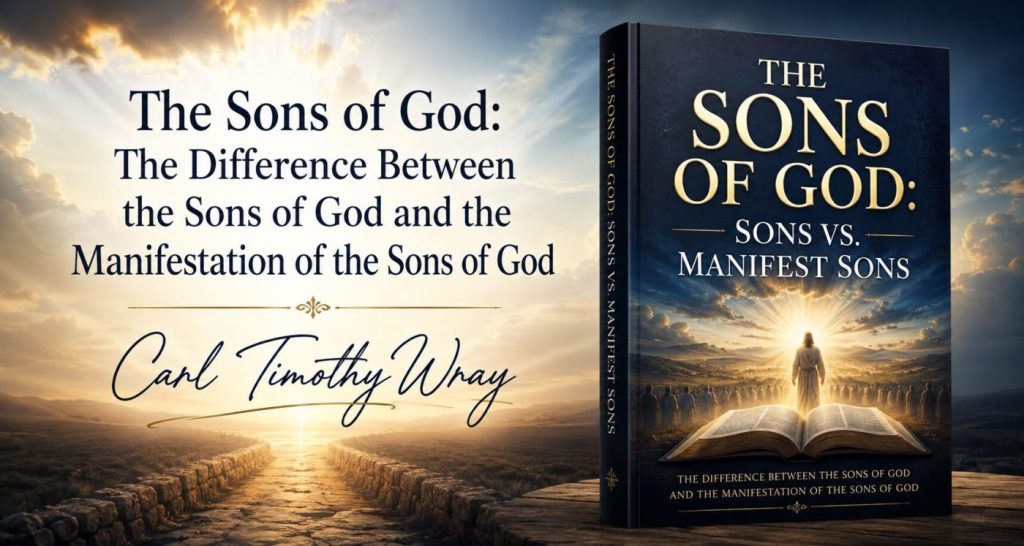
The Sons of God: The Difference Between the Sons of God and the Manifestation of the Sons of God
By Carl Timothy Wray
Carl Timothy Wray is the founder of The Finished Work of Christ ministry and the author of hundreds of books devoted to unveiling Jesus Christ through the whole counsel of God. For more than four decades, he has dedicated himself to the study of Scripture, seeking to understand the eternal purpose of God from Genesis to Revelation.
His writings emphasize the finished work of Christ, the Gospel of Grace, the Kingdom of God, the Revelation of Jesus Christ, the Plan of the Ages, the Order of Melchizedek, the Manifestation of the Sons of God, and the Restoration of All Things. His passion is to make the Scriptures plain by allowing the Bible to interpret itself through line upon line and precept upon precept.
His mission is simple: See the vision. Write the vision. Make it plain, that he may run that readeth it.
The Sons of God: Sons vs. Manifest Sons explores one of the New Testament’s most important questions: If believers are already the sons of God, why does creation still wait for the manifestation of the sons of God? Through a careful study of Romans 8, 1 John 3, Ephesians 4, Hebrews 7, 1 Corinthians 15, Revelation 12, and many other passages, this book examines the biblical distinctions between present sonship and the manifestation of the sons of God. Readers will discover how these Scriptures connect with spiritual maturity, the redemption of the body, the royal priesthood, the order of Melchizedek, and God’s eternal purpose revealed in Jesus Christ.
Introduction
Few questions in the New Testament are more important than this one:
If believers are already the sons of God, why does the whole creation still wait for the manifestation of the sons of God?
John writes:
“Beloved, now are we the sons of God…”
(1 John 3:2)
Yet Paul writes:
“For the earnest expectation of the creation waiteth for the manifestation of the sons of God.”
(Romans 8:19)
These two inspired statements stand side by side.
One declares that believers are the sons of God now.
The other declares that creation still waits for the manifestation of the sons of God.
This book is devoted to carefully examining those passages and many others throughout the New Testament. Rather than beginning with theological systems or traditions, we will begin with the Scriptures themselves. Every chapter starts with the biblical text, identifies the distinction revealed in that passage, and then follows the testimony of the New Testament from one revelation to the next.
Among the questions we will explore are:
- Are we the sons of God now?
- Why does creation still wait?
- What is the purpose of the five-fold ministry?
- What does Paul mean by “a perfect man”?
- Why does Paul continue to speak of groaning, pressing forward, and waiting for the redemption of the body?
- Why does Hebrews contrast a priesthood interrupted by death with a priesthood established by the power of an endless life?
- What is the relationship between the royal priesthood and the priesthood after the order of Melchizedek?
- How does Revelation 12 relate to the manifestation of the sons of God?
- How do these truths fit within God’s eternal purpose?
The goal of this book is not to build its foundation upon human opinion. Its purpose is to open the Scriptures, place them before the reader, and carefully examine the distinctions they reveal. By comparing Scripture with Scripture, we seek to understand the harmony of God’s Word and the unfolding of His eternal purpose in Christ.
Table of Contents
Chapter One
Are We the Sons of God Now?
Primary Scriptures:
- 1 John 3:1–3
- Romans 8:14–17
- Galatians 4:4–7
Chapter Two
If We Are Already the Sons of God, Why Does Creation Wait for the Manifestation of the Sons of God?
Primary Scriptures:
- Romans 8:18–23
- 1 John 3:2
Chapter Three
What Is God’s Purpose for the Church in This Present Age?
Primary Scriptures:
- Ephesians 4:11–16
- 1 Peter 2:9
- Galatians 1:4
Chapter Four
What Does Paul Mean by “Till We All Come… Unto a Perfect Man”?
Primary Scriptures:
- Ephesians 4:11–16
Chapter Five
Why Do Mature Sons Still Groan?
Primary Scriptures:
- Romans 8:23
- Philippians 3:12–14
- 2 Corinthians 5:1–5
Chapter Six
What Are the Sons of God Waiting For?
Primary Scriptures:
- Ephesians 1:13–14
- 1 Corinthians 13:9–10
- 1 Corinthians 15:51–54
Chapter Seven
Why Does Hebrews Contrast Two Priesthoods?
Primary Scriptures:
- Hebrews 5–7
- 1 Peter 2:9
Chapter Eight
What Is the Relationship Between the Woman and the Man-Child?
Primary Scriptures:
- Revelation 12
- Ephesians 4
Chapter Nine
What Is the Manifestation of the Sons of God?
Primary Scriptures:
- Romans 8
- 1 Corinthians 15
- 2 Corinthians 5
Chapter Ten
How Does God’s Eternal Purpose Culminate?
Primary Scriptures:
- Ephesians 1:9–10
- Colossians 1:19–20
- 1 Corinthians 15:24–28
Chapter One
ARE WE THE SONS OF GOD NOW?
The Question
Before we can understand the manifestation of the sons of God, we must first answer a much simpler question.
Are believers the sons of God now?
The New Testament answers that question plainly.
The Scriptures do not tell us that we might become the sons of God.
They do not tell us that we will one day begin to be the sons of God.
They declare that those who are in Christ are the sons of God now.
Before we consider Romans 8 and the manifestation of the sons of God, we must establish this truth beyond question.
PRIMARY SCRIPTURES
1 John 3:1–2
“Behold, what manner of love the Father hath bestowed upon us, that we should be called the sons of God… Beloved, now are we the sons of God, and it doth not yet appear what we shall be: but we know that, when he shall appear, we shall be like him; for we shall see him as he is.”
Romans 8:14–17
“For as many as are led by the Spirit of God, they are the sons of God.
For ye have not received the spirit of bondage again to fear; but ye have received the Spirit of adoption, whereby we cry, Abba, Father.
The Spirit itself beareth witness with our spirit, that we are the children of God:
And if children, then heirs; heirs of God, and joint-heirs with Christ…”
Galatians 4:4–7
“But when the fulness of the time was come, God sent forth his Son…
That we might receive the adoption of sons.
And because ye are sons, God hath sent forth the Spirit of his Son into your hearts, crying, Abba, Father.
Wherefore thou art no more a servant, but a son; and if a son, then an heir of God through Christ.”
THE DISTINCTION
These passages establish one truth with absolute clarity.
Believers are the sons of God.
This is not a future promise.
This is a present reality.
John writes:
“Now are we the sons of God.”
Paul writes:
“As many as are led by the Spirit of God, they are the sons of God.”
Again Paul writes:
“Because ye are sons…”
The testimony is consistent throughout the New Testament.
Those who have been born of the Spirit, reconciled to God through Jesus Christ, and brought into the family of God are truly the sons of God.
No further proof is needed to establish that truth.
A SECOND STATEMENT
Yet John does not stop after declaring that believers are the sons of God.
He immediately adds another statement.
“It doth not yet appear what we shall be.”
These words deserve careful attention.
John places two truths beside one another.
Truth One:
“Now are we the sons of God.”
Truth Two:
“It doth not yet appear what we shall be.”
He does not explain the second statement in this passage.
He simply places it beside the first.
Therefore, whatever John means, he is telling us two things at the same time:
Believers are truly the sons of God now.
Yet there remains something that has “not yet” appeared.
Both statements belong to the inspired testimony of Scripture.
Neither can be ignored.
THE FOUNDATION OF THIS BOOK
This first chapter establishes the foundation upon which the remainder of this book is built.
We begin with the clear declaration that believers are the sons of God.
This truth is not questioned.
It is affirmed.
The remaining chapters will examine another question raised by the New Testament:
If believers are already the sons of God, why does the apostle Paul write that the whole creation waits for the manifestation of the sons of God?
Before answering that question, we must first stand firmly upon the truth already revealed.
The sons of God are not merely a future people.
According to the New Testament, they are a present reality.
That reality becomes the starting point for everything that follows.
Chapter Two
IF WE ARE ALREADY THE SONS OF GOD, WHY DOES CREATION WAIT FOR THE MANIFESTATION OF THE SONS OF GOD?
The Question
Chapter One established from the Scriptures that believers are the sons of God now.
John declares:
“Beloved, now are we the sons of God…” (1 John 3:2)
Paul likewise declares that those who are led by the Spirit of God are the sons of God.
If that truth is firmly established, another question immediately arises.
If we are already the sons of God, why does the whole creation still wait for the manifestation of the sons of God?
This is one of the great questions of the New Testament.
Before attempting to answer it, we must first allow the Scriptures to speak.
PRIMARY SCRIPTURES
Romans 8:18–23
“For I reckon that the sufferings of this present time are not worthy to be compared with the glory which shall be revealed in us.
For the earnest expectation of the creature waiteth for the manifestation of the sons of God.
For the creature was made subject to vanity, not willingly, but by reason of him who hath subjected the same in hope,
Because the creature itself also shall be delivered from the bondage of corruption into the glorious liberty of the children of God.
For we know that the whole creation groaneth and travaileth in pain together until now.
And not only they, but ourselves also, which have the firstfruits of the Spirit, even we ourselves groan within ourselves, waiting for the adoption, to wit, the redemption of our body.”
1 John 3:2
“Beloved, now are we the sons of God, and it doth not yet appear what we shall be…”
THE DISTINCTION
The Scriptures present two truths that must be understood together.
John says:
“Now are we the sons of God.”
Paul says:
“The whole creation waiteth for the manifestation of the sons of God.”
Both statements are inspired.
Both are true.
Therefore, they cannot contradict one another.
The careful student of Scripture must ask:
What distinction is the Holy Spirit making?
John establishes present sonship.
Paul speaks of a manifestation that creation eagerly awaits.
The Bible itself places these two truths side by side and invites us to search the Scriptures to understand how they fit together.
THE WHOLE CREATION IS WAITING
Notice that Paul does not say only the Church is waiting.
He widens the scope.
He says the whole creation groans.
He says the whole creation waits.
He says the creation itself shall be delivered from the bondage of corruption.
This chapter introduces a larger horizon than individual salvation. Paul’s language reaches beyond the experience of individual believers and includes the hope of creation itself.
BELIEVERS ARE ALSO WAITING
Paul then makes another important statement.
Those who have “the firstfruits of the Spirit” are also groaning.
They possess the Spirit.
They belong to Christ.
Yet they still wait.
Paul identifies what they are waiting for:
“The redemption of our body.”
This passage presents present possession and future expectation together.
Believers have received the firstfruits of the Spirit.
Believers are the sons of God.
Yet believers also groan and wait for the redemption of the body.
These truths stand together in the apostolic writings.
LOOKING AHEAD
The question before us is no longer whether believers are the sons of God.
The Scriptures have answered that.
The next question is:
What is God’s purpose for the sons of God in this present age?
To answer that question, we must turn to Ephesians 4 and examine the ministry Christ gave to His Church and the goal toward which that ministry is directed.
Chapter Three
WHAT IS GOD’S PURPOSE FOR THE SONS OF GOD IN THIS PRESENT AGE?
The Question
Having established that believers are the sons of God now, and having seen that the whole creation waits for the manifestation of the sons of God, another question naturally follows.
What is God’s purpose for the sons of God in this present age?
The New Testament does not leave us without an answer.
Christ did not simply save His people and leave them without direction.
He gave His Church a ministry.
He gave His Church a purpose.
He gave His Church a mandate.
To understand that mandate, we must begin with the Scriptures.
PRIMARY SCRIPTURES
Ephesians 4:11–16
“And he gave some, apostles; and some, prophets; and some, evangelists; and some, pastors and teachers;
For the perfecting of the saints, for the work of the ministry, for the edifying of the body of Christ:
Till we all come in the unity of the faith, and of the knowledge of the Son of God, unto a perfect man, unto the measure of the stature of the fulness of Christ:
That we henceforth be no more children, tossed to and fro, and carried about with every wind of doctrine…
But speaking the truth in love, may grow up into him in all things, which is the head, even Christ.”
1 Peter 2:9
“But ye are a chosen generation, a royal priesthood, an holy nation, a peculiar people; that ye should shew forth the praises of him who hath called you out of darkness into his marvellous light.”
Galatians 1:3–4
“Grace be to you and peace from God the Father, and from our Lord Jesus Christ,
Who gave himself for our sins, that he might deliver us from this present evil world, according to the will of God and our Father.”
THE DISTINCTION
These passages reveal a clear purpose for the ministry Christ established within the Church.
Paul does not describe a ministry without direction.
He tells us exactly why Christ gave apostles, prophets, evangelists, pastors, and teachers.
They were given:
- For the perfecting of the saints.
- For the work of the ministry.
- For the edifying of the Body of Christ.
- Till we all come in the unity of the faith.
- Unto a perfect man.
- Unto the measure of the stature of the fullness of Christ.
The direction is unmistakable.
The ministry moves toward maturity.
A ROYAL PRIESTHOOD
Peter adds another important truth.
He declares that believers are:
“A royal priesthood.”
This priesthood has been called out of darkness into God’s marvelous light.
It has a testimony.
It has a ministry.
It has a people to build.
The New Testament presents the Church as an ekklesia—a people called out unto God and built together into the Body of Christ.
FROM CHILDREN TO MATURITY
Notice the progression in Ephesians.
The goal is not simply conversion.
The goal is not merely beginning the journey.
Paul says that believers are to be:
“No more children…”
Instead, they are to grow up into Christ in all things.
The ministry Christ gave to His Church is therefore a ministry of growth.
Its purpose is to establish believers in the faith, strengthen the Body of Christ, and bring God’s people to spiritual maturity.
This chapter establishes that the New Testament has a clearly stated purpose for the ministry of the Church in the present age.
It is a ministry that gathers, equips, edifies, and matures the saints.
LOOKING AHEAD
As we continue our study, another question immediately arises.
Paul says the ministry continues:
“Till we all come…”
What does Paul mean by that expression?
What does he mean by:
“Unto a perfect man?”
The next chapter will examine that question by allowing Ephesians 4 to define its own goal before we connect it with the other passages of the New Testament.
Chapter Four
WHAT DOES PAUL MEAN BY “TILL WE ALL COME… UNTO A PERFECT MAN?”
The Question
The previous chapter established that Christ gave apostles, prophets, evangelists, pastors, and teachers to equip His Church.
Paul also tells us that this ministry has a definite goal.
It is not endless.
It is moving toward an appointed purpose.
Paul writes:
“Till we all come…”
What does he mean?
What is the destination of this ministry?
The answer is found in the very passage itself.
Before we draw any conclusions, let us first place the Scriptures before our eyes.
PRIMARY SCRIPTURES
Ephesians 4:11–16
“And he gave some, apostles; and some, prophets; and some, evangelists; and some, pastors and teachers;
For the perfecting of the saints, for the work of the ministry, for the edifying of the body of Christ:
Till we all come in the unity of the faith, and of the knowledge of the Son of God, unto a perfect man, unto the measure of the stature of the fulness of Christ:
That we henceforth be no more children, tossed to and fro, and carried about with every wind of doctrine…
But speaking the truth in love, may grow up into him in all things, which is the head, even Christ.”
Hebrews 5:12–14
“For when for the time ye ought to be teachers…
But strong meat belongeth to them that are of full age, even those who by reason of use have their senses exercised to discern both good and evil.”
Philippians 3:15
“Let us therefore, as many as be perfect, be thus minded…”
THE DISTINCTION
Paul does not describe the Church as remaining in spiritual infancy.
Neither does he describe the ministry as existing merely to gather converts.
Its stated purpose is to bring the saints to maturity.
Notice the progression:
Children…
Growing…
Unity of the faith…
Knowledge of the Son of God…
A perfect man…
The measure of the stature of the fullness of Christ.
The direction is always forward.
The ministry Christ established is a ministry that produces growth.
NO MORE CHILDREN
Paul says:
“That we henceforth be no more children…”
This is one of the clearest maturity statements in the New Testament.
The Church is not intended to remain spiritually immature.
It is to become established.
Grounded.
United.
Able to discern truth.
Able to stand without being carried about by every wind of doctrine.
The goal of the ministry is a mature people.
THE UNITY OF THE FAITH
Paul also speaks of:
“The unity of the faith.”
This unity is more than organizational agreement.
It is a people growing together in the knowledge of the Son of God.
The ministry Christ gave is continually building the Body until it reaches the objective Paul describes.
The emphasis throughout the passage is maturity.
A PERFECT MAN
Paul concludes this progression with these words:
“Unto a perfect man.”
This is the destination toward which the ministry is directed.
The saints are perfected.
The Body is edified.
The Church grows.
Children become mature.
The knowledge of Christ increases.
The measure of the stature of the fullness of Christ becomes the standard toward which the ministry labors.
The New Testament therefore presents a ministry that has both a purpose and a goal.
It is moving toward maturity.
LOOKING AHEAD
Having established that the ministry brings God’s people to maturity, another important question immediately arises.
If Paul speaks of believers reaching maturity, why does the same apostle continue to write about groaning, pressing toward the mark, and waiting for the redemption of the body?
The next chapter will examine those passages and consider how Paul holds together both spiritual maturity and continuing expectation.
Chapter Five
WHY DO MATURE SONS STILL GROAN?
The Question
The previous chapter established that Christ gave apostles, prophets, evangelists, pastors, and teachers to bring His Church unto maturity.
Paul calls that goal:
“A perfect man.”
If the ministry accomplishes its purpose and brings the saints to spiritual maturity, another question immediately follows.
Why does the same apostle continue to speak of groaning?
Why does he write about pressing toward the mark?
Why does he say believers are waiting for the redemption of the body?
The Scriptures answer these questions.
Let us first place them before our eyes.
PRIMARY SCRIPTURES
Romans 8:22–23
“For we know that the whole creation groaneth and travaileth in pain together until now.
And not only they, but ourselves also, which have the firstfruits of the Spirit, even we ourselves groan within ourselves, waiting for the adoption, to wit, the redemption of our body.”
2 Corinthians 5:1–5
“For we that are in this tabernacle do groan, being burdened…
Not for that we would be unclothed, but clothed upon, that mortality might be swallowed up of life.”
Philippians 3:12–14
“Not as though I had already attained, either were already perfect: but I follow after…
Brethren, I count not myself to have apprehended…
I press toward the mark for the prize of the high calling of God in Christ Jesus.”
1 Corinthians 15:51–54
“Behold, I shew you a mystery…
We shall all be changed…
For this corruptible must put on incorruption, and this mortal must put on immortality…
Then shall be brought to pass the saying that is written, Death is swallowed up in victory.”
THE DISTINCTION
The apostle Paul presents two truths that stand together.
On one hand, he labors to bring the Church unto maturity.
On the other hand, he speaks of groaning.
He speaks of pressing.
He speaks of waiting.
He speaks of mortality being swallowed up by life.
These are not contradictory statements.
They are complementary truths found within the same apostolic testimony.
PAUL WAS A MATURE MAN
No one reading the New Testament could honestly conclude that Paul was spiritually immature.
He preached Christ among the nations.
He established churches.
He endured persecution.
He instructed the saints.
He testified that he had fought the good fight and kept the faith.
Yet this same apostle writes:
“We ourselves groan…”
He writes:
“We that are in this tabernacle do groan…”
He writes:
“I press toward the mark…”
Paul demonstrates that spiritual maturity and future expectation are not opposites.
The New Testament presents both realities together.
THE FIRSTFRUITS OF THE SPIRIT
Romans 8 makes another important statement.
Paul says believers possess:
“The firstfruits of the Spirit.”
Yet those same believers continue waiting for:
“The redemption of our body.”
The apostle therefore describes a people who possess the Spirit while still anticipating something he identifies as future.
The possession of the firstfruits does not eliminate expectation.
Instead, it produces hope.
MORTALITY AND IMMORTALITY
Paul also directs our attention to another distinction.
He speaks of:
“This mortal…”
And then declares:
“…must put on immortality.”
Again he writes:
“…that mortality might be swallowed up of life.”
The language is unmistakable.
Paul continually points beyond the present mortal condition toward a future work of God that he describes in terms of life swallowing up mortality.
LOOKING AHEAD
Paul’s writings reveal a mature people who continue to groan, continue to press, and continue to wait.
Why?
The answer leads us into another distinction repeatedly found in the New Testament.
Paul speaks of an earnest.
He also speaks of fullness.
He speaks of knowing in part.
He also speaks of that which is perfect.
The next chapter will examine these distinctions and consider how they fit within the unfolding purpose revealed throughout the New Testament.
Chapter Six
WHAT ARE THE SONS OF GOD WAITING FOR?
The Question
The previous chapter established that the apostle Paul describes mature believers as still groaning.
They possess the firstfruits of the Spirit.
They are the sons of God.
Yet they continue waiting.
That raises another important question.
What are the sons of God waiting for?
Paul answers that question by distinguishing between what believers presently possess and what they continue to anticipate.
Before drawing any conclusions, let us first place the Scriptures before our eyes.
PRIMARY SCRIPTURES
Ephesians 1:13–14
“In whom ye also trusted, after that ye heard the word of truth, the gospel of your salvation: in whom also after that ye believed, ye were sealed with that holy Spirit of promise,
Which is the earnest of our inheritance until the redemption of the purchased possession, unto the praise of his glory.”
Romans 8:23
“And not only they, but ourselves also, which have the firstfruits of the Spirit, even we ourselves groan within ourselves, waiting for the adoption, to wit, the redemption of our body.”
1 Corinthians 13:9–10
“For we know in part, and we prophesy in part.
But when that which is perfect is come, then that which is in part shall be done away.”
2 Corinthians 5:4–5
“For we that are in this tabernacle do groan, being burdened…
Not for that we would be unclothed, but clothed upon, that mortality might be swallowed up of life.
Now he that hath wrought us for the selfsame thing is God, who also hath given unto us the earnest of the Spirit.”
1 Corinthians 15:51–54
“Behold, I shew you a mystery…
We shall all be changed…
For this corruptible must put on incorruption, and this mortal must put on immortality…
Then shall be brought to pass the saying that is written, Death is swallowed up in victory.”
THE DISTINCTION
Throughout these passages, Paul repeatedly distinguishes between present possession and future expectation.
He speaks of:
- The earnest.
- The firstfruits.
- Knowing in part.
- Prophesying in part.
Yet he also speaks of:
- The inheritance.
- The redemption of the body.
- That which is perfect.
- Mortality swallowed up by life.
These distinctions appear throughout his writings.
THE EARNEST OF THE SPIRIT
Paul calls the Holy Spirit:
“The earnest of our inheritance.”
An earnest is a pledge.
It is a guarantee.
It points toward an inheritance that belongs to the people of God.
Paul does not diminish the earnest.
It is God’s gift.
It is God’s seal.
It is God’s promise.
Yet Paul distinguishes the earnest from the inheritance toward which it points.
THE FIRSTFRUITS
Romans 8 uses similar language.
Believers possess:
“The firstfruits of the Spirit.”
Yet those same believers continue waiting.
The firstfruits testify that the work of God has begun.
At the same time, Paul directs our attention toward the redemption of the body.
Once again, present possession and future expectation stand together.
IN PART
Paul writes:
“We know in part.”
He also writes:
“We prophesy in part.”
Then he immediately adds:
“But when that which is perfect is come…”
The apostle clearly distinguishes between what he calls “in part” and what he calls “the perfect.”
This passage introduces another distinction that must be carefully considered alongside the others already examined.
MORTALITY SWALLOWED UP OF LIFE
Paul returns again to the same hope.
He does not speak merely of escaping mortality.
He says:
“That mortality might be swallowed up of life.”
Again he declares:
“This mortal must put on immortality.”
The language remains consistent.
The apostle continually directs the reader beyond the present mortal condition toward the victory God has promised.
LOOKING AHEAD
The New Testament repeatedly distinguishes between the earnest and the inheritance, the firstfruits and the redemption of the body, knowing in part and that which is perfect, mortality and immortality.
These distinctions prepare us for another important question.
Why does the writer of Hebrews contrast a priesthood interrupted by death with a priesthood established after the power of an endless life?
The next chapter will examine Hebrews and the priesthood after the order of Melchizedek.
Chapter Seven
WHY DOES HEBREWS CONTRAST TWO PRIESTHOODS?
The Question
The previous chapters established several distinctions found throughout the New Testament.
Paul speaks of the earnest and the inheritance.
He speaks of knowing in part and that which is perfect.
He speaks of groaning and the redemption of the body.
He speaks of mortality being swallowed up by life.
Now another important question arises.
Why does the writer of Hebrews place such great emphasis upon the priesthood?
More importantly,
Why does he repeatedly contrast one priesthood with another?
The answer begins with the Scriptures themselves.
PRIMARY SCRIPTURES
Hebrews 7:11–12
“If therefore perfection were by the Levitical priesthood, (for under it the people received the law,) what further need was there that another priest should rise after the order of Melchizedek, and not be called after the order of Aaron?
For the priesthood being changed, there is made of necessity a change also of the law.”
Hebrews 7:15–17
“And it is yet far more evident: for that after the similitude of Melchisedec there ariseth another priest,
Who is made, not after the law of a carnal commandment, but after the power of an endless life.
For he testifieth, Thou art a priest for ever after the order of Melchisedec.”
Hebrews 7:23–25
“And they truly were many priests, because they were not suffered to continue by reason of death:
But this man, because he continueth ever, hath an unchangeable priesthood.
Wherefore he is able also to save them to the uttermost that come unto God by him, seeing he ever liveth to make intercession for them.”
1 Peter 2:9
“But ye are a chosen generation, a royal priesthood, an holy nation, a peculiar people…”
THE DISTINCTION
The writer of Hebrews does more than compare two historical priesthoods.
He repeatedly draws attention to two characteristics.
One priesthood could not continue.
The other continues forever.
One was interrupted by death.
The other is established after the power of an endless life.
These are the distinctions the text itself places before the reader.
THE POWER OF AN ENDLESS LIFE
The centerpiece of Hebrews 7 is this declaration:
“After the power of an endless life.”
This statement is unique.
The writer does not merely emphasize genealogy.
He does not merely emphasize succession.
He points directly to life.
The priesthood of Christ is identified with an endless life.
That phrase becomes one of the great themes of Hebrews.
BECAUSE OF DEATH
The writer also explains why the former priests were many.
“They were not suffered to continue by reason of death.”
Death interrupted their ministry.
Another priest had to arise.
Then another.
Then another.
The ministry continued, but the individual priest could not remain because death brought every ministry to an end.
Hebrews deliberately places this fact before the reader.
A PRIEST FOREVER
The contrast is immediate.
Speaking of Christ, the writer declares:
“Because he continueth ever…”
Again he says:
“Thou art a priest for ever after the order of Melchisedec.”
The emphasis throughout the chapter is continuity grounded in life.
Christ’s priesthood is not presented as temporary.
It is not interrupted by death.
It is described as an everlasting priesthood established by the power of an endless life.
THE ROYAL PRIESTHOOD
Peter also declares that believers are:
“A royal priesthood.”
The New Testament therefore presents believers as priests who minister unto God and proclaim His praises.
Hebrews, however, directs our attention to Christ as the High Priest after the order of Melchizedek and repeatedly emphasizes the enduring character of His priesthood.
These passages invite us to consider carefully the relationship between the royal priesthood described by Peter and the priesthood after the order of Melchizedek described in Hebrews.
LOOKING AHEAD
The writer of Hebrews has now introduced another important distinction.
He contrasts a priesthood interrupted by death with a priesthood established after the power of an endless life.
The apostle Paul has already spoken of mortality being swallowed up by life.
He has spoken of the redemption of the body.
He has spoken of immortality.
The next chapter turns to the prophetic vision of Revelation 12 and examines the relationship between the woman and the man-child as that vision unfolds within the broader testimony of the New Testament.
Chapter Eight
WHAT IS THE RELATIONSHIP BETWEEN THE WOMAN AND THE MAN-CHILD?
The Question
The previous chapter examined the contrast presented in Hebrews between a priesthood interrupted by death and a priesthood established after the power of an endless life.
The New Testament has also shown us another progression.
The Church is called out.
The saints are equipped.
The Body is edified.
The ministry continues until believers come in the unity of the faith and unto a perfect man.
Now another question arises.
Does the Book of Revelation present a prophetic picture of that maturity?
To answer that question, we must first allow the Scriptures to speak.
PRIMARY SCRIPTURES
Revelation 12:1–5
“And there appeared a great wonder in heaven; a woman clothed with the sun, and the moon under her feet, and upon her head a crown of twelve stars:
And she being with child cried, travailing in birth, and pained to be delivered.
…
And she brought forth a man child, who was to rule all nations with a rod of iron: and her child was caught up unto God, and to his throne.”
Ephesians 4:11–13
“And he gave some, apostles; and some, prophets; and some, evangelists; and some, pastors and teachers;
For the perfecting of the saints…
Till we all come in the unity of the faith, and of the knowledge of the Son of God, unto a perfect man, unto the measure of the stature of the fulness of Christ.”
Romans 8:19
“For the earnest expectation of the creature waiteth for the manifestation of the sons of God.”
Galatians 4:19
“My little children, of whom I travail in birth again until Christ be formed in you.”
THE DISTINCTION
The Scriptures present two pictures.
Paul presents the Church growing toward maturity.
John presents a woman travailing until a child is brought forth.
Both passages describe movement.
Both passages describe purpose.
Both passages describe fulfillment following preparation.
THE WOMAN
John first directs our attention to the woman.
She is not introduced as weak.
She is presented in remarkable glory.
She is:
“Clothed with the sun.”
The moon is beneath her feet.
Upon her head is a crown of twelve stars.
Then John reveals something else.
She is with child.
She is travailing.
She is about to bring forth.
The vision is one of expectation.
A PROPHETIC PICTURE
Paul writes that Christ gave ministry gifts until believers come:
“Unto a perfect man.”
John presents a prophetic vision of a woman who has reached the moment of bringing forth.
Within the framework presented in this book, these passages are understood together as portraying maturity that moves toward fulfillment.
The emphasis is not merely upon beginning.
The emphasis is upon bringing forth.
THE MAN-CHILD
John writes:
“She brought forth a man child.”
Immediately the narrative changes.
The child is caught up unto God and to His throne.
The vision moves from preparation to manifestation.
From travail to bringing forth.
From expectancy to fulfillment.
THE PROGRESSION
Notice the progression that has unfolded throughout the New Testament.
The sons of God are revealed.
The Church is established.
The saints are perfected.
The Body grows into maturity.
The woman travails.
The man-child is brought forth.
The narrative continually moves toward fulfillment.
Each passage contributes another piece to the unfolding picture.
LOOKING AHEAD
The vision of Revelation 12 prepares us for the central question of this book.
Why does the whole creation wait for the manifestation of the sons of God?
Having examined present sonship, the purpose of the ministry, spiritual maturity, groaning, the earnest, the hope of immortality, the priesthood after the power of an endless life, and the prophetic vision of the woman and the man-child, we are now ready to return to Romans 8.
The next chapter will focus on the manifestation of the sons of God and examine why the whole creation waits with earnest expectation.
Chapter Nine
WHAT IS THE MANIFESTATION OF THE SONS OF GOD?
The Question
From the opening pages of this book, one question has stood before us.
If believers are already the sons of God, why does the whole creation still wait for the manifestation of the sons of God?
We have examined the testimony of John.
We have examined the ministry described by Paul.
We have followed the growth of the Church unto a perfect man.
We have seen mature believers continuing to groan, press forward, and wait for the redemption of the body.
We have examined the contrast between a priesthood interrupted by death and a priesthood established after the power of an endless life.
We have considered the prophetic picture of the woman and the man-child.
Now we return to the passage that introduced the question.
PRIMARY SCRIPTURES
Romans 8:18–23
“For I reckon that the sufferings of this present time are not worthy to be compared with the glory which shall be revealed in us.
For the earnest expectation of the creature waiteth for the manifestation of the sons of God.
For the creature was made subject to vanity, not willingly, but by reason of him who hath subjected the same in hope,
Because the creature itself also shall be delivered from the bondage of corruption into the glorious liberty of the children of God.
For we know that the whole creation groaneth and travaileth in pain together until now.
And not only they, but ourselves also, which have the firstfruits of the Spirit, even we ourselves groan within ourselves, waiting for the adoption, to wit, the redemption of our body.”
1 John 3:2
“Beloved, now are we the sons of God, and it doth not yet appear what we shall be…”
1 Corinthians 15:51–54
“Behold, I shew you a mystery…
We shall all be changed…
For this corruptible must put on incorruption, and this mortal must put on immortality…
Then shall be brought to pass the saying that is written, Death is swallowed up in victory.”
2 Corinthians 5:4
“For we that are in this tabernacle do groan, being burdened…
That mortality might be swallowed up of life.”
THE DISTINCTION
John declares:
“Now are we the sons of God.”
Paul declares:
“The whole creation waiteth for the manifestation of the sons of God.”
Paul also declares:
“We ourselves groan.”
He identifies what believers are waiting for:
“The redemption of our body.”
He speaks again of mortality being swallowed up by life.
Throughout these passages the New Testament presents present sonship together with continuing expectation.
THE WHOLE CREATION
Notice where Paul’s attention is directed.
He does not speak only of individual believers.
He does not speak only of the Church.
He says:
“The whole creation groaneth.”
Again he says:
“The creature itself also shall be delivered from the bondage of corruption.”
The horizon of Romans 8 reaches beyond the individual and beyond the gathered Church.
Paul places before us a vision that includes creation itself.
THE REDEMPTION OF THE BODY
Paul tells us exactly what believers are awaiting.
“The redemption of our body.”
He does not describe believers as waiting to become the sons of God.
That truth has already been established.
Instead, he identifies a hope connected with the redemption of the body.
He joins that hope with the language of glory, manifestation, and creation’s expectation.
These themes stand together throughout Romans 8.
THE MANIFESTATION
The Scriptures examined throughout this book reveal a consistent progression.
Believers are the sons of God.
The Church is equipped.
The saints grow into maturity.
The Body is built.
Believers possess the firstfruits of the Spirit.
Yet believers continue to groan.
They continue to wait.
They continue to look toward the redemption of the body.
Romans 8 places the manifestation of the sons of God within that larger expectation.
The chapter gathers together the great themes that have appeared throughout the New Testament and directs the reader toward the fulfillment anticipated by the apostolic writings.
LOOKING AHEAD
One question remains.
Where is the entire testimony of the New Testament leading?
Paul answers that question by lifting our eyes beyond the present age to the consummation of God’s purpose.
He speaks of all things being gathered together in Christ.
He speaks of all enemies being put under His feet.
He speaks of the day when God shall be all in all.
The final chapter will examine that glorious conclusion.
Chapter Ten
HOW DOES GOD’S ETERNAL PURPOSE CULMINATE?
The Question
From the beginning of this book, we have followed one question through the New Testament.
If believers are already the sons of God, why does the whole creation still wait for the manifestation of the sons of God?
The Scriptures have led us through one distinction after another.
We have seen present sonship.
We have seen the ministry of the Church.
We have seen the perfecting of the saints.
We have seen believers groaning for the redemption of the body.
We have seen the earnest and the inheritance.
We have seen mortality contrasted with immortality.
We have seen the priesthood after the power of an endless life.
We have seen the prophetic vision of the woman and the man-child.
Now we come to the final question.
Where is the entire plan of God leading?
The answer is found in the closing vision of the apostles.
PRIMARY SCRIPTURES
Ephesians 1:9–10
“Having made known unto us the mystery of his will, according to his good pleasure which he hath purposed in himself:
That in the dispensation of the fulness of times he might gather together in one all things in Christ, both which are in heaven, and which are on earth; even in him.”
Colossians 1:19–20
“For it pleased the Father that in him should all fulness dwell;
And, having made peace through the blood of his cross, by him to reconcile all things unto himself… whether they be things in earth, or things in heaven.”
1 Corinthians 15:24–28
“Then cometh the end, when he shall have delivered up the kingdom to God, even the Father…
For he must reign, till he hath put all enemies under his feet.
The last enemy that shall be destroyed is death…
And when all things shall be subdued unto him… then shall the Son also himself be subject unto him… that God may be all in all.”
Romans 8:21
“Because the creature itself also shall be delivered from the bondage of corruption into the glorious liberty of the children of God.”
THE DISTINCTION
The New Testament continually directs our attention beyond the present age.
Paul speaks of:
- The fullness of times.
- All things gathered together in Christ.
- All things reconciled unto God.
- Death destroyed.
- Creation delivered.
- God all in all.
The biblical vision does not end with the calling of the Church.
It moves toward the consummation of God’s eternal purpose.
THE FULLNESS OF TIMES
Paul speaks of:
“The dispensation of the fulness of times.”
God’s purpose is not presented as fragmented.
It is one eternal purpose unfolding according to His wisdom.
Throughout the New Testament, every promise, every ministry, and every work of God moves toward this great conclusion.
THE LAST ENEMY
Paul makes another remarkable declaration.
“The last enemy that shall be destroyed is death.”
Death entered through Adam.
Christ came to destroy the works of the devil.
The apostle points forward to the day when death itself will no longer remain.
The New Testament consistently presents death as an enemy, not the final triumph.
ALL THINGS IN CHRIST
Paul writes:
“To gather together in one all things in Christ.”
Again he writes:
“To reconcile all things unto himself.”
These passages lift our eyes beyond the individual to the breadth of God’s redemptive purpose.
The same apostle who speaks of the Church also speaks of all things being gathered together in Christ.
The same apostle who speaks of the sons of God also speaks of creation being delivered.
The same apostle who speaks of the redemption of the body also speaks of God becoming all in all.
The testimony remains wonderfully consistent.
THE CONSUMMATION
The New Testament opens with God’s purpose revealed in Christ.
It closes with God’s purpose brought to completion.
The sons of God.
The Church.
The ministry.
The perfecting of the saints.
The redemption of the body.
The manifestation of the sons of God.
The reconciliation of all things.
The destruction of death.
These themes form one unfolding testimony concerning the eternal purpose of God in Christ Jesus.
CONCLUSION
This study began with a simple question.
If believers are already the sons of God, why does creation still wait for the manifestation of the sons of God?
The answer has been sought by comparing Scripture with Scripture and allowing the testimony of the New Testament to unfold one step at a time.
May every reader continue searching the Scriptures with diligence, rejoicing in the reality of present sonship while fixing their eyes upon the glorious hope set before the people of God.
For from Him, through Him, and unto Him are all things.
To Him be glory forever.
Amen.
THE SONS OF GOD
Sons vs. Manifest Sons
Scripture Index by Chapter
Chapter One
Are We the Sons of God Now?
Primary Scriptures
- 1 John 3:1–3
- Romans 8:14–17
- Galatians 4:4–7
- John 1:12–13
- Romans 8:1–17
Theme:
Present Sonship
Chapter Two
If We Are Already the Sons of God, Why Does Creation Wait for the Manifestation of the Sons of God?
Primary Scriptures
- Romans 8:18–23
- 1 John 3:2
- Romans 8:24–25
- Isaiah 11:6–9 (creation hope)
- Isaiah 65:17–25
Theme:
Present Sonship vs. Manifestation
Chapter Three
What Is God’s Purpose for the Sons of God in This Present Age?
Primary Scriptures
- Ephesians 4:11–16
- 1 Peter 2:9
- Galatians 1:3–4
- Matthew 28:18–20
- Acts 2:1–47
- Acts 20:28
- Ephesians 2:19–22
Theme:
The Ministry of the Church
Chapter Four
What Does Paul Mean by “Till We All Come… Unto a Perfect Man?”
Primary Scriptures
- Ephesians 4:11–16
- Hebrews 5:12–14
- Philippians 3:15
- Colossians 1:27–29
- Colossians 2:9–10
Theme:
Spiritual Maturity
Chapter Five
Why Do Mature Sons Still Groan?
Primary Scriptures
- Romans 8:22–23
- Philippians 3:12–14
- 2 Corinthians 5:1–5
- 1 Corinthians 15:51–54
- Romans 7:22–25
- Philippians 3:20–21
Theme:
Maturity with Expectation
Chapter Six
What Are the Sons of God Waiting For?
Primary Scriptures
- Ephesians 1:13–14
- Romans 8:23
- 1 Corinthians 13:9–10
- 2 Corinthians 5:4–5
- 1 Corinthians 15:51–54
- Hebrews 6:4–5
- Romans 8:29–30
Theme:
Earnest vs. Fullness
Chapter Seven
Why Does Hebrews Contrast Two Priesthoods?
Primary Scriptures
- Hebrews 5
- Hebrews 6
- Hebrews 7
- Psalm 110:1–4
- Genesis 14:18–20
- 1 Peter 2:9
- Revelation 1:5–6
- Revelation 5:9–10
Theme:
Royal Priesthood and the Order of Melchizedek
Chapter Eight
What Is the Relationship Between the Woman and the Man-Child?
Primary Scriptures
- Revelation 12:1–17
- Ephesians 4:11–16
- Galatians 4:19
- Isaiah 66:7–9
- Micah 5:2–4
- Revelation 14:1–5
Theme:
The Prophetic Picture
Chapter Nine
What Is the Manifestation of the Sons of God?
Primary Scriptures
- Romans 8:18–23
- 1 John 3:2
- 1 Corinthians 15:51–54
- 2 Corinthians 5:1–5
- Philippians 3:20–21
- Revelation 12:5
- Revelation 14:1–5
Theme:
The Manifestation
Chapter Ten
How Does God’s Eternal Purpose Culminate?
Primary Scriptures
- Ephesians 1:9–10
- Colossians 1:19–20
- 1 Corinthians 15:24–28
- Romans 8:21
- Revelation 21:1–5
- Revelation 22:1–5
- Acts 3:19–21
- Ephesians 3:8–11
Theme:
God All in All